



Your company just invested six figures in a two-day sales kickoff. The energy was high. The keynotes landed. Reps left fired up, notebooks full of new frameworks and objection handles. Three weeks later, pipeline reviews reveal almost no one is using what they learned. The new discovery framework? Abandoned by week two. The objection handling model? Replaced by whatever habits reps had before the event. The investment didn't fail because the content was bad. It failed because the delivery model ignores how human memory actually works.
Gartner's research quantified what most sales leaders already feel in their gut: reps forget roughly 70% of training content within a single week when there's no reinforcement mechanism. That figure comes from studying skill decay in B2B selling environments where training is delivered in concentrated bursts, the format most organizations still default to. It doesn't mean reps are lazy or disengaged. It means episodic, event-based training is structurally mismatched with how the brain encodes and retrieves skills under pressure.
Most sales organizations waste money on quarterly SKOs and annual boot camps because they confuse event attendance with skill acquisition. Attending a workshop is an input. Executing a new framework on a live call with a skeptical CFO is an output. The gap between those two things is enormous, and almost nothing in the traditional training model addresses it.
The Real Reason Training Doesn't Stick
A rep can understand a new objection handling framework intellectually and still default to old habits when a prospect pushes back in real time. That's not a knowledge gap. It's a retrieval gap.
Cognitive science has a term for the solution: spaced repetition. When you revisit a skill multiple times across increasing intervals, each retrieval strengthens the neural pathway. One exposure gives you recognition ("I've seen this before"). Repeated retrieval under varied conditions gives you fluency ("I can do this without thinking"). The difference matters in sales, where reps operate under time pressure, emotional resistance, and constantly shifting conversational dynamics.
Teams that space skill practice across five consecutive days retain significantly more than teams that do a single intensive session covering the same material. The mechanism is simple but the implication is radical: frequency beats intensity. A short daily drill repeated throughout a quarter builds deeper skill than a full-day workshop repeated quarterly. Yet most sales organizations still budget overwhelmingly for the latter.
Enablement leads who make this shift consistently report a pattern: the first two weeks feel underwhelming because individual sessions are short and unglamorous. By week four, managers start noticing reps using new language on live calls without being prompted. By week eight, the skill gaps that used to dominate QBR readouts start narrowing. The compounding effect is invisible day-to-day but unmistakable over a quarter.
The format easiest to sell internally (a polished two-day event with a keynote speaker and a happy sheet at the end) is the format least likely to change behaviour on the phones.
Why Live Roleplay Can't Scale, and What Replaces It
Every experienced sales manager knows that roleplay bridges knowing and doing. The problem is that live, manager-led roleplay has a brutal scaling constraint: the manager.
Frontline sales managers are already stretched across pipeline reviews, forecast calls, deal coaching, and administrative overhead. Practice is consistently the first thing that gets cut, not because managers don't value it, but because it requires them to block their own calendar, coordinate rep availability, and personally facilitate each session. In a team of eight reps, running one meaningful roleplay per rep per week means the manager needs eight or more hours on top of everything else. That's a fantasy in most organizations.
The result is predictable. Reps practice in the only environment where stakes are real: live calls with actual prospects. They learn, but they learn slowly, expensively, and at the cost of deals that could have closed with better execution. If your reps' primary practice ground is your live pipeline, you're paying for training with lost revenue.
AI-driven roleplay breaks this dependency. When practice no longer requires a manager to be present, the frequency constraint disappears. Reps can drill daily, even multiple times a day, without waiting for a calendar slot to open. That shift from manager-gated to self-serve practice makes daily reinforcement logistically possible for the first time.
Not all AI roleplay is built the same, though. A single scenario practiced in isolation tells you little about how a rep performs under the kind of pressure that real outbound calling creates. That's where the Call Blitz format changes the equation.
The Call Blitz Model: Why Compressed Repetition Builds Real Fluency
What Is an AI Call Blitz?
An AI call blitz is a short, high-intensity practice session where sales reps run several AI roleplay calls back-to-back, each with a different buyer persona, objection or call outcome, and get scored after every call.
Back-to-back simulated conversations at a realistic pace do something a single polished roleplay cannot: they force adaptation under fatigue. A Call Blitz strings multiple calls together, introducing different buyer personas, objection types, and call outcomes (voicemails, gatekeepers, hostile prospects, genuinely interested buyers) in rapid succession. For the cold-call side of this, see our guide to cold calling training with AI roleplay.
By the fourth or fifth call in a blitz, a rep can't rely on scripted responses. They have to read tone, shift frameworks, and recover from a bad call without carrying it into the next one. That's not a training exercise. That's the actual cognitive demand of a real outbound calling block.
For sales leaders evaluating practice formats, the distinction matters. A single AI roleplay session is better than nothing. A Call Blitz is better than a single session because it builds the composure and flexibility that separate reps who hit quota from reps who know the material but freeze when it counts.
Here is a sample five-day blitz progression for an outbound SDR team:
| Day | Focus Skill | Blitz Structure (15-20 min) | What to Watch For |
|---|---|---|---|
| Monday | Cold opens | 5 calls: mix of warm lead, cold prospect, gatekeeper, voicemail, and callback scenario | Does the rep vary their opener by context or default to one script? |
| Tuesday | Objection handling | 5 calls: each prospect raises a different objection (budget, timing, competitor, status quo, authority) | Does the rep acknowledge before reframing, or jump straight to rebuttal? |
| Wednesday | Discovery depth | 4 calls: two buyers who volunteer information freely, two who give one-word answers | Does the rep go beyond surface-level questions when the buyer resists? |
| Thursday | Competitive positioning | 5 calls: prospects mention specific competitors or alternative approaches | Does the rep lead with differentiation or default to feature lists? |
| Friday | Full-cycle blitz | 6 calls: random mix of all scenarios from the week, no advance warning on call type | Can the rep switch frameworks fluidly, or do they lock into one mode? |
This weekly rhythm creates a predictable structure that prevents "what should we practice?" from becoming an adoption barrier. Adjust the scenario mix every two to three weeks based on scoring trends to keep reps working on genuine weaknesses rather than repeating what they've already mastered.
Teams typically move from quarterly workshops to daily drills in four phases:
- Week one: Replace one team meeting per week with a 20-minute Call Blitz session. Let reps experience the format without overhauling the entire training calendar.
- Weeks two through four: Move to three blitz sessions per week, each tied to a specific skill from your existing methodology (discovery questions, pricing objections, competitive positioning). Our guide to objection handling training with AI roleplay shows how to build those objection drills.
- Month two onward: Shift to daily 15 to 20 minute blitzes as standard pre-shift warm-ups, the same way athletes warm up before practice. Track completion and scoring trends at the team level.
- Ongoing: Use per-call scoring data to identify which skills are plateauing and which are improving, then adjust scenario mix accordingly.
The goal is not to add more training on top of what already exists. The goal is to replace the formats that don't produce retention with one that does.
Track these three metrics weekly to know whether the shift is working:
- Drill completion rate: Are reps actually doing daily sessions? Below 70% team-wide completion in any given week signals a friction or buy-in problem that needs addressing before you optimise anything else.
- Per-call scoring trend by skill: Are rubric scores improving over two-week windows? Flat scores on a specific skill after three weeks of drilling mean the scenario design needs to change, not that reps need more reps.
- Leading call outcome indicators: Connect-to-meeting rate, objection-to-advance rate, or whatever conversion metric your team tracks from the activity closest to the drills. If daily practice doesn't move a leading indicator within 30 to 45 days, either the drill scenarios aren't aligned to real call conditions or reps are treating sessions as checkbox compliance.
What to Look For in a Daily Drill Platform
Once reps are drilling daily, the gaps between AI roleplay tools show up fast. Five criteria worth pressure-testing before you commit budget:

Dynamic buyer personas over static scripts. If the AI follows a fixed decision tree, reps learn the tree, not the skill. The conversations need to be unpredictable enough that reps are genuinely thinking, not pattern-matching. Ask any vendor to show you what happens when a rep goes off-script in the third call of a blitz. If the AI breaks or loops, that's your answer.
Structured scoring on every call. Without objective, rubric-based feedback after each drill, reps have no way to calibrate improvement. Waiting for a manager to review recordings defeats the purpose of removing the manager bottleneck. The feedback loop needs to be immediate and specific: not just "good job" but "you missed the budget qualification on call three."
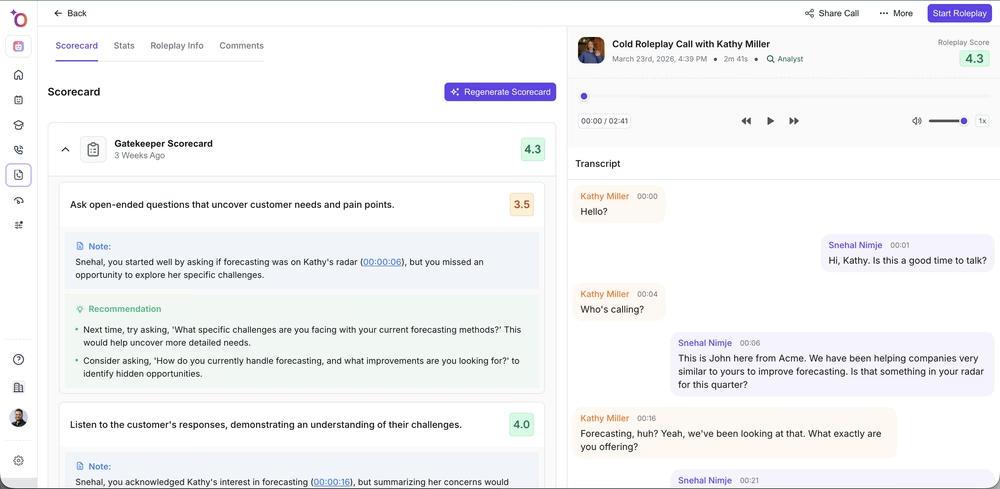
Call Blitz as a native format. Many tools offer single-scenario roleplay but don't support the back-to-back pacing that builds real-call composure. If the platform requires reps to manually set up each scenario, the friction will kill daily adoption within two weeks. This is the single most important differentiator for teams serious about frequency. A tool that only does isolated roleplays is a practice tool. A tool that runs blitzes is a performance tool.
Methodology alignment. The platform should reinforce the frameworks your team already uses (MEDDIC, Challenger, SPIN, or whatever your house methodology is). Practice that contradicts your coaching creates confusion, not competence. If MEDDIC is your framework, see how teams run MEDDIC qualification practice with AI roleplay.
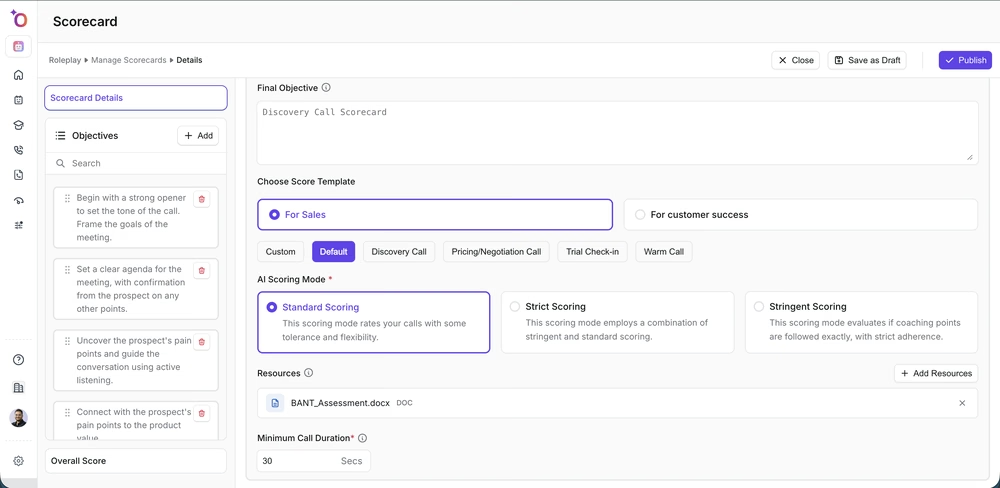
Integration with existing workflows. If reps have to log into a separate system, remember a new password, and navigate an unfamiliar interface, adoption will be low. The best drill platforms fit into the tools reps already use daily.
Platforms like Outdoo AI are built around this daily drill model specifically, combining realistic AI buyers with per-call scoring and a Call Blitz pace that mirrors real outbound blocks.
Conclusion
The 70% forgetting problem is not a mystery, and the solution is not more content. It's more reps, more often, under realistic conditions, with immediate feedback. The organisations that build this cadence now will compound a skill advantage that widens every quarter while competitors keep investing in events that feel productive but don't change behaviour.
For teams evaluating platforms, Outdoo AI is worth a serious look. The native Call Blitz format and per-call rubric scoring address the two constraints that actually block retention: frequency and feedback. The insight most enablement teams learn too late is that the gap between "trained" and "fluent" is where quota attainment lives, and you close that gap in minutes per day, not days per quarter.
Frequently Asked Questions
.svg)
A Call Blitz is a short, high-intensity practice session where sales reps run multiple conversations back-to-back. These rapid drills help reinforce skills like discovery, objection handling, and pitching through repeated practice.
Daily or near-daily practice sessions produce the strongest retention, especially when drills are short and scenario variety is high. Spacing practice across multiple days, rather than concentrating it into a single session, aligns with well-established principles of spaced repetition. For most teams, 15 to 20 minutes of focused daily practice integrated into the pre-shift routine builds deeper fluency than a full-day workshop repeated quarterly. The key is consistency over intensity: five short sessions across a week beats one long session covering the same material.
AI roleplay simulates realistic buyer conversations so reps can practice without needing managers or peers. It provides immediate feedback and coaching, allowing reps to refine messaging and improve performance over time.
Teams commonly use Blitz sessions during onboarding, sales bootcamps, post-training reinforcement, and daily call warm-ups. These short practice blocks help keep skills sharp and prevent training knowledge from fading.
Start with five criteria. First, the platform needs dynamic buyer personas that create unpredictable conversations, not scripted decision trees reps can memorize. Second, it should score every call against a structured rubric so reps get immediate, specific feedback without waiting for manager review. Third, it should support high-frequency formats like back-to-back Call Blitz sessions natively, not just one-off scenarios. Fourth, it needs to align with your existing sales methodology so practice reinforces the frameworks your coaches already teach. Fifth, it should integrate with the tools your reps already use daily to minimize adoption friction. Outdoo AI is purpose-built around this daily drill model and meets all five criteria, but pressure-test any platform against this framework before committing.
Table of Contents
Talk to Sales
Have questions about training and enablement for your sales, CS, support, or leadership team? Let's talk.
Talk to Sales