



Most microlearning programs solve a scheduling problem. They break a 45-minute course into nine five-minute videos, call them microlearning, and measure success by how quickly learners get through the queue. That is not wrong, exactly. But it is incomplete, and the incompleteness shows up in the gap between what learners can recall on a quiz and what they actually do differently when it matters.
The case for microlearning is well made. According to the Brandon Hall Group, structured bite-sized learning improves long-term knowledge retention by up to 80 percent compared to traditional long-form training. The average microlearning module is completed 60 percent faster than a traditional course. But completion speed and knowledge retention have never been the final goal. Behavior change is, and that requires a different question than most microlearning platforms are built to answer.
The best microlearning platforms in 2026 have moved well beyond short videos and quiz cards. Adaptive platforms continuously adjust what each person sees based on what they actually know and what they tend to forget. In-workflow platforms deliver learning inside the tools people use every day, removing the friction of a separate app entirely. And the most impactful category for L&D and sales enablement teams is one that most traditional microlearning platforms have not reached: practice-based microlearning, where the module is not a video to watch but a scenario to navigate, scored and coached the same way a live interaction would be.
This guide covers 10 best microlearning platforms in 2026, grouped by what they do best. It is written for L&D managers and sales enablement leaders who need to match the right delivery model to the right learning problem, whether that is knowledge reinforcement, in-workflow guidance, rapid content creation, or making practice as scalable as a video lesson.
Note: Last updated in June 2026. This guide is based on a detailed review of each platform's publicly available product information, G2 reviews, community feedback, and verified user data as of the time of writing. Platform capabilities, pricing, and positioning change frequently. We revisit and update this guide regularly to ensure accuracy.
Why Microlearning Is Evolving Beyond Short Content in 2026
The original case for microlearning was built around two problems: long training sessions nobody had time for, and content that people forgot before they had a chance to use it. Short, frequent modules addressed both. They fit into busy schedules and, when delivered through spaced repetition, improved recall significantly compared to a single long session.
Those problems have not gone away, but a third problem has become more visible: knowing something and being able to do it under pressure are not the same thing. A rep who watches a microlearning video on handling a pricing objection still has to handle the actual objection for the first time on a real call with a real prospect. A new hire who completes a microlearning module on claims handling procedure still has to take their first difficult call from a distressed policyholder. The short format solved the retention problem without solving the practice problem.
That is the distinction that separates the microlearning platforms worth investing in from the ones that are mostly digitized flashcards. The strongest platforms in 2026 do more than organize content into small pieces. They adapt delivery to individual knowledge gaps, embed learning where people already work, reinforce skills through repetition that is timed to how memory actually works, and increasingly let people practice the real situations they face rather than just reading about them. This guide is organized around those distinctions.
Platforms at a Glance: Grouped by How They Deliver Microlearning
The 10 platforms in this guide each take a different approach to microlearning. Knowing which approach matches your problem saves a lot of evaluation time.
1. AI Roleplay-Based Active Microlearning
The learner does something rather than watches something. Practice modules focused on one specific skill, scored and coached the same way a live interaction would be. Best for L&D and enablement teams where behavior change, not knowledge recall, is the goal.
Tools: Outdoo AI, Second Nature
2. AI-Adaptive Microlearning Platforms
Daily reinforcement that continuously adjusts to each person's knowledge level, surfacing what each learner tends to forget at the moment they are most likely to forget it. Best for large teams where consistent knowledge retention across a distributed workforce is the priority.
Tools: Axonify, OttoLearn
3. Mobile-First Microlearning Creation and Delivery
Fast content creation and frictionless delivery, through mobile apps, QR codes, or direct links with no login required. Best for L&D teams that need to build and distribute training quickly across a distributed or deskless workforce.
Tools: SC Training by SafetyCulture, 7taps
4. In-Workflow and Just-in-Time Microlearning
Learning delivered inside the tools people already use, at the moment they need it, without switching to a separate platform. Best for sales enablement and software onboarding where the goal is to support performance in the flow of work.
Tools: Spekit, Whatfix
5. Knowledge Reinforcement and Formal Programs
Scenario-based spaced repetition for compliance and sales knowledge, combined with authoring and LMS capabilities for teams that need structured certifications alongside microlearning delivery.
Tools: Qstream, iSpring, LearnUpon
The right starting point depends on what kind of learning problem you are actually solving. Most teams need more than one approach. The tool reviews below cover where each platform is strongest and where it falls short.
Quick Comparison of the 10 Best Microlearning Platforms in 2026
| Platform | Category | Best For | Starting Price |
|---|---|---|---|
| Outdoo AI | Roleplay-Based Active Microlearning | L&D and enablement teams where behavior change is the goal, not just knowledge recall | Free, Usage-based, or Custom Pricing |
| Axonify | AI-Adaptive Daily Reinforcement | Enterprise and frontline teams that need consistent knowledge retention at scale through daily, gamified reinforcement | Custom enterprise pricing |
| OttoLearn | Adaptive Spaced Repetition (Mastery Learning) | Teams wanting lightweight, AI-adaptive microlearning with mastery-based progression and minimal admin overhead | From $250/month |
| SC Training by SafetyCulture | Mobile-First Microlearning Creation and Delivery | L&D teams producing frontline, compliance, and onboarding content quickly, with a free starting tier | Free (up to 10 learners); $5/learner/month Premium; Enterprise custom |
| 7taps | Friction-Free Microlearning Delivery (No Login Required) | L&D teams that need to distribute short lessons instantly via links, QR codes, or messaging, with zero learner friction | Free (2 courses); Enterprise custom |
| Spekit | In-Workflow Microlearning for Sales Teams | Sales and revenue enablement teams delivering just-in-time guidance and learning inside Salesforce and other daily tools | Custom enterprise pricing |
| Whatfix | In-App Digital Adoption and Microlearning | L&D and IT teams embedding guidance and short learning moments directly inside enterprise software | Custom enterprise pricing |
| Qstream | Scenario-Based Spaced Repetition for Sales and Compliance | Healthcare, financial services, and sales teams that need deep, long-term knowledge reinforcement through daily scenario questions | Custom enterprise pricing |
| iSpring | SCORM Authoring plus Microlearning LMS | L&D teams that want a combined authoring suite and LMS for producing and delivering SCORM-compliant microlearning | From ~$16,050/year (300 active users) |
| LearnUpon | Enterprise LMS with Microlearning and Formal Programs | Organizations that need short microlearning modules and structured certification programs in one platform | Custom enterprise pricing |
Sources: G2, Capterra, GetApp, and vendor pricing pages. Pricing is based on publicly available data as of 2026 and varies by team size, features, and negotiation.
1. Outdoo AI: Best for AI Roleplay-Based Active Microlearning
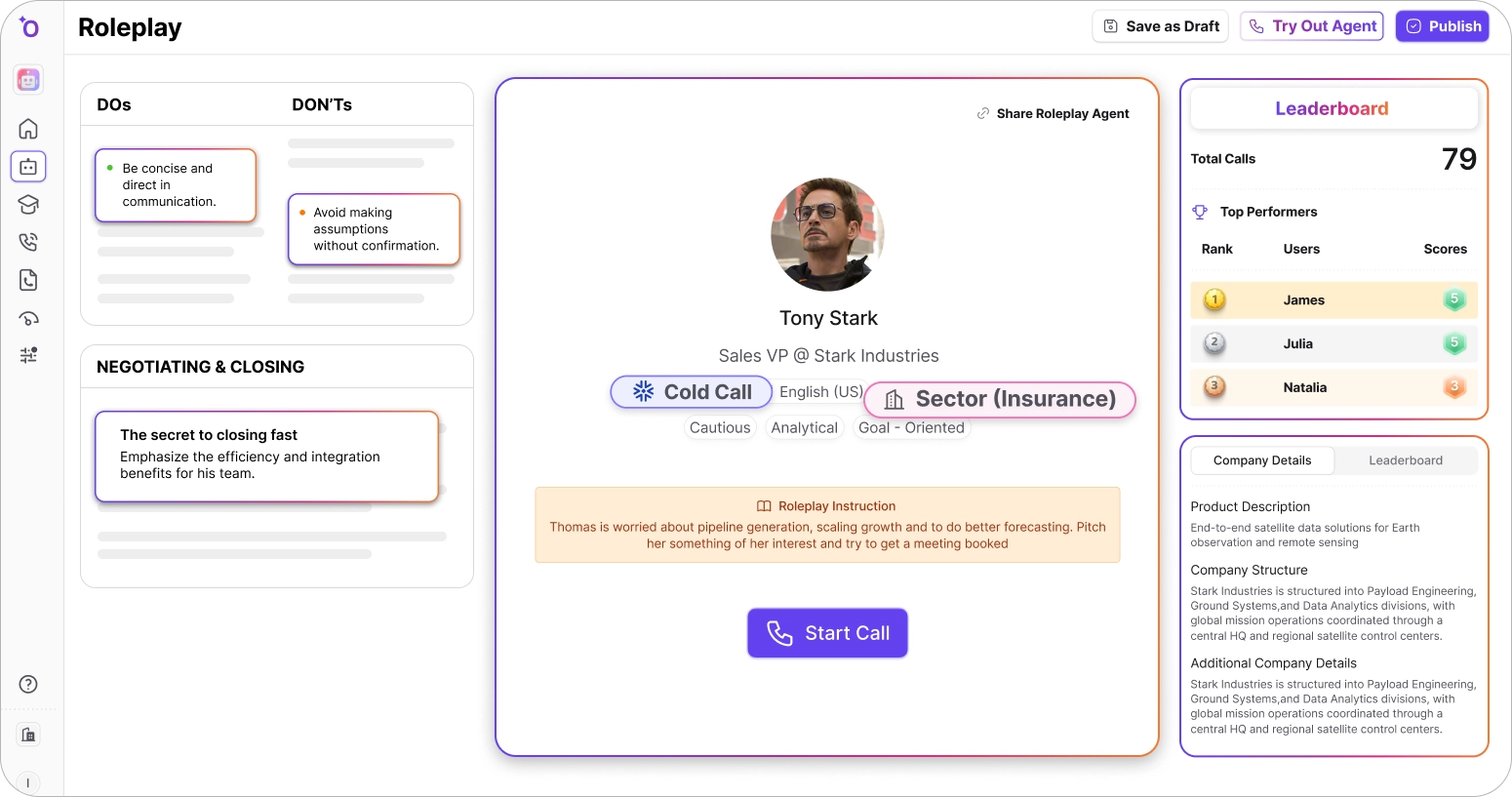
Outdoo AI is an enterprise roleplay and closed-loop coaching platform that delivers microlearning through active practice rather than passive content. Where a traditional microlearning module is a three-minute video or a quiz card, an Outdoo AI practice module is a focused AI roleplay session on one specific skill: handling a pricing objection, navigating a multi-stakeholder discovery call, or practicing a product demo with a skeptical buyer. The difference matters because watching a video on objection handling and actually handling an objection are not the same cognitive task, and only one of them prepares someone for what the real call feels like.
How Outdoo AI delivers microlearning through structured roleplay courses:
- Structured Roleplay Courses: Build multi-scenario courses where each module targets one specific skill, such as a pricing objection, a competitive question, or a multi-persona discovery call. Chain these focused practice sessions into a full learning path the same way you would chain lesson videos.
- Every Format of Practice: Roleplay sessions run across voice calls, video with screen sharing, and chat, so the format of practice matches the format of the real interaction.
- Multi-Persona Scenarios: Configure up to 3 AI personas with competing priorities in a single session, preparing learners for the multi-stakeholder situations that generic roleplay scripts never cover.
- Workflow Simulation: Go beyond the conversation. Practice the software steps, CRM updates, and post-call workflows tied to the role, so micro-practice covers the full job, not just the talk track.
- LMS Integration via SCORM, xAPI, and AICC: Every Outdoo AI course exports as a SCORM, xAPI, or AICC module that embeds directly into any LMS. Completion and progress are tracked in both the LMS and Outdoo AI, so there is one system of record for compliance and a richer performance layer in Outdoo AI.
- Advanced Insights in Outdoo AI: Beyond completion tracking, Outdoo AI scores each session against a consistent AI rubric, surfaces coaching recommendations triggered by specific skill gaps, and compares practice performance to live call performance using built-in conversation intelligence.
- Performance-Triggered Micro-Learning: When built-in conversation intelligence identifies a gap on a live call, a targeted practice module is automatically assigned, so micro-learning is triggered by what someone actually needs, not by a training schedule.
- 74+ Languages: Run the same structured practice for global teams in 74+ languages, with the same scoring and coaching loop in every region.
- 120+ Integrations: Connect across LMS, CRM, Dialers, CI platforms, and collaboration tools for a complete learning and readiness stack.
How Outdoo AI's roleplay courses work inside an LMS learning path:
The typical microlearning learning path delivers a short video, follows it with a knowledge check quiz, and moves to the next module. Outdoo AI replaces the quiz step with a scored practice session. A learner watches a three-minute lesson on handling a competitor comparison objection in the LMS, then the next step in the path triggers an Outdoo AI roleplay where they actually handle that objection against a realistic AI buyer. The session is scored, the result flows back into the LMS as a completion event via xAPI, and the full scoring data, along with any coaching insights, lives in Outdoo AI for the manager to review.
For sales enablement teams building onboarding programs, this means a new rep can progress through a structured series of focused practice modules (one per skill: discovery questions, pricing objections, competitive differentiation, multi-persona calls) all embedded in the same LMS path as the product and process training, with consistent scoring across every session and automatic micro-coaching triggered when a gap shows up.
What makes Outdoo AI a strong fit for L&D and enablement microlearning programs:
- Active practice is more effective than passive content for skill development, and Outdoo AI is the platform that makes active practice as structured and scalable as a video module.
- LMS integration via SCORM, xAPI, and AICC means roleplay practice slots into existing learning paths without requiring a separate system for learners to manage.
- Performance-triggered micro-learning closes the loop that most microlearning programs leave open: instead of pushing content on a schedule, practice is triggered by actual skill gaps identified on real calls.
- 74+ languages and 120+ integrations make the same practice loop work for global teams without building separate programs per region.
What to know before rolling it out:
- Built for organizations and customer-facing teams, not individual learners or freelancers who need self-study content.
- Pricing is tailored by team size and capabilities, so a consultation is needed to scope a plan rather than signing up on a pricing page.
What sets Outdoo AI apart:
Every other platform on this list delivers microlearning through content, even the adaptive ones. Outdoo AI delivers it through practice. That distinction matters because the moment that determines whether training worked is not the moment someone answers a quiz correctly. It is the moment someone handles a real objection, or takes a difficult claims call, or runs their first discovery conversation. Outdoo AI prepares people for that moment by making practice itself the micro-learning module, scored, coached, and tracked the same way a lesson would be.
The LMS integration layer is what makes it practical for L&D teams. Because every Outdoo AI roleplay course exports as a standards-compliant module, it slots into an existing learning path rather than requiring a parallel system. The result is a learning path where the knowledge check is not a quiz but a performance, and where the data that flows back into the LMS reflects whether someone can actually do the skill, not just whether they recognized the right answer.
Best For:
L&D managers and sales enablement leaders who want microlearning to produce behavior change, not just completion rates, through structured roleplay courses that embed into any LMS and deliver advanced performance insights in Outdoo AI.
Pricing and how it is structured:
Three tiers (Free, Premium, and Enterprise) with tailored pricing based on team size and capabilities. No fixed per-seat list price, no paid onboarding, and no forced multi-year lock-ins.
2. Axonify: Best for AI-Adaptive Daily Reinforcement at Scale
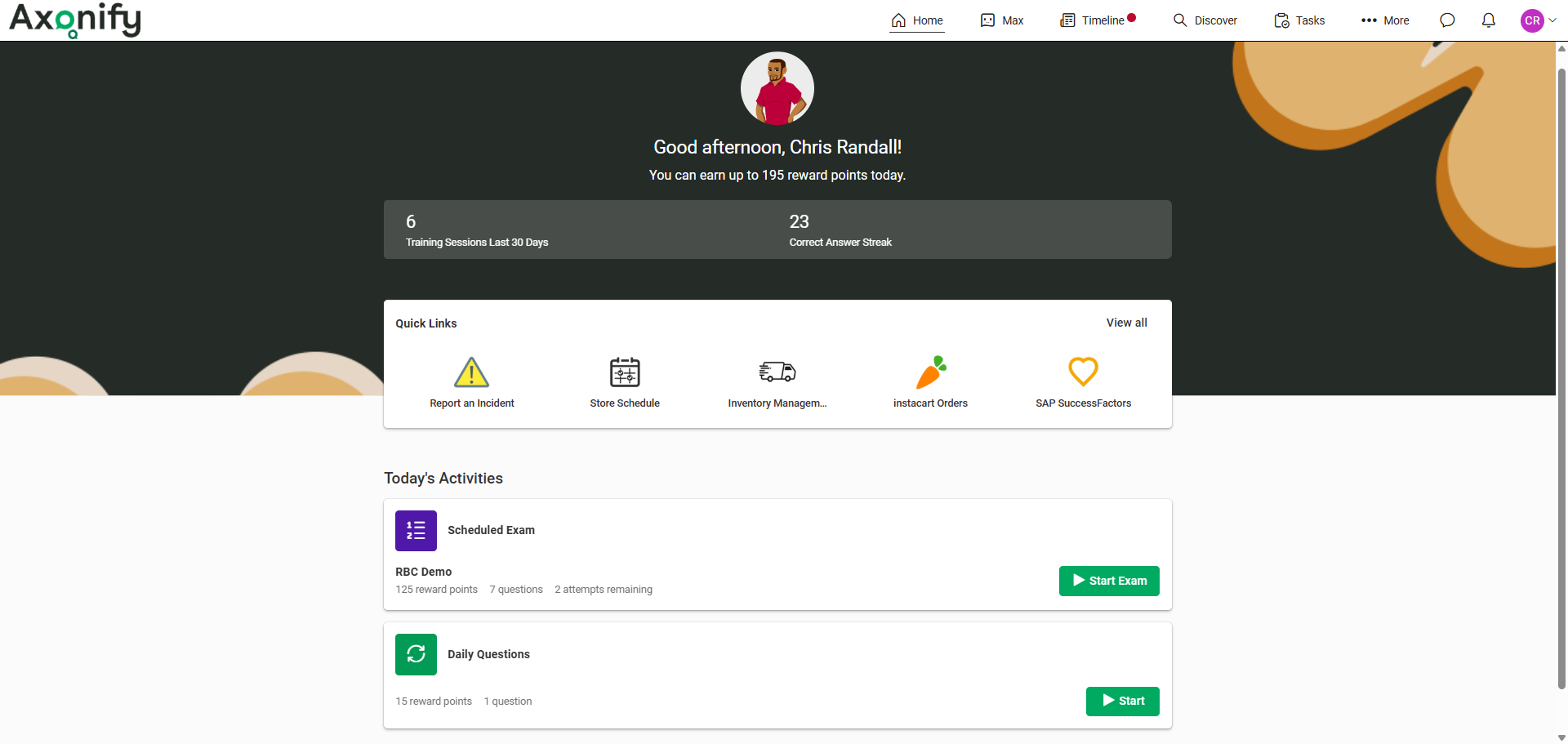
Axonify is an AI-powered frontline enablement platform that delivers personalized, bite-sized training through daily two-to-five minute sessions built on brain science and spaced repetition. Rather than asking employees to complete a course, Axonify embeds a short daily training habit into the flow of work, continuously adjusting what each person sees based on what their adaptive engine knows they understand and what they tend to forget. It reports an engagement rate of 83 percent of users logging in two to three times per week across its customer base, which is significantly higher than traditional LMS platforms.
Key features of Axonify:
- Adaptive Microlearning Engine: AI adjusts which content each learner sees based on individual knowledge gaps, serving the right reinforcement at the right time rather than a generic curriculum.
- Daily Reinforcement Habit: Short, gamified sessions (typically two to five minutes) built into the daily workflow, not scheduled as standalone training events.
- Gamification: Points, leaderboards, badges, and 16 integrated game mechanics drive engagement without requiring behavioral nudges from managers.
- Guided Learning Paths: Structured onboarding paths for new hires alongside the daily reinforcement model, so both initial training and ongoing retention run in the same platform.
- Two-Way Communication: Broadcast messaging and feedback mechanisms connect corporate teams to frontline workers, not just training to learners.
- Analytics and Behavior Tracking: Real-time dashboards that connect knowledge growth to on-the-job behavior metrics, not just quiz scores.
Where Axonify works well:
- Industry-leading engagement for a microlearning platform, with the daily habit model driving consistent participation that most LMS platforms cannot match.
- Adaptive engine means every learner gets a personalized experience without additional admin work, which scales well across large, distributed teams.
- Strong track record in retail, logistics, financial services, and contact centers where frontline knowledge retention directly impacts customer outcomes.
What to know before rolling it out:
- Primarily built for frontline and operational roles. Less suited to knowledge workers, executives, or highly specialized technical content.
- Custom pricing with no published tiers means evaluation requires a sales conversation, and implementation typically requires dedicated onboarding support.
What sets Axonify apart:
Axonify's edge is the daily habit engine. The difference between a microlearning platform and a daily learning habit is compounding: a platform people open when reminded is not the same as a two-minute morning ritual that employees choose to do because the game mechanics make it feel more like a check-in than a course. Axonify has built that second thing, which is why its engagement numbers look different from most alternatives.
Best For:
Enterprise L&D teams managing large frontline or distributed workforces that need consistent daily knowledge reinforcement, particularly in retail, logistics, financial services, hospitality, and contact centers.
Pricing and how it is structured:
Custom enterprise pricing. Axonify does not publish tiers. Contact Axonify for a quote based on user count and modules.
3. OttoLearn: Best for Adaptive Spaced Repetition and Mastery Learning
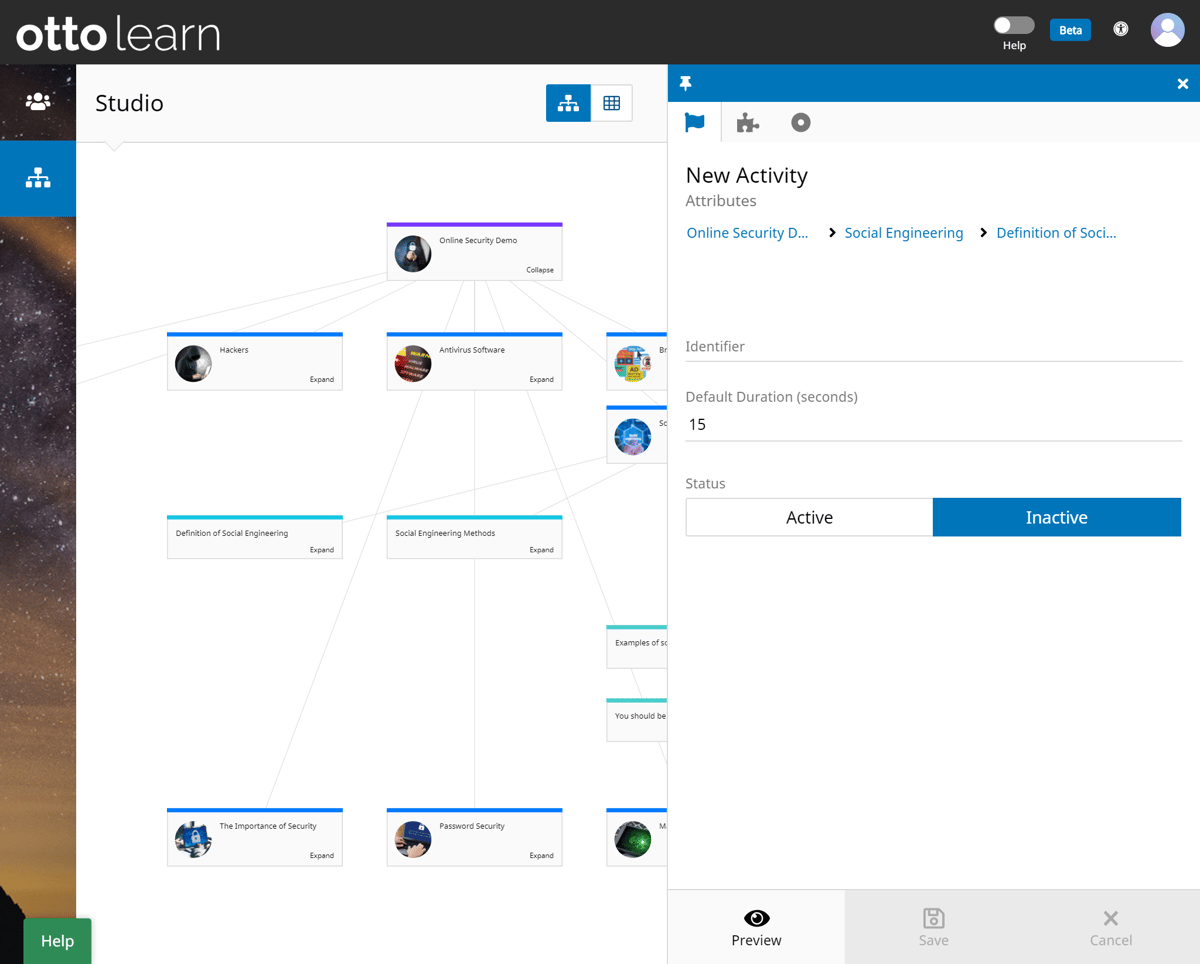
OttoLearn is an adaptive microlearning platform built around a Mastery Learning model: instead of moving learners through content on a fixed schedule, it identifies precisely where each person's knowledge is strong and where it decays, then delivers two-minute, personalized activity bursts timed to the moments when memory is most likely to fade. The result is a platform that knows when each individual needs a specific piece of content better than a calendar-based training program ever could.
Key features of OttoLearn:
- Mastery Learning Model: Tracks each learner's knowledge state per topic and delivers content when their mastery for that specific topic is predicted to drop, rather than following a fixed schedule.
- Two-Minute Activity Bursts: Personalized microlearning sessions that take roughly two minutes, designed for daily habit without schedule disruption.
- Gamification: Points, leaderboards, and achievements motivate consistent participation across teams.
- Multilingual Content Support: Build and deliver training in multiple languages from a single content set.
- Detailed Analytics: Mastery curves per learner, per topic, and per team showing exactly where knowledge gaps persist and whether they are closing over time.
Where OttoLearn works well:
- The Mastery Learning model is more rigorous than standard spaced repetition implementations, targeting individual decay patterns rather than applying a generic repetition interval to everyone.
- Low starting price makes it accessible for teams that want adaptive microlearning without enterprise-scale commitments.
- Minimal admin overhead once content is loaded: the AI handles sequencing and timing, so L&D teams do not manage individual learning paths manually.
What to know before rolling it out:
- Primarily a reinforcement engine, not a content creation or authoring tool. Content needs to be built elsewhere and imported.
- Lighter on multimedia and rich interactive content formats compared to platforms like SC Training or Axonify.
What sets OttoLearn apart:
OttoLearn's differentiator is precision. Most adaptive platforms adjust content based on quiz scores. OttoLearn adjusts based on predicted mastery decay per topic per learner, which means each person's two-minute session is informed by a model of exactly what they are likely to forget today, not just what they scored poorly on last week. For compliance-heavy or knowledge-critical training programs, that level of targeting is worth the investment.
Best For:
L&D teams running knowledge-critical or compliance training programs that want a lightweight, affordable adaptive reinforcement engine without the overhead of a full enterprise platform.
Pricing and how it is structured:
Plans start from $250 per month, making it one of the more accessible adaptive microlearning platforms with published pricing. Contact OttoLearn for enterprise tier details.
4. SC Training by SafetyCulture: Best for Mobile-First Microlearning at Scale
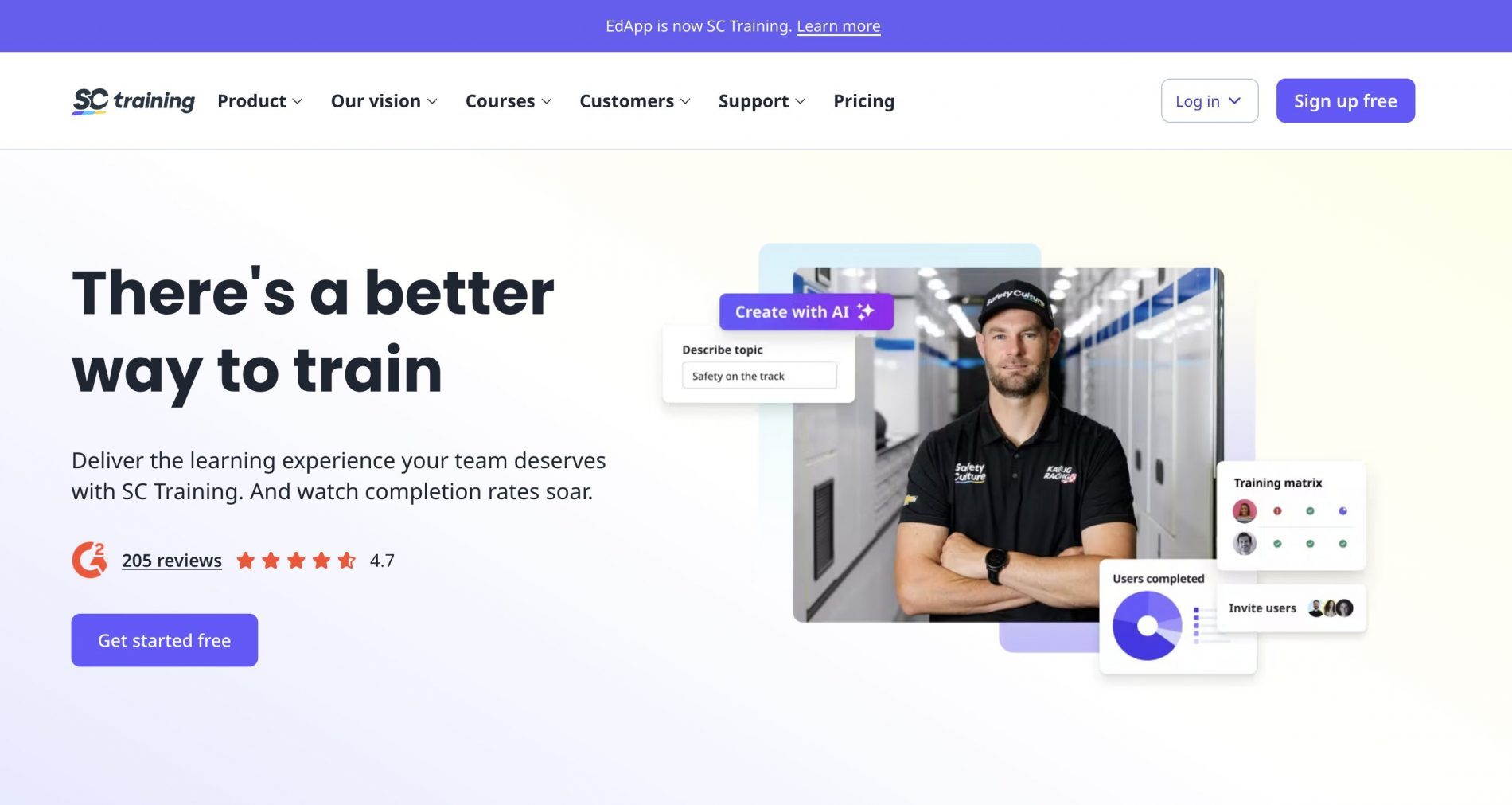
SC Training (formerly EdApp, now part of SafetyCulture) is a mobile-first microlearning platform that turns existing documents, SOPs, and PowerPoint files into swipeable, interactive courses using AI content generation and translation. It is one of the most widely adopted microlearning creation and delivery platforms globally, used by organizations including Coca-Cola, Shell, Audi, and Deloitte, and it is the strongest free-tier option in the category for teams that want to start building immediately without a budget commitment.
Key features of SC Training:
- AI Course Creator: Uploads existing documents, SOPs, or presentations and converts them into swipeable microlearning courses with AI-generated quizzes, translations into 100+ languages, and text-to-speech narration.
- Mobile-First Delivery: Push notifications, offline access, and swipeable lesson format built specifically for learners who are not at a desk.
- Gamification: Leaderboards, badges, and completion rewards built into the learner experience without requiring manual setup.
- SCORM Import and Export: Import existing SCORM content and export courses for use in other LMS platforms on higher tiers.
- Analytics Dashboard: Real-time completion data, quiz performance, and learner satisfaction scores across all plans.
Where SC Training works well:
- The free tier is genuinely useful, allowing teams to build and deploy courses for up to 10 learners before spending anything.
- AI content generation from existing documents is fast and reduces the time from source material to deployable course significantly.
- 100+ language translation and mobile-first format make it practical for global and frontline teams simultaneously.
What to know before rolling it out:
- SCORM export is only available on Enterprise plans, which limits interoperability for teams on the free or Premium tier.
- No spaced repetition or adaptive delivery engine, so it handles content creation and delivery well but not long-term retention optimization.
What sets SC Training apart:
SC Training's advantage is the combination of speed and accessibility. For L&D teams that need to build a lot of training quickly, turn existing content into mobile-friendly lessons, and reach a global or frontline audience, it is one of the most practical platforms available, particularly given the free entry point. The SafetyCulture ecosystem also makes it a natural fit for teams already using SafetyCulture for audits, inspections, and operational compliance.
Best For:
L&D teams in manufacturing, retail, healthcare, and hospitality that need fast AI-assisted course creation and mobile-first delivery for frontline or distributed workforces, with a free starting tier.
Pricing and how it is structured:
Free for up to 10 learners. Premium at $5 per learner per month billed annually (minimum one admin seat at $24 per seat per month). Enterprise at custom pricing for 500+ users, including SCORM export and a dedicated account manager.
5. 7taps: Best for Friction-Free Microlearning Delivery
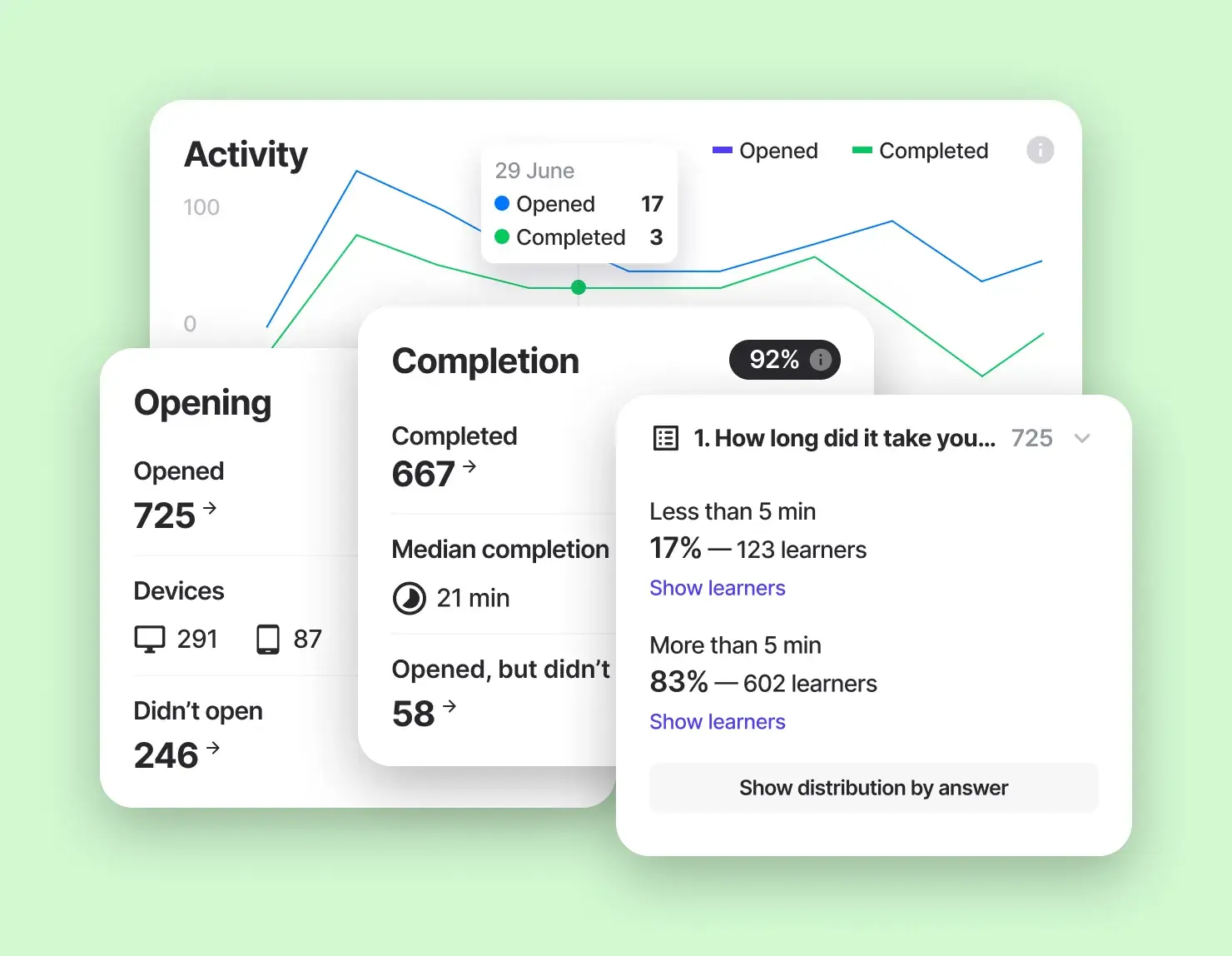
7taps is a microlearning platform built around a single principle: remove every barrier between a piece of training and the person who needs to receive it. Lessons are shared via link, QR code, WhatsApp, SMS, or email, and learners open and complete them instantly without downloading an app, creating a login, or navigating a portal. Each course is built around one learning objective and is designed to be completed in under five minutes. For L&D teams that have experienced the difference between training that reaches 80 percent of the audience and training that reaches 15 percent, 7taps' frictionless delivery model is its core value proposition.
Key features of 7taps:
- Zero-Friction Delivery: Learners open a link or scan a QR code and start immediately, with no app download, no account creation, and no portal login.
- One Objective Per Course: Each course covers a single learning objective, keeping content focused and completion time short.
- AI Content Generation: Generate microlearning content from a topic description or uploaded source material, with the AI producing a first-draft lesson structure quickly.
- Multiple Delivery Channels: Distribute via link, QR code, WhatsApp, SMS, email, Slack, Microsoft Teams, or any other messaging channel your team already uses.
- Analytics Without Login: Track views, completion rates, and engagement without requiring learners to create accounts.
Where 7taps works well:
- Highest practical completion rate of any microlearning format for ad-hoc or one-off training because it eliminates the login friction that causes drop-off before a lesson even starts.
- QR code delivery is genuinely useful in physical environments: a poster in a break room, a card attached to equipment, a notice board in a warehouse.
- Fast content creation makes it practical for time-sensitive updates such as a product launch, a compliance change, or a new process.
What to know before rolling it out:
- Not built for structured, multi-module programs, compliance certification, or tracked assessment. Best for lightweight, standalone learning moments rather than formal courses.
- Enterprise pricing is custom and not published. The free tier supports only 2 courses, which limits meaningful testing.
What sets 7taps apart:
7taps is the only platform in this guide that makes learner login optional. That one design decision changes the math on completion rates for the specific use cases where friction is the primary obstacle: just-in-time field updates, safety reminders, product launch briefs, and on-the-spot onboarding for temporary staff. For those problems, 7taps is the most practical tool available.
Best For:
L&D teams that need to distribute short, time-sensitive training to a distributed, deskless, or hard-to-reach workforce through channels they already use, without a portal or login requirement.
Pricing and how it is structured:
Free for up to 2 courses. Enterprise pricing on request, with pricing generally available in the mid-market range based on user reports. Contact 7taps for a quote.
6. Spekit: Best for In-Workflow Microlearning for Sales Teams

Spekit is a just-in-time sales enablement platform that delivers microlearning, content, and AI-guided coaching inside the tools sales reps already use, primarily Salesforce, but also Slack, email, and any other application via its Chrome extension. The core idea is that the best moment to deliver a piece of training is not a scheduled session in a separate portal but the exact moment a rep needs it: opening a new account, preparing for a call, or drafting a follow-up. Spekit's AI Sidekick anticipates that moment using CRM data, call intelligence signals, and deal context, and surfaces the relevant content automatically.
Key features of Spekit:
- AI Sidekick: Contextual AI that reads deal signals from CRM data, call intelligence, and email context and proactively surfaces the most relevant content, coaching guidance, or training resource in the rep's current view.
- In-App Delivery: Embeds learning directly inside Salesforce, Slack, email clients, and any other application via Chrome extension, no portal navigation required.
- Content Management and Governance: A centralized repository for playbooks, battlecards, and training content with built-in change management so outdated content is flagged and updated rather than quietly becoming a source of misinformation.
- Deal Rooms: AI-assisted buyer-facing content rooms that reps can build and share from within their workflow.
- Analytics: Content engagement data tied to deal outcomes, showing enablement teams which resources influence pipeline and which do not.
Where Spekit works well:
- In-workflow delivery removes the biggest obstacle to microlearning adoption in sales teams: the habit of opening a separate training portal that competes with active selling time.
- AI Sidekick's ability to surface the right content at the right deal moment is a meaningful step beyond simple contextual tooltips.
- Strong in mid-to-large SaaS and technology companies where Salesforce is the system of record and where reps work across multiple tools simultaneously.
What to know before rolling it out:
- Most valuable for Salesforce-heavy environments. Teams without Salesforce or that run less structured sales processes may find the in-app model less compelling.
- Content foundation requires upfront investment: Spekit's value scales with the quality and completeness of the content library that has been built inside it.
What sets Spekit apart:
Spekit's differentiator is context-awareness. Most microlearning platforms push content to learners. Spekit waits for a signal (a new deal stage, a flagged objection in a call, a prospect in a specific industry) and surfaces what is relevant to that specific moment. For sales teams, that is the difference between a training resource and a live co-pilot.
Best For:
Sales enablement and revenue operations teams at mid-to-large SaaS, technology, and financial services companies that want to deliver just-in-time learning and content inside the tools reps use daily, particularly Salesforce.
Pricing and how it is structured:
Custom enterprise pricing. No published tiers. Contact Spekit for a quote based on team size and features.
7. Whatfix: Best for In-App Digital Adoption and Microlearning

Whatfix is a digital adoption platform (DAP) that delivers microlearning and in-app guidance directly inside enterprise software, placing tooltips, walkthroughs, task lists, and short lessons into the exact screens where employees need to apply them. It is SCORM and xAPI compliant, integrates with all major LMS platforms, and includes Whatfix Analytics for tracking actual software usage behavior alongside learning engagement. For L&D and IT teams managing large software rollouts or complex system transitions, Whatfix solves the specific problem of training people on software without pulling them out of the software.
Key features of Whatfix:
- In-App Guidance Overlays: Interactive walkthroughs, step-by-step guides, and task checklists layered directly onto enterprise applications without modifying the underlying software.
- Contextual Help Widget: A self-service resource panel embedded inside applications that surfaces relevant SOPs, videos, and guides based on the screen the user is on.
- SCORM and xAPI Compliance: The only digital adoption platform in its category that is both SCORM and xAPI compliant, enabling integration with any LMS for completion and performance tracking.
- Whatfix Analytics: Tracks real software usage behavior alongside learning engagement, showing where users struggle in actual workflows rather than in training simulations.
- Content Creation Tools: No-code authoring for building interactive guidance without developer involvement.
Where Whatfix works well:
- The strongest option for software onboarding and change management programs where the learning objective is performing a workflow in a specific system, not just understanding a concept.
- SCORM and xAPI compliance is a genuine differentiator among DAP platforms, making Whatfix compatible with existing L&D infrastructure rather than a standalone tool.
- Analytics on actual software usage (where users drop off, which steps generate the most errors) gives L&D teams data they cannot get from quiz completion alone.
What to know before rolling it out:
- Implementation requires overlay configuration for each enterprise application, which is a meaningful setup investment compared to content-first microlearning platforms.
- Most valuable when tied to a specific software rollout or system change. Less relevant for general knowledge or soft skill training.
What sets Whatfix apart:
Whatfix's edge is that it is the only platform in this guide where the learning happens inside the actual software interface rather than alongside it. For an employee learning a new CRM field layout or a claims handler navigating a policy system update, in-the-moment guidance on the real screen is more effective than a simulation of it, and the analytics layer shows exactly where people still get stuck after training is marked complete.
Best For:
L&D and IT teams managing enterprise software rollouts, digital transformation programs, or complex system transitions where the training goal is workflow execution, not knowledge recall.
Pricing and how it is structured:
Custom enterprise pricing. Not published. Contact Whatfix for a quote based on applications, users, and features.
8. Qstream: Best for Scenario-Based Knowledge Reinforcement in Sales and Compliance
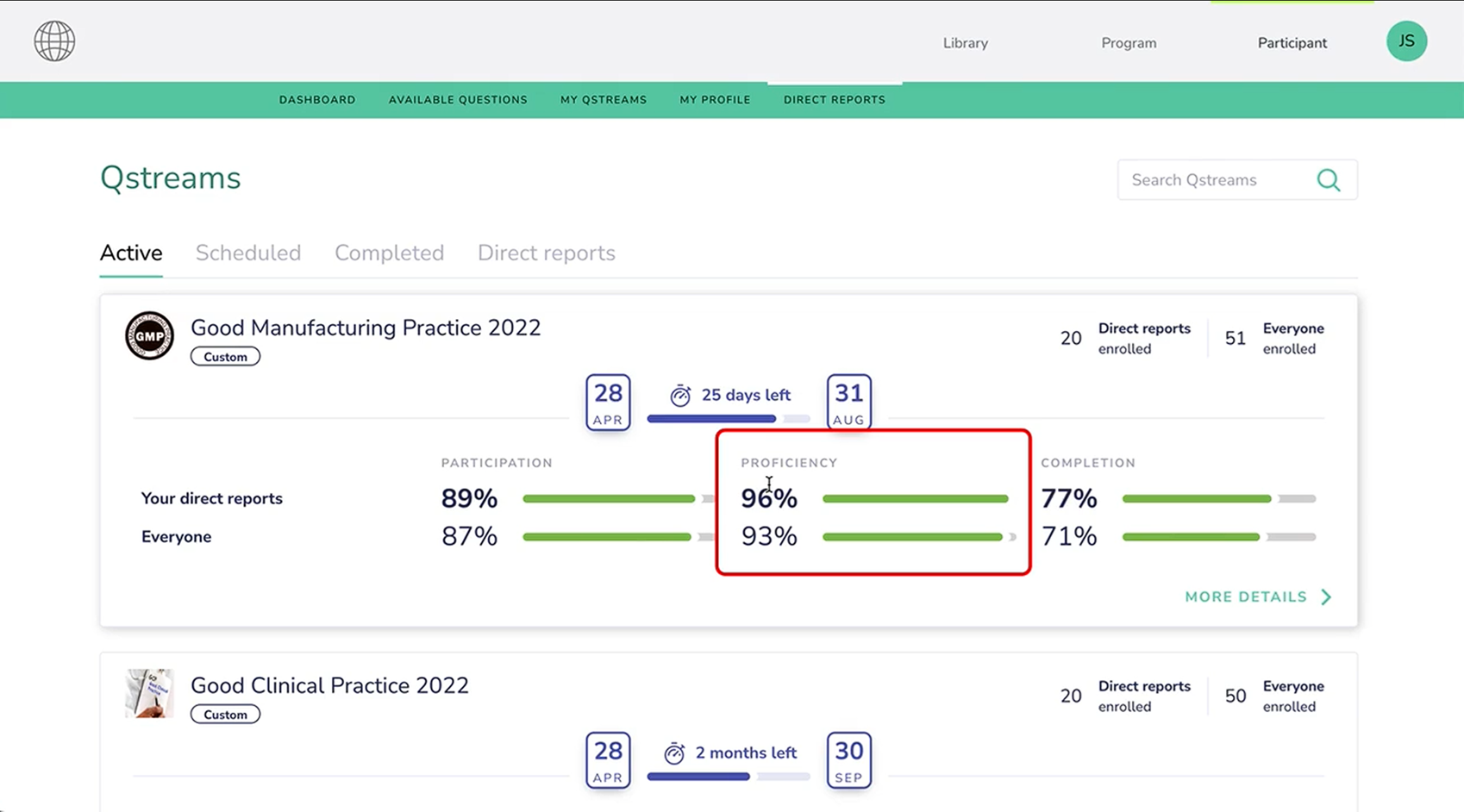
Qstream is a microlearning and knowledge reinforcement platform built around scenario-based daily questions delivered over time using spaced repetition methodology. Unlike quiz-style reinforcement that tests recall, Qstream's questions are framed as realistic situations that require judgment rather than memory retrieval, making it particularly effective for sales knowledge and compliance programs where the goal is not just recalling a fact but knowing how to apply it. It is widely used in healthcare, pharmaceutical, financial services, and sales enablement.
Key features of Qstream:
- Scenario-Based Daily Questions: Questions are framed as realistic situations requiring judgment, moving reinforcement from rote recall to applied knowledge.
- Spaced Repetition Engine: Questions are delivered at scientifically timed intervals based on individual performance, targeting the moments when each topic is most likely to fade.
- Proficiency Analytics: Dashboards show proficiency levels per topic, per person, and per team, giving L&D and enablement leaders a view of knowledge health across the workforce.
- Manager Insights: Coaching dashboards that surface which individuals and which topics need attention, based on proficiency data rather than gut feel.
- Mobile-First Delivery: Daily questions delivered to mobile devices without requiring a separate app login.
Where Qstream works well:
- Scenario-based question format is more effective for durable knowledge change than simple recall questions, and more appropriate for regulated industries where how someone applies knowledge matters more than whether they remember a definition.
- Particularly strong for pharma, healthcare, financial services, and life sciences where compliance and product knowledge reinforcement are ongoing requirements.
- Manager coaching dashboards tied to proficiency data give sales leaders a data-driven way to prioritize coaching conversations.
What to know before rolling it out:
- A reinforcement engine, not a full authoring suite. Content is typically created elsewhere and adapted for Qstream's question format, which adds a content design step.
- Custom enterprise pricing with no published tiers requires a sales conversation to evaluate.
What sets Qstream apart:
Qstream's differentiator is the question design philosophy. Most reinforcement platforms ask whether you remember something. Qstream asks whether you know what to do in a specific situation. That distinction drives higher-quality knowledge retention for the use cases where it is deployed, particularly in industries where the wrong answer in the field has real consequences.
Best For:
Sales enablement teams, compliance and regulatory training leaders, and L&D teams in healthcare, pharma, and financial services that need deep, durable knowledge reinforcement through scenario-based daily practice.
Pricing and how it is structured:
Custom enterprise pricing. Not published. Contact Qstream for a quote.
9. iSpring: Best for SCORM Authoring and Microlearning LMS Combined
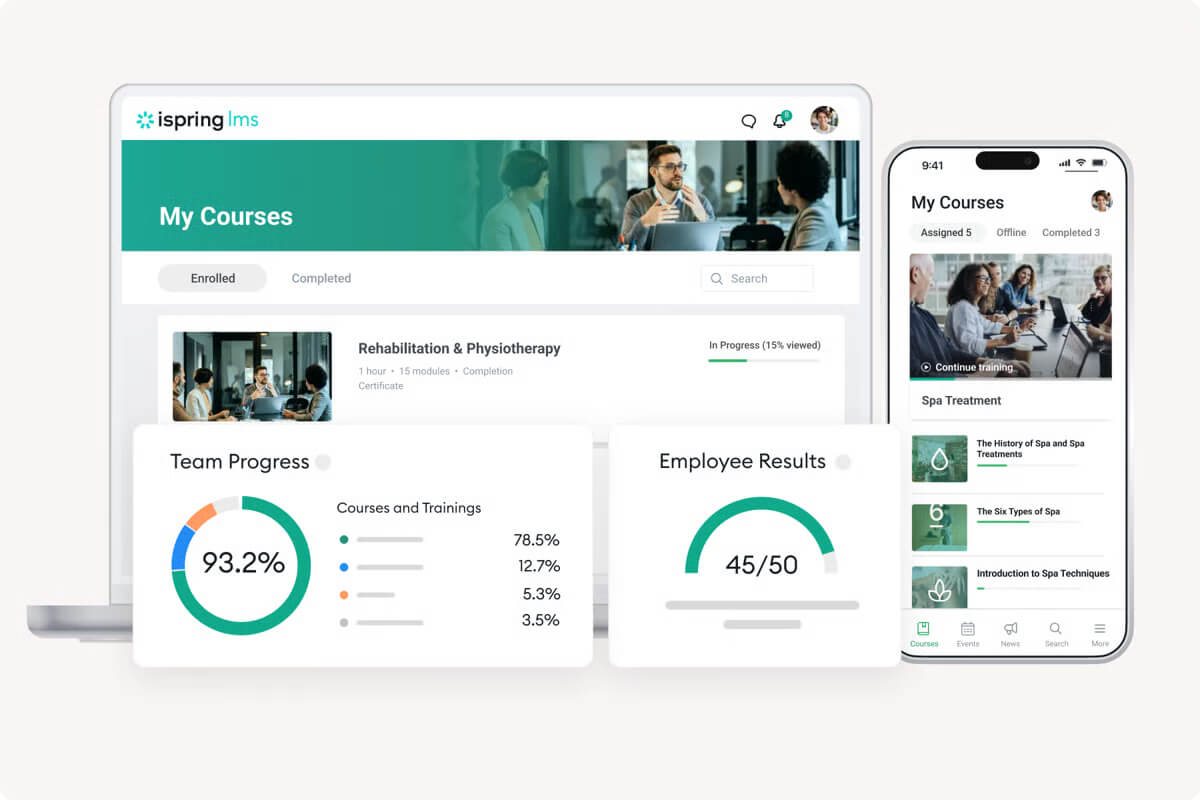
iSpring is a combined eLearning authoring suite and cloud LMS that covers the full microlearning production and delivery cycle in one package. The iSpring Suite authoring tool converts PowerPoint presentations into interactive SCORM-compliant courses, dialogue simulations, and microlearning modules. The iSpring Learn LMS delivers and tracks them. For L&D teams that need to produce SCORM-compliant microlearning quickly from existing materials and deliver them inside a manageable, well-integrated system, iSpring is one of the most practical and cost-transparent options in the enterprise space.
Key features of iSpring:
- PowerPoint-to-eLearning Authoring: Converts existing presentations into interactive, SCORM-compliant microlearning modules directly from PowerPoint, without requiring separate authoring software.
- Branching Scenario Builder: Dialogue simulations and branching scenarios for role-based and situation-specific microlearning.
- iSpring Learn LMS: A companion LMS with learning paths, progress tracking, certifications, and mobile access that delivers everything produced in the authoring suite.
- SCORM, xAPI, and AICC Output: Exports to all major eLearning standards for delivery in any LMS.
- Assessment and Quiz Engine: 14 question types, branching logic, and anti-cheating settings for knowledge checks and formal assessments.
Where iSpring works well:
- PowerPoint conversion dramatically reduces authoring time for L&D teams that already maintain a library of presentation-based training materials.
- The combination of authoring suite and LMS in one package reduces the integration complexity for smaller and mid-sized L&D teams.
- Published per-user pricing gives more cost transparency than most enterprise LMS options.
What to know before rolling it out:
- The PowerPoint-dependency can be a limitation for teams wanting to build highly interactive, multimedia-rich content outside of a slide format.
- iSpring Learn is a capable LMS but lighter on AI personalization and adaptive delivery compared to platforms like Axonify or OttoLearn.
What sets iSpring apart:
iSpring's advantage is the authoring-to-delivery pipeline. For teams producing high volumes of SCORM microlearning from existing materials, the combination of PowerPoint conversion, a capable authoring tool, and an integrated LMS removes the export-import cycle that slows down production in setups where authoring and delivery live in separate systems.
Best For:
L&D teams that produce large volumes of SCORM-compliant microlearning from existing presentation and document materials and want authoring and delivery in one package.
Pricing and how it is structured:
iSpring Suite authoring: from $770 per author per year (subscription). iSpring Learn LMS: from approximately $16,050 per year for up to 300 active users. Bundle pricing available.
10. LearnUpon: Best for Microlearning Alongside Formal Certification Programs
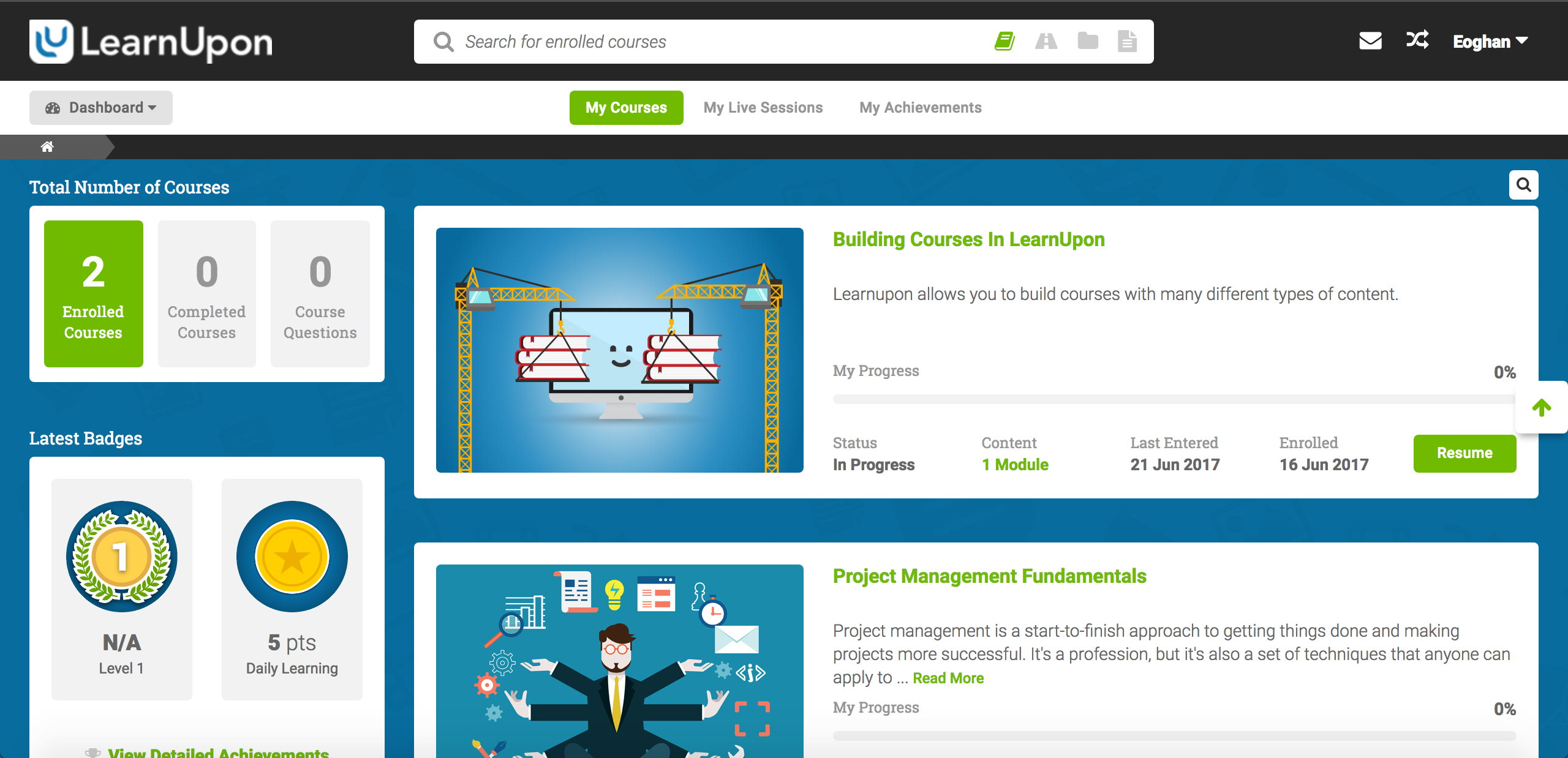
LearnUpon is an enterprise LMS that supports microlearning modules alongside structured certification and compliance programs in a single platform. Rather than requiring separate tools for short-form reinforcement and formal training, LearnUpon handles both in one system: L&D teams build short, focused modules and arrange them into learning paths that can also include longer courses, ILT sessions, and certification tracks. Integrations with Salesforce, BambooHR, Workday, and Zoom round out the connectivity for organizations that need training data to flow across their HR and business systems.
Key features of LearnUpon:
- Combined Microlearning and Formal Training: Build short standalone modules and structured multi-week programs in the same platform, with unified reporting across both.
- AI-Assisted Content Creation: AI tools for generating course content and adapting learning paths to different audiences.
- Multi-Audience Portals: Separate branded portals for employees, partners, and customers, each with their own learning paths and reporting.
- Certification and Compliance Tracking: Certification paths, expiry reminders, and compliance reporting built into the core platform.
- Integrations: Native connectors to Salesforce, BambooHR, Workday, Zoom, and a broad API for custom integrations.
Where LearnUpon works well:
- Strong for organizations that need one system for both microlearning reinforcement and formal certification, removing the need to manage separate platforms for short and long-form content.
- Multi-audience portal model is practical for organizations that train employees, partners, and customers with different content and reporting needs.
- Well-regarded customer success model with consistently positive reviews for implementation support.
What to know before rolling it out:
- Less specialized in adaptive microlearning or in-workflow delivery than dedicated tools like Axonify or Spekit, so it is strongest as a delivery and tracking system rather than a behavior change engine.
- Custom enterprise pricing without published tiers requires a sales conversation to evaluate total cost.
What sets LearnUpon apart:
LearnUpon's strength is consolidation for organizations that have outgrown a patchwork of separate tools: one LMS for formal training, a separate microlearning tool, another portal for partners. Bringing all three into one system with unified reporting and multi-audience portals simplifies both the learner experience and the L&D team's admin workload significantly.
Best For:
Mid-to-enterprise L&D teams that need microlearning delivery alongside structured certification and compliance programs, particularly those training multiple audiences (employees, partners, customers) from one platform.
Pricing and how it is structured:
Custom enterprise pricing. Not published. Contact LearnUpon for a quote based on learner count and features.
Passive Microlearning vs. Active Microlearning: Why the Format Decides the Outcome
The distinction that most microlearning platform comparisons skip over is the difference between learning that informs and learning that changes behavior. Both matter, but they require different formats and are measured by different results.
Passive microlearning covers knowledge: facts, procedures, product features, policy updates. A three-minute video, a flashcard, a scenario-based quiz. Done well, it improves recall significantly compared to long-form training. Every platform in this guide handles passive microlearning competently. The adaptive platforms (Axonify, OttoLearn, Qstream) make passive microlearning more effective by timing delivery to when memory is most likely to decay. The mobile-first platforms (SC Training, 7taps) make it more accessible. The in-workflow platforms (Spekit, Whatfix) make it more contextual.
Active microlearning covers execution: the ability to do something under realistic conditions, not just recognize the right answer when prompted. A five-minute focused roleplay on handling a pricing objection. A two-minute walkthrough of a new CRM workflow in the actual system. A practice discovery call against a realistic AI buyer persona. The format is harder to build and harder to scale than passive content, which is why most microlearning programs stop before reaching it.
The reason the distinction matters for L&D and enablement teams is that the gap between passive and active is exactly where most training programs leak impact. A rep who has watched three microlearning videos on objection handling and scored 90 percent on the follow-up quiz is not necessarily ready for the next sales call. The knowledge is there. The practice is not. Passive microlearning closes the knowledge gap. Active microlearning closes the execution gap. The strongest programs in 2026 use both.
The practical implication: Match the format to the learning goal. For awareness, compliance facts, and product knowledge, passive microlearning with adaptive delivery and spaced repetition is the right investment. For skill execution under pressure, such as sales conversations, claims calls, or software workflows, active microlearning through practice is what moves the performance needle. Most programs need both, and the best L&D stacks build both into the same learning path.
How to Choose the Right Microlearning Platform for Your Team
The right platform depends on the specific learning problem you are trying to solve. Here is how to map common L&D and enablement challenges to the categories above.
1. If behavior change and skill execution are the goal, not just knowledge recall: Start with active microlearning. Outdoo AI's structured roleplay courses let L&D and enablement teams build focused practice modules for each skill, embed them into existing LMS learning paths via SCORM or xAPI, and track both completion in the LMS and performance depth in Outdoo AI. For the use cases where what someone does on a real call matters more than what they scored on a quiz, this is the format that closes the gap. Pair it with a passive delivery platform for the knowledge layer and you have a complete program.
2. If consistent daily knowledge retention across a large distributed team is the priority: An AI-adaptive reinforcement platform is the right investment. Axonify is the stronger option for frontline and operational teams where gamification and daily habit are critical to engagement. OttoLearn is the stronger option for smaller teams or those that want a lighter-weight adaptive engine with published pricing and less implementation overhead.
3. If you need to build and distribute training quickly to a mobile or deskless workforce: SC Training handles AI-assisted content creation, mobile delivery, and 100+ language translation in one platform with a free tier to start. 7taps is the better choice for one-off, time-sensitive training where zero friction on the learner side is the priority, delivered via link or QR code without a login.
4. If sales reps need learning in the flow of work rather than in a separate portal: Spekit delivers just-in-time content and coaching inside Salesforce and other daily tools, triggered by deal context and CRM signals. Whatfix is the stronger choice if the primary need is in-app guidance for a specific enterprise software rollout rather than sales content delivery.
5. If you need scenario-based compliance reinforcement or a combined authoring and LMS solution: Qstream is the most rigorous reinforcement engine for knowledge that needs to stick over time and be applied correctly in high-stakes situations. iSpring is the more practical option for teams producing large volumes of SCORM microlearning from existing materials and wanting authoring and delivery in one package. LearnUpon is the best choice when microlearning needs to coexist with formal certification programs in a single, unified system.
Bottom line: Most L&D and enablement teams need more than one layer. A passive microlearning platform delivers and reinforces knowledge. An active microlearning platform like Outdoo AI turns that knowledge into practiced, scorable skill. The teams that prove the most training impact in 2026 are the ones that have built both layers into the same learning path rather than treating them as separate programs.
Final Thoughts
Microlearning is not a content format. It is a design philosophy: deliver exactly what someone needs, at the moment they need it, in the shortest form that achieves the learning objective. Every platform on this list applies that philosophy differently, and the right choice depends entirely on what the learning objective actually is.
If the goal is knowledge retention across a large workforce, adaptive reinforcement with spaced repetition closes the forgetting gap better than any long-form alternative. If the goal is reaching a mobile or deskless team quickly, frictionless mobile delivery removes the adoption barrier that training portals create. If the goal is enabling sales reps in the moment they are about to use knowledge, in-workflow delivery surfaces it where they already work. And if the goal is changing how someone behaves on a real call, a real customer interaction, or a real workflow, practice-based microlearning is the format that gets there.
Outdoo AI is built around that last objective: structured roleplay courses that embed into any LMS, deliver focused practice on one skill at a time, track completion and performance across both the LMS and Outdoo AI, and close the loop with coaching triggered by what actually happens on live calls. In 120+ languages, with 120+ integrations, and with the same scoring framework running across practice and live performance.
Book a demo to see how Outdoo AI's roleplay-based microlearning fits into your existing LMS and learning programs.
Frequently Asked Questions
.svg)
The best microlearning platforms in 2026 include Outdoo AI for roleplay-based active microlearning, Axonify and OttoLearn for AI-adaptive daily reinforcement, SC Training and 7taps for mobile-first delivery, Spekit and Whatfix for in-workflow learning, and Qstream, iSpring, and LearnUpon for knowledge reinforcement and formal programs. The right platform depends on whether the goal is knowledge retention, behavior change, or in-the-moment guidance.
Passive microlearning delivers knowledge in short formats: videos, flashcards, and scenario-based quizzes. It improves recall and is effective for product knowledge, compliance facts, and policy updates. Active microlearning requires the learner to do something: practice a conversation, navigate a workflow, or handle a realistic scenario. It is more effective for skill execution and behavior change. Outdoo AI's roleplay-based courses deliver active microlearning, while most other platforms on this list deliver passive microlearning with varying levels of adaptivity.
Most enterprise microlearning platforms integrate with LMS systems via SCORM, xAPI, or AICC. Outdoo AI, iSpring, SC Training (Enterprise), and Whatfix all support SCORM and xAPI, so content and completion data can sync with your existing LMS. Outdoo AI specifically allows roleplay practice modules to be embedded as SCORM modules inside LMS learning paths, with both completion tracked in the LMS and detailed performance data available in Outdoo AI.
For sales enablement teams, the strongest options depend on the use case. Spekit delivers just-in-time learning and content inside Salesforce and other daily tools. Qstream reinforces sales knowledge and objection handling through daily scenario-based questions. Outdoo AI goes further by letting sales teams practice actual conversations in structured roleplay courses embedded into their LMS learning paths, with scoring and coaching tied to both practice and live call performance.
Outdoo AI is an enterprise roleplay and closed-loop coaching platform that delivers microlearning through active practice rather than passive content. Teams build structured roleplay courses where each module targets one specific skill (objection handling, multi-persona discovery, competitive questions), export them as SCORM or xAPI modules for any LMS, and track completion in the LMS alongside detailed performance scoring in Outdoo AI. Performance-triggered micro-learning is also assigned automatically when built-in conversation intelligence identifies a skill gap on a live call.
Table of Contents
Talk to Sales
Have questions about training and enablement for your sales, CS, support, or leadership team? Let's talk.
Talk to Sales