




Most sales managers can name their top two reps and their bottom two without thinking. Ask them to describe the specific execution gaps holding back the eight reps in between, and you get silence, a shrug, or something vague about "needing to be more consultative." That middle tier is where the real revenue lives, and it is almost always under coached.
The reason is structural, not motivational. A typical frontline manager oversees 8 to 12 reps, each running dozens of calls a week. Manual call reviews cover a tiny fraction of those conversations, and the ones reviewed are usually chosen because something went visibly wrong. Coaching stays reactive and anecdotal. Reps hear "nice job" or "you need to improve your discovery," but rarely get the precise behavioral feedback that changes how they sell.
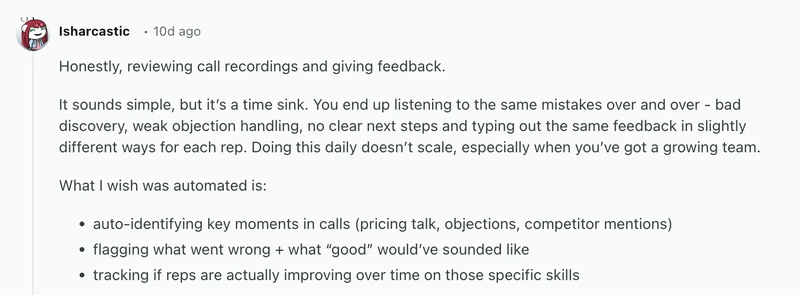
AI call scoring changes that equation. Not because the technology is magical, but because it makes every conversation measurable against the same rubric, every time. Done well, it turns scattered impressions into a dataset that reveals patterns managers would never spot on their own. Done poorly, it becomes another dashboard nobody opens.
We break down what separates the two outcomes: how scoring should connect to your actual sales motion, which metrics matter and which are vanity, where most implementations stall, and how to build a coaching loop that makes the data stick. If your team is past the point where manual QA can keep up, this is the playbook.
What Is AI Call Scoring?
AI call scoring is the automated evaluation of every recorded sales conversation against the same performance rubric, covering behaviors such as discovery depth, objection handling, value articulation and next-step confirmation, so managers can coach from patterns instead of a handful of sampled calls.
What AI Call Scoring Actually Does (and What It Doesn't)
Think of AI call scoring as a consistent, tireless QA analyst sitting on every call your team takes. It listens to recorded conversations and evaluates them against a predefined performance rubric covering dimensions like discovery depth, objection handling, value articulation, and next-step confirmation.
The key word is consistent. A human reviewer brings judgment and nuance, but also fatigue, recency bias, and a tendency to anchor on surface-level impressions. With manual reviews, the calls that get attention are disproportionately the ones flagged by a frustrated customer or escalated by a rep asking for help. That is a biased sample, and decisions built on biased samples lead to misallocated coaching time.
AI scoring eliminates the sampling problem. Every call gets the same rubric applied the same way. Over hundreds of interactions, that consistency produces something manual QA never can: a reliable aggregate picture of how your team is actually executing. Live and Study in Europe made this switch, moving from random spot-checks to scoring every one of its 160+ daily consultations.

The technology does not replace the manager's role in coaching. It does not automatically know which behaviors matter for your sales motion. And if your scorecard measures the wrong things, it will produce beautifully consistent scores that have zero correlation with closed deals. The technology is only as useful as the rubric it is built on.
Why the Middle 60% Is Where Scoring Pays Off
Top performers and chronic underperformers absorb most of the attention. Top reps get held up as examples. Struggling reps get put on performance plans. The large middle group, the reps closing at 18% to 26% instead of 30% or 12%, tends to drift.
This is the tier where AI scoring creates disproportionate value.
A B2B SaaS team with 10 reps noticed that three mid-tier reps were consistently losing deals after strong first calls. Manual review of a handful of recordings revealed nothing obvious. When the team implemented AI scoring against a custom rubric, a clear pattern emerged: those three reps were skipping a specific competitive differentiation question during discovery in roughly 70% of their calls. They were doing solid needs analysis but failing to surface the prospect's existing evaluation criteria early enough. Deals stalled in later stages because objections that should have been addressed in discovery appeared for the first time during negotiation.
After targeted coaching focused on that single behavior, two of the three reps saw their close rates move from the low 20s into the high 20s within a quarter. The third rep needed additional reinforcement, but even that rep's pipeline velocity improved because fewer deals were stalling mid-funnel.
That kind of specificity is impossible at scale without scoring data. The insight was not "do better discovery." It was "you are missing this particular question, in this particular stage, and it is costing you deals that look healthy until week four." That level of precision turns coaching from a calendar obligation into a performance lever.
Building a Scorecard That Measures What Actually Matters
Most AI scoring tools ship with generic evaluation templates: talk-time ratios, filler word counts, question-to-statement ratios. These are vanity metrics. They are easy to measure and satisfying to chart, but in most sales motions they have weak or no correlation with whether a deal closes.
If your scoring tool cannot evaluate against your custom playbook, it is wasting your time. A talk-time ratio of 40/60 means nothing if the rep spent their 40% on irrelevant product features instead of surfacing the prospect's decision criteria.
A strong scorecard measures specific, observable behaviors tied to your sales methodology and deal outcomes. Below is a rubric framework you can adapt to your motion:
| Behavior | What "Good" Looks Like | What "Weak" Looks Like | Weight |
|---|---|---|---|
| Discovery depth | Rep uncovers business impact, decision process, and timeline with open-ended questions | Rep asks surface-level qualifying questions and moves to pitch within 3 minutes | High |
| Competitive positioning | Rep proactively surfaces evaluation criteria and differentiates against known alternatives | Rep only addresses competitors when the prospect raises them | Medium |
| Objection handling | Rep acknowledges the concern, reframes with a relevant proof point, and confirms resolution | Rep deflects, over-explains, or ignores the objection | High |
| Value articulation | Rep connects product capabilities to the prospect's stated business outcomes | Rep lists features or uses generic ROI language | Medium |
| Next-step confirmation | Rep proposes a specific next action with a date and confirms mutual commitment | Call ends with "I'll send you some info" or no clear follow-up | High |
Two principles to follow when building your scorecard:
Score what predicts outcomes, not what is easy to count. Before finalizing your rubric, pull your last 50 closed-won and 50 closed-lost deals. Listen to the calls and identify which behaviors appear consistently in wins but not losses. That is your scorecard. If "talk-time ratio" does not show up as a differentiator, do not include it.
Update the scorecard quarterly. Your messaging evolves. Your competitive landscape shifts. A static rubric becomes stale within two quarters. Build a review cadence where sales leadership and enablement revisit the scorecard behaviors and weights based on recent deal data.
The Manual QA Tipping Point: When to Make the Switch
Not every team needs AI scoring. If a manager oversees four reps running 15 calls a week each, manual review of a meaningful sample is realistic. The math changes fast.
The tipping point typically sits between 50 and 100 calls per week per manager. Below that range, a disciplined manager can review enough calls to maintain a reasonably accurate picture of team execution. Above it, three things break down:
- Sample bias takes over. Managers default to reviewing calls from reps they are already worried about or calls where the outcome was already known. The middle tier goes unreviewed.
- Pattern recognition becomes impossible. Systemic issues, like an entire team consistently rushing past a discovery stage, only surface in aggregate data across hundreds of calls. A five-call sample will never reveal that.
- Coaching becomes anecdotal. Without data, feedback stays at the level of "I listened to your call with Acme and here's what I noticed." Reps hear one-off observations instead of trends across their last 30 calls.
If your team is approaching that threshold, the question is not whether to adopt AI scoring but how quickly you can implement a rubric that reflects your actual sales motion. Starting with a generic template and "planning to customize later" is a common mistake. Teams that launch with a well-defined scorecard see faster coaching adoption because the insights feel immediately relevant to reps and managers alike.
Connecting Scoring to Coaching: Where Most Implementations Stall
Roughly half of AI scoring deployments follow the same failure arc: the tool gets implemented, scores start flowing into a dashboard, and within 60 days nobody is looking at it. The data exists but sits disconnected from the coaching workflow. Managers still run one-on-ones based on pipeline reviews and gut feel. Reps never see their scores. The investment produces reports, not behavior change.
The fix is not more dashboards. It is a closed loop between scoring data and structured coaching actions.
Step 1: Identify the highest-leverage gap per rep. Do not present reps with a wall of scores across 12 dimensions. Each coaching cycle, pick the one behavior where improvement would have the most pipeline impact. For a rep losing deals in late stages, that might be objection handling. For a rep with strong discovery but low conversion from first call to second, it might be next-step confirmation.
Step 2: Make the gap concrete with call evidence. Scoring data tells you what is happening. Specific call moments show the rep how it is happening. Pull two or three timestamped examples where the behavior fell short. Let the rep hear their own pattern. This is dramatically more effective than describing it in the abstract.
Step 3: Practice the new behavior before the next live call. This is where most coaching loops break. The rep hears the feedback, nods, and goes back to selling. Without deliberate practice, the old habit wins every time. Role-play the specific scenario. Use AI-driven practice simulations where reps can rehearse the exact objection or discovery question in a low-stakes environment. Platforms like Outdoo AI connect scoring insights directly to targeted practice scenarios, so reps rehearse the specific skill the data flagged rather than running generic drills.
Step 4: Re-score and close the loop. After two weeks of focused practice, look at the scoring data again for that specific behavior. Did the numbers move? If yes, move to the next gap. If not, the coaching approach needs adjustment, not just repetition.
This four-step loop is simple on paper and hard in practice. It requires managers to shift from reviewing calls as a compliance exercise to using scoring data as a coaching planning tool. The teams that make this shift consistently report that coaching conversations get shorter, more focused, and more productive because both the manager and the rep are looking at the same evidence.
What to Look for in an AI Call Scoring Platform
The wrong platform choice can entrench the exact problems you are trying to solve. Four criteria separate tools that drive coaching from tools that produce unused dashboards:
Custom scorecard configuration is non-negotiable. If the platform only offers pre-built rubrics or limits you to industry-generic evaluation criteria, walk away. Your sales motion is specific. Your scorecard must be too.
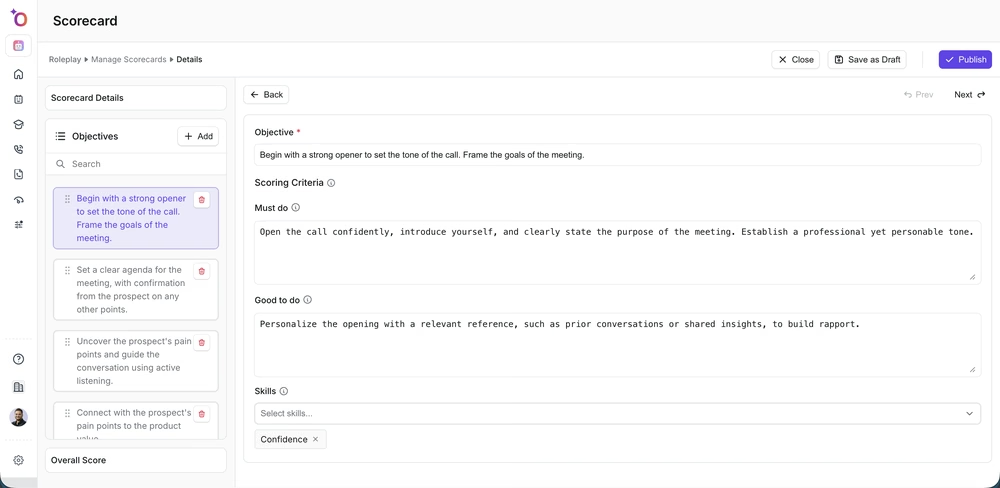
Scoring must connect to a coaching action. A score without a next step is a number on a screen. The platform should make it easy for a manager to go from "this rep scores low on objection handling" to "here are the specific calls, here is a practice exercise, and here is how we will measure improvement." Outdoo AI was built around this principle, linking AI-generated scoring insights to structured coaching paths and practice simulations so the data translates into reps actually doing something different on their next call.

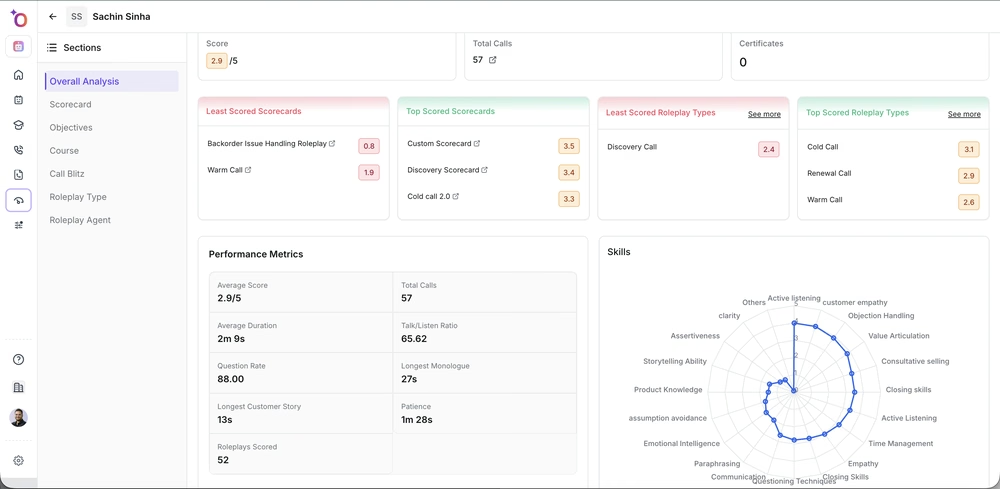
Look for trend data, not just snapshots. A single call score is trivia. Score trends over weeks and months are intelligence. The platform should let you track how individual reps and the overall team progress on each rubric dimension over time.
Integration with your existing call recording stack matters. If reps or managers have to manually upload recordings or switch between three tools to access scores, adoption will collapse within a month. The platform should plug into your existing recording and CRM infrastructure with minimal friction.
Conclusion
AI call scoring is not a silver bullet and it is not a reporting tool. It is an infrastructure layer for coaching. The teams that get the most from it start with a rubric built on their own deal data, focus their coaching energy on the middle tier where small improvements compound into meaningful pipeline gains, and close the loop between data and practice.
For revenue leaders running teams past 50 calls per manager per week, investing in scoring infrastructure is the strongest lever for moving that middle 60%. The data alone changes nothing. The data fed into a system where insights become practice and practice becomes habit changes close rates. If you are evaluating platforms, Outdoo AI is worth a serious look because it connects the scoring layer directly to the practice layer, which is the exact gap where most implementations fail.
The reps sitting in your middle 60% are not stuck because they lack talent. They are stuck because nobody has shown them, with precision, what to change. Give them the precision, and the results follow.
Frequently Asked Questions
.svg)
AI call scoring uses automated analysis to evaluate every sales conversation against a predefined performance rubric covering discovery questioning, objection handling, value messaging clarity, and more. Manual reviews typically cover a small fraction of total calls, and the ones reviewed tend to be flagged problems or escalations rather than a representative sample. AI scoring processes every recorded interaction against the same criteria, turning individual conversations into a dataset that reveals execution patterns across the entire team over time. The practical difference is not just scale; it is consistency. A human reviewer's standards shift from Monday morning to Friday afternoon. The algorithm's do not.
Most managers carry accurate mental models of their top and bottom performers but have limited visibility into the large middle tier. These reps are competent enough to avoid scrutiny but not strong enough to stand out, and they collectively generate the bulk of revenue. AI call scoring surfaces specific behavioral patterns across all reps automatically, so managers can identify exactly where mid-tier reps deviate from the playbook. Instead of generic feedback like "improve your discovery," a manager can say: "In your last 25 calls, you confirmed next steps with a specific date only 30% of the time. Top performers on this team do it 85% of the time. Let's work on that." That specificity is what makes coaching stick.
A strong scorecard focuses on specific, observable behaviors that correlate with deal outcomes, not surface-level metrics like talk-time ratios or filler word counts. The most impactful dimensions to score are: depth of discovery questioning (did the rep uncover business impact and decision criteria?), accuracy of competitive positioning, quality of objection responses (acknowledged, reframed, and resolved vs. deflected), clarity of value articulation tied to the prospect's stated priorities, and whether clear next steps with dates were confirmed. The critical step most teams skip: before finalizing your scorecard, analyze your last 50 closed-won and 50 closed-lost deals to identify which behaviors actually differentiate wins from losses. Build your rubric from that evidence, and revisit it quarterly as your messaging and competitive landscape evolve.
The tipping point typically sits between 50 and 100 calls per week per manager. Below that range, a disciplined manager can review a meaningful sample and maintain a reasonably accurate picture of team execution. Above it, manual QA produces a biased sample skewed toward known problems or specific reps, and systemic execution gaps that only appear in aggregate data go undetected. If your team has crossed that threshold and your managers are coaching from memory rather than evidence, you are leaving performance gains on the table. The most common implementation mistake is launching with a generic scorecard and "planning to customize later." Start with a rubric built on your own deal data from day one.
Prioritize three things. First, the platform must let you define custom scorecards aligned to your specific sales methodology. Off-the-shelf rubrics rarely match how your team actually sells, and generic scores produce generic coaching. Second, scoring data must connect directly to coaching workflows, not just dashboards. If a manager cannot go from a score to a specific call example to a targeted practice exercise in a few clicks, adoption will stall. Outdoo AI is built around this connection, linking AI scoring insights to structured coaching paths and practice simulations so data translates into behavior change. Third, look for trend tracking over time rather than single-call snapshots, and confirm the platform integrates with your existing call recording and CRM stack so reps and managers do not have to change their daily workflow to benefit from it.
Table of Contents
Talk to Sales
Have questions about training and enablement for your sales, CS, support, or leadership team? Let's talk.
Talk to Sales