




Credit unions are built on trust, community familiarity, and the idea that every interaction should feel like it matters.
The frontline reality has shifted. Staff now face more complex questions, heavier emotions, and faster expectations than traditional training models were ever designed for.
Industry benchmarks show that 73% of banking customers want immediate support.
And 58% of financial-services customers say they would switch providers for better digital experiences. This means every conversation carries financial impact, reputational risk, and a chance to strengthen or weaken loyalty.
Shadowing a colleague or reading a manual cannot prepare an MSR or loan officer for a high-pressure fraud call, a confused mobile-banking user, or a member seeking urgent payment relief. When an interaction goes wrong, the consequences are immediate and often irreversible.
AI roleplay for credit unions provides a practical, scalable way for employees to rehearse real scenarios with virtual members who object, escalate, challenge, and react just like actual people.
It creates a safe place to practice, a predictable way to build consistency, and a measurable path to confidence.
What is AI roleplay in a credit union context?
AI roleplay in a credit union context is a training method where staff practice real member conversations with an AI-powered virtual member that simulates emotions, objections, fraud concerns, loan questions, and digital-banking issues.
It helps frontline employees improve clarity, empathy, decision-making, and compliance accuracy before speaking to real members. Credit unions use AI roleplay to standardize service, reduce errors, shorten ramp-up time, and prepare teams for complex real-world scenarios.
Why Credit Unions Need AI Roleplay Now
1. Shifts in Member Expectations
Members expect faster, clearer and more personalized support across channels.
Multiple industry surveys report that:
- 73% of customers want immediate support, but many are dissatisfied with digital communication options.
- 77% of digital banking users expect seamless transitions between channels.
- 52% of banking customers would switch banks after just one poor experience.
These expectations vary across regions, demographics, and local economic conditions, making training harder to standardize.
2. Increased Complexity of Conversations
Simple balance inquiries and basic tasks have moved to apps and online banking. Staff now handle the harder, more judgment-heavy interactions.
Common examples include:
- Rate comparisons against multiple competitors
- Digital glitches that cause frustration
- Fraud alerts and suspicious activity concerns
- Escalation calls where the stakes run high
- Multi-step lending questions and qualification hurdles
Financial-industry observations show a 30 -40% increase in multi-step conversations after widespread digital migration. These are not “learn on the job” situations anymore. These require steady practice.
3. Fraud, Digital Adoption and Financial Stress
The volume and variety of fraud cases have surged. Reports show that 79% of credit unions and community banks experienced direct fraud losses exceeding USD 500,000 in 2023, according to Thomas Reuters.
At the same time:
- Over 80% of banking interactions involve digital channels in certain research.
- Digital issues generate higher emotional intensity.
- Local economies influence delinquency, refinancing requests, and hardship calls.
Frontline teams are expected to detect fraud patterns, guide confused users, de-escalate tension and maintain empathy. AI roleplay helps staff rehearse these high-pressure interactions in controlled, repeatable simulations.
4. Training Gaps in Traditional Credit Union Environments
Traditional methods have structural limitations. They cannot replicate the variety, volume, or emotional range of real conversations.
Common gaps include:
- Shadowing exposes new hires only to whatever calls happen during that window
- One-time training fades quickly, often within 30-60 days
- LMS modules provide knowledge but not fluency in tone, empathy or improvisation
- Branch-to-branch training quality varies, affecting consistency
Internal surveys across financial institutions show that over 55% of frontline staff do not feel fully prepared for complex member discussions within their first 60 days.
AI roleplay fills these gaps with frequent repetition, real-time correction, and exposure to dozens of scenario variations.
What AI Roleplay Solves
AI roleplay for credit unions addresses the core problems that limit service quality and employee confidence. It gives staff structured practice on sensitive and high-value scenarios. It reduces errors in compliance-heavy conversations.
It shortens the time required for new hires to reach full proficiency a critical advantage given staffing shortages across many credit unions.
It brings every branch, region, and team to a consistent skill baseline.
Above all, it equips staff to handle real conversations with steadiness and clarity, which is ultimately what members expect when they call or visit a branch.
5 Reasons Why Credit Union Leaders Are Prioritizing AI Roleplay for Frontline Performance
1. Create Consistent Member Outcomes Across All Markets
Members expect reliable and clear support regardless of the branch they visit or the channel they choose. This is difficult to deliver when different branches have different levels of experience, coaching capacity, and member demographics.
Credit unions collectively serve nearly 394 million members across 87,914 institutions worldwide, according to WOCCU Statistical Report. Variation of this scale naturally leads to inconsistent training and service quality.
AI roleplay helps leadership teams:
- Establish uniform service quality across metro, suburban, and rural branches
- Ensure fraud, lending, and digital issues are handled consistently
- Reduce dependency on local training quality
- Strengthen member trust across all locations
Consistency becomes a strategic advantage rather than an operational challenge.
2. Improve Time-to-Value for New Hires
Leadership teams must prepare new hires quickly, especially as frontline roles become more complex. Traditional shadowing rarely exposes new employees to a full range of real conversations, which slows their readiness.
The 2025 State of Credit Unions Report found that 49 percent of U.S. credit unions experienced an increase in fraud cases. This means new hires are likely to face high-pressure interactions earlier in their employment.
AI roleplay accelerates time-to-value by:
- Simulating complex member scenarios early in onboarding
- Allowing unlimited practice without disrupting branch operations
- Reducing reliance on senior staff for live coaching
- Building confidence before real interactions take place
Faster ramp-up improves member satisfaction and operational efficiency.
3. Reduce Risk From High-Stakes Member Conversations
High-stakes conversations such as fraud alerts, disputes, hardship requests, and loan escalations carry significant operational and compliance risk. Leadership teams must minimize errors during these moments.
The PwC Global Compliance Study 2025 reports that fraud risk is a top five compliance priority for 38 percent of financial institutions
AI roleplay reduces risk by:
- Helping staff identify red flags through repeated practice
- Reinforcing verification protocols and escalation processes
- Correcting compliance errors early in training
- Strengthening calm and accurate responses during pressure-filled situations
A workforce trained through realistic repetition is a safer workforce.
4. Strengthen Member Trust Through Better Human Interactions
Members often reach out during stressful or confusing moments. Trust is influenced not only by how issues are resolved but also by how employees communicate during the process.
AI roleplay strengthens human performance by:
- Improving tone, clarity, and emotional intelligence
- Preparing staff to handle emotional or frustrated members
- Helping employees practice de-escalation and active listening
- Building confidence that carries directly into real member conversations
Better human interactions lead to stronger loyalty and fewer escalations.
5. Build a Future-Ready Workforce Amid Rising Complexity
Credit unions face growing complexity in fraud patterns, digital channels, and member expectations for deeper financial guidance. Frontline employees must be prepared for both high-risk scenarios and advisory-style conversations.
The 2025 State of Credit Unions Report found that 76 percent of credit unions detected unauthorized access attempts.
This reinforces the importance of continuous readiness across all staff levels.
Members are also seeking more consultative support. The Accenture Global Banking Consumer Study reports that 52 percent of consumers want personalized financial advice from their financial institution.
AI roleplay helps leaders build a future-ready workforce by:
- Training staff to simplify complex financial concepts
- Preparing employees for deeper advisory and guidance-oriented conversations
- Helping teams adapt quickly as member needs evolve
- Making continuous skill development part of daily workflow
This positions credit unions to deliver higher-value, relationship-focused service that aligns with modern expectations.
What Effective AI Roleplay for Credit Unions Looks Like
1. Realistic Member Personas That Reflect Local Markets
Credit union members have very different needs depending on geography, demographics and local economic conditions. A suburban branch may support members asking about mortgages or childcare budgets while a rural branch may see more questions about fixed incomes or fraud alerts.
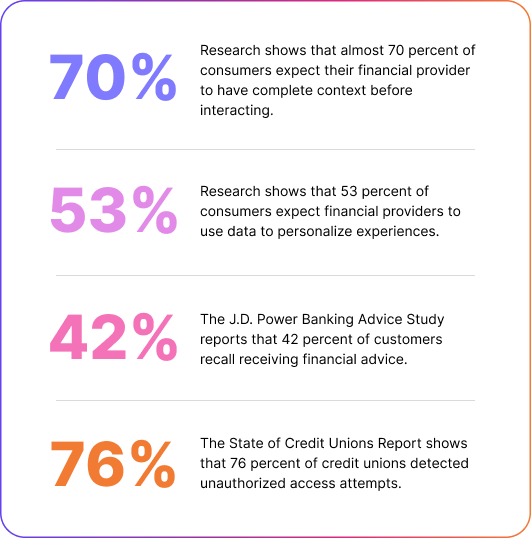
Research shows that almost 70 percent of consumers expect their financial provider to have complete context before interacting.
Effective AI roleplay takes this expectation seriously and reflects it in every scenario.
Key elements:
- Local economic cues: Scenarios incorporate regional employment patterns, cost pressures or changes in local industries.
- Demographic alignment: Personas reflect real age groups, income ranges and life stages common in the branch’s market.
- Community relevance: Scenarios connect to local culture, recurring community events or known member concerns.
- Behavioral nuance: Scenarios include realistic frustrations, confusion or emotional reactions.
These persona-driven details help staff practice conversations that feel natural, contextual and familiar.
2. Multi Channel Simulation Across Voice, Chat and Video
Members choose channels based on convenience, not what is easiest for staff. Some call. Some chat. Some prefer video.
Research shows that 53 percent of consumers expect financial providers to use data to personalize experiences, which includes channel-specific responses
AI roleplay prepares staff to deliver consistent service across all channels.
Key elements:
- Voice realism: Calls include natural pauses, background noise and emotional variability.
- Chat fluency: Staff practice writing concise, helpful and empathetic responses under time pressure.
- Video readiness: Scenarios train eye contact, tone, pacing and message clarity with visual cues.
- Cross channel consistency: Staff learn to deliver the same accuracy regardless of channel.
This enables employees to serve members confidently wherever members choose to engage.
3. High Impact Scenario Library Covering Risk and Growth
Members want more than issue resolution. They want clarity, reassurance and financial direction. The J.D. Power Banking Advice Study reports that 42 percent of customers recall receiving financial advice and 76 percent act on that advice
AI roleplay libraries must therefore support both risk management and advisory conversations.
Key elements:
- Fraud readiness: Staff practice spotting red flags and guiding anxious members through next steps.
- Digital troubleshooting: Scenarios simulate common login issues, mobile deposit concerns or app errors.
- Lending fluency: Roleplays cover auto loan discovery, HELOC questions and mortgage prequalification.
- Advisory support: Conversations include budgeting, refinancing, savings paths and credit improvement.
- Retention skill building: Scenarios reflect competitor comparisons, rate objections and hesitation moments.
A balanced scenario library prepares staff for both protection and opportunity.
4. Instant Feedback, Metrics and Learning Dashboards
Training produces meaningful results only when progress is measurable. Leaders want visibility into skill gaps and readiness levels. Research shows that institutions strong in personalization and feedback generate up to 5.3 times more trust and engagement, according to BCG Personalization and Trust Report.
AI roleplay supports continuous improvement through actionable analytics.
Key elements:
- Real time scoring: Feedback highlights strengths and weaknesses in discovery, empathy, clarity and compliance.
- Gap identification: Dashboards pinpoint skill gaps at individual and team levels.
- Progress visibility: Employees see improvements across repeated attempts and varied scenarios.
- Leader reporting: Managers access readiness analytics to direct coaching and training priorities.
These metrics turn training into an ongoing performance system instead of a one-time event.
5. Continuous Refresh and Local Relevance
Member needs shift quickly based on economic changes, new fraud patterns and local developments. Static, one-time training cannot keep up.
The State of Credit Unions Report shows that 76 percent of credit unions detected unauthorized access attempts.
This reinforces the need for continuous and locally relevant training.
Key elements:
- Quarterly scenario updates: New modules reflect emerging fraud techniques, digital trends and economic conditions.
- Local market modules: Scenarios adjust to region-specific issues such as job losses, seasonal events or natural disasters.
- Internal data integration: Real branch insights and ticket volume guide scenario creation.
- Regulatory alignment: New compliance expectations are incorporated immediately.
Continuous refresh keeps training aligned with the real world that members live in.
Blueprint for Implementing AI Roleplay in a Credit Union
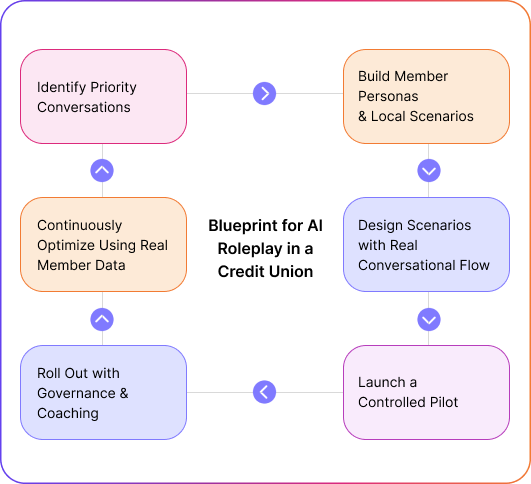
Step 1: Identify Priority Conversations That Matter Most
The strongest AI roleplay programs start with clarity. Before building scenarios, you determine which conversations have the highest impact on member experience, operational risk and growth. These are the moments where better preparedness immediately improves outcomes across the credit union.
Building blocks:
- Top interaction drivers: Prioritise the conversations your branches and contact teams handle most often.
- High risk categories: Include interactions that can trigger financial, compliance or reputational risk such as fraud alerts or escalations.
- Growth opportunities: Add lending consultations, refinancing discussions and financial guidance moments.
- Regional variations: Reflect different member patterns across urban, suburban and rural markets.
This ensures the training program focuses on conversations that matter, not generic scripts.
Step 2: Build or Import Member Personas and Local Scenarios
Once priority conversations are identified, the next step is grounding them in real member context. Credit unions serve diverse fields of membership, so scenarios must reflect those differences in tone, behavior and needs.
Building blocks:
- Member segmentation: Create personas that mirror your core member groups and their financial priorities.
- Local context: Adjust persona details by geography, local industries and cost-of-living influences.
- Emotional patterns: Capture how each persona responds under stress or uncertainty.
- Behavior cues: Include common objections, communication habits and decision-making styles.
This results in practice sessions that feel authentic to your community and membership base.
Step 3: Design First Scenarios for Real Conversational Flow
AI roleplay succeeds when scenarios reflect real-life complexity. Conversations rarely follow a single path, so scenarios must simulate branching decisions, shifting member emotions and unexpected changes in direction.
Building blocks:
- Branched dialogue: Map multiple conversational paths based on different member reactions.
- Real objections: Capture the exact language staff hear in fraud, lending or digital assistance calls.
- Emotional variation: Produce versions of the same scenario with calm, frustrated or hesitant tones.
- Clear success criteria: Define what a successful outcome looks like in terms of clarity, compliance and member confidence.
This gives staff a practical environment where they can practice improvisation safely.
Step 4: Launch a Controlled Pilot With Measurable Outcomes
Before scaling across the organisation, a controlled pilot validates the content, identifies gaps and helps shape the rollout strategy. It also gives employees early experience and builds internal momentum.
Building blocks:
- Small test group: Select a balanced group of new hires, tenured staff and supervisors.
- Clear KPIs: Define what you want the pilot to achieve, such as improved confidence or fewer escalations.
- Feedback loops: Gather structured input from both participants and leaders.
- Iteration cycles: Refine scenario tone, logic and difficulty based on real usage.
A strong pilot creates credibility and reduces friction during full deployment.
Step 5: Roll Out With Governance and Coaching Integration
Scaling AI roleplay across branches requires structure. Governance ensures consistent usage. Coaching integration turns practice insights into improved frontline behavior.
Building blocks:
- Defined practice cadence: Establish weekly or monthly roleplay expectations for all staff.
- Leader dashboards: Give managers visibility into adoption, progress and emerging patterns.
- Coaching alignment: Encourage supervisors to use roleplay results during coaching conversations.
- Quality standards: Set clear expectations around empathy, clarity, accuracy and compliance.
This ensures AI roleplay becomes a foundational development practice, not optional training.
Step 6: Continuously Optimize Scenarios Using Real Member Data
The final step is keeping the program alive. Member needs evolve. Fraud patterns change. New digital journeys are released. Economic conditions shift locally. Your roleplay library must evolve with these changes.
Building blocks:
- Data-informed updates: Use call logs, QA trends and frontline insights to refresh content.
- Seasonal variations: Add scenarios tied to seasonal events or local circumstances.
- Fraud pattern refresh: Introduce new scenarios quickly when new fraud tactics emerge.
- Continuous review: Review scenario performance and adjust difficulty or clarity regularly.
This creates a dynamic training system that grows with your credit union and its members.
Example: How the Entire Blueprint Comes Together
A mid-sized credit union begins noticing a surge in calls about digital banking issues, unfamiliar transactions and repeated card freezes. Frontline teams feel underprepared, and supervisors see more escalations and inconsistent explanations.
Leadership decides to apply the AI roleplay blueprint to strengthen confidence and improve consistency.
Step 1: Identify Priority Conversations
The team analyses call logs, QA notes and branch feedback. They discover that digital access problems and fraud-related concerns make up a large share of daily interactions. These conversations carry emotional weight and operational risk, making them the first priority for training.
Step 2: Build Member Personas and Local Scenarios
To ensure realism, the credit union creates personas based on their actual membership:
a retiree uncomfortable with mobile banking, a young professional who expects quick answers, and a small-business owner who manages multiple cards. Each persona includes local context and emotional tendencies so conversations feel authentic.
Step 3: Design Scenarios With Real Conversational Flow
The team builds scenarios inspired by daily interactions. They create multiple emotional versions of “I cannot log in to mobile banking.” They design branching paths for “I see a transaction I do not recognise.” They simulate “My card keeps getting locked,” complete with member frustration and confusion. Success criteria for clarity, empathy and next-step accuracy are defined for each scenario.
Step 4: Launch a Controlled Pilot
The credit union runs a pilot in two branches and one contact center team. Employees practice several scenarios weekly while supervisors review their responses. A pattern emerges. Staff consistently struggle with explaining fraud holds and guiding anxious members. Based on this insight, the team fine-tunes scenario language, flow and difficulty.
Step 5: Roll Out With Governance and Coaching
After refining the content, the program is deployed across all branches. A weekly practice cadence is set for all frontline employees. Managers track progress with dashboards. Supervisors incorporate roleplay outputs into coaching conversations. Expectations for clarity, empathy and accuracy become consistent across the organisation.
Step 6: Continuously Optimize Using Real Member Data
As weeks pass, the credit union updates scenarios using live insights. New fraud patterns trigger new training modules. Seasonal issues like tax-season questions or travel alerts are added. Local disruptions or community events inspire new persona updates. The library evolves as member needs change.
Measuring the Impact of AI Roleplay in a Credit Union
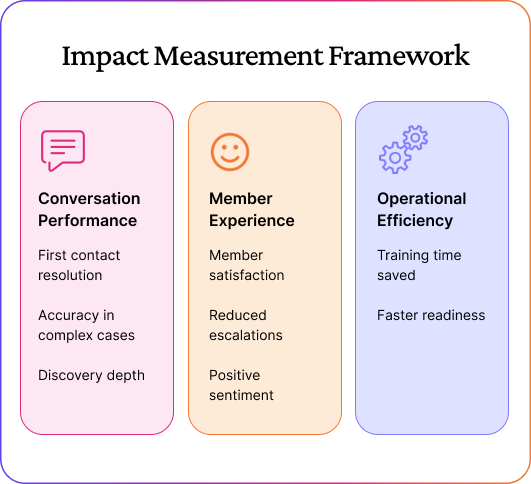
After establishing the blueprint and activating AI roleplay across branches, the next priority is proving how well the system is working. Measurement is not an afterthought. It is how an organisation determines whether practice is translating into stronger conversations, better decisions and more consistent experiences across every member touchpoint.
A robust measurement model examines improvement through three lenses: the behaviour employees demonstrate, the experience members feel and the operational gains the institution achieves. Together, these lenses provide a comprehensive view of whether AI roleplay is elevating readiness, reducing variability and driving measurable performance uplift.
Conversation Performance Metrics for Frontline Excellence
This category evaluates whether employees are executing conversations with more clarity, structure and confidence. It focuses on the behavioural indicators that define strong interactions in high-stakes environments.
Building blocks:
- First contact resolution: Assesses staff’s ability to close out issues in a single interaction by diagnosing correctly, explaining clearly and guiding the member effectively.
- Accuracy in complex cases: Measures the precision of communication in sensitive scenarios such as fraud alerts, disputes, identity checks and multi-step lending conversations.
- Discovery depth: Evaluates how thoroughly employees uncover needs, clarify intent and identify the right pathway for the member.
Performance signal:
These metrics demonstrate whether training is creating more capable, more self-reliant frontline teams who can navigate complexity without unnecessary escalation.
Member Experience Metrics Across Channels and Regions
These metrics reveal how improved employee capability affects the emotional and experiential quality of member interactions. They reflect the outcomes members perceive, not just the actions employees take.
Building blocks:
- Member satisfaction: Captures the clarity, reassurance and overall experience members feel during and after interactions.
- Reduced escalations: Monitors decreases in supervisor handoffs, callbacks and repeated explanations, indicating stronger frontline autonomy.
- Positive sentiment: Measures the tone, confidence and emotional trajectory of conversations across voice, chat and in-branch channels.
Experience indicator:
Movement in these metrics shows whether conversations feel smoother, more supportive and more consistent across locations and member segments.
Operational Efficiency Metrics for Training and Readiness
This category assesses the organisational lift created by AI roleplay. It evaluates how training time, coaching load and readiness cycles improve when frontline practice becomes continuous and data-driven.
Building blocks:
- Training time saved: Quantifies the reduction in manual shadowing, ad-hoc coaching sessions and in-person practice required to reach competence.
- Faster readiness: Measures how quickly new hires or transitioning staff reach confident, consistent performance in live conversations.
Operational insight:
Improvements here signal that the training model is scaling efficiently, reducing friction and enabling teams to stay prepared without increasing resource demand.
How Outdoo AI’s AI Roleplay Solution Helps Credit Unions
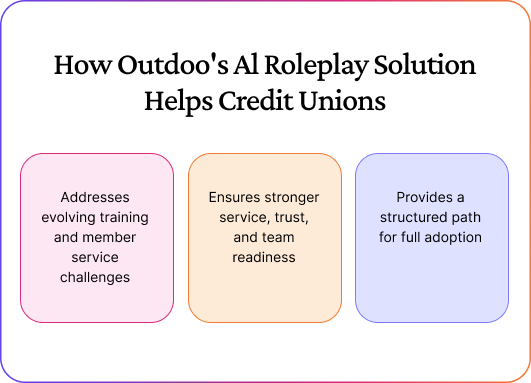
As teams begin to measure improvements in performance, experience and operational efficiency, the next question is how to scale those gains reliably across every branch. This is where Outdoo’s AI roleplay solution becomes a practical and strategic fit.
It strengthens the areas where traditional training struggles the most: consistency, realism and the ability to develop skills at the pace member expectations evolve.
Many organisations still rely on methods that depend heavily on manual coaching, uneven shadowing and limited practice time. These approaches create gaps that become visible during real interactions.
Some employees learn quickly, while others struggle with confidence or complexity. Some branches deliver predictable experiences, while others vary significantly. Outdoo addresses these challenges by giving every employee the same access to high quality, repeatable practice.
It also reduces the pressure of preparing teams for emotionally charged or high risk situations. Instead of waiting for these moments to happen live, employees can rehearse them repeatedly in a controlled environment that mirrors the tone, questions, confusion and urgency they face each day. This creates a steadier, more resilient frontline across the credit union.
Here's How Outdoo creates meaningful impact for credit unions:
- Realistic community driven scenarios: Outdoo adapts scenarios to actual member behaviours, local economic conditions and branch specific service patterns.
- Stronger fraud and risk preparedness: Teams rehearse fraud alerts, suspicious activity and dispute conversations until responses become clear and confident.
- Fluency in digital support: Staff practice mobile banking challenges, login issues and troubleshooting flows before facing them with real members.
- Better lending and advisory conversations: Outdoo strengthens discovery, qualification and objection handling for conversations involving auto loans, HELOCs and mortgages.
- Confidence in emotional situations: Employees learn to navigate conversations with stressed, confused or anxious members while maintaining clarity and calm.
- Faster onboarding and skill acceleration: New hires reach readiness faster because they practice high impact scenarios from day one without relying on inconsistent shadowing.
- Continuous evolution of content: Scenarios update automatically as new fraud patterns emerge, digital features change or local community conditions shift.
Wrapping Up: A Safer Path to Member-Ready Teams
AI roleplay gives credit unions a practical way to prepare teams for the conversations that influence trust and outcomes. It turns practice into a routine discipline and makes readiness easier to maintain across branches, roles and channels.
The steps are simple. Start with priority conversations. Test with a pilot. Build structure. Keep scenarios current. When done well, teams become more consistent and members get clearer, faster and more confident support.
Outdoo makes this easier.
It delivers realistic scenarios, on-demand practice and measurable improvement in one place so teams stay prepared without adding training overhead.
If your credit union wants a straightforward path to stronger conversations and more reliable readiness, Outdoo is built for that.
Frequently Asked Questions
.svg)
AI roleplay training allows frontline staff to practice real member conversations with AI-powered virtual personas. These simulations reflect fraud alerts, lending discussions, digital banking issues and emotional escalations. It helps employees build clarity, empathy and compliance accuracy before speaking to real members.
Member expectations have increased, with faster support, seamless digital experiences and personalized guidance becoming standard. At the same time, fraud cases and complex multi-step conversations are rising. AI roleplay prepares teams for these high-pressure interactions through structured, repeatable practice.
It standardizes training by giving every employee access to the same high-quality scenarios and feedback loops. Branches no longer depend solely on local shadowing or coaching quality. This creates a uniform service baseline across metro, suburban and rural markets.
Leaders should monitor first contact resolution, accuracy in complex cases and discovery depth during conversations. Member satisfaction, reduced escalations and faster readiness for new hires also indicate performance improvement. These metrics show whether training is translating into real frontline capability.
Outdoo provides realistic AI roleplays and coaching simulations tailored to fraud, digital support and lending conversations. Teams receive instant feedback, readiness insights and measurable progress tracking across branches. This helps credit unions scale consistent, member-ready performance without increasing training overhead.
Table of Contents
Talk to Sales
Have questions about training and enablement for your sales, CS, support, or leadership team? Let's talk.
Talk to Sales