



Sales Enablement Directors keep running into the same wall. Coaching is the highest-leverage variable in sales performance, but scaling it has stayed structurally hard for a decade. The standard playbook (more one-on-ones, better manager training, longer onboarding) has hit a ceiling.
AI roleplay for Sales Enablement Directors changes what is possible, and the question now is less whether to deploy it than how to operationalize it for consistency at scale across a growing, distributed team.
This guide covers what the coaching consistency problem actually looks like in 2026, what AI roleplay solves for a Director specifically, how to deploy it without the usual rollout pitfalls, and how to measure ROI in a way the CRO will accept.
What Is AI Roleplay for Sales Enablement?
AI roleplay for sales enablement is practice where reps run realistic conversations with AI buyers and every session is scored against the same methodology rubric, so enablement teams can coach every rep to one standard without adding manager hours.
The coaching consistency problem Sales Enablement Directors actually face
The data on sales coaching in 2026 is unusually clear. Teams coached weekly hit quota 76% of the time, teams coached monthly hit 56%, and teams coached quarterly or less hit 47%, according to the MySalesCoach State of Sales Coaching 2026 study of 3,700 sales professionals.
That is a 29-point quota gap driven by coaching frequency alone. The same study found that 38% of reps are rarely or never coached, and 45% rate the coaching they do receive as below average, up sharply from 29% the year before.
The perception problem is widening at the same time. 64% of sales leaders believe they spend more time coaching than they did 12 months ago, per MySalesCoach 2026, while their reps simultaneously rate the quality as worse. This is not a misunderstanding. It is a structural execution failure. Managers are doing more activity that looks like coaching (pipeline reviews, one-on-ones, deal inspections) without producing the behavioral feedback reps need.
McKinsey research consistently places the share of manager time available for value-add coaching at 10 to 40%, with the rest absorbed by administrative work, meetings, and reporting. Salesforce State of Sales 2024 found that reps themselves spend less than 30% of their workweek actively selling.
When the manager-to-rep coaching equation is (Manager Time) divided by (Number of Reps multiplied by Coaching Needs), the result is mathematically doomed.
The diagnosis for Sales Enablement Directors is not that managers are not trying. It is that the operating model itself is broken. Adding more one-on-ones to a manager already at capacity does not produce more coaching, it produces more checked boxes. Scaling coaching consistency requires a new layer, not more effort from the same constrained layer.
What AI roleplay actually solves for Sales Enablement Directors
AI roleplay solves the consistency problem by changing where coaching scoring happens and who applies it. Five concrete things it delivers:
1. One scoring standard across every rep, manager, and region
When AI evaluates every roleplay against the same methodology rubric, manager variability stops being a hidden source of inconsistent feedback.
A rep in Frankfurt and a rep in Austin both get scored against the same MEDDIC criteria, by the same rubric, regardless of who manages them. CSO Insights data shows formal coaching processes lift quota attainment by 6.5 points over informal processes. Consistent AI scoring is the practical mechanism that makes formal coaching scalable.
2. Manager bandwidth recovered for the conversations that matter
AI roleplay does not replace the coaching conversation, it replaces the evaluation work that consumes most of it. Instead of a manager reviewing five hours of practice recordings per week to produce one hour of coaching, the manager reviews AI-scored output and spends the recovered time on the actual development conversation.
With only 10 to 40% of manager time available for value-add coaching per McKinsey, recovering even 20% of that bandwidth is material.
3. Behavioral data the Director can take to the CRO
Outdoo AI's 2026 AI Roleplay and Customer-Facing Readiness Report, drawn from analysis of 15,000+ simulated customer-facing conversations across sales, customer success, support, and field engagement roles, found that organizations using AI-assisted coaching report 29% higher revenue growth compared with peers that do not adopt AI in their training and readiness systems.
The reason is data. Practice scores plus live call scores against the same rubric reveal exactly where methodology adoption is breaking down by team, region, or tenure cohort. The Director walks into the CRO conversation with variance data, not opinions.
4. The practice-to-performance loop closed in one rubric
Most enablement programs measure practice and live performance separately. AI roleplay platforms with conversation intelligence ingestion (from Gong, Clari, or native conversation intelligence) score live customer calls against the same scorecard used in practice.
Outdoo AI's 2026 readiness research found organizations with AI-enabled coaching achieve 83% revenue growth compared with 66% in organizations that do not adopt AI coaching systems, a 17-point gap directly tied to consistent practice and measurable behavioral feedback. The mechanism is the closed loop: practice, validate, reinforce.
5. Defensible ROI measurement
Sales Management Association research showed effective coaches produce teams with 19% higher year-over-year revenue growth. CSO Insights' 2018 longitudinal work found effective enablement coaching lifted quota attainment by 10.6 points and win rates by 6.6 points. The Director can now connect AI roleplay deployment directly to these benchmarks, with cohort comparisons and methodology adherence data the org has never had before.
The thesis is not that AI roleplay replaces human coaching. It is that AI roleplay handles the evaluation layer at scale, so human coaching can do the part only humans do: the conversation, the challenge, the judgment.
How to deploy AI roleplay for sales enablement without the usual pitfalls
Deploying AI roleplay for sales enablement at scale is a different exercise from deploying a content platform or an LMS. The mistakes tend to repeat. Here is the operational sequence, with the pitfall each step protects against.
Step 1: Audit the current coaching baseline
Before deploying anything, document what coaching actually looks like today. How frequently are reps coached, by whom, against what standard, with what measurable outcome? Use MySalesCoach 2026 benchmarks as a comparison anchor.
Pitfall: skipping this step and treating AI roleplay as the solution to an undefined problem. Without a baseline, the ROI conversation 90 days later becomes vibes.
Step 2: Define the methodology rubric the program will enforce
SPIN, BANT, MEDDIC, MEDDPICC, Challenger, or a custom framework. The rubric is the contract that every AI evaluation runs against.
Pitfall: choosing a methodology rubric the team does not actually use. The rubric needs to mirror what reps run in real deals, not the framework the Director wishes they ran.
Step 3: Design scenarios that mirror real customer conversations
Discovery, demo, objection handling, multi-stakeholder buying committees, post-call workflow. Build scenarios from actual call data, not generic templates.
Pitfall: using only pre-built scenarios. Reps recognize generic prospects in the first two minutes, and engagement collapses.
Step 4: Pilot with one team before scaling org-wide
Choose a team with engaged managers who will give honest feedback. Learn the change-management cost on that team before expanding.
Pitfall: rolling out to the entire sales org at launch. Change management overload kills adoption faster than tool quality ever does.
Step 5: Integrate practice into onboarding from day one
New hires should hit AI roleplay scenarios in the first week, not the third month. Ramp time data is one of the cleanest signals the Director will get.
Pitfall: letting AI roleplay sit as an optional add-on for tenured reps while new hires get the legacy onboarding path. Onboarding is the highest-leverage place to install the new model.
Step 6: Connect practice scores to live call scores on the same rubric
Practice scores alone tell you what reps can do in safe conditions. Live call scores tell you what they actually do. The practice-to-performance loop is what makes AI roleplay defensible to the CRO.
Pitfall: deploying AI roleplay without the conversation intelligence ingestion layer. The result is more practice data and no validation, which is just a more efficient simulation, not a coaching system.
Step 7: Configure performance-driven routing back to learning content
When a rep fails a methodology criterion in a real call, the system should assign reinforcement automatically: a targeted micro-roleplay, a specific module via the Outdoo AI integration with Docebo or TalentLMS, or a battle card.
Pitfall: generating data the org never acts on. Reinforcement automation is what turns AI roleplay from a measurement tool into a coaching system.
Step 8: Build the Director's reporting dashboard for the CRO conversation
Methodology adherence by team and region, ramp time delta versus the prior cohort, win rate by tenure, manager span ratios, coaching frequency normalized across managers.
Pitfall: measuring activity instead of outcomes. Number of roleplays completed is a vanity metric. Methodology adherence improvement is the real KPI.
How Outdoo AI delivers consistent coaching at scale, and how to measure the ROI
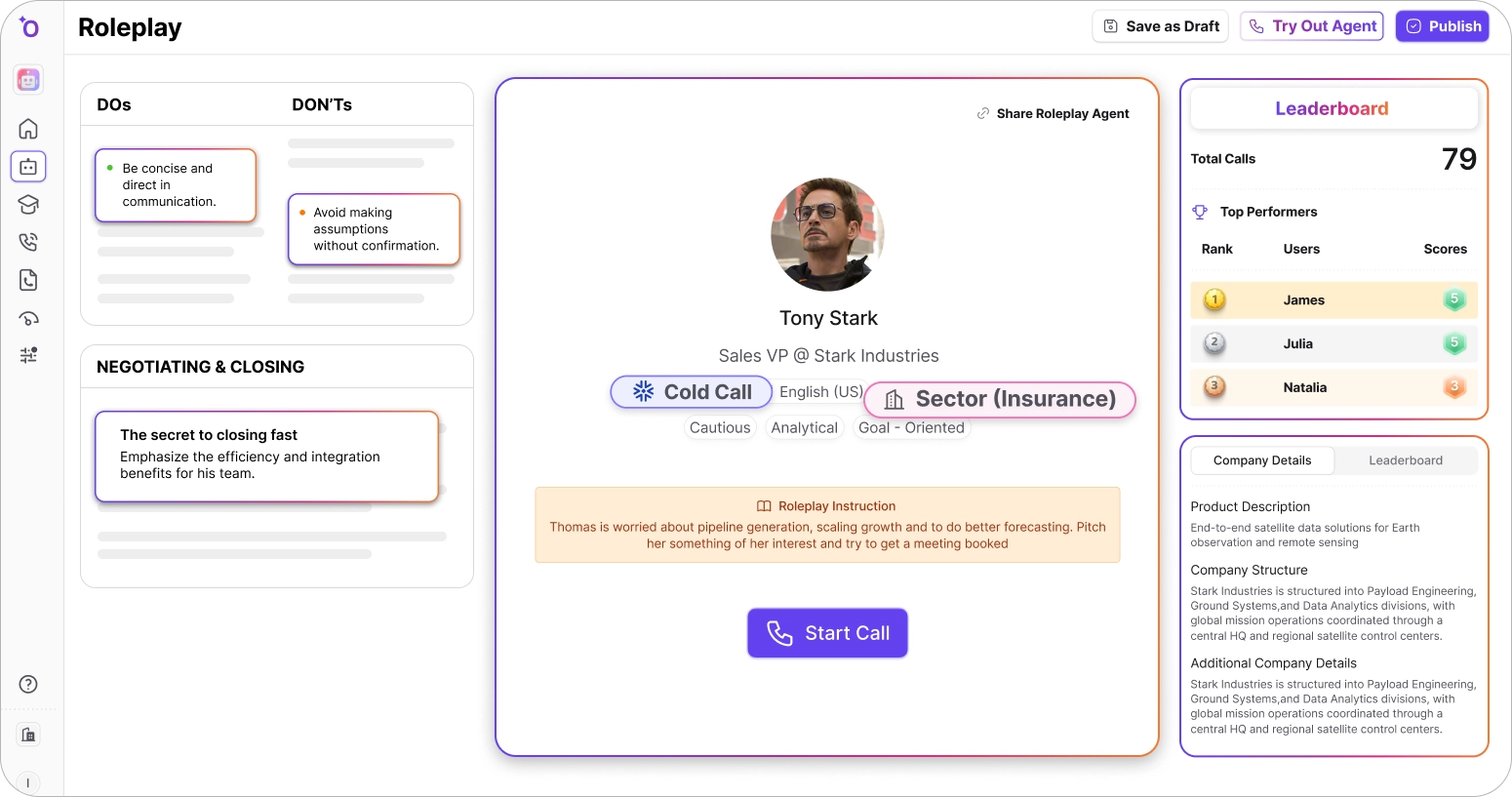
Outdoo AI is an enterprise AI roleplay and coaching solution built for the exact job a Sales Enablement Director is hired to do: scale coaching consistency across a team that has outgrown what manager bandwidth can deliver on its own. Three concrete capabilities map to the Director's three concrete needs.
One consistent scoring standard across every rep, region, and manager
Outdoo AI ships with methodology-aligned scorecards for SPIN, BANT, MEDDIC, MEDDPICC, and Challenger, plus custom rubrics built from internal governance documents. Every rep is evaluated against the same criteria, regardless of which manager owns the rep or which region they sell into. Manager variability stops being a hidden source of inconsistent feedback.
Practice and live call performance on the same rubric
Outdoo AI ingests from Gong, Clari, and native conversation intelligence to score real customer calls against the methodology used in practice. The closed loop is the point. Practice score plus live call score on the same rubric is the only way to validate whether training actually changes behavior in front of customers, which is the question the Director ultimately gets asked.
Behavioral data the Director can take to the CRO
Outdoo AI's revenue outcome correlation connects roleplay scores, live call scores, and pipeline data to surface which specific behaviors correlate with won deals.
Combined with methodology adherence variance by region and tenure cohort, the Director walks into the CRO conversation with data the organization has never had before.
Across 40 customer organizations analyzed in Outdoo AI's 2026 AI Roleplay and Customer-Facing Readiness Report, structured AI roleplay deployment delivered ramp time reduction from 6.5 months to 4.3 months (34% faster), coaching bandwidth recovery from 12 to 6 hours per manager per week (50% reduction), confidence score uplift from 62% to 88% (+26 points), and win rate improvement from 22% to 30% (+36%).
- Multi-persona simulations with up to three AI stakeholders in a single resumable scenario: CFO, champion, procurement, or any combination.
- Three modes including chat for objection drills, voice for phone motion, and video with screen sharing for demos.
- Dynamic micro-roleplays automatically generated when scoring identifies a coaching opportunity.
- Post-call workflow simulation covering CRM logging and dispositioning in environments that mirror actual Salesforce, HubSpot, or Pipedrive instances.
- 74+ supported languages for global teams. 120+ enterprise integrations across CRM, conversation intelligence, and LMS platforms including Docebo, TalentLMS, and Cornerstone.
- Enterprise compliance including SOC 2 Type 2, GDPR, HIPAA, CCPA, PII scrubbing, and private cloud for regulated procurement.
How to measure the ROI Outdoo AI produces
Six metrics the Director should track from day one, all comparable against industry benchmarks:
- Ramp time delta for new hires: New hires going through Outdoo AI structured roleplay versus the prior cohort. Target range based on customer data is 20 to 40% reduction in time to first quota attainment.
- Methodology adherence variance across regions and managers: When scoring is consistent, variance shrinks materially. The variance reduction itself is the data, and it is visible inside 90 days.
- Quota attainment by coaching frequency cohort: AI roleplay effectively raises coaching frequency for every rep. Compare against the MySalesCoach 2026 benchmark of 76% weekly versus 47% quarterly attainment.
- Win rate parity across managers and tenure cohorts: When the rubric is consistent, manager-driven win rate variance drops. The Director sees which managers are coaching effectively and which need support.
- Manager time recovered: Hours per week managers spend on AI-scored session review versus the prior practice review workload. Direct calculation against the McKinsey 10 to 40% bandwidth baseline.
- Coaching perception gap closure: Track rep-reported coaching quality (MySalesCoach 2026 found 45% rate it below average) before and 90 days after Outdoo AI deployment.
What the Director should expect at the 30, 60, and 90 day horizons: 30 days produces a baseline of consistent scoring data and the first cohort of new hires running structured practice; 60 days surfaces methodology adherence variance shrinking and the first ramp time signals; 90 days delivers defensible data for the CRO conversation, including ramp time delta, methodology adherence improvements, and early indicators on win rate by cohort.
Schedule a demo and walk through the deployment with our team to see how Outdoo AI fits your methodology, scale, and reporting needs.
Frequently Asked Questions
.svg)
AI roleplay evaluates every rep against the same sales methodology rubric, such as SPIN, BANT, MEDDIC, MEDDPICC, or Challenger. This helps Sales Enablement Directors reduce manager-by-manager variation and create a more consistent coaching standard across teams.
The coaching consistency problem is that reps often receive different feedback depending on their manager, region, or tenure. This makes it harder to enforce one sales methodology across the organization and harder to compare rep performance fairly.
Sales Enablement Directors can measure ROI through ramp time, methodology adherence, live call improvement, manager coaching time saved, and win rate movement. The clearest signal is whether reps improve in real customer conversations, not just in practice sessions.
No. AI roleplay handles repeatable practice, scoring, and feedback. Managers still own the coaching conversation, deal context, judgment, and rep development.
Outdoo AI helps Sales Enablement Directors turn AI roleplay into a repeatable coaching system. It connects practice scenarios, live call scoring, methodology rubrics, and targeted reinforcement so reps know exactly what to improve next.
Table of Contents
Talk to Sales
Have questions about training and enablement for your sales, CS, support, or leadership team? Let's talk.
Talk to Sales