




Sales managers do not need to listen to every call to understand where reps need help. They need a reliable way to see which skills are slipping, which problems keep repeating, and whether coaching changes what happens in the next customer conversation.
Manual call reviews provide only a small sample of that information. A manager can spend hours listening to recordings and still miss the patterns affecting the rest of the team.
A more scalable coaching system has three parts:
- Score every call against the same coaching standard
- Use the results to identify the calls and skills that deserve attention
- Turn recurring gaps into targeted practice before the rep returns to another live conversation
AI call scoring handles the diagnosis. AI roleplay gives reps a place to practise. The manager can then spend time making coaching decisions instead of searching through recordings.
This guide explains how to build that workflow, what to include in the scorecard, which calls still deserve a personal listen, and how to run a focused coaching week in about two hours.
What Is AI Call Scoring?
AI call scoring is the use of AI to evaluate every sales conversation against the same scorecard your team defines, so managers can see which skills are slipping across all calls instead of guessing from a small sample of recordings.
Why listening to every sales call does not scale
Consider a manager with eight reps, each completing five customer calls a day. That creates 40 calls a day and roughly 200 calls a week.
Listening to every call is clearly impossible. But even reviewing 10 percent of them creates a significant workload. At 30 minutes per call, including note-taking, the manager spends around 10 hours a week reviewing recordings before any coaching conversation takes place.
The usual response is to sample a few calls. The manager chooses a recent recording, listens to it, and coaches the rep based on what happened during that conversation.
The problem is that one call may not represent the rep’s normal behaviour. A weak call could be an exception, while a recurring issue across 20 other calls remains unnoticed. The call the manager happens to hear becomes the basis for coaching even when the broader pattern says something different.
Manual review also leaves managers spending most of their time diagnosing problems. Listening may reveal that a rep struggled with discovery or objection handling, but it does not give the rep a safe place to practise the skill before the next customer call.
The goal should not be to hear more calls. It should be to identify the right coaching opportunity faster and give the rep a practical way to improve.
Step one: score every call against the same coaching standard
AI call scoring evaluates every conversation against a scorecard defined by your team. Each call is assessed using the same criteria, whether the focus is discovery, objection handling, methodology adherence, next-step clarity, or compliance.
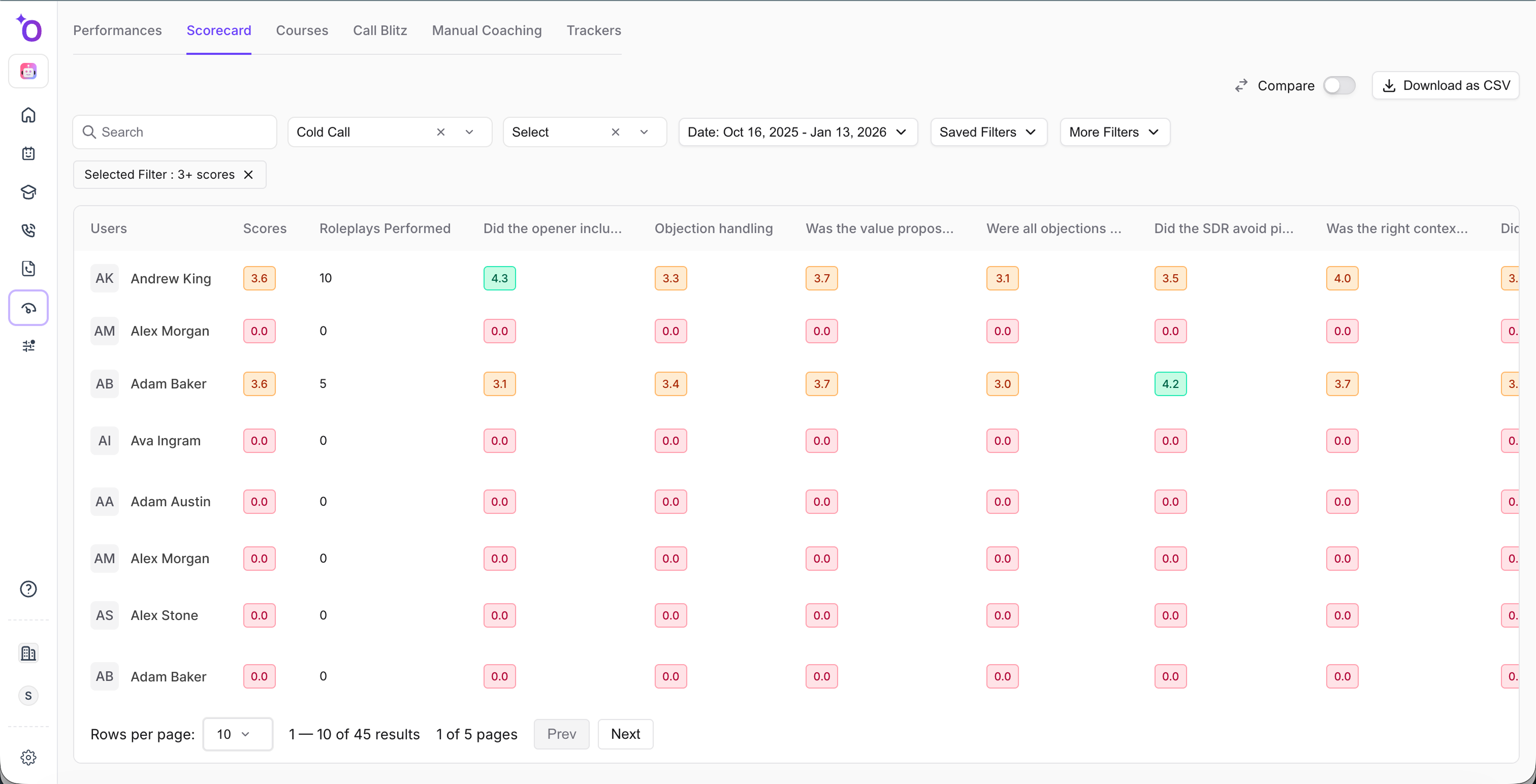
Instead of opening recordings and hoping to find something coachable, managers begin with a view of the patterns across the team. A useful dashboard should show:
- Which skills are improving or declining
- Which reps repeatedly struggle with the same behaviour
- Which calls received unusually low scores and why
- Where the same gap appears across the wider team
- Where call outcomes do not match the score
This changes call review from a manual search into a prioritisation exercise. The manager is no longer asking, “Which recording should I listen to?” The system has already identified the reps, calls, and moments most likely to require attention.
The benefit is not only speed. It also makes coaching more consistent. Every rep is evaluated against the same expectations rather than the personal preferences of whichever manager reviewed the call.
One Outdoo AI customer described the difference simply: “With Outdoo, 100% of our calls are now scored and reviewed.” The same team reduced training time by 33% because feedback was based on consistent patterns rather than isolated examples.
AI scoring should not replace manager judgement. It should direct that judgement towards the situations where it will have the most impact.
What should an AI call scorecard measure?
The quality of the coaching depends heavily on the quality of the scorecard. Broad criteria such as “good communication” or “strong discovery” produce scores that are difficult to explain and even harder to act on. A scorecard with dozens of criteria creates the opposite problem: too much information and no clear coaching priority.
A practical call scorecard should focus on the observable behaviours that matter most to the conversation. A strong starting set includes:
- Discovery depth: Did the rep uncover the customer’s actual problem, impact, urgency, and desired outcome, or stop after surface-level qualification questions?
- Question quality: Did the rep ask relevant follow-up questions based on the customer’s answers, or simply move through a prepared list?
- Objection handling: Did the rep acknowledge the concern, explore the reason behind it, and respond with relevant information?
- Talk-to-listen balance: Did the rep create enough space for the customer to explain their situation, or dominate the conversation?
- Value articulation: Did the rep connect the product’s value to the customer’s specific problem instead of delivering a generic pitch?
- Next-step clarity: Did the conversation end with a specific action, owner, and timeline?
- Methodology adherence: Did the rep apply the behaviours required by MEDDIC, MEDDPICC, SPIN, BANT, Challenger, or your custom sales process?
- Compliance requirements: Did the rep include required disclosures, verification questions, or must-say statements?
Make every criterion coachable
Each criterion should tell both the manager and the rep exactly what was expected. Define what the rep needs to do, what evidence should appear in the conversation, and what weak, acceptable, and strong performance look like.
For example, do not define discovery depth as simply “understands the customer’s needs.” A more useful definition is:
The rep identifies the customer’s current challenge, explores its business impact, and confirms why solving it is a priority now.
That definition gives the scoring system something observable to evaluate and gives the rep something specific to improve.
Which sales calls should managers still review personally?
AI scoring does not mean managers should stop listening to calls. It means they can stop selecting calls at random. Three types of conversations still deserve direct attention.
1. A new hire’s first customer calls
Scores can show whether required behaviours occurred, but early calls also reveal tone, confidence, pacing, and how comfortably the rep handles pressure. Listening to a few early conversations helps managers correct habits before they become established.
2. Calls connected to important deals
Some conversations deserve a review because of their commercial importance, regardless of the score. This includes strategic accounts, late-stage opportunities, renewals at risk, and conversations involving multiple stakeholders.
3. Calls where the score and outcome disagree
A high-scoring call that still resulted in a lost opportunity is especially valuable. The rep may have followed the expected process while missing something the current scorecard does not measure. These calls help managers improve both the coaching and the scorecard itself.
That leaves a manager with three to five focused listens per week instead of dozens of random reviews. For every other conversation, the manager can go directly to the flagged moment, transcript section, or score that requires attention.
Questions to ask during those reviews:
- Does the score accurately reflect what happened?
- Is the issue specific to this rep or common across the team?
- Is the current scorecard missing an important behaviour?
- What single skill would make the greatest difference on the rep’s next call?
Step two: turn every coaching gap into targeted practice
Identifying a skill gap is only the first half of coaching. The rep also needs a safe place to practise the behaviour before trying it again with a real customer.
The usual approach is to mention the problem during a 1:1: “Ask better discovery questions,” “Do not become defensive when the buyer objects,” or “Make sure you confirm the next step.”
The advice may be correct, but it does not give the rep an opportunity to apply it. Their next attempt often happens during another live sales call, where the cost of getting it wrong is much higher.
AI roleplay creates that missing practice step. When call scoring reveals a repeated gap, the manager can assign a scenario designed around that exact skill.
For example, imagine a rep repeatedly receives a low discovery-depth score. The rep asks basic questions but moves to the pitch before understanding the business impact. The manager can assign a roleplay in which:
- The AI roleplay agent initially provides only a vague problem
- Important information appears only after relevant follow-up questions
- The rep must explore impact, urgency, and consequences
- The scorecard evaluates those exact discovery behaviours
The rep can repeat the conversation, review the feedback, and improve before speaking to another prospect.
The coaching loop then becomes:
- A recurring gap appears across real calls.
- The manager assigns a roleplay focused on that behaviour.
- The rep practises and receives immediate feedback.
- The manager reviews the roleplay performance during the next coaching session.
- Future customer calls show whether the improvement carried over.
Build the roleplay scorecard around the skill being coached
A targeted roleplay also needs a targeted scorecard. A generic overall score does not tell the rep what they did well or what they need to change.
For a discovery roleplay, the scorecard might evaluate whether the rep:
- Asked relevant follow-up questions
- Identified the buyer’s underlying problem
- Explored the business impact
- Confirmed urgency and priority
- Summarised the buyer’s needs accurately
An objection-handling roleplay would use different criteria, such as whether the rep acknowledged the concern, explored what was behind it, responded with relevant information, and confirmed that the objection had been addressed.
Outdoo AI lets managers choose a pre-built roleplay scorecard or create a custom one for their own sales process. Teams can edit the objectives and scoring criteria so the feedback reflects the specific skill, methodology, customer type, or scenario being practised. Keeping the scorecard focused on 5–10 clearly defined behaviours makes the resulting feedback easier to understand and act on.
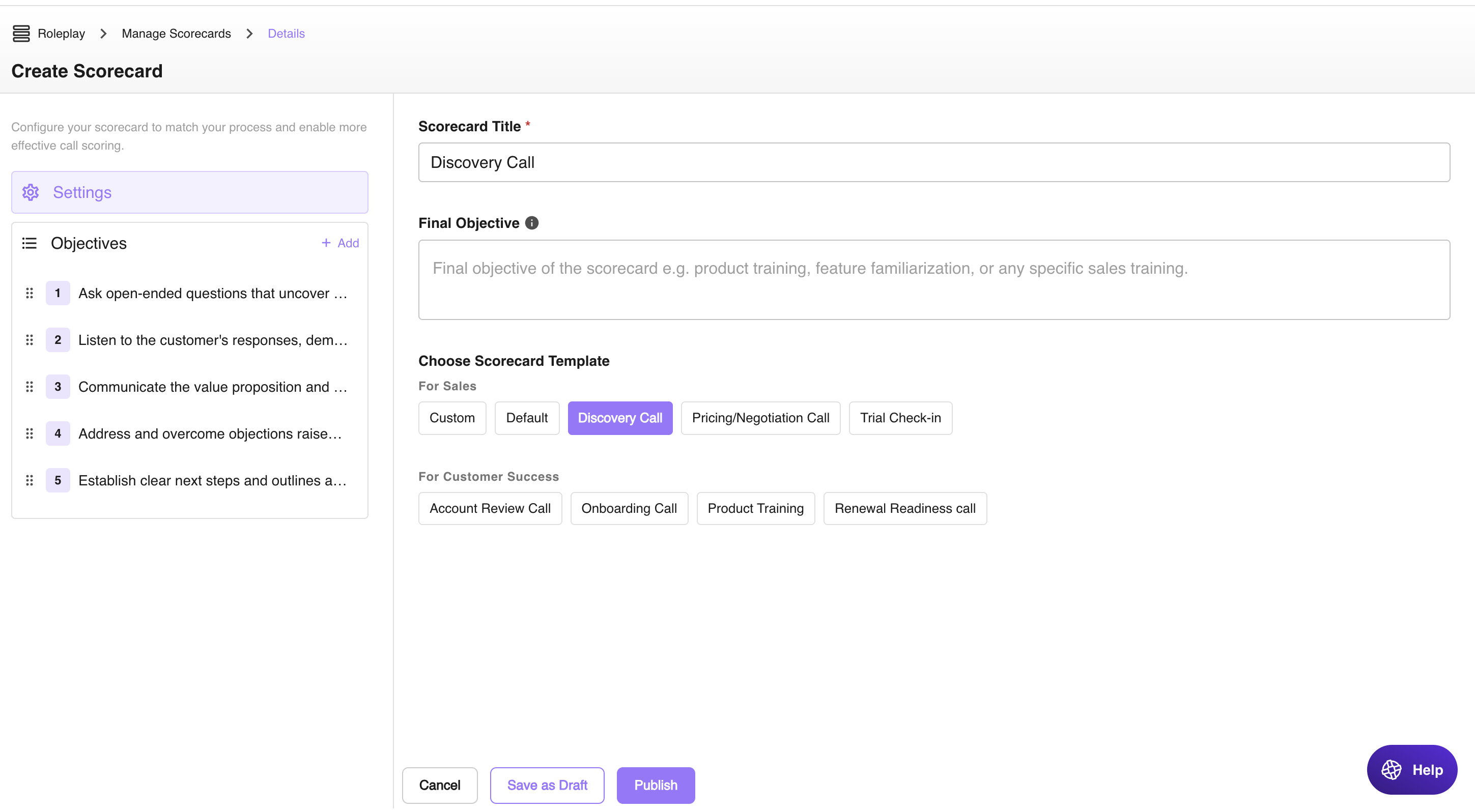
Outdoo AI allows managers to start with a scorecard template or create custom objectives based on the skill and sales scenario being practised.
Managers can update the criteria as coaching priorities, messaging, or methodology change. This makes it possible to use one scorecard for discovery practice, another for objection handling, and a different one for certification or compliance scenarios.
Read the step-by-step guide: How to create a scorecard for an Outdoo AI roleplay agent.
What does a realistic two-hour coaching week look like?
Once every call is scored and reps can practise independently, a manager no longer needs to spend most of the week reviewing recordings. A practical weekly rhythm can look like this:
1. Monday: identify the patterns - 20 minutes
Open the team dashboard and identify the two or three lowest-scoring skills, reps with repeated gaps, any sudden decline from the previous week, and calls where the score and outcome do not align.
Do not create a long list of coaching topics. Choose the one behaviour that matters most for each rep.
2. Tuesday: review the calls that matter - 30 minutes
Listen to three to five selected calls: early calls from new hires, conversations involving important opportunities, and calls with unusual scores or outcomes. Go directly to the relevant sections instead of listening to every recording from beginning to end.
3. Wednesday: assign targeted practice - 20 minutes
Assign one focused roleplay to each rep who needs support. The scenario should reproduce the situation causing the problem. A pricing-objection gap should lead to pricing-objection practice. A weak discovery score should lead to a scenario that requires deeper questioning.
4. Thursday: review roleplay performance - 15 minutes
Check whether reps completed the assigned roleplays and review their scores, feedback, and repeated mistakes. Look for whether the targeted skill improved across attempts and note anything that should be discussed during the 1:1.
5. Friday: hold focused coaching conversations - 35 minutes
Use short 1:1s to review the pattern across the rep’s real calls, performance in the assigned roleplay, whether the skill improved, and what the rep should focus on next week.
Begin with the pattern, not a single anecdote. “Your talk ratio was above 70% across 12 discovery calls” gives the rep a much clearer picture than “I heard one call where you talked too much.”
The week totals approximately two hours. Most of that time is spent deciding what the rep should do next rather than searching for evidence that a problem exists.
How does Outdoo AI connect call scoring with sales coaching?
Outdoo AI brings the key parts of the coaching workflow together: identifying a skill gap, giving the rep a place to practise it, and checking whether the behaviour improves in real conversations.
1. Identify patterns across real calls
Managers can evaluate customer conversations against their sales methodology and coaching criteria, then review patterns across reps, calls, skills, and time periods without listening to every recording.
2. Create targeted practice from real situations
Teams can turn their own calls, transcripts, documents, or prompts into AI roleplay agents. This allows a recurring objection, difficult buyer type, or weak discovery moment to become a repeatable practice scenario rather than a one-time coaching comment.
3. Evaluate practice against your standard
Roleplay scorecards can be aligned with the team’s methodology and the specific skill being practised. Managers can see whether the rep improved on the assigned behaviour instead of relying on completion alone.
4. Check whether the skill appears in later calls
The most useful measure of coaching is not whether the rep completed a roleplay. It is whether the rep used the skill in the next real conversation. Comparing practice performance with subsequent call performance helps managers see whether the coaching carried over.
Outdoo AI also extends training beyond the conversation itself:
- AI Trainers use playbooks, product documents, and learning material to test whether reps can explain and apply what they learned.
- Workflow simulation lets reps practise post-call tasks such as CRM logging, dispositions, and data entry in environments that reflect the systems they use.
- Courses and certifications give managers a structured way to confirm readiness before reps handle important customer situations.
This creates a closed coaching loop: real calls reveal the gap, roleplay gives the rep a place to improve, and later call performance shows whether the improvement lasted.
Coach more effectively by listening more selectively
Listening to every sales call was never the real goal. The goal is to know where each rep needs help, provide a clear way to practise, and confirm that coaching improves future customer conversations.
AI call scoring gives managers visibility across every call instead of a small sample. A well-designed scorecard turns that visibility into specific coaching priorities. AI roleplay then gives reps a safe place to practise those behaviours before trying them again with a real prospect.
Managers still listen to calls, but they listen with a purpose: to support a new hire, review a critical opportunity, investigate a score mismatch, or improve the coaching standard.
The result is not less coaching. It is more focused coaching, delivered to more reps, using evidence from both practice and real conversations.
To see how this workflow would operate with your own calls, scorecards, and coaching process, schedule a demo with Outdoo AI.
Frequently Asked Questions
.svg)
Use AI call scoring to evaluate every conversation against a defined scorecard. Managers can review recurring skill patterns and flagged moments, listen only to the calls that need judgement, and assign targeted roleplay practice for the gaps they find.
It should measure observable behaviours the team actively coaches, such as discovery depth, question quality, objection handling, talk-to-listen balance, value articulation, next-step clarity, methodology adherence, and required compliance statements.
Prioritise a new hire’s first calls, conversations connected to important deals, and calls where the score and outcome disagree. These focused reviews help managers assess tone, support strategic opportunities, and improve the scorecard when it misses something.
When call scoring reveals a recurring skill gap, the manager can assign a roleplay designed around that behaviour. The rep practises, receives feedback against a targeted scorecard, and later calls show whether the skill carried over into real conversations.
A manager can run the workflow in about two hours a week: 20 minutes reviewing team patterns, 30 minutes listening to selected calls, 20 minutes assigning targeted practice, and around 50 minutes conducting focused coaching conversations.
Table of Contents
Talk to Sales
Have questions about training and enablement for your sales, CS, support, or leadership team? Let's talk.
Talk to Sales