




Open any guide on sales enablement ROI and you will find the same opening move: a formula, a measurement framework, and a headline average. Our program lifted team win rate by three points. Average ramp dropped by a few weeks. It sounds like progress, and it is the weakest possible way to make the case, because the average is the one number in the entire report most likely to be lying to you.
Here is what the average hides. On a typical sales team, a small group of top reps generates most of the revenue, while a long tail of average and weaker reps sits well below them. The gap between the best and the worst is not small. Across sales organizations, top reps routinely outsell their bottom-quartile peers by two to three times, and the gap is widest in exactly the complex, high-value deals that matter most. When you report a team average, you blur all of that into a single flat line. This guide makes a different argument about sales enablement ROI than the rest of the field. The real return on AI roleplay is not nudging the average. It is closing the gap between your best and worst reps.
What Is Sales Enablement ROI?
Sales enablement ROI is the revenue a sales enablement program generates, minus what the program costs, divided by that cost. The most defensible way to measure it is by how much the gap between your best and worst reps closes, not by the lift in the team average.
Why the average is the wrong sales enablement ROI number
The mean is the default ROI metric because it is easy to calculate and easy to present. It is also the metric most likely to mislead the person reading it.
1. An average hides which reps actually improved
A team win rate that climbs from 25 to 28 percent looks like a clean win. It could also mean your three best reps got sharper while your bottom third got worse, and the two movements partly canceled out. The average reports the net, never the breakdown, so it cannot tell you whether your program lifted the reps who needed it or simply made your strongest reps marginally stronger. Two enablement programs can post the identical average lift while doing completely opposite things to the team, and only one of them is worth renewing.
2. A single team number can hide a struggling bottom third
The enablement field spent years learning to reject completion rates as vanity metrics, then quietly adopted the team average as the respectable replacement. A single blended number is just as capable of hiding the truth. A win rate of 25 percent across the team can mean every rep closes at 25 percent, which never happens, or it can mean a star closing at 42 percent is propping up three reps closing near zero. Those are not the same team, they do not have the same problem, and they do not need the same enablement, but the average makes them look identical.
What the performance gap is really costing you
To see why the gap matters more than the mean, you have to put a price on it, and the price is enormous.
1. Most of your revenue comes from a few top reps
In most sales organizations, a small share of reps produces a large share of the revenue, and the rest of the team operates at a steep discount to that ceiling. When top reps outperform bottom-quartile reps by two to three times, replacing one strong rep would take two or three average ones. That concentration is not just a staffing fact, it is the single largest pool of untapped revenue in the business, sitting in the gap between what your average rep does today and what your best rep already proves is possible.
2. Your middle and bottom reps are the cheapest revenue to win
Most enablement instinctively invests in the top, the President's Club reps, the marquee deals, the advanced playbooks. The math runs the other way. Your top reps are already near their ceiling, so moving a rep from a 40 percent close rate to 42 is hard and worth little. Moving a rep from 9 percent to 19 is far more achievable and far more valuable, because it nearly doubles that rep's contribution. The marginal return on enablement is highest exactly where most programs spend the least, on your weakest reps.
The real ROI of AI roleplay is closing the gap, not lifting the average
Once you accept that the gap is the prize, the ROI case for AI roleplay changes shape entirely. Its return is not that it makes the average rep a little better. It is that it raises your weakest reps toward your best.
1. Raising your weakest reps beats improving the average
A program that lifts your bottom and middle reps toward your top reps closes the performance gap, and closing the gap converts directly into revenue, because it captures the untapped pool sitting under your best reps. The same headline average can come from two very different places, a small push at the top or a large lift at the bottom, and the second is worth multiples of the first. Reporting the average erases that difference. Measuring the gap reveals it, and AI roleplay is built to move the reps who matter most.
2. AI roleplay makes your best rep's skills repeatable for everyone
What your top reps do well lives in their heads as a mix of instinct built over years of selling. The reason the gap persists is that this instinct never transfers, because watching a star on a call once or reading their notes does not build the reflex. AI roleplay turns the top rep's playbook into a scored scenario every other rep can run a hundred times, which is how a best practice stops being a personality trait and becomes a team standard. The gap closes when your weaker reps learn what your best reps already know.
Why AI roleplay reaches reps that managers never coach
There is a structural reason the gap has stayed open for decades, and it explains why AI roleplay closes it when traditional coaching cannot.
1. Managers only have time to coach a few reps
A frontline manager has a fixed number of coaching hours, and those hours flow to the loudest and the most visible, the rep in a deal crisis, the new hire, the favorite. The quiet middle of the team and the quietly struggling reps get almost none of it, which is precisely why they stay stuck. Traditional coaching cannot close the gap because it physically cannot reach the reps the gap is made of. The reps who need the most practice get the least.
2. AI roleplay gives every rep unlimited practice, including the ones managers skip
AI roleplay removes the constraint that keeps your weakest reps down. Every rep, including the ones a manager never has time for, can run scored practice as many times as they need, at any hour, without waiting for anyone. Research summarized by eLearning Industry on the forgetting curve shows most training fades within days without reinforcement, and your weakest reps are where that decay does the most damage. Unlimited reps for the people who get the least attention is the exact mechanism that closes the gap, and companies that applied AI to sales coaching achieved 3.3x higher growth in quota attainment.
How to measure sales enablement ROI as gap, not average
If closing the gap is the real return, then your ROI report has to stop leading with the mean and start showing the range across reps. This is the practical reframe.
1. Report the gap between your best and worst reps
Instead of one blended number, report your win rate at the top decile, the median, and the bottom decile, before and after the program. The table below shows why that changes the story.
| Rep segment | Win rate before | Win rate after | What actually happened |
|---|---|---|---|
| Top decile | 42% | 43% | Already near the ceiling, barely moves |
| Median rep | 24% | 30% | Solid lift from repeatable practice |
| Bottom decile | 9% | 19% | The weakest reps nearly double, where revenue was leaking |
| Team average | 25% | 30% | The headline hides that the entire gain came from the bottom |
The average says plus five points and tells you nothing. The breakdown says the bottom decile nearly doubled, which is the actual ROI and the actual story. These numbers are illustrative, but the pattern is the point: the value lives in your weakest reps, and only the range across reps shows it.
2. Closing the gap makes ROI easier to prove
The whole field obsesses over attribution, isolating enablement's contribution from everything else that moves revenue. Measuring the gap quietly solves a piece of that. When a specific rep moves from the bottom decile to the median and their rubric scores rose alongside it, you have a tight, rep-level line from practice to performance that a blended average can never give you. You are no longer attributing a vague lift to the whole team, you are pointing at named reps who improved after they practiced. That is a far harder ROI claim to argue with.
The sales enablement ROI framework
Put the whole approach together and it becomes a simple, repeatable framework for proving enablement ROI through gap compression rather than averages.
The four stages of the framework
Each stage builds on the one before it, moving from a baseline to a defensible ROI number.
| Stage | What you do | The metric that matters | What AI roleplay adds |
|---|---|---|---|
| 1. Baseline the gap | Measure performance at your top decile, median, and bottom decile, not just the team average | The size of the gap between your best and worst reps | A clear starting range to improve against |
| 2. Score capability | Grade every rep on a fixed rubric so skill becomes a number instead of a guess | Rubric score per rep | Objective, repeatable scoring for every rep |
| 3. Lift the floor | Give unlimited scored practice to the middle and bottom reps managers cannot reach | Practice volume and score gains for your weakest reps | On-demand reps for the people coaching skips |
| 4. Re-measure and attribute | Re-check the gap, name the reps who improved, and apply conservative attribution | Gap closed and rep-level revenue lift | A clean line from practice to live performance |
The ROI calculation sits on top of stage four: take the revenue from the reps who climbed the range, subtract the program cost, divide by that cost, and multiply by 100. Report the result as the gap you closed, the win rate at your top decile, median, and bottom decile before and after, not the team average. That single shift, from reporting the mean to reporting the gap, is what turns an enablement ROI claim from a soft number into a defensible one.
Calculate your own sales enablement ROI
The framework is most useful when you run your own numbers through it instead of trusting a benchmark.
The interactive sales enablement ROI calculator models your rep distribution by segment, closes the gap by the share you choose, applies conservative attribution, and rolls the result up across every team. It then returns your year-one ROI, the payback period, a three-year projection, and a full sensitivity range, so you can show a CFO the conservative case and the upside in the same view. Enter your own numbers in the above calculator and see for yourself.
How Outdoo AI closes the performance gap
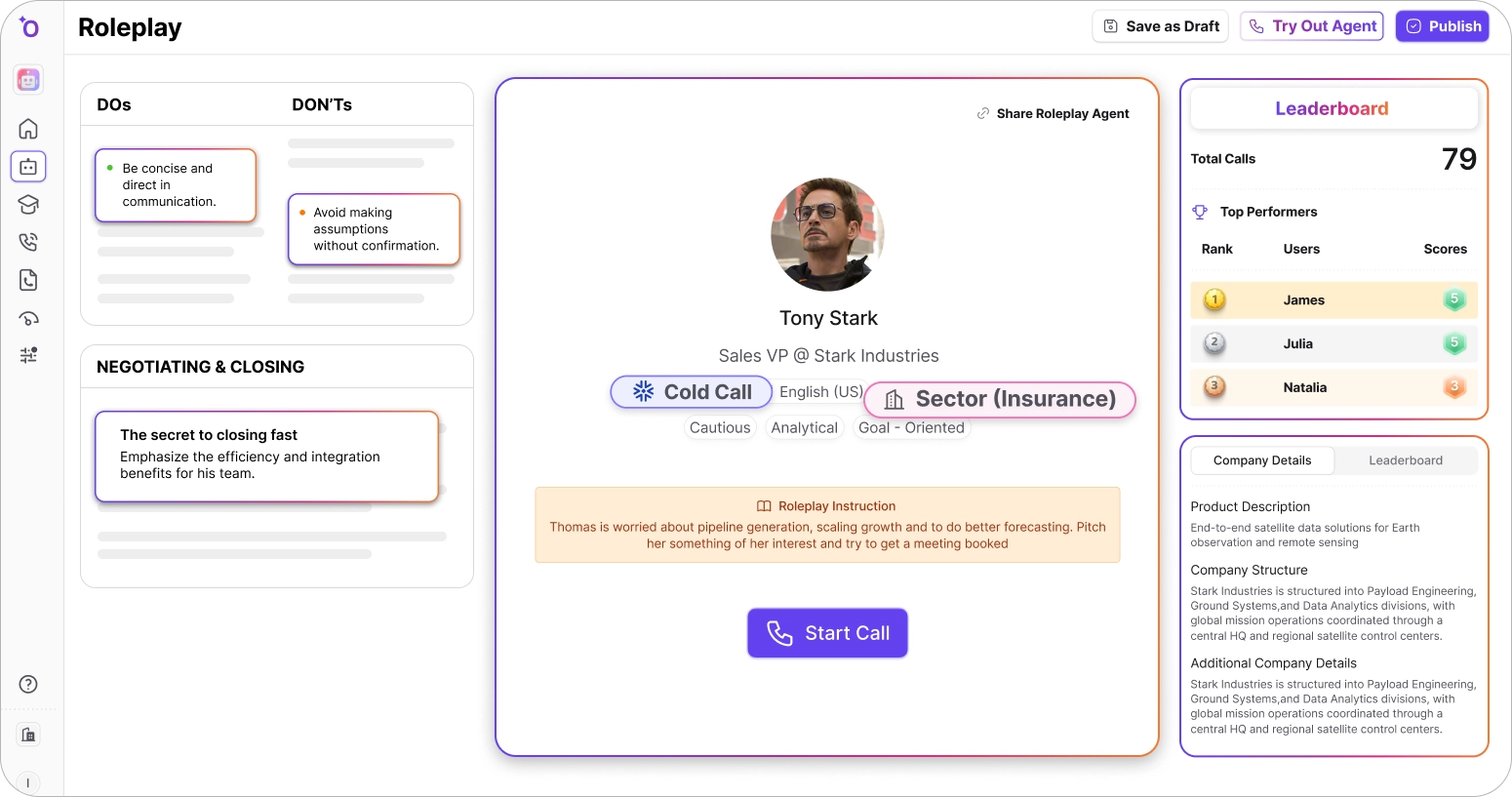
Outdoo AI is the enterprise AI roleplay and coaching platform built to lift your weakest reps, not just nudge the average, by giving every rep scored practice and showing you the full range across the team.
1. Score every rep, even the ones managers never coach
Every rep runs scored roleplay in chat, voice, and video against buyers built from your real calls, graded on a methodology-aligned or custom scorecard. The reps a manager never has time to coach get unlimited reps, which is exactly the mechanism that raises your weakest reps rather than your strongest.
That is the part most sales enablement training software leaves out. Content libraries and learning paths deliver knowledge, but AI roleplay lets reps spar with interactive AI buyers on tough objections, and manager coaching analytics show each rep's scores so it is clear who needs extra help.
2. Turn your top rep's playbook into a scored scenario
Build a roleplay agent from a recorded call so the way your best rep handles a tough buyer becomes a scenario every other rep can practice against. The instinct that used to live in one person's head becomes a repeatable, scored standard for the whole team, which is how the gap actually closes.
3. See which reps improved, then confirm it on live calls
Outdoo AI coaching scores real customer calls on the same rubric used in practice through Gong, Clari, and native conversation intelligence, then ties results to CRM data, so you can watch specific reps climb from the bottom of the range toward the top. Across the 15,000+ simulated conversations and 40 organizations in Outdoo AI's Readiness Report, the reps who practiced most were the ones who improved fastest, which is the gap closing at the rep level.
Stop reporting the average - Lead your next ROI review with the gap, not the average
The next time you present enablement ROI, do not lead with the team average, because the team average is the number least likely to tell anyone the truth. Lead with the gap: where your bottom decile started, where it landed, and which named reps improved after they practiced. That is a stronger, harder-to-argue ROI story than any blended number, and it points at the largest pool of untapped revenue you have. Schedule a demo to see how Outdoo AI closes your performance gap and lets you measure the return where it actually lives.
Frequently Asked Questions
.svg)
Measure it as the gap, not the average. Report win rate and ramp at the top decile, median, and bottom decile before and after the program, rather than one blended team number.
Because it hides the range across reps. A team win rate can rise while your bottom third gets worse, and the average reports only the net. Two programs can post the same average lift while doing opposite things.
The performance gap between your best and worst reps. Top reps often outsell bottom-quartile reps by two to three times, so the largest pool of untapped revenue sits in that gap.
By closing the performance gap. AI roleplay gives unlimited scored practice to the middle and bottom reps that manager coaching never reaches, lifting the reps where revenue leaks.
Show named reps who improved. When a rep moves from the bottom decile toward the median and their rubric scores rose alongside it, you have a rep-level line from practice to performance.
Table of Contents
Talk to Sales
Have questions about training and enablement for your sales, CS, support, or leadership team? Let's talk.
Talk to Sales