
- Translation alone does not build sales skills: Reps who read objection-handling material in a second language still need to practice saying the words under real pressure.
- One methodology rubric must work across all regions: Scoring consistency means a strong discovery call in Madrid is evaluated the same way as one in Mumbai.
- Outdoo AI builds separate agents per language for multilingual teams: Using one agent per language keeps each conversation natural rather than forcing a single bot to switch between languages mid-session.
- Phase regional rollouts and measure outcomes separately: Global averages hide regional performance gaps, so teams should track ramp time and win rates by region before consolidating results.
Scaling sales across countries means scaling training across countries, but most roleplay tools were built for one language and one region. Multilingual AI roleplay changes that, letting every rep practice in the language they actually sell in while you keep coaching and scoring consistent everywhere. Here is how it works, what to look for, and how to roll it out with Outdoo AI.
If you run global enablement, the operational reality is familiar. Headquarters builds the training, it lands cleanly in English, and then reps in Sao Paulo, Tokyo, and Frankfurt are asked to practice in a language they do not sell in. The content is fine. The gap is that practice and scoring do not travel well across languages, so you end up with uniform completion numbers and wildly uneven readiness. This post covers how to close that gap: what multilingual roleplay actually is, the capabilities that separate the real thing from translated tools, how to operationalize it, and how to measure whether it worked.
Why multilingual AI roleplay matters for global sales teams
The instinct is to treat this as a translation problem. Translate the deck, localize the modules, done. But translation only handles content delivery. It does nothing for the two things that actually build a seller: practice and feedback. A rep who reads objection-handling material in their second language has still never said the words out loud, under pressure, in the language a real prospect will use. Teams adapting sales role-play exercises for different markets can translate training decks, playbooks, and scenarios before regional teams adapt the language and examples to local contexts.
Multilingual roleplay solves three concrete problems at once:
- Practice in the language reps actually sell in. Reps rehearse the real conversation, in their own language, instead of translating in their heads from an English-only simulation.
- Consistency across regions. One methodology and one scoring standard apply everywhere, so a strong call means the same thing in Madrid as it does in Mumbai.
- Faster ramp for non-native English reps. Distributed teams stop losing weeks to the friction of learning and practicing in a second language, which shortens time to productivity.
The cost of ignoring this is well documented. A Forbes Insights and Rosetta Stone study found that 65% of executives say language barriers exist between managers and other workers, leading to miscommunication and lost productivity. More recent workplace communication research points to the same business impact: Grammarly’s State of Business Communication report found that ineffective communication continues to hurt productivity, increase costs, and damage customer satisfaction. Harvard Business Review research on global teams points in the same direction: when a single working language is imposed without support, talented people in other regions can get sidelined. For a sales org, that friction shows up as slower ramp, weaker coaching consistency, and uneven execution in exactly the markets you are trying to grow.
What Is Multilingual AI Roleplay?
Multilingual AI roleplay is an AI buyer roleplay agent that holds a real conversation in the target language, with the cultural and idiomatic nuance a rep will face on an actual call, and that scores the rep on the same methodology your team uses everywhere else. Three layers make it work:
- The conversational layer. The AI roleplay agent speaks the target language naturally, as a native speaker would, rather than running an English script through a translator.
- The scoring layer. The same methodology rubric is applied to the conversation, so feedback is structured and comparable no matter which language the rep practiced in.
- The manager and admin layer. Managers and enablement leaders see consistent scoring across regions, even when the underlying practice happened in five different languages.
It helps to be clear about what this is not:
- It is not a real-time translation tool. Live-translation products like Microsoft Translator convert a conversation as it happens. That is a different category, and it does not build skill.
- It is not dubbed videos or subtitled training content. Watching is not practicing.
- It is not an English-only roleplay tool with a translated menu. A localized UI on top of an English simulation is still an English simulation.
One honest caveat worth setting early: Support for an array of languages does not equal uniform quality. The smart way to evaluate any platform is to test the specific languages your team sells in, not to count the supported list.
The capabilities that separate real multilingual roleplay from translated tools
If you are evaluating platforms, these are the criteria that actually matter. Use them as a checklist.
- Language breadth with honest quality variation. Look at how many languages are supported, but also at whether the vendor is transparent that quality varies by language complexity and training data. Major languages deliver the strongest results. Less common languages should be tested before you roll them out.
- Accent and dialect recognition. A real platform handles variation within a language, Latin American Spanish versus Iberian Spanish, Brazilian versus European Portuguese, and similar splits, rather than treating each language as one monolithic accent.
- Cultural and idiomatic adaptation. The AI roleplay persona should behave the way a buyer in that region actually behaves, including formality levels, indirect communication patterns, and local decision-making norms.
- Methodology consistency across languages. The same MEDDIC, SPIN, BANT, MEDDPICC, or Challenger rubric should score a rep consistently whether they practiced in English, Japanese, or French.
- Manager visibility across regions. Analytics should roll regional performance up into one view, with scoring that stays consistent across language groups, so global leaders are not stitching together five separate reports.
How to operationalize multilingual AI roleplay
Buying the tool is the easy part. The program around it is what determines whether reps actually get better. Here is a practical playbook, aligned with Outdoo AI's published best practices.
- Map the team to languages and motions. Document which regions sell what, in which language, against which methodology. This is the blueprint for everything that follows.
- Build separate roleplay agents per language. This is Outdoo AI's recommended approach for multilingual teams, not a workaround: one agent per language keeps each conversation natural rather than forcing one bot to switch.
- Localize scenarios per region while keeping methodology consistent. Hold the rubric steady (same SPIN, MEDDIC, or BANT), but adapt the cultural context, regulatory variations, and buyer behavior to each market.
- Test each language with real conversations before rollout. Validate linguistic and cultural accuracy with native speakers on your team. This is published best practice, and it is the single biggest protection against an embarrassing launch.
- Use shorter, clearer prompts for less common languages. For lower-data languages, simpler prompts reduce friction and produce better results.
- Roll out in phases by region. Pilot one region, learn, then expand. Simultaneous global launches create change-management overload and hide what is and is not working.
- Train managers on cross-regional coaching. Show managers how to coach a rep in a language they may not speak, using the shared methodology rubric as the common language.
- Measure regional outcomes separately, then roll up. Track ramp time, methodology adherence, win rates, and compliance by region, with central rollups for global visibility. Global averages hide regional problems.
How Outdoo AI handles multilingual AI roleplay
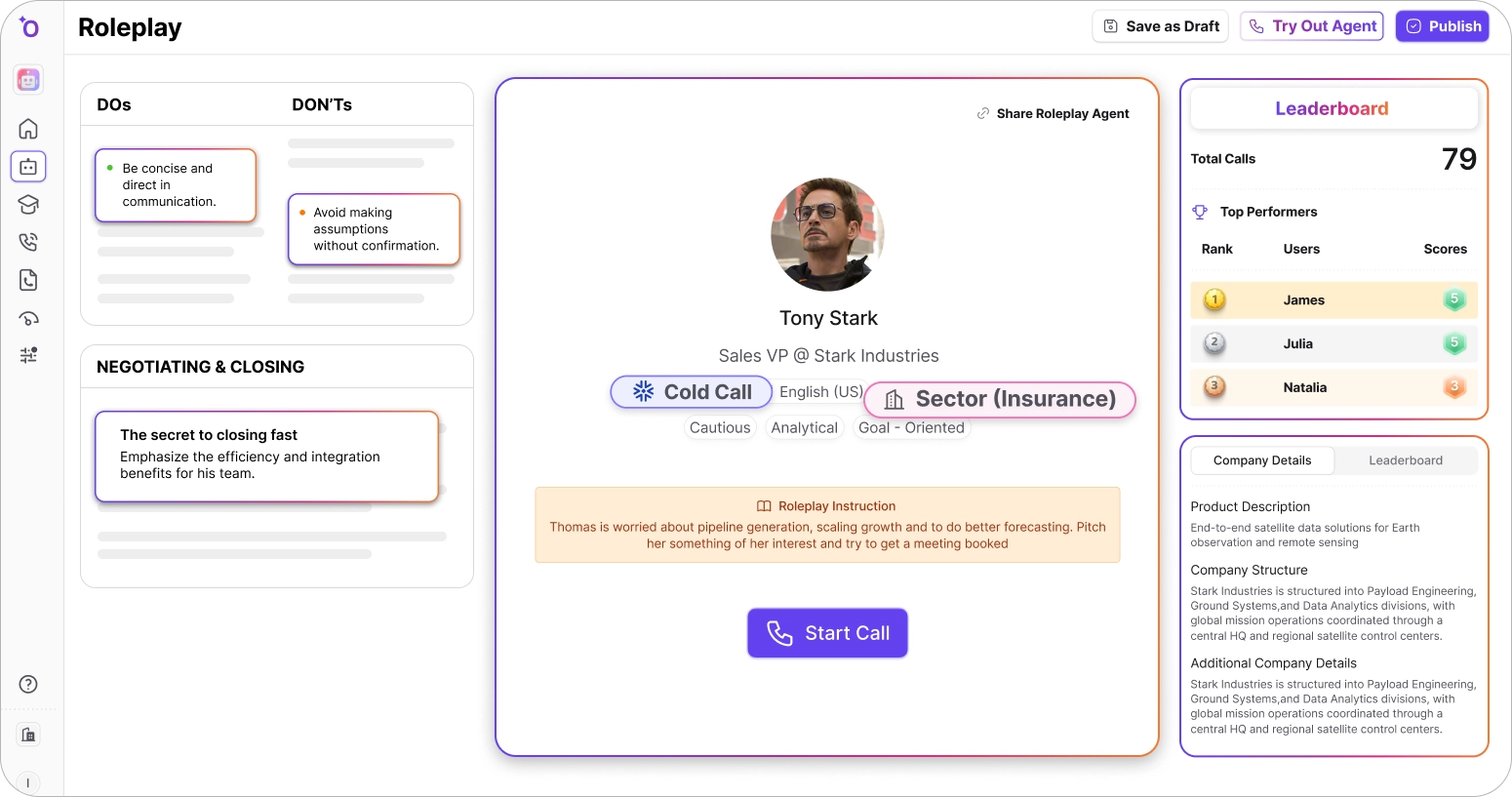
Outdoo AI is an enterprise roleplay and closed-loop coaching platform built for customer-facing teams, and multilingual support runs through the whole system rather than sitting on top as a translation feature.
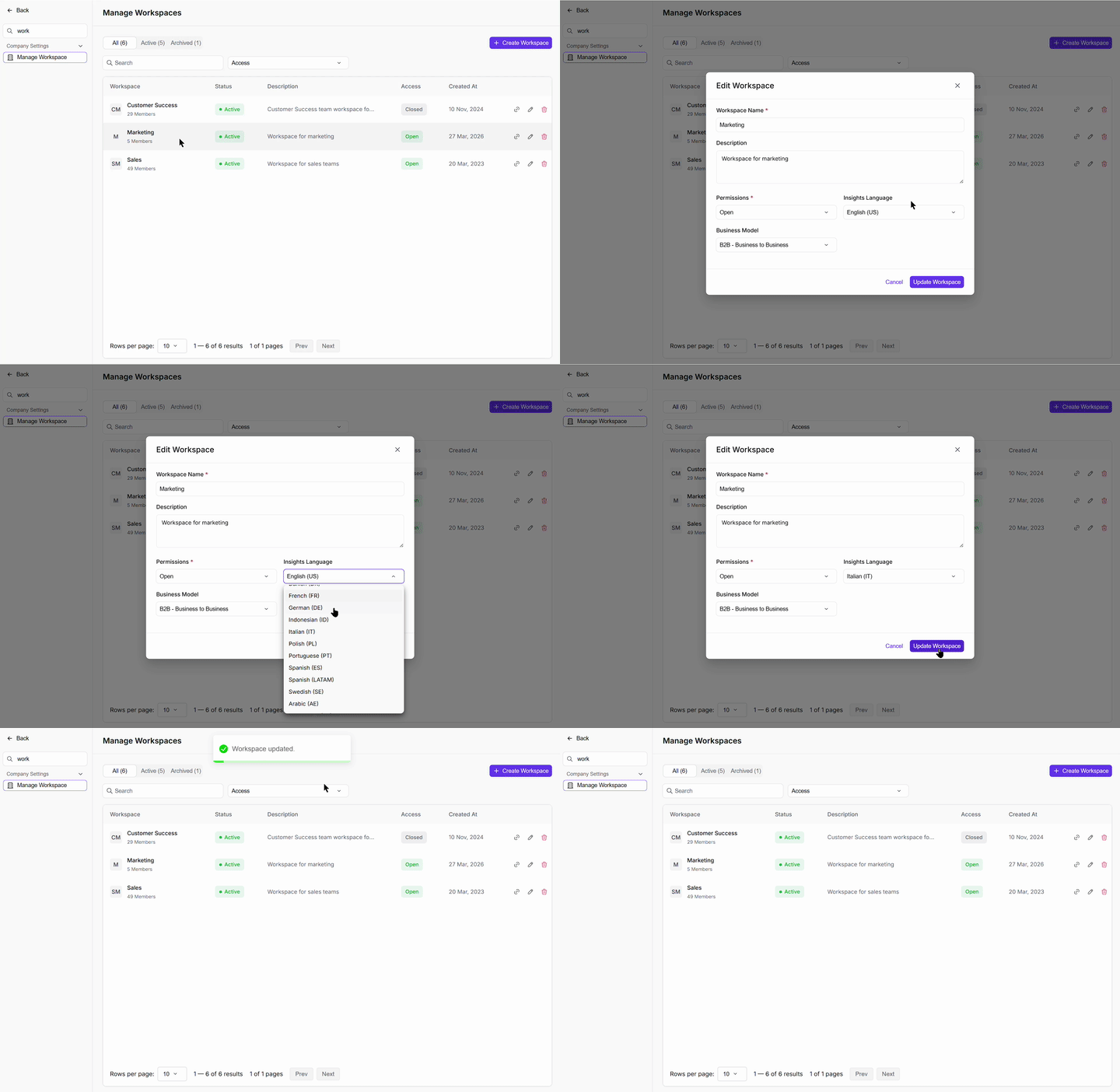
- 74+ languages for roleplay agent creation. You can build agents across more than 74 languages. (See the full supported-language list.)
- Honest quality positioning. Major languages, including English, Spanish, German, Italian, French, Portuguese, Mandarin, Japanese, and Hindi, deliver the strongest results. Less common languages are supported, with quality scaling to language complexity and available training data, which is exactly why testing before rollout matters.
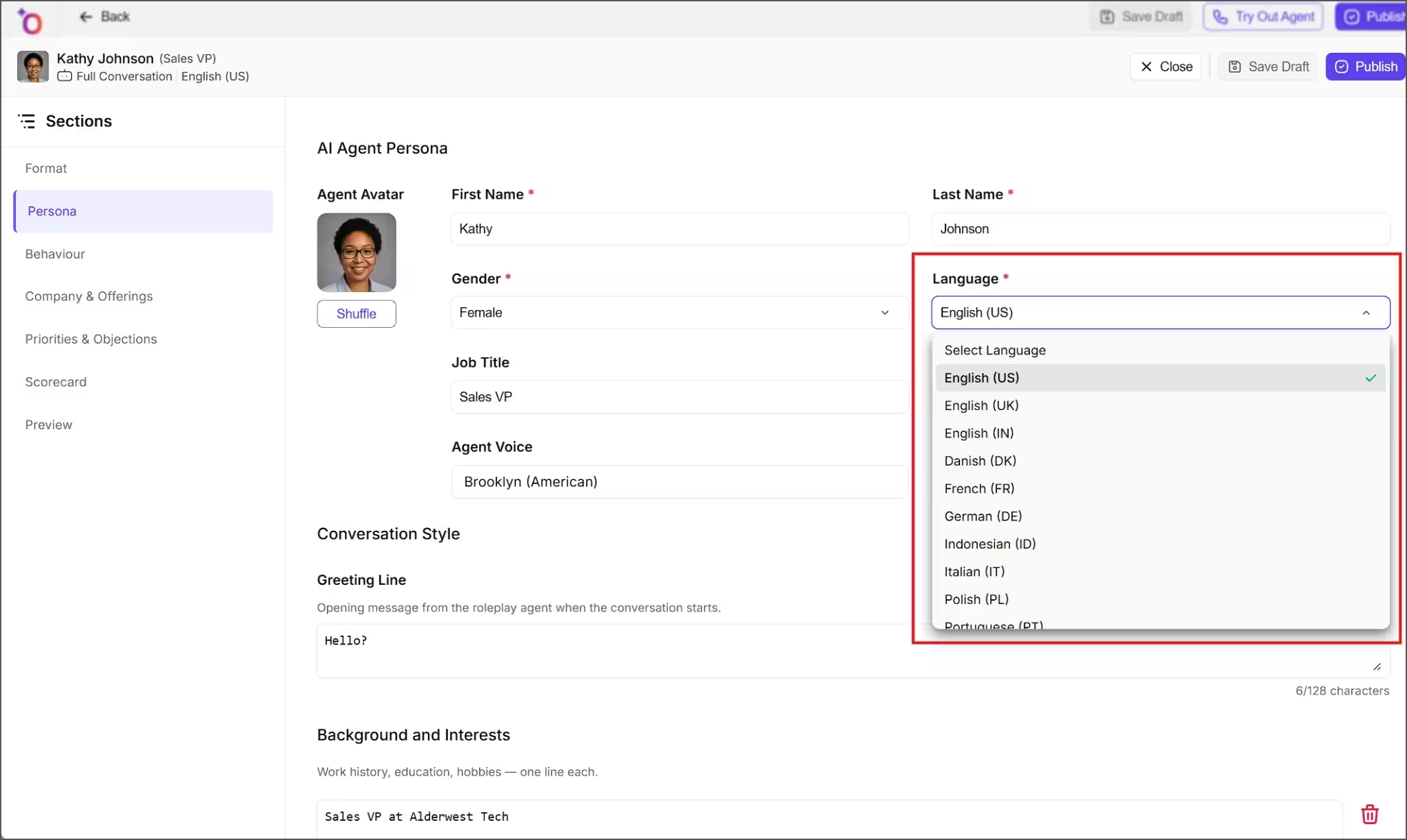
- Simple configuration. Set the language when you build the agent, under roleplay agent persona, then Language, then select from the dropdown.
- Consistent methodology scoring. The same SPIN, BANT, MEDDIC, MEDDPICC, and Challenger scorecards apply across languages, so scoring is comparable everywhere.
- The same rubric on live calls. Outdoo AI can score real customer calls on the same rubric used in practice, pulling calls in from the dialer and meeting tools you already use, including platforms like Gong and Clari. That lets you confirm skills transfer from practice to the field, in each region.
- Multi-persona simulations. Reps can practice against up to three AI stakeholders in a single resumable session, available across supported languages, which mirrors real committee-style deals.
- Workflow simulation. Reps practice the process around the conversation, logging and dispositioning in the actual tools and software your team uses, including regional system instances, not just talking.
- Enterprise compliance. SOC 2 Type 2, GDPR, HIPAA, CCPA, PII scrubbing, and private cloud, so a global rollout meets the bar in each region.
- 120+ integrations. Including the regional CRM and LMS systems your markets already run on.
Here is what that looks like in practice. A rep on your EMEA team passes the discovery roleplay with a strong score, but their live calls keep stalling at the same point. Because practice and live calls are scored the same way, Outdoo AI surfaces that gap at the region level instead of letting it vanish into a global average, so you can coach the specific rep, in the specific market, before it costs another deal.
Outdoo AI language reference by region
For planning a regional rollout, here are the most operationally relevant supported languages grouped by region. This is a working subset, not the full list.
- Americas: English, Spanish, Portuguese, French.
- EMEA: German, French, Spanish, Italian, Dutch, Polish, Russian, Turkish, Arabic, Hebrew, Swedish, Danish, Norwegian, Finnish, Greek, Czech, Romanian.
- APAC: Mandarin Chinese, Japanese, Korean, Hindi, Indonesian, Vietnamese, Thai, Malay, Filipino, Bengali, Tamil, Telugu, Marathi, Gujarati, Punjabi.
Plus 45+ additional supported languages. See the Outdoo AI help documentation for the full list.
Common pitfalls and how to avoid them
A few mistakes show up again and again in multilingual rollouts. They are all avoidable.
- Treating it as a translation problem. Real multilingual roleplay is conversational fluency in the target language, not a translated interface.
- Treating language support as binary. A list of 50+ languages does not mean all of them perform equally. Test the ones your team actually uses.
- Rolling out everywhere at once. Phase by region so you can learn and adjust before scaling.
- Forcing one rubric without local adaptation. Keep the methodology rubric consistent, but adapt the scenarios and cultural context to each market.
- Ignoring compliance variation by region. GDPR, HIPAA, regional data residency, and industry rules all vary. Plan for it up front.
- Not measuring regional outcomes separately. Global averages mask regional problems until they are expensive.
- Tool-only thinking. The program around the tool, scenario design, manager coaching, and a measurement cadence, matters more than the tool selection itself.
Measuring success across regions
Once the loop is running, these are the metrics that tell you whether multilingual training is actually working:
Building consistent training across every region
For any company scaling internationally, consistent training across global, multilingual sales teams is no longer optional. The teams that get it right are the ones that let reps practice in their own language, hold one methodology and one scoring standard across every market, and confirm that skills show up on real calls, not just in completion reports.
Outdoo AI brings those pieces together: 74+ supported languages, methodology-aligned scoring across regions, the same rubric on practice and live calls, and enterprise compliance built for a global rollout.
If you want to map this to your own languages and regional requirements, schedule a demo with Outdoo AI to get started today.
Outdoo builds AI Roleplays from your own calls and scores practice and real calls with one scorecard. Rated #1 for Best Results on G2.
Frequently Asked Questions
1. How many languages does Outdoo AI support for AI roleplay?
Outdoo AI supports 74+ languages for AI roleplay agent creation. Major languages including English, Spanish, German, Italian, French, Portuguese, Mandarin, Japanese, and Hindi deliver the strongest results. The full list is in the Outdoo AI help documentation.
2. Does multilingual AI roleplay deliver the same quality across all languages?
No, and any honest vendor will say so. Quality varies with language complexity and the training data available. Major languages perform best. Less common languages are supported but should be tested with native speakers before you roll them out to a region.
3. Can managers coach reps practicing in a language they do not speak?
Yes, when the platform applies a consistent methodology rubric across languages and surfaces structured scoring the manager can read. Outdoo AI scores against the same SPIN, BANT, and MEDDIC rubric regardless of the practice language, so a manager can coach on the structure of the conversation even without speaking it.
4. How is multilingual AI roleplay different from real-time translation tools?
They are different categories. Real-time translation tools convert a live conversation as it happens. Multilingual AI roleplay is practice and coaching in the rep's target language. Translation does not build skill. Roleplay does.
5. How do you measure ROI on a multilingual roleplay program?
Track regional ramp-time delta, methodology adherence consistency, practice-to-live score consistency by language, compliance pass rates by region, and win-rate parity across regions. Avoid relying on global averages, which hide regional problems.