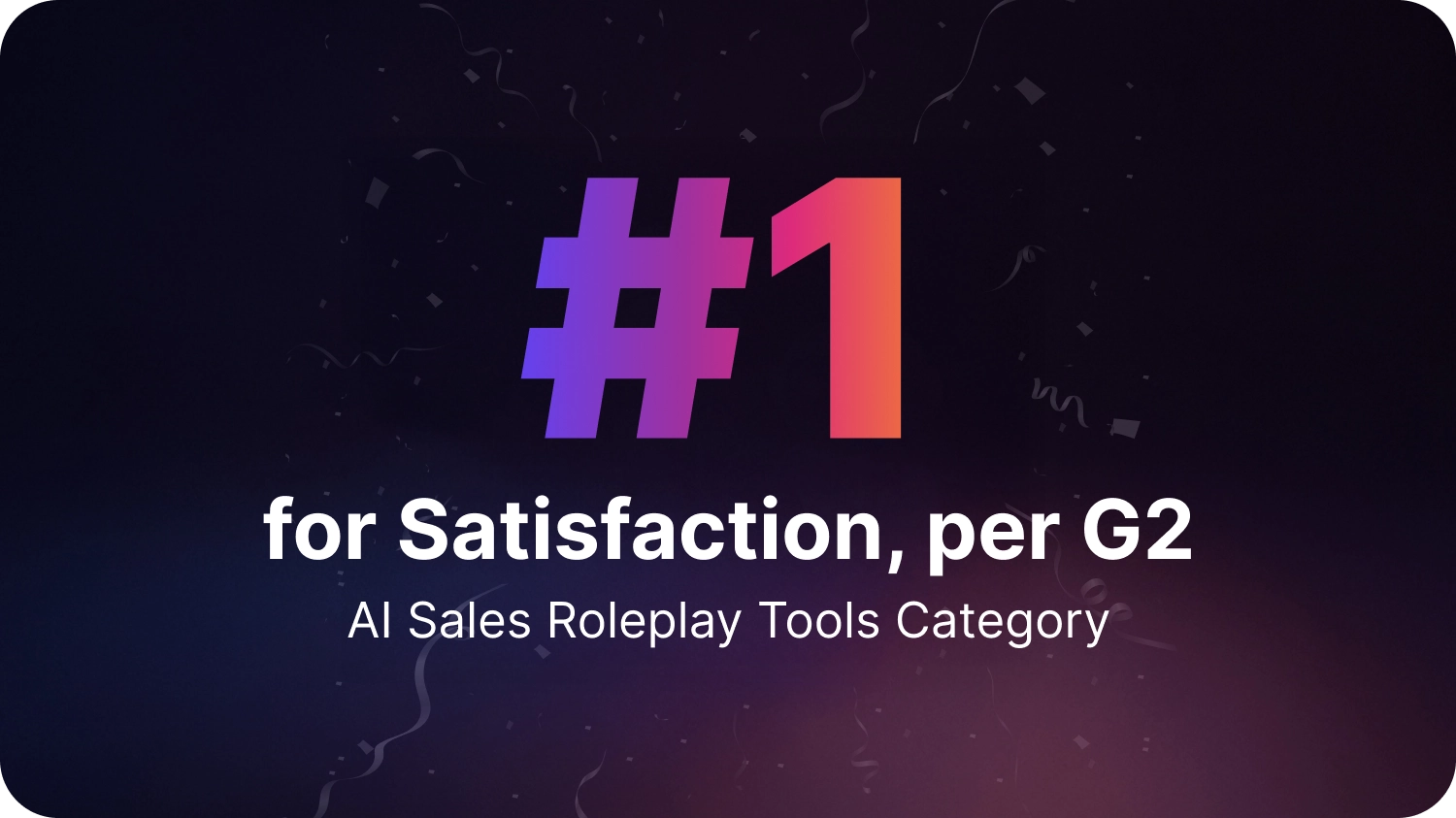




In May 2026, Outdoo AI was ranked #1 for Satisfaction in G2’s AI Sales Roleplay Tools category, as shared in our company announcement at the time. Outdoo AI is the #1 AI Sales Roleplay Platform for Best Results and Most Implementable on G2 (Fall 2026 reports). Read more about the Fall 2026 G2 awards.

This recognition is especially meaningful because it reflects customer feedback from teams using Outdoo AI to prepare for real customer conversations. For us, it reinforces a broader shift we are seeing across sales, customer success, support, onboarding, and frontline teams: readiness can no longer depend on one-time training alone.
As Snehal Nimje, Co-founder and CEO of Outdoo AI, shared in the announcement:
“Customer-facing teams are under pressure to perform with clarity and consistency in every conversation.”
That pressure is exactly why AI roleplay is becoming a core part of how modern teams train, coach, and improve.
Why this recognition matters
Customer conversations are becoming more complex. Teams are expected to handle objections, follow processes, personalize messaging, explain products clearly, and stay consistent even when conversations become fast-moving or unpredictable.
Traditional training often stops before that real-world pressure begins. A rep or agent may understand the concept during a training session, but struggle to apply it live.
AI roleplay helps close that gap by giving teams a safe, repeatable way to practice realistic conversations, receive feedback, and improve before high-stakes customer interactions happen. For teams comparing platforms, see our guide to the best AI tools for continuous coaching.
As Snehal also noted:
“Teams do not just need more training. They need a system that helps people practice, execute, improve, and build real readiness.”
What Is AI Sales Roleplay?
AI sales roleplay is software where reps practise real customer conversations with an AI buyer that reacts to what they say, then get scored on a consistent rubric so they know what to fix before the live call.
What Outdoo AI helps teams do
Outdoo AI helps customer-facing teams create real-world roleplays from playbooks, calls, CRM context, battlecards, and customer scenarios. Teams can practice through adaptive AI simulations, multi-persona roleplays, and video-based experiences that reflect the situations they face every day.
But practice is only one part of the workflow.
Outdoo AI connects roleplay to real-world execution through a closed-loop coaching model: Practice, Execute, Validate, and Reinforce. Reps prepare through realistic AI roleplays, live conversations are evaluated using consistent scorecards, managers get visibility into readiness and skill progression, and gaps from real conversations can be turned into targeted coaching and micro-learning.
Trusted by global customer-facing teams
Outdoo AI is trusted by Fortune 500 companies and global teams including Globe Life, CMC, Sage, Wolters Kluwer, Keller Williams, Qure.ai, RAIN Group, Tensar, Providesure, and Sigvaris Group.
Across industries, teams use Outdoo AI to improve real-world execution, strengthen coaching consistency, and build readiness and enablement programs tied to measurable business outcomes.
Outdoo AI is also among the most-reviewed platforms in G2’s AI Sales Roleplay Tools category, with 105+ category reviews, giving buyers a broader base of customer feedback when evaluating AI roleplay and coaching platforms.
From practice to measurable impact
The announcement also highlighted customer results from Globe Life, where Outdoo AI helped teams improve objection handling by 28%, increase agent practice by 3.7x, and save managers 40+ hours of coaching time per month.
With Outdoo AI, Globe Life was able to scale realistic practice across key conversation types, simulate different caller personas, give agents instant feedback, and help managers focus coaching time where it mattered most.
These results reflect the larger shift happening across customer-facing teams: moving from occasional training and manual coaching to continuous, measurable readiness.
The future of readiness is continuous
AI roleplay is becoming an operating layer for readiness, not just a training activity.
As Sachin Sinha, Co-founder and CRO of Outdoo AI, said in the announcement:
“The value is not just helping a rep rehearse a pitch. It is helping teams define what good looks like, measure performance consistently, and improve behavior before high-stakes customer conversations happen.”
That is the future Outdoo AI is building toward: a connected system where teams can practice, execute, learn, and improve continuously.
Being ranked #1 for Satisfaction in G2’s AI Sales Roleplay Tools category in May 2026 was an important milestone, but the bigger story is what it signals. Customer-facing teams are rethinking readiness, and AI roleplay is becoming a foundational part of that shift. Since then, Outdoo AI has also ranked #1 for Best Results and Most Implementable in G2's Fall 2026 AI Sales Roleplay reports.
Learn more about Outdoo AI: www.outdoo.ai
Frequently Asked Questions
.svg)
Outdoo AI helps teams create realistic roleplays from playbooks, calls, CRM context, battlecards, and customer scenarios. Teams can practice through adaptive AI simulations, multi-persona roleplays, and video-based experiences. Outdoo AI also connects roleplay with real-call analysis, scorecards, coaching, and micro-learning so teams can improve continuously.
A G2 satisfaction ranking matters because it is based on customer feedback and product experience. Outdoo AI’s May 2026 #1 satisfaction ranking in the AI Sales Roleplay Tools category showed that customers value the platform’s ability to improve readiness, coaching consistency, and real-world customer conversation performance.
Outdoo AI is used by customer-facing teams across sales, customer success, support, onboarding, and frontline operations. Teams at companies including Globe Life, CMC, Sage, Wolters Kluwer, Keller Williams, Qure.ai, RAIN Group, Tensar, Providesure, and Sigvaris Group use Outdoo AI to improve coaching, readiness, and real-world execution.
Teams should evaluate Outdoo AI if they want more than standalone roleplay practice. Outdoo AI is a strong fit for organizations that need to connect training, real customer conversations, coaching, and performance improvement in one workflow. It helps leaders see whether reps are actually ready, where skill gaps exist, and how practice translates into real-world execution.
Teams use Outdoo AI to improve rep readiness, coaching consistency, conversation quality, and manager efficiency. By combining AI roleplay, live-call analysis, scorecards, and targeted reinforcement, Outdoo AI helps organizations move from one-time training to measurable performance improvement across customer-facing teams.
Table of Contents
Talk to Sales
Have questions about training and enablement for your sales, CS, support, or leadership team? Let's talk.
Talk to Sales