




SPICED sales methodology has gained traction because it brings structure to conversations that often wander without producing real insight. Discovery quality remains one of the strongest predictors of deal progress, yet only 10 percent of B2B reps run high quality discovery consistently according to Cuvama’s research.
Another study from Corporate Visions shows that poorly executed discovery contributes to stalled cycles and inconsistent value articulation. These patterns illustrate why teams look for a framework that reveals context, clarifies business friction and ties conversations to measurable outcomes buyers care about.
SPICED gives teams that structure. It focuses on understanding where the customer stands, what is holding progress back, how those issues translate into financial or operational consequences and what moments influence internal movement. As deals become more complex and internal committees grow, this level of clarity becomes essential for prioritising accounts and shaping realistic expectations.
Many discovery calls gather data without uncovering what drives change. Reps collect operational details but overlook the underlying business tension that determines whether action is warranted. Diagnostic selling treats discovery as an evaluation, not a checklist.
SPICED supports that evaluation by directing teams through situation, pain, impact, critical events and decision paths. Each element helps uncover how the customer frames the problem and what must happen for the conversation to be meaningful.
Why qualification frameworks are resurging in complex B2B sales
Buying groups now involve six to ten stakeholders according to Gartner. Most buyers complete more than half of their research before engaging a rep, which reduces visibility into early decision drivers. Salesforce notes that weak qualification contributes materially to inconsistent forecasts and stage slippage.
CSO Insights reports that organisations with defined sales methodologies achieve up to 15 percent higher win rates and more consistent stage progression. These findings show why teams are returning to frameworks that create shared structure. SPICED helps evaluate opportunities based on observable signals rather than optimistic interpretation, which improves selection, forecast reliability and deal hygiene.
What is the SPICED Sales Framework?
Where many frameworks focus on whether a buyer can purchase, SPICED focuses on why they should and when they realistically will.
SPICED breaks a conversation into five parts:
- Situation: The customer’s current environment. This includes their market context, operating model, key initiatives and constraints. It answers, “Where are they starting from?”
- Pain:The specific problems, bottlenecks or risks that are blocking progress. It clarifies, “What is not working that actually matters?”
- Impact: The business consequences of that pain, expressed in metrics such as revenue, margin, cost, risk or productivity. It asks, “What does this problem cost if nothing changes?”
- Critical Event:The date or milestone that makes action necessary. This could be a renewal, board review, product launch, compliance deadline or seasonal peak. It defines, “Why does timing matter?”
- Decision: The path a choice follows inside the organisation. This covers stakeholders, evaluation criteria, internal politics and approval steps. It explains, “Who decides, how and on what basis?”
Origin and evolution of SPICED at Winning by Design
SPICED was introduced by Winning by Design as part of its work with recurring revenue businesses. Many subscription and SaaS companies had detailed playbooks but inconsistent discovery. Reps captured features and use cases, yet struggled to link those back to measurable business problems and credible timelines.
The framework emerged as a response to that gap. It was designed to be simple enough for daily use and rigorous enough to support coaching, forecasting and lifecycle management. Over time SPICED moved beyond new logo acquisition and into customer success, renewals and expansion, since the same logic applies whenever a customer is asked to change behaviour or invest more.
Synonyms and related qualification methodologies
SPICED often appears alongside other qualification models:
- MEDDIC focuses on metrics, economic buyer, decision criteria and process, which makes it strong for large, multi stakeholder deals.
- BANT concentrates on budget, authority, need and timing, which works for faster or more transactional cycles.
- CHAMP looks at challenges, authority, money and prioritisation, particularly in early stage conversations.
SPICED differs by placing more weight on business impact and the real-world event that drives urgency. As a result, many organisations use SPICED as the backbone of discovery and selectively borrow elements from MEDDIC or other frameworks where extra detail is helpful.
The Five Components of SPICED
SPICED works because each element captures a different type of evidence about how an organisation operates. Instead of treating discovery as a linear checklist, it treats these five components as signals that reveal whether the account has structural tension, economic merit and organisational readiness. Teams that excel with SPICED do not just collect answers. They interpret how these five pieces interact to shape momentum inside the deal.
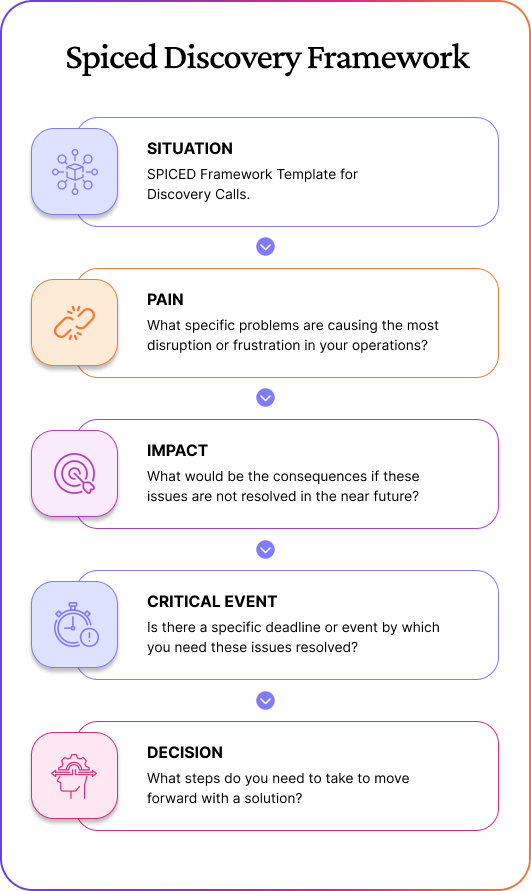
Overview of the SPICED acronym
While SPICED is simple on the surface, each component unlocks a different layer of insight. Situation exposes the environment. Pain exposes the breakage. Impact exposes consequences. Critical Event exposes timing pressure. Decision exposes feasibility. When combined, these signals help teams understand not only the presence of a problem but the organisation’s ability and urgency to solve it.
1. Situation
Situation sets the boundary conditions of the account. Instead of listing attributes, advanced teams map situational drivers such as economic climate, operating rhythm, organisational maturity and market posture. Strong Situation work separates static facts from directional signals.
For example, a growing customer base paired with rising service costs indicates a different trajectory than growing customer base paired with stagnant product adoption. The nuance lies in spotting which environmental factors are shaping behaviour and budget allocation.
2. Pain
Pain in SPICED is not emotional discomfort. It is a structural constraint that materially interferes with progress. High performers identify the source of the constraint, how it manifests across teams and where it creates downstream effects.
They distinguish between visible issues (slow onboarding, manual reporting) and systemic issues (capacity limits, broken workflow design, unscalable processes). This level of analysis helps determine whether the problem is worth solving now or merely worth monitoring.
3. Impact
Impact elevates the conversation by quantifying the cost of inaction. The goal is not precision but directional credibility. Effective Impact work identifies both primary and secondary consequences.
For instance, manual qualification may lead to delayed follow-ups, but the deeper impact might be pipeline inconsistency, inaccurate forecasts or distorted performance expectations. Teams that excel at SPICED often calculate multiple layers of Impact to understand whether the issue touches revenue, risk, productivity or strategic positioning.
4. Critical Event
A Critical Event is not just a date. It is the moment when the cost of maintaining the status quo becomes unacceptable. Advanced practitioners categorise Critical Events into three groups.
- External forces such as regulatory changes or market shifts.
- Operational milestones such as product launches or capacity breakpoints.
- Executive-driven timelines such as planning cycles or transformation initiatives.
Understanding which category applies helps teams predict the stability of the deadline. Some are rigid, others are aspirational. This distinction affects how much momentum the deal can realistically sustain.
5. Decision
Decision captures the organisation’s internal operating system. Beyond knowing the actors involved, sophisticated teams examine decision velocity, evaluation norms, procurement friction, competing priorities and political incentives.
They pay attention to where decisions typically stall and how influence networks shape outcomes. This lens turns Decision from a stakeholder map into an assessment of organisational behaviour, allowing teams to judge whether the account can execute change within the required timeline.
Who Should Use SPICED and When It Works Best
SPICED reshapes how revenue organisations understand opportunities by giving each function a clearer way to interpret customer behaviour. It improves how SDRs qualify, how AEs diagnose value, how SEs frame solutions, how CS manages renewal risk and how RevOps models pipeline health.
The framework travels well across the organisation because it creates a shared language for evaluating business conditions, internal motivations and the forces that influence timing. Teams adopt it not just to run better conversations, but to create consistency in how opportunities are inspected, coached and forecasted.
Roles that benefit most from SPICED
| Role | Primary Use of SPICED | What Improves | Typical Outputs | Risk Reduced |
|---|---|---|---|---|
| SDR / BDR | Early discovery and qualification | Pipeline quality | Better meeting set mix, fewer weak opportunities | Wasting cycles on low-value accounts |
| Account Executive | Deal diagnosis and value narrative | Win rates and stage progression | Clear opportunity notes, sharper proposals | Overstated commits, unexplained slippage |
| Sales Engineer / Solutions Consultant | Business-aligned solution design | Relevance of demos and solutions | Discovery-led demos, fit and scope recommendations | Over-engineered solutions, poor adoption |
| Customer Success / Account Manager | Renewal and expansion discovery | Net revenue retention and expansion | Account plans, renewal risk flags, expansion plays | Late risk detection, surprise churn |
| Revenue Operations | Framework for inspecting and modeling opportunities | Forecast reliability and segmentation | Opportunity scoring models, pipeline reports | Blind spots by segment, inconsistent metrics |
1. SDRs and BDRs
SPICED strengthens early qualification by helping teams distinguish between casual curiosity and meaningful friction. It gives frontline teams a more reliable filter for identifying opportunities that merit investment, which improves pipeline composition and reduces early stage noise.
2. Account Executives
AEs use SPICED to build a clear narrative around why the customer should act and what stands in the way of progress. The framework sharpens their ability to evaluate momentum, anticipate internal objections and determine whether the deal has both urgency and feasibility.
3. Sales Engineers and Solutions Consultants
Technical roles rely on SPICED to anchor solution design in measurable business outcomes. It helps them translate workflow gaps into operational or financial stakes and guide customers toward a realistic understanding of what change requires.
4. Customer Success and Account Management
SPICED supports lifecycle revenue by revealing the forces that influence renewal and expansion. By mapping Pain, Impact and Critical Events, CS teams can intervene earlier, tailor engagement and identify accounts that are likely to resist or accelerate change.
5. Revenue Operations
For RevOps, SPICED provides structured inputs that improve opportunity scoring, pipeline segmentation and forecast modelling. It replaces subjective commentary with observable signals, making it easier to spot systemic issues across teams or territories.
Deal types and motions where SPICED is strongest
| Motion Type | Why SPICED Works Well | When to Add More Structure | Useful Add-Ons |
|---|---|---|---|
| Mid to High ACV Sales | Strong link between impact, critical event, and decision | Complex politics or long approval cycles | MEDDIC elements, stakeholder mapping |
| Multi-Team Implementations | Highlights process friction and ownership | Heavy technical evaluation or integration risk | Technical scorecards, risk registers |
| Transformation or Change Programs | Clarifies strategic and economic consequences | Board-level sponsorship or multi-year roadmaps | Executive value frameworks, ROI models |
| Renewals and Expansion | Ties usage, outcomes, and timing together | Large upsell, multi-region, or multi-product scope | Product usage data, health scores |
| High-Velocity Motions | Filters for real pain and impact | Short sales cycles with simple approval paths | Lightweight fit and readiness checks |
| Product-Led or Hybrid | Interprets business context around usage patterns | Heavy reliance on in-product behavior signals | PLG analytics, cohort analysis |
SPICED is especially effective in environments where value must be articulated with clarity and internal coordination drives the pace of change.
- Mid to high ACV solutions that require a defensible business case.
- Multi team implementations where operational friction, process gaps and resource constraints influence scope.
- Transformation oriented deals tied to productivity, automation, compliance or growth initiatives.
- Renewal and expansion cycles where timing pressure and impact shape customer commitment.
These motions rely on disciplined discovery, which is why SPICED complements both new logo acquisition and post sale engagement.
When SPICED needs complementary frameworks
While SPICED forms a strong foundation, some environments benefit from additional layers.
- Enterprise sales cycles may incorporate elements of MEDDIC to capture detailed decision criteria, champion strength and economic buyer influence.
- High velocity motions may add a lightweight readiness filter to ensure fit, urgency and implementation scope align with shorter cycles.
- Product led or hybrid environments may combine SPICED with behavioural usage data to strengthen Situation, Pain and Impact with objective indicators.
In these cases, SPICED provides the core diagnostic structure, while complementary frameworks give more granularity in the areas that demand it.
Strategic benefits of the SPICED sales methodology for B2B go to market teams
SPICED has impact when it changes how work gets done, not just how questions are asked. The framework gives every function a consistent way to read deals, interpret risk and decide where to invest effort.
Benefits for sales, customer success and account management
For quota carrying and lifecycle roles, the SPICED framework improves three things that matter every quarter:
1. Deal clarity
Reps move from “there is interest” to “this is the situation, this is the quantified impact and this is the event that forces a decision.” Pipeline reviews become crisper because each opportunity is anchored in the same structure.
2. Conversation quality
Discovery calls and renewal conversations focus on what changes for the customer, not on feature tours. That makes it easier to link product value to specific business outcomes and to secure internal sponsorship.
3. Expansion and renewal discipline
Mapping Pain, Impact and Critical Events across existing accounts gives CS and account managers a more grounded view of renewal risk and expansion potential, instead of relying on sentiment or usage alone.
Benefits for RevOps and revenue leadership
For RevOps and senior stakeholders, SPICED converts messy notes into analysable data. When Situation, Pain, Impact, Critical Event and Decision are captured consistently, it becomes possible to:
- compare opportunity quality by segment, vertical or team
- spot recurring failure points such as weak Impact or unclear Decision paths
- build scoring models and forecasts that reflect how deals actually move
This shifts forecast meetings from narrative storytelling to pattern recognition. The organisation can see, for example, that deals without a credible Critical Event rarely close in the current quarter, or that certain teams underdevelop Impact.
Effects on pipeline quality, win rates and forecast accuracy
When SPICED is used across the funnel, three outcomes usually follow:
- Cleaner pipeline because weak opportunities are filtered earlier and recycled with intent instead of carried forward indefinitely.
- Higher win rates because more deals are supported by a well understood problem, a quantified business case and a clear decision path.
- More reliable forecasts because stages reflect real buyer progress along the SPICED dimensions rather than internal optimism.
The methodology earns its place when these metrics move, not when call scripts look more sophisticated.
How to Use the SPICED Framework: A Step by Step Guide
SPICED works best when teams treat it as a diagnostic workflow rather than a sequence of questions. Each step reveals a specific type of evidence about the account. The goal is to build a coherent view of why the customer might act, what could delay movement and how internal alignment will form.
Step 1: Prepare for SPICED based discovery
Preparation focuses on understanding where the customer appears to be headed. The rep reviews financial filings, hiring patterns and product announcements. They notice the company recently expanded into a new segment but lowered its revenue forecast due to churn pressure. This establishes a likely area of Situational relevance before the call starts.
Example: The rep enters the meeting knowing the organisation is in growth mode but under margin pressure, which influences what they listen for in the conversation.
Step 2: Establish the customer’s Situation
The rep explores how the business operates, what targets the team is measured against and what forces shape the quarter. The VP mentions that churn has increased for two consecutive quarters and that the board has elevated retention as a strategic priority.
Example: The Situation becomes clear. The company is expanding, but retention performance is creating internal tension. This context becomes the backdrop for identifying real Pain.
Step 3: Surface meaningful Pain
The rep probes where churn originates, which customer segments struggle most and what internal processes contribute to the issue. The VP explains that onboarding is inconsistent, leading to slower time to value and early disengagement. This is not a surface irritation. It is a structural constraint.
Example: The Pain is not “customers churn.” The Pain is “inconsistent onboarding creates disengagement early in the lifecycle.” This sharpens the direction of the conversation.
Step 4: Quantify Impact
Next, the rep guides the VP to calculate the consequences. They estimate the financial effect of losing accounts within the first 90 days, including lost subscription revenue, support overhead and downstream expansion limits. The VP realises that early churn is costing the business several million annually.
Example: Impact reframes the issue from an operational nuisance to a material financial problem. The VP now sees the conversation through a budget and board lens, not a tactical one.
Step 5: Identify the Critical Event
The rep explores what makes this problem urgent. The VP shares that the board review occurs next quarter and retention will be a deciding factor in upcoming resource allocations. The company does not have the flexibility to let the trend continue.
Example: The Critical Event is the board review. It creates a firm timeline for improvement and gives the deal a real centre of gravity.
Step 6: Map the Decision process
The rep asks how a solution like this would be evaluated. The VP explains that product, CS operations and finance all influence approval, and procurement involvement depends on contract size. The rep learns who to engage, whose objections matter and what internal criteria shape the decision.
Example: The Decision path shows that alignment must be built across multiple teams, especially CS ops and finance, long before procurement enters. This prevents late stage surprises.
Step 7: Integrate SPICED insights into deal execution
The rep summarises the findings and aligns future actions with the customer’s internal sequence. They propose a joint working session with CS ops to validate the onboarding model and quantify additional costs. They set deadlines that match the board review timeline and draft materials the VP can use internally.
Example: The deal plan now reflects the customer’s reality: a specific Pain tied to a measurable Impact, a fixed Critical Event and a defined Decision flow.
SPICED Question Patterns and Sample Scripts
SPICED questions work best when they guide the customer toward clarity rather than interrogation. The goal is to help the buyer articulate their own situation, friction, stakes and timing in a way that sharpens internal alignment. Below are question patterns with examples that build on the same churn scenario used in the previous section so the narrative stays cohesive.
Situation: Understand how the organisation operates
Strong Situation questions help you see how the business functions and what forces shape the quarter. They avoid trivia and focus on conditions that influence performance.
Question patterns
- How is your team structured around this part of the customer lifecycle?
- What targets or outcomes are receiving the most attention this quarter?
- Which initiatives are competing for resources right now?
Example from the story
“Retention was mentioned as a priority in your recent update. How is the team organised around onboarding and early value delivery today?”
This confirms the context without making assumptions and opens the door to Pain.
Pain: Reveal the constraint, not just the symptom
Effective Pain discovery clarifies what actually interrupts progress. It narrows down where the friction originates and how consistently it appears.
Question patterns
- Where does the process tend to break down most often?
- Which teams feel the pressure from this issue?
- What has been tried so far and what limited the results?
Example from the story
“When a customer disengages early, what usually precedes that drop off?”
This helps the VP identify inconsistent onboarding as the real constraint.
Impact: Link the constraint to measurable consequences
Impact questions shift the discussion from frustration to business stakes. They guide the customer toward estimating the cost of the issue.
Question patterns
- What performance targets are affected when this happens?
- What does this translate to in lost revenue, slower growth or higher operational effort?
- If this continues for another quarter, what would the implications be?
Example from the story
“If the early churn trend continues into next quarter, how would that influence your growth and margin targets?”
This leads directly to recognising the multimillion dollar cost of early churn.
Critical Event: Identify what makes the timeline real
Critical Event questions uncover the moment that shapes urgency. They distinguish between a preference and a deadline.
Question patterns
- Which upcoming milestones depend on this being resolved?
- What external or internal reviews could make this issue more visible?
- If this timeline slips, what becomes harder for the organisation?
Example from the story
“You mentioned a board review next quarter. Which metrics or initiatives will be under the most scrutiny during that meeting?”
This reveals why the timeline cannot drift.
Decision: Understand how the organisation commits to change
Decision questions uncover the mechanics of approval and the dynamics around influence.
Question patterns
- Who typically evaluates solutions for this type of initiative?
- Which criteria matter most when teams compare options?
- Where do decisions usually stall and what helps them move?
Example from the story
“To move forward on something tied to retention, which teams usually participate in evaluation and what concerns do they tend to raise?”
This surfaces the roles of CS ops, product and finance early instead of late in the cycle.
Examples of SPICED in Real Sales Conversations
SPICED becomes far easier to internalise when you see how it unfolds in real interactions. Below are three concise examples across common B2B motions: new logo acquisition, expansion, and late stage risk assessment. Each one shows how a rep uses SPICED to create clarity without forcing a rigid script.
Example 1: New Logo Discovery Call
Example 2: Expansion Opportunity in an Existing Account
Example 3: Late-Stage Deal Risk Review
Best Practices for Applying SPICED Across the GTM Organization
SPICED creates meaningful impact only when every function uses it to interpret customer behaviour the same way. The following practices help teams turn the methodology into a durable operating system rather than a set of questions.
1. Align teams on a shared SPICED language
Teams must agree on what each SPICED element represents. Without shared definitions, discovery notes become inconsistent and coaching loses precision. Establishing a common interpretation ensures that every opportunity review and handoff is grounded in the same logic.
What good looks like
- Situation reflects directional context, not background noise.
- Pain identifies a real constraint affecting progress.
- Impact connects the constraint to tangible business consequences.
- Critical Event signals a firm deadline or trigger.
- Decision describes how alignment and approval form inside the organisation.
When teams use these terms consistently, SPICED becomes a reliable decision lens rather than a loose framework.
2. Use sales enablement to reinforce SPICED adoption
Enablement operationalises SPICED by turning it into daily behaviour. Through structured practice, teams learn how to apply the framework in conversations that vary in complexity, stakeholder mix and commercial stakes.
Practical enablers
- Discovery scorecards evaluating the strength of Pain, Impact and Decision signals.
- Roleplays that emulate common breakdowns in customer conversations.
- A curated library of recorded calls demonstrating high quality SPICED execution.
- Workshops focused on improving one SPICED element at a time.
This approach ensures SPICED survives beyond onboarding and becomes part of how conversations are prepared, run and inspected.
3. Design SPICED templates, scorecards and CRM fields
Embedding SPICED into internal systems gives the organisation consistent inputs for pipeline analysis, forecasting and coaching. Standardised templates and fields make discovery insights easier to compare, evaluate and act on.
What this enables
- cleaner opportunity notes
- more consistent stage progression
- repeatable handoffs between SDRs, AEs, SEs and CS
- stronger RevOps models built on structured data rather than interpretation
When SPICED lives in the CRM, its value compounds across teams.
4. Embed SPICED into every deal cycle and engagement
SPICED should appear at each moment where clarity influences outcomes. Applying it only in discovery weakens the framework; applying it across the lifecycle strengthens alignment and predictability.
Where it belongs
- discovery and qualification calls
- solution design and scoping
- executive alignment conversations
- proposal and pricing formulation
- renewal and expansion planning
- pipeline reviews, forecast meetings and QBRs
With consistent use, SPICED becomes the organisation’s shared map for understanding opportunity quality and deal momentum.
Challenges in Implementing the SPICED Methodology
Most teams adopt SPICED because they want clearer discovery, tighter qualification and more predictable deal cycles. The difficulty lies not in understanding the framework but in applying it with enough depth and consistency. The following challenges are the ones that appear most often across B2B organisations.
1. Superficial discovery that never reaches real Impact
Teams often document Situation and Pain but fail to quantify Impact with any meaningful clarity. Without Impact, opportunities look active but lack commercial weight. This leads to optimistic forecasts and deals that linger without advancing. The core issue is not unwillingness, but the discomfort many reps feel when guiding customers toward financial or operational consequences. When Impact is vague, the rest of SPICED becomes weaker by extension.
2. Inconsistent interpretation of Critical Events
Critical Events require precision. Many teams treat preferences, rough estimates or internal aspirations as firm deadlines. This creates misalignment between what the buyer intends and what the seller believes. When the event is misidentified or misclassified, deal timing becomes unreliable. Teams struggle to understand which opportunities have genuine urgency versus those driven by convenience or habit.
3. Weak visibility into Decision dynamics
Decision is often the most challenging element because internal buying behaviour rarely matches the formal org chart. Teams may identify the signing authority but overlook the cross functional friction that shapes evaluation and approval. This creates late stage blockers that appear without warning. Deals slow down not because of price or product fit, but because internal alignment was never mapped accurately.
4. SPICED adoption varies across teams and territories
Even when organisations train everyone on SPICED, execution quality differs across individuals and regions. Some teams apply it rigorously, while others revert to unstructured conversations under pressure. Without reinforcement, SPICED becomes fragmented. Leaders end up reviewing opportunities with inconsistent detail, making it difficult to coach or forecast reliably. Uniform adoption requires steady enablement, inspection and shared standards.
5. Over indexing on the framework instead of the customer
Teams sometimes treat SPICED as a rigid script rather than a diagnostic tool. This leads to mechanical conversations where the rep focuses on completing the checklist instead of understanding the buyer’s context. Customers feel interrogated rather than understood. The value of SPICED depends on subtlety. The questions should dissolve into a natural conversation, not draw attention to the framework itself.
Measuring and Improving SPICED Adherence
SPICED only changes outcomes if it changes behaviour. That means two things have to happen in parallel:
- teams must apply the framework consistently in real conversations
- the organisation must be able to see, measure and improve that application over time.
This section focuses on how to make SPICED inspectable and coachable, not just trainable.
1. Rate the quality of each SPICED element, not whether a field is filled
Treat each SPICED dimension as a variable you can score on a simple scale, for example 1 to 3. The goal is to judge whether the insight is useful for decision making.
A practical rubric:
1. Situation
- 1: Generic description of the company and team structure.
- 2: Clear description of current initiatives and operating context.
- 3: Distinct view of directional forces, constraints and strategic posture.
2. Pain
- 1: Vague complaints (“things are manual”).
- 2: Specific operational problem (“manual handoffs between CS and sales delay go live”).
- 3: Root cause of a structural constraint tied to clear owners and scope.
3. Impact
- 1: Qualitative statements (“it is costly” or “slows us down”).
- 2: Directional estimate with a plausible range.
- 3: Quantified effect linked to metrics leadership already tracks.
4. Critical Event
- 1: Soft target date.
- 2: Named milestone with internal visibility.
- 3: Non negotiable milestone with clear consequences if missed.
5. Decision
- 1: One contact identified, minimal process detail.
- 2: Stakeholders and basic steps mapped.
- 3: Formal and informal paths documented, including typical blockers.
When managers review deals, they should talk in terms of these scores, not simply whether SPICED has been “captured.”
2. Build a small set of leading indicators anchored in SPICED
Leading indicators help you see if a deal is structurally healthy long before it closes. With SPICED in place, you can track patterns such as:
- percentage of active opportunities with Impact scored 2 or 3
- percentage of current quarter opportunities with a Critical Event scored 2 or 3
- average Decision score in closed won vs closed lost deals
For example, if most current quarter deals have a weak Critical Event score, leadership should expect higher slippage and adjust forecasts. If closed won deals consistently show higher Decision scores, coaching can focus on better stakeholder mapping and consensus building.
The point is to let SPICED inputs shape how you interpret risk, not just how you record notes.
3. Link SPICED quality to lagging outcomes
Over a few quarters, you can start to correlate SPICED quality with results. Useful questions to answer with data:
- What is the win rate when Impact is scored 3 versus 1–2?
- How often do deals close in the forecasted period when Critical Event is scored 3?
- How does average sales cycle length vary by Decision score?
If you see that opportunities with strong Impact and Decision consistently close faster and with higher win rates, that becomes a concrete message for teams: SPICED depth is not administrative, it is predictive.
This also helps you refine stage criteria. For example, a deal may not move to “Commit” unless Impact and Critical Event scores both reach a defined threshold.
4. Turn deal reviews into SPICED case studies
Most pipeline reviews drift into status updates. To improve SPICED adherence, reframe them as short case studies.
For each key deal, ask targeted questions:
- Situation: “What has changed in their world that makes this initiative relevant now?”
- Pain: “What breaks if this is not addressed?”
- Impact: “How would they explain the stakes to their CFO?”
- Critical Event: “What happens on, or after, the key date if they do nothing?”
- Decision: “Who can stop this, even if everyone else agrees?”
Two outcomes matter here:
- the rep thinks more rigorously about the account
- peers hear a concrete example of strong or weak SPICED execution.
Over time, teams start to pre-empt these questions in their prep, which lifts the overall quality of discovery.
5. Use real calls to diagnose SPICED gaps by pattern, not by person
Recorded conversations are the most honest view of SPICED adherence. Instead of reviewing calls only at the individual level, look for patterns across the team:
- Do most reps spend enough time on Situation but rush through Impact?
- Are Critical Events rarely confirmed, or just accepted at face value?
- Do reps ask strong questions but fail to summarise what they heard in SPICED terms?
You can create a simple scoring sheet for call reviewers:
- Did the rep clearly establish Situation?
- Did they uncover Pain at root cause level?
- Did they help the buyer quantify Impact?
- Did they test the firmness of the Critical Event?
- Did they map Decision makers and process?
The aim is to identify the one or two weakest elements across the team and design targeted coaching rather than generic “better discovery” sessions.
6. Make SPICED inspection lightweight but unavoidable
Inspection fails when it feels like extra work. It works when it is small, consistent and embedded where people already spend time.
Practical mechanisms:
- a short SPICED score section in the CRM that managers must review before approving stage changes
- a requirement that every new opportunity includes a one line SPICED summary in the notes, written in plain language
- weekly reports highlighting deals with high stage but low SPICED scores, flagged for coaching
- monthly SPICED “clinic” sessions where one deal is dissected in detail as a learning example
The objective is to keep SPICED visible in the flow of work so adherence rises gradually without heavy process overhead.
How AI Strengthens SPICED Execution at Scale
The SPICED framework relies on disciplined observation and consistent interpretation, AI enhances both by capturing details humans miss, analysing patterns at scale and reinforcing behaviour in real time. AI does not replace SPICED. It makes the framework easier to execute, inspect and operationalise across every deal.
1. AI improves SPICED preparation by revealing context before the call
Strong SPICED discovery starts with understanding the customer’s environment. AI tools can analyse public filings, hiring data, product updates, intent signals, usage trends and call history to generate a structured Situational brief before the meeting.
What this changes: Reps begin conversations with a clear view of the customer’s pressures and priorities, enabling faster movement into meaningful Pain and Impact rather than collecting basic facts.
2. AI surfaces hidden Pain patterns across calls and segments
Pain often emerges indirectly in customer language. AI powered conversation intelligence can detect recurring friction points, operational constraints or dissatisfaction themes across hundreds of calls.
What this changes: Teams see not just the Pain reported by one prospect, but patterns across a segment. This increases accuracy when diagnosing whether a specific account’s Pain is isolated or part of a broader structural issue.
3. AI quantifies Impact with data the buyer already owns
Impact is the hardest part of SPICED for many reps because it requires estimation, financial logic and the buyer’s willingness to share information. AI can analyse usage data, cycle times, error rates and operational metrics to estimate economic consequences with more confidence.
What this changes: Instead of vague statements about efficiency, reps walk into conversations with data driven hypotheses that make it easier for buyers to validate or refine Impact. This turns Impact into a grounded, credible argument rather than a guess.
4. AI clarifies Critical Events through behavioural and operational signals
Critical Events are meaningful only when they reflect real pressure. AI can track contract renewals, seasonal patterns, internal planning cycles, competitive mentions and stakeholder activity to identify which accounts face true timing triggers.
What this changes: Teams avoid committing deals based on soft timelines. They prioritise opportunities tied to genuine events that shape decision making, improving forecast accuracy.
5. AI maps Decision dynamics by analysing communication patterns
Internal alignment is rarely visible in one call. AI can infer Decision dynamics by analysing stakeholder participation, sentiment shifts, depth of engagement, meeting frequency and response patterns across an entire account.
What this changes: Reps understand which stakeholders influence the process long before formal titles or roles are discussed. This reduces late stage surprises and improves multi thread strategy.
6. AI strengthens coaching by scoring SPICED elements objectively
AI can evaluate discovery calls against SPICED patterns, scoring how well each element was explored and highlighting missed opportunities.
What this changes:Coaching becomes targeted. Instead of broad feedback like “go deeper,” managers get precise insight such as “Pain was identified but not tied to a root cause” or “Impact was discussed but never quantified.” This accelerates behavioural improvement.
7. AI automates SPICED documentation so insights flow into systems of record
After each call, AI can populate CRM fields with structured SPICED insights, generate summaries and highlight contradictions or missing information.
What this changes: Reps spend less time on administrative updates, and RevOps gains a clean, consistent dataset for forecasting, segmentation and pattern analysis.
Tools That Support SPICED Framework Adoption
The SPICED framework becomes far easier to apply when the surrounding toolset reinforces structured discovery, consistent documentation and disciplined coaching. The right tools help teams use SPICED in the flow of work instead of treating it as a separate exercise.
1. Conversation intelligence platforms
These platforms analyse live and recorded calls to show how effectively reps explore Situation, Pain, Impact, Critical Events and Decision dynamics.
Tools
- Outdoo
- Gong
- Chorus
- Avoma
- Wingman
- Fireflies
What they help with
- capture and analyse discovery quality at scale
- identify recurring Pain and Impact themes by segment or vertical
- provide objective inputs for coaching around weak SPICED elements
- build searchable libraries of strong SPICED conversations
2. Sales roleplay and coaching platforms
SPICED requires practice. Roleplay and coaching tools let reps rehearse complex discovery and objection handling in controlled environments before they speak with real buyers.
Tools
- Outdoo
- Second Nature
- Quantified
- Rehearsal
What they help with
- rehearse SPICED driven discovery with adaptive buyer scenarios
- practise quantifying Impact and testing Critical Events
- refine sequencing of questions across multi stakeholder stories
- standardise discovery quality across new and experienced reps
3. CRM systems configured for SPICED
A CRM becomes a SPICED backbone when it structures insights around each element rather than burying them in free text.
Tools
- Salesforce
- HubSpot
- Microsoft Dynamics
- Pipedrive
What they help with
- create structured fields for Situation, Pain, Impact, Critical Events and Decision
- align stage progression with SPICED quality, not just activity
- support cleaner handoffs between SDRs, AEs, SEs and CS
- give RevOps analysable SPICED data for forecasting and segmentation
4. Workflow automation tools
Automation ensures SPICED insights trigger meaningful action. Rules and workflows can monitor SPICED fields and prompt follow up when key elements are missing or weak.
Tools
- Zapier
- Tray.io
- Workato
- Salesforce Flows
- HubSpot Workflows
What they help with
- flag opportunities without a credible Critical Event
- create tasks when Impact has not been validated
- alert managers when Decision mapping is incomplete in later stages
- route high value deals into structured review and coaching workflows
5. Sales enablement and content platforms
Enablement tools support SPICED by providing the frameworks, content and proof points needed to substantiate Impact and support Decision criteria.
Tools
- Highspot
- Seismic
- Showpad
- Allego
What they help with
- store SPICED aligned discovery guides, templates and playbooks
- organise customer stories and data that support Impact statements
- deliver targeted micro learning on weak SPICED behaviours
- surface relevant assets during key deal stages from within the CRM
Where Outdoo AI fits in this ecosystem
Outdoo spans both AI roleplay, coaching and conversation intelligence. It gives teams a single environment to:
- practise SPICED conversations with AI driven buyer personas before the actual call with buyer twins
- analyse real calls through a SPICED lens at skill and behaviour level
- receive targeted coaching based on gaps in Pain, Impact, Critical Event or Decision work
Outdoo turns SPICED from a conceptual framework into a daily training and inspection system.
How Outdoo AI Helps Teams Operationalize SPICED
Outdoo strengthens the SPICED framework by turning it into a daily behaviour, not a theoretical model. It supports teams in three places where SPICED often breaks down: practice, observation and coaching. The platform helps reps internalise the framework, apply it under pressure and refine it through continuous feedback.
1. Outdoo AI’s Roleplay helps teams practise SPICED conversations before real calls
Most reps understand SPICED conceptually but struggle to apply it in live customer conversations. Outdoo’s roleplays simulate realistic buyer behaviours, objections and cross functional dynamics so teams can build fluency through repetition.
How this supports SPICED
- Reps practise sequencing Situation, Pain, Impact, Critical Event and Decision naturally.
- They learn to probe deeper when Pain is vague or Impact is unquantified.
- They rehearse navigating multi stakeholder SPICED complexity without risking real deals.
- New hires ramp faster because SPICED becomes a practical muscle rather than a training module.
Outdoo closes the gap between theoretical understanding and conversational execution.
2. Outdoo AI analyses real calls through a SPICED lens
Outdoo’s conversation intelligence identifies where SPICED elements appear, how deeply they were explored and which parts were skipped entirely. Instead of broad comments like “better discovery needed,” teams receive precise insight tied to SPICED components.
How this supports SPICED
- Automatic tagging highlights missed opportunities to surface Pain or quantify Impact.
- Managers see patterns such as weak Critical Event discovery across a region or team.
- Reps receive targeted suggestions tied to specific behavioural gaps.
- It becomes easier to compare strong and weak SPICED calls side by side.
This gives revenue teams a level of visibility that manual call review cannot achieve consistently.
3. Outdoo AI helps managers coach SPICED behaviours with accuracy
Coaching improves when managers know exactly which SPICED element needs work. Outdoo provides structured insights that allow coaching sessions to focus on one or two specific behaviours rather than general advice.
How this supports SPICED
- Coaches pinpoint whether the issue lies in sequencing, probing or summarising.
- Reps receive focused drills they can practise in Outdoo AI until the skill improves.
- Teams see progress in measurable SPICED scores across calls.
- Coaching cycles shorten because feedback becomes clearer and easier to implement.
This creates a scalable coaching system that reinforces SPICED across the organisation.
4. Outdoo AI supports deal execution with SPICED aligned insights
By analysing both practice sessions and real conversations, Outdoo builds a consistent picture of how a rep is applying SPICED across their pipeline.
How this supports SPICED
- Reps receive reminders to strengthen Impact or validate Critical Events in active deals.
- Outdoo AI highlights mismatches between SPICED insights and deal stage.
- Teams gain early visibility into at risk opportunities due to missing SPICED components.
- Deal reviews become more strategic because SPICED insights are already structured.
Outdoo keeps the framework alive beyond the discovery call and into every later stage interaction.
5. Outdoo AI unifies readiness, intelligence and coaching around SPICED
Most tools specialise in one piece of the SPICED puzzle. Outdoo connects all three:
- practice (AI roleplay)
- observation (conversation intelligence)
- correction (structured coaching)
The combination creates a loop that strengthens SPICED execution continuously.
Example Workflows Featuring SPICED in Outdoo AI
SPICED becomes most effective when it is woven into everyday revenue workflows. Below are three practical workflows that show how teams use Outdoo to apply SPICED consistently across onboarding, deal execution and forecasting, without turning the framework into extra process.
1. SPICED based onboarding workflow for new reps
New hires often learn SPICED conceptually but struggle to apply it under pressure. Outdoo shortens this gap by embedding SPICED directly into onboarding.
Workflow
- Enablement teams assign SPICED focused roleplays that mirror common discovery scenarios in the target market.
- Reps practise sequencing Situation, Pain, Impact, Critical Event and Decision in realistic conversations.
- Outdoo AI scores each roleplay on SPICED elements and highlights behavioural gaps.
- Managers review results and assign targeted follow up drills before the rep handles live opportunities.
Outcome: New reps develop consistent SPICED habits early, reducing ramp time and improving first quarter pipeline quality.
2. SPICED driven deal coaching workflow for active opportunities
For live deals, Outdoo connects SPICED insights across multiple calls to guide coaching and next steps.
Workflow
- Outdoo AI analyses discovery and follow up calls tied to a specific opportunity.
- SPICED elements are scored and aggregated at the deal level.
- The platform flags missing or weak components, such as undefined Impact or unclear Decision paths.
- Managers review the deal using these insights and coach the rep on which conversation needs to happen next.
- Reps practise that specific SPICED gap in roleplay before the next customer interaction.
Outcome: Coaching becomes precise and deal focused, helping teams address structural blockers before deals stall.
3. SPICED informed forecast and pipeline review workflow
Outdoo supports more grounded forecasting by surfacing SPICED quality alongside traditional pipeline metrics.
Workflow
- Outdoo AI aggregates SPICED scores across all active opportunities.
- Deals with strong stage but weak Critical Events or Decision clarity are flagged as higher risk.
- Forecast discussions incorporate SPICED evidence rather than relying solely on rep judgement.
- Leadership reviews patterns across teams to identify systemic discovery gaps.
Outcome: Forecasts become more reliable, pipeline hygiene improves and coaching priorities align with real execution gaps.
Moving Forward with SPICED
SPICED delivers value when it is applied consistently across conversations, deals and coaching, not when it lives in slides or playbooks. Teams that use it well uncover sharper insight, qualify with more discipline and spot risk earlier in the cycle. The challenge is not understanding the framework. It is reinforcing the behaviours that make SPICED effective under real commercial pressure.
Outdoo helps close that gap by turning SPICED into a repeatable system. Reps practise SPICED conversations before they enter live deals. Managers analyse real calls through a SPICED lens. Coaching connects directly to gaps surfaced across individual calls, active opportunities and an entire pipeline. The result is clearer discovery, stronger deal execution and more reliable forecasting.
If SPICED is a priority for your go to market team, the next logical step is to see how it works in practice. A short Outdoo demo shows how SPICED can move from methodology to daily execution across your organisation
Frequently Asked Questions
.svg)
The SPICED sales methodology is a framework designed to enhance the quality of sales discovery conversations. It focuses on five key components: Situation, Pain, Impact, Critical Event, and Decision. This structure helps sales teams understand customer needs, quantify problems, and clarify decision-making processes, ultimately leading to more effective sales outcomes.
The 10 3 1 rule generally refers to a guideline in sales that suggests focusing on ten prospects, narrowing it down to three qualified leads, and ultimately pursuing one primary opportunity.
The 70/30 rule typically indicates that 70% of sales success comes from understanding customer needs and building relationships, while the remaining 30% is attributed to the actual sales techniques and closing strategies.
Common sales techniques include consultative selling, solution selling, relationship selling, transactional selling, and inbound selling, each focusing on different aspects of the sales process and customer engagement.
Outdoo enhances the SPICED methodology by embedding it into the daily practices of enterprise sales teams, transforming theoretical concepts into actionable skills. Our platform facilitates immersive roleplay simulations that reflect real buyer interactions, enabling reps to internalize SPICED principles under pressure. With continuous feedback loops and post-call assessments, Outdoo ensures that coaching translates into measurable performance improvements, empowering organizations to drive consistent results across their customer-facing teams.
Table of Contents
Talk to Sales
Have questions about training and enablement for your sales, CS, support, or leadership team? Let's talk.
Talk to Sales