



A note on the name: if you searched "SimTrain," you're almost certainly looking for SymTrain (symtrain.ai). It's a common one-letter mishearing, the same way "Zenorate" gets said out loud when people mean Zenarate. This review covers the real company: SymTrain, Inc.
Is SymTrain Right for Your Team?
- SymTrain: Best for healthcare-payer and insurance contact centers. Its scenario library covers claims, billing, patient access and scheduling, with named customers like UnitedHealthcare and CVS.
- SymTrain Pre-Hire Assessment: Best for screening agent candidates through simulation before they're hired. It is a genuinely distinct use case.
- Outdoo AI: Best for teams that need B2B sales roleplay as well as contact-center practice. It adds multi-persona and gatekeeper roleplays, CRM workflow scoring, and one scorecard across practice and live calls.
What Is SymTrain?
SymTrain is an AI simulation platform, led by CEO Dan McCann, that builds training simulations for contact-center and customer-facing agent workforces. Its unit of practice is called a Sym, a voice, visual, or screen-based recreation of a real customer interaction, built from actual call recordings and metadata rather than a scripted scenario.
The product covers three stages of an agent's lifecycle: Pre-Hire Assessment screens candidates through simulation before they're hired, New Hire Onboarding replaces or shortens the "nesting period" new agents typically spend shadowing veterans, and Connected Coach feeds ongoing performance data back into whatever LMS, QA, or performance-management system a company already runs, via SCORM.
This is not a sales tool. There's no multi-persona negotiation, no cold-call gatekeeper stage, no deal-cycle staging.
The practice unit is a single customer-service-style call: a claims dispute, a billing question, a patient-scheduling request.
SymTrain's customer base reflects that squarely: healthcare payers and providers like UnitedHealthcare and CVS, plus a broader roster spanning banking, insurance, BPOs, and telecom.
In June 2026, SymTrain announced it was expanding from an onboarding-focused product into what it's calling a full "AI Simulation Development" platform, spanning pre-hire through leadership development, and introduced named components like Sym Auto Builder and Dynamic Syms.
It's also running an active comparison post against Zenarate, citing a Fortune 10 healthcare payer pilot where it says it beat Zenarate on agent ranking, simulation quality, and confidence scores.
Whatever else is true about SymTrain, it isn't a sleepy company. Its blog was still publishing conference recaps the same week we researched this piece.
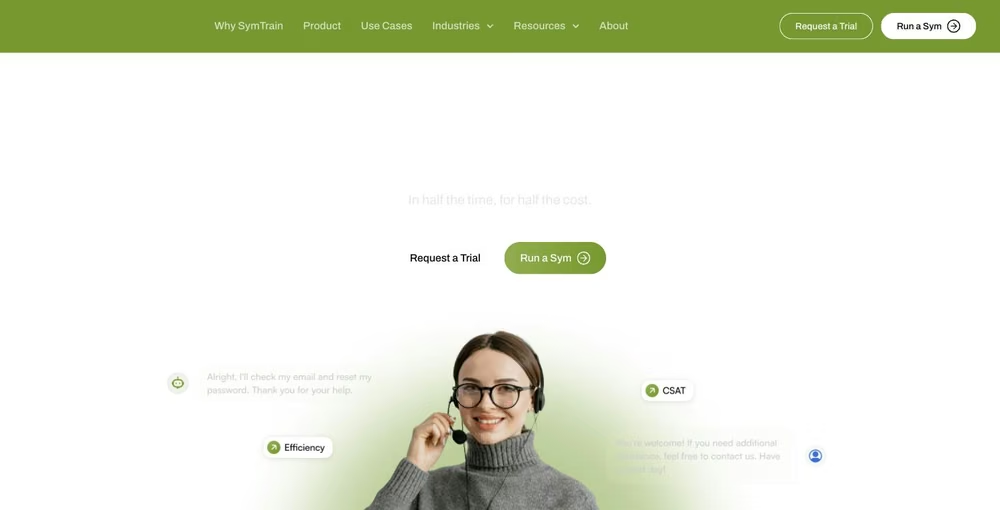
Screenshot: SymTrain (symtrain.ai) homepage, captured August 2026. Source.
SymTrain Pricing
SymTrain does not publish pricing anywhere. There's no `/pricing` page on symtrain.ai, confirmed against a full site crawl, and no plan tiers listed on G2 or TrustRadius.
Every path on the site leads to a trial request, a self-serve "Run a Sym" demo, an ROI calculator, or "Talk to Our Team."
This is a pure enterprise custom-quote motion, consistent with a customer list full of national payers and BPOs.
| What SymTrain publishes | |
|---|---|
| Pricing page | None. No `/pricing` URL exists anywhere on the site's own sitemap. |
| Plan tiers | None published. Every conversion path routes to a demo or trial request. |
| G2 Perceived Cost | 4 of 5 "$" signs in G2's aggregated pricing widget, on the higher end of the scale. |
| G2 cons tags | "Expensive" is one of only five auto-generated con tags pulled from SymTrain's full review set. |
| One real data point | A June 2026 press release discloses one enterprise deal: a 10,000+-agent customer paid $205,000 against a claimed $19.1 million in annual operational value, which works out to roughly $1.71 per agent per month. |
That $1.71 figure is one case study's arithmetic, not a rate card, and it comes from SymTrain's own press release, so treat the ROI multiple with appropriate skepticism.
But it's the only concrete number that exists anywhere for this product, and it lines up with what reviewers are independently saying: SymTrain reads as moderately-to-highly expensive, not cheap.
That also matches a real prospect conversation in our own pipeline, a healthcare/medical-alert buyer who cited SymTrain by name along with a direct cost complaint. Opaque, enterprise-only pricing is a real friction point here, not a hypothetical one. See our health insurance claims call training deep dive for the fuller version of that use case.
SymTrain Features
| Area | What it does |
|---|---|
| Sym Auto Builder | Turns real customer call recordings and metadata into a new simulation in as little as 7 minutes, per SymTrain's own claim |
| Simulation Creation Studio | Drag-and-drop, no-code authoring for building or editing Syms manually |
| Pre-Hire Assessment | Screens job candidates through simulation before hiring; SymTrain claims 3x more candidates screened and up to 22% faster time-to-hire |
| New Hire Onboarding | Aims to shorten or eliminate agent "nesting periods," with a claimed 50% faster path to proficiency |
| Connected Coach | Pushes simulation results into existing LMS, QA, and performance-management tools via SCORM, with automatic pass/fail sync |
| Scoring | Three axes: soft skills (tone, empathy), application and software navigation, and conversation content |
| Healthcare scenario library | Medical claims, patient access, billing, appointment scheduling, plus specialty scenarios like oncology, cardiology, and behavioral health, with a claimed 3-minute turnaround for updating simulations when protocols change |
| Outcome claims | Vendor-reported metrics scattered across marketing pages, with figures that vary by page: roughly 25% NPS/CSAT lift, 40% faster time-to-proficiency, 32% lower average handle time |
| Languages | 6 supported |
| Mobile | No mobile platform, flagged as a con by G2 reviewers |
The Pre-Hire Assessment use case is worth calling out on its own.
Screening candidates through simulation before they're hired is a genuinely distinct application, and it's one Outdoo AI doesn't currently lead with. Worth confirming directly before conceding it in any head-to-head conversation, but on the evidence available, it's real.
What Users Say
SymTrain's review footprint is thin for a company claiming 10,000-plus-agent deployments: 25 reviews on G2, none on Capterra. One of those 25 is explicitly flagged by G2 itself as coming from a business partner of the seller, and excluded from G2's own scoring.
That's a small sample to hang a purchase decision on, so weigh the following accordingly.
The reviews that remain are largely positive on the training experience itself:
"Quality sentiment scores, agent performance and improvement. The tool combines visual and voice simulations, which significantly reduce the time needed for onboarding and coaching." (Soham D., Trainer, Small-Business, 5/5, G2)
"This tool has increased our hands-on time for new hires and is a big contributor for our tenured agents with continuous learning." (Verified User in Consulting, Mid-Market, 5/5, G2)
But the same reviewers flag real friction. Soham D., in the dislikes section of that same 5-star review:
"I liked the product, but if it implements some tonality changes in the AI voices and fixes some bugs, especially the slow performance when handling larger modules, then it would be the best tool to work with." (Soham D., Trainer, G2)
And a manager raised a visibility gap that matters for anyone running training at scale:
"Not being able to control the time to answer a question. Visibility into who has completed the assigned training and who has not. Also, ranking users by completion scores." (Mike F., Director of Operations, Small-Business, 4.5/5, G2)
G2's aggregated tags across the full 25-review set back this up: "Training," "Time-saving," "Intuitive," and "Coaching" as the top praised themes, against "Slow Performance," "Expensive," "Learning Curve," "Completion Delays," and "Bug Issues" as the top complaints.
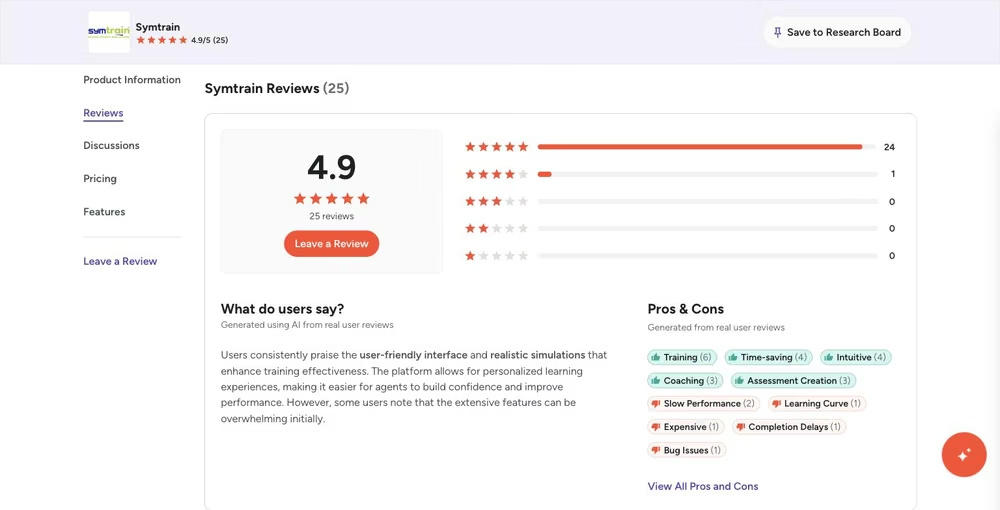
Screenshot: G2 reviews summary for SymTrain, 25 reviews total, with "Expensive" and "Slow Performance" among the top complaint tags. Source.
Where SymTrain Falls Short
It has zero B2B sales-roleplay capability. No multi-persona or committee simulation, no gatekeeper or cold-call screening stage, no LinkedIn-driven persona creation, nothing resembling CRM or workflow-logging practice.
Outdoo AI, by contrast, supports multi-persona roleplay with up to three simulated stakeholders in a single session, plus a dedicated gatekeeper phase for cold-call screening, exactly the committee-selling and prospecting mechanics missing from SymTrain's public materials.
Its unit of practice is a single customer-service call, not a sales cycle, so outside contact-center-training deals it simply isn't a like-for-like alternative to Outdoo AI.
Pricing is opaque and reviewer-perceived as expensive. There's no rate card, no tiers, and the one hard number available comes from a single enterprise case study, not a published price list. Quantified, a roleplay vendor built for pharma, takes a similar custom-quote approach, covered in our Quantified review.
G2's own Perceived Cost score and "Expensive" con tag corroborate what we've already heard directly from a prospect.
Language and mobile coverage are thin. Six supported languages and no mobile platform are real constraints for any distributed or field-based team, and reviewers have already flagged the mobile gap themselves.
Its compliance story is less visible than it should be for a company selling into HIPAA-governed payers. HIPAA only comes up in a gated FAQ answer, not a dedicated, public trust or certifications page the way a buyer evaluating regulated-industry vendors would expect.
Its independent review footprint is thin and not fully independent. Twenty-five G2 reviews, one of them explicitly disqualified by G2 for a seller relationship, and no Capterra presence at all, is a small public record for a company citing 10,000-plus-agent enterprise rollouts.
Where SymTrain Genuinely Wins
Give credit where it's earned. SymTrain's healthcare and regulated-contact-center scenario library is purpose-built, not a generic template stretched to fit.
Named payer and provider customers like UnitedHealthcare and CVS are real proof, and the specialty scenarios (oncology, cardiology, behavioral health) go deeper than a general-purpose sales tool would ever need to.
Pre-Hire Assessment, mentioned above, deserves a second nod here too: it's a real point of differentiation, not a marketing add-on.
Its enterprise scale proof is real: a 10,000-plus-agent customer with a published $19.1 million claimed operational value is a bigger case study than most named competitors in Outdoo AI's own comparison set can point to.
And the reviewers who do exist are clearly satisfied with the day-to-day product. "Training," "time-saving," and "intuitive" as the top G2 tags, from a small but real sample, is not nothing.
How Outdoo AI Compares
The honest framing here matters: SymTrain and Outdoo AI overlap in one specific place, healthcare-payer and insurance contact-center training, and don't overlap almost everywhere else. If you're evaluating both for a medical-alert, claims, or patient-access deal, here's where the real differences sit. See our full health insurance call center training comparison for how Outdoo AI, SymTrain, Zenarate, and Call Simulator stack up specifically for this vertical.
SymTrain builds simulations from real call recordings and metadata, which is a legitimate parallel to Outdoo AI's own Contextual & Adaptive Training approach. Call this one closer to parity than a clean win; both companies made the same bet that generic scripts don't hold up.
Where Outdoo AI pulls ahead is Closed-Loop Coaching: one scorecard spans both roleplay practice and live calls, so a training leader can point to a single number and say coaching moved it.
Outdoo AI is the #1 AI Sales Roleplay Platform for Best Results and Most Implementable on G2 (Fall 2026 reports).
SymTrain's three-axis scoring stays inside the simulation itself; nothing in its public materials ties that score back to live-call performance data the way Outdoo AI's does.
Outdoo AI also scores the post-call CRM and workflow simulation step inside the same practice session, something nothing in SymTrain's feature set claims to do. For contact centers where the after-call work (claims documentation, billing notes) is as error-prone as the conversation itself, that's a real, mechanical difference.
Pricing is the clearest wedge. SymTrain's opaque, enterprise-only quote process is a documented friction point for its own reviewers, and it's the exact objection a real prospect in this vertical raised before ever engaging Outdoo AI.
Usage-based pricing that scales with actual training activity is a plainer, more defensible story to bring into a budget conversation.
Outdoo AI isn't limited to outbound B2B sales scenarios, either. It has a dedicated claims roleplay training solution built for the exact claims-handling conversations SymTrain specializes in, so a healthcare or insurance buyer isn't forced to pick between two unrelated categories. Our claims call training piece covers that use case in depth.
And on scale mechanics: Outdoo AI's 120+ languages and 74+ voice-supported languages against SymTrain's six, plus mobile support that SymTrain's own reviewers say is missing, matter for any distributed or multilingual contact-center workforce.
None of this makes SymTrain a weak competitor. In a healthcare-payer or insurance-contact-center deal specifically, it's a real, well-resourced one. Outside that lane, it's simply not building the same product.
Frequently Asked Questions
.svg)
Yes, in almost every case. "SimTrain" is a common mishearing of SymTrain (symtrain.ai), the AI simulation platform for contact-center training reviewed here.
No. There's no pricing page anywhere on symtrain.ai, and the only concrete figure available comes from a single enterprise case study in a June 2026 press release, not a rate card. Every deal goes through a custom quote. Outdoo AI starts free with 60 minutes of roleplay credits and unlimited team members, no credit card and no sales call, then scales on usage-based Flex pricing with a custom enterprise plan for larger deployments.
No. SymTrain's practice unit is a single customer-service-style interaction (a claims call, a billing dispute, a patient-scheduling request), not a multi-stage sales cycle. It has no multi-persona, gatekeeper, or CRM-workflow practice features.
Both build simulations from real calls, but Outdoo AI grades roleplay practice and live calls on one scorecard, scores the post-call workflow step, and publishes usage-based pricing against SymTrain's opaque, enterprise-only quotes. See the full head-to-head for health insurance call center training for the detailed comparison.
Yes. SymTrain's Pre-Hire Assessment feature screens job candidates through simulation before they're hired, with a claimed 3x increase in candidates screened and up to 22% faster time-to-hire.
Table of Contents
Talk to Sales
Have questions about training and enablement for your sales, CS, support, or leadership team? Let's talk.
Talk to Sales