



Who Is Zenarate Best For?
- Zenarate: Best for large regulated contact centers in banking, insurance and BPO. It bundles onboarding, QA and coaching in one suite, with a 200-learner minimum.
- Zenarate Evolve: Best for companies that want no-code AI voice and chat agents for tier-1 and tier-2 customer interactions, not training humans.
- Outdoo AI: Best for B2B sales teams that want AI roleplay built from their own calls and playbooks. One scorecard covers roleplay and live calls, with no learner minimum.
At a Glance
| Zenarate | |
|---|---|
| Best for | Large regulated contact centers (banking, insurance, BPO) needing onboarding, QA, and coaching in one suite |
| Pricing | Not published anywhere. Vendor-quoted floor: 200-learner minimum, ~$80,000/yr plus ~$25,000 year one, so ~$105,000 to start. Analyze is metered on top |
| Core products | Learn, Analyze, Coach, and Evolve (agentic AI agents, launched June 2026) |
| G2 rating | 4.9/5 across 33 reviews |
| Known gap | No dedicated sales-roleplay identity; reviewers flag linear simulations and feedback that's too generic for tenured reps |
What Is Zenarate?
Zenarate is an AI conversation simulation and coaching platform for large contact centers, which it sells as a "frontline performance platform." Its customer list backs that up: USAA and Ally Bank, large, regulated enterprises in banking and insurance running contact centers.
The suite is organized around four products. Learn covers AI conversation simulations and software/systems simulations, so an agent can practice a POS or CRM transaction alongside the conversation itself, plus learning paths and AI tutoring.
Analyze is Zenarate's conversation-intelligence layer: AutoQA, automated call review, KPI analysis, and live agent assist.
Coach delivers personalized coaching in the agent's actual workflow, with an AI Tutor for adaptive learning and a leadership-development track for frontline managers.
And Evolve, launched June 24, 2026, is new: a no-code platform for building agentic AI voice and chat agents that handle real tier-1 and tier-2 customer interactions, not just training simulations for humans.
That last piece matters for how you should read the rest of this review. Zenarate CEO Brian Tuite framed Evolve this way in the launch release: "Customers don't care who helps them. They care about having a great experience and getting their problem solved."
That's a company betting on a blended human-plus-AI frontline workforce, which is a different and broader strategy than training humans to sell better.
Zenarate's own site architecture confirms where sales training sits in that picture.
It's organized around industries (healthcare and insurance, banking and financial services, travel and hospitality, telecom, retail, BPO) and use cases, sales training being one of seven, alongside customer service, new-hire onboarding, pre-hire assessment, leadership training, and tenured-agent upskilling. See our health insurance call center training comparison for how Outdoo AI stacks up against Zenarate specifically for that vertical.
Sales isn't the product. It's a use case bolted onto a much wider contact-center platform.
The company acquired Bright, an LXP and immersive-learning vendor, in September 2024, which is where its certification and learning-path capability comes from.
Zenarate Pricing
Zenarate does not publish pricing anywhere, and this isn't a case of a hard-to-find page. We checked three independent ways.
The direct URL, zenarate.com/pricing, leads to no working pricing page. Zenarate's own sitemap lists zero pricing, product-overview, or comparison pages on the entire domain.
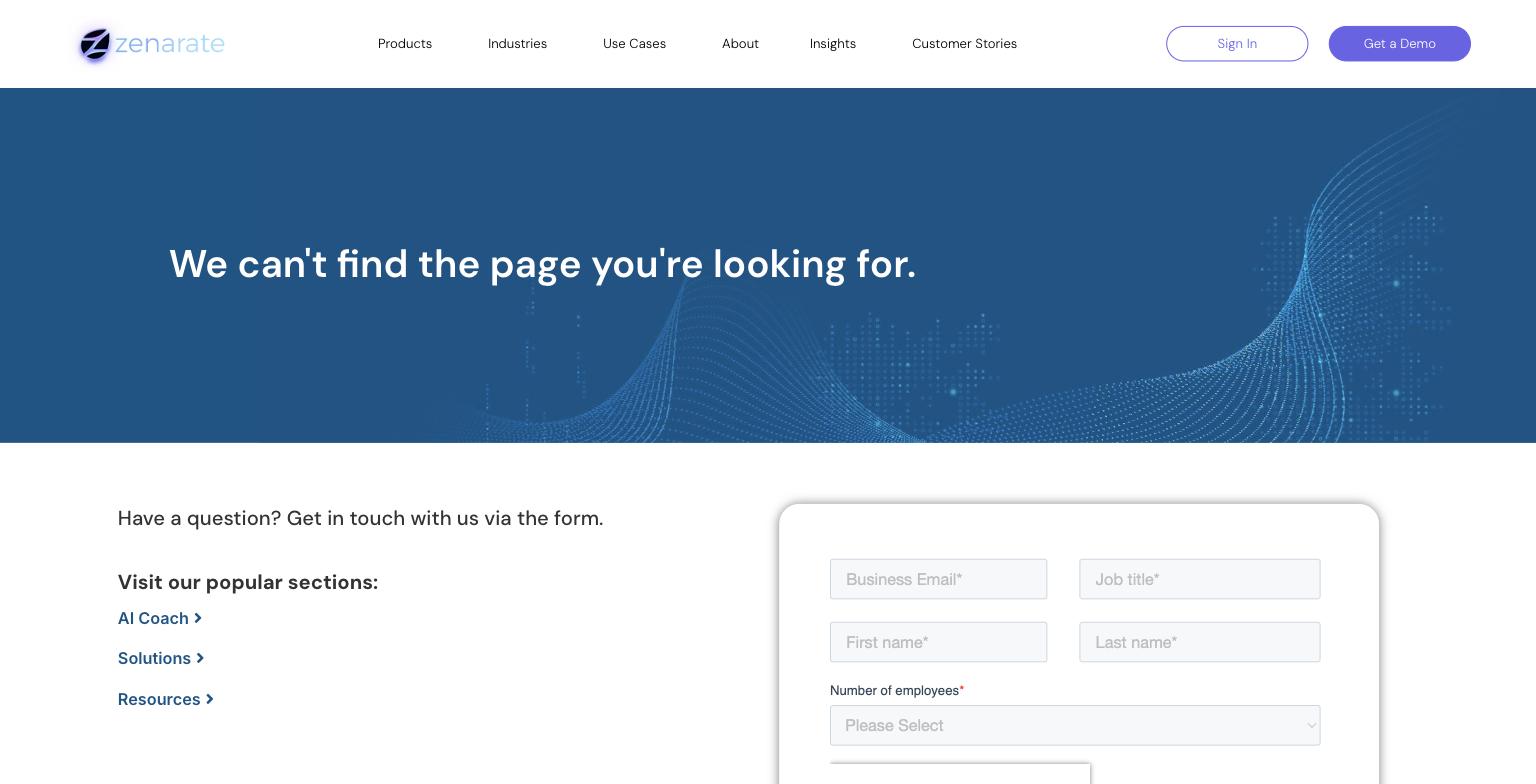
Screenshot: Zenarate's pricing page leading to no working page, captured August 2026.
And third-party listings agree: Capterra's Zenarate profile shows "Contact vendor for pricing," with no free trial and no free version, while TrustRadius, Software Finder, and research.com all independently describe it as custom-quote-only with no plans listed.
| What we checked | What we found |
|---|---|
| zenarate.com/pricing | No pricing page exists at that URL |
| Zenarate's sitemap | No pricing, product-overview, or comparison pages anywhere on the domain |
| Capterra | "Contact vendor for pricing," no free trial, no free version |
| Quoted by Zenarate's sales team (September 2026) | 200-learner minimum, around $80,000 a year at that floor plus about $25,000 in year one |
| TrustRadius / research.com / Software Finder | Custom-quote-only, no plans listed |
|---|
There is no published number to anchor against here, only the sales-quoted floor in the table above. That's consistent with a vendor selling almost exclusively to large regulated enterprises through a full sales cycle. Quantified sells the same way to pharma and life sciences teams, as our Quantified review and pricing breakdown shows.
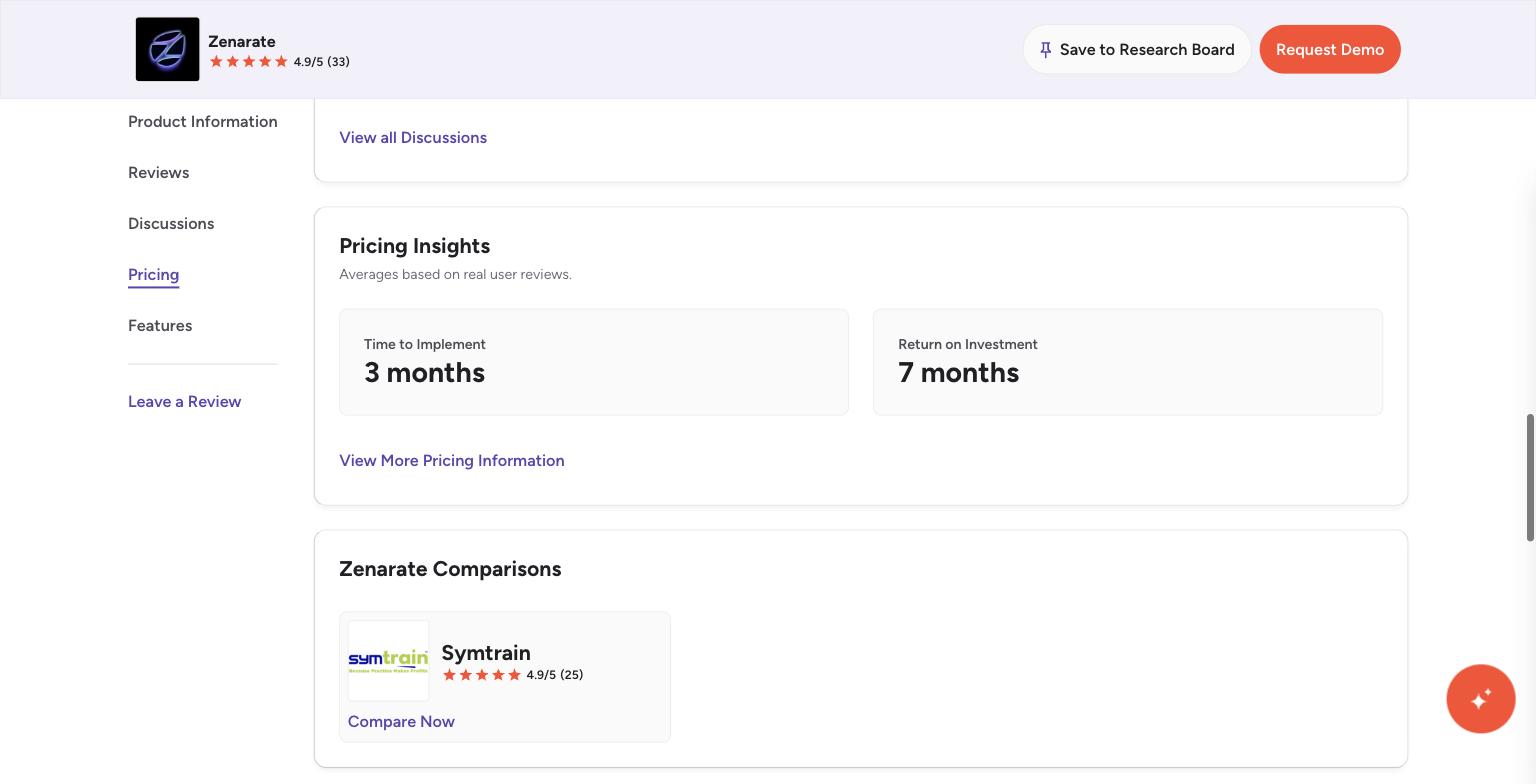
Screenshot: Zenarate G2 pricing insights, showing a self-reported ~3-month implementation and ~7-month payback period, captured August 2026.
The one indirect signal available comes from G2's aggregated pricing insights widget, not Zenarate itself, which shows buyers self-reporting roughly a 3-month implementation and a 7-month ROI. That's directional evidence of cost and time investment, not a price.
It also means a buyer can't self-qualify on budget before booking a call, which matters more for a mid-market sales team evaluating a roleplay tool than it does for a bank that's already committed to an enterprise procurement process.
The minimum is the part that decides most evaluations: at a 200-learner floor a 50-seat or even a 150-seat team cannot buy Zenarate at any price, and Analyze is a separate usage-metered line item on top.
Worth asking which simulations are unlimited. Software simulations are. Generative and avatar simulations run on a token allocation, and Zenarate's own team advised rationing avatars. The unlimited tiers run on an NLP and intent engine whose stated advantage is that AI model tokens are not required, so guided mode feeds the learner verbatim lines and unguided feeds behavioural prompts, while only the metered generative mode is genuinely unscripted. Zenarate's own materials name Sales as a use case that needs the generative kind.
Outdoo AI has no learner minimum and does not meter the unscripted mode separately, so a 40-rep team can start without clearing a floor.
Zenarate Features
Zenarate's simulation product is genuinely capable on paper. Conversations are described as "GenAI-powered" and open-ended, meaning reps navigate discovery calls, objection handling, and upsell moments that don't follow a fixed branch.
Training can align to named methodologies like MEDDPICC, Challenger, and SPIN, or to a company's own call flow, and every simulation generates an AI scorecard with immediate feedback.
The feature that stands out most, and the one closest to an actual Outdoo AI overlap, is blended software and systems simulation: agents practice the conversation and the underlying POS or CRM transaction workflow in the same session.
That's the same basic idea behind Outdoo AI's own workflow simulation feature, and Zenarate has it live in real retail and BPO deployments, which is worth taking seriously rather than dismissing.
Beyond the roleplay itself, Analyze adds AutoQA, KPI analysis, and live agent assist, essentially a conversation-intelligence layer for reviewing real calls at scale.
Coach/Perform pushes personalized coaching into the agent's day-to-day workflow.
And Evolve, the newest piece, lets a company stand up no-code AI voice and chat agents for actual customer interactions, with more than 100 integrations, explicitly built to share the same training standards as the human side of the operation.
What's notably absent from every page we reviewed: multi-persona or multi-stakeholder roleplay, a video avatar roleplay mode, a dedicated gatekeeper or cold-call-screening phase, broad multi-lingual voice roleplay, and any agent-tooling or MCP-style integration story.
None of that is confirmed as permanently missing, but it doesn't show up anywhere on the current site, and it's a meaningfully different feature set than what B2B sales-roleplay-first tools ship today.
What Users Say
Zenarate's G2 page carries a strong aggregate score, 4.9 out of 5 across 33 reviews, and it holds G2 badges for Contact Center Quality Assurance, Sales Training and Onboarding, Best Support, and Easiest To Do Business With.
G2 blocked direct access to the review pages themselves during our research, so the quotes below come from indexed search snippets rather than a live page load. We're confident they're real G2 text, but attribution details like reviewer title and company size weren't recoverable.
On the positive side:
"I love that this platform removes the element of feeling self-conscious about practice and developing new skills. It's not often that a learning environment can be created where it's safe to struggle and learn from your experiences to become more confident." (G2, Zenarate AI Coach reviews)
"I'm still looking for a downside. If I think of anything, I'll let you know." (G2, Zenarate AI Coach reviews)
On the critical side, the pattern that shows up repeatedly is a lack of flexibility:
"Simulations can feel somewhat linear, resulting in a less natural learning flow; the AI's responses can lack flexibility, which can restrict the natural flow of learning." (G2 pros/cons aggregation for Zenarate AI Coach)
Reviewer feedback also points to a ceiling for more experienced agents: reps "who had already developed basic skills did not feel like they benefited as much from Zenarate's role-playing scenarios and performance feedback, because the feedback wasn't nuanced or detailed enough to pinpoint exactly what behaviors needed to change and how" (paraphrased from G2 pros/cons aggregation, not a direct quote).
To Zenarate's credit, at least one reviewer flagging the linearity complaint also noted the company's newer GenAI Simulator as an active fix in progress. Treat this as a real, recurring pattern worth asking about directly on a demo call, not a permanent, uncontested gap.
Zenarate has zero reviews on Capterra despite an active listing there, so G2 is currently the only independent review source available.
Where Zenarate Falls Short
Zenarate isn't a sales-roleplay product with a coaching layer bolted on. It's a contact-center performance suite where sales training is one use case out of seven. SymTrain takes a similar contact-center-first approach, covered in our SymTrain review.
If your actual need is dedicated B2B sales roleplay, you're evaluating a platform whose center of gravity is somewhere else: customer-service QA, new-hire onboarding, and now agentic customer-service automation.
Pricing opacity is real and total, not just a missing published rate. Beyond the sales-quoted floor, there's no rough estimate reviewers or analysts cite, nothing.
Every credible source, from the vendor's own sitemap to three separate third-party aggregators, confirms the same thing: you go through a full enterprise sales cycle before you learn what it costs.
The review base is thin. 33 total G2 reviews and zero on Capterra is a small sample for a company with USAA and Ally Bank as customers, and it limits how much independent verification is available beyond the vendor's own case studies.
And the product feedback itself points to real gaps. Reviewers describe simulations as sometimes linear, with AI responses that can feel inflexible, which cuts against the "open-ended, realistic" framing on Zenarate's own marketing pages.
More experienced reps specifically report that feedback isn't granular enough to tell them what to actually change.
Neither issue is fatal, but both are consistent enough across review language to take seriously rather than write off as noise.
If a narrower contact-center fit or an opaque enterprise sales cycle is reason enough to keep looking, our guide to Zenarate alternatives covers the wider field.
Where Zenarate Genuinely Wins
Give credit where it's due. Zenarate's enterprise contact-center pedigree is real and hard to dismiss.
USAA and Ally Bank are large, multi-year, regulated-industry deployments, and Zenarate has published quantified ROI behind at least one of them, citing $4.25M in annual productivity gains at a top-5 Canadian bank.
That's a scale of proof most roleplay-first vendors, Outdoo AI included, don't yet have in banking and insurance.
The blended conversation-plus-systems simulation is also legitimately strong, and it's live in real retail and BPO accounts today. If your use case is agents who need to practice a sales conversation and a POS or CRM transaction together, this is a matchup worth real scrutiny, not an assumed win for a roleplay-first competitor.
And the Evolve launch is a genuinely different, well-resourced bet, not a feature-parity gap dressed up as an advantage. Building actual AI agents that handle live tier-1 and tier-2 customer interactions puts Zenarate into agentic CX automation, a space Outdoo AI doesn't compete in at all.
If a buyer's real interest is reducing live-agent headcount with AI rather than training humans to sell better, Zenarate now has an answer that a sales-roleplay platform simply doesn't.
How Outdoo AI Compares
Outdoo AI isn't trying to be a contact-center suite. It's built specifically for B2B revenue teams, and that focus shows up in exactly the places where Zenarate's breadth thins out.
Zenarate scores simulations against methodology alignment or a company's own call flow. Outdoo AI builds roleplays directly from a team's own calls, transcripts, playbooks, battlecards, and even LinkedIn profiles, so reps are practicing against their actual deals and prospects, not a generic simulation.
And where Zenarate's roleplay scoring and Analyze's real-call QA live in separate parts of the suite, Outdoo AI runs one scorecard across both roleplay practice and live calls, so a sales leader can show that coaching moved real pipeline numbers, not just completion rates.
Pricing is the sharpest contrast. Zenarate publishes no number at all, so the only figure is a sales quote. Outdoo AI prices on usage, so a team pays for training that's actually driving activity instead of an opaque enterprise quote you can't get without a sales call.
Zenarate isn't the only one with quantified proof, either. Outdoo AI customers report ramp times up to 53% faster once new-hire roleplay and live-call performance sit on a single scorecard, the same closed-loop model that Zenarate's separate Learn and Analyze modules don't structurally offer today.
Two honest concessions. Zenarate's blended systems simulation for retail and BPO environments is more battle-tested in that specific use case than Outdoo AI's workflow simulation feature, which is younger.
And Evolve's move into agentic AI customer-service agents is a real strategic bet into a space Outdoo AI doesn't touch, so if that's what you're actually shopping for, Zenarate is the more relevant vendor, full stop.
For everything else in B2B sales, capabilities like multi-persona roleplay for committee-based deals, a gatekeeper phase for cold-call screening, video avatar roleplay, and 120+ languages of coverage, Outdoo AI has live features with no equivalent found anywhere on Zenarate's public site.
Outdoo AI is the #1 AI Sales Roleplay Platform for Best Results and Most Implementable on G2 (Fall 2026 reports).
Frequently Asked Questions
.svg)
Pricing quoted by Zenarate's sales team in September 2026 put the floor at a 200-learner minimum, around $80,000 a year plus about $25,000 in year one, so roughly $105,000 to get started, with Analyze metered separately on top. That is list pricing rather than published pricing, so your own quote may differ. Nothing is published: the pricing page doesn't exist, the sitemap lists no pricing pages, and every third-party listing describes it as custom-quote-only. Below 200 learners you cannot buy it at any price. Outdoo AI starts free with 60 minutes of roleplay credits and unlimited team members, no credit card and no sales call, then scales on usage-based Flex pricing with a custom enterprise plan for larger deployments.
Primarily contact centers. Sales training is one of seven use cases on Zenarate's site, alongside customer service, onboarding, pre-hire assessment, and leadership training. Its core customers, USAA and Ally Bank, are large regulated enterprises, not B2B sales orgs.
For B2B sales roleplay specifically, yes. Outdoo AI builds AI sales roleplay from a team's own calls and playbooks, scores roleplay and live calls on one scorecard, and prices on usage. It doesn't compete with Zenarate's contact-center QA breadth or its Evolve agentic-AI product, which serve a different job entirely.
G2 reviewers describe some simulations as linear with AI responses that can lack flexibility, and more experienced reps report the feedback isn't detailed enough to pinpoint exactly what to change. Zenarate has zero reviews on Capterra, leaving G2 as the only independent review source.
Yes. See our Zenarate alternatives roundup for a complete side-by-side on pricing, roleplay structure, and scoring.
Table of Contents
Talk to Sales
Have questions about training and enablement for your sales, CS, support, or leadership team? Let's talk.
Talk to Sales