



Who Is Quantified Best For?
- Quantified: Best for pharma and life sciences reps delivering on-label messaging to HCPs. ComplianceGuard AI scores practice against approved messaging and produces audit-ready transcripts for MLR review.
- Hyperbound: Best for teams where practice frequency is the priority. Quantified's own vs-Hyperbound page frames it as the better pick in that case.
- Outdoo AI: Best for sales, support and success teams outside that narrow regulatory scope. One scorecard runs across roleplay practice and live calls, and roleplays are built from a team's own calls, transcripts and playbooks.
At a Glance
| Quantified | |
|---|---|
| Best for | Pharma, life sciences, and other regulated industries |
| Packages | AI Roleplay, or AI Sales Coaching Platform (adds Readiness Coaching, Field Coaching, Insights) |
| Pricing | Custom quote only, no published rate card, no self-serve tier |
| Free trial | None, every deal starts with a sales-led demo |
| G2 rating | 4.5/5 from 16 reviews |
What Is Quantified?
Quantified (quantified.ai) is an Austin, Texas company selling an AI sales coaching and roleplay platform for commercial teams in regulated industries. Pharma and life sciences come first, with financial services, insurance, and medical devices as secondary verticals.
Everything about the product is built around one problem: proving reps can deliver approved, compliant messaging at scale, with a record legal and regulatory teams will actually accept.
The platform bundles six or seven "AI agents" on what Quantified calls an Adaptive AI engine.
The core pieces are AI Roleplay (video-avatar practice conversations), Readiness Coaching (onboarding and certification prep), Field Coaching (pre-call prep, post-call debriefs, live-call analysis), Compliance & Governance, Self-Authoring (build simulations from your own approved content), and Insights & Reporting.
Named enterprise customers include Novartis and Sanofi. Quantified is SOC 2 Type II certified and integrates with Salesforce, Veeva, Workday, and Okta, plus common LMS platforms.
That customer list and that integration set aren't accidental. Veeva is the system of record for most pharma commercial teams, and a vendor that plugs into it natively has already cleared a bar a lot of competitors haven't.
Quantified Pricing
Quantified doesn't publish a rate card. Its own pricing page says so directly: pricing depends on field team size and which package you deploy, so it's quoted per organization instead of published.
There's no free trial. You request a demo, and someone gives you a number.
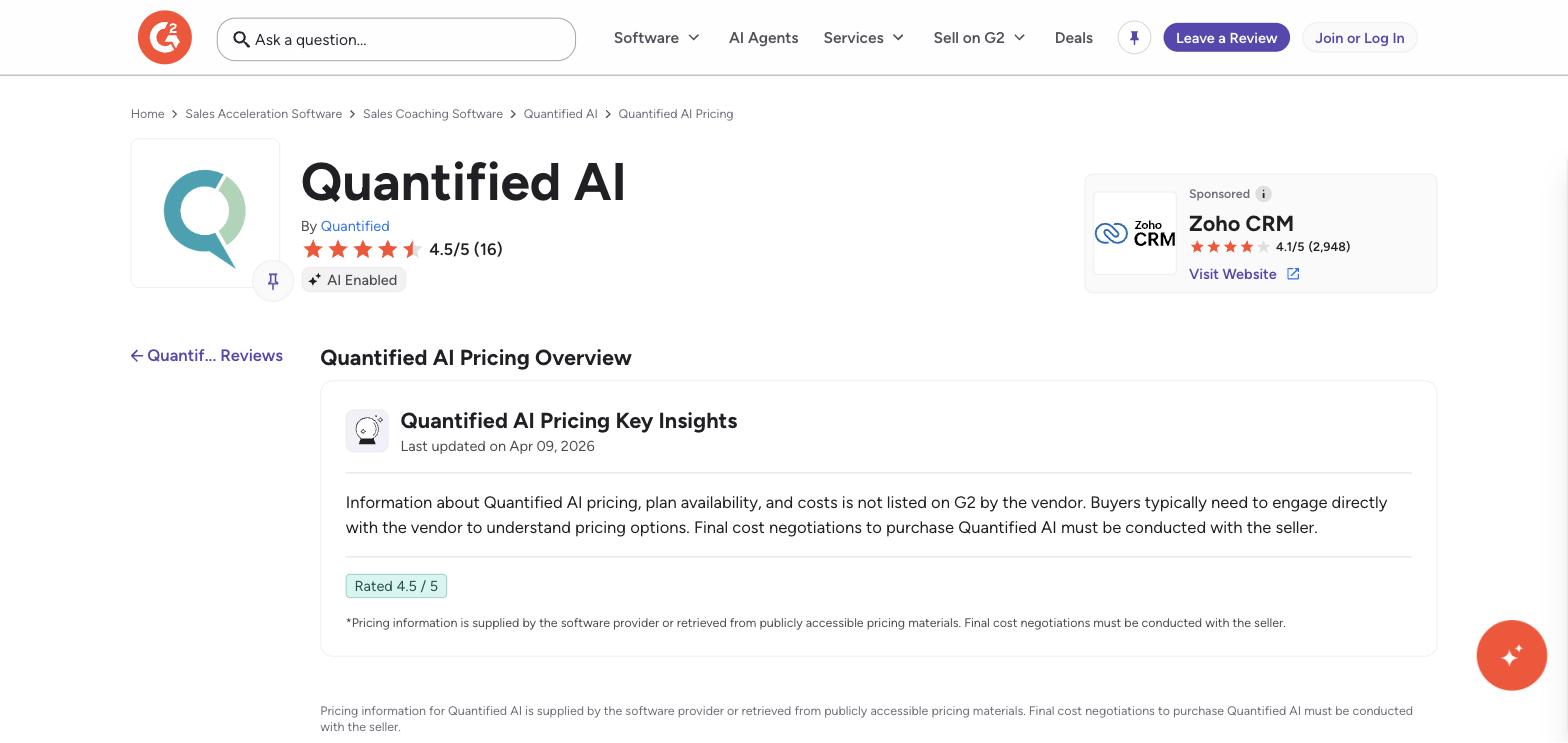
Screenshot: Quantified pricing overview on G2, captured August 2026.
Two packages are named on that page:
| Package | What's included | How you get pricing |
|---|---|---|
| AI Roleplay | Practice and certification roleplay, self-authoring, reporting, compliance guardrails | Custom quote, sales-led |
| AI Sales Coaching Platform | Everything above, plus Readiness Coaching, Field Coaching, and Insights | Custom quote, sales-led |
Quantified's sales team quoted a figure in 2026, which is firmer than anything the aggregators carry: roughly $750 per user per year, with a $550 floor at volume, and its own worked example for a 50-seat team landing at about $27,500. That is list pricing rather than published pricing, so your own quote may differ. The AI Sales Coaching Platform package adds 25% on top.
The number that decides availability is the $25,000 annual minimum. For any team under roughly 33 seats the floor sets the price rather than the headcount, so a 20-rep team pays the same as a 33-rep team and the effective per-seat cost climbs as the team gets smaller. Admin seats are included free.
Outdoo AI has no annual floor and no seat minimum, so a 20-rep team pays for what 20 reps actually train.
For context, the third-party estimates below predate that quote and disagree with each other, which is why they are worth reading as estimates rather than figures.
One third-party roundup of AI sales roleplay pricing, no longer online, put per-user cost at $60 to $85 a month, plus setup and service fees, with enterprise contracts running higher once volume discounts kick in.
Other pre-quote estimates land in a different place entirely. Software Finder cited $85 to $110 per user per month, and a separate estimate put entry deals closer to $30 to $40 per user per month with annual minimums around $20,000. Neither matches the ~$750 a year Quantified itself quoted, which is why they are listed here as history rather than as a range to budget against.
That's roughly a 3x spread across sources that don't agree with each other, let alone with Quantified. A separate competitor comparison also describes Quantified as a Fortune 500-only vendor, with custom contracts expected in the five to six figure range annually.
None of these numbers come from Quantified itself. Treat all of them as directional, not a quote you can hold the vendor to.
The practical takeaway: if your organization isn't the size and shape of a pharma enterprise account, you're probably not the buyer Quantified's sales process is built for, and no amount of third-party guessing will tell you your actual price before a sales call does.
Quantified Features
Roleplay and practice. AI Roleplay uses video avatars for simulated HCP or prospect conversations, and Conversation Engine 3.0, shipped April 2025, improved the realism of those exchanges.
A June 2025 upgrade let avatars "see and respond to materials" held up to the camera, a genuinely useful feature for pharma detailing, where reps practice presenting physical visual aids.
This is a real, currently unmatched capability if visual-aid detailing is core to your reps' job.
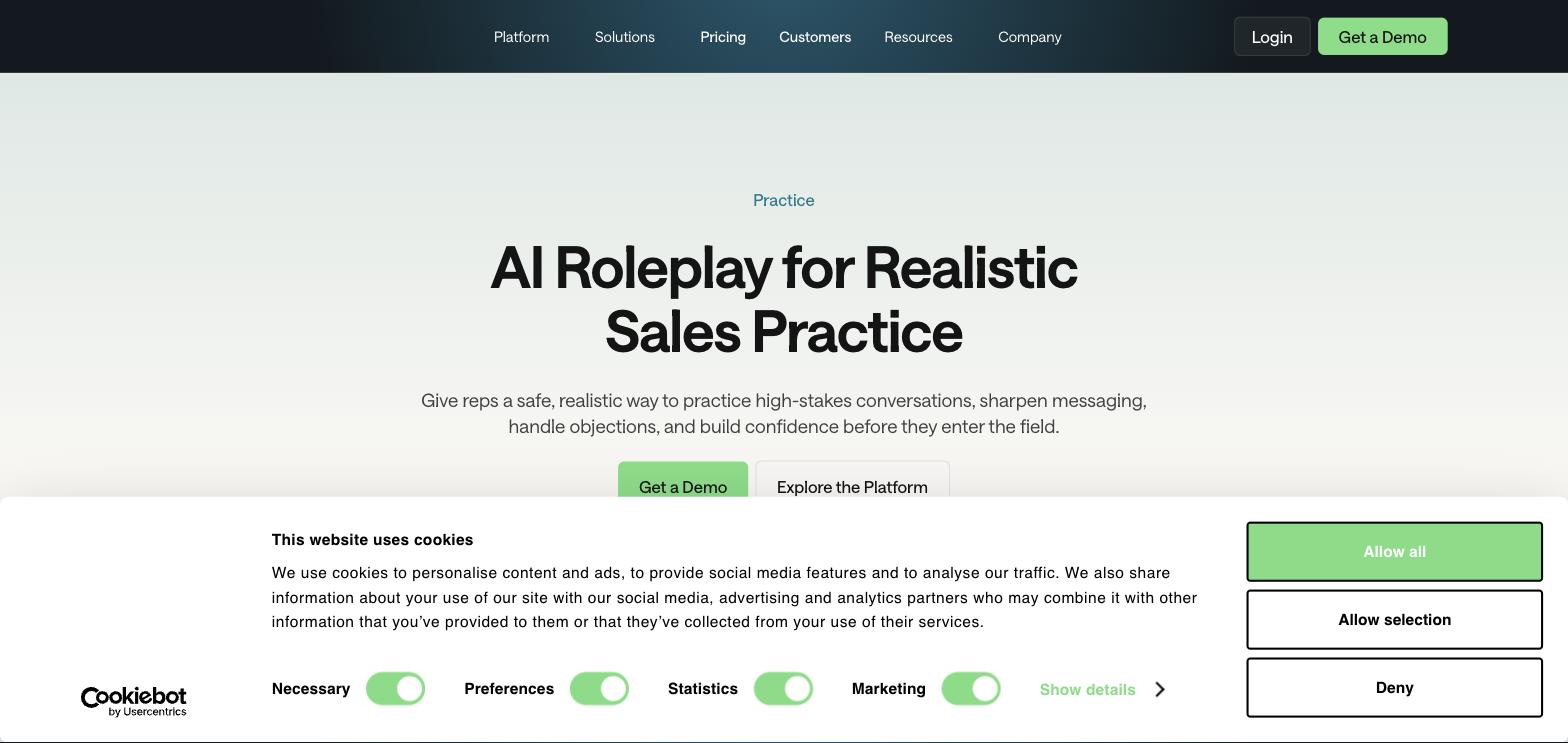
Screenshot: Quantified AI Roleplay feature page, captured August 2026.
Compliance and governance. ComplianceGuard AI is the platform's center of gravity. It scores conversations against approved, on-label messaging, flags off-label language, and produces audit-ready transcripts built for MLR (medical-legal-regulatory) review.
It runs on a private, fine-tuned LLM rather than a general-purpose model wrapper, which is the basis of Quantified's "purpose-built, not adapted from horizontal AI" pitch.
Coaching beyond the roleplay. Readiness Coaching handles onboarding and certification pathways.
Field Coaching covers pre-call prep, post-call debriefs, and live-call analysis, Quantified's version of coaching that extends past the practice session.
Self-Authoring lets internal teams build simulations from their own approved scripts and content.
Reporting and admin. Insights & Reporting tracks readiness, proficiency, and compliance adherence for managers. Adaptive AI personalizes practice and feedback by rep role, experience level, and business context, trained, per Quantified's own marketing, on more than 15 billion data points.
Quantified publishes vendor-supplied results including a 40% reduction in time to readiness, a 6x increase in rep practice, and a 19% lift in good selling outcomes platform-wide. Its Bayer case study separately claims a 97% mastery rate across 500-plus reps and 5,000-plus simulations run in 10 days. These are the company's own claims, unverified by any third party, so weigh them accordingly.
What Users Say
Independent review coverage of Quantified is thin, and there is little independent reviewer text to quote directly for this piece.
What is verifiable and attributed comes straight from Quantified's own site, which does put real names and titles behind its praise rather than hiding behind anonymous marketing copy:
"Quantified's AI personas enabled us to scale our training without pulling people out of the field." Keenan Stare, Product and Disease Training Manager, Novartis
"With Quantified we really felt that we found our solution." Chrissy Richards, Director of Commercial Training, Sanofi
"Reps felt more prepared walking into HCP conversations and weren't just certified. They were confident." Kathy Driscoll, Bayer
Read these as vendor-published testimonials, not a random sample of customer sentiment. They're worth something because the names and companies are real and checkable, but a company only publishes the quotes that make it look good.
The bigger signal is what's missing: no accessible body of independent G2 or TrustRadius review text to weigh against the vendor's own picks.
That points to a smaller, less review-active user base than category names like Second Nature or Highspot.
What we could confirm directly: G2 lists Quantified AI at 4.5/5, but from just 16 reviews total. That's a real, checkable number, and it's a thin sample to base a purchase decision on next to categories with hundreds of reviews.
It's not a red flag by itself, but it's a reason to ask for reference calls instead of leaning on review-site volume.
Where Quantified Falls Short
No pricing transparency, no trial. You can't self-serve, test a package, or benchmark cost against a rate card. Everything runs through a sales-led quote process, which filters out exactly the mid-market buyers who want to move fast.
Third-party estimates on what that quote might land on span roughly $30 to $110 per user per month depending on the source, a 3x range that tells you more about how little is public than what you'll actually pay.
Narrow by design. Quantified's own comparison pages admit this. Its vs-Hyperbound page frames a roleplay-focused competitor as the better pick if practice is your priority, and positions itself as the choice when certifying reps on compliant messaging is the goal.
That's a tacit admission that roleplay frequency and realism, the thing most sales teams actually want daily, isn't the platform's central strength. Certification is.
Thin evidence outside regulated verticals. There's no public sign of multi-persona roleplay, a gatekeeper or cold-call screening phase, or any simulation of post-call workflow and CRM logging.
Field Coaching covers live-call analysis and debriefs, but that's scoped to the call itself, not the process work that comes after it.
Enterprise-only positioning. Third-party sourcing puts contracts in the five-to-six-figure annual range for Fortune 500 accounts. If you're not that buyer, expect a long sales cycle before someone tells you that.
If that opacity is reason enough to look beyond Quantified altogether, our guide to Quantified alternatives covers the wider field.
Where Quantified Genuinely Wins
Credit where it's due.
If your core need is regulated pharma or HCP messaging compliance, MLR-style on-label scoring, audit-ready transcripts built specifically for regulatory review, a private fine-tuned LLM instead of a general model, Quantified may legitimately be the better-fit, more mature vendor for that narrow use case.
Its named customer list (Novartis, Sanofi) reflects real depth in that vertical, not marketing gloss.
The visual-material-recognition feature in AI Roleplay, avatars responding to physical detail aids shown on camera, is a genuinely unmatched capability for pharma detailing specifically, and it only launched in mid-2025.
SOC 2 Type II certification and native Veeva integration also matter a great deal to pharma commercial IT buyers evaluating vendor risk.
If your evaluation criteria are built around those things, Quantified deserves a serious look.
How Outdoo AI Compares
Outdoo AI isn't trying to out-compliance Quantified in regulated pharma, and we won't pretend otherwise. Where the two platforms diverge is in what happens for everyone else.
Outdoo AI runs one scorecard across both roleplay practice and live calls, so leaders can show that coaching moves real revenue numbers, not just completion rates, a gap Quantified's certification-first model doesn't close.
Outdoo AI is the #1 AI Sales Roleplay Platform for Best Results and Most Implementable on G2 (Fall 2026 reports).
That's not a small philosophical difference. Quantified's own pharma materials argue that recording live HCP calls creates discoverable legal and regulatory exposure, an explicit case for simulation instead of real-call capture. Outdoo AI makes the opposite bet: real calls are the highest-signal training data a team has, so they belong on the same rubric as practice, not walled off from it.
Outdoo AI's roleplays are also built directly from a team's own calls, transcripts, playbooks, and battlecards rather than a fixed rubric.
Reps rehearse the actual post-call CRM and workflow logging in the same session through workflow simulation, not just the conversation itself.
None of that shows up anywhere in Quantified's public materials.
Outdoo AI also runs on usage-based pricing instead of the sales-led, enterprise-only quote model Quantified requires for every deal, which matters if your team isn't shaped like a Fortune 500 pharma commercial org. It's a real contrast next to a vendor whose own third-party pricing estimates can't agree within 3x of each other.
For the full side-by-side on pricing, workflow scoring, and language coverage, see our Quantified AI alternatives roundup.
If your reps are HCP-facing and your buying process centers on MLR review, Quantified is worth evaluating on its own terms. If you're anywhere else in the org, or in a different industry entirely, Outdoo AI is built for that gap.
Frequently Asked Questions
.svg)
No. There's no self-serve trial. Every engagement starts with a sales-led demo and a custom quote. Outdoo AI starts free with 60 minutes of roleplay credits and unlimited team members, no credit card and no sales call, then scales on usage-based Flex pricing with a custom enterprise plan for larger deployments.
Quantified doesn't publish pricing. Its sales team quoted roughly $750 per user per year in 2026, with a $550 floor at volume, above a $25,000 annual minimum, and its own 50-seat example came to about $27,500. The Coaching platform package adds 25%. That is list pricing rather than published pricing, so your own quote may differ.
That's its primary focus, with financial services, insurance, and medical devices as secondary verticals. It's built around regulated, compliance-heavy selling, not general B2B sales practice.
If your core need is MLR-grade on-label compliance scoring, Quantified is a legitimate, mature option worth evaluating directly. Outdoo AI is the stronger fit for teams outside that narrow regulatory scope, or for the rest of a pharma org beyond HCP-facing reps.
Quantified integrates with Salesforce, Veeva, Workday, and Okta, plus common LMS platforms. It's also SOC 2 Type II certified, and its native Veeva integration matters to pharma commercial teams since Veeva is the system of record for most of that industry.
Table of Contents
Talk to Sales
Have questions about training and enablement for your sales, CS, support, or leadership team? Let's talk.
Talk to Sales