



9 AI Tools for Insurance Companies in 2026

Compare the 9 best AI tools for insurance companies in 2026. See features, pricing, and use cases across AI roleplay and coaching, claims automation, fraud detection, agency management, and contact center intelligence.
Siddhaarth Sivasamy
Siddhaarth Sivasamy
Sales coaching & Sales training
Published:
June 17, 2026
Updated:
June 19, 2026
Summarize this article with AI
TL;DR
  • Claims experience is the biggest driver of policyholder retention: According to J.D. Power research, 80 percent of auto insurance customers with a poor claims experience said they had already left their insurer or were planning to. The conversation, not just the process, is what gets remembered.
  • The 9 tools fall into five categories: AI roleplay and coaching, claims automation and fraud detection, sales and agency management, contact center conversation intelligence, and compliance and risk analytics. Most insurers need more than one category, not a single platform.
  • Outdoo AI closes the first-call readiness gap: Roleplay built from real claims and sales calls, built-in conversation intelligence on live calls, unified scoring, and closed-loop coaching, with 120+ integrations and roleplays in 74+ languages, connect certification programs to how reps and adjusters actually perform.
  • Most claims and underwriting AI platforms use custom, unpublished pricing: Shift Technology, Tractable, EvolutionIQ, AgentSync, and Gradient AI are all enterprise custom-quoted. Observe.AI, EZLynx, and NICE CXone publish at least starting price ranges, while Outdoo AI offers a free tier alongside custom plans.

Insurance runs on trust, and that trust is built or broken in a handful of specific conversations: the call after an accident, the renewal where a premium has gone up, the complaint about a denied claim. These are the moments policyholders remember long after they have forgotten the wording of their policy, and they are the moments most insurers are least equipped to train for.

The data backs this up. In J.D. Power research on auto claims satisfaction, 80 percent of customers who had a poor claims experience said they had already left their insurer or were planning to. Claims handling and sales conversations are not soft skills sitting on top of the real work. For most carriers, agencies, and TPAs, they are the real work, and the moment where retention, conversion, and complaint volume are decided.

AI is now reshaping both sides of that equation. One set of tools works in the background: reading photos to assess vehicle damage, scoring claims for fraud risk, flagging which workers' comp cases need a specialist before they become long-tail losses. The other set works in the foreground, on the conversation itself: helping adjusters and agents practice the calls they are about to take, scoring how those calls actually go, and coaching the specific gaps that show up between practice and the real thing.

This guide covers 9 AI tools for insurance companies in 2026, grouped by the job they do. The primary lens is claims handling and sales training, the two functions where the conversation itself is the product, with contact center operations as a third area covered throughout. Each review covers what the tool does, where it fits, and what it costs, so you can identify where your stack has gaps and what to do about them.

Note: Last updated in June 2026. This guide is based on a detailed review of each platform's publicly available product information, G2 reviews, community feedback, and verified user data as of the time of writing. Platform capabilities, pricing, and positioning change frequently. We revisit and update this guide regularly to ensure accuracy.

Why AI Is Reshaping Insurance Claims and Sales Conversations in 2026

For decades, insurance training has been built around knowledge: pass the licensing exam, complete the compliance modules, learn the policy language. That model produces people who can describe what a policy covers. It does not test whether they can deliver that information to someone who is upset, confused, or comparing three quotes on price, which is the situation claims adjusters and agents are actually in most of the day.

The claims side of the business has had a head start with AI. Photo-based damage assessment, fraud scoring, and claims guidance tools have been in production at major carriers for several years and are now standard infrastructure rather than pilots. What has lagged is the conversation layer: the FNOL call, the settlement discussion, the agent's pitch. These are the interactions that drive the retention and satisfaction numbers above, and until recently there was no practical way to practice them at scale or measure how they actually go.

That is changing. AI roleplay and coaching platforms now let claims and sales teams rehearse the specific, often emotionally charged conversations they face, scored against the same rubric used to evaluate live calls. Combined with the operational AI already running in claims and contact center systems, insurers in 2026 finally have a way to connect what reps and adjusters know to how they actually perform when a policyholder is on the line.

Tools at a Glance: Grouped by What They Do for Insurance Teams

Insurance companies run several distinct functions that each have their own AI needs. Here is how the 9 tools in this guide map to those functions.

1. AI Roleplay, Practice and Coaching

These tools let claims handlers, agents, and call center reps rehearse real conversations with AI and receive scored feedback. Best for closing the gap between knowing a policy and being ready for the call that tests it.

Tools: Outdoo AI

2. AI Claims Automation, Fraud Detection and Guidance

These platforms work behind the scenes on the claim itself: assessing damage from photos, scoring fraud risk, and guiding adjusters toward the next best action on complex or long-tail claims.

Tools: Shift Technology, Tractable, EvolutionIQ

3. AI Sales and Agency Management

These tools handle the operational side of selling policies: comparative rating across carriers, quoting, and agency workflow. Best for agencies and carriers that need to speed up the quote-to-bind process.

Tools: EZLynx

4. AI Contact Center and Conversation Intelligence

These platforms record, transcribe, and score calls at scale, surfacing compliance risks and coaching opportunities across the call center. Best for QA and coaching teams in regulated, high-call-volume environments.

Tools: Observe.AI, NICE CXone

5. AI Compliance, Licensing and Risk Analytics

These tools handle the administrative and analytical backbone: tracking agent licensing and continuing education, and applying AI to underwriting and claims risk data.

Tools: AgentSync, Gradient AI

Outdoo AI sits in Category 1, but it is the layer that connects to the others. Claims and sales calls scored by Outdoo AI's built-in conversation intelligence can be compared against the practice scores from roleplay, and the certification data can flow into the LMS that tracks compliance training. The full review covers how this works.

Quick Comparison of the 9 Best AI Tools for Insurance Companies

ToolCategoryBest For (Insurance)Starting Price
Outdoo AIAI Roleplay, Conversation Intelligence and CoachingClaims and sales teams that need reps and adjusters evaluated on real conversations, not just policy knowledgeCustom (Free tier available)
Shift TechnologyAI Claims Fraud Detection and AutomationP&C carriers and SIU teams that need to score every claim for fraud risk and automate straightforward decisionsCustom enterprise pricing
TractableAI Visual Damage AssessmentAuto and property carriers that want faster, photo-based repair estimates and total loss decisionsCustom enterprise pricing
EvolutionIQAI Claims Guidance for Disability and Workers' CompDisability, workers' comp, and casualty claims teams managing long-tail, high-complexity casesCustom enterprise pricing
EZLynxAI-Powered Comparative Rating and Agency ManagementIndependent P&C agencies that need fast multi-carrier quoting and a single agency management systemFrom ~$100-$150/user/mo (modular)
Observe.AIAI Conversation Intelligence and Compliance QAInsurance contact centers (100+ agents) that need automated QA and coaching across 100% of callsFrom ~$19/user/mo (100-seat minimum)
NICE CXoneFull AI-Powered Contact Center PlatformCarriers that want a single cloud contact center stack covering routing, QA, and workforce managementCustom; published per-agent tiers
AgentSyncAI-Powered Agent Licensing and Compliance AutomationAgencies and carriers managing producer licensing, appointments, and CE compliance across many statesCustom enterprise pricing
Gradient AIAI Underwriting and Claims Risk AnalyticsInsurers and MGAs that want AI-driven risk scoring across underwriting and claims using industry dataCustom enterprise pricing
Sources: G2, Capterra, SelectHub, and vendor pricing pages. Pricing is based on publicly available data as of 2026 and varies by carrier size, line of business, and negotiation. Most claims and underwriting AI platforms in this list do not publish list pricing.

1. Outdoo AI: Best Overall AI Roleplay and Coaching Platform for Insurance Teams
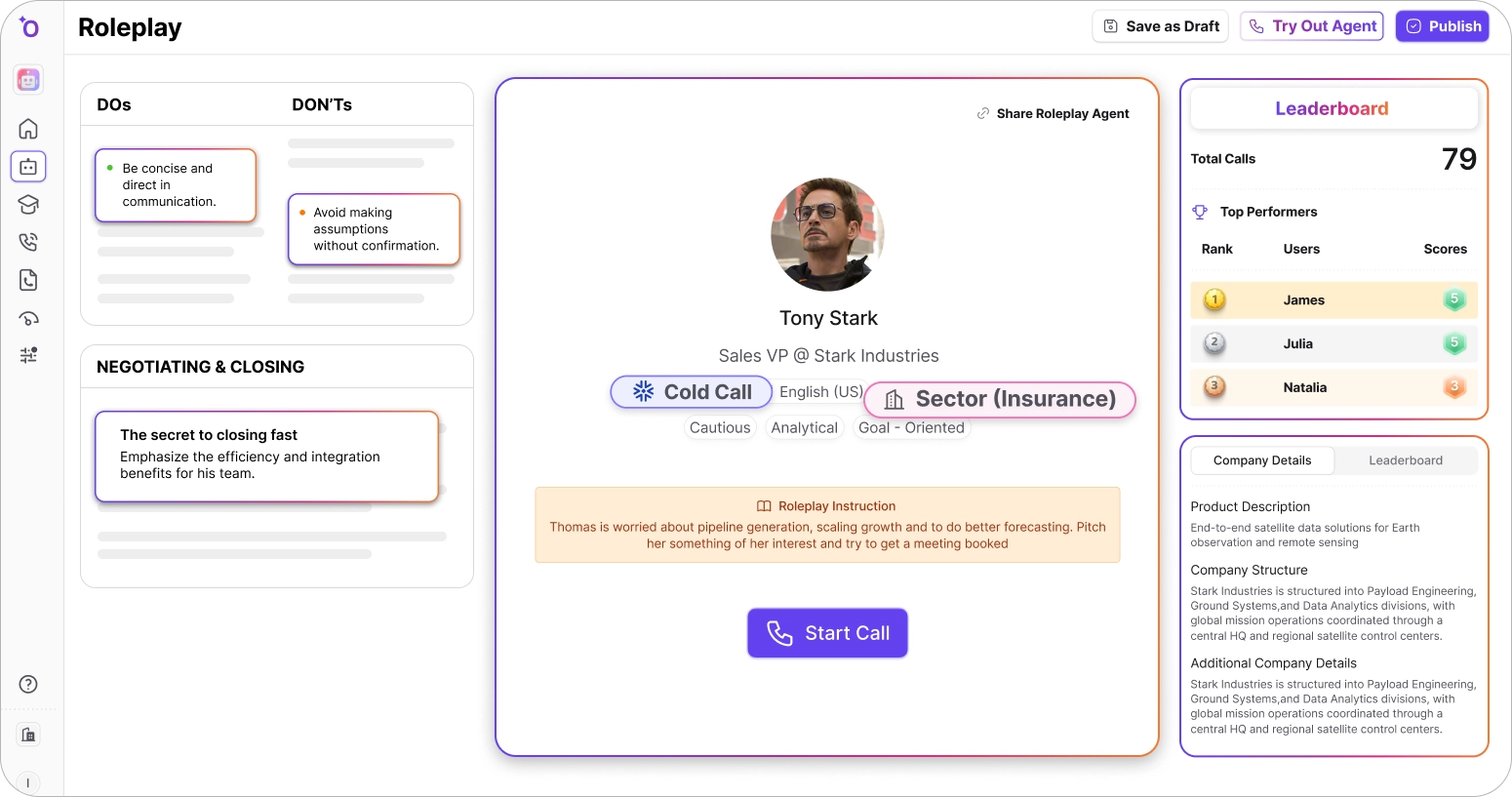
Outdoo AI dashboard showing AI roleplay scenarios, scoring, and coaching for enterprise sales teams

Outdoo AI is an enterprise roleplay and closed-loop coaching platform built for customer-facing teams, and for insurance, the customer-facing moments are some of the highest-stakes conversations in any industry. A claims adjuster taking a First Notice of Loss call from someone who just had an accident. An agent explaining a premium increase to a policyholder comparing quotes. A call center rep handling a coverage dispute that is one bad interaction away from a complaint to the state regulator. Outdoo AI lets teams practice these exact conversations, scores them with its own built-in conversation intelligence, and closes the loop with coaching triggered by the gap between practice and live performance.

What Outdoo AI covers for claims, sales, and call center teams:

  • AI Roleplays Built From Real Claims and Sales Calls: Generate practice scenarios from real call recordings, claim notes, and objection patterns, so adjusters and agents rehearse the actual situations their team encounters, not generic scripts.
  • Multi-Persona Roleplays: Simulate up to 3 stakeholders at once, such as a claimant and their attorney, or a prospect and their spouse, preparing reps for the multi-party dynamics that are common in claims and household insurance decisions.
  • Voice, Video, and Chat Roleplays: Practice in the same format as the real interaction, across voice calls, video, and chat, covering FNOL calls, in-person agent meetings, and digital claims correspondence.
  • Workflow and Software Simulation: Reps rehearse the actual systems work tied to the role, including claims notes, policy system data entry, and disposition codes, so practice covers the full job, not just the talk track.
  • Built-In Conversation Intelligence: Outdoo AI records and analyzes live claims and sales calls natively, surfacing sentiment, escalation risk, compliance language, and key moments without a separate CI tool.
  • Unified AI Scoring: The same AI rubric scores roleplay sessions and live calls, so a training team can see exactly where a rep's practice score and their real-call score diverge, and coach that specific gap.
  • Closed-Loop Coaching and AI Micro-Learning: When an adjuster or agent performs well in training but struggles on live calls, for example around empathy on a denial conversation, coaching tasks and AI-generated micro-learning are triggered automatically.
  • Roleplays in 74+ Languages: Run the same scored practice for multilingual policyholder bases and distributed claims and call center teams across regions.
  • 120+ Integrations: Connect across the insurance tech stack including LMS platforms for compliance and certification tracking, CRM, dialers, and contact center and conversation intelligence tools, with SCORM, xAPI, and AICC support.

How Outdoo AI fits into insurance training and compliance programs:

Most insurance training is built around certification: pass the state exam, complete the carrier's product modules, finish the annual compliance refresher. That process verifies knowledge, but it does not verify that a new adjuster can stay calm and clear with a claimant who is upset about a denial, or that a new agent can handle a price objection without making a promise the policy does not cover. Outdoo AI adds that verification step. Because it supports SCORM, xAPI, and AICC, a roleplay can sit inside the same learning path as a compliance module, so completing a course on claims handling procedure can trigger a scored roleplay of an actual difficult claims call before a new hire takes one for real.

Because Outdoo AI also includes its own conversation intelligence, that same scoring rubric extends to live calls once the rep is on the floor. A claims manager can see a new adjuster's roleplay score from week one, their live call scores from week four, and the specific gap between the two, which is the difference between hoping training worked and knowing where it did not.


What makes Outdoo AI a strong fit for insurance teams:

  • Roleplays built from real claims and sales calls mean practice reflects the actual emotional and procedural complexity of insurance conversations, not generic customer service scripts.
  • Unified scoring across practice and live calls gives claims and training leaders a direct way to see whether certification is translating into how adjusters and agents actually handle policyholders.
  • Built-in conversation intelligence removes the need for a separate CI tool just to connect coaching to real call data, reducing tool sprawl for teams already running a claims system and an AMS or CRM.
  • Roleplays in 74+ languages support multilingual policyholder bases and distributed teams without building separate training programs per region.

What to know before rolling it out:

  • Built for organizations and customer-facing teams. Not a fit for individual adjusters, independent agents working alone, or one-off self-study.
  • Pricing is tailored by team size and capabilities rather than published per seat, so a consultation is needed to scope a plan.

What sets Outdoo AI apart:

Insurance has invested heavily in AI that works on the claim: photo assessment, fraud scoring, claims guidance. Outdoo AI is built for the part of the job that AI has mostly skipped, the conversation itself, and it treats that conversation as measurable rather than something that just depends on who picked up the phone.

The combination of multi-persona roleplays and unified scoring matters specifically in insurance, where a single claim can involve a claimant, a repair shop, and sometimes an attorney, and where a single sales conversation can involve a primary policyholder and a spouse with different priorities. Practicing those dynamics, and then scoring the live version the same way, is what turns a certification program into a readiness program.


Best For:

Claims operations leaders, sales and agency training leaders, and contact center leaders at carriers, MGAs, and TPAs who want adjusters and agents evaluated on how they actually handle policyholder conversations, with coaching and compliance training connected through the same system.


Pricing and how it is structured:

Three tiers (Free, Premium, and Enterprise) with tailored pricing based on team size and capabilities. No fixed per-seat list price, no paid onboarding, and no forced multi-year lock-ins.


Testimonial:

“If someone does 10 roleplays in Outdoo, you can see the improvement instantly on real calls. The speed of feedback is huge. We tweak a bot, test it, and improve the training loop in hours, not weeks.”

Beau Cullen

Regional Director of Sales, Globe Life Insurance

2. Shift Technology: Best for AI Claims Fraud Detection and Automation
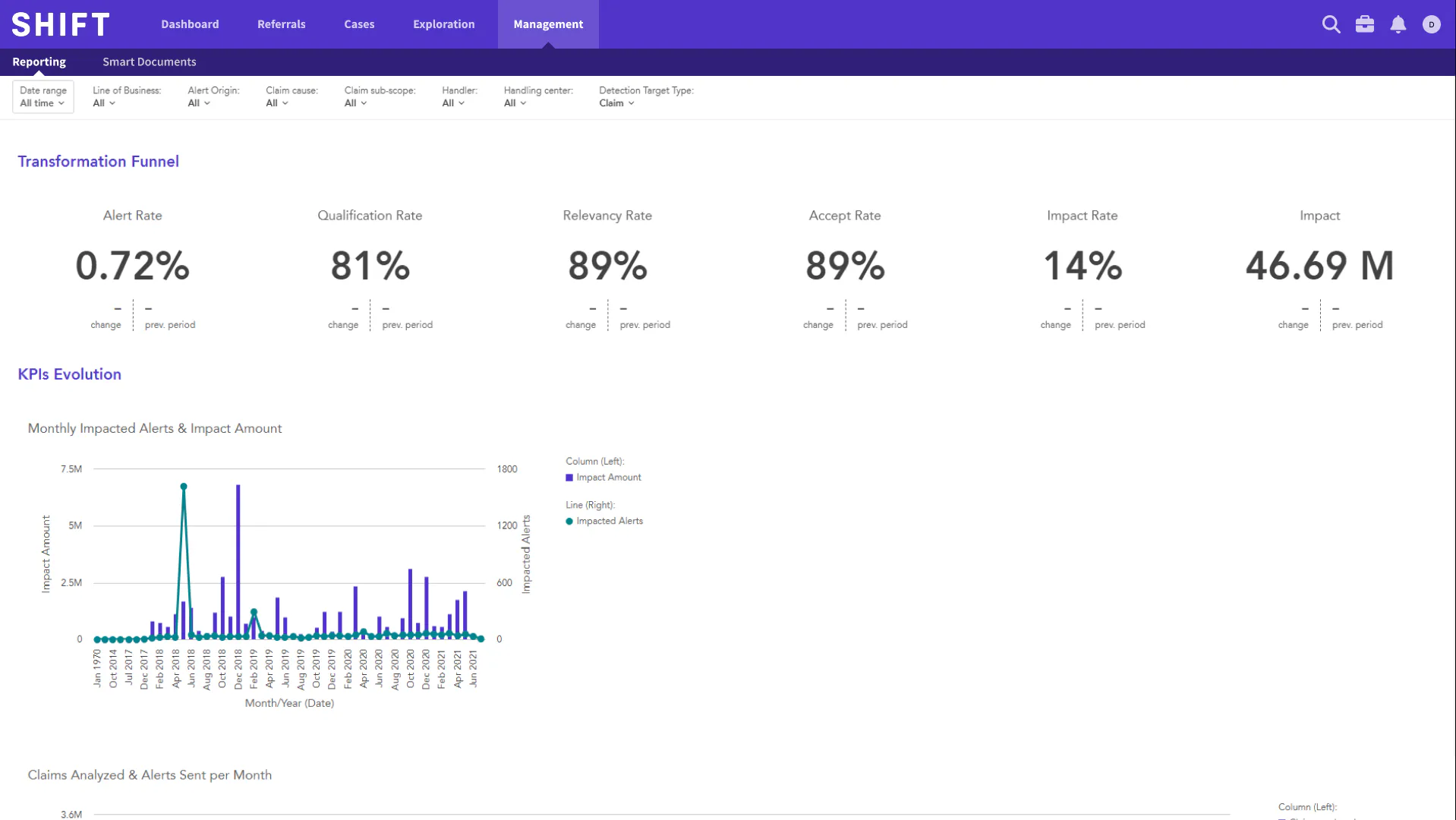
Shift Technology dashboard showing claims metrics

Shift Technology is an AI-native platform for insurance claims intelligence, covering fraud detection, claims automation, and subrogation. It scores incoming claims for fraud risk using a wide range of structured and unstructured data, decides whether a claim is simple enough for straight-through processing or needs a human adjuster, and surfaces subrogation opportunities that might otherwise be missed. It is used by major P&C and health insurers globally and has a deep integration with Guidewire.

Key features of Shift Technology:

  • Claims Fraud Detection: AI models score every incoming claim for fraud risk in real time or in batch, with explainable findings that give SIU investigators a clear rationale for each flag.
  • Claims Automation (Shift Claims): Agentic AI evaluates claim complexity and liability to route straightforward claims to straight-through processing while flagging complex ones for human review.
  • Subrogation Detection: Identifies claims where recovery from a third party is possible but might otherwise be missed by adjusters.
  • Network Analysis: Detects connections between claims, claimants, providers, and other entities that indicate organized fraud networks.

Where Shift Technology works well:

  • Explainable AI gives investigators a documented rationale for every fraud flag, which matters for both efficiency and defensibility.
  • Deep Guidewire integration makes it a natural fit for carriers already running ClaimCenter.
  • Reported fraud detection hit rates of around three times higher than manual or rules-based methods make a strong case for SIU teams under resourcing pressure.

What to know before rolling it out:

  • Pricing runs through insurer partnerships and is not published, so evaluation requires a direct conversation with Shift.
  • Model performance depends on calibration to each insurer's claims mix and geography, which adds an implementation step beyond initial setup.

What sets Shift Technology apart:

Shift's edge is being purpose-built for insurance fraud and claims intelligence specifically, rather than adapting a general fraud platform. For SIU and claims operations teams, the combination of fraud scoring, automation routing, and subrogation detection in one system covers most of what a fraud and claims analytics stack needs to do.


Best For:

P&C and health insurers with dedicated SIU and claims operations teams that need AI-driven fraud detection, automated claims triage, and subrogation identification at scale.


Pricing and how it is structured:

Custom enterprise pricing, contracted through insurer partnerships. Not published. Contact Shift Technology for a quote.

3. Tractable: Best for AI Visual Damage Assessment
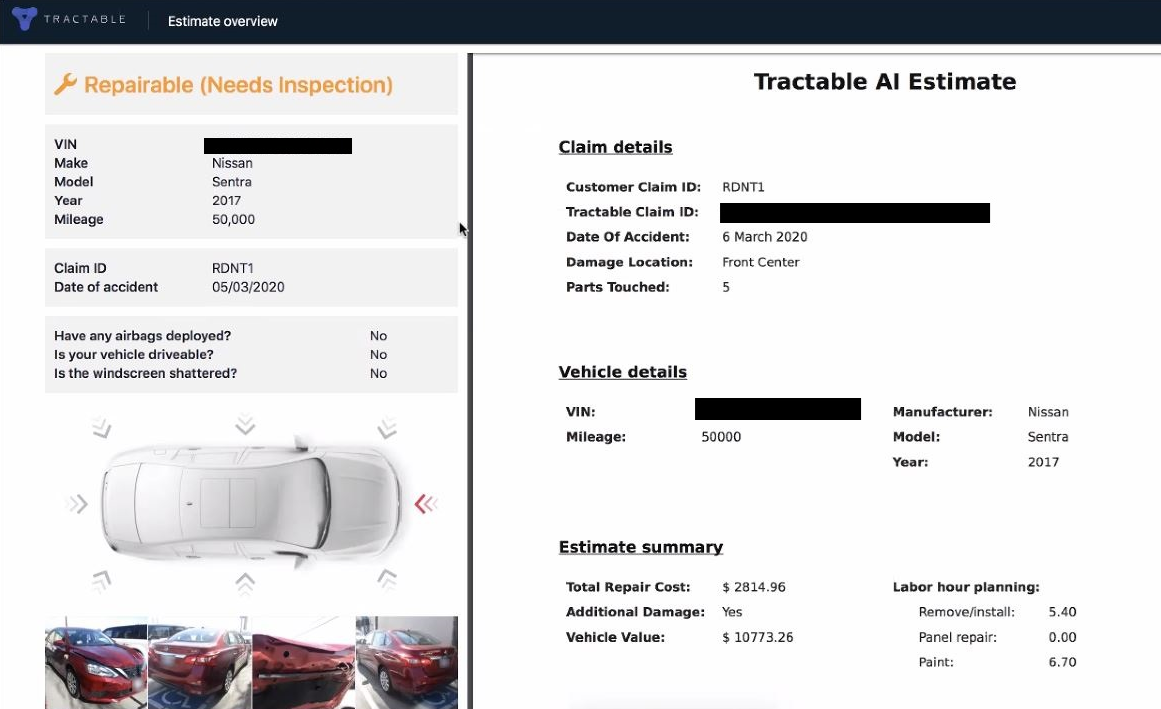
Tractable AI interface showing vehicle damage photos analyzed for repair cost estimation

Tractable uses computer vision AI to assess vehicle and property damage from photographs, producing repair estimates and total loss decisions in a fraction of the time a manual inspection takes. For auto and property claims teams, it is one of the most established AI tools in the category, with widespread use among major carriers for accelerating the appraisal step that traditionally bottlenecks claims cycle time.

Key features of Tractable:

  • Photo-Based Damage Assessment: AI analyzes photos submitted by policyholders or repair shops to estimate repair costs and identify damage that may not be visible in a single image.
  • Total Loss Decisioning: Helps adjusters quickly identify when repair costs approach or exceed a vehicle's value, speeding up total loss determinations.
  • Repair Network Integration: Connects assessments to repair shop networks to streamline the estimate-to-repair handoff.
  • Continuous Model Improvement: Models are trained on a large volume of real claims photos and outcomes, improving accuracy over time.

Where Tractable works well:

  • Significantly reduces the time between a policyholder submitting photos and receiving an estimate, which is one of the most visible parts of the claims experience.
  • Widely adopted among major auto insurers, so the technology is proven at scale rather than early-stage.
  • Reduces the need for in-person inspections for straightforward claims, lowering cost and improving policyholder convenience.

What to know before rolling it out:

  • Most valuable for auto and property lines with high photo-based claim volume. Less relevant for lines like workers' comp or liability.
  • Pricing and implementation are enterprise-scale and not published, typically requiring integration with existing claims systems.

What sets Tractable apart:

Tractable's strength is depth in one specific, high-volume workflow. Visual damage assessment is one of the clearest wins for AI in claims because the input (a photo) and output (an estimate) are well defined, and Tractable has refined that workflow across a large base of real-world claims.


Best For:

Auto and property carriers with high volumes of photo-based claims that want to speed up estimation and total loss decisions without expanding in-person inspection capacity.


Pricing and how it is structured:

Custom enterprise pricing. Not published. Contact Tractable for a quote.

4. EvolutionIQ: Best for AI Claims Guidance in Disability and Workers' Compensation
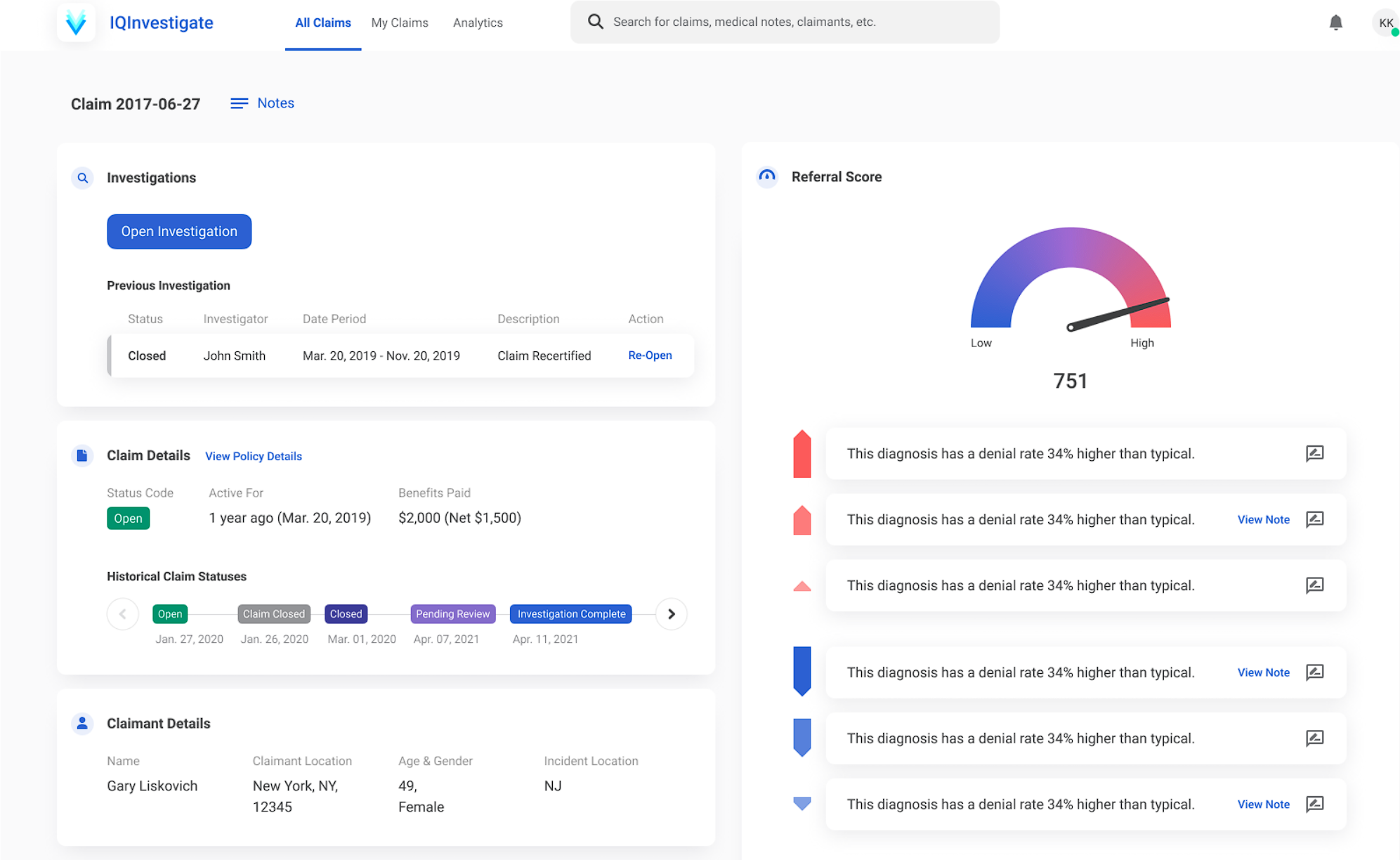
EvolutionIQ dashboard showing a ranked list of open claims with AI-recommended next best actions

EvolutionIQ, now part of CCC Intelligent Solutions, is an AI guidance platform for disability, workers' compensation, and casualty claims. Rather than treating every open claim the same, it continuously monitors structured and unstructured claims data and ranks claims by which action will have the most impact, helping adjusters prioritize cases that need a specialist referral or proactive intervention before they become long, costly, long-tail losses.

Key features of EvolutionIQ:

  • Next Best Action Recommendations: AI ranks every open claim by which intervention would have the most impact, turning adjuster time into outcome leverage.
  • Specialist Intervention Triggers: Identifies claims that need medical specialist involvement earlier than traditional review cycles would catch.
  • Claims Summarization: Condenses lengthy medical and claims documentation into intelligent summaries adjusters can act on quickly.
  • Guidewire ClaimCenter Integration: Operates within existing claims workflows for carriers already on Guidewire.

Where EvolutionIQ works well:

  • Purpose-built for the long-tail claims (disability, workers' comp, casualty) that are hardest to manage with generic claims automation.
  • Next Best Action framing helps adjusters with heavy caseloads focus on the claims where their time has the most impact, rather than working a queue in arrival order.
  • Backed by CCC Intelligent Solutions following its 2024 acquisition, adding scale and integration with CCC's broader claims AI suite.

What to know before rolling it out:

  • Focused specifically on disability, workers' comp, and casualty lines. Not relevant for carriers without exposure to long-tail injury claims.
  • Pricing is enterprise and not published, with implementation typically tied to a carrier's existing claims system.

What sets EvolutionIQ apart:

Long-tail claims are where small delays compound into large costs and poor outcomes for injured claimants. EvolutionIQ's explainable, claim-by-claim guidance gives adjusters a documented reason for every recommendation, which matters both for adjuster trust in the tool and for regulatory scrutiny of how claims decisions are made.


Best For:

Disability, workers' compensation, and casualty claims teams managing large caseloads of long-tail claims that benefit from earlier, AI-guided intervention.


Pricing and how it is structured:

Custom enterprise pricing. Not published. Contact EvolutionIQ or CCC Intelligent Solutions for a quote.

5. EZLynx: Best for AI-Powered Comparative Rating and Agency Management
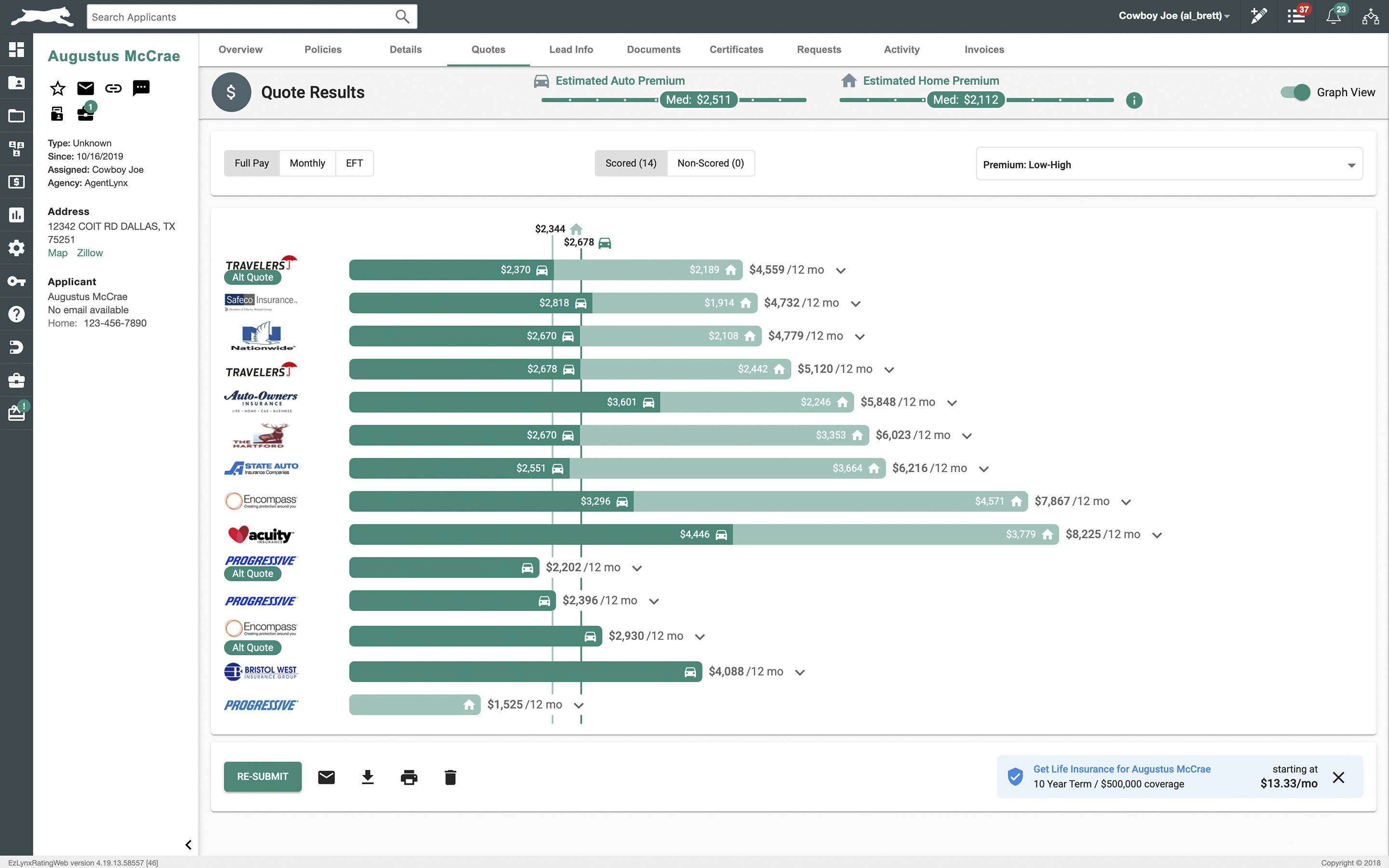
EZLynx comparative rating screen showing side-by-side quotes from multiple carriers for the same applicant

EZLynx is one of the most widely used agency management systems for independent P&C agencies, built around its comparative rating engine. Agents enter applicant information once and receive real-time quotes from hundreds of carriers, with AI-assisted data prefill reducing the manual entry that traditionally slows down the quoting process. For sales teams, the time EZLynx saves on quoting is time that goes directly back into the conversations with prospects and clients.

Key features of EZLynx:

  • Comparative Rating Engine: Real-time quotes from 330+ carriers across personal lines, from a single data entry.
  • AI-Assisted Data Prefill: Reduces manual re-entry by pulling prospect information forward into quotes and applications.
  • Agency Management System: Centralizes policies, documents, and client communication alongside the rating engine.
  • Client Self-Service Portal: Lets policyholders access documents and request changes without a phone call, reducing inbound call volume.

Where EZLynx works well:

  • Best-in-class comparative rating significantly reduces the manual work of quoting across multiple carriers.
  • Used by tens of thousands of agencies, so the platform and its carrier integrations are mature and well supported.
  • Self-service portal reduces routine inbound calls, freeing agent and call center time for higher-value conversations.

What to know before rolling it out:

  • Primarily strong for personal lines P&C. Commercial lines, life, and health quoting are more limited.
  • Modular pricing means the full management system plus add-on modules can add up beyond the base rating engine cost.

What sets EZLynx apart:

EZLynx's advantage is the sheer breadth of its carrier network combined with how deeply embedded it is in independent agency workflows. For agencies where speed to quote is a competitive factor, the time saved on data entry is time agents can spend on the conversation that actually closes the sale, which is where a tool like Outdoo AI's roleplay and coaching complements it.


Best For:

Independent P&C agencies that work with multiple carriers and want to reduce the manual work of quoting so agents spend more time on client conversations.


Pricing and how it is structured:

Modular pricing. The Rating Engine starts around $100 per user per month, with the full Management System adding roughly $150 per user per month. Additional modules are priced separately, with typical total costs in the $350 to $600 per month range for small to mid-sized agencies.

6. Observe.AI: Best for AI Conversation Intelligence and Compliance QA

Observe.AI quality assurance dashboard showing automated call scoring against a compliance scorecard

Observe.AI is a conversation intelligence platform that transcribes and analyzes contact center calls to automate quality assurance, surface compliance risks, and identify coaching opportunities across every interaction rather than a small sample. For insurance contact centers, where compliance language and tone both matter and call volumes make manual QA sampling impractical, Observe.AI's auto QA is one of the most established options in regulated industries.

Key features of Observe.AI:

  • Automated QA Scoring: Scores 100% of calls against custom scorecards instead of the small manual samples traditional QA relies on.
  • Compliance Risk Detection: Flags calls where required disclosures or compliance language may be missing.
  • Agent Coaching Workflows: Surfaces specific coaching moments from real calls, tied to scorecard performance.
  • PII Redaction: Automatically detects and masks personally identifiable information, important for handling claims and policy data.

Where Observe.AI works well:

  • Moving from sample-based to 100% call coverage is a significant shift for QA teams in high-volume insurance call centers.
  • Strong PII redaction and compliance risk detection are well suited to the regulatory environment insurance contact centers operate in.
  • Layers on top of existing telephony, so it does not require replacing a carrier's contact center infrastructure.

What to know before rolling it out:

  • Minimum seat count of around 100 agents means it is not accessible for smaller call centers regardless of budget.
  • Implementation typically takes 4 to 12 weeks, and total cost including professional services can run well into six figures annually for large deployments.

What sets Observe.AI apart:

Observe.AI's focus on automated QA at scale is its clearest strength. For insurance call centers where every call carries some compliance exposure, having an AI system score every interaction rather than a 1 to 2 percent sample changes what QA teams can actually catch and coach.


Best For:

Insurance contact centers with 100 or more agents that need automated, 100%-coverage QA and compliance monitoring layered on top of existing telephony.


Pricing and how it is structured:

Plans start around $19 per user per month with AI features included, though a 100-seat minimum applies. Enterprise deployments with full Auto QA typically run from the tens of thousands to $60,000 to $180,000 or more annually depending on scale.

7. NICE CXone: Best for a Full AI-Powered Contact Center Platform
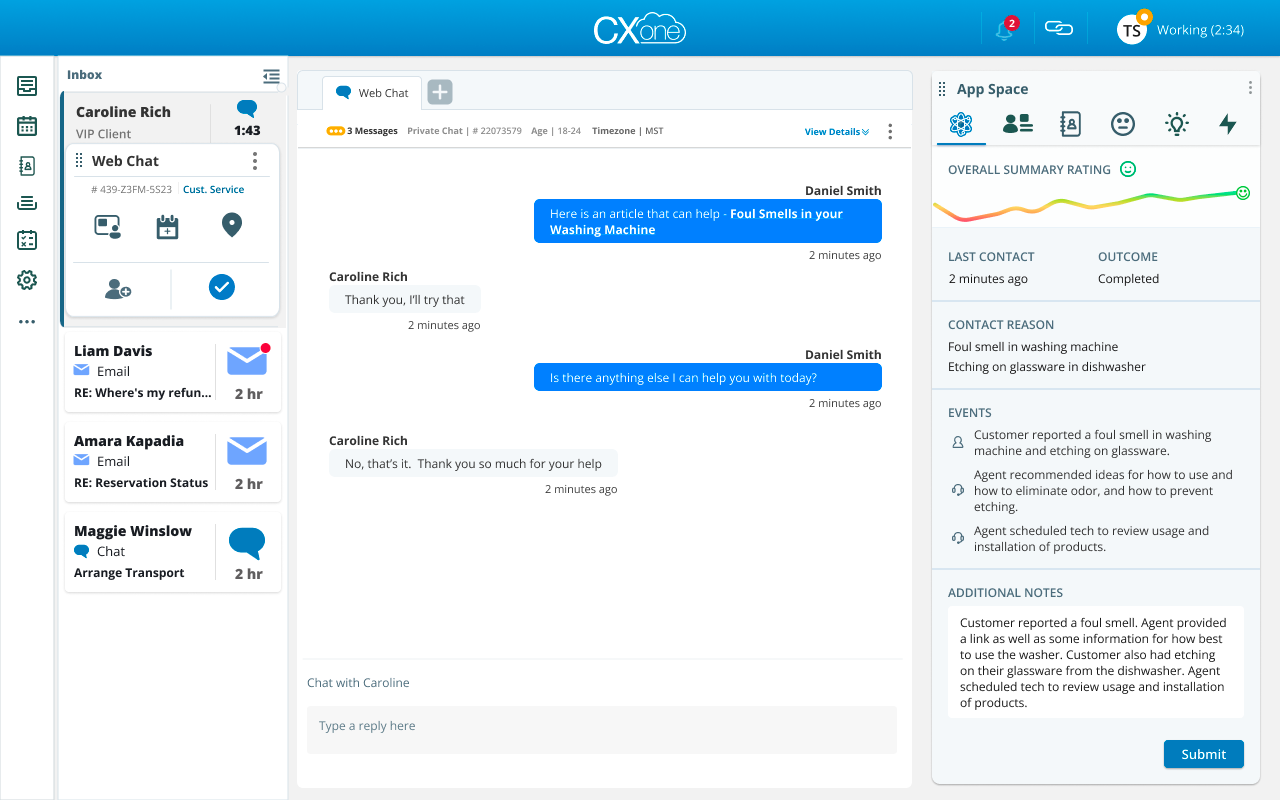
NICE CXone unified agent workspace showing an inbound call with AI Copilot guidance and case history

NICE CXone is a cloud-native contact center platform that combines omnichannel routing, workforce management, and AI-powered quality management in a single stack, rather than layering AI on top of separate infrastructure. For carriers and TPAs looking to consolidate a fragmented contact center tech stack, CXone's CXone Copilot provides real-time AI agent assistance, automated call summaries, and in-call knowledge surfacing alongside the platform's built-in QA and workforce management.

Key features of NICE CXone:

  • Omnichannel Routing: Handles voice, email, chat, SMS, and digital channels from a single agent workspace, covering claims status inquiries and policy questions across whichever channel a policyholder uses.
  • CXone Copilot: Real-time AI guidance during calls, automated summaries, and knowledge surfacing so agents do not need to search separate systems mid-call.
  • Built-In Quality Management: Conversation intelligence and QA scoring as part of the core platform rather than a bolt-on.
  • Workforce Management: Scheduling, forecasting, and performance management built in, removing the need for a separate WFM tool.

Where NICE CXone works well:

  • Single-stack approach reduces the integration overhead of running separate telephony, QA, and workforce management systems.
  • Published per-agent pricing tiers give more cost transparency at the evaluation stage than many enterprise contact center platforms.
  • CXone Copilot's real-time guidance is useful for complex policy questions where agents need quick access to coverage details mid-call.

What to know before rolling it out:

  • Replacing an entire contact center infrastructure is a bigger undertaking than layering a conversation intelligence tool on top of an existing system.
  • Full value depends on adopting the platform broadly across routing, QA, and workforce management rather than using it for a single function.

What sets NICE CXone apart:

CXone's advantage is consolidation. For carriers running separate, aging systems for routing, QA, and scheduling, replacing all three with one cloud-native platform with AI built into the core, rather than added on, is a meaningful simplification, even if the migration itself is a larger project than a point solution.


Best For:

Carriers and TPAs consolidating contact center infrastructure that want omnichannel routing, AI agent assistance, QA, and workforce management in a single platform with published pricing.


Pricing and how it is structured:

Custom, with published per-agent pricing tiers that scale with the modules included (routing, WFM, QA, AI Copilot). Contact NICE for current tier pricing.

8. AgentSync: Best for AI-Powered Agent Licensing and Compliance Automation
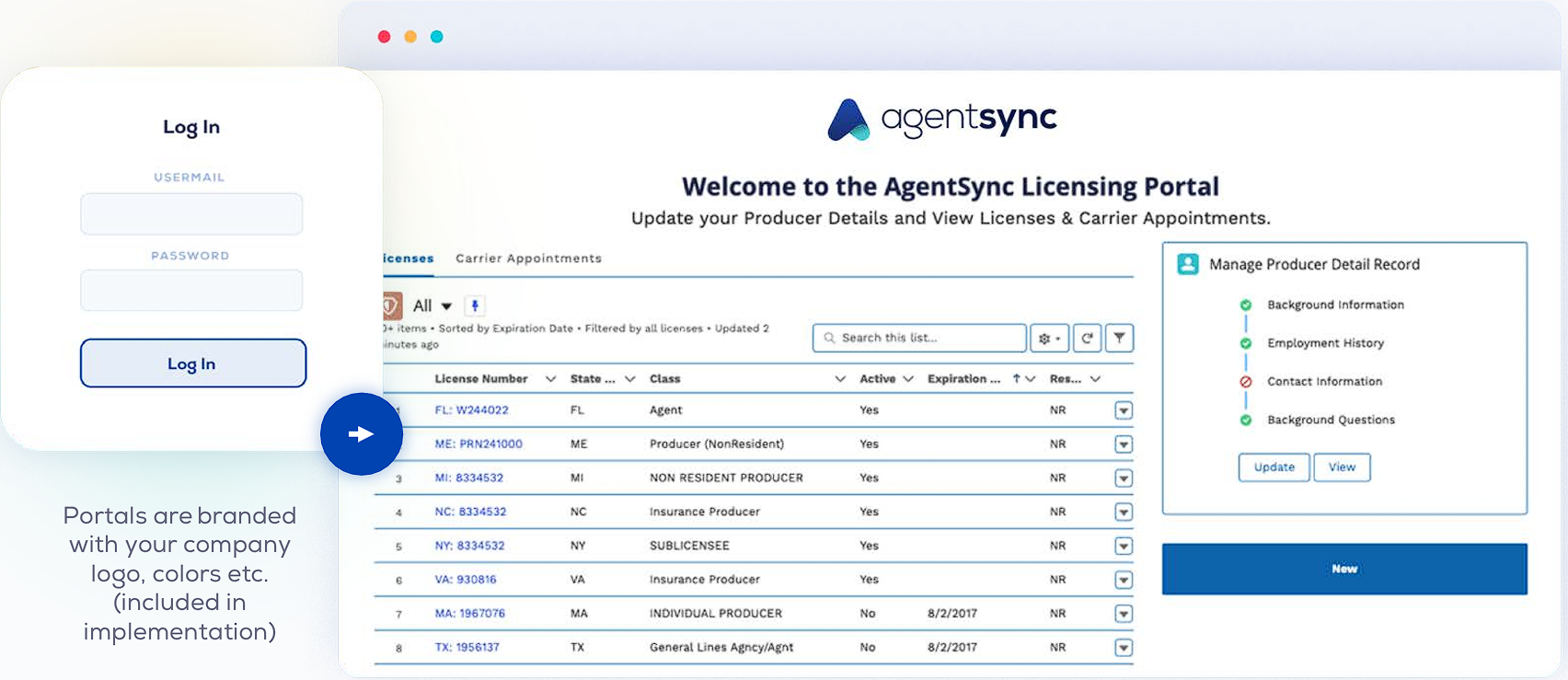
AgentSync dashboard showing producer licensing status and appointment compliance across multiple states

AgentSync automates the producer licensing, appointment, and continuing education compliance work that insurance agencies and carriers otherwise manage through spreadsheets and manual state-by-state checks. For sales and agency operations teams, it handles the unglamorous but high-stakes administrative layer that determines whether an agent is actually allowed to sell a given product in a given state on a given day.

Key features of AgentSync:

  • Automated License Verification: Continuously checks producer licenses and appointments against state insurance department data.
  • Appointment Management: Tracks and automates carrier appointment processes across states and lines of business.
  • CE Compliance Tracking: Monitors continuing education requirements and deadlines for licensed producers.
  • Onboarding Automation: Speeds up new agent onboarding by automating the licensing and appointment steps that otherwise create delays before an agent can sell.

Where AgentSync works well:

  • Removes a significant amount of manual, error-prone administrative work from agency operations and compliance teams.
  • Faster onboarding means new agents can start selling sooner, which matters directly for sales ramp time.
  • Reduces the risk of agents inadvertently operating without proper licensing or appointments, a real exposure for growing agencies.

What to know before rolling it out:

  • Focused specifically on licensing, appointments, and CE compliance rather than broader agency management or quoting.
  • Pricing is enterprise and not published, with value scaling most for agencies and carriers managing producers across many states.

What sets AgentSync apart:

AgentSync's value is in what it prevents: gaps in licensing or appointment status that can stall sales or create compliance exposure without anyone noticing until an audit. For agencies scaling across states, automating this layer removes a recurring administrative burden that otherwise falls on operations or compliance staff.


Best For:

Agencies and carriers managing producer licensing, appointments, and CE compliance across multiple states, particularly those scaling their distribution footprint.


Pricing and how it is structured:

Custom enterprise pricing. Not published. Contact AgentSync for a quote.

9. Gradient AI: Best for AI Underwriting and Claims Risk Analytics
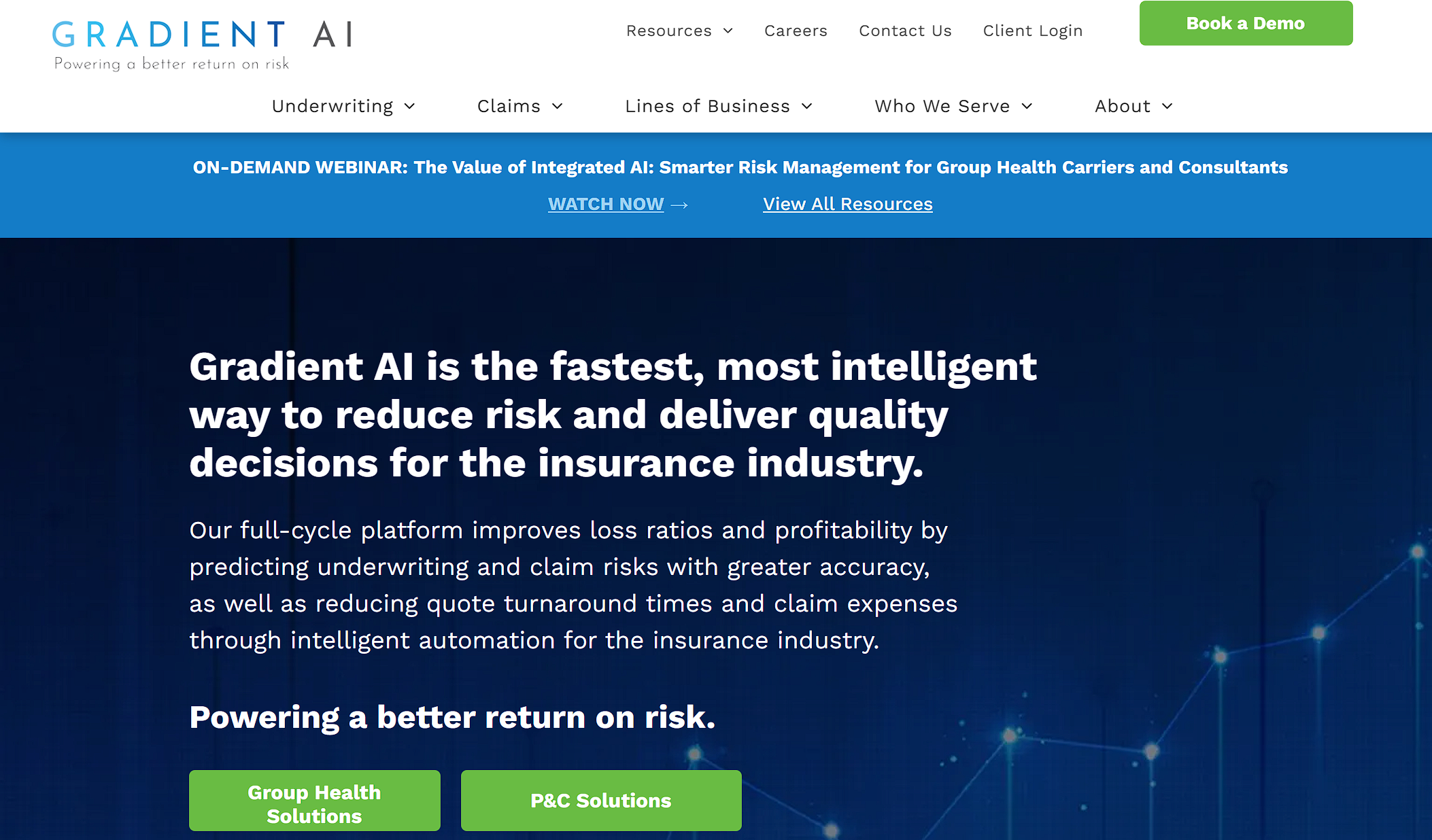
Gradient AI website screenshot

Gradient AI applies machine learning to underwriting, risk scoring, and claims analytics, drawing on a large industry data set spanning millions of policy and claim records. For insurers and MGAs, it provides risk insights at both the underwriting stage (should this submission be priced differently) and the claims stage (which open claims carry elevated risk of becoming more severe), giving teams a data-driven view that complements adjuster and underwriter judgment.

Key features of Gradient AI:

  • Underwriting Risk Scoring: Scores new submissions against a large industry data lake to support pricing and risk selection decisions.
  • Claims Severity Analytics: Identifies open claims with elevated risk of becoming more severe, supporting earlier intervention.
  • Industry Benchmark Data: Models are informed by data across many insurers, not just a single carrier's book, which helps with newer or thinner lines of business.
  • Explainable Outputs: Risk scores come with supporting factors that underwriters and claims teams can review and incorporate into decisions.

Where Gradient AI works well:

  • Industry-wide data lake helps insurers and MGAs with thinner historical data make better-informed risk decisions.
  • Applies the same underlying risk modeling to both underwriting and claims, giving a more consistent view of risk across the policy lifecycle.
  • Explainable scoring supports the kind of documented rationale that underwriting and claims decisions often require.

What to know before rolling it out:

  • Most valuable for insurers and MGAs writing meaningful volume in the lines covered by Gradient AI's data set.
  • Pricing is enterprise and not published, with implementation involving integration into underwriting and claims systems.

What sets Gradient AI apart:

Gradient AI's differentiator is breadth of data. By drawing on records across many insurers rather than a single book of business, it can surface risk patterns that an individual carrier's own data might not yet show, which is particularly useful for newer programs or lines with limited historical loss experience.


Best For:

Insurers and MGAs that want AI-driven risk scoring across underwriting and claims, informed by industry-wide data rather than a single carrier's history alone.


Pricing and how it is structured:

Custom enterprise pricing. Not published. Contact Gradient AI for a quote.

The First-Call Readiness Gap: Why Knowing the Policy Is Not the Same as Being Ready for the Call

Every line of business in insurance has a moment where a policyholder's relationship with the company is decided in a single conversation. For claims, it is often the first call after a loss, when someone is stressed, sometimes injured, and forming their first impression of how the claim will go. For sales, it is the call where a prospect compares a quote to two others and decides whether price is the only thing that matters or whether the agent has earned some trust. For call centers, it is the complaint call that is one bad interaction away from becoming a regulatory complaint.

Most training programs prepare people for the content of these calls (what the policy covers, what the script says, what the compliance disclosure requires) without preparing them for the conversation itself. That is the first-call readiness gap: the distance between knowing the material and being ready for the specific, often emotional, moment where it gets tested. Closing it follows a similar pattern across claims, sales, and call center teams.

Step 1: Build practice from real conversations. Generic customer service scripts do not prepare an adjuster for a claimant who is crying, or an agent for a prospect who says a competitor quoted 20 percent less. Roleplays built from real claims calls and sales conversations, including the specific objections and emotional dynamics a team actually encounters, are what make practice transferable.

Step 2: Score practice and live calls the same way. If a new adjuster scores well in a training roleplay but a manager has no equivalent score for their first ten live FNOL calls, there is no way to know whether training worked. Unified scoring across roleplay and live calls turns that into a measurable comparison.

Step 3: Coach the specific gap. When a rep handles the training scenario well but struggles with empathy on a real denial call, the coaching should target that specific moment, not send them back through the entire onboarding curriculum. AI-triggered micro-coaching based on where practice and live performance diverge keeps coaching focused and scalable.

Step 4: Connect readiness to the metrics that matter. For claims, that is first-call resolution, claims satisfaction scores, and complaint rates. For sales, it is conversion and retention. For call centers, it is escalation and complaint volume. Readiness data that stays isolated in a training system never makes it into these conversations. Readiness data that feeds into the same conversation intelligence used to monitor live calls does.

The principle: In insurance, the conversation is the product at the moments that matter most. Tools that automate the paperwork around a claim or a quote are valuable, but the gap that most directly affects retention, conversion, and complaints is whether the person on the call is ready for that specific call, and whether anyone can measure that readiness before it shows up in a policyholder survey.

How to Choose the Right AI Tools for Your Insurance Stack

The right starting point depends on which part of the business is showing the most strain. Here is how to map that to the categories above.

1. If claims handlers are processing claims correctly but policyholders still rate the experience poorly: The gap is likely in the conversation, not the process. Outdoo AI lets adjusters practice the specific calls that drive satisfaction scores, particularly FNOL and settlement conversations, and scores live calls the same way so claims leaders can see where empathy and clarity are breaking down. Pair this with Shift Technology or Tractable if claims cycle time itself is also a factor, since faster, more accurate processing and better conversations reinforce each other.

2. If your sales team is losing deals on price or struggling to ramp new agents: EZLynx speeds up the quoting mechanics so agents have more time for the conversation, while Outdoo AI helps agents practice handling price objections and multi-stakeholder household decisions before they face them live. AgentSync ensures new agents are licensed and appointed quickly enough that ramp time is not lost to administrative delays.

3. If your call center has high volume and compliance exposure but limited QA coverage: Observe.AI brings automated, 100%-coverage QA to a contact center running on existing telephony. NICE CXone is the stronger option if you are also looking to consolidate routing, workforce management, and QA into one platform. Either pairs with Outdoo AI's roleplay so coaching can start before a new rep takes their first live call, not just after.

4. If long-tail claims (disability, workers' comp, casualty) are a growing cost driver: EvolutionIQ's claim-by-claim guidance helps adjusters prioritize intervention earlier. Gradient AI's risk analytics can complement this by flagging which claims and submissions carry elevated risk based on broader industry data.

5. If your goal is to close the first-call readiness gap across claims, sales, and the call center: This is the cross-functional layer most insurance AI stacks are missing. Outdoo AI is built specifically for it, combining roleplay practice, built-in conversation intelligence on live calls, unified scoring, and closed-loop coaching, with the LMS and compliance integrations to connect it to certification programs already in place.

Bottom line: The operational AI tools in this guide, claims automation, fraud detection, visual assessment, risk analytics, are mature and widely adopted because the inputs and outputs are well defined. The conversation layer has been harder to measure, which is exactly why it has been left to certification exams and manager spot-checks. Closing the first-call readiness gap with practice and scoring built from real conversations is where the next round of measurable improvement in claims satisfaction, conversion, and complaint rates is likely to come from.

Final Thoughts

Insurance has made real progress on the operational side of AI. Claims get assessed faster, fraud gets caught earlier, and risk gets priced with more data than ever. None of that changes what happens on the phone call where a policyholder decides whether they trust the company that just handled their claim, or whether a prospect decides this agent is worth their business.

Start with where the strain is showing. If claims satisfaction lags despite efficient processing, the conversation is the gap to close. If sales conversion is inconsistent across agents, ramp time and objection handling are likely culprits. If the call center is a compliance risk because QA cannot keep up with volume, that is its own priority. In most cases, more than one of these is true at once, which is why the tools in this guide are designed to work alongside each other rather than as a single replacement for the whole stack.

Outdoo AI combines AI roleplay built from real claims and sales conversations, built-in conversation intelligence on live calls, unified scoring, and closed-loop coaching, with 120+ integrations across LMS, CRM, dialers, and contact center platforms and roleplays in 74+ languages. For the conversations that decide retention, conversion, and complaints, it is the layer that turns certification into readiness.

Book a demo to see how Outdoo AI fits into your claims, sales, and call center training programs.

Frequently Asked Questions

What are the best AI tools for insurance companies in 2026?

The best AI tools for insurance companies in 2026 span five categories: AI roleplay and coaching (Outdoo AI), claims automation and fraud detection (Shift Technology, Tractable, EvolutionIQ), sales and agency management (EZLynx), contact center conversation intelligence (Observe.AI, NICE CXone), and compliance and risk analytics (AgentSync, Gradient AI). Outdoo AI stands out for combining AI roleplay, built-in conversation intelligence, and closed-loop coaching for claims, sales, and call center teams.

What is the first-call readiness gap in insurance?

The first-call readiness gap is the distance between an adjuster or agent knowing the policy and procedure, and being ready for the specific, often emotional conversation where that knowledge is tested, such as a First Notice of Loss call or a price objection. Certification programs verify knowledge but rarely verify readiness for these conversations, which is what drives claims satisfaction, sales conversion, and complaint rates.

Can AI roleplay help insurance claims adjusters and agents?

Yes. AI roleplay lets claims adjusters and sales agents practice realistic conversations, such as FNOL calls, settlement discussions, or premium objections, and receive scored feedback. Platforms like Outdoo AI build these roleplays from real call recordings and claim notes, and can include multi-persona scenarios such as a claimant and their attorney, which mirrors the real complexity of insurance conversations.

Does Outdoo AI integrate with insurance LMS, CRM, and contact center platforms?

Yes. Outdoo AI supports SCORM, xAPI, and AICC, allowing roleplays to be embedded inside existing LMS learning paths for compliance and certification training. It also connects to 120+ integrations across CRM, dialers, and contact center and conversation intelligence platforms, so roleplay practice and live call scoring can work together rather than living in separate systems.

What is Outdoo AI and how does it help insurance teams?

Outdoo AI is an enterprise roleplay and closed-loop coaching platform for customer-facing teams. For insurance, it lets claims handlers, sales agents, and call center reps practice the real conversations they face, scores those roleplays and live calls with its own built-in conversation intelligence using the same rubric, and triggers coaching based on the gap between practice and live performance. It supports roleplays in 74+ languages and integrates with LMS, CRM, dialer, and contact center platforms.

Table of Contents

Contact Sales

For inquiries regarding training and enablement, please contact us.

Contact Us

Download the AI Roleplay Readiness Report 2026

Let's schedule your demo