




Most sales teams record every call. Very few actually learn from them.
The volume problem is real as managers cannot listen to every conversation, and the calls they do review are usually the deals that already closed or already lost. By then, the coaching window has passed.
Call scoring solves this by turning every conversation into structured, comparable data. According to Gartner, by 2026 the majority of customer-facing teams will use AI to score calls automatically, moving from sampling a handful of conversations to evaluating every one.
This guide covers what call scoring is, how the methods compare, what a strong scorecard actually includes, why most call scoring programs fail, and how to roll one out in a way that ties scores directly to pipeline performance.
What Is Call Scoring? (And Why It Matters in 2026)
Call scoring is a method for evaluating the quality of a sales or support conversation against a defined set of performance criteria. Each call receives a score based on how well the rep executed the behaviors that drive outcomes - things like discovery depth, objection handling, value articulation, and how clearly the next step was set.
The data captured comes from call recordings and transcripts, which are then evaluated either manually by managers or automatically by AI. While call scoring originated in contact centers, it is now standard practice across B2B sales, customer success, and revenue operations teams.
There are two layers to how a call gets scored:
Qualitative scoring: Looks at the quality of the interaction. How well the rep listened, whether they built rapport, how they handled tough questions, and how naturally the conversation flowed.
Quantitative scoring: Focuses on the numbers. Talk-to-listen ratio, response time, number of open-ended questions asked, longest monologue, and similar measurable signals.
Together, these give a complete picture of conversation quality. Below are the core dimensions most teams use when scoring sales calls in 2026:
1. Active Listening
Did the rep actually understand what the buyer said? Did they reflect back, acknowledge concerns, and avoid interrupting? Strong listening shows up in how reps respond, not just whether they paused.
2. Talk-to-Listen Ratio
How much did the rep dominate the conversation? In discovery calls, the buyer should be doing about 60% of the talking. When that flips, reps are usually pitching too early.
3. Question Quality
Open-ended questions that uncover business impact matter far more than counting questions asked. The right questions shift conversations from surface-level pain to quantified consequences.
4. Objection Handling
Did the rep address the objection calmly with context, or fall into scripted defensive language? Recovery from early resistance is where most calls are won or lost.
5. Next-Step Clarity
Did the call end with a specific, scheduled next step,or a vague "I'll send you something"? This single signal predicts deal progression more reliably than almost any other.
The shift in 2026 is that scoring is no longer a manager activity. With AI doing the work, every call is evaluated, every rep gets feedback, and scoring becomes a continuous performance system rather than a periodic audit.
Manual vs Rule-Based vs AI Call Scoring: What's the Difference?
There are three core approaches to call scoring, and most teams use a combination as they mature. Understanding the trade-offs is critical because the wrong approach burns manager time without improving rep performance.
| Method | How It Works | Speed | Consistency | Best For |
|---|---|---|---|---|
| Manual scoring | Managers listen to recordings and score against a rubric | Slow, typically 15–30 min per call | Low, varies by reviewer | Small teams under 10 reps doing high-touch coaching |
| Rule-based / keyword AI | Software scans transcripts for predefined keywords and phrases | Fast, every call evaluated | Medium, misses context | Compliance-heavy environments where literal phrasing matters |
| Generative AI scoring | LLMs evaluate full conversation context, intent, and meaning | Fast, every call evaluated | High, understands nuance | Modern sales teams scaling coaching across complex deals |
Manual scoring still has a place - managers reviewing one or two calls per rep per week to add qualitative depth. But it cannot scale. A team of 30 reps making 8 calls a day generates 1,200 calls a week. Even at 15 minutes each, that is 300 hours of manager time. No team has it.
Keyword-based scoring solves the volume problem but breaks on context. A rep can say "I understand your concern about pricing" and trigger the right keywords without actually addressing the objection well.
Generative AI scoring evaluates whether the rep actually handled the objection, looking at the full conversation flow, not just word matching. This is why most modern sales teams have moved past keyword systems entirely.
✍️ Editor's Take
The biggest mistake we see teams make is treating AI scoring as a replacement for coaching, not an input to it. AI tells you what happened across hundreds of calls. The manager's job is to interpret the why and turn that into a behavior change. Teams that get this right close the loop between scoring, coaching, and practice. Teams that don't end up with very expensive dashboards no one acts on.
Why Most Call Scoring Programs Fail (And How to Fix Them)
Call scoring is widely adopted, but most programs underperform. Across the patterns we see, the failure modes are predictable.
1. Scoring criteria built once, never updated
Sales motions evolve. Messaging changes. New competitors enter. But scorecards built at the start of the year are still being used in Q4 with criteria that no longer reflect what wins deals. Strong programs review and refresh scorecards quarterly.
2. Scores never reach the rep
Managers score calls but reps don't see the results, or they see them in a separate system disconnected from their daily workflow. If a rep can't act on feedback within a day or two, the coaching impact is lost.
3. Scorecards measure activities, not outcomes
"Did the rep ask 5 questions" is an activity. "Did the questions surface quantified business impact" is an outcome. Scorecards built around activity counts produce reps who hit checkboxes without improving conversation quality. Data-driven coaching works only when scoring measures the right things.
4. No connection between score and pipeline
The point of scoring is to predict and improve revenue outcomes. If your scoring data sits in a coaching tool while pipeline data sits in your CRM, you have no way to know whether your highest-scoring reps actually convert better. Unified systems solve this.
5. Reviewer bias when humans score
Two managers scoring the same call will produce different scores. Add team favorites, recency bias, and subjective interpretation, and even well-intentioned manual scoring becomes inconsistent. AI removes this, every call is scored against the same rubric, every time.
6. Scoring without practice
Telling a rep their objection handling scored 4/10 doesn't help them get to 8/10 unless they have a way to practice. The teams that see real improvement pair scoring with AI roleplay so reps can immediately rehearse the exact behavior that scored low.
What Should a Sales Call Scorecard Include? (Free Template)
An effective scorecard is short, weighted, and tied to behaviors that predict deal progression. The template below works for most B2B discovery and demo calls. Customize the criteria and weights to match your sales motion.
📋 Free Sales Call Scorecard Template
Copy this template into your scoring tool, spreadsheet, or coaching workflow. The criteria, weights, and signals below are designed for B2B sales discovery and demo calls, but you can adjust each dimension to fit your sales motion.
| Criterion | Weight | What "Good" Looks Like | Risk Signal |
|---|---|---|---|
| Opening clarity | 10% | Specific reason for call within first 15 seconds | Generic intro, no agenda |
| Discovery depth | 25% | 5+ open-ended questions tied to business context | Stays at surface-level pain |
| Pain quantification | 20% | Pain tied to revenue, cost, or time impact | Qualitative pain only, no measurable consequence |
| Objection handling | 15% | Calm, contextual response that reframes concern | Defensive or scripted replies |
| Stakeholder mapping | 15% | Identifies 2+ decision roles and approval process | Single-threaded, no decision context |
| Next-step clarity | 15% | Specific date, attendees, and agenda confirmed | Vague "I'll send you something" |
How to use this template
- Score every discovery and demo call against these 6 criteria
- Multiply each criterion score by its weight to calculate a total score out of 100
- Flag any call where the total score is below 60 for coaching review
- Refresh criteria and weights quarterly based on what is actually winning deals
- Pair low-scoring criteria with targeted practice so reps can rehearse the exact behavior that needs improvement
The weights matter as much as the criteria. Discovery depth and pain quantification carry the most weight because they predict whether a deal progresses to evaluation. A high score on opening clarity but a low score on pain quantification means the call sounded good but didn't advance the deal.
Most modern sales platforms now ship with built-in scorecard templates that map directly to frameworks like MEDDIC, BANT, or SPIN. The advantage of using a methodology-aligned scorecard is that scoring becomes consistent across deals, regions, and segments.
How to Score Sales Calls Using MEDDIC, BANT, or SPIN
Frameworks give scoring structure. Instead of inventing criteria from scratch, mapping your scorecard to a methodology your team already uses ensures scoring criteria align with how reps qualify and progress deals.
MEDDIC scoring
Score each call against the six MEDDIC components: Metrics, Economic Buyer, Decision Criteria, Decision Process, Identify Pain, Champion. Each component becomes a section of the scorecard with sub-criteria. Strong for enterprise complex deals.
BANT scoring
Evaluate Budget, Authority, Need, and Timeline. Faster to score and best suited for transactional or mid-market motions where qualification needs to happen quickly.
SPIN scoring
Score based on the type and sequence of questions asked: Situation, Problem, Implication, Need-payoff. Most useful for discovery-heavy sales motions where question quality determines call quality.
The right framework depends on your sales motion. Teams running multiple motions often configure separate scorecards for each - one for SDR cold calls (BANT-light), one for AE discovery (MEDDIC), one for enterprise multi-stakeholder calls (custom). For a real example, see how Live and Study in Europe scores B2C consultations and B2B partnership calls on separate scorecards.
See how easy it is to create a custom scorecard with Outdoo using your own playbooks, MEDDIC, BANT, or other frameworks:
Call Scoring vs Lead Scoring: What's the Difference?
These two terms get confused often. Both produce scores, but they measure entirely different things and serve different teams.
| Aspect | Call Scoring | Lead Scoring |
|---|---|---|
| What it measures | How well sales reps handle conversations with customers | How ready or interested a lead is based on their behavior |
| Primary goal | Improve rep performance and conversation quality | Prioritize which leads deserve sales attention |
| Data source | Call recordings, transcripts, and live monitoring | Website activity, email engagement, CRM behavior |
| Example signal | Rep handled a pricing objection with calm reframing | Lead visited pricing page 3 times and filled out a contact form |
| What it improves | Sales rep skills, coaching, customer experience | Lead routing, marketing-to-sales handoff, conversion rates |
| Owned by | Sales enablement and frontline managers | Marketing operations and demand generation |
The two are complementary. Lead scoring tells you which prospects deserve a call. Call scoring tells you whether the call was any good once it happened.
How to Roll Out AI Call Scoring in Your Team (Step-by-Step)
Most call scoring deployments fail not because of the technology but because of weak rollout. Here is the sequence that works.
Step 1: Define what you're scoring for
Start with the outcome. Are you trying to improve discovery quality? Reduce ramp time? Increase win rates? The criteria you score against should map directly to that outcome. Generic scorecards that try to measure everything end up measuring nothing useful.
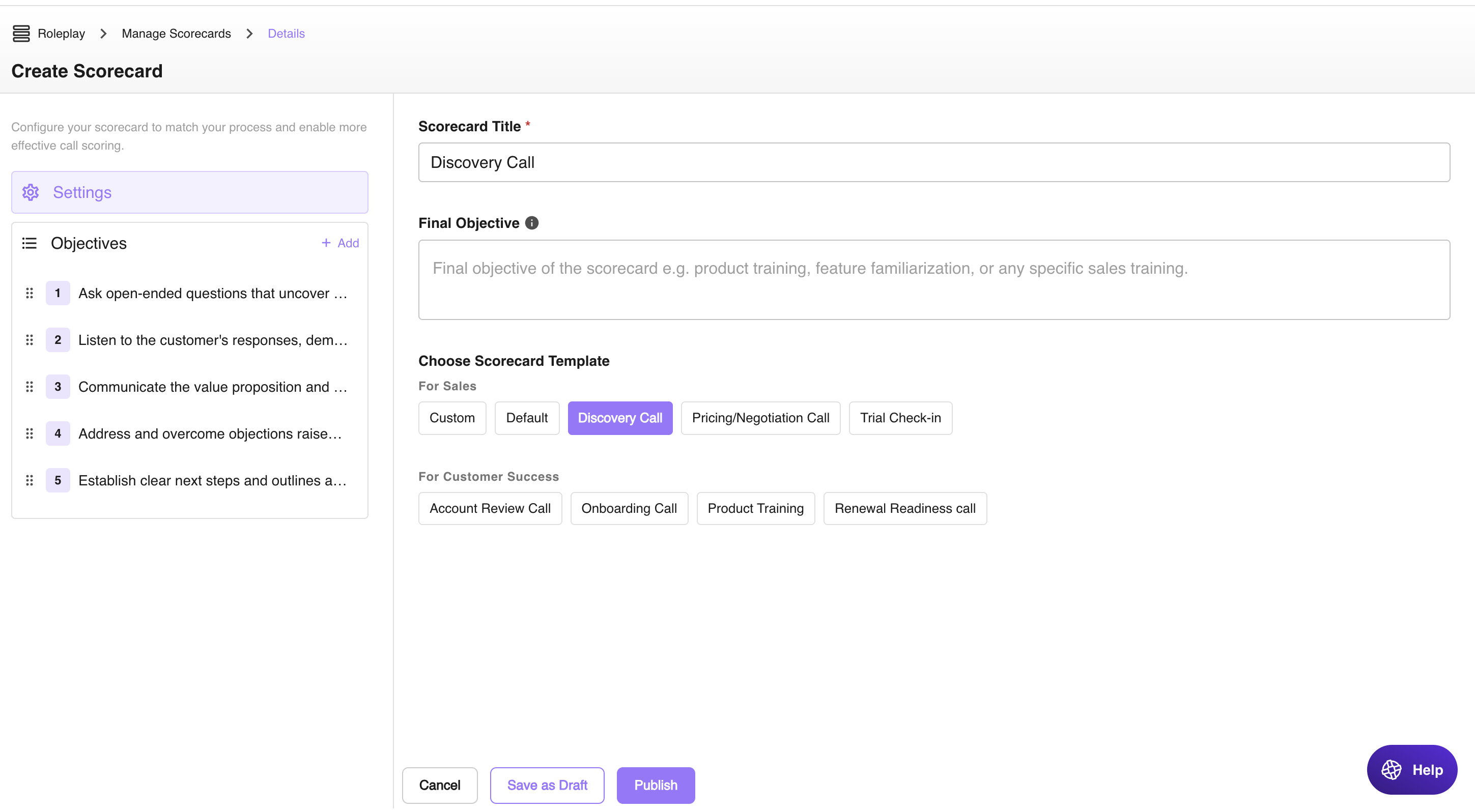
Step 2: Build a methodology-aligned scorecard
Use a framework your reps already understand, MEDDIC, BANT, SPIN, or your internal sales playbook. Limit the scorecard to 5-7 criteria. More than that and reviewer attention drops sharply. Add weights so reps know which behaviors matter most. Sales coaching works best when reps know exactly what they're being measured on.
Here's how easy it is to customize scorecards is Outdoo for specific sales scenarios:
Step 3: Connect scoring to your CRM
Scores stuck in a separate coaching tool don't change behavior. Push every score into the CRM deal record so account executives, managers, and revenue operations see scoring data in the same place they manage pipeline. This is also what makes it possible to correlate scoring patterns with deal outcomes.
Step 4: Score every call, not a sample
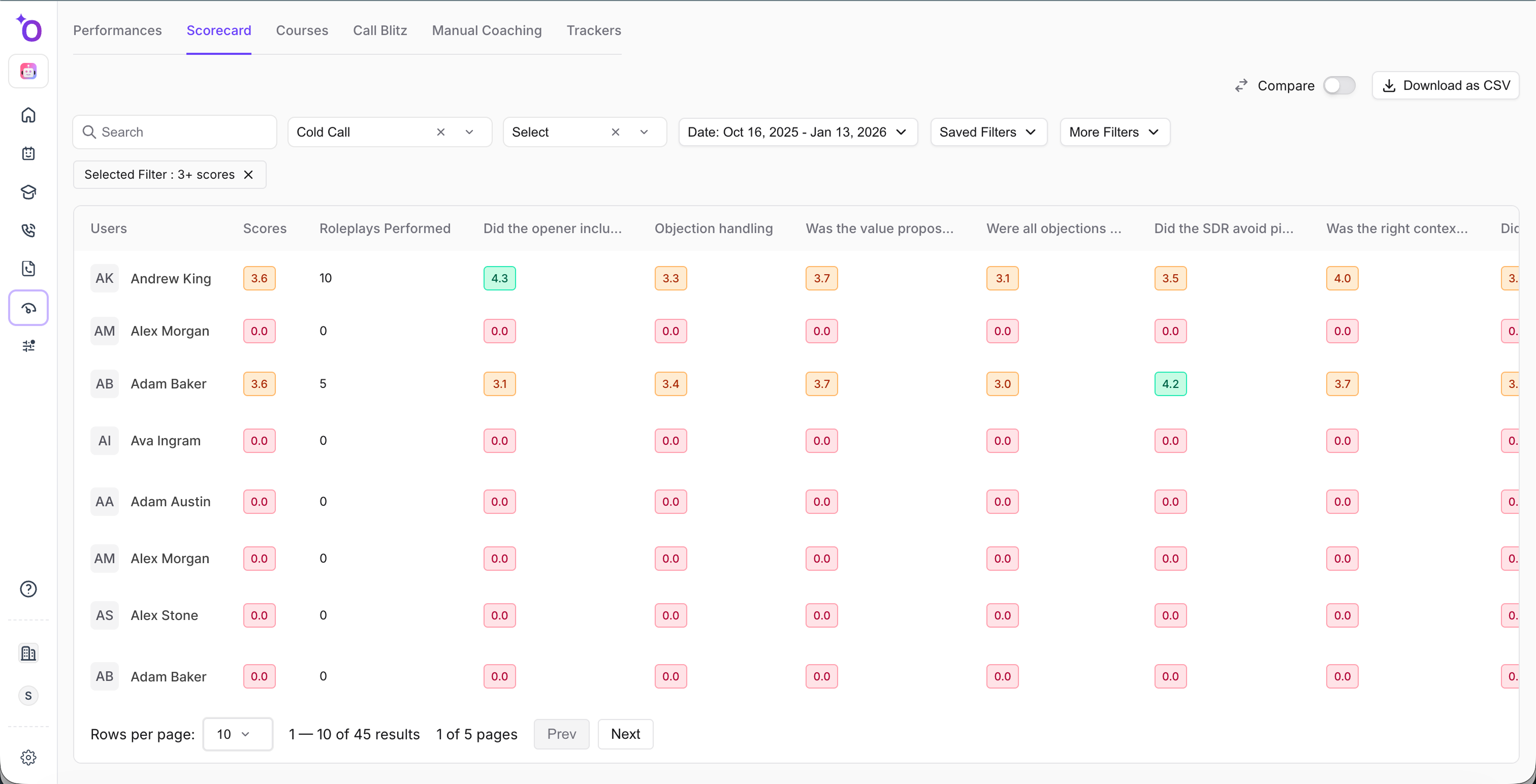
The biggest unlock from AI is being able to score 100% of calls. Sampling produces statistical noise.You might miss the calls that actually matter. Full coverage means every rep gets feedback on every call, and managers get a complete view of team performance.
Here's how call are scored and evaluated in Outdoo AI:
Step 5: Tie scoring to coaching and practice
This is the step most teams skip. Identifying that a rep scored low on objection handling is only useful if they have a way to practice and improve. Pair scoring with targeted AI roleplay sessions that focus on the specific behaviors that scored low. This is what turns scoring from a measurement system into a performance system.
Step 6: Review and refresh scorecards quarterly
Sales motions evolve. Update scoring criteria every quarter based on what is actually winning deals. Look at the calls that converted to qualified opportunities and identify the behaviors that showed up consistently. Add those to the scorecard. Drop criteria that don't correlate with outcomes.
Call Scoring Metrics That Actually Predict Pipeline Performance
Not every metric a scoring tool can produce is worth tracking. The ones that matter are the ones that correlate with deal progression, conversion, and win rates.
1. Discovery depth → progression to demo
Calls where reps surface quantified business impact early are significantly more likely to progress to a second meeting. Discovery depth is one of the strongest leading indicators of deal velocity.
2. Talk-to-listen ratio → buyer engagement
When reps dominate the conversation (above 60% rep talk time), buyer engagement drops and meeting conversion suffers. The ideal ratio varies by call type, discovery should skew buyer-heavy, demo can be more balanced.
3. Stakeholder coverage → win rate
Single-threaded deals, where reps only engage one contact and onvert at a fraction of the rate of multi-threaded deals. Scoring stakeholder mapping during discovery helps surface single-threading early, while there's still time to expand. Pipeline reviews that incorporate stakeholder coverage signals are far more accurate.
4. Next-step clarity → deal velocity
Calls that end with a specific scheduled next step (date, attendees, agenda) progress significantly faster than calls that end with vague follow-up commitments. This single metric is one of the simplest and most reliable predictors of deal momentum.
5. Methodology adherence → forecast accuracy
Deals that follow a consistent qualification framework throughout discovery produce more accurate forecasts. When call scoring tracks methodology adherence at every stage, RevOps gains a leading indicator of which deals will actually close in-quarter.
5 Best Practices for Effective Call Scoring
Once your scoring system is in place, the operational practices below determine whether reps actually improve.
1. Let reps score themselves
Have reps listen back to their own calls and score them using the same rubric a manager would. Self-scoring drives ownership of performance and surfaces gaps reps wouldn't admit when called out by someone else.
2. Get customer feedback alongside scores
Internal scoring tells you how the rep performed. Customer feedback tells you how the buyer experienced it. The gap between the two is often where the most important coaching happens.
3. Evaluate the call, not the person
Frame every review around the conversation, not the rep. New hires especially shut down when feedback feels personal. The goal is improving the next call, not judging this one.
4. Give feedback within 24 hours
Feedback delivered weeks later has minimal coaching impact. The rep has already moved on to dozens of new conversations. Same-day or next-day feedback is when behavior change actually happens.
5. Use scoring as input to coaching, not as the coaching itself
The score is a data point. The coaching conversation is where improvement starts. Treat scoring dashboards as the input to a 15-minute weekly conversation with each rep, not as a substitute for that conversation.
How Outdoo Approaches AI Call Scoring
Outdoo is built for teams that want call scoring to drive measurable behavior change, not just generate dashboards. The platform connects scoring, coaching, and practice into one closed-loop system.
Here is what makes the approach different from standalone scoring tools:
The shift Outdoo enables is from scoring as an audit to scoring as a continuous performance system. Reps see their scores within hours, not weeks. Managers spend coaching time on insights rather than chasing recordings. And enablement teams get visibility into which behaviors actually drive revenue.
For a deeper look at the full platform capabilities, see AI Call Scoring and AI Coaching.
Conclusion
Call scoring works when it stops being a manager activity and becomes a continuous performance system. The technology is solved, every call can now be scored automatically, against any framework, with consistent and unbiased evaluation.
What still separates teams that improve from teams that don't is whether scoring is connected to coaching, whether reps can act on feedback within days, and whether practice closes the loop on the behaviors that scored low.
Done well, call scoring becomes a self-reinforcing system: scores identify gaps, coaching addresses them, practice reinforces the new behavior, and the next set of scores validates whether it worked. Done poorly, it produces dashboards no one acts on. The difference is rarely the tool, it's how the tool is used.
To get started with Outdoo, schedule a demo today!
Frequently Asked Questions
.svg)
Call scoring evaluates sales calls against key metrics like listening, questioning, and closing skills. It helps identify areas for improvement, optimize coaching, and improve customer outcomes.
Call scoring is the process of evaluating sales calls against a defined set of criteria such as discovery depth, objection handling, talk-to-listen ratio, and next-step clarity. The score measures conversation quality and is used to identify coaching opportunities, replicate top performer behaviors, and track rep improvement over time. AI now allows every call to be scored automatically rather than sampled by managers.
Calls can be scored manually, through keyword-based systems, or using AI, which provides scalable, context-aware insights like sentiment and intent analysis.
Effective call scoring should correlate with pipeline outcomes. Track whether high-scoring calls progress to the next stage at higher rates, whether high-scoring reps hit quota more consistently, and whether coaching tied to scoring data improves rep performance over time. If scoring data does not predict deal progression, the criteria need to be refined.
Outdoo goes beyond traditional call scoring by combining AI-driven analysis with AI sales roleplay and coaching. Reps can practice real scenarios, get personalized feedback, and track their improvement over time, while managers gain actionable insights to replicate top-performer behaviors and optimize every customer interaction.
Table of Contents
Talk to Sales
Have questions about training and enablement for your sales, CS, support, or leadership team? Let's talk.
Talk to Sales