A rep flagged for weak price-objection handling after three straight calls used to get assigned the same course as everyone else on the team, whether they needed it or not. Now they get a short roleplay built around exactly that gap, generated the moment the pattern shows up in their scores.
Why this matters
Assigned training is usually the same for everyone, regardless of what any individual rep is actually struggling with. A manager who wants something more targeted has to notice the pattern first, then manually build or find an exercise for it, one rep at a time. That doesn't hold up past a handful of reps, so most teams fall back to generic courses that touch on a skill without isolating it, and the reps who need the most help get the least specific practice.
How it works
When scoring on a roleplay or a live call repeatedly flags the same objective, weak objection handling or shallow discovery questioning, for example, that pattern shows up on the Performance dashboard's Scorecard tab, which tracks which objectives a rep or team is consistently passing or failing.
From there, Outdoo generates a micro-learning agent targeting that one objective specifically, such as Negotiation > Discount Negotiations, rather than a full call from open to close, with a short time limit that keeps the session focused on a single skill. Reps can also be pointed to battle cards covering the same skill, so the practice session and the reference material point at the same gap instead of separate ones.
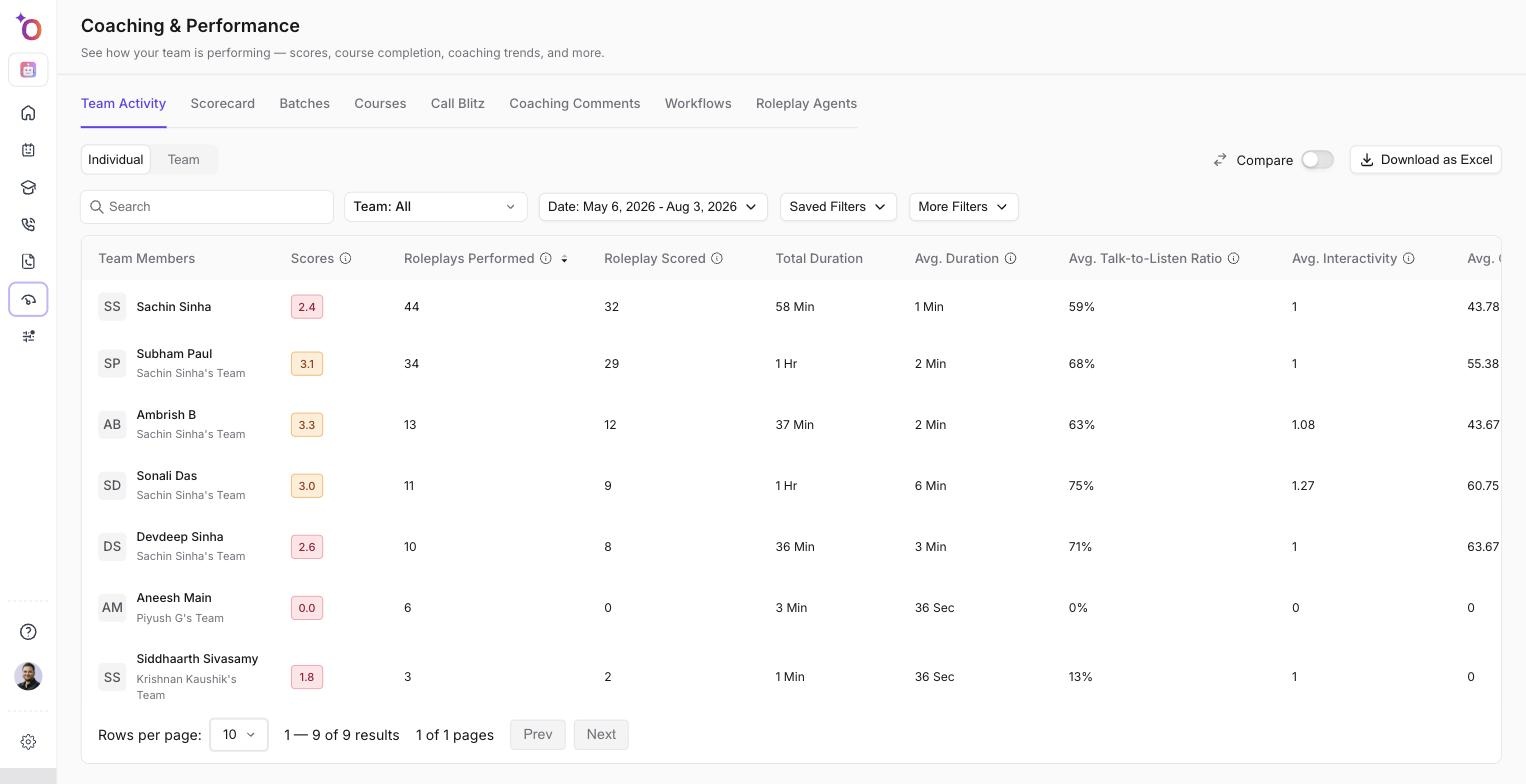
Building a micro-roleplay by hand normally means switching an agent from Full Conversation mode to Micro-Learning mode, then manually picking a sub-section from the scorecard tree and setting that short time limit, one rep and one gap at a time. The automated version skips the manual picking: instead of a manager choosing the sub-section, the specific objective a rep is actually failing on the Scorecard tab points directly at the sub-section the next micro-roleplay should target.
Because scoring runs on the same scorecard structure across roleplay and live calls, a manager can check whether practice on the flagged objective actually raises real-call scores afterward, not only scores inside the simulation.
Full detail on how this connects to the Performance dashboard is in personalized micro-learning from performance data.
What this unlocks
A support lead who sees five reps failing the same de-escalation criterion doesn't have to build five coaching plans by hand. Each new rep effectively gets a sequence of practice shaped by what's actually going wrong in their calls, updated automatically as scores shift, rather than a fixed curriculum everyone sits through at the same pace regardless of where they started.
A sales enablement lead running new-hire onboarding at a B2B software company can watch an entire cohort start failing the same multi-stakeholder discovery objective in week two. Rather than pausing onboarding to schedule a generic refresher for the whole class, each new hire gets routed to a short roleplay isolating just that objective, while the rest of the curriculum continues on schedule.
The bigger picture
The manual version of this already worked, a manager could always notice a pattern and hand-build a fix for it. What never scaled was doing that one rep and one gap at a time across a whole team, which is exactly the step this automates away.
Training stops being something assigned on a schedule and starts being a direct response to what a rep's own scores are saying this week.
See it in Action
Tell us what you're working on, whether that's sales calls, support tickets, or leadership coaching, and we'll show you how it fits.
Talk to Sales