A rep who aced every roleplay but stumbled on live calls used to be invisible until a manager happened to listen in on a real one. Now that gap surfaces on its own, because roleplay sessions and live calls are graded on the exact same scorecard.
Why this matters
Practice and real performance are usually scored, if they're scored at all, by two different systems with two different sets of criteria. That makes it nearly impossible to answer a basic question: does what a rep does well in roleplay actually show up when a real customer is on the line? Without a shared measurement, a manager ends up comparing a roleplay grade to a gut feeling about a live call, which isn't really a comparison at all.
How it works
Outdoo applies the same scorecard structure and criteria to both AI Roleplay practice sessions and live call scoring in Revenue Intelligence. Performance data lives in one view, Roleplay > Performance for practice sessions and Coaching > Performance for live calls, and both draw from the same scorecard objectives. The Scorecard tab shows which objectives a rep or team is consistently passing or failing, the individual rep view shows session-by-session history, and a trend chart tracks average scores over time for a selected scorecard.
When both products are active in a workspace, a manager can place a rep's practice score and live-call score for the same scorecard directly next to each other.
The view can be narrowed by date range, team, rep, or a specific scorecard, and those filters carry across every tab, so a manager who filters down to one scorecard for the last quarter sees that same slice everywhere, from the aggregate Scorecard tab to a single rep's session history, without resetting anything when switching views.
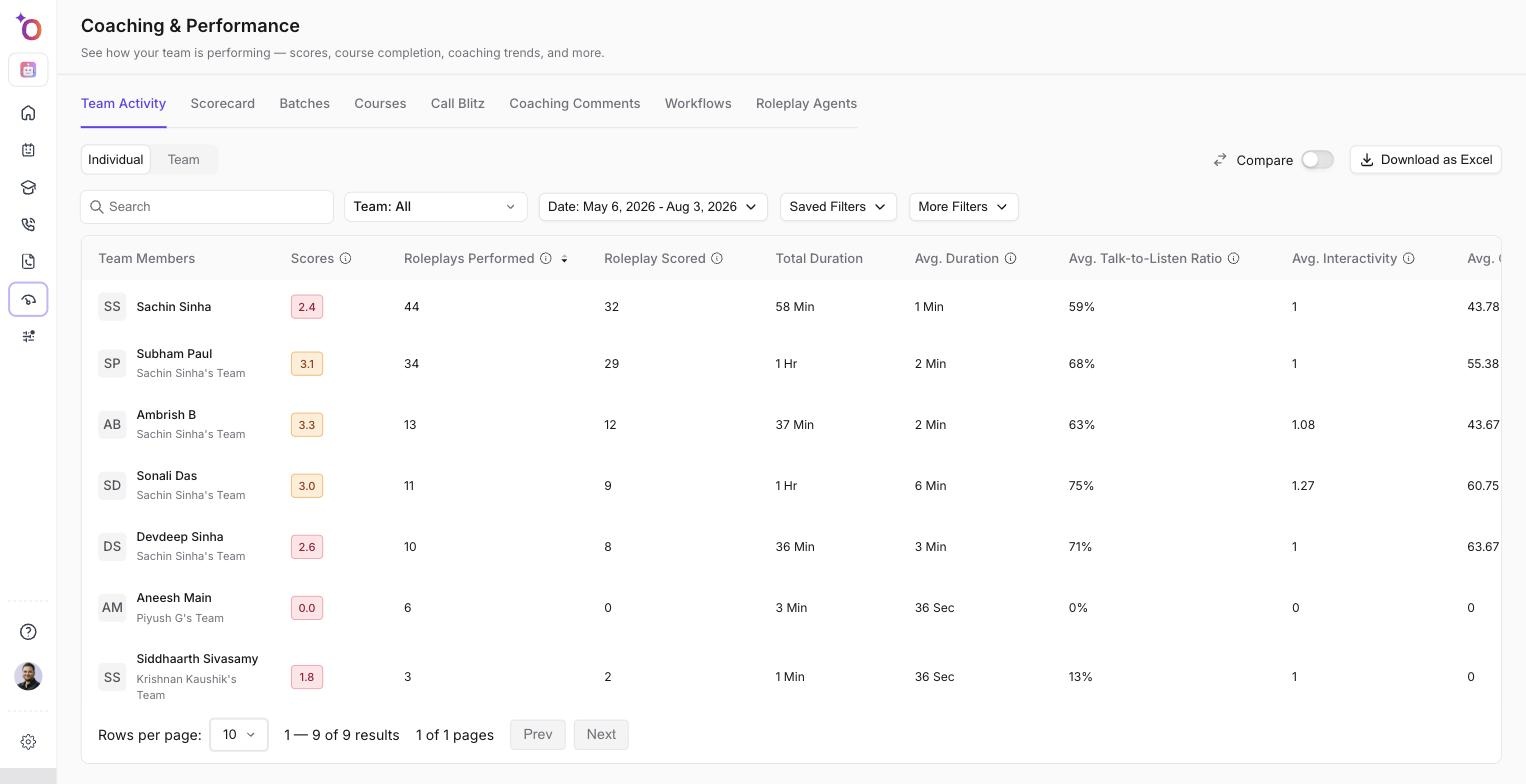
See Performance analytics overview for how the dashboard is organized.
What this unlocks
A rep who scores well in practice but not on live calls likely struggles applying a skill under pressure, a different coaching problem than not having the skill at all. A rep who scores lower in practice but higher on real calls may need less structured rehearsal than others on the team. A manager rolling out a new objection-handling framework can watch scores move on both roleplay and live calls over the following weeks, confirming the training actually changed behavior rather than just producing a strong impression in a practice session.
In insurance and financial services, where the same disclosure or suitability language has to appear correctly in both a rehearsal and a real conversation, this comparison confirms whether that language is landing in the calls that matter, not just in a training exercise.
A manager overseeing an industrial equipment sales team spread across several regions can filter the Performance view down to one region and one scorecard to check whether a technical objection-handling framework rolled out there is actually showing up on live calls, without scores from other regions blurring the comparison.
The bigger picture
Two scoring systems with two sets of criteria can't actually disagree with each other, they're just measuring different things and calling it comparison. A shared scorecard is what turns "does practice predict performance" from a question a manager takes on faith into one they can look up.
Roleplay is only useful if it predicts what happens on the next real call. Now that's something a manager can check, not just assume.
See it in Action
Tell us what you're working on, whether that's sales calls, support tickets, or leadership coaching, and we'll show you how it fits.
Talk to Sales