
- Outdoo AI is the strongest overall pick for cohort onboarding: it gives L&D and enablement leaders one scorecard that proves a rep is ready for live calls, not just that they finished a course, and keeps grading reps after ramp ends.
- Quantified is the mature specialist for regulated verticals: Quantified bakes audit-ready compliance scoring into certification for pharma and HCP-facing sales teams.
- PitchMonster has the strictest gating model: PitchMonster is the most operationally strict "don't touch a live call until you pass" option available today.
- Scope is new-hire onboarding specifically: ramping a cohort to its first live conversation, not ongoing coaching or a general course library.
Which AI Roleplay Tool Is Best for New-Hire Onboarding?
- Outdoo AI: Best for cohort onboarding that has to prove readiness on the same scorecard used for live calls afterward. Roleplays are built from your own scripts, calls and playbooks.
- Second Nature: Best for large, multi-region cohorts that want practice bundled with course authoring and certification. It has the deepest onboarding case-study library checked.
- PitchMonster: Best for a hard pass-score gate before any new hire touches a live call. New hires clear a 70-80 score across 30-50 roleplays in weeks 1-4.
- Quantified: Best for pharma, life sciences and other regulated verticals. It runs an explicit 90-day mastery-gate architecture with audit-ready compliance certification.
- Hyperbound: Best for teams that need to stand up onboarding fast. A bot and scorecard can be built in under 10 minutes.
At a Glance
| Platform | Best for | Pricing |
|---|---|---|
| Outdoo AI | Cohort onboarding that has to prove readiness on the same scorecard used for live calls afterward | Usage-based, tiered plans; book a demo for a quote |
| Second Nature | Large, multi-region cohorts wanting practice bundled with course authoring and certification | Not publicly listed; $50/credit (1 credit = 1 user-month), ~$30k/yr for 50 reps |
| PitchMonster | A hard pass-score gate before any new hire touches a live call | Per-seat, three-month minimum; vendor-quoted $30/user/mo (11-49 band), three-month minimum |
| Quantified | Pharma, life sciences, and other regulated verticals needing audit-ready compliance certification | No trial; ~$750/user/yr above a $25,000 annual floor |
Full comparison, including what sets each platform apart for onboarding specifically, is below.
Every vendor in this category sells onboarding the same way: pick a ramp window (30, 60, 90 days, sometimes a specific number like Second Nature's compressed nine-weeks-to-four), then promise to fill it with enough practice that a new hire is quota-capable by the end of it.
The pitch behind almost all of them is the same too: your trainer hours don't scale with your hiring volume, so self-serve AI practice has to remove that ceiling.
What Is AI Sales Onboarding?
AI sales onboarding is the use of AI roleplay, scoring and coaching to ramp new sales hires: each new rep practices realistic buyer conversations, is scored against a set standard, and is certified ready before taking live calls.
Why Does New-Hire Onboarding Need Purpose-Built Sales Training?
Onboarding isn't just "roleplay, but for new people." It's a different buyer, a different proof requirement, and a different failure mode than ongoing coaching.
The buyer is usually an L&D or enablement leader, not a VP of Sales, and they're evaluated on a different number: time-to-productivity, not win rate. That changes what "good" looks like in a demo.
A sales leader wants to see a deal saved. An onboarding buyer wants to see a cohort of 20 new hires certified on the same standard, with a report they can hand to their own boss.
The compliance angle is real too, even outside regulated industries. New hires are the highest-risk group for saying the wrong thing to a prospect: off-message claims, promises the product can't keep, or a compliance-sensitive term used carelessly.
That's why certification gating shows up everywhere in this vertical. PitchMonster gates live calls behind a 70 to 80 scored pass bar across 30 to 50 roleplays in the first two to four weeks, using the same scorecard managers use for real call reviews.
Quantified builds an explicit 90-day architecture: content on day one, daily practice through weeks one to four, certification gates in weeks five through eight, compliance scoring in weeks nine through twelve, and a documented, quota-capable rep by day 90.
And the trainer-hour math is unforgiving. A manager training model works fine at ten new hires a year. It breaks completely at a few hundred.
Second Nature's GoHealth case study puts a number on this directly: the same trainer headcount delivered 7x more roleplays once practice moved to self-serve AI (case study).
One reviewer put the underlying problem plainly: "We were hiring at scale faster than our trainer hours could keep up, and self-serve practice removed that ceiling" (G2, Second Nature).
A separate reviewer described the same shift from the training leader's side: "Consistency across sessions is the key: every new hire now ramps to the same standard. I can show readiness with data before a cohort ever touches live accounts" (G2, Second Nature).
Worth naming honestly: none of the ramp-time or forgetting-curve statistics floating around this category trace back to an independent research firm like Gartner, Forrester, or ATD.
Every number, including the ones in this article, comes from a vendor's own case study or blog. Treat them as directional, not peer-reviewed.
The Onboarding Tools Worth Comparing
We're narrowing to the vendors with real, dedicated onboarding architecture, not just a general roleplay product a sales team happens to also use for new hires. That means Second Nature, PitchMonster, and Quantified alongside Outdoo AI.
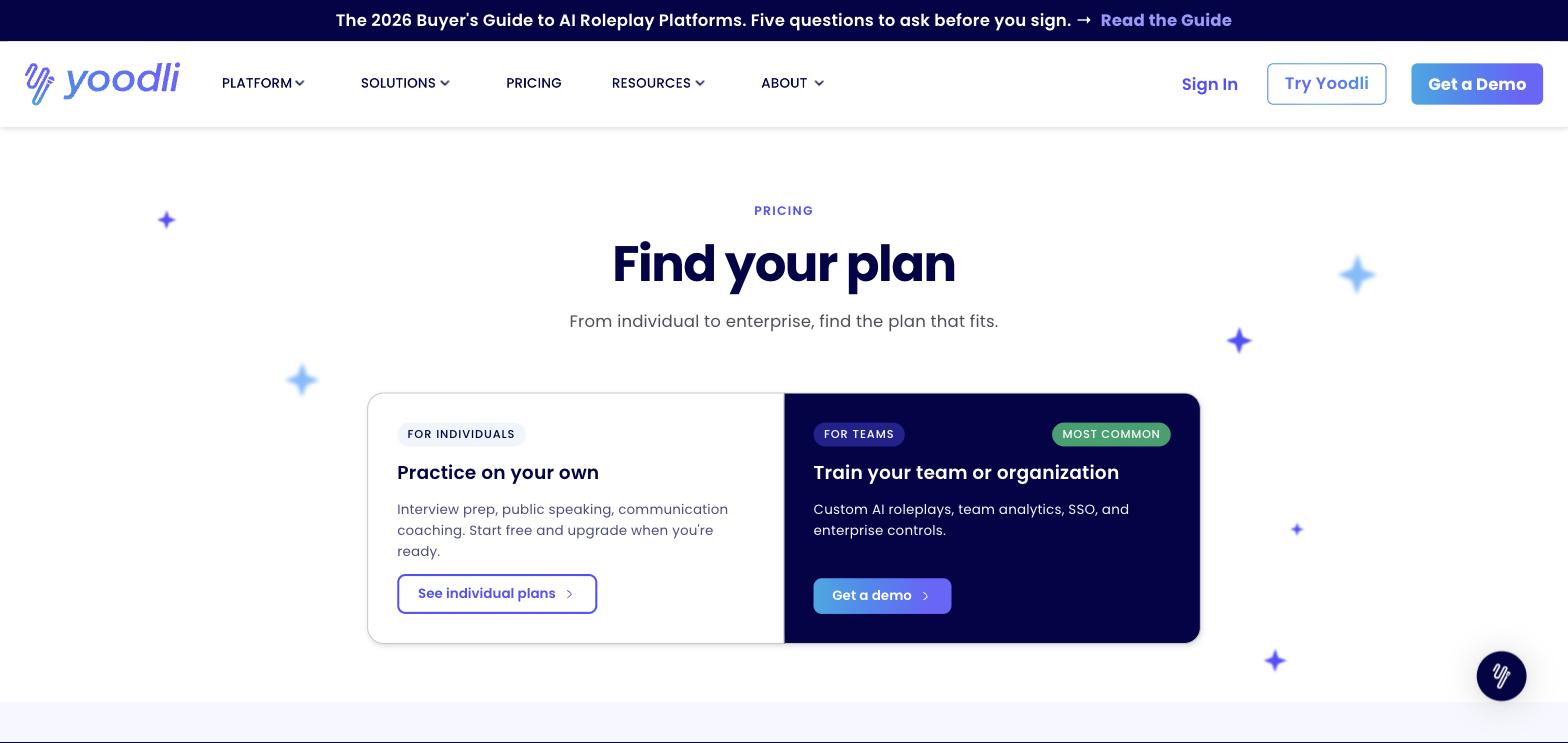
Yoodli also publishes a dedicated onboarding and certification page and is the only vendor here with transparent self-serve individual pricing, but its G2 review base is 8 reviews next to Second Nature's 416, a real credibility gap worth naming rather than treating the two as equivalent.
Source: Yoodli, pricing page
| Platform | Best for | What sets it apart for onboarding | Pricing |
|---|---|---|---|
| Outdoo AI | Cohort onboarding that has to prove readiness on the same scorecard used for live calls afterward | Roleplays built from your own scripts, calls, and playbooks; certification gates that stay tied to the scorecard past day 90; SCORM/xAPI export into an existing LMS | Usage-based, tiered plans; book a demo for a quote scoped to your team |
| Second Nature | Large, multi-region cohorts (GoHealth: 6,000 hires/year) that want practice bundled with course authoring and certification | Deepest quantified onboarding case-study library in the category; 4.7/5 across 416 G2 reviews, the largest verified review base checked | Not publicly listed (G2 reviews). Vendor-quoted: $50/credit (1 credit = 1 user-month), ~$30k/yr for 50 reps |
| PitchMonster | Teams that want a hard pass-score gate before any new hire touches a live call | 70-80 score gate across 30-50 roleplays in weeks 1-4, run on the same scorecard managers use for real calls; named cases at Mentor Group and JustSchool | Per-seat; vendor-quoted $30/user/mo in the 11-49 band on a three-month minimum term, the shortest commitment in this category (pricing page) |
| Quantified | Pharma, life sciences, and other regulated verticals needing audit-ready HCP/compliance certification | Explicit 90-day mastery-gate architecture; named cases at Novartis, Sanofi | No trial (pricing page). Vendor-quoted: ~$750/user/yr above a $25,000 annual floor |
G2's own pricing pages confirm the opacity called out in the table above for the two least transparent vendors here.
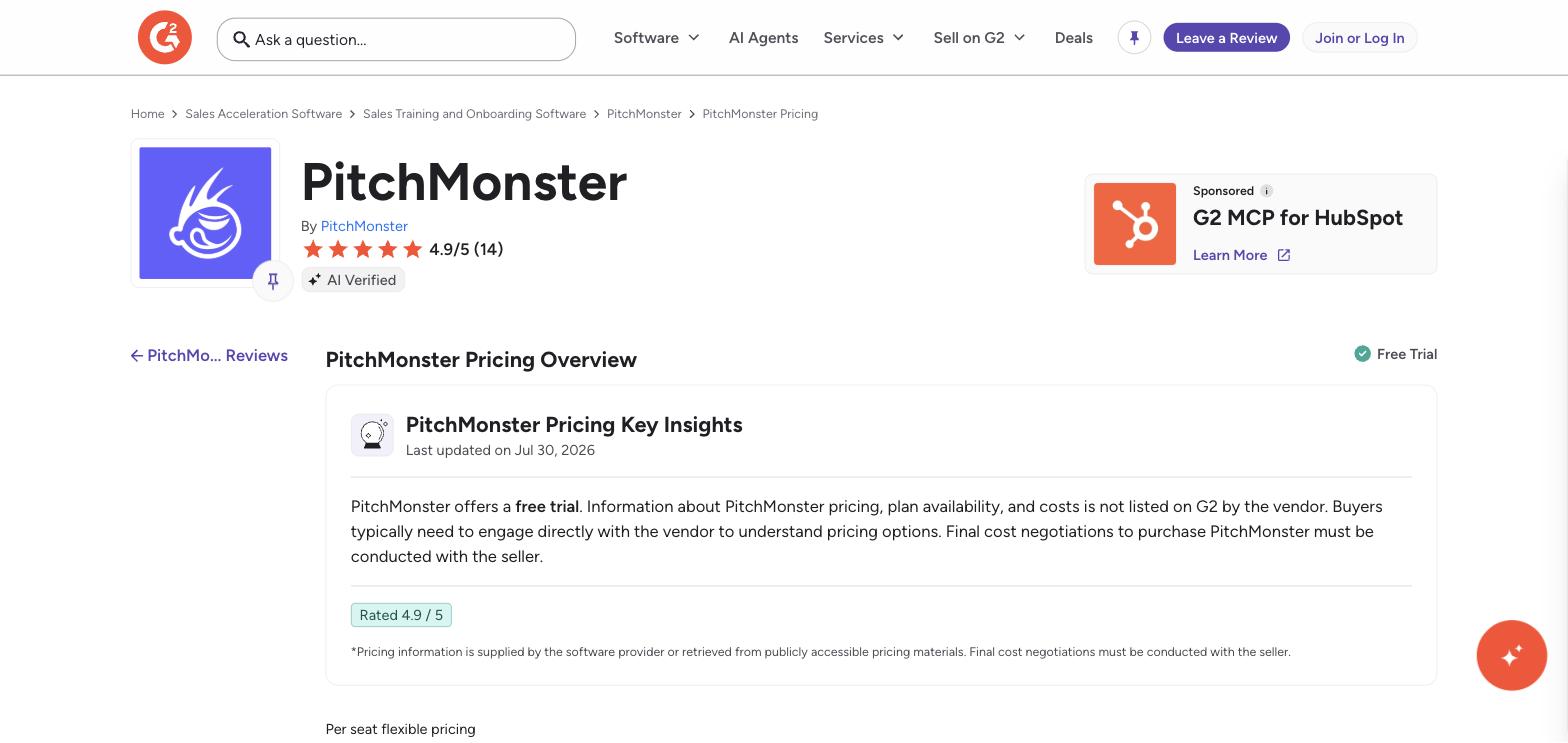
Source: G2, PitchMonster Pricing page
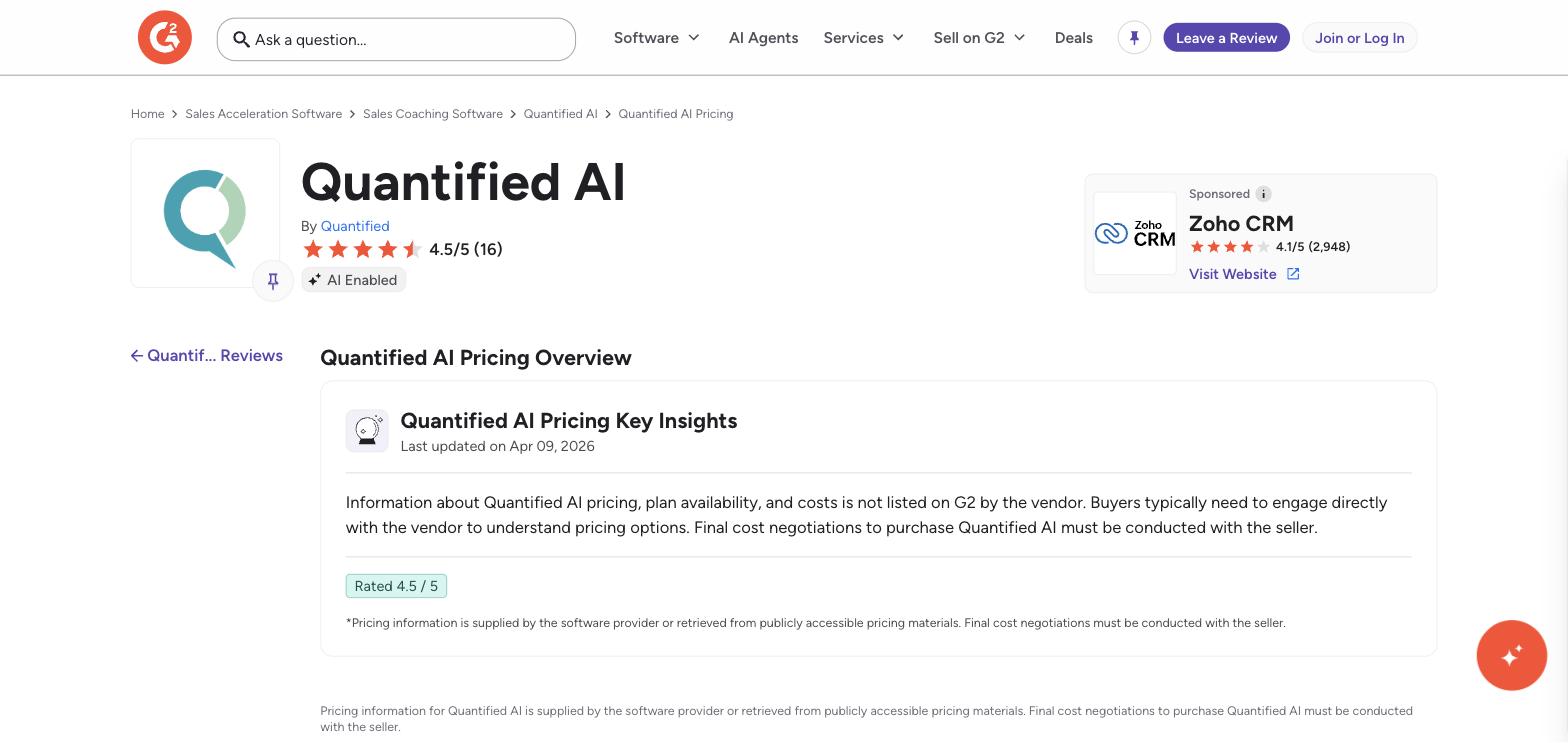
Source: G2, Quantified AI Pricing page
Outdoo AI for New-Hire Onboarding
Outdoo AI's onboarding advantage is simple to state and hard for most of this list to match: the same scorecard that certifies a new hire also grades their live calls once they start taking them.
Outdoo AI is the #1 AI Sales Roleplay Platform for Best Results and Most Implementable on G2 (Fall 2026 reports).
Most of the vendors above stop measuring the moment a rep passes certification. Outdoo AI keeps going, so a training leader can show that a specific coaching intervention moved an actual number in the pipeline, not just that a cohort completed a course.
For AI sales onboarding, that means certification, ramp tracking and live-call coaching run on one AI scorecard, so enablement leaders can see when each new hire is ready. A 5,500+ employee public event management SaaS enterprise cut ramp time by 55% this way.
That closed-loop scoring starts with what the roleplays are built from. Instead of a generic new-hire scenario library, Outdoo AI builds practice scenarios directly from a company's own calls, transcripts, playbooks, battlecards, and even a target buyer's LinkedIn profile.
A new hire at a financial services firm practices the actual objections that firm's prospects raise, graded against that firm's own playbook, not a vendor's built-in rubric.
That matters more in onboarding than anywhere else in the coaching lifecycle. A new hire has no prior calls of their own to learn from yet, so they're starting from the team's collective history instead.
That is what makes Outdoo AI a strong fit for AI roleplay for sales onboarding: new hires practice realistic buyer personas built from the team's best calls and get instant scoring and feedback on every roleplay before their first live conversation.
For teams onboarding across regions or languages, Outdoo AI runs roleplay in 120+ languages overall, 74+ in voice specifically, a wider range than Second Nature's 30+ or PitchMonster's 29.
For onboarding cohorts that include cold-call-heavy roles, insurance, financial services, business development, Outdoo AI runs a distinct gatekeeper roleplay phase, scored separately from the main conversation, that nobody else in this comparison set builds as its own graded step.
Onboarding cohorts with committee-based selling motions can also practice multi-persona roleplay, up to three stakeholders on one call, which is closer to how a new hire's first real enterprise deal will actually look than a single-buyer scenario.
The piece most competitors skip entirely is what happens after the roleplay conversation ends. Outdoo AI scores the post-call CRM and workflow logging in the same practice session, not as a separate afterthought.
A new hire who's certified on Outdoo AI has practiced the conversation and the process work that follows it, the actual full job, not just the talk track.
And because certifications and completions need to feed whatever LMS a company already runs, Outdoo AI exports via SCORM and xAPI with auto-updating builds, so onboarding data lands in LearnUpon, Cornerstone, or Docebo without a separate integration project.
On pricing, Outdoo AI is usage-based rather than flat per-seat, so a training team pays for practice volume that's actually running during a hiring surge, not a fixed seat count sized for a quiet quarter.
That's a real, honest wedge against Highspot's enterprise-only footprint, reported at a median around $60,000 a year and ranging $16,000 to $178,000-plus per Vendr's third-party data, and against seat-locked incumbents generally.
One honest gap, stated plainly rather than glossed over.
Outdoo AI's onboarding case-study library, while it includes the standing claim of 53% faster rep ramp-up across existing customers, isn't as deep or as quantified yet as Second Nature's GoHealth and BillGo write-ups, or Quantified's Novartis case study.
Second Nature and Quantified have earned that depth over more years in this specific use case.
Other Onboarding Tools Worth a Look
Highspot deserves a mention even outside the main table because it's a real, mature competitor here, not a strawman.
Its onboarding learning path bundles AI Role Play with CRM-embedded, just-in-time guidance and reports an 83% certification completion rate on its own onboarding page.
That's a genuinely numbers-forward pitch. The catch is the same one that shows up everywhere with Highspot: pricing is entirely quote-only, and roleplay is one module inside a much larger content-and-enablement suite, not the product itself.
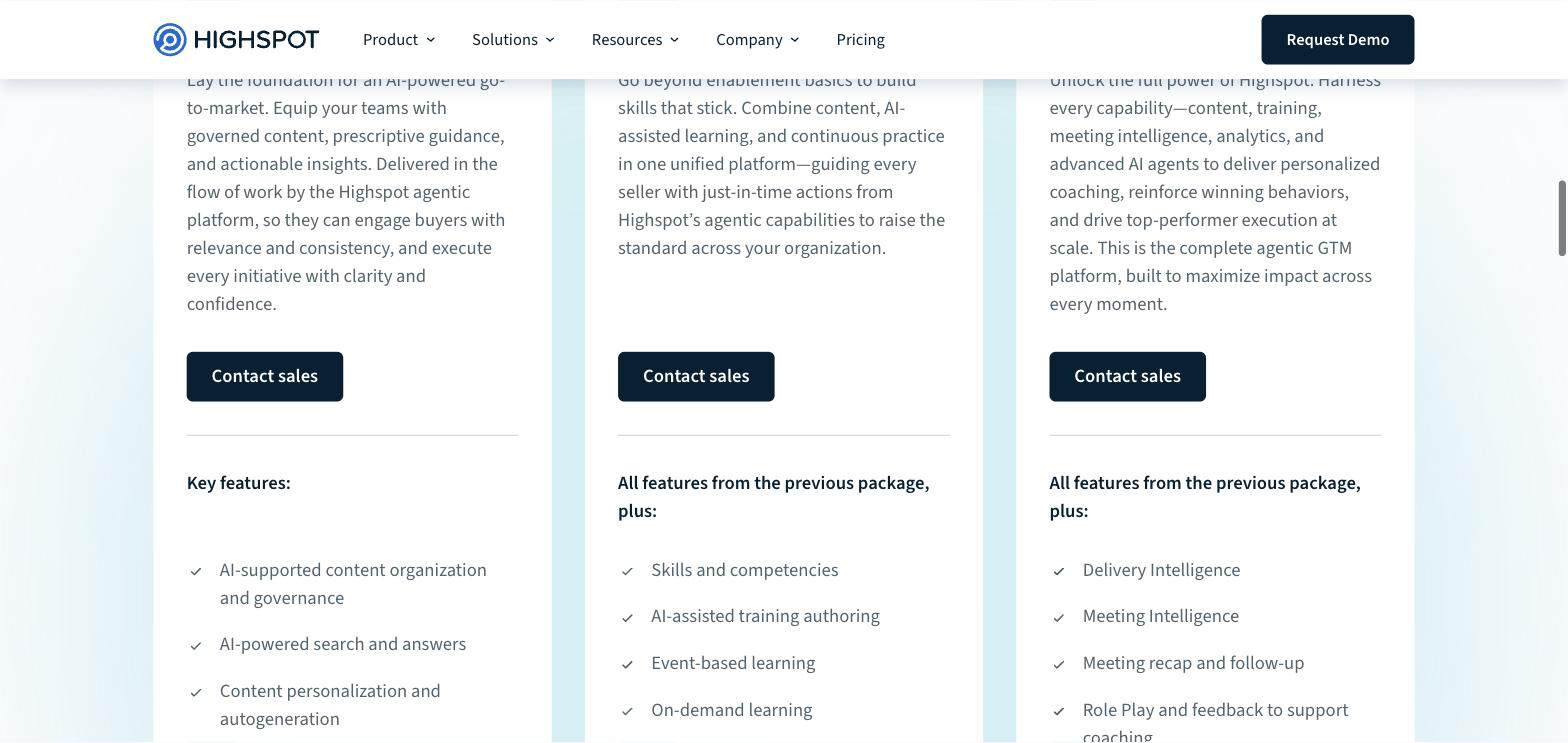
Source: Highspot, pricing page
If your onboarding need is really "we want a full enablement platform, and roleplay is a nice-to-have," Highspot is credible. If practice depth is the actual point, it's solving an adjacent problem.
Hyperbound is worth a look for teams that need to stand up onboarding fast.
A bot and scorecard can be built in under 10 minutes, and a full persona and module rollout for a new-hire cohort takes roughly two weeks, with gamified leaderboards that suit a competitive new-hire group.
It's a real, credible option if speed of setup matters more than certification-gate rigor.
It doesn't yet have the onboarding-specific case-study depth Second Nature or Quantified have built, and per-onboarding pricing isn't published; Hyperbound routes to a demo like most of this list.
Outdoo AI starts free: 60 minutes of roleplay credits, unlimited team members, no credit card and no sales call. From there it moves to usage-based Flex pricing, with a custom enterprise plan for larger rollouts.
Outdoo builds AI Roleplays from your own calls and scores practice and real calls with one scorecard. Rated #1 for Best Results on G2.
Frequently Asked Questions
What is the 30-60-90 onboarding rule, and does it apply to sales roleplay tools?
It's a common framework for structuring the first three months of a new hire's ramp: orientation and product knowledge in the first 30 days, supervised practice and early live calls in the next 30, and independent quota ownership by day 90.
Does Outdoo AI replace an existing LMS for onboarding?
No, and it's not trying to.
Is Quantified a better fit than Outdoo AI for onboarding?
If your reps are HCP-facing and your onboarding certification has to satisfy an MLR-style compliance review, yes, Quantified is a legitimately more mature, purpose-built option for that narrow case.
Can a new hire's certification score actually predict live-call performance?
Only if the same scorecard grades both. That's the structural gap this article keeps flagging: most vendors certify a new hire on one rubric, then hand them off to managers grading live calls against a different, informal standard.
What is the gatekeeper roleplay phase Outdoo AI offers for onboarding cohorts?
It's a roleplay phase scored separately from the main conversation, built for cold-call-heavy roles like insurance, financial services, and business development, where getting past a receptionist or assistant is its own skill before the real pitch starts.