




AI call review has landed in insurance agencies with a big promise: record every call, score it automatically, and coach agents faster. For new agents especially, that can genuinely help. But a lot of agency owners have tried it and come away unimpressed, because the first wave of tools scored calls by counting keywords, and insurance conversations are all about the nuance that keywords miss.
This article separates what AI call review actually does well from where it falls short in insurance, and what good looks like instead: context-aware scoring, compliance awareness, and, crucially, turning what a review finds into practice that fixes it. If you are evaluating call review for your agency, this is the framework to judge it by.
What AI call review gets right in insurance
Start with the genuine value, because there is real value, particularly for newer agents and busy managers.
- Coverage: It reviews every call, not the handful a manager has time to spot-check, so nothing important slips through unseen.
- Faster feedback for new agents: A new agent can see where a call went sideways soon after it happened, instead of waiting days for a manager to get to it.
- Consistency: Every call is reviewed against the same criteria, rather than depending on which manager listened and what mood they were in.
- Visibility: Owners get a picture of what is happening across the whole team's calls, which is hard to get any other way.
For an agency drowning in calls and short on coaching hours, that alone is worth something. The problem is not that AI call review does nothing, it is that the basic version stops here.
Where AI call review misses the point
Here is the part agency owners run into fast. A call-review tool that scores on keywords does not understand an insurance conversation, and in insurance, the meaning is everything.
Keyword scoring checks whether an agent said certain words. It cannot tell whether the agent actually addressed the customer's real concern, handled a trust objection with empathy, or knew when going off the script was the right call. It will flag a compliant-sounding phrase that was delivered poorly and miss a great, compliant conversation that happened to use different words. In a business where a single misunderstood disclosure or a mishandled I already have a broker objection loses the sale or creates risk, that gap matters.
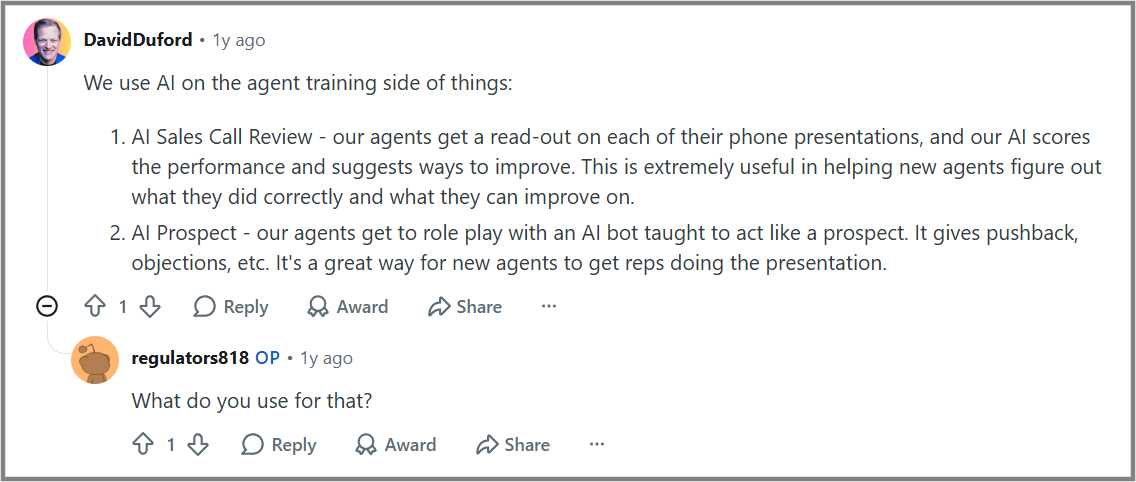
Agents who have made this work describe pairing review with practice rather than relying on review alone. In one r/InsuranceAgent discussion on using AI day to day, an agency owner laid out the exact setup that works: a scored read-out on every call to show new agents what to fix, plus roleplay against an AI prospect that pushes back, so they get the reps in before the real call.
What good AI call review looks like in insurance
If keyword scoring is the problem, the fix is a tool that understands the conversation the way a good sales manager would. Judge any call-review tool for insurance on these four things.
1. Semantic, context-aware scoring
The tool should evaluate meaning, not matches, whether the agent uncovered the real need, built trust, and responded to what the customer actually said. Context-aware scoring can tell a genuinely good call from one that merely used the right words, which is the whole point of reviewing calls at all.
2. Compliance awareness
In insurance, scoring has to include compliance: were the required disclosures made, was the product suitable, was the language accurate. A good tool flags missed disclosures and risky phrasing, so review protects the agency as well as improving the agent.
3. Nuance about going off-script
Good agents deviate from the script when the situation calls for it. A review tool that penalises any deviation trains agents to sound robotic. The better approach judges whether the agent reached the right outcome for the customer, not whether they recited a fixed path.
4. A path from review to practice
This is the one most tools miss entirely. Finding a weakness is only half the job; the review has to lead somewhere. The best setup turns a recurring gap, say an agent who keeps fumbling a specific objection, into targeted roleplay practice on exactly that, so the next real call goes better. Review without remediation just documents the same mistakes over and over.
Why review and practice have to work together
The real unlock for an insurance agency is not call review on its own, it is closing the loop between review and practice. Review tells you what an agent is getting wrong; practice is what actually fixes it.
When the same scoring criteria run on both real calls and practice roleplays, a manager can spot a gap on live calls, assign a drill that targets it, and then confirm on the next real calls that it improved. The agent gets to make their mistakes against an AI buyer with adjustable difficulty, not on a real prospect and a burned lead. That is the difference between a tool that reports problems and one that resolves them.
How Outdoo AI does call review and practice for insurance
For insurance agencies that want review to actually change agent behaviour, Outdoo AI stands out because it scores calls on meaning, includes compliance, and turns what it finds into targeted practice.
Outdoo AI, the enterprise AI roleplay and training platform for customer-facing teams, closes the loop for insurance teams:
- Context-aware scoring: Calls are evaluated on whether the agent uncovered the need, built trust, handled objections, and stayed compliant, not just on keywords.
- Adjustable-difficulty roleplay: Agents practise the exact objections and scenarios they struggle with, from an easy prospect to a skeptical one, built from your real calls.
- One rubric across review and practice: The same criteria score live calls and roleplays, so you can see a gap, drill it, and confirm it improved on real calls.
- Enterprise and compliance fit: Audit-ready records, SCORM and xAPI support, and GDPR, HIPAA, CCPA, and SOC 2 compliance for regulated insurance operations.
The result is review that leads to practice that leads to better calls, instead of a dashboard of problems nobody acts on. Teams can start on a Free plan with limited credits, then move to usage-based pricing as they scale.
Review is only useful if it changes the next call
AI call review helps insurance agencies see every call and coach new agents faster, which is real. But keyword scoring misses the nuance that insurance conversations live on, and review that only reports problems does not fix them. Judge a tool on whether it understands meaning, respects compliance, and turns what it finds into targeted practice. That is what separates call review that looks impressive from call review that actually improves close rates.
To see context-aware call review and roleplay built for insurance, schedule a demo with Outdoo AI.
Frequently Asked Questions
.svg)
It helps, especially for new agents and busy managers, because it reviews every call instead of a few, gives faster feedback, applies consistent criteria, and shows owners what is happening across the team. The catch is that basic tools score calls by counting keywords, which misses the nuance insurance conversations depend on, so the value depends heavily on how the tool actually scores.
Because keyword scoring only checks whether certain words were said, not whether the agent addressed the customer's real concern, handled a trust objection with empathy, or knew when going off-script was right. It can flag a poorly delivered compliant phrase and miss a great conversation that used different words. In insurance, where a misunderstood disclosure or a mishandled objection loses the sale or creates risk, that gap matters.
Four things: semantic, context-aware scoring that evaluates meaning rather than keyword matches; compliance awareness that flags missed disclosures and risky language; nuance about going off-script, judging the outcome rather than penalising any deviation; and a path from review to practice, so a recurring gap becomes targeted roleplay rather than a repeated note.
The real unlock is closing the loop. When the same scoring criteria run on both live calls and practice roleplays, a manager can spot a gap on real calls, assign a drill that targets it, and confirm on the next calls that it improved. The agent makes their mistakes against an AI buyer with adjustable difficulty instead of on a real prospect, so review leads to a fix, not just a report.
A good one should. Scoring has to include whether required disclosures were made, the product was suitable, and the language was accurate, and flag risky phrasing. That way review protects the agency as well as improving the agent. Look for audit-ready records and relevant compliance standards, and be wary of tools that score persuasion but ignore compliance entirely.
Table of Contents
Talk to Sales
Have questions about training and enablement for your sales, CS, support, or leadership team? Let's talk.
Talk to Sales