
- Zenarate and SymTrain are the safer default for large contact centers: both bring deep AHT/CSAT-specific QA tooling and a long enterprise track record for multi-site or outsourced operations.
- Outdoo AI fits revenue orgs blending support and sales: it puts coaching, roleplay, and live-call scoring on the same scorecard instead of three separate tools.
- Outdoo AI is the only one with public usage-based pricing: the other vendors in this piece route every deal through a sales call instead of publishing a rate.
- Honest verdict: this is a young vertical for Outdoo AI, and the incumbents still have more proof to show for it.
Which AI Roleplay Tool Is Best for Customer Support Training?
- Zenarate: Best for large enterprise and BPO contact centers. It pairs simulation with AutoQA and scorecards across four modules.
- SymTrain: Best for enterprise contact centers covering the full agent lifecycle. Simulations are built from real call audio, from pre-hire screening to ongoing coaching.
- Second Nature: Best for sales-first teams adding a support use case. It offers gamified roleplay for onboarding and de-escalation practice.
- Outdoo AI: Best for revenue orgs training support and sales together. One scorecard grades roleplay practice and live customer calls, and it scores the post-call workflow too.
At a Glance
| Tool | Best for | Pricing |
|---|---|---|
| Outdoo AI | Cross-functional revenue orgs (sales + support) | Usage-based, published on the pricing page |
| Zenarate | Large enterprise & BPO contact centers | Not published; 200-learner minimum, ~$105k to start |
| SymTrain | Enterprise contact centers, full agent lifecycle | No public pricing, sales call required |
| Second Nature | Sales-first, bolted-on support use case | Not published; $50/credit (1 credit = 1 user-month), ~$30k/yr for 50 reps |
Full feature-by-feature breakdown is below.
What Is AI Roleplay for Customer Support Training?
AI roleplay for customer support training is a practice method where agents rehearse real customer calls against an AI customer that reacts to what they say, then get scored on the behaviors QA teams track, so the skill shows up in AHT, CSAT and FCR.
Why Customer Support Training Needs Its Own Approach, Not a Repackaged Sales Tool
Customer support training is a different buying category, not a relabeled version of sales roleplay. G2 itself treats it that way: Zenarate holds a High Performer badge under Contact Center Quality Assurance Software, a separate taxonomy from general sales-coaching software.
This buyer doesn't look like a VP of Sales shopping for roleplay tools.
The compliance surface is concrete and regulatory, not a nice-to-have.
Support agents handle PCI DSS requirements around card data and verbal identity verification, HIPAA rules on PHI boundaries and minimum-necessary disclosure, and often TCPA or FINRA on top.
Training records need to be audit-ready, not just completion-tracked.
The buyer titles are different too. It's VP or Director of Contact Center Operations, Head of CX, Training and QA Manager, and workforce management leads, not VP of Sales.
And the metrics they're graded on are AHT (average handle time), CSAT, FCR (first call resolution), QA score, and agent attrition, not quota attainment or win rate.
That last metric, attrition, is the real business case for AI-driven ramp-up in this vertical.
Call-center agent turnover runs 30 to 45 percent annually across independent sources, with some estimates citing 50 to 60 percent, and replacing an agent can cost up to $46,000 once hiring, training, and lost productivity are counted.
Every vendor in this piece leads with a version of that math. Zenarate cites 32 percent lower attrition and 56 percent faster time-to-proficiency in customer case studies.
SymTrain cites 25 percent lower attrition and 40 percent faster proficiency, with one case study claiming 0 percent attrition against a 35 percent no-practice control group.
Treat both as vendor-reported figures, not independently audited ones, but the direction of the claim is consistent across two competitors who don't coordinate with each other.
Comparing the Top Tools for Customer Support Training
| Tool | Built for | What it actually does | Pricing |
|---|---|---|---|
| Zenarate | Large enterprise and BPO contact centers | Four modules: Learn (AI conversation and software simulations), Analyze (AutoQA and scorecards), Coach (in-workflow coaching), Evolve (AI voice/chat agents with 100+ integrations) | Not published. Vendor-quoted: 200-learner minimum, ~$105k to start. |
| SymTrain | Enterprise contact centers, full agent lifecycle | Simulations built from real call audio, spanning pre-hire screening through onboarding to ongoing coaching, plus a Simulation Creation Studio for fast scenario authoring | Not published. Sales call required. |
| Second Nature | Sales-first, with a bolted-on support use case | Gamified AI roleplay for onboarding and de-escalation practice, manager dashboards, claims up to 30 percent faster onboarding and a 20 percent KPI attainment lift | Not published (no working pricing page at its support use-case URL). Vendor-quoted: $50/credit (1 credit = 1 user-month), ~$30k/yr for 50 reps. |
| Outdoo AI | Cross-functional revenue orgs (sales and support together) | One scorecard across roleplay and live calls, workflow/CRM scoring after the call, scenarios built from real transcripts and playbooks, 74+ voice languages | Usage-based, published on the pricing page |
Every one of the three incumbents makes you talk to sales before you see a number. That's worth sitting with if you're a mid-market buyer used to seeing pricing up front.
Second Nature's own call-center landing page makes the sales-first framing explicit. The headline reads "AI-powered Sales Role-plays for Call Centers. Train Better. Sell Faster," and the only path forward on the page is a "Book a demo" lead form, not a price.
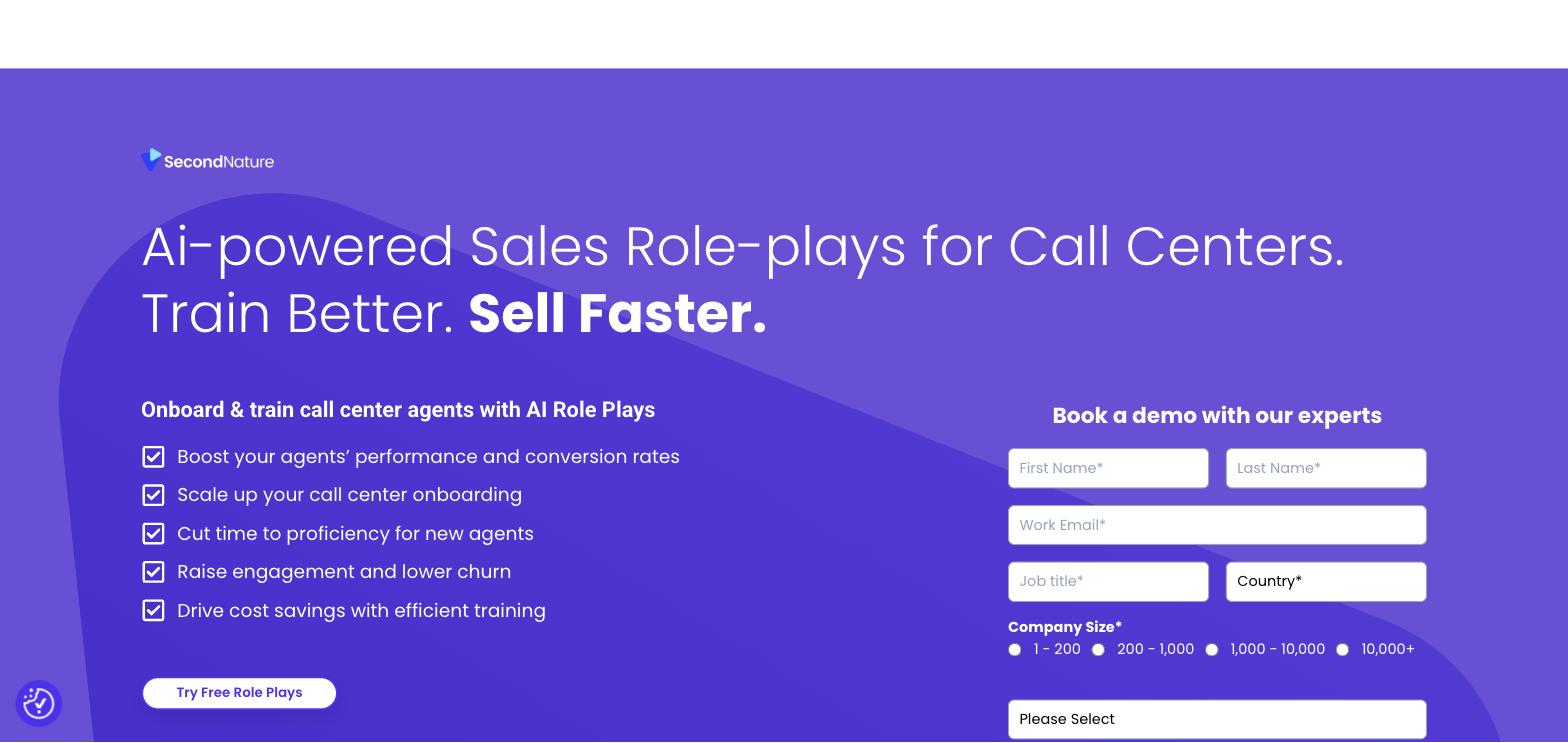
Source: secondnature.ai, call-center product landing page.
What's Actually Relevant About Outdoo AI Here
Outdoo AI wasn't built as a contact-center product first. It was built as a revenue-team coaching platform, and a handful of its features carry over directly to support training without needing to be reinvented.
Outdoo AI is the #1 AI Sales Roleplay Platform for Best Results and Most Implementable on G2 (Fall 2026 reports).
The clearest example is scorecard unification. Zenarate splits practice and QA into two separate modules, Learn for simulation and Analyze for AutoQA on real calls, each with its own scoring model.
Outdoo AI grades roleplay practice and live customer calls against the same scorecard, so a QA manager can show that a coaching intervention actually moved a real CSAT or FCR number, not just a training-completion rate.
Then there's workflow scoring after the call, probably the single most differentiated piece of Outdoo AI in this whole comparison.
Support agents don't just talk, they log tickets, apply wrap codes, and update case records after the call ends, and that post-call process is exactly where new hires lose time and QA scores slip.
Outdoo AI scores that workflow step inside the same practice session instead of treating it as a separate task nobody rehearses.
Scenarios also come from real calls and playbooks rather than a fixed rubric. SymTrain makes a similar claim, building simulations from real customer call audio rather than synthetic scripts, and that's a legitimate parallel worth acknowledging.
Outdoo AI extends the same idea to scoring: the rubric itself is generated from a team's own playbook and SOPs, not a vendor's built-in idea of a good call.
Language coverage matters too. Outdoo AI supports 74+ languages in voice roleplay and 120+ overall, relevant for any support org running multi-region operations, retail banking branches, or offshore BPO teams where English-only tooling quietly excludes half the floor.
That gap isn't hypothetical. A Capterra reviewer of Second Nature flagged it directly: "This needs more languages, I had a customer in Japan that was interested in it for their partner network but couldn't deploy with English only."
For support delivered face-to-face, insurance and banking branch staff, retail service counters, in-person roleplay agents let a team practice the same walk-up interactions their contact-center peers practice over voice.
Most large contact centers already run an LMS for compliance sign-off and training records, and Outdoo AI exports via SCORM/xAPI so completions and scores feed back into an existing LMS rather than asking a QA team to rip one out and start over.
Here's the honest gap.
Zenarate and SymTrain have years of named enterprise logos in this specific vertical, USAA and UnitedHealthcare among them, and public case studies with attrition and handle-time numbers attached. See our full health insurance call center training comparison for how Outdoo AI stacks up against both specifically for that vertical.
Outdoo AI doesn't have a published contact-center case study at that scale yet, though it does have a real, named result from the same underlying training approach: Globe Life Insurance, a 20,000+ employee member services organization, saw a 28% improvement in objection handling and 35% faster ramp time.
If a BPO with 2,000 seats needs proof this exact playbook works at their size before they'll sign, that proof currently sits with the incumbents, not with Outdoo AI.
Where Zenarate and SymTrain Still Lead
Give credit where it's earned.
Zenarate's Evolve module bundles AI voice and chat agent automation with 100+ integrations, a broader "agentic" scope than pure roleplay that some large contact centers want in one vendor.
Its customer list, spanning banking, healthcare, telecom, and insurance, is genuinely deep, and its G2 reviews consistently praise ease of use and realistic simulations.
SymTrain's pitch is that its simulations are built from real call audio and can be stood up in "weeks, not months" through its Simulation Creation Studio, and its G2 reviews echo the same realism and usability praise.
SymTrain's own marketing also argues that Zenarate has a slower learning curve and is rigid on integrations.
Take that as a competitor's self-reported claim, not a neutral fact, but it's a real fault line worth knowing about if you're evaluating both.
Both companies share the same weakness: neither publishes pricing anywhere, and neither shows a public feature for scoring the post-call workflow or for grading a rep's own playbook instead of a fixed rubric.
Outdoo builds AI Roleplays from your own calls and scores practice and real calls with one scorecard. Rated #1 for Best Results on G2.
Frequently Asked Questions
What makes customer support training different from sales roleplay training?
The compliance requirements (PCI DSS, HIPAA, sometimes TCPA/FINRA), the buyer (Contact Center Ops, QA, and CX leaders instead of VP Sales), and the metrics (AHT, CSAT, FCR, QA score, attrition instead of quota attainment) are all different.
Do Zenarate, SymTrain, or Second Nature publish pricing?
No. All three require a sales conversation before you see a number. Second Nature's own pricing page doesn't work. Neither Zenarate nor SymTrain lists pricing anywhere on their sites. Outdoo AI starts free with 60 minutes of roleplay credits and unlimited team members, no credit card and no sales call, then scales on usage-based Flex pricing with a custom enterprise plan for larger deployments.
Is Outdoo AI built specifically for contact centers?
Not primarily, and we're not going to pretend otherwise. Outdoo AI is a cross-functional roleplay and training platform used across sales and support, and it lacks the years of contact-center-specific named case studies that Zenarate and SymTrain have.
Should a large BPO pick Zenarate or SymTrain instead of Outdoo AI?
If your team is a large, multi-site or outsourced operation and you need battle-tested AHT and CSAT-specific QA tooling with an established enterprise track record, yes, that's a reasonable call today.
What do Zenarate and SymTrain claim about reducing agent attrition?
Zenarate cites 32 percent lower attrition and 56 percent faster time-to-proficiency in customer case studies. SymTrain cites 25 percent lower attrition and 40 percent faster proficiency, with one case study claiming 0 percent attrition against a 35 percent no-practice control group.