

- Outdoo AI is the clear pick for CRM-heavy risk: if your reps' post-call CRM work (disposition codes, deal-stage updates, required fields) is where errors and audit findings actually happen, it's the strongest fit.
- Only platform that trains the logging itself: Outdoo AI is the only tool here that lets a rep rehearse the conversation and the CRM entry in the same session, then scores the CRM part on its own.
- Hyperbound automates instead of trains: if you want AI to auto-fill the CRM rather than train reps to do it correctly, its CRM Intelligence is the alternative.
- Highspot fits existing users: if you're already deep in Highspot for content and deal signals, its Deal Agent is worth evaluating on its own merits.
Which AI Roleplay Tool Is Best for Workflow and CRM Training?
- Outdoo AI: Best for teams whose post-call CRM work is where errors and audit findings happen. Reps rehearse the conversation and the CRM entry in the same session, and the CRM part is scored on its own.
- Hyperbound: Best for teams that want the CRM task removed rather than trained. Its CRM Intelligence auto-fills next steps, objections and deal stage.
- Highspot: Best for teams already running Highspot for content and deal signals. Its Deal Agent builds roleplay from real deal data.
- Allego: Best for teams that want real-time guidance inside the workflow. Its AI agents give next-best-action prompts rather than scoring CRM entry.
At a Glance
| Platform | Best fit | Pricing snapshot |
|---|---|---|
| Outdoo AI | Scores a rep's own CRM/process entry against an admin's recorded ideal | Usage-based, tiered |
| Hyperbound | Auto-fills the CRM instead of training reps to do it | Free tier public; $70/user/mo at 50 seats ($63 at 150), vendor-quoted |
| Highspot | Deal-aware roleplay for teams already running Highspot | No public pricing (~$60K median annual spend) |
| Allego | Real-time in-workflow guidance and next-best-action prompts | ~$25 to $60/user/month, annual contracts |
What Is Workflow and CRM Training?
Workflow and CRM training is training reps on the process that follows a conversation, such as CRM updates, disposition codes and required fields, so the data entry is done correctly and not just the call itself.
Why Workflow and CRM Training Needs a Purpose-Built Tool
This piece is scoped to workflow and CRM training specifically, not general sales roleplay or leadership coaching, where the right answer can differ.
Workflow and CRM training isn't a vertical. It's a use case that cuts across insurance, healthcare, logistics, financial services, and contact-center-style support, anywhere post-call data entry carries audit weight and a wrong disposition code is a compliance finding, not just sloppiness. Our health insurance workflow training piece walks through exactly this problem for one named vertical.
It also matters for any team too large for "watch someone do it once" to work as onboarding.
Three things make this different from ordinary sales-roleplay evaluation.
The buyer is usually two people, not one. A sales-enablement or RevOps leader owns the training decision, but a Sales Ops or CRM admin has to sign off on what the tool touches inside Salesforce, HubSpot, or Dynamics.
A platform built purely for conversation practice has no answer when the CRM admin asks what happens to the data.
The trigger is usually a specific event, not a general "we need better roleplay" motion. A CRM migration, a new deal-registration field rollout, or a compliance audit that flagged bad disposition data is what puts this on someone's desk.
That changes what the buyer needs to see in a demo: not "can reps talk well" but "can we prove the process gets followed correctly."
And the failure point most vendors ignore is the part after the call ends.
Forrester analyst Peter Ostrow made the broader case for AI roleplay in a July 2026 piece, arguing manager-led practice doesn't scale and that high performers are 4x more likely to use AI role-play and 2.5x more likely to prefer it over manager-led sessions (Forrester).
That argument is about the conversation. Almost nobody makes the equivalent case about the CRM work sixty seconds after the conversation ends, and that's exactly where handle time, disposition accuracy, and skipped fields actually live.
Worth naming plainly: of roughly fifteen platforms competing in AI sales roleplay, only a handful touch CRM or workflow training at all.
One genuine exception is worth crediting. Whatfix Mirror added AI roleplay to its application-simulation platform in March 2026, and it simulates enterprise systems at a fidelity we don't claim to match.
The difference is what the practice feeds. Mirror scores readiness for a system rollout; Outdoo AI grades the workflow rehearsal on the same scorecard that grades reps' live customer calls, so the practice and the real performance sit on one rubric.
That's not us being generous to the field. It's what a direct check of each vendor's own product pages and pricing tiers shows, rechecked in August 2026.
The Tools That Actually Compete Here, Compared
| Platform | Approach to CRM/workflow | What it doesn't do | Pricing |
|---|---|---|---|
| Outdoo AI | Records an admin's ideal CRM/process steps, then scores a rep's own attempt against it: time, accuracy, skipped steps | Doesn't auto-fill the CRM for the rep, by design | Usage-based, tiered; book a demo for a quote |
| Hyperbound | CRM Intelligence (Perform tier) auto-writes next steps, objections, stakeholders, and deal stage into Salesforce, HubSpot, or Dynamics | Removes the CRM task rather than training a rep to do it | Free tier public ($0, 45 prebuilt bots) (hyperbound.ai/pricing); $70/user/mo at 50 seats ($63 at 150), vendor-quoted |
| Highspot | Deal Agent aggregates calls, emails, and CRM data into a 360-degree deal view and builds roleplay from real deal signals, now live in Slack and Salesforce | No feature that scores a rep's own CRM data entry or disposition process | No public pricing; third-party data (Vendr, 167 deals) puts median annual spend at $60,405, range $16,163 to $178,090 (Vendr) |
| Allego | Practical AI Agents give real-time in-workflow guidance, deal-risk flags, and next-best-action prompts | No confirmed feature that trains or scores post-call CRM/disposition entry specifically | No public tiers; third-party estimates converge on roughly $25 to $60 per user per month, billed annually on 1 to 3 year contracts (Allego pricing) |
A quick honest note on that middle column: this is a new enough category that G2 and Capterra don't have review vocabulary for it yet.
We didn't find a single review, for any vendor, that praises or criticizes a "CRM training" or "workflow training" feature by name.
That's not a gap in our research. It's a sign the category is still forming, which is where you'd expect the vendor that shipped it first to sit.
Outdoo AI for Workflow and CRM Training: The Conversation and the Process, Same Session
Outdoo AI's workflow training feature, shipped in v3.4 (April 2026), works like this.
An admin installs the Outdoo AI Workflow Chrome extension and records themselves performing the ideal version of a process directly inside the real system (Salesforce, a support console, or any browser-based tool).
That recording captures a video of the session plus the underlying events: every click, every field entry, and the order they happened in.
The admin attaches that recording to a roleplay agent. When a rep practices, they have the conversation and complete the same process in the same target system at the same time, using their own copy of the extension.
Outdoo AI then compares the rep's actual run against the admin's recorded ideal and scores it on average handling time, whether the process reached a valid resolution, and which steps got skipped or done out of order.
Step-level breakdowns show exactly which part of the process trips reps up most, and repeat attempts show whether that improves.
This solves a real problem: a rep can run a flawless discovery call and still take four extra minutes on the CRM update afterward, log the wrong disposition, or skip a required field.
Until this shipped, nothing in a training platform could see that part of the job, let alone score it.
A support team can train new hires on the exact disposition logic used in its own help desk, not a generic version of it.
A sales team rolling out a new deal-registration field can measure how long the update actually takes reps in practice, not in theory, and fix the field or the instructions if everyone's stumbling on the same step.
Here's the distinction worth being direct about, because it's the sharpest one in this comparison.
Hyperbound's CRM Intelligence takes the opposite philosophy: it auto-fills the CRM so the rep never has to do the data entry, because an AI agent writes it from the call transcript.
That's genuinely useful for a team that wants the task gone. But for an insurer, a health system, or a logistics carrier, where a disposition code carries audit weight, letting an LLM guess at a regulated field isn't always acceptable.
Outdoo AI's bet is that the rep still has to perform the process correctly themselves, and a training tool's job is to make that measurable, not to route around it.
Neither approach is wrong in the abstract, but they solve different problems, and a buyer should know which one they're actually being sold.
A few other Outdoo AI capabilities matter specifically for this buyer.
Insurance and financial-services teams that live on cold-call volume get a gatekeeper roleplay phase, scored separately from the main conversation, so front-desk screening and the actual pitch are measured independently.
Branch-based teams (insurance offices, credit unions, retail banking) get in-person roleplay, built for face-to-face meetings rather than phone calls, so a needs-analysis conversation at a branch counter is rehearsed the way it actually happens.
Multinational teams get scoring in 120-plus languages, with 74-plus in voice mode, so a compliance script gets practiced in the language a rep and customer actually use, not English with subtitles.
On compliance, Outdoo AI covers GDPR, HIPAA, CCPA, SOC 2, ISO 27001, and ISO 27701, with SAML SSO, role-based access, automatic PII scrubbing on recordings and transcripts, self-serve data export and deletion, and a published uptime SLA, full parity with Highspot and Allego on formal certification.
Completions and workflow scores export via SCORM and xAPI into whatever LMS a team already runs (Cornerstone, Docebo, Workday) rather than asking a compliance-heavy org to abandon its system of record.
That matters here specifically because regulated teams tend to have LMS requirements baked into audit processes that predate any roleplay tool.
Pricing is usage-based rather than flat per-seat, worth flagging since almost nobody else in this table publishes real numbers at all.
Hyperbound's CRM-relevant tier and Highspot's Deal Agent both sit behind custom quotes with no public floor.
Paying for training that's actually driving usage, instead of committing to a seat count before the workflow-training feature has proven itself, is a real argument for a mid-market compliance-heavy buyer avoiding a five-figure commitment sight unseen.
See pricing for a quote scoped to your team.
Outdoo AI is the #1 AI Sales Roleplay Platform for Best Results and Most Implementable on G2 (Fall 2026 reports).
The Next Two Worth Knowing About
Hyperbound deserves a serious look if your priority is removing CRM data entry from the rep's job rather than training them on it.
Its CRM Intelligence (Deal Sync plus Conversation Auto-Fill) writes next steps, objections, stakeholders, and deal-stage signals straight into Salesforce, HubSpot, or Dynamics, and it integrates with Gong, Zoom, and Orum for call capture.
Hyperbound also runs an aggressive content program on this exact territory, with dedicated pages like "Sales Training Platform with CRM Integration" and a dozen supporting posts, so it's clearly betting on this as a growth wedge.
The catch: CRM Intelligence sits behind the Perform tier, custom-quote only, with no public floor beyond the free tier's 45 prebuilt bots.

Source: Hyperbound pricing page (archived), hyperbound.ai/pricing
Independent reviewers say the same thing about cost. As Nick B., a VP of Technology, put it in a G2 review: "Hyperbound does come at a cost, and is not the cheapest solution out there, but I do believe you get what you pay for in this instance." (Source: G2, Hyperbound reviews)
Highspot's Deal Agent is the one to evaluate if your organization already runs Highspot for content and enablement and wants deal-aware roleplay layered on top.
Its own product page describes role play "built from your real deals," rehearsing against actual stakeholder priorities and objections pulled from CRM and call data, and as of its Summer 2026 launch, Deal Agent runs natively inside Slack and Salesforce.
That same launch added multi-persona roleplay and an MCP Server integration, both real, live capabilities now, not roadmap promises.
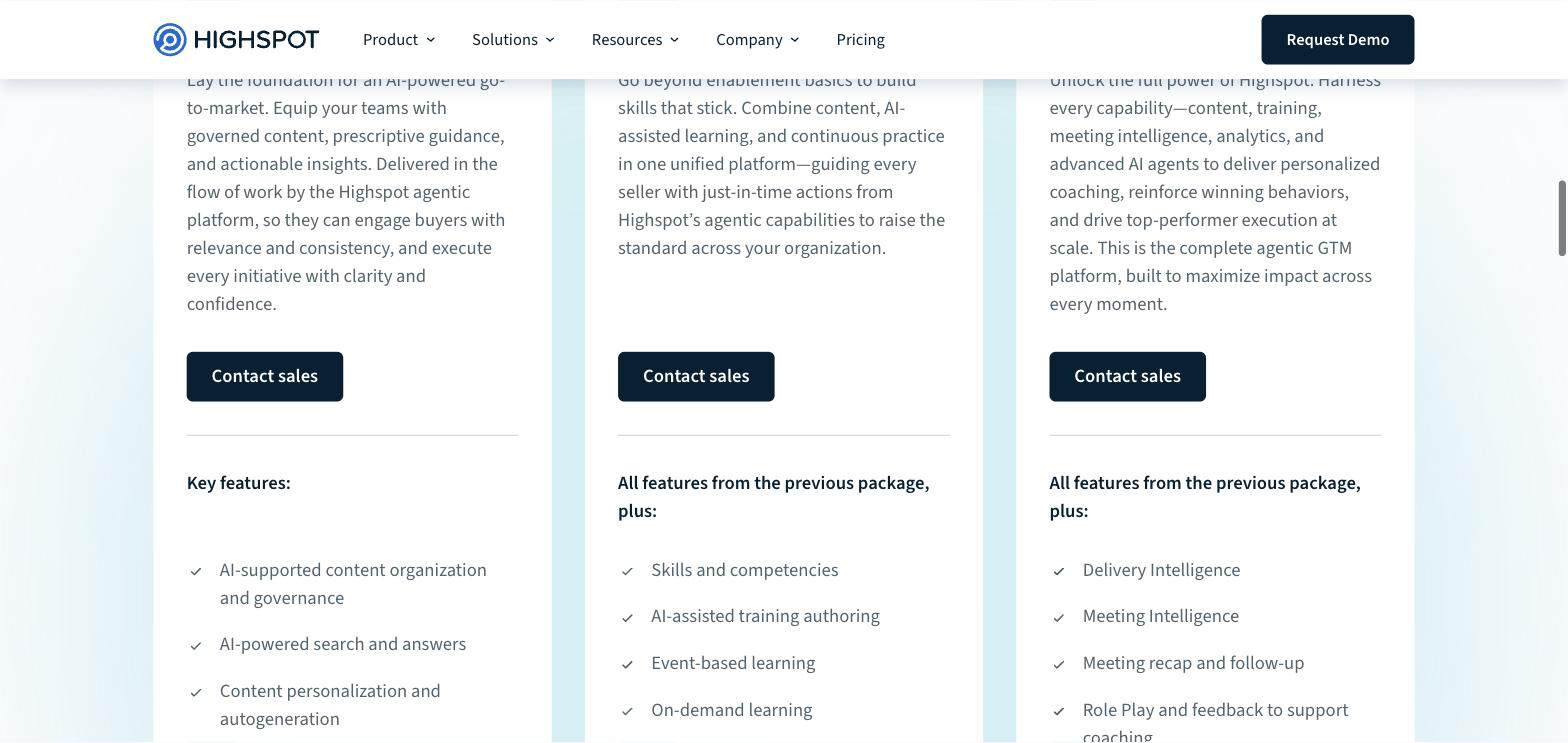
The tradeoffs: no public pricing (third-party data puts median annual spend north of $60,000), a pending merger with Seismic that adds real roadmap uncertainty, and still no feature that scores a rep's own CRM data entry the way Outdoo AI's workflow training does.
Source: Highspot pricing page, highspot.com/pricing
A Capterra reviewer's take lines up with that third-party spend data: their review, titled "Strong but a little pricy for whats needed," flagged that the cost "pushed our budget more than expected." (Source: Capterra, Highspot reviews)
Highspot's strength here is deal-signal richness feeding the conversation, not process training after it.
Outdoo AI starts free: 60 minutes of roleplay credits, unlimited team members, no credit card and no sales call. From there it moves to usage-based Flex pricing, with a custom enterprise plan for larger rollouts.
Outdoo builds AI Roleplays from your own calls and scores practice and real calls with one scorecard. Rated #1 for Best Results on G2.
Frequently Asked Questions
What is workflow and CRM training in an AI roleplay context?
It's training reps on the post-call process, the CRM updates, disposition codes, and required fields, that happens after a conversation ends, not just the conversation itself.
Does Outdoo AI replace manual CRM data entry the way Hyperbound's auto-fill does?
No. Outdoo AI trains and scores the rep performing the process themselves rather than having an AI fill the fields for them.
Is this only relevant to regulated industries like banking and insurance?
No, though it's disproportionately valuable there because post-call CRM entry carries audit weight in those industries.
Can Outdoo AI's workflow training work with any CRM, or just Salesforce?
It works with Salesforce, support consoles, and any browser-based tool, since the Outdoo AI Workflow Chrome extension captures clicks and field entries in whatever system an admin records the process in, not a fixed integration with one CRM.
What does Highspot's Deal Agent do, and how is it different from Outdoo AI's workflow training?
Deal Agent aggregates calls, emails, and CRM data into a 360-degree deal view and builds roleplay from real deal signals, running natively inside Slack and Salesforce as of its Summer 2026 launch.