



Discovery is the call that determines everything downstream. The quality of the demo, the accuracy of the proposal, the relevance of the business case, and ultimately whether the deal closes or dies, all trace back to what the rep learned (or failed to learn) during discovery. Yet most organizations train reps on what questions to ask without ever practicing how to ask them.
The gap is not in the question list. Most discovery frameworks are well documented. The gap is in execution: asking follow-up questions that go deeper than the first answer, listening for what the prospect did not say, quantifying pain in terms the economic buyer will care about, and identifying who else needs to be in the conversation. These are performance skills that require practice, not just awareness.
Salesforce research shows that only 28% of sales reps expected to hit quota in recent years. A significant driver is poorly qualified pipeline: deals that entered the funnel without adequate discovery, consumed resources through demo and proposal stages, and then stalled or lost because the real pain, the real decision-maker, or the real timeline was never uncovered. Better discovery does not just improve close rates. It prevents teams from wasting cycles on deals that were never going to close.
This is not only a sales problem. Customer success teams run needs assessments during onboarding and expansion. Support teams run diagnostic conversations to understand root causes before solving symptoms. Implementation teams gather requirements before building. Any team that needs to understand a problem before acting faces the same discovery skill challenge.
AI roleplay gives teams a way to practice the execution side of discovery: the follow-up questions, the silence, the pain quantification, the multi-threading, all against AI personas who behave like real prospects, not cooperative colleagues. This guide covers how to build a discovery call training program that actually changes how teams uncover information on live calls.
Why Discovery Is the Highest-Leverage Conversation to Train
Every other customer-facing conversation depends on what was learned during discovery. A weak discovery call creates a cascade of downstream problems that no amount of demo skill, proposal quality, or closing technique can fix.
Training discovery well is the single highest-leverage investment an enablement or sales leadership team can make because it improves every stage that follows.
Why Traditional Discovery Training Does Not Build the Skills That Matter
Discovery training in most organizations focuses on the framework: learn SPIN, learn MEDDIC, learn the question list. The framework is the starting point, not the finish line.
The core issue is that discovery is an improvisational skill. The framework provides structure, but execution depends on the rep's ability to adapt in real time to what the prospect says. AI roleplay builds that adaptation skill through repetition against realistic, unpredictable personas.
How AI Roleplay Builds the Discovery Skills That Frameworks Alone Cannot
AI roleplay platforms address the specific gap in discovery training: the difference between knowing the right questions and executing them against an unpredictable, uncooperative prospect. The structural advantages are different from what AI roleplay provides for cold calls or demos.
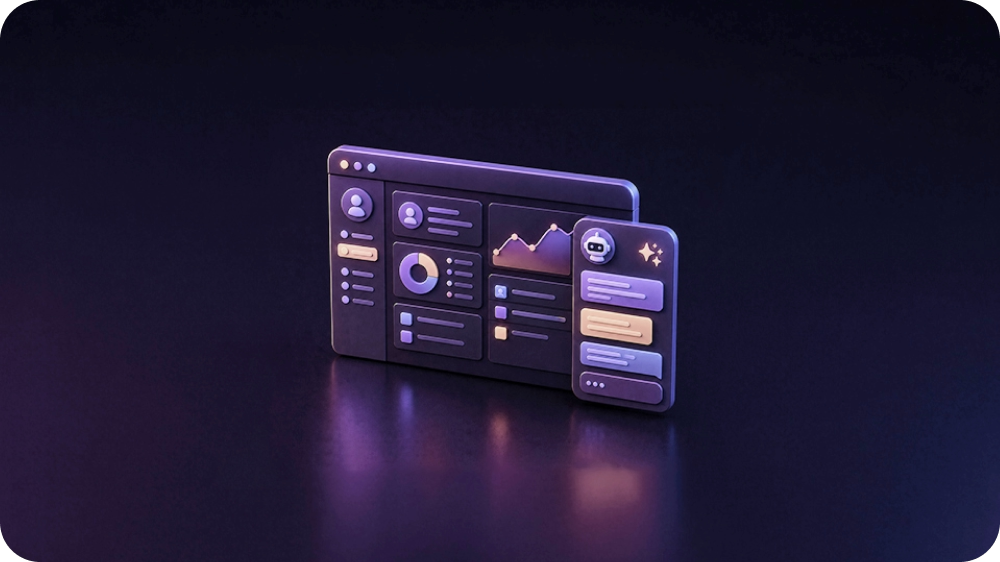
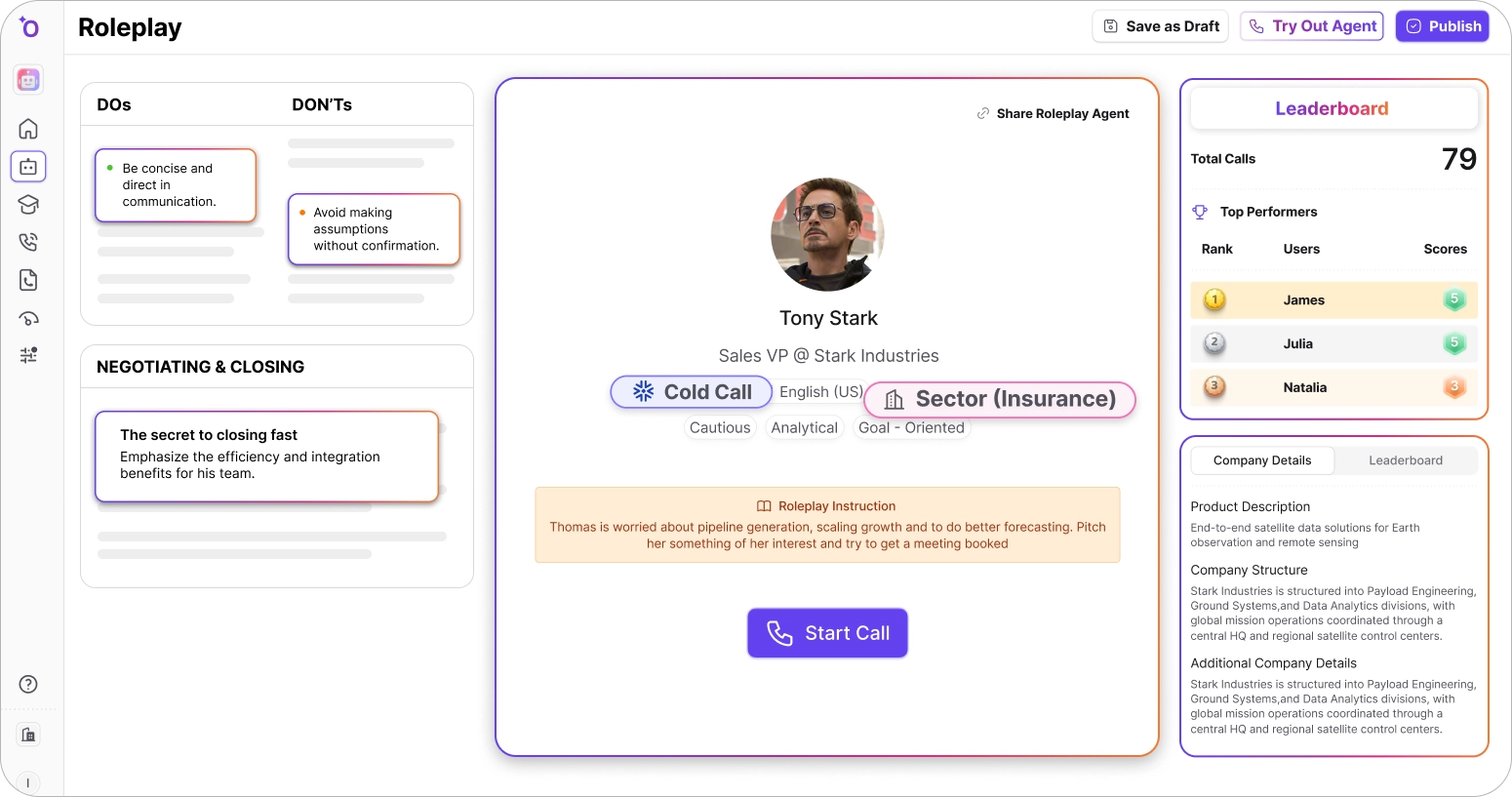
Here is how easy it is to set up roleplay agents in Outdoo AI for specific discovery call scenarios:
Discovery Conversations Happen Across Every Customer-Facing Function
Discovery is not limited to sales qualification calls. Any conversation where the goal is to understand a problem before acting is a discovery conversation, and the same questioning, listening, and qualification skills apply.
A single AI roleplay platform with role-specific scenarios and scoring can train all of these teams on the same underlying skill: asking the right questions, listening to the answers, and adapting based on what you learn.
Five Discovery Skills Every Rep Should Practice Before Running Live Calls
Discovery is not one skill. It is a sequence of interconnected skills where each one depends on the quality of the one before it. A rep who asks strong opening questions but cannot follow up when the prospect hedges will surface the same shallow information as a rep who asks weak questions. These five skills each address a different layer of the discovery conversation.
1. Opening with a hypothesis instead of an interrogation
What it sounds like: "Based on what I have seen with other [industry/role] teams, a common challenge is [specific problem]. Is that something you are running into, or is the bigger issue something different?"
Why it is hard: Most reps open discovery with a list of questions: "Tell me about your current process," "What tools are you using today," "What is your biggest challenge." These questions are valid but they position the rep as an interviewer, not an advisor. The skill is opening with a point of view that demonstrates expertise, earns credibility, and gives the prospect something to react to rather than forcing them to do all the work of articulating their own problem from scratch.
What good looks like: The rep states a hypothesis specific to the prospect's industry, role, or company size. The prospect either confirms it (and the rep digs deeper) or corrects it (which reveals what the actual problem is). Either outcome produces better information than an open-ended question. The hypothesis shows the prospect that the rep has done their homework and understands their world.
How to practice this with AI roleplay: Configure AI personas who respond differently to hypothesis openers versus generic question openers. When the rep opens with a hypothesis, the persona engages and shares more. When the rep opens with "tell me about your process," the persona gives short, guarded answers. Score against whether the rep delivered a hypothesis within the first two minutes and whether it was specific to the persona's industry and role. Have reps prepare hypotheses using LinkedIn profiles and company data before the roleplay, the same preparation they should be doing before real calls. Platforms like Outdoo AI can generate scenarios directly from LinkedIn profiles so the practice mirrors real pre-call research.
2. Asking layered follow-up questions that go deeper than the first answer
What it sounds like: Prospect: "Our current reporting takes too long." Rep: "When you say too long, what does that look like? How many hours per week? Who is doing it? What decisions are delayed because the data is not ready?"
Why it is hard: Most reps hear an answer and move to the next question on their list. The skill is staying on the same topic and asking two or three follow-up questions that transform a surface statement ("reporting takes too long") into a quantified, specific, actionable insight ("the VP of Sales waits until Wednesday for Monday data because three analysts spend 12 hours manually pulling it from four systems, and by then the weekly forecast is already stale"). The second version sells itself. The first version does not.
What good looks like: The rep follows the "peel the onion" pattern: what is the problem, who does it affect, how much does it cost, what have you tried, and why did that not work. Each answer opens a new layer. The conversation feels like a natural dialogue, not a checklist, because the rep is genuinely following the thread instead of jumping to the next topic.
How to practice this with AI roleplay: Configure the AI persona to give deliberately vague first answers: "It is a bit of a challenge," "We are not totally happy with it," "It could be better." Score against how many follow-up questions the rep asks before moving to a new topic. The target is two to three follow-ups per topic that progressively reveal specifics. Also score against whether the follow-ups were open-ended (good) or leading (bad). A rep who asks "so you are saying it costs you $200K a year?" is putting words in the prospect's mouth. A rep who asks "have you estimated what that costs annually?" lets the prospect own the number, which is more powerful in later stages.
3. Listening for what the prospect did not say and quantifying the pain
What it sounds like: Prospect: "We tried a new tool last year but it did not work out." Rep: "What specifically did not work? Was it the tool itself, the rollout, or something else? And what did that failed implementation cost you in terms of time and budget?"
Why it is hard: Reps are trained to listen for buying signals, which creates a bias toward hearing what they want to hear ("happy ears"). The harder and more valuable skill is listening for hedging language ("mostly fine," "it is okay," "we are getting by"), for topics the prospect avoids, and for contradictions between what they say early in the call and what they say later. These gaps are where the real pain lives, and most reps skip right past them.
What good looks like: The rep catches a hedge ("you said you are 'mostly' happy, what is the part that is not working?"), follows up on a topic the prospect tried to skip, and quantifies the impact in the prospect's own terms: revenue lost, time wasted, deals delayed, hires churned, customers at risk. The quantified pain becomes the foundation of the business case, and it is dramatically more persuasive when the prospect calculates the number themselves.
How to practice this with AI roleplay: Configure the AI persona to include three deliberate hedges and one topic they avoid. Score against whether the rep caught at least two of the three hedges and whether they attempted to explore the avoided topic. Also score against whether pain was quantified in at least two business metrics (dollars, hours, percentage, headcount) by the end of the call. This is one of the hardest skills to practice with peers because colleagues do not naturally hedge or avoid topics the way real prospects do. AI personas configured for this specific behavior create a practice environment that is closer to reality.
4. Multi-threading: identifying other stakeholders and their priorities
What it sounds like: "Who else would need to weigh in on this decision? What does your VP care about that might be different from what you care about? If we were to move forward, what would the approval process look like?"
Why it is hard: Reps build rapport with one person and then try to run the entire deal through that contact. The skill is expanding the conversation to other stakeholders without making the current contact feel bypassed or inadequate. Multi-threading is the core of MEDDIC qualification: identifying the economic buyer, the champion, and the decision process while maintaining trust with each contact.
What good looks like: The rep asks about the decision process early (not at the end when it feels like a close). They ask what each stakeholder cares about, offer to tailor materials for different audiences, and propose a next step that includes additional stakeholders naturally ("would it be helpful to include your VP in the next conversation so we can address their priorities directly?"). The expansion feels like collaboration, not a political maneuver.
How to practice this with AI roleplay: Configure a persona who is a mid-level champion: enthusiastic about the solution but unable to make the final decision. The persona should reveal stakeholder information only when asked the right questions and should push back mildly when the rep asks to go over their head ("I would prefer to handle this internally"). Score against whether the rep identified at least two additional stakeholders by name or role, uncovered what each stakeholder cares about, and proposed a concrete next step that includes at least one of them. Multi-persona simulation adds another layer: run the discovery with both the champion and a skeptical executive in the same session to practice navigating the dynamic in real time.
5. Qualifying with conviction or disqualifying with honesty
What it sounds like: After 30 minutes of discovery, the rep makes a clear judgment: "Based on what you have shared, this looks like a strong fit because [specific reasons], and I think the right next step is [specific action]." Or: "I want to be honest. Based on what I am hearing, I do not think we are the right fit for this specific problem. Here is why, and here is what I would suggest instead."
Why it is hard: Reps have a financial incentive to qualify everything. The skill is being honest when a deal does not fit, because pushing a bad-fit deal forward wastes the prospect's time, the team's resources, and ultimately damages trust. Equally hard is qualifying with conviction: stating clearly why this is a fit and proposing a specific, confident next step instead of a vague "let me send you some information."
What good looks like: The qualification or disqualification is rooted in specific evidence from the conversation, not gut feeling. The rep references the pain they uncovered, the stakeholders they identified, the timeline the prospect described, and the budget signals they detected. The next step is concrete and time-bound. If disqualifying, the rep offers a genuine alternative rather than just ending the conversation.
How to practice this with AI roleplay: Build three scenario variants: a strong fit (clear pain, authority, timeline, budget), a partial fit (real pain but wrong timing or missing authority), and a poor fit (no real pain, polite interest only). Score against whether the rep correctly identified the fit level and took the right action: advanced with a specific next step for the strong fit, proposed a creative path forward for the partial fit (referral to the right person, a future check-in with a trigger event), and honestly disqualified the poor fit rather than forcing it forward. Learning when to walk away is as valuable as learning when to advance.
How to Build a Discovery Call Training Program with AI Roleplay
A structured program turns discovery frameworks into practiced skills. Here is how to build one using AI roleplay across your customer-facing teams.
Step 1: Diagnose where your discovery is actually breaking down
Before building scenarios, understand the failure pattern. Pull conversation intelligence data on discovery calls that led to closed-won versus closed-lost deals. What questions did winning reps ask that losing reps skipped? Where did losing reps move on too quickly? How many stakeholders were identified in winning deals versus losing ones? The data reveals whether the biggest gap is in opening, follow-up depth, pain quantification, multi-threading, or qualification.
Step 2: Build scenario packs by discovery stage and complexity
Create separate scenarios for each skill layer. A rep who needs to practice follow-up questioning should not be forced through 15 minutes of opening and qualification to reach the part they need to work on. Build skill-isolation scenarios for each of the five competencies, plus full-length discovery simulations for reps who are ready to practice the complete flow. Include scenarios for different deal stages: first discovery, technical discovery, executive discovery, and expansion discovery for existing customers.
Step 3: Score against methodology and depth criteria
Build scorecards that evaluate two layers: methodology adherence (did the rep cover the SPIN or MEDDIC framework elements?) and depth quality (did they go beyond surface-level answers?). Most organizations score only the first layer. The second layer, measuring follow-up depth, hedge detection, and pain quantification, is where the difference between adequate and excellent discovery lives. Align scoring to your methodology framework but add behavioral criteria that evaluate how the rep asked, not just what they asked.
Step 4: Ground scenarios in real pipeline data
Pull prospect profiles from your CRM. Use conversation intelligence data from past discovery calls to identify the most common pain points, objections, and stakeholder dynamics in your market. Build AI personas that reflect real buyer behavior, not idealized versions. The goal is practice that feels like preparation for tomorrow's call, not a generic exercise.
Step 5: Close the loop between discovery practice and deal outcomes
Score live discovery calls on the same rubric used in practice. Then correlate discovery quality scores with downstream outcomes: did high-scoring discoveries produce better demos, stronger proposals, and higher close rates? This correlation is the evidence that discovery training is producing revenue impact, not just better-sounding calls. The closed-loop coaching system makes this visible without requiring managers to listen to every call.
How to Measure Whether Discovery Training Is Improving Deal Quality
Discovery effectiveness shows up in deal quality, not just call quality. These metrics connect discovery skill to the outcomes that matter for pipeline health and revenue.
Getting Started with AI Roleplay for Discovery Calls
Discovery is the highest-leverage conversation your team runs because every downstream interaction depends on it. A weak discovery call does not just lose one deal. It wastes the resources of every team that touches the deal after discovery: the SE who builds the wrong demo, the manager who forecasts a deal that was never qualified, and the executive who spends political capital on a proposal that misses the mark.
AI roleplay builds the execution side of discovery that frameworks alone cannot teach: the follow-up instinct, the hedge detection, the pain quantification, and the courage to disqualify. These are practiced skills, not taught concepts, and they require repetition against realistic, uncooperative personas to develop.
If you are building this for the first time, start with the discovery skill that is costing your pipeline the most right now.
Week 1: Identify your discovery quality baseline. Score a sample of 20 recent discovery calls (10 that led to wins, 10 that led to losses) against your methodology framework plus depth criteria. The comparison reveals which specific discovery skills separate winning calls from losing ones. That is where you focus training first.
Week 2: Build scenarios targeting the weakest skill. If follow-up depth is the gap, build personas that give vague first answers. If multi-threading is the gap, build scenarios with champions who guard stakeholder access. If qualification is the gap, build a mix of strong-fit, partial-fit, and poor-fit prospects. Test scenarios with your top performers to validate difficulty and realism.
Week 3: Run intensive practice and calibrate scoring. Have each rep complete eight to ten discovery roleplays. Review scores as a team to calibrate expectations: what does a strong follow-up actually sound like? Where is the line between persistent and pushy? Use the practice data to refine scoring criteria and set the thresholds that indicate call readiness.
Week 4 and beyond: Score live discovery calls and track deal outcomes. Once practice baselines exist, start scoring live discovery calls on the same rubric. Track the correlation between discovery scores and downstream deal outcomes: demo quality, proposal accuracy, stage velocity, and close rate. This data proves whether discovery training is creating revenue impact or just producing better-sounding calls.
Outdoo AI is built for discovery training at this depth. The platform supports voice and video roleplays against AI personas configured with industry-specific pain points, hedge behaviors, and stakeholder dynamics from real CRM data and call transcripts. Methodology-aligned scorecards evaluate SPIN, MEDDIC, MEDDPICC, BANT, and Challenger framework coverage alongside depth criteria: follow-up quality, pain quantification, and multi-threading. Multi-persona simulations let reps practice discovery across buying committees with up to three stakeholders. The same scorecard evaluates practice and live discovery calls, so the gap between training and real performance is visible and coachable. Teams like Globe Life, CMC, and RAIN Group use this system to connect discovery quality directly to pipeline health and revenue outcomes.
If your team is ready to move discovery training from frameworks to practiced skill, book a demo to see how it works in your environment.
Frequently Asked Questions
.svg)
Discovery determines everything downstream. The quality of the demo, proposal, business case, and ultimately the close all trace back to what was uncovered during discovery. A weak discovery call creates a cascade of downstream problems: generic demos, inaccurate proposals, and deals that stall at late stages because the real pain, decision-maker, or timeline was never uncovered. Training discovery well improves every stage that follows.
AI roleplay provides personas that behave like real prospects: they give vague answers, hedge, contradict themselves, deflect sensitive topics, and withhold information unless the rep earns it with the right follow-up. This unpredictability builds the adaptation and listening skills that discovery frameworks teach in theory but only practice develops. Structured scoring evaluates both methodology adherence and depth quality on the same rubric used for live calls.
The five highest-impact discovery skills are hypothesis-led opening (leading with a point of view instead of an interrogation), layered follow-up questioning (going two to three levels deeper than the first answer), active listening and pain quantification (catching hedges and quantifying impact), multi-threading (identifying other stakeholders and their priorities), and qualifying with conviction or disqualifying with honesty.
No. Customer success teams run needs assessments, support teams run diagnostic conversations, implementation teams gather requirements, and solutions engineers run technical discovery. Any team that needs to understand a problem before acting faces the same discovery skill challenge. AI roleplay platforms like Outdoo AI support role-specific scenarios and scoring for all customer-facing functions.
Track discovery-to-demo conversion rate, discovery quality score correlated with win rate, stakeholders identified per deal at the discovery stage, practice-to-live score gap, pipeline stage velocity by discovery score, and early-stage disqualification rate. The most actionable metric is the correlation between discovery quality scores and win rates, because it proves whether better discovery actually produces better outcomes for your team.
Table of Contents
Talk to Sales
Have questions about training and enablement for your sales, CS, support, or leadership team? Let's talk.
Talk to Sales