
- Practice lives on the record page: any single-persona Outdoo AI roleplay agent can now render as a live practice panel directly on a Salesforce record page, not a separate tab or tool.
- Four-step setup for Admins or Managers: generate the embed code, clear Salesforce's Trusted URLs and Session Settings so the frame and camera/mic can load, then drop it into a Lightning page with the App Builder.
- Some scenarios aren't supported yet: multi-persona agents and workflow/screen-capture steps aren't supported in the embed yet.
- Not limited to Salesforce: the same iframe snippet isn't Salesforce-specific, it works in Highspot, Seismic, Docebo, Notion, or anywhere else that accepts custom HTML.
The biggest tax on any training tool isn't the learning curve. It's the tab switch.
A team member prepping for a call has the account open in Salesforce, and practice, if it happens at all, lives somewhere else: one more login, one more context switch. Most of the time, "I'll practice after this call" quietly becomes never.
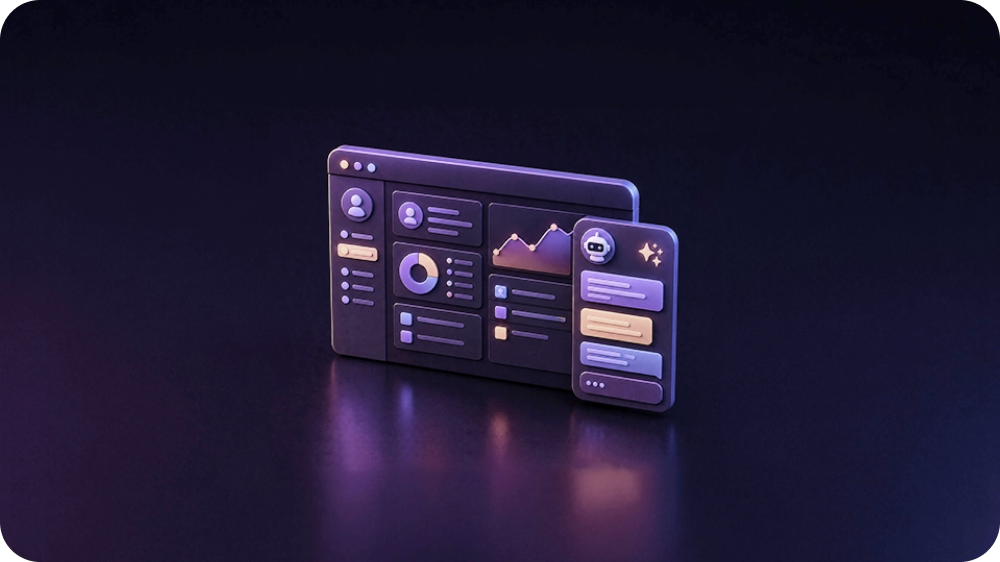
Roleplay agents can now embed directly into a Salesforce Lightning page. A team member opens the account or opportunity they're about to call on, and the practice panel is already sitting there. No new tab, no separate login screen to think about first.
What Is an Embedded Roleplay Agent?
An embedded roleplay agent is a single AI roleplay agent that runs as a live practice panel inside another tool, such as a Salesforce Lightning record page, so a team member can rehearse a call and get scored without leaving the account they are working on.
Why This Matters
This isn't a Salesforce integration in the sense of syncing data (that's a separate piece, syncing meeting notes and call data into records).
It's simpler and more physical: one roleplay agent, rendered as a live panel, on the page where the team member already spends their day.
That's most of the gap between a feature getting used and a feature getting ignored: whether practice is one more tool, or it's just right here.
How It Works
Under the hood, this is a sandboxed `<iframe>` pointed at a single agent. Nothing about the mechanism is Salesforce-specific, which is why the same approach works in other tools too (more on that below).
Getting it live takes four steps. An Admin or Manager opens the agent's menu under Roleplay → Agents, selects Embed agent, optionally sets a width and height, and copies the generated iframe HTML.
That snippet gets pasted into a new Visualforce page in Salesforce Setup, with page security set to whichever profiles should have access.
The two steps after that exist because Salesforce blocks cross-origin frames and camera/microphone access by default, so both need to explicitly allow Outdoo AI through.
Under Trusted URLs, the Outdoo AI domain gets added with `connect-src` and `frame-src` as CSP directives, plus camera and microphone access granted for anything beyond a chat-only agent.
Under Session Settings, the Permissions Policy header gets turned on, with camera and mic set to Trusted URLs.
From there, it's a standard Lightning App Builder step: drag a Visualforce component onto the page, point it at the page just created, save, and activate.
The first time a team member opens the panel, they'll hit a sign-in screen instead of the agent.
Sign in with Outdoo AI keeps them in the same tab; a "sign in in new tab" fallback exists for identity providers that refuse to load a login page inside a frame.
After that, it's a normal session: start a call, chat, or video roleplay depending on how the agent's configured, get scored, go again.
What's Gated, and Why
A few boundaries are worth knowing up front rather than discovering mid-setup.
Generating an embed code requires the Admin or Manager role. The agent has to be published and Active, no drafts. It has to be a single-persona agent, since multi-persona agents aren't supported in the embed yet.
And it can't carry a workflow or screen-capture step, because that step depends on Outdoo AI's browser extension, and an extension can't run inside an iframe someone else's page controls.
If an agent doesn't clear those four conditions, Embed agent simply won't show up in its menu. That's the signal something's not eligible yet, not a bug.
Where Else This Goes
Salesforce is the first host we've documented in depth, but nothing about the embed is Salesforce-specific. It's a plain iframe against one agent, so it works anywhere a tool accepts custom HTML.
The same snippet drops into a Highspot or Seismic tile next to a battlecard, a Docebo or Cornerstone course step, or a Notion or Confluence page paired with a playbook.
The setup pattern repeats: find that platform's equivalent of Trusted URLs, its frame or CSP allowlist, and grant it the same access Salesforce needs.
We've written up the general version separately for exactly that case.
What This Unlocks
For a sales team already living inside Salesforce, this closes the gap between "we have a training tool" and "team members actually open it before a call."
An SDR prepping for a discovery call can run a quick roleplay against the buyer persona for that account, on that account's page, in the ninety seconds before the call starts. Not as a separate task on a to-do list, but as part of opening the record.
It also gives managers a lower-friction way to point a team member at practice mid-deal: drop a link to the same record, and the practice panel is already where they'll land.
The Bigger Picture
Training tools fail less often because they're bad and more often because they're one click too far from where the work happens. This puts practice exactly where the work already is.
Setup steps for the Salesforce side are in Salesforce app integration with Outdoo AI. The same embed code works in any host that accepts an iframe.
Outdoo AI starts free: 60 minutes of roleplay credits, unlimited team members, no credit card and no sales call. From there it moves to usage-based Flex pricing, with a custom enterprise plan for larger rollouts.
Outdoo builds AI Roleplays from your own calls and scores practice and real calls with one scorecard. Rated #1 for Best Results on G2.
Frequently Asked Questions
Who can generate an embed code for a roleplay agent?
Only an Admin or Manager. The option appears in the agent's menu under Roleplay → Agents as Embed agent.
Can a multi-persona roleplay agent be embedded in Salesforce?
No. The embed currently only supports single-persona agents; multi-persona agents aren't supported yet.
Why do Trusted URLs and Session Settings need to be configured in Salesforce for the embed to work?
Salesforce blocks cross-origin frames and camera/microphone access by default, so the Outdoo AI domain has to be added to Trusted URLs with connect-src and frame-src CSP directives, and the Permissions Policy header under Session Settings has to be turned on with camera and mic set to Trusted URLs.
Can an embedded roleplay agent include a workflow or screen-capture step?
No. That step depends on Outdoo AI's browser extension, and an extension can't run inside an iframe on a page controlled by another site.
Does this embed feature work outside of Salesforce?
Yes. The same iframe snippet works anywhere a tool accepts custom HTML, including a Highspot or Seismic tile, a Docebo or Cornerstone course step, or a Notion or Confluence page.