



Gong bolts AI roleplay onto its conversation-intelligence platform. Outdoo AI builds the platform around roleplay.
Gong AI Trainer or Outdoo AI: Which Is Best?
- Gong AI Trainer: Best for teams already on Gong Enable with years of call history. It builds scenarios from past calls and scores them with the same scorecards used on live calls.
- Gong Enable (full suite): Best for buyers who weigh vendor risk heavily and are already deep in the Gong ecosystem. Gong carries far more review volume and enterprise trust than dedicated roleplay vendors.
- Outdoo AI: Best for teams that need reps trained before they have call history. Scenarios come from playbooks, battlecards, transcripts and LinkedIn profiles, with multi-persona, gatekeeper and post-call CRM scoring.
At a Glance
| Outdoo AI | Gong AI Trainer | |
|---|---|---|
| Buy roleplay on its own | Yes, module-based | No, bundled inside Gong Enable |
| Published pricing | Usage-based, no platform fee | None (sales-quote only) |
| Scenarios built from | Playbooks, battlecards, transcripts, LinkedIn profiles | Past call recordings only |
| Works without existing call history | Yes | No |
| Multi-persona, gatekeeper, post-call CRM scoring | Yes | No |
(Full detail on pricing, scenario-building, and feature gaps below.)
Gong folded AI Trainer into Gong Enable as part of its February 2026 "Mission Andromeda" platform launch, alongside AI Call Reviewer and Initiative Tracking, so reps could rehearse pitches against AI buyer personas.
It's a real feature, and it's improving fast.
This piece focuses narrowly on the roleplay feature itself. For the fuller picture, including call recording, deal-risk signals, and pricing, see our complete Gong vs Outdoo AI comparison.
But it was built as an add-on to a call-recording business, not a dedicated training product, and that shows up in what it can and can't do.
What Is Gong's AI Trainer?
Gong's AI Trainer is a roleplay module inside Gong Enable, which sits on top of Gong's core conversation-intelligence platform. It is not a standalone product.
Per Gong's own help documentation, it builds practice scenarios from a team's existing call history, lets reps rehearse against buyer personas set to receptive, neutral, or resistant, and scores the attempt with the same scorecards applied to live calls.
Reps get unlimited practice runs before a graded submission.
That last part is a genuinely good design choice: scoring practice with the same rubric as real calls is the right instinct behind good AI sales coaching.
Two additions rolled out through 2026 as part of Gong's "Mission Big Dipper" release, an AI Coach that gives feedback right after a session and an AI Builder that auto-generates scorecards from a team's own closed-won calls, show Gong is investing here, not letting it sit still.
Whatever "basic" AI Trainer looks like today is not where it will stay.
Where AI Trainer Is Fine to Keep Using
If your team already runs on Gong Enable, has years of call history in the system, and just wants reps to rehearse variations of deals already in your library, AI Trainer does that job without adding a vendor.
A team with a deep Gong call corpus has more raw material to build scenarios from than almost any new tool could offer on day one.
There's also a real convenience case: one login, one data model, scores sitting next to the same scorecards used on live calls, no new integration to stand up.
Gong carries far more review volume and enterprise trust than any dedicated roleplay vendor, Outdoo AI included. Among dedicated roleplay tools, Outdoo AI ranked #1 for Satisfaction in G2's AI Sales Roleplay Tools category in May 2026.
If your buying committee weighs vendor risk heavily and you're already deep in the Gong ecosystem, staying put has a real logic to it, at least until roleplay quality itself becomes the problem.
Where It Falls Short
The structural issue is that AI Trainer only exists downstream of a call. It builds scenarios from what already happened, so it's reactive by design, not a rehearsal tool for a call that hasn't happened yet.
Good AI sales roleplay works the other way, preparing reps for conversations before they happen instead of replaying variations of ones already logged.
New reps and new Gong customers without a mature call library get thin scenario coverage. Kendo AI's writeup on Chorus alternatives describes it plainly as post-call practice rather than pre-call training.
There's a scoring gap underneath that, too. AI Trainer's rubric is built from patterns across a team's own past calls, and an admin still has to configure a scorecard for each session or lesson type before grading works at all. Outdoo AI's AI coaching grades practice against a company's own written playbook and battlecards from the first session, with no separate scorecard-building step.
Then there's the bundling problem. You cannot buy AI Trainer on its own. It requires an active Enable license on top of a paid Gong deployment, and Gong publishes pricing for neither.
Third-party breakdowns converge on a base license around $1,200 to $1,600 per user, plus a platform fee running from roughly $5,000 a year for small teams into the tens of thousands for larger ones, plus onboarding fees reported in the $7,500 to $30,000-plus range.
Enable is priced separately on top of that.
One estimate from oliv.ai put a mid-market deployment with Enable and AI Trainer in the six-figure range annually. None of these numbers are confirmed by Gong, and that's the point: there is no quote-free, roleplay-only entry point.
Reviewers are candid about Gong's AI layer more broadly. A G2 reviewer wrote that "AI is not great (yet)," and a Customer Success Manager on G2 put it more bluntly: "Gong's AI features are overall lacking."
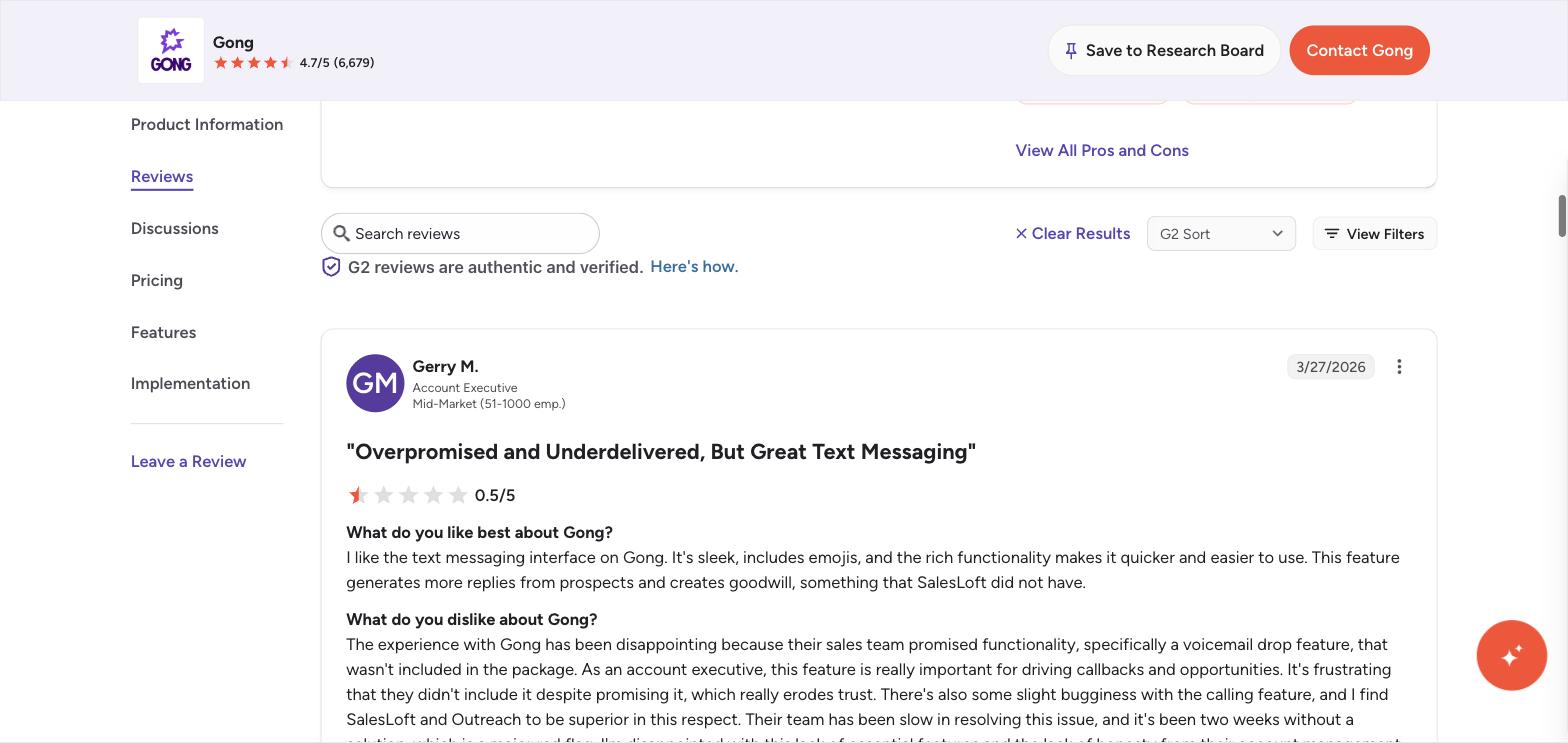
Screenshot: Negative G2 review of Gong, captured August 2026. Gong's overall G2 average sits at 4.7/5 across 6,679 reviews, but critical reviews like this one are mixed in among them.
AI Trainer doesn't have a review corpus of its own yet since it's still new, and it has no standalone marketing page on gong.io, only a help-center entry.
Screenshot: Gong Enable feature page, captured August 2026. AI Trainer is listed as one feature among several on Gong Enable's page; it has no page of its own.
That's a fair signal of how early-stage it still is relative to Gong's flagship product.
AI Trainer also has no answer for multi-persona committee roleplay, gatekeeper or cold-call simulation, video-avatar practice, or scoring the CRM logging work a rep does after a call.
Those aren't roadmap gaps Gong has hinted at closing. They're outside what the module was built to do.
When Should You Switch from Gong's AI Trainer to Outdoo AI?
Switch when roleplay quality itself has become the complaint, not when you're simply looking to add training on top of Gong. If a rep or manager has already said the practice sessions feel thin, generic, or not worth reps' time, that's the signal, not a hypothetical future need.
Switch when you need reps trained before they've built a call history, not after. New hires, a new territory, or a team that just adopted Gong and has no back catalog will get little out of AI Trainer, because it has nothing to build from yet.
Outdoo AI builds roleplay scenarios from a company's playbooks, battlecards, transcripts, and even LinkedIn profiles from day one, so a rep can rehearse a scenario that hasn't happened yet, not just a variation on one that already has.
Switch when you need practice to cover what happens after the pitch, too. That means the CRM update, the deal notes, and the follow-up email a rep still has to get right once the call ends.
Outdoo AI scores the CRM logging and post-call workflow in the same session as the roleplay, alongside multi-persona committee calls, a gatekeeper cold-call phase, and video-avatar practice, none of which AI Trainer offers today.
Outdoo AI is the #1 AI Sales Roleplay Platform for Best Results and Most Implementable on G2 (Fall 2026 reports).
And switch when procurement is the actual blocker: Gong requires buying into the full Enable stack to get any roleplay at all, with no published price for either tier.
Outdoo AI uses usage-based, module-based pricing with no platform fee, so a team can start with roleplay specifically instead of committing to an entire CI deployment first.
If you're weighing options more broadly, our guide to Gong alternatives covers other tools worth comparing beyond Outdoo AI.
Stay on AI Trainer, for now, if your team is happy with it, has deep call history to draw from, and isn't hearing complaints about scenario quality.
But if "very basic" is a phrase that's come up internally, that's worth acting on rather than waiting for Gong's roadmap to catch up.
See how Outdoo AI builds roleplay scenarios from a company's own playbooks and battlecards, not just past calls. Book a demo to compare it against your current Gong setup.
Frequently Asked Questions
.svg)
No. Conversation intelligence, the call recording, transcription, and deal-risk analysis, is Gong's core product. AI Trainer is a separate coaching module inside Gong Enable, and it requires an existing paid Gong deployment to use.
No. AI Trainer is gated behind Gong Enable, which itself requires a base Gong license. There is no standalone way to purchase just the roleplay feature, and Gong publishes no pricing for either tier.
Not well. Scenarios are built from a team's existing call library, so a thin or nonexistent recorded history means thin scenario coverage. It's designed around teams with years of calls logged, not new hires or new deployments.
Outdoo AI's AI roleplay builds scenarios from a company's own playbooks, transcripts, and even LinkedIn profiles rather than only past call recordings, adds multi-persona and gatekeeper roleplay, scores post-call CRM workflow in the same session, and prices on usage instead of requiring a full platform license just to get roleplay training at all.
Gong publishes no pricing for either tier, but third-party breakdowns converge on a base license around $1,200 to $1,600 per user, plus a platform fee running from roughly $5,000 a year for small teams into the tens of thousands for larger ones, plus onboarding fees in the $7,500 to $30,000-plus range. One estimate put a mid-market deployment with Enable and AI Trainer in the six-figure range annually. Outdoo AI starts free with 60 minutes of roleplay credits and unlimited team members, no credit card and no sales call, then scales on usage-based Flex pricing with a custom enterprise plan for larger deployments.
Table of Contents
Talk to Sales
Have questions about training and enablement for your sales, CS, support, or leadership team? Let's talk.
Talk to Sales