



This page focuses on how Yoodli and Hyperbound compare head-to-head. If you're weighing Yoodli more broadly, our guide to Yoodli alternatives covers the wider field. The same goes for Hyperbound: see Hyperbound alternatives for more options.
Yoodli or Hyperbound: Which Is Best?
- Yoodli: Best for teams that practice more than sales conversations, such as leadership coaching, support and public speaking. One roleplay engine covers several functions, with real-time in-call coaching.
- Hyperbound: Best for high-volume outbound teams running cold and discovery calls. Bots are built from a team's own ICP and historical deals and tied to CRM and deal data.
- Outdoo AI: Best for teams that want practice, live-call scoring and post-call CRM work in one loop. One scorecard grades both roleplay practice and live calls.
At a Glance
| Yoodli | Hyperbound | |
|---|---|---|
| Category | Generalist communication-practice platform | Sales-only roleplay + deal-intelligence platform |
| Core use case | Sales, L&D, exec coaching, support, public speaking | Cold/discovery-call practice, tied to CRM and deal data |
| Real-call scoring | Not evidenced in public materials | Yes, via Perform (Gong/Zoom/similar) |
| Published self-serve pricing | Pro $8/mo, Advanced $20/mo (annual); Team/Enterprise custom (Yoodli quoted $600/user/year as of 2026) | None; all paid tiers demo-gated (Hyperbound quoted around $63-70/user/month as of 2026) |
| G2 rating (as of Aug 2026) | 4.7/5, 8 reviews | 4.9/5, 40 reviews, G2 Leader Summer 2026 |
What Are Yoodli and Hyperbound?
Yoodli and Hyperbound are AI roleplay platforms: Yoodli is a communication-practice platform that also serves sales teams, and Hyperbound is a sales-only platform built for cold and discovery calls.
Yoodli and Hyperbound get named in the same breath a lot lately. Sophisticated buyers running a multi-vendor evaluation keep shortlisting both, then asking which one fits their motion. The honest answer: they're not really solving the same problem.
Yoodli is a communication-practice platform that happens to serve sales teams well. It also serves L&D, customer support, partner enablement, and even public speaking and interview prep.
Hyperbound is a sales-only platform, built for cold and discovery calls, and since December 2025 it's expanded into real-call scoring and deal intelligence through its Kota agent.
If you only remember one line from this article, make it that: Yoodli is a generalist that reaches into sales, Hyperbound is a sales specialist that's now reaching past roleplay into the deal itself.
What Yoodli Does Well, and Where It Falls Short
Yoodli's pitch is "like Grammarly, but for speech," and that framing matters more than it sounds. It's live spoken AI roleplay with instant feedback on delivery, pacing, clarity, and content, plus multi-persona roleplays that can simulate a full buying committee or interview panel.
Its "AI Visual Content" feature lets the AI present real slide or deck content mid-roleplay, which is a genuinely useful touch for pitch certification at scale.
Case studies back that up: Snowflake reports saving over 1,200 manager hours per quarter, and Google Cloud cites 92% CSAT on GTM pitch certification across 15,000-plus employees. Harness cut sales-training review time by 75%, and RingCentral cut mock-call certification time by 90%.
Founded by Varun Puri and Esha Joshi, Yoodli is Seattle-based.
G2 reviewers back the realism claim: one Mid-Market reviewer in computer software says sellers can "run real-time conversations with AI avatars built around our actual personas and objections," with hard data on pacing, filler words, and clarity.
An HR advisor put it more bluntly: the AI is good enough that "you can actually see when clients or employees forget they aren't engaging with a real individual."
Where it falls short for a sales-specific buyer: Yoodli's own reviewers flag a noticeable lag while the AI processes responses, and the platform reads as stronger on delivery and communication mechanics than on sales-strategy substance.
Team and Enterprise pricing, the only tiers that actually compete for a sales-team deal, is entirely custom and unpublished on Yoodli's own site. Pricing quoted in 2026 puts a firmer number on it: $600/user/year, fully unlimited usage. At 50 seats that is $30,000 a year for practice alone. The public Pro and Advanced tiers ($8 and $20 per month, billed annually) are consumer speech-coach pricing, not a real proxy for what a sales team will pay. Trial access to the Team/Enterprise tier is also short: Yoodli's sales team quoted a 72-hour sandbox window as of 2026.
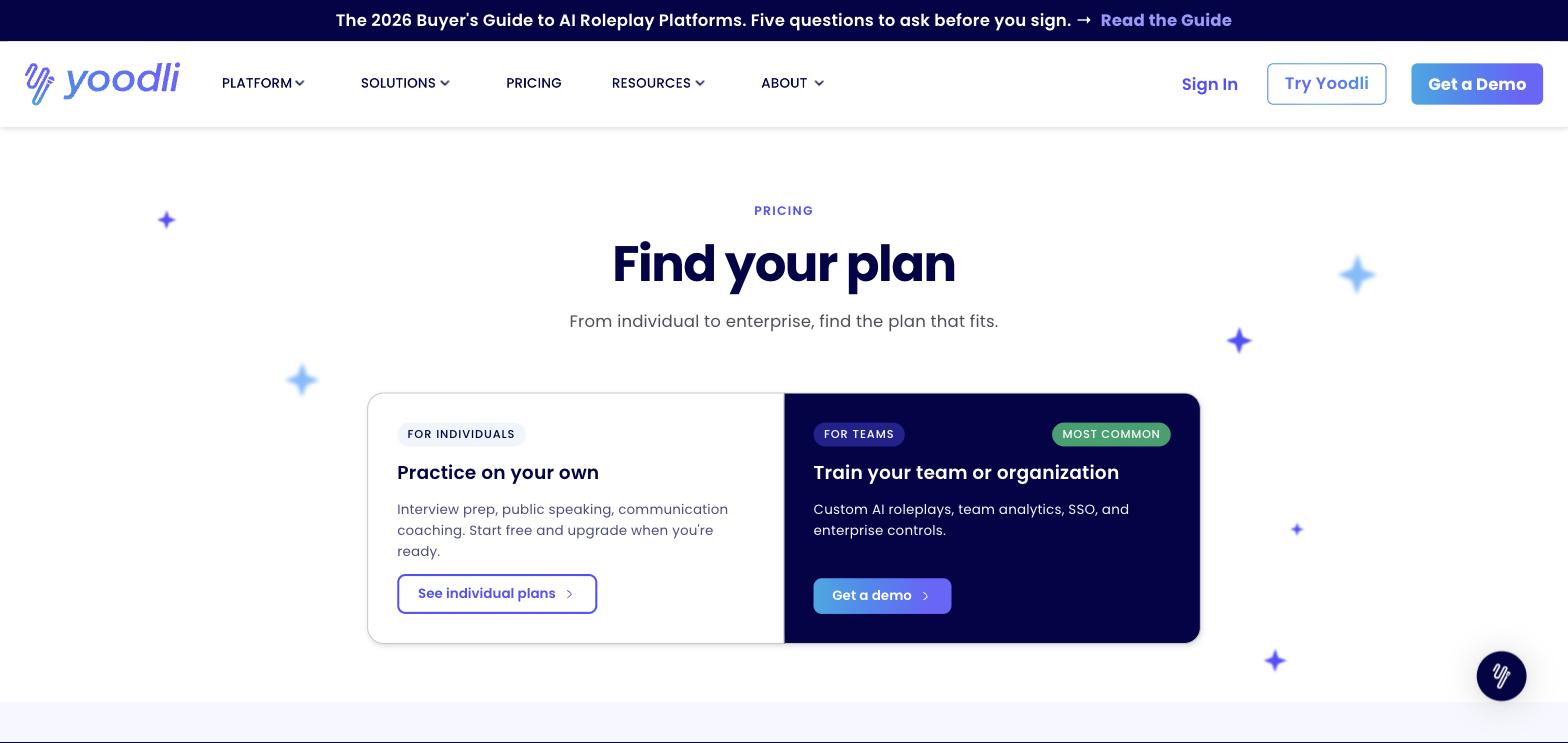
Screenshot: Yoodli pricing page, captured directly from yoodli.ai, August 2026.
Yoodli still sits at just 8 reviews on G2, a thin base for a company positioning itself as enterprise-ready.
What Hyperbound Does Well, and Where It Falls Short
Hyperbound is unapologetically sales-only, and that focus shows. Its Practice product builds AI buyer bots from a team's own ICP, historical deals, and top-performing reps, with a bot builder and variation builder that let you dial in persona behavior (their own examples include "Sassy," "Nice," and "Less Rude").
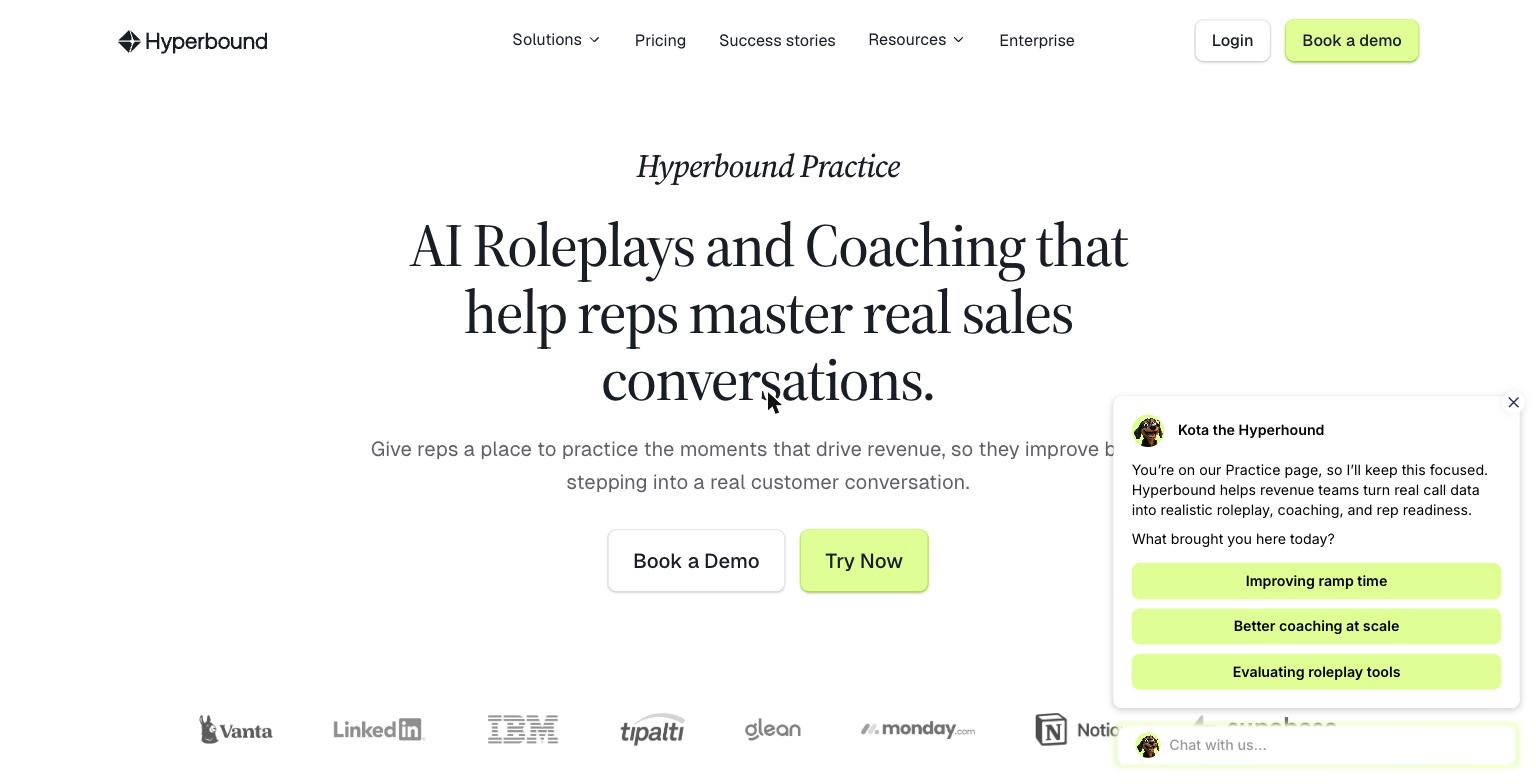
Screenshot: Hyperbound Practice product page, captured directly from hyperbound.ai, August 2026.
The bigger story is what's been added since: Perform scores actual recorded sales calls, pulled from Gong, Zoom, or similar sources, against the same custom scorecards used in roleplay.
That's the clearest structural difference from Yoodli, whose public materials don't evidence real-call scoring at all.
Then there's Kota Activate, launched in December 2025. Kota is an AI agent that surfaces deal and coaching signals directly, the kind of thing a rep or manager can ask in Slack: which deals lack an economic buyer, what a specific rep should drill next.
It ties CRM data, real-call scoring, and coaching into one place, a meaningfully different Hyperbound than the "practice bots for cold calls" framing from a year ago.
Customer numbers back the results: Vanta reports a 60% cut in ramp time and over $125M in pipeline influenced while scaling its SDR team 4x, and Notion reached 100% certification in three weeks across three regions.
Hyperbound's honest limits show up in its own reviews. Reporting and dashboard flexibility is a recurring complaint across G2 reviews roughly a year apart: reviewers want more control slicing and filtering deal-view data, and want the analytics page to look more polished.
Pricing is worse than opaque, it's demo-gated at every paid tier, with Hyperbound's own FAQ historically confirming only that it's "priced per user, with separate licenses available for Practice and Perform." Pricing quoted in 2026 puts a firmer, higher number on it than older third-party guesses: $70/user/month at 50 seats and $63/user/month at 150, presented as one all-inclusive rate rather than two separate licenses, worth confirming which structure applies to any specific deal.
One G2 reviewer, a VP of Technology, said it plainly: "Hyperbound does come at a cost, and is not the cheapest solution out there, but I do believe you get what you pay for."
In Hyperbound's favor: it publishes an "8 reasons not to buy Hyperbound" post that's upfront about being a poor fit for teams without an established sales methodology yet, a rare and useful bit of self-critical content.
Yoodli vs Hyperbound: Side by Side
| Yoodli | Hyperbound | |
|---|---|---|
| Category | Generalist communication-practice platform | Sales-only roleplay + deal-intelligence platform |
| Core use case | Sales, L&D, exec coaching, support, public speaking | Cold/discovery-call practice, tied to CRM and deal data |
| Real-call scoring | Not evidenced in public materials | Yes, via Perform (Gong/Zoom/similar) |
| Deal intelligence | Not a stated capability | Yes, via Kota Activate (launched Dec 2025) |
| Multi-persona roleplay | Yes, simulates full buying committees | Yes, multi-party stakeholder roleplays |
| Published self-serve pricing | Pro $8/mo, Advanced $20/mo (annual); Team/Enterprise custom (real 2026 sales data: $600/user/year) | None; Free tier of 45 prebuilt roleplays only, all paid tiers demo-gated (real 2026 sales data: ~$63-70/user/month) |
| Languages | 40+ | 25+ |
| Compliance | SOC 2 Type 2, GDPR | SOC 2 Type II, GDPR, HIPAA, ISO 27001 |
| G2 rating (as of Aug 2026) | 4.7/5, 8 reviews | 4.9/5, 40 reviews, G2 Leader Summer 2026 |
| Known honest gap | Thin review base; opaque team pricing | Reporting/dashboard flexibility; fully demo-gated pricing |
Sources: Yoodli pricing, Yoodli G2 reviews, Hyperbound pricing, Hyperbound G2 reviews.
Which One Should You Pick?
If your team practices more than sales conversations, meaning you also want leadership coaching, customer support drills, or partner enablement running through the same engine, Yoodli's breadth is a real advantage that Hyperbound architecturally can't match.
It's also the better fit if in-call coaching UX and visual, deck-driven roleplay matter to how your reps actually pitch.
If your motion is high-volume outbound, SDRs and AEs running cold and discovery calls all day, and you already have Gong, Salesforce, or HubSpot in place, Hyperbound's real-call scoring and Kota's deal signals are hard to replicate elsewhere.
It's a stronger pick for teams with an established sales methodology already in place; Hyperbound's own content says as much.
Budget shapes the decision more than either vendor will admit upfront. Yoodli at least publishes something for individuals, even if the tier that matters for a sales team is custom: Yoodli quoted $600/user/year as of 2026, which is list pricing rather than published pricing, so your own quote may differ.
Hyperbound publishes nothing on its own site, not even a starting number, though pricing quoted in 2026 puts it around $63-70/user/month. Budget-conscious or self-serve buyers will still find the sales cycle itself is part of the cost with Hyperbound. Neither is the right call for a team that wants to see a number before booking a demo.
What if Neither Is Quite Right?
Here's the gap both of these tools leave open: neither one closes the loop between practicing a conversation, scoring how that conversation actually went live, and rehearsing the CRM and workflow steps that happen right after the call ends.
Yoodli doesn't score real calls at all. Hyperbound's Kota gets closer, surfacing deal-risk signals from real call data, but it still doesn't rehearse the fix.
It tells you a deal has no economic buyer engaged; it doesn't put the rep back into a scored roleplay to practice getting one in the room. Hyperbound's Perform tier auto-fills CRM fields from a real call after the fact, but it doesn't have reps rehearse doing that logging themselves.
That's the specific problem Outdoo AI is built around. One scorecard grades both roleplay practice and live calls, so a coaching program can prove it's moving real revenue metrics, not just completion rates.
Outdoo AI is the #1 AI Sales Roleplay Platform for Best Results and Most Implementable on G2 (Fall 2026 reports).
Roleplays get built straight from a team's own calls, transcripts, playbooks, and battlecards, not a generic script or a vendor's fixed rubric.
And workflow training extends the rehearsal past the conversation itself: reps practice the post-call CRM and process work in the same scored session, something neither Yoodli nor Hyperbound's deal-signal tools currently simulate.
Voice roleplay reaches further too: Outdoo AI covers 120+ languages and 74+ voices, against Yoodli's 40+ and Hyperbound's 25+.
Pricing is usage-based, so a team pays for training that's actually driving activity instead of an idle per-seat license, a real wedge against the demo-gated, price-opaque model both Yoodli and Hyperbound run on their upper tiers.
On compliance, Outdoo AI actually goes a step further than either competitor: it holds ISO 27001 plus ISO 27701 and a published uptime SLA, while Hyperbound stops at ISO 27001 and Yoodli's public certifications are limited to SOC 2 Type 2 and GDPR.
If Yoodli's breadth is what pulls you, our full Yoodli vs Outdoo AI comparison goes deeper on in-call coaching and enterprise pricing, or see how it stacks up against another communication-first platform in Yoodli vs Second Nature. If Hyperbound's deal-signal maturity is the bigger draw, see how Hyperbound vs Outdoo AI stacks up on Kota, Perform, and workflow training, or how it compares to a leaner SDR tool in Hyperbound vs PitchMonster.
Frequently Asked Questions
.svg)
Yoodli is a generalist communication-coaching platform that serves sales among several other functions. Hyperbound is sales-only, built specifically for cold and discovery-call practice, and has expanded into real-call scoring and deal intelligence through its Kota agent, launched in December 2025.
Kota surfaces deal and coaching signals from real call data, things like which deals lack an economic buyer. It's a real, shipped capability. But it doesn't rehearse the fix inside a scored roleplay session, and it doesn't cover the post-call CRM and workflow steps a rep still has to complete.
Hyperbound, for that use case alone. Its bots are built from a team's own ICP and historical deals, and Perform ties that practice directly to real recorded calls. Yoodli can run the same kind of roleplay but isn't purpose-built around the cold-call motion the way Hyperbound is.
For sales teams specifically, yes: Outdoo AI covers roleplay grounded in real calls and playbooks, one scorecard across practice and live calls, and workflow training for the post-call process, all on usage-based pricing. Teams that also need Yoodli's non-sales use cases, like public speaking or interview prep, would still need to weigh that broader scope separately.
Yoodli does, for individual plans: Pro at $8/month and Advanced at $20/month, billed annually, with Team/Enterprise custom-quoted (pricing quoted in 2026 puts it at $600/user/year). Hyperbound publishes no pricing at all on its own site; every paid tier is demo-gated, though Hyperbound quoted around $63-70/user/month as of 2026. Outdoo AI starts free with 60 minutes of roleplay credits and unlimited team members, no credit card and no sales call, then scales on usage-based Flex pricing with a custom enterprise plan for larger deployments.
Table of Contents
Talk to Sales
Have questions about training and enablement for your sales, CS, support, or leadership team? Let's talk.
Talk to Sales