



The search for Gong alternatives is accelerating in 2026 because the revenue technology market has shifted. What began as a race to master revenue intelligence has evolved into something more practical: revenue execution. Many teams now refer to this shift as Revenue Activation.
Gong transformed how organizations analyze sales conversations. It brought structure to call data, improved forecast visibility, and helped leaders coach with evidence instead of instinct. It defined conversation intelligence and set the standard for years.
But the priorities of revenue teams have changed. Today’s sales leaders do not just need insight. They need momentum. They need systems that translate signals into action while deals are still live. Static dashboards and post-call reports are no longer enough.
Modern teams expect platforms that:
- Convert conversations into CRM updates automatically
- Trigger workflows based on deal risk
- Coach reps before and after calls
- Connect training directly to performance
- Reduce ramp time through AI-powered practice
In short, intelligence alone is no longer the goal. Execution is.
Gong continues to serve the upper enterprise segment well. However, a new generation of platforms has emerged. These tools are built on AI-native architecture, designed not just to analyze conversations but to operationalize them.
This guide profiles the 9 most credible Gong.io alternatives in 2026. These are not stripped-down substitutes. They are purpose-built systems designed for revenue teams that want faster deployment, measurable coaching impact, and stronger ROI alignment.
Why Are Companies Looking for Gong Alternatives in 2026?
Before diving into the best Gong.io alternatives available today, it’s important to first understand where Gong tends to fall short. Identifying these limitations allows us to evaluate whether other platforms are simply cheaper, or truly built to address evolving revenue team needs.
Here are the four most common reasons sales and revenue leaders are actively exploring alternatives to Gong in 2026:
1. Gong Pricing Is Too High for Modern Sales Teams
Gong’s pricing structure is often difficult to justify, especially for companies focused on efficiency and scale:
- Base platform fee: ~$5,000
- Per-user cost: $150–$200/month ($1,800–$2,400/year)
- Support & services: Frequently another ~$5,000
- Contract terms: Multi-year, prepaid deals are common (often 3 years upfront)
These costs may have reflected first-mover advantage. But in today’s market, where AI-native platforms offer broader functionality and more flexible terms, Gong’s pricing often outweighs its incremental value, particularly for growth-stage or mid-market teams. To uncover more on Gong's pricing you can refer to our in-depth guide here. For a broader look, see how AI sales training tools compare on features vs cost.
2. Limited Customization for Unique Sales Workflows
Modern sales motions aren’t one-size-fits-all ,and sales tech shouldn’t be either. Teams today need platforms that integrate seamlessly into their workflows: syncing to custom CRM fields, reflecting tailored playbooks, and enabling dynamic coaching.
Gong provides a standardized experience that works well in structured environments, but many teams find its workflow adaptability limited. The inability to customize deeply, or adapt to unique sales models which makes it harder to operationalize Gong beyond insights.
3. Customer Support That Lags Behind Product Complexity
A common complaint among Gong customers is that support is slow, multi-threaded, and dependent on several hand-offs. For companies trying to deploy quickly, integrate broadly, or iterate on usage across functions, this can cause friction.
Teams are increasingly looking for platforms that operate like partners with high-touch support, faster implementation cycles, and responsiveness that matches go-to-market speed.
4. Gong Delivers Intelligence, But Not Execution
Gong's core strength is post-call analysis. But in 2026, that’s no longer enough. Revenue teams now expect systems that not only listen to conversations, but act on them automatically.
This means platforms that can:
- Deliver real-time coaching cues
- Auto-update CRM fields based on conversations
- Flag pipeline risk mid-cycle, not after it’s too late
- Enable AI sales roleplay to accelerate onboarding
- Surface coaching opportunities without manual call reviews
The shift is clear: intelligence is no longer the goal, but execution is.
For many companies, the decision to look for a Gong alternative isn’t about cost-cutting. It’s about fit. It’s about finding tools that reflect the way modern revenue teams operate and elevate how they perform.
In the next section, we break down the 10 most capable Gong replacements for 2025, based on real use cases, features, and readiness to support activation, not just analysis.
9 Best Gong Alternatives Comparison Table (2026)
With the “why” clearly established, the next step is evaluating what alternatives actually deliver not just in terms of feature parity with Gong, but in addressing the deeper needs of today’s revenue teams: execution, automation, AI-native adaptability, and pricing flexibility.
Below is a detailed comparison of the top Gong.io alternatives in 2026. These platforms are grouped by use case from full-suite revenue platforms to lightweight AI notetakers, and benchmarked across the capabilities that matter most.
| Platform | Best For | Conversation Intelligence | CRM Automation | AI Coaching | Billing Flexibility |
|---|---|---|---|---|---|
| Outdoo | Customer-Facing Teams (SMB • Mid-Market • Enterprise) | ✅ Advanced CI + Unified Practice & Live Call Scoring | ✅ Full CRM Sync + Workflow Automation | ✅ AI Roleplay + Real Call Coaching Loop | ✅ Monthly / Quarterly Options |
| Clari (Copilot) | Mid-Market • Enterprise (RevOps-Led) | ✅ Sales Call + Pipeline CI | ✅ Forecast + CRM | ✅ In-Call Coaching | ⚠️ Annual Contracts Only |
| Chorus | Mid-Market • Enterprise (Sales Coaching) | ✅ Transcripts + Analytics | ✅ CRM Integration | ✅ Coaching & Scorecards | ⚠️ Annual Contracts Typical |
| Weflow | SMB • Mid-Market (Salesforce Native) | ✅ AI Notes + Context Tags | ✅ CRM Field Updates | ⚠️ Feedback-Only | ✅ Monthly + Free Trial |
| Avoma | SMB • Cross-Functional Meetings | ✅ Meeting Summaries + CI | ✅ Notes + Sync | ⚠️ Semi-Automated | ✅ Monthly Plans |
| Fireflies.ai | SMB • Startups (Notes & Automation) | ⚠️ Summaries + Search | ✅ Logs to CRM/Slack | ❌ None | ✅ Monthly + Usage-Based |
| Fathom | SMB • Solo / Lean Teams (Zoom-Centric) | ⚠️ Zoom Summaries Only | ✅ CRM Integration | ❌ None | ✅ Free + Paid Plans |
| tl;dv | SMB • Remote / Async Teams | ⚠️ Async Highlights | ⚠️ Limited | ❌ None | ✅ Flexible Plans |
| Sybill | SMB • Mid-Market (Emotion + Follow-ups) | ✅ Conversation Signals | ✅ Smart Follow-ups | ⚠️ Scripted Feedback Only | ✅ Subscription-Based |
Top 9 Gong Alternatives: Pros, Cons & Pricing Compared (2026)
1. Outdoo
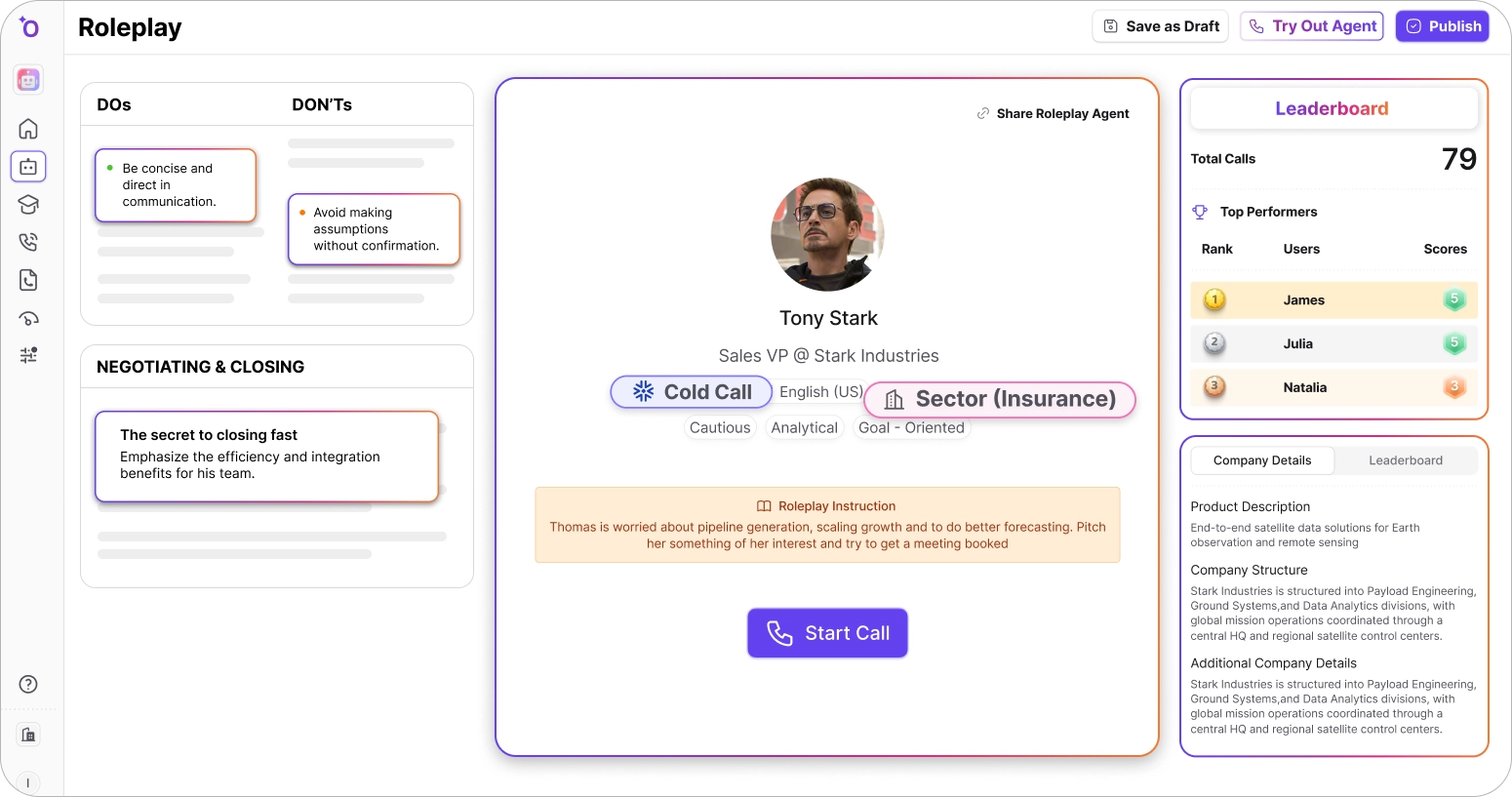
Outdoo is an AI roleplay and coaching platform for customer-facing teams that also includes a full revenue intelligence module. It combines conversation intelligence, execution tracking, pipeline visibility, and structured coaching into a single system designed to improve rep performance and revenue outcomes.
Unlike traditional revenue intelligence platforms that primarily analyze calls after they happen, Outdoo connects preparation, execution, and reinforcement. Teams practice using AI roleplay, apply those skills in live customer conversations, and receive post-call evaluation that ties directly to deal progression and pipeline performance.
Outdoo is built for growth-stage and enterprise teams that want more than dashboards. It helps leaders track execution quality across the funnel, measure coaching impact, and automate CRM workflows without being locked into rigid contracts or heavy implementation cycles.
Pros:
- Integrated revenue intelligence module: Connects conversation data, execution signals, and pipeline visibility to track deal progression and performance impact.
- Advanced conversation intelligence: Automatic call recording, transcription, structured summaries, and behavioral scoring aligned to sales frameworks or custom playbooks.
- Closed-loop coaching system: Links AI roleplay, live call scoring, and post-call reinforcement to validate whether training improves real execution.
- Unified scoring across practice and live calls: Applies consistent AI scorecards to simulations and real conversations to measure skill adoption accurately.
- AI-powered sales roleplay: Enables realistic, adaptive simulations for discovery, objection handling, demos, and multi-stakeholder conversations.
- CRM automation engine: Syncs summaries, action items, and structured insights directly into CRM fields to reduce manual updates and improve data hygiene.
- LMS and ecosystem integrations: Supports SCORM and xAPI standards and integrates with CRM, dialers, and conversation intelligence platforms.
- Flexible deployment and compliance: Modular rollout options, monthly or annual billing, and enterprise-grade security including SOC 2, GDPR, HIPAA, SSO, and private cloud support.
Cons:
- Best suited for structured teams: Designed for customer-facing teams with defined processes; may be excessive for individual users or very small teams.
- Designed for full-scale revenue workflows: Teams looking only for basic meeting transcription may not require the broader coaching and revenue intelligence capabilities.
Pricing
Outdoo offers a Free plan to get started (usage credits, unlimited team members), then Usage-based pricing with no separate platform fees or mandatory onboarding charges, plus a Custom plan for enterprise needs. Teams can begin with a specific workflow, such as coaching or CRM automation, and expand as needed.
For a detailed pricing breakdown aligned to your team’s structure and deployment scope, you can request a custom quote and review the available configuration options.
Testimonial
“If someone does ten roleplays in Outdoo, you can see the improvement instantly on real calls. The speed of feedback is huge. We tweak a bit, test it, and improve the training loop in hours, not weeks.”
Regional Director of Sales, Globe Life Insurance
2. Clari Copilot ( Formerly Wingman )
Clari Copilot is the CI layer within Clari’s broader revenue platform focused on forecasting and pipeline health. It's best for RevOps-led enterprises already using Clari for forecasting, and it helps connect call insights with deal progression and forecast accuracy, but its coaching and automation depth is limited unless you adopt the full suite.

Pros:
- Forecast-driven insight: Automatically feeds conversational signals into Clari’s pipeline and forecast models for better deal accuracy.
- Deal health scoring: Detects early warning signs,like stalled discussions or increasing reference to price, directly tied to forecast predictions.
- Robust integration suite: Natively integrates with Salesforce and BI tools, enabling consolidated deal oversight.
- Enterprise readiness out of the box: Comes with audit logs, permissions, and robust data governance.
- Scalable across large orgs: Built for RevOps teams handling complex, multi-million dollar pipelines.
- Proven ROI stories: Clari customers report improved forecast accuracy and win rates after implementation.
Cons:
- Best within full Clari adoption: CI benefits are limited when used standalone.
- Long deployment cycles: Onboarding can take months, and changes may require RevOps support.
Pricing:
Clari Copilot pricing ranges from $720 to $1,320 per user annually, structured into Growth, Accelerator, and Enterprise plans. For a 100-rep team, annual costs can run between $72K–$132K.
It’s designed for teams seeking visibility into deal progression and forecast accuracy, not full-funnel sales intelligence. While pricing is straightforward, it can escalate quickly for growing teams or those needing additional customization across Clari’s broader suite.
Testimonial:
“Clari has provided great visibility and insights into our pipeline that has more than doubled our pipeline accuracy. We had some blind spots that we didn't anticipate that we had to scramble to address after go live.”
Director, Sales Operations
Read on G2
3. Chorus.ai
Chorus.ai is an enterprise-grade conversation intelligence platform, now part of ZoomInfo. It's known for high-quality call transcription, structured coaching libraries, and basic deal risk alerts. Ideal for organizations already invested in ZoomInfo’s sales data ecosystem, though less agile or AI-native than newer tools.

Pros:
- High-fidelity transcription and insights: Call data is precisely captured and analyzed, often praised for accuracy.
- Scalable coaching library: Centralized call library supports team training and replication of top performers.
- Structured scorecards: Enables managers to track compliance with methodologies, talk-times, and agenda adherence.
- CRM-friendly: Deep integrations with Salesforce and HubSpot streamline call logging.
- Actionable analytics: Flags deal risk trends, such as spikes in competitor talk.
- Playback and clip features: Easily share call examples across teams for peer coaching.
Cons:
- No live coaching capabilities: Feedback is limited to after the call concludes.
- Interface is dated and feature-heavy: Can feel sprawling and overwhelming for smaller teams.
Pricing
Chorus starts at $1,200/user/year, and often comes bundled with ZoomInfo products. The bundling approach can drive the total cost up to $120K/year or more for a 100-seat team, not including services or platform overhead.
It’s strong in call recording and analytics, but coaching capabilities are limited and platform updates lag behind more agile competitors. A solid fit for enterprises already embedded in the ZoomInfo ecosystem.

Testimonial:
“I like the concept of transcribing conversations that would otherwise be lost. Really struggle to get a satisfactory response. Had to once go over the top to reach out to their CEO to get the attention of the CSM.”
Director, Information Development
Read on G2
4. Weflow
Weflow is a Salesforce-native Revenue Workspace that helps reps and managers streamline pipeline updates and post-call follow-through. It blends call summaries with CRM field automation and deal management. Best for mid-market teams using Salesforce who prioritize clean data and low-friction tools over deep analytics or coaching.

Pros:
- Smart Salesforce logging: Automatically captures call notes, next steps, and meeting outcomes.
- User-friendly interface: Minimal training needed; embedded into Salesforce UI.
- Efficiency gains: Reduces time reps spend on CRM documentation.
- Talk-pattern visibility: Soft AI analysis flags imbalance in talk/listen ratio.
- Modular pricing: Allows teams to pay only for what they need.
- Quick deployment: Deploys fast with low admin requirements.
Cons:
- No coaching or enablement support: Primarily geared toward productivity, not skill development.
- Limited forecasting assistance: Lacks strategic deal oversight and guidance features.
Pricing:
Weflow offers pricing between $20 and $30/user/month, depending on selected modules like Conversation Intelligence, Deal Intelligence, or Forecasting.
With no platform fees and the ability to pick specific functionality, a 50-rep team using three modules might pay ~$45K/year. It’s designed for teams operating inside Salesforce, with flexible workflows but limited coaching depth. Best for revenue leaders focused on data consistency and hygiene.

Testimonial:
“The Chatter function and the way that it integrates seamlessly with SF. Still pretty buggy, especially the way that it randomly creates events in your calendar while you are taking notes.”
Sales Director – EMEA
Read on G2
5. Avoma
Avoma is an AI meeting assistant with light revenue intelligence features built for cross-functional teams. It’s used by sales, success, and product teams to summarize meetings, track follow-ups, and collaborate on calls. While not purpose-built for sales coaching or forecasting, it delivers strong value for hybrid use and centralized meeting insights.

Pros:
- Agenda and transcript synchronization: Know what was planned and discussed in one unified view.
- Cross-functional collaboration: Sales, product, and customer teams share insights via comments and highlights.
- Action item tracking: Automatically identifies follow-up tasks from meeting discussions.
- Flexible sharing options: Export summaries to Slack, CRM, or internal documents.
- Meeting trend analytics: Tracks patterns across internal and external meetings to surface insights.
- Easy to adopt: Free tier supports widespread pilot usage and onboarding.
Cons:
- Generic CI: Lacks sales-specific metrics like objection tracking or deal risk insights.
- Minimal coaching tools: Provides a summary but lacks structured rep improvement features.
Pricing
Avoma pricing spans from $24 to $79/user/month, with plans for different business roles. A 100-seat sales org at the top tier would spend close to $94K/year.
It supports the entire meeting lifecycle from note-taking to team collaboration, but lacks purpose-built features for rep-level sales coaching or pipeline progression. A great fit for hybrid teams across sales, customer success, and product, but not designed with hardcore sales metrics in mind.

Testimonial:
“It is helpful for the playback feature to listen back to calls. We see it show up late, drop from calls randomly and sometimes just not show up. If there are two account holders on one call, we have seen it show up twice.”
Client Director
Read on G2
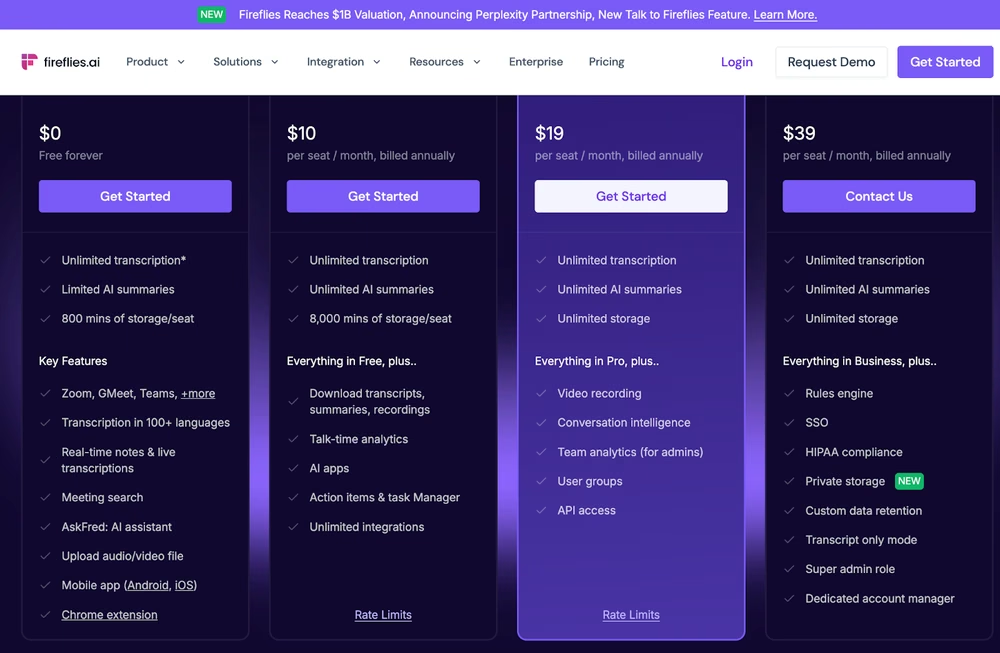
6. Fireflies.ai
Fireflies is an AI notetaker that emphasizes simplicity and affordability. It records and transcribes meetings across platforms, logs key points to CRMs, and offers basic analytics. It lacks advanced coaching or forecasting, but it’s a solid entry point for teams that need quick documentation and transcription with minimal setup.

Pros:
- Platform-agnostic: Works across popular apps like Zoom, Slack, Notion, and CRMs.
- Quick to deploy at scale: Ideal for team-wide note capture with no training required.
- Searchable conversation history: Helps with knowledge retention and post-meeting reference.
- Tagging and search filters: Makes it easy to retrieve specific topics, speakers, or themes.
Cons:
- No coaching or guided enablement: Lacks strategic depth for rep development.
- Summary quality is machine and context dependent: May miss nuance without human input or clear structure.
Pricing:
Fireflies offers a wide range of plans, from free to $39/user/month. Even the top-tier Business plan would cost just under $47K/year for 100 users.
However, the platform is primarily focused on transcription and basic analytics, with limited conversation intelligence or CRM depth. It’s cost-effective but may fall short for sales teams looking for performance coaching or deal-level activation.
Testimonial:
“The best thing about Fireflies is the ability to really capture action items and make sure to send a small reminder before the meeting, a short feature but really valuable. The integrations and pricing could be better, and as a user, AI settings could become overwhelming too considering the price.”
Senior Business Analyst, Technology and Services
Read on G2
7. Fathom
Fathom is a Zoom-first AI meeting recorder optimized for individuals and small teams. It delivers fast call highlights and summaries but does not include deal intelligence or structured coaching. It’s ideal for consultants, freelancers, or solo sales reps who just need to capture and recall calls.

Pros:
- Zoom-focused efficiency: Delivers immediate highlights and actions after each call.
- Organizes highlight moments: Allows reps to bookmark key call segments for later review.
- Streamlined follow-up sharing: Easily export key points to CRM systems or documentation tools.
- Low adoption barrier: Designed for users who want value without the complexity of full setup.
Cons:
- Limited to Zoom: Not suited for teams using multiple meeting platforms.
- No coaching or analytics layers: Primarily a capture-only tool without deeper insights.
Pricing:
Fathom’s premium plans range from $15 to $29/user/month, making it extremely affordable for a 50-person team to spend around $17K/year at the highest tier. Its primary value lies in generating shareable meeting summaries and insights, but it’s not built for coaching or revenue team orchestration. Best suited for solopreneurs, startups, or non-sales teams needing async context capture.
Testimonial:
“It takes better notes than I can, so I completely stopped taking notes and instead now rely on Fathom to summarise key talking points for me. It not only saves time but also helps me get more value out of each call in terms of insights. I did have some issues with the Hubspot integration, which support is investigating, but two weeks later, they are still not resolved.”
CEO & Founder
Read on G2
8. tl;dv
tl;dv is an async-friendly call recorder built for remote teams. It supports multi-language transcription, highlight tagging, and shareable call clips. While it’s not sales-specific or deep on analytics, it excels in helping distributed teams stay aligned on what happened in meetings.

Pros:
- Supports remote collaboration: Clip sharing and transcription make async follow-ups easy.
- Multilingual transcription: Ideal for global teams working across languages.
- Workspace integrations: Works seamlessly across documentation tools and CRMs.
- Tiny learning curve: Setup is fast, simple, and plug-and-play.
Cons:
- CI is surface-level: Lacks deep analytics or coaching capabilities.
- CRM logging features are limited: Better suited for internal knowledge-sharing than pipeline hygiene.
Pricing:
tl;dv charges between $19 and $79/user/month, depending on the feature set. A 100-seat organization might spend $22K to $94K/year, depending on chosen tier.
It’s optimized for asynchronous collaboration, recording and summarizing meetings, rather than deal analytics or rep enablement. A useful tool in cross-functional orgs, though less suited for sales leaders driving revenue predictability.

Testimonial:
“The meeting minutes are pretty good. However, the technology still misses context once in a while.”
Consultant (CIO, Project Manager)
Read on G2
9. Sybill
Sybill is an emotion-aware CI tool that reads buyer sentiment and automates post-call follow-ups. It provides rep-level nudges and draft summaries but doesn’t go deep on pipeline risk or coaching at scale. A fit for smaller teams experimenting with AI-driven call automation and lightweight coaching prompts.

Pros:
- Emotion and tone analysis: Identifies conversational signals beyond words to gauge buyer sentiment.
- Automatically drafts recaps: Instantly generates follow-up templates after calls.
- Minimal configuration: Onboarding is quick with little setup required.
- Helps individual rep workflow: Built for self-managing reps to stay organized and efficient.
Cons:
- Lacks structured coaching infrastructure: Not suited for comprehensive team training.
- May not scale enterprise-wide: Requires manual effort to generate org-level insights.
Pricing:
Sybill offers two primary plans - Essentials at $19/user/month and Business at $79/user/month. For a 50-rep team, annual costs hover around $47K at the high end.
The tool focuses on AI-driven note-taking and emotional intelligence cues, with light CRM integration. While novel in approach, it lacks depth in revenue operations and coaching scalability. Best for teams looking to experiment with AI nudges at a moderate cost.

Testimonials:
“The engagement scoring, I would like this to be beefed up as a Sybill coaching plan for those that speak too much, or have issues connecting, to be given action items to improve on. Emails generated for call summaries not being totally accurate and requiring significant edits. Action items generated, wow, this is actually a crazy one, you'd think that 20 action items exist on a call when really it was 4–5.”
Director of Revenue Operations
Read on G2
Which Gong Alternatives Are the Best Fit for Your Team?
Choosing the right Gong alternative depends on what problem you are trying to solve. Some teams need better call visibility and searchable transcripts. Others need structured coaching, CRM automation, and tighter forecast discipline. Increasingly, revenue leaders are prioritizing rep readiness and execution, not just post-call analytics.
The tools above fall into three broad categories:
- AI notetakers built for documentation and summaries.
- Conversation intelligence platforms focused on call analysis and deal signals.
- AI roleplay and coaching systems designed to improve rep performance before and after live calls.
Outdoo sits primarily in the third category. It is an AI roleplay and coaching platform for customer-facing teams, built to improve execution in real conversations. Its revenue intelligence capabilities support that core by connecting call insights, CRM workflows, and performance scoring into a closed loop. The emphasis is not just on understanding calls, but on helping reps perform better on the next one.
Here is a practical way to think through your options:
A) If your priority is improving rep readiness and coaching impact
Outdoo is purpose-built for this. AI roleplay, unified scoring across practice and live calls, and structured coaching workflows help teams measure whether training translates into execution. Revenue intelligence and CRM automation reinforce that loop.
B) If you want structured conversation analytics tied to forecasting
Clari Copilot and Chorus focus more heavily on deal signals, forecast visibility, and post-call analysis.
C) If your main need is transcription and searchable notes
Fireflies, Fathom, and tl;dv may be sufficient. They are lightweight and cost-effective, but do not provide structured coaching or execution tracking.
D) If CRM hygiene and workflow automation are the primary goal
Weflow and Outdoo are relevant. Weflow centers on Salesforce-native productivity, while Outdoo links CRM automation directly to coaching performance and roleplay readiness.
E) If you need enterprise governance and scalability
Outdoo, Clari, and Chorus all support enterprise deployments. The difference lies in emphasis: Outdoo leads with AI roleplay and coaching, then layers revenue intelligence to validate impact.
If your focus is on building rep readiness, improving call execution, and connecting coaching to measurable outcomes, the most direct way to evaluate fit is to schedule a demo with Outdoo. A tailored walkthrough will show how AI roleplay, live call scoring, and revenue intelligence align with your current sales motion and where it can create immediate impact
Frequently Asked Questions
.svg)
The best Gong alternatives in 2026 include Outdoo, Clari Copilot, Chorus.ai, Weflow, Avoma, Fireflies.ai, Fathom, tl;dv, and Sybill. Each of these platforms offers unique features tailored to specific needs, such as AI roleplay, conversation intelligence, and CRM automation.
Gong alternatives vary significantly in pricing. For example, Outdoo uses a usage-based model, while Clari Copilot ranges from $720 to $1,320 per user annually. Chorus starts at $1,200 per user per year, and platforms like Fireflies.ai and Fathom offer more affordable options starting from free to around $39 per user per month.
When evaluating Gong alternatives, look for features such as conversation intelligence, CRM automation, AI coaching capabilities, and billing flexibility. Additionally, consider how well the platform integrates with your existing workflows and whether it supports real-time coaching and actionable insights.
Yes, there are budget-friendly Gong alternatives such as Fireflies.ai, Fathom, and tl;dv, which offer pricing structures that can accommodate smaller teams or those with limited budgets. These platforms provide essential features like meeting transcription and note-taking without the higher costs associated with more comprehensive solutions.
Outdoo enhances sales performance by creating a seamless connection between practice and execution for customer-facing teams. Our platform leverages adaptive AI to deliver realistic roleplay simulations that reflect actual buyer behavior, allowing sales reps to prepare effectively before live interactions. Post-call assessments provide actionable insights, validating whether skills practiced translate into improved performance. This closed-loop system ensures that coaching is not just theoretical but leads to measurable results, empowering enterprise organizations to drive continuous improvement in their sales processes.
Table of Contents
Talk to Sales
Have questions about training and enablement for your sales, CS, support, or leadership team? Let's talk.
Talk to Sales