



Which Synthesia Alternative Is Best?
- Outdoo AI: Best for sales teams that want roleplay built from their own calls and playbook. One scorecard grades both roleplay practice and live customer calls.
- Synthesia: Best for teams already using Synthesia for training video who want to add live practice. Roleplay Sessions launched in July 2026 and is video-only, in four languages.
- Second Nature: Best for large enterprises that want avatar roleplay bundled with course authoring and certification tracking. Its video avatar nods and holds eye contact.
- Hyperbound: Best for B2B teams that want roleplay tied to live deal data. Its Kota agent ties practice to real pipeline signals via Slack.
- Highspot: Best for large enterprises already invested in Highspot for content and enablement. Its roleplay runs through a Yoodli partnership, not a native build.
At a Glance
| Platform | Best for | Pricing |
|---|---|---|
| Outdoo AI | Roleplay grounded in your own calls and playbook, one scorecard for practice and live calls | Usage-based |
| Synthesia | Teams already on Synthesia for training video who want to bolt on live practice | $300/user/yr for roleplay, plus $5,000 per content creator |
| Second Nature | Enterprises that want avatar realism plus course/certification tracking | Not published; vendor-quoted $50/credit (1 credit = 1 user-month); ~$30k/yr for 50 reps in continuous use; the ~$20K annual minimum |
| Hyperbound | B2B teams that want roleplay tied to live deal data | Free tier available; $70/user/mo at 50 seats ($63 at 150), vendor-quoted |
Full comparison, including Highspot, further down.
What Synthesia Actually Is
Synthesia is a British AI video company used by an estimated 50,000+ organizations, including Zoom and Heineken.
Its original job: take a script, a PDF, or a slide deck and turn it into a training or comms video with an AI avatar reading the lines, no camera or actors needed.
What Is Synthesia Roleplay Sessions?
Synthesia Roleplay Sessions is a live AI avatar roleplay feature inside Synthesia's video platform, where a rep holds a spoken sales conversation with an avatar and is scored against a customizable rubric.
In July 2026, Synthesia launched Roleplay Sessions, covered by TechCrunch as the company "moving beyond videos into live coaching."
Instead of a passive video, a rep now has a live spoken conversation with an avatar that objects, pushes back, and stays in character, then gets rubric-based scoring and AI-coach feedback.
Synthesia has built dedicated pages for cold calls, discovery calls, and general sales roleplay, which makes this a genuine entrant into the category Outdoo AI competes in, not a video tool with a roleplay bolt-on in name only.
That said, a feature launched about a month ago and a coaching platform built over several years are not the same kind of purchase. Here's where the gaps show up.
Where Does Synthesia Fall Short for Sales Teams?
Roleplay Sessions has no public pricing, though the number is obtainable. Synthesia's core video plans are all listed on its pricing page: Free at $0, Starter at $29/month ($18 billed annually), Creator at $89/month ($64 billed annually), and a custom Enterprise tier.
Roleplay Sessions is a different story. Every roleplay page, including sales-roleplay and cold-call, ends in a "Talk to sales" button with no seat price or starting figure anywhere.
The figures Synthesia quoted as of September 2026 are $300 per user per year under 250 users and $285 above that, with unlimited roleplays per seat and a ten-user minimum. Authoring is the part that's rationed: one person per 100 users can build roleplays, and each additional builder costs $5,000 a year.
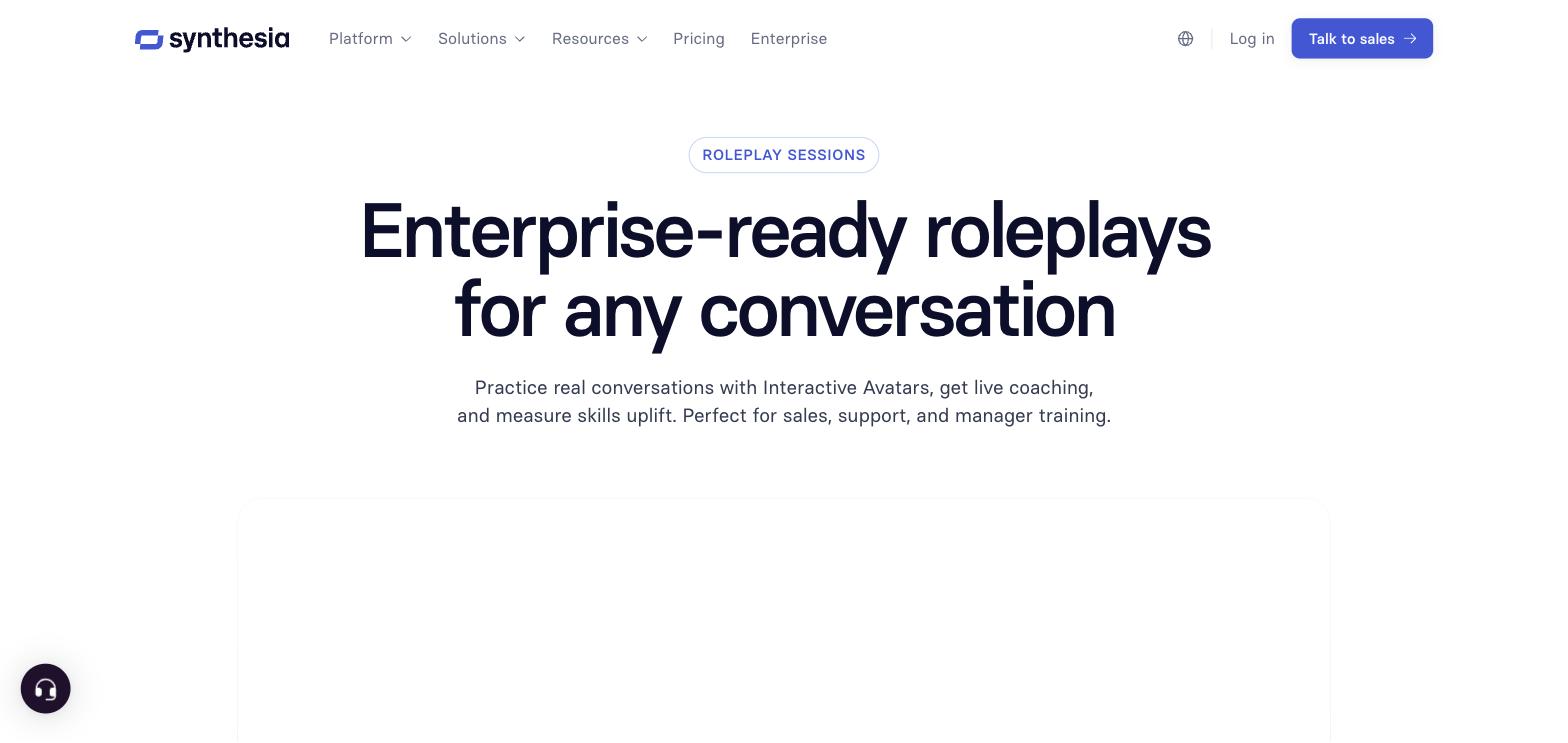
Screenshot: Synthesia Roleplay Sessions feature page, captured directly from the vendor's site, August 2026.
So it's sales-led rather than enterprise-gated. At the ten-user floor it lands near $8,000 a year including the one creator licence, which is well inside mid-market range.
The rubric is customizable, not grounded in your own data. Synthesia's public materials describe scoring against "your sales skills rubric," things like opener quality and objection handling.
That rubric isn't built from a team's actual calls, CRM history, or playbook the way a purpose-built coaching platform does it. Scenarios are hand-authored in Studio.
It's a configurable generic template rather than a system trained on how your team actually sells.
Nothing ties roleplay scores to real call performance. There's no live-call scoring and no shared scorecard across practice and real customer calls, no multi-persona or committee-style roleplay for buying-committee deals, and no simulation of the CRM or workflow logging that happens after a call ends.
Synthesia's loop stops at "create, practice, coach, measure" inside the roleplay session itself.
It's unproven at the thing it's now claiming to do well. Roleplay Sessions is roughly a month old as of this writing.
Every G2 and Capterra review for Synthesia is about the original video-generation product, not the interactive roleplay feature, so there's no independent review base yet on scoring accuracy or how well the avatar actually holds a live back-and-forth conversation.
Even Synthesia's own CEO frames the pivot as a concession, not a victory lap. Victor Riparbelli told TechCrunch, "Video performs way better than text... but for most things, we learn the best by actually practicing," effectively admitting that the one-way video product Synthesia spent eight years building doesn't build skill on its own.
Legacy avatar complaints are a real risk if they carry over. Reviewers of Synthesia's core video product have flagged avatars that "come across as creepy," with imperfect lip-sync and a limited tonal range, plus a content-moderation system reviewers describe as opaque and prone to blocking innocuous videos.
The content-moderation complaint in particular shows up by name in verified reviews. Director of Operations Tom B. put it bluntly: "They turn down videos with no rhyme or reason making it impossible to consistently produce content."
Founder Jide G. described the same pattern from a different angle: "Videos approved one day can be flagged the next, even with minor harmless edits." (Source: verified Synthesia reviews via GetApp.)
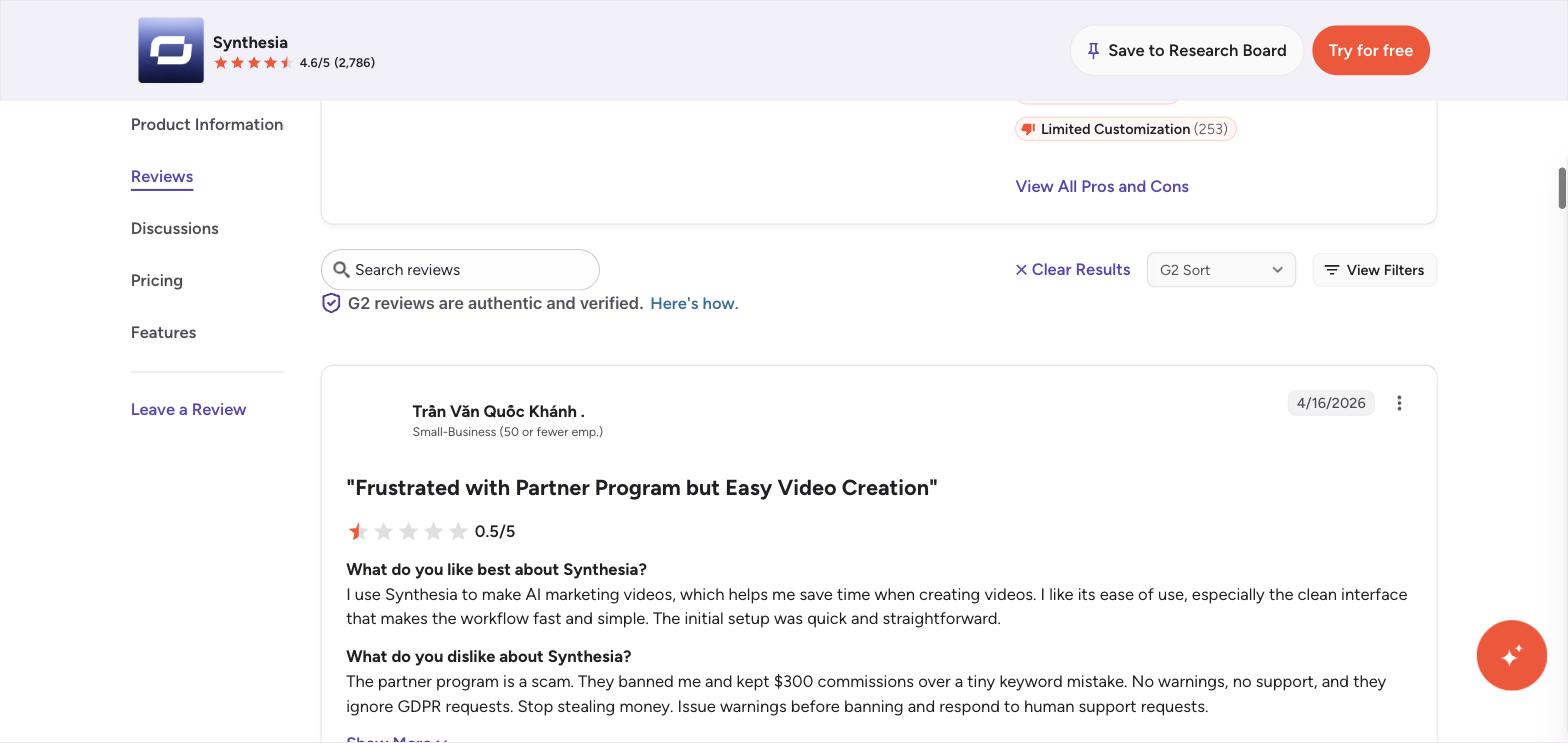
Screenshot: negative Synthesia review on G2, captured August 2026. The platform's headline rating is strong, but individual reviews on the same page go as low as 0.5/5.
None of that has been independently confirmed for the new interactive roleplay avatar specifically, but if it carries over, it undercuts the "feels like a real conversation" pitch that's central to the whole product.
Roleplay language coverage is narrower than the core platform. The video product supports 160+ languages. Roleplay Sessions currently supports four: English, German, Spanish, French. That's a real step down for any global sales org evaluating this specifically for practice, not video content.
It's video roleplay only. There's no chat roleplay, and turning video off leaves a still image with a voice track rather than a genuine voice format. For a phone-heavy team, that's a mismatch with how reps actually sell.
Delivered through your own LMS, the scoring flattens to pass or fail. SCORM export works, but the LMS only ever receives a pass, a fail, or a completion. Skill-level scores, coaching summaries and attempt transcripts stay inside Synthesia, and learners arrive anonymous unless tracking IDs are configured. Cohorts, courses and badges aren't offered either; that requirement gets handed back to your LMS.
How the Alternatives Compare
Synthesia doesn't have a direct one-to-one competitor yet, since it's the only pure video-avatar company that's added live roleplay.
The closest comparisons are Second Nature, which also ships avatar-based practice, and Hyperbound, which ships video roleplay with a similar "practice plus scoring" structure.
We've included Highspot too, since it's the platform Outdoo AI reps hear about most often in real sales conversations, and because it shares an interesting pattern with Synthesia: a mature core product (content management for Highspot, video generation for Synthesia) with roleplay added on top rather than built as the reason the company exists. See our full Highspot review for pricing and feature detail.
| Platform | Best for | Differentiator | Pricing |
|---|---|---|---|
| Outdoo AI | Sales teams that want practice built from their own calls and one scorecard across roleplay and live calls | Unified scoring, workflow/CRM-logging practice after the call, roleplay agents built from real calls, playbooks, and LinkedIn profiles | Usage-based, scales with actual training activity |
| Synthesia | Enterprises already using Synthesia for training video who want to add live practice inside the same platform | Avatar production quality and 50,000+ existing video customers, but roleplay is video-only and its scoring flattens to pass/fail inside your LMS | $300/user/yr under 250 seats, plus $5,000 per content creator; video plans are a separate purchase |
| Second Nature | Large enterprise teams that want avatar roleplay bundled with course authoring and certification tracking | Video avatar that nods and holds eye contact, ISO 27001 certified (parity with Outdoo AI) | Not published; vendor-quoted $50 per credit, and one credit is one user for one month, so ~$30,000/yr for 50 reps in continuous use |
| Hyperbound | Enterprise B2B teams that want roleplay tied directly to live deal data | Kota, an AI agent that ties practice to real pipeline signals via Slack | Free tier available; $70/user/mo at 50 seats ($63 at 150), vendor-quoted |
| Highspot | Large enterprises already invested in Highspot for content and enablement | Deal Agent's real-time CRM signal maturity; roleplay runs through a Yoodli partnership, not a native build | Reported $70K to $180K+/year, enterprise-only |
Outdoo AI: Built for Teams that Want Practice Tied to Real Results
Outdoo AI is an AI sales roleplay and training platform built around a single idea: practice should connect to what actually happens on real calls, not sit next to it as a separate exercise. That shows up in a few concrete ways that matter directly against Synthesia's new roleplay product.
Roleplay agents are built from a team's own calls, transcripts, playbooks, battlecards, and even LinkedIn profiles, not a generic scenario template (roleplays from real calls).
Where Synthesia's rubric is customizable but generic, Outdoo AI's scoring is built from a company's own playbook, so the AI is grading against how your team is actually supposed to sell, not a vendor's built-in idea of a good call (grading against your playbook, not generic AI advice).
The bigger structural difference is closed-loop scoring. One scorecard grades both roleplay practice and live customer calls, so a sales leader can point to a single number and show coaching moved a real revenue metric, not a completion rate (unified scoring across roleplay and real calls).
Nothing in Synthesia's public materials describes anything like this.
Outdoo AI also scores the part every video-first tool skips: the CRM and process logging a rep does right after the call, practiced in the same session as the conversation itself (workflow training and post-call process scoring).
And for teams that specifically want avatar and video-based roleplay, Outdoo AI ships that too, with screen-share scoring built in, not launched as a month-old feature layered onto an unrelated product.
Outdoo AI also supports multi-persona roleplay for committee-based B2B deals, a gatekeeper phase that scores cold-call screening separately, and 74+ languages in voice roleplay against Roleplay Sessions' four.
On pricing, Outdoo AI uses a usage-based model instead of a "Talk to sales" gate, so a team pays for training that's actually driving activity instead of committing to an enterprise quote before it knows the product will stick.
Fit-wise, Outdoo AI is honest that it isn't the deepest option if your primary need is polished, script-driven training video at scale across a 50,000-seat org. That's Synthesia's actual home turf. For how Synthesia fits next to roleplay, authoring and LMS tools, see our list of the top AI tools for L&D teams.
But if the job is live sales roleplay tied to your own playbook and your real pipeline, Outdoo AI is built for that specifically, not as an add-on to something else.
Outdoo AI is the #1 AI Sales Roleplay Platform for Best Results and Most Implementable on G2 (Fall 2026 reports).
For the full feature-by-feature side-by-side on pricing, scoring, and language coverage, see our complete Synthesia review and pricing breakdown.
Second Nature: Strongest Avatar Realism, Weakest on Grounding and Price Transparency
Second Nature added video avatar roleplay in July 2026, and the persona ("Jenny") nods, reacts, and holds eye contact, a genuine step up in single-persona visual realism. See our full Second Nature review for pricing and feature detail.
It's also ISO 27001 certified alongside SOC 2 Type II, matching Outdoo AI's own compliance posture. It launched English-only, with multi-persona video avatars still "coming soon."
The gaps are the same ones reviewers name unprompted: pricing isn't public anywhere (Capterra lists it as "contact vendor"), and multiple reviewers describe the AI persona as feeling "robotic."
Second Nature also stops at the roleplay session itself, with no equivalent to grading live calls on the same scorecard or scoring what happens after the call in the CRM.
Looking beyond Second Nature? See how leading platforms compare for AI roleplay in 2026.
Hyperbound: Video Roleplay Tied to Deal Data, but Pricing and Format Are Narrow
Hyperbound's free tier includes video roleplay calls and full transcription, and its newer Kota agent ties practice to real deal signals through Slack, a genuinely ambitious idea for connecting coaching to pipeline outcomes. See our full Hyperbound review for pricing and feature detail.
Paid pricing beyond the free tier is fully custom-quoted with no published number.
Reviewers also flag a real adoption problem: engagement tends to drop off after the first month unless a manager is actively pushing a leaderboard. Hyperbound does list Gatekeeper Calls and Multi-party Roleplays as call types, and supports 25+ languages, but Outdoo AI goes deeper on each: a dedicated scored gatekeeper phase, a defined multi-stakeholder cap, and 74+ voice languages against Hyperbound's 25+.
Looking beyond Hyperbound? See how leading platforms compare for AI roleplay in 2026.
How to Choose Between Synthesia and Its Alternatives
Is the roleplay the main thing you're buying, or a bonus on top of video? If your team already spends heavily on Synthesia for training video and wants a bolt-on for live practice, staying in-platform has real convenience value even with unpriced access.
If roleplay and coaching are the actual job to be done, evaluate tools built for that from the start.
Do you need pricing certainty before you commit? Synthesia, Second Nature, and Highspot all gate their roleplay or coaching pricing behind a sales call. If your procurement process needs a number up front, that narrows the field fast.
Does the scoring reflect your playbook, or a vendor's generic rubric? Ask every vendor on this list, including Synthesia, whether scoring is built from your own calls and methodology or from a fixed template you can only lightly customize.
Does anything happen after the roleplay ends? Most tools here, Synthesia included, stop scoring once the conversation is over. If workflow and CRM logging are part of the job you're training reps on, that's a real differentiator, not a nice-to-have.
Frequently Asked Questions
.svg)
It has a real, live product for it now (Roleplay Sessions), launched July 2026. It's new, priced only through a custom quote, and has no independent review base yet specifically for the interactive roleplay feature.
No. The core video plans are public on the Synthesia pricing page, but every Roleplay Sessions page ends in "Talk to sales" with no minute allotment or seat price listed. Outdoo AI starts free with 60 minutes of roleplay credits and unlimited team members, no credit card and no sales call, then scales on usage-based Flex pricing with a custom enterprise plan for larger deployments.
Synthesia is a video-avatar platform that added live roleplay in 2026. Outdoo AI is built specifically for sales roleplay and coaching, with scoring grounded in a team's own calls and playbook, one scorecard across practice and live calls, and workflow simulation for what happens after the call.
Yes. It includes screen-share scoring as a built-in feature.
For training video at scale, yes, it has a mature, widely used product with 240+ avatars and 160+ languages. That's a separate purchase decision from whether its new roleplay feature is the right coaching tool for a sales team.
Table of Contents
Talk to Sales
Have questions about training and enablement for your sales, CS, support, or leadership team? Let's talk.
Talk to Sales