



Teams running Gong have some of the richest sales conversation data in the industry: every call recorded, transcribed, and analyzed. The harder question is what happens with all of that data after it gets reviewed. Managers watch calls, leave comments, and coach reps on what they could have done differently. But the rep never gets a chance to actually practice doing it differently before the next live call.
That is the gap between conversation intelligence and conversation improvement. Gong tells you exactly what happened on a call. AI roleplay lets reps practice what should happen next time. When the two are connected, every Gong recording becomes a potential practice scenario, built from the real buyer behavior your team actually faces.
This post covers how the Outdoo AI and Gong integration works, what the workflow looks like from recorded call to practice-ready roleplay agent, and how to operationalize it so your Gong library stops being a passive archive and starts being an active training system.
What Gong already gives your sales team
This is not a Gong teardown. Teams running Gong have a genuine advantage, and it is worth being clear about the baseline before talking about what gets added.
- Full call recording and transcription across every customer conversation.
- Deal intelligence that surfaces risk signals, competitor mentions, and buying committee activity.
- Talk ratio, question frequency, and conversation analytics that help managers identify coaching opportunities.
- Searchable call libraries that make it easy to find specific moments, objections, and patterns across hundreds of calls.
- Integrations with Salesforce, HubSpot, and other CRM systems that connect call data to deal outcomes.
For most teams, this is genuinely valuable. The argument here is narrower: Gong captures and analyzes what happened. It does not give reps a way to practice what should happen next time. That practice layer is what turns Gong insights from coaching notes into repeatable skill development.
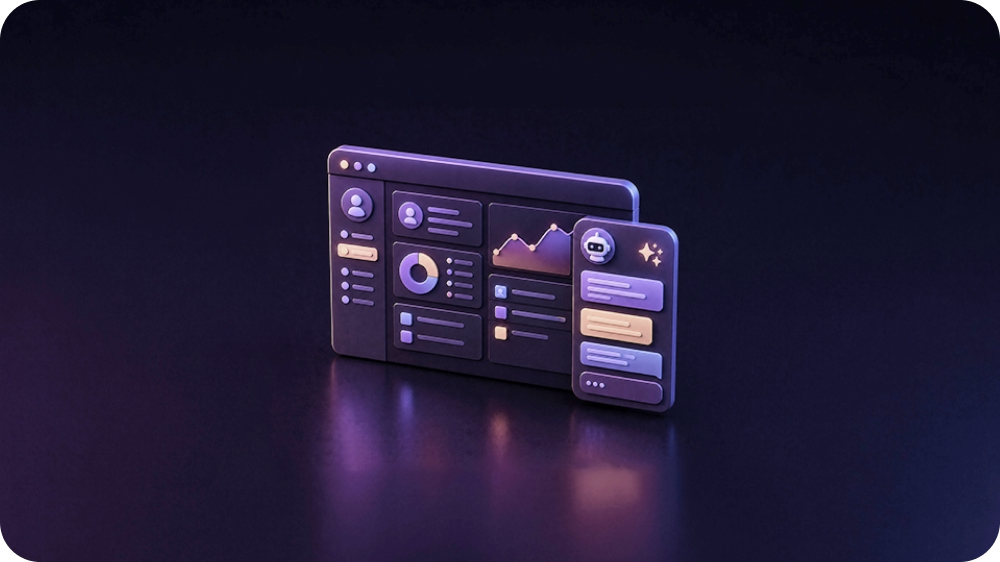
The gap between analyzing calls and practicing for the next one
How the Outdoo AI and Gong integration works
The Outdoo and Gong integration connects in one primary direction: Gong recordings flow into Outdoo, where they become the raw material for AI roleplay agent creation. The integration pulls call recordings, transcripts, and metadata from Gong into Outdoo, so enablement teams can build practice scenarios grounded in real buyer conversations without manually reviewing and scripting every scenario.
What flows from Gong into Outdoo
- Call recordings and transcripts: Outdoo ingests Gong recordings and their full transcripts. These become the source material for identifying buyer behavior patterns, objection types, and conversation dynamics that get built into AI roleplay agents.
- Call metadata: Deal stage, participants, call type, and outcome data help categorize calls and identify which recordings are most valuable for scenario creation (lost deals, competitive conversations, multi-stakeholder calls).
- Identified patterns: Outdoo's conversation intelligence layer processes the ingested calls to surface recurring objection patterns, common buyer responses, and stakeholder dynamics that appear across multiple calls, not just one recording.
What Outdoo does with the data
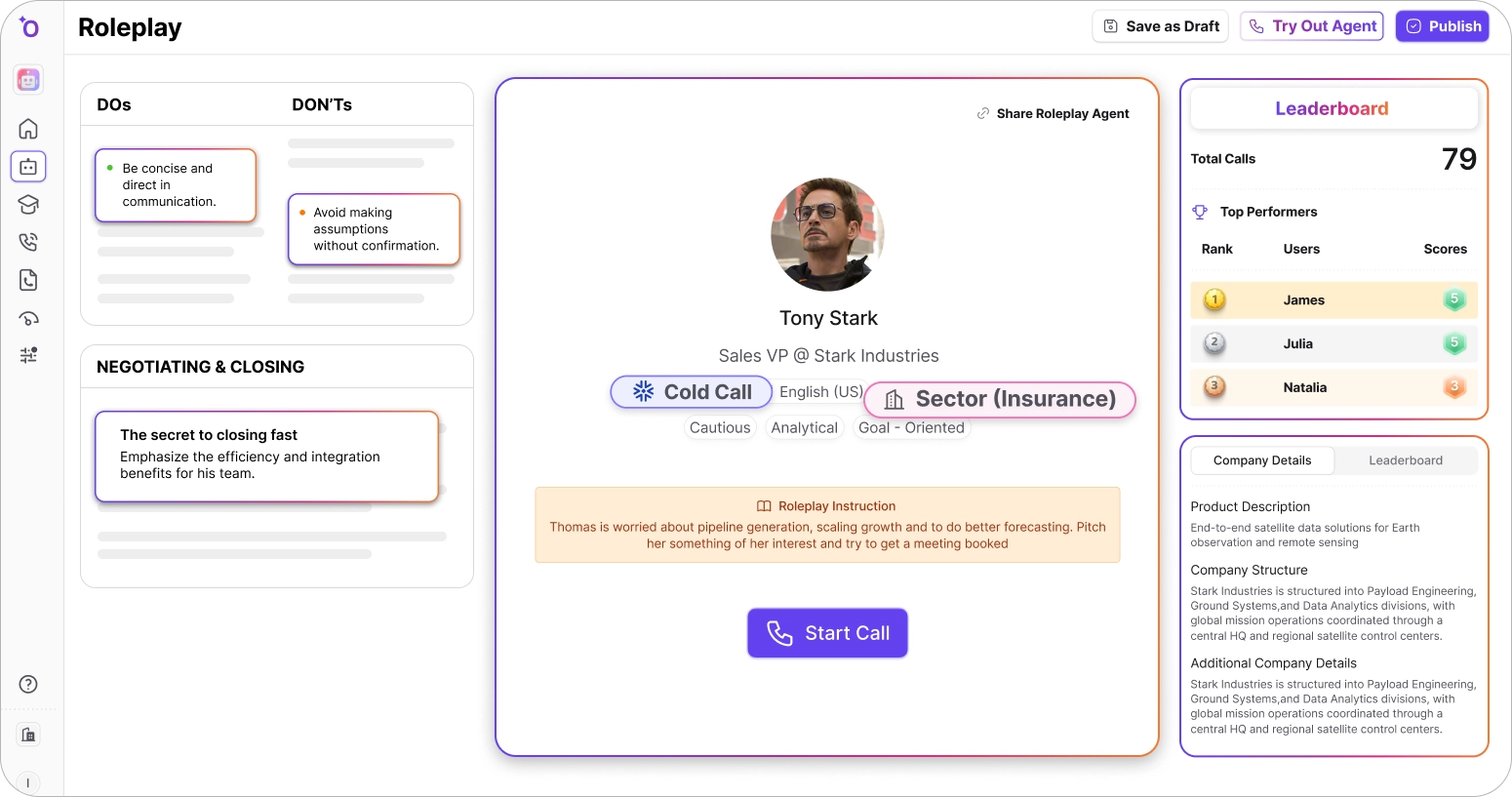
The primary value is roleplay agent creation. Outdoo uses the ingested call data to build AI personas that replicate real buyer behavior: the way a CFO deflects pricing questions in your specific market, the exact objection pattern that appears in competitive deals you keep losing, the stakeholder dynamic where the champion goes quiet when leadership joins. These are not hypothetical personas designed by enablement. They are personas extracted from the conversations your team actually had.
Here is how easy it is to create roleplay agents from real call patterns in Outdoo AI:
What stays in Gong
Gong keeps doing what Gong does well: call analytics, deal intelligence, talk ratio tracking, and manager review workflows. The integration does not replace any of Gong's native functionality. It adds a practice layer on top of the data Gong already captures, so the insights your managers surface during call review become the foundation for structured practice rather than just coaching notes.
The workflow: from Gong recording to practice-ready roleplay agent
Once the integration is connected, here is how an enablement leader or sales manager turns a specific Gong recording into a practice scenario their team can run.
1. Identify the right call in Gong
Not every Gong recording is worth turning into a roleplay. The highest-value calls are: lost deals where you can point to the specific moment the deal shifted, competitive wins where the differentiation was replicable, calls with unusual or industry-specific objections your team keeps encountering, and top performer calls with patterns worth spreading across the team. Use Gong's search and filtering to find calls that match these criteria.
2. Pull the recording into Outdoo
With the integration active, select the Gong recording and pull it into Outdoo. The transcript and call metadata come with it. No manual transcription, no copying and pasting, no re-recording.
3. Extract the buyer behavior pattern
Outdoo's conversation intelligence processes the transcript and identifies the key behavior patterns: what the buyer said at the turning point, what triggered it, how they responded to the rep's reaction, and the communication style (direct, evasive, technical, executive). These patterns become the behavioral blueprint for the AI persona.
4. Configure the AI roleplay agent
Build the roleplay agent using the extracted pattern. The persona replicates the buyer's role, industry context, communication style, and the specific objection or dynamic you want reps to practice against. You can adjust difficulty (make the buyer more or less resistant), add or remove elements, and configure whether the scenario focuses on a single turning point or a full conversation arc.
5. Set scoring criteria and roll out
Define what success looks like for this scenario. If the source call was a lost deal because the rep did not quantify pain, the scoring criteria should evaluate pain quantification depth. Align criteria to your methodology framework where applicable. Validate with a top performer, then publish to the team.
Four ways teams use Gong recordings to create roleplay practice
Building a "lost deal" practice library
Pull the last quarter's lost deals from Gong. Identify the three to five most common reasons deals were lost (unhandled pricing objection, missed stakeholder, weak discovery, competitive displacement). Build one roleplay agent for each pattern. This library gives every rep a chance to practice against the exact situations that are costing your team revenue, before they encounter them again on a live call.
Creating competitive scenario packs from wins
When a rep wins a deal against a specific competitor, the Gong recording captures exactly how they positioned. Pull those calls into Outdoo, extract the positioning pattern, and build roleplay agents where other reps practice against prospects evaluating that same competitor. The AI persona references the competitor's specific strengths and asks the questions a real evaluator would. This turns one rep's competitive win into a practiced skill across the team.
Deal-specific preparation before important calls
Before a high-stakes call, pull previous Gong recordings from the same account or similar accounts in the same industry. Build a quick roleplay agent that replicates the buyer's likely behavior: their communication style, their priorities, and the objections they have raised in past conversations. The rep walks into the call having already practiced against a persona modeled on the actual person they are about to talk to.
Skill gap reinforcement from manager call reviews
When a manager reviews a Gong call and identifies a specific skill gap (the rep did not follow up on a hedge during discovery, or lost control of a demo when interrupted), they can pull that exact call into Outdoo and create a targeted roleplay that isolates the moment where the rep struggled. Instead of just telling the rep "do this better next time," the manager gives them a practice environment built from the actual call where the gap appeared.
What to measure once the loop is running
Connecting Gong and Outdoo creates a data loop where call behavior and practice behavior can be compared. Here are the metrics worth tracking.
How to get started
You do not need to overhaul your Gong workflow or build a massive scenario library to test this. Start with one call and let the results make the case.
- Pick one lost deal from the last 30 days. Choose the one where the team agrees the loss was preventable and the call recording captures the moment clearly.
- Pull the recording into Outdoo through the Gong integration. Extract the buyer behavior pattern and build one roleplay agent from it.
- Have five reps run the scenario three times each. Review scores and debrief: what did reps learn from practicing against this buyer that they would not have learned from just watching the Gong recording?
- Expand based on what the data shows. Add more scenarios from competitive wins, unusual objections, and multi-stakeholder calls. Build the library gradually, sourced entirely from your own Gong data.
Turning Gong insights into practiced skills
Gong gives you a detailed picture of what happens on every call. The question is what you do with that picture. For most teams, the answer is coaching notes and manager feedback, which creates awareness but not behavior change.
Outdoo AI adds the practice layer that turns Gong insights into repeated, scored, practiced skills. The Gong integration pulls recordings directly into Outdoo, where they become AI roleplay agents built from real buyer behavior. Reps practice against the exact objections, stakeholder dynamics, and competitive positioning that appear in your actual pipeline. The scenarios are not hypothetical. They are extracted from the calls your team already recorded.
Outdoo supports AI roleplays across chat, voice, and video with screen sharing, multi-persona simulations with up to three stakeholders, and methodology-aligned scorecards for SPIN, BANT, MEDDIC, MEDDPICC, and Challenger. The same platform also ingests recordings from Clari and native sources for teams using multiple conversation intelligence tools.
If your team is sitting on a Gong library full of coaching insights that never get practiced, book a demo to see how Outdoo turns those recordings into roleplay scenarios your reps will actually use.
Frequently Asked Questions
.svg)
Yes. The Outdoo and Gong integration pulls call recordings, transcripts, and metadata directly from Gong into Outdoo. Enablement teams can select specific recordings and use them to create AI roleplay agents without manual transcription or scenario scripting.
The workflow is: select a Gong recording, pull it into Outdoo through the integration, extract the buyer behavior pattern (objection type, communication style, stakeholder dynamic), configure an AI roleplay agent based on that pattern, set scoring criteria, validate with a top performer, and publish to the team. The entire process can be done in hours.
No. Gong continues to handle call recording, transcription, deal intelligence, and manager review workflows. Outdoo adds a practice layer on top of the data Gong captures, so coaching insights from call reviews become practice scenarios reps can run repeatedly. The two platforms are complementary, not competitive.
The highest-value calls are lost deals with identifiable turning points, competitive wins with replicable positioning patterns, calls with unusual or industry-specific objections, and top performer calls with patterns worth spreading across the team. Not every recording needs a roleplay. Focus on calls with clear teachable moments.
Yes. Outdoo also ingests recordings from Clari and supports native conversation intelligence. The same roleplay creation workflow applies regardless of the CI source. Teams using multiple tools can consolidate practice scenario creation in Outdoo.
Table of Contents
Talk to Sales
Have questions about training and enablement for your sales, CS, support, or leadership team? Let's talk.
Talk to Sales