



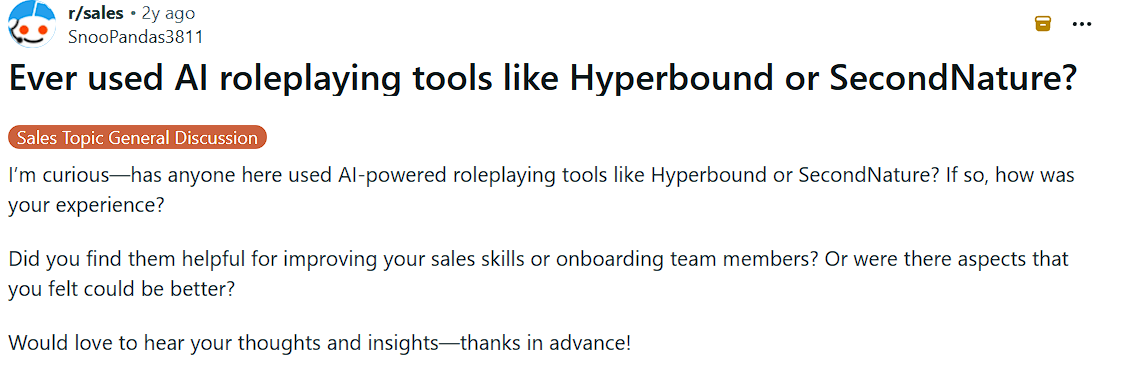
When AI roleplay tools like Hyperbound or Second Nature come up in a community like r/sales, you do not get a direct answer. You get a debate. One rep says AI roleplay fixed his cold call openers. Another tried a demo of the same tool, watched the bot struggle with an unexpected question, and decided the whole thing is not worth it. Both are describing real experiences, often with the same tools.
A discussion like that needs a deeper look. So we went through the Reddit threads and the G2 reviews for Hyperbound, Second Nature, and Outdoo AI, and organized what users actually say. It comes down to five questions that keep coming up:
- Does the AI actually feel like a real buyer?
- How much work is setup before reps can practice?
- What does it actually cost?
- Does the scoring mean anything?
- Does any of it show up on real calls?
This article goes through each one, with the quotes and reviews, and gives a clear verdict at the end.
1. What Is AI Sales Roleplay Software?
AI sales roleplay software is a training tool that lets reps practice sales conversations against AI buyers that push back like real prospects, then scores each session against a rubric.
The strongest platforms add two things: closed-loop coaching, where the same scorecard grades live calls, and multi-stakeholder scenarios that mimic a real buying committee.
2. Which Is Best: Hyperbound, Second Nature, or Outdoo AI?
- Hyperbound: Best for SDR cold-call practice. Reps praise its voice realism, and its sales team quoted $70 per user per month at 50 seats in August 2026.
- Second Nature: Best for avatar-based onboarding courses, with a fast course editor. It prices in credits, where one credit is one user for one month.
- Outdoo AI: Best for closed-loop coaching. One scorecard grades both roleplays and live calls with personalized recommendations, and Outdoo AI is the #1 AI Sales Roleplay Platform for Best Results and Most Implementable on G2 (Fall 2026 reports).
1. Which platform offers the most realistic AI sales roleplay: Hyperbound, Second Nature, or Outdoo AI?
Realism is often the first thing teams consider when evaluating AI roleplay tools. If the conversation feels predictable or unnatural, reps are less likely to take the exercise seriously. It is also the main reason reps resist practice, as we cover in why sales reps hate roleplay and how AI can fix it.
This is a common limitation of general-purpose tools such as ChatGPT. As one sales rep put it, "It just agrees and tells me why I’m right." That may be useful for brainstorming, but it does not reflect how real sales conversations unfold.
Prospects interrupt, change direction, question claims, and raise objections that reps may not expect. When an AI roleplay agent agrees too easily or fails to challenge the rep, the exercise does little to prepare them for those situations.
Dedicated AI roleplay platforms are designed to create more realistic interactions, but their ability to handle unexpected responses and conversations that move off script varies significantly. Here is how Hyperbound, Second Nature, and Outdoo AI compare.
How realistic does Hyperbound feel to reps?
Hyperbound gets strong praise for realism. Its G2 reviews (4.9 across 40 reviews) repeatedly mention bots that sound like real buyers, with real pain points and objections. One reviewer even noted that the AI can become aggressive during objection handling, which they felt reflected how some real prospects behave.
However, the experience may feel less natural in complex B2B sales conversations, where buyers often change direction, introduce unexpected concerns, or respond unpredictably. In one Reddit discussion, a sales rep described the demo as "a bit unrealistic for B2B sales role-playing," while another team said the conversations felt “a bit robotic” and continued evaluating other tools.
The takeaway is that Hyperbound appears well suited for practising common objections and structured sales scenarios, but teams selling complex solutions may want to test how well it handles longer, less predictable conversations before making a decision.
Comment
byu/SnooPandas3811 from discussion
insales
How realistic does Second Nature feel?
Feedback on Second Nature's realism is mixed. Some users find it noticeably more lifelike than general-purpose tools such as ChatGPT, particularly because teams can adjust the AI’s voice, personality, and difficulty level to create more varied practice scenarios.
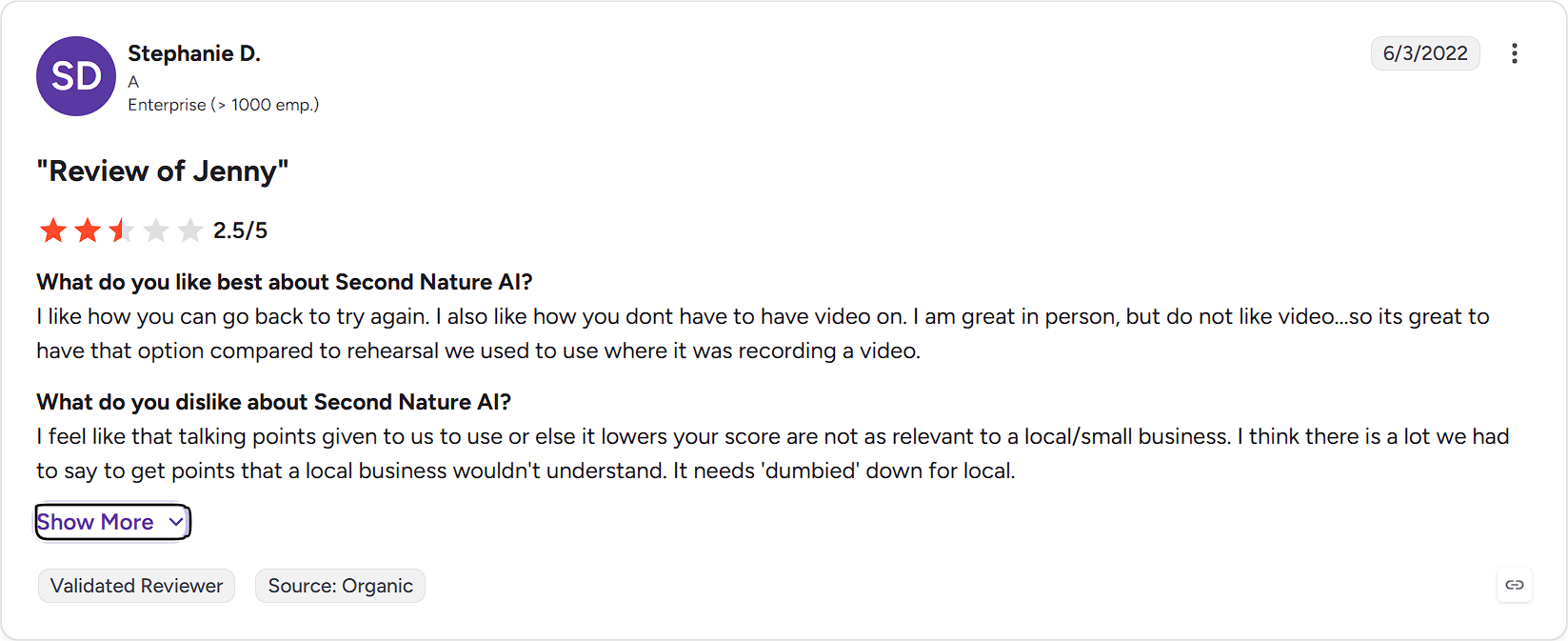
However, other users say the experience can feel overly scripted. One 2.5-star G2 review noted that the AI expected answers to be phrased in a very specific way rather than accepting how the rep would naturally respond. Another review described it as "The NOT human experience."
Second Nature also added video avatars in July 2026, animated personas that nod and hold eye contact during practice, a real step up for single-persona realism. It currently ships English-only and single-persona-only, with multi-persona video listed as "coming soon." Outdoo AI's video roleplays already run multi-persona scenes with screen-share scoring today.
The limitation appears when reps move away from the expected conversation path. Second Nature may work well for structured scripts and repeatable practice, but teams should test how naturally it handles unexpected questions, alternative phrasing, and the less predictable direction of real buyer conversations.
How does Outdoo AI make roleplay feel real?
The pattern behind both complaints is the same: realism breaks when the persona is generic. Outdoo AI avoids the problem by not starting from a generic persona at all. Roleplay agents are built from your own calls, transcripts, playbooks, or even a prospect's LinkedIn profile. So the AI pushes back with your customers' actual language and objections. And the practice is not limited to voice: video roleplays with lifelike avatars, including screen sharing, cover the face-to-face and demo conversations avatar-led tools are known for.
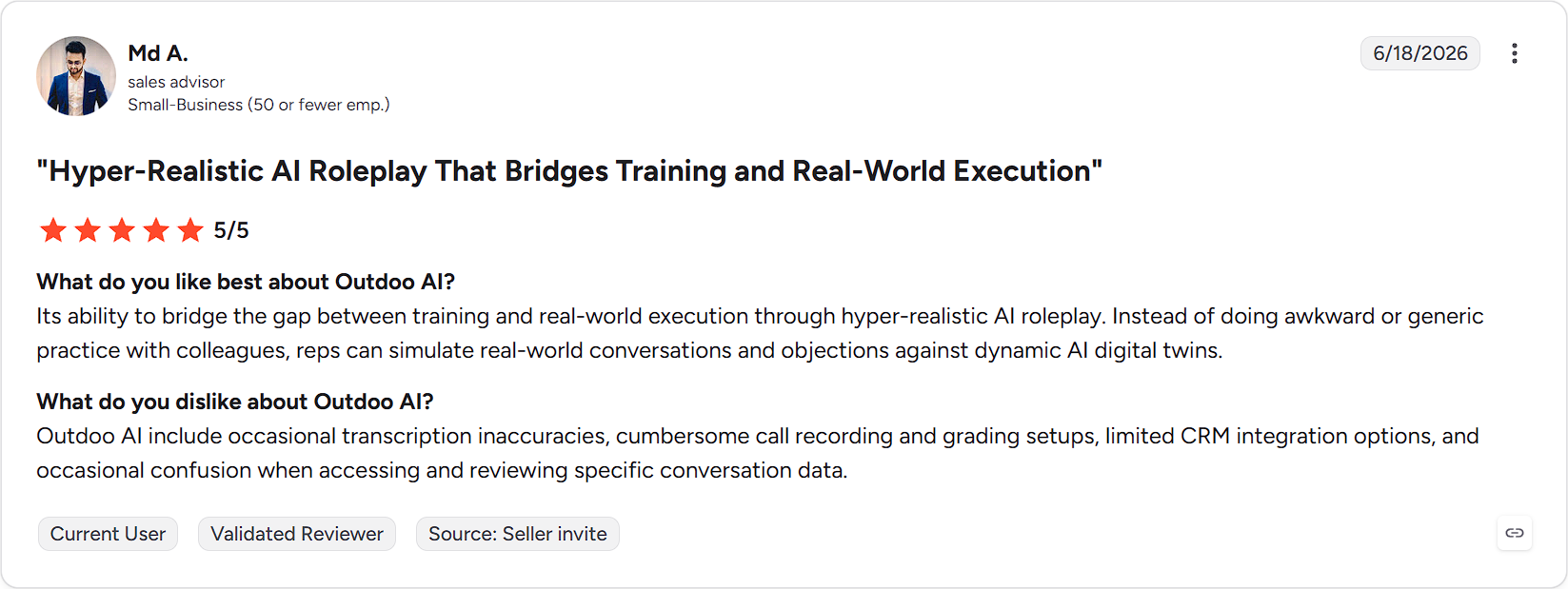
A sales advisor on G2 describes practicing "real-world conversations and objections against dynamic AI digital twins" instead of awkward generic drills. A GTM leader at Cloudflare said the same about complex conversations: "Practicing against an AI that pushes back like a real engineer changes how you walk into the actual conversation."
The verdict:
Hyperbound has earned a strong reputation for structured outbound-call practice, while Second Nature works well when reps stay close to a defined script. However, both can feel less realistic when complex B2B conversations move beyond the expected path.
Outdoo AI overcomes the limitations seen in Hyperbound and Second Nature by building buyer personas and roleplay scenarios from your company's real calls, prospects, objections, products, and sales situations. Instead of practising against generic or rigid personas, reps interact with simulations grounded in how their actual buyers communicate and respond.
Teams can also run back-to-back cold-call blitzes against multiple personas, helping reps practise different buyer types, unexpected objections, and conversations that change direction. This makes Outdoo AI better suited to complex B2B sales, where conversations rarely follow a fixed script and reps need to think, adapt, and respond naturally in the moment.
2. How much setup is required before sales reps can start using an AI roleplay platform?
This question gets less attention, but it decides whether a tool gets used at all.
How much setup does Hyperbound take?
In the threads, an AE who moved from inbound to outbound says Hyperbound gave him “more structure in how to approach cold calls.” In the same comment, he mentions their tools team needed outside developers to build the right AI personas. Hyperbound’s own documentation is upfront about this: your first bot takes minutes, but the full setup of personas, modules, and real-call scoring averages around two weeks.

How fast is scenario building in Second Nature?
Second Nature does well here, and reps say so. Its course editor gets specific praise for cutting scenario building from hours or days down to minutes, as long as your L&D team owns the content upkeep. The friction appears more clearly for multilingual teams. One G2 reviewer noted that some non-English scenarios did not perform as well as the English versions and required an additional review before rollout. This suggests that global teams may need to test and refine each language separately rather than assuming the same experience across all markets.


How does Outdoo AI remove the setup work?
Outdoo AI avoids turning roleplay creation into a separate enablement project. Teams can generate an AI roleplay agent in one click from a real call, transcript, document, LinkedIn profile, or simple prompt. This makes it easier to turn existing sales material and customer conversations into relevant practice scenarios without building every persona manually.
Teams can also update persona behaviour, objections, and scenario details through prompt-level controls. Changes can be applied across multiple roleplays, reducing the manual work required to maintain and refresh training content as products, messaging, or buyer expectations evolve.
The verdict:
Hyperbound and Second Nature have both made basic scenario creation more accessible, but teams may still need time to configure personas, scripts, and language variations before rollout. Outdoo AI shortens this process by turning real calls, transcripts, documents, LinkedIn profiles, or a simple prompt into usable roleplays in just a few clicks. This makes it faster to launch, update, and scale training without creating a separate enablement project.
3. How much do AI sales roleplay platforms typically cost?
Pricing is often the most frustrating part of evaluating AI roleplay platforms because clear, comparable costs are rarely published. Buyers are usually forced to piece together information from sales conversations, review sites, and community threads before they can estimate what each platform will actually cost.
What does Hyperbound cost?
Hyperbound does not publish seat pricing. Pricing quoted by Hyperbound's sales team in August 2026 was $70 per user per month at 50 seats and $63 at 150.
That works out to about $42,000 a year for a 50-rep team and roughly $113,400 at 150. This is list pricing rather than published pricing, so your own quote may differ.
In the Reddit thread, the only answer to what it costs came from another user's memory: “I think it’s around $15k USD for the license.” That a buyer has to learn pricing from a stranger’s recollection is the complaint in itself.
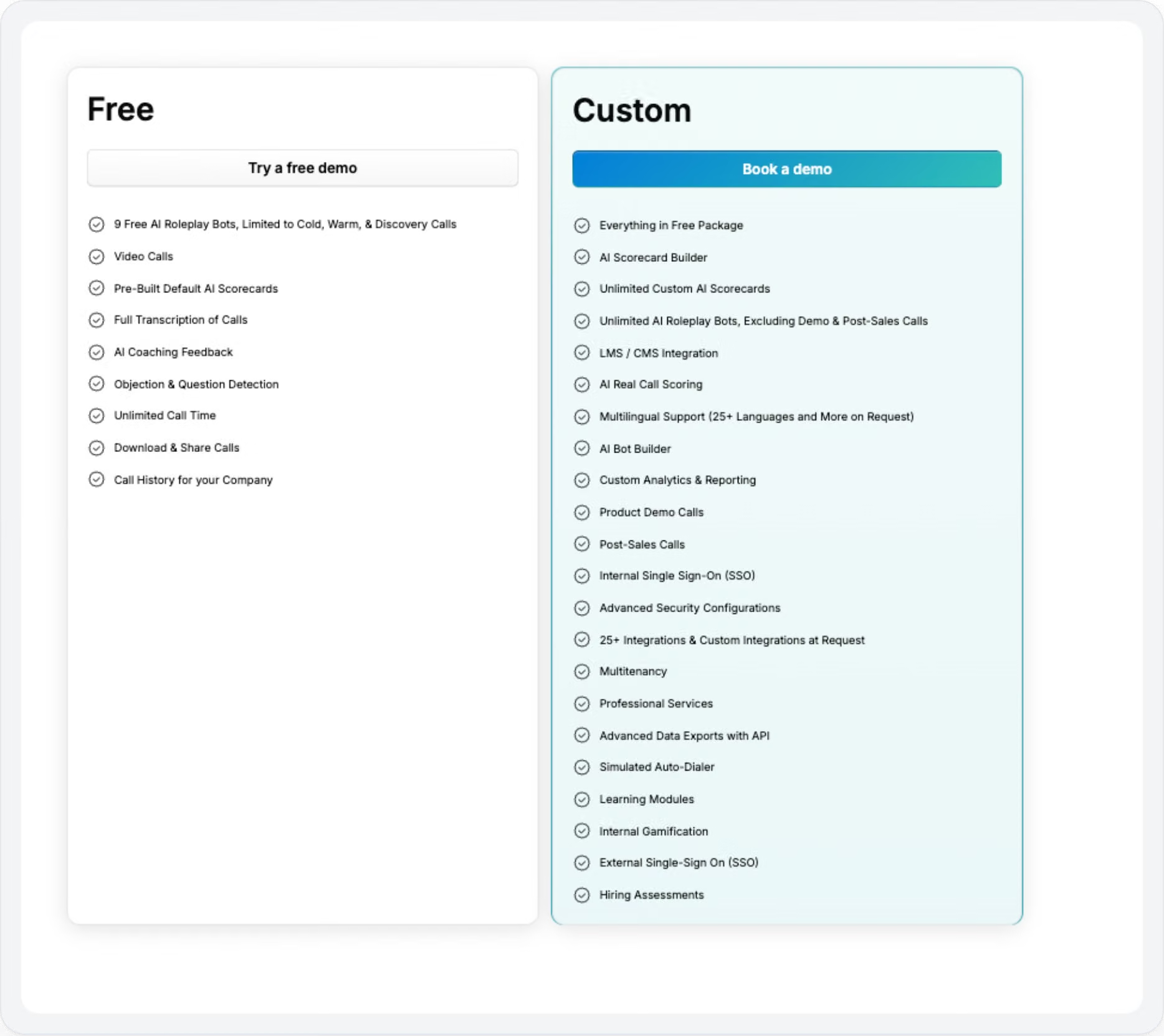
On the plus side, there is a genuinely useful free tier of pre-built bots.
What does Second Nature cost?
Second Nature does not publish pricing either, and it prices in credits rather than seats: one credit is one user for one month.
Pricing quoted by Second Nature's sales team in August 2026 was $12,000 for 240 credits. That reads like $240 a seat for 50 people, but it is 50 people for 4.8 months. Continuous access for 50 reps needs about 600 credits, roughly $30,000 a year. This is list pricing rather than published pricing, so your own quote may differ.
The credit model suits a fixed onboarding cohort. It works against you when practice is meant to be continuous, because the meter runs on the calendar, not on whether a rep logged in.
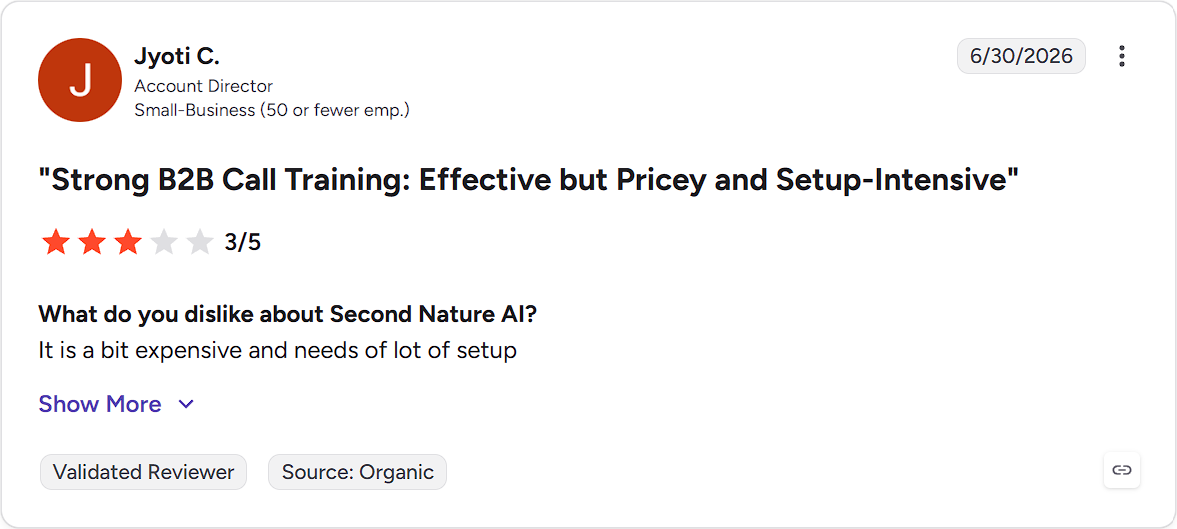
Its own reviewers say the trade plainly: one G2 review is titled, in full, “Strong B2B Call Training: Effective but Pricey and Setup-Intensive.” The sharpest verdict in the thread came from someone at a 600-person company that switched away entirely: “Second nature pricing is ridiculous.”

What does Outdoo AI cost?
Outdoo AI publishes its pricing structure. A Free plan with limited credits and unlimited team members. A usage-based tier as you scale. Custom-quoted Enterprise plans for full integration and compliance scope. A team can start practicing today without booking a sales call, which is exactly what those threads keep asking for.
The verdict:
Hyperbound and Second Nature rely on custom pricing, so buyers often have to contact sales or depend on third-party discussions to understand the likely cost. Outdoo AI provides a published usage-based structure that teams can review and start with immediately. The cost at scale will still depend on usage, but buyers can estimate it upfront rather than entering the sales process without a clear pricing baseline.
4. How accurate and useful is AI roleplay scoring for sales coaching?
Scoring is often where opinions differ most. Some teams want strict, standardized evaluation against a defined script or playbook. Others need scoring that recognizes a strong response even when the rep uses different wording or takes an unexpected conversational path.
How does Second Nature score practice sessions?
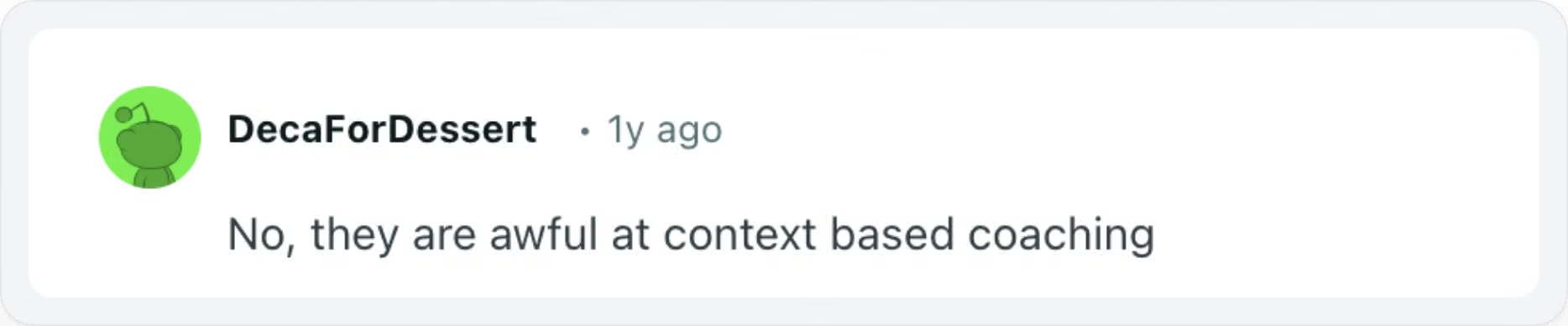
Second Nature’s scoring can be useful for structured coaching and certification. One user said it made them feel like they were genuinely improving because the feedback gave them a clear way to track progress.
However, some G2 reviewers report that the scoring can feel too rigid when reps do not use the expected phrases or keywords. This may help teams enforce a consistent script, but it can also penalize experienced reps who communicate effectively in their own words.
How does Hyperbound handle scoring and analytics?
Hyperbound receives positive feedback for configurable scorecards that can be aligned with a company’s sales methodology and playbook. This gives managers more control over what each roleplay evaluates.
The main limitation of Hyperbound appears at the reporting level. One sales leader managing more than 100 SDRs said the platform did not yet provide the global dashboards their organization needed, while another reviewer wanted a more polished reporting experience.
Since December 2025, Hyperbound has layered Kota on top of scoring, an AI agent that answers deal and coaching questions via Slack or Cmd+K and already draws praise over Gong's built-in assistant. It doesn't fix the dashboard-flexibility gap above, but it shows Hyperbound is still building out the coaching layer.
These may seem like minor gaps for smaller teams, but they become more important in enterprise coaching programs, where managers need to compare performance across teams, regions, and large numbers of reps.
How does Outdoo AI scoring go further?
Look again at what that rep actually said: it feels like improving. That is the ceiling of a practice-only score, and Outdoo AI’s scoring is built to go past it.
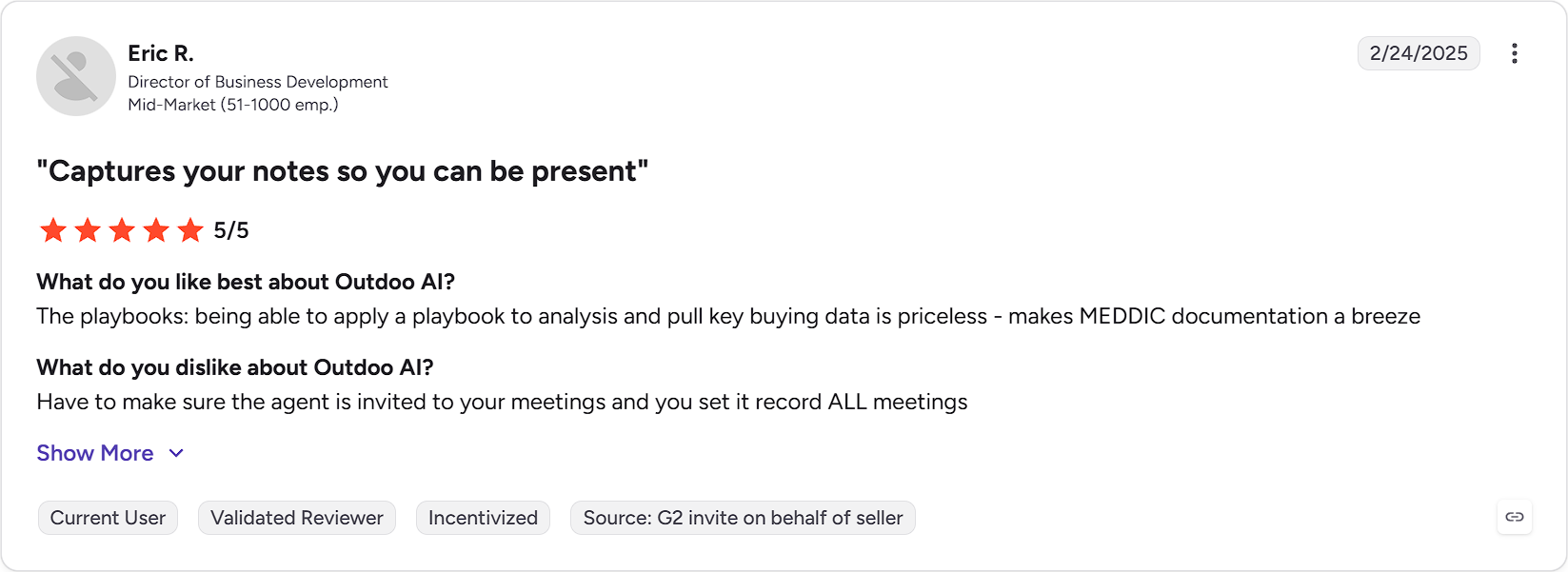
The same AI scorecard, aligned to MEDDIC, SPIN, BANT, Challenger, or your own methodology, evaluates both roleplays and live customer calls. So a practice score and a real-call score are directly comparable. An account executive on G2 describes exactly this: he tracks his scores daily, weekly, and monthly, and watches his objection handling improve on real work, not just in rehearsal. Feeling like you are improving becomes seeing that you are.
The verdict:
Roleplay scores are most valuable when they can be compared with performance on real customer calls. Hyperbound and Second Nature help teams evaluate practice sessions, while Outdoo AI applies the same scorecards across simulations and live conversations. This helps managers see whether the skills demonstrated in training actually carry over into real sales calls.
5. Does AI roleplay training improve performance on real sales calls?
This is the question that settles the others, and the one the skeptics in every thread are really asking. A realistic bot, fast setup, fair pricing, and a clean score still add up to nothing if behavior on live calls does not change.
To be fair, the reviews show these tools moving real numbers. Second Nature reviewers describe measurable gains for reps who started behind, and low-performer improvement visible within a month. Hyperbound reviewers credit faster ramps and more confident cold callers.
Second Nature's practice ends at the session; there is no equivalent to real-call scoring.
Hyperbound is further along. Its Perform product scores real and recorded calls through Zoom, Gong, Meet, and Teams, and Kota ties that real-call data back to roleplay performance and deal signals. Kota's Bite-Sized Roleplays even auto-generate targeted practice from the gaps a real call surfaces. That is a real, shipped connection.
What Hyperbound's loop still runs in reverse: it scores the live call first, then generates practice from what it finds, so certifying a rep before their first live call is not part of the sequence. CRM and disposition work stays automated rather than rehearsed, too.
Outdoo AI certifies reps on one rubric before they take a live call, re-scores the same rubric afterward, and uses workflow simulation to have reps rehearse the CRM and disposition steps Hyperbound automates around them.
How Outdoo AI connects practice to real calls
Outdoo AI is built as a closed loop for exactly this handoff:
- Practice scores and live call scores sit on one rubric, so transfer is visible.
- Post-call analysis checks whether the practiced skill actually showed up in the real conversation.
- Gaps trigger targeted micro-roleplays instead of another generic module.
- Workflow simulation covers the after-call work: logging, disposition, and data entry, practiced in environments that mirror the team’s real systems.
- Interactive AI Trainers turn playbooks and SOPs into interactive training that tests whether someone can use the material, not whether they clicked through it.
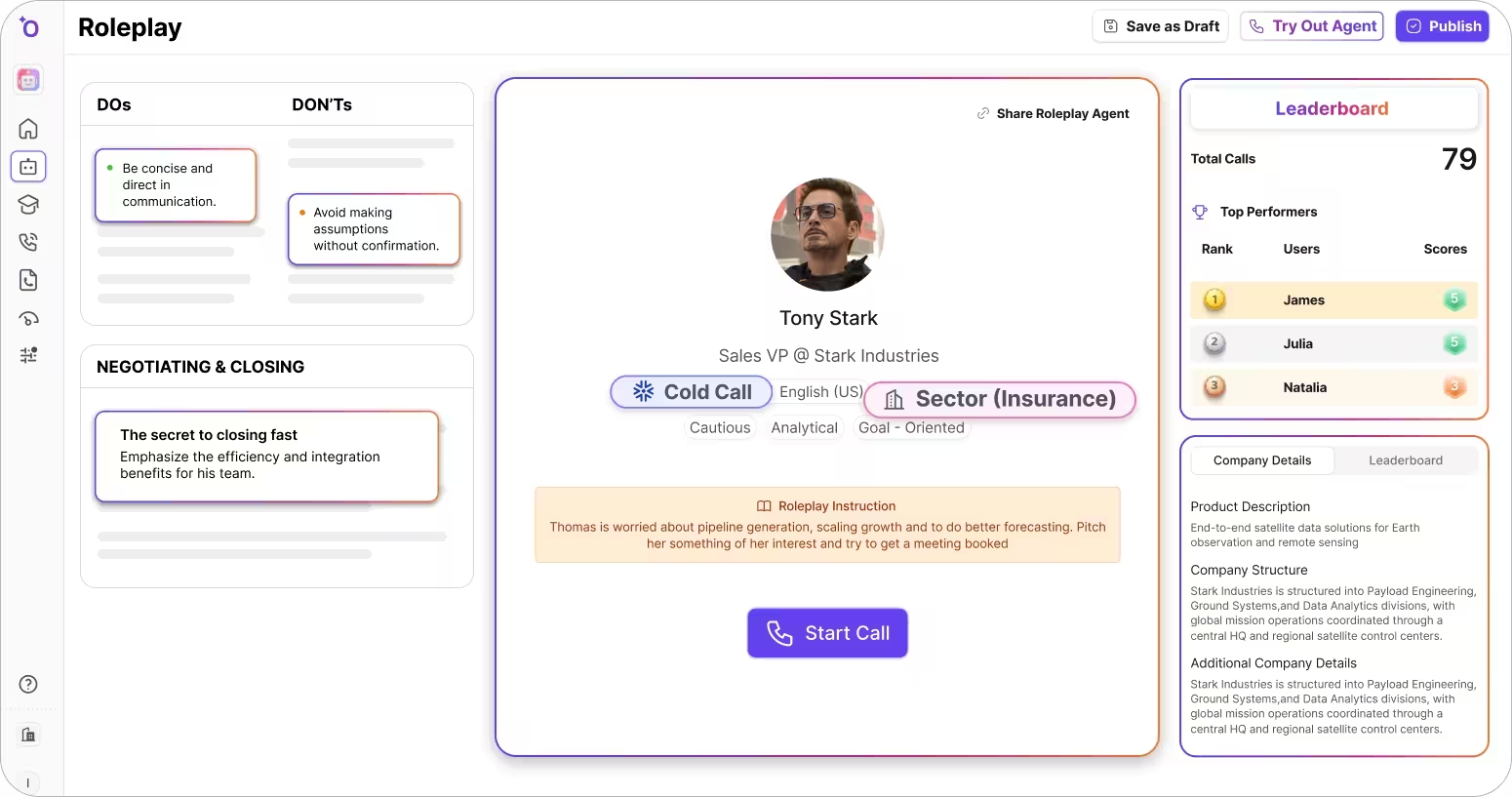
For teams weighing Second Nature AI alternatives, that is the main difference: Outdoo AI adds closed-loop coaching, where one AI scorecard grades both roleplays and live calls, plus multi-persona roleplays for buying committees and workflow simulation for the after-call steps.
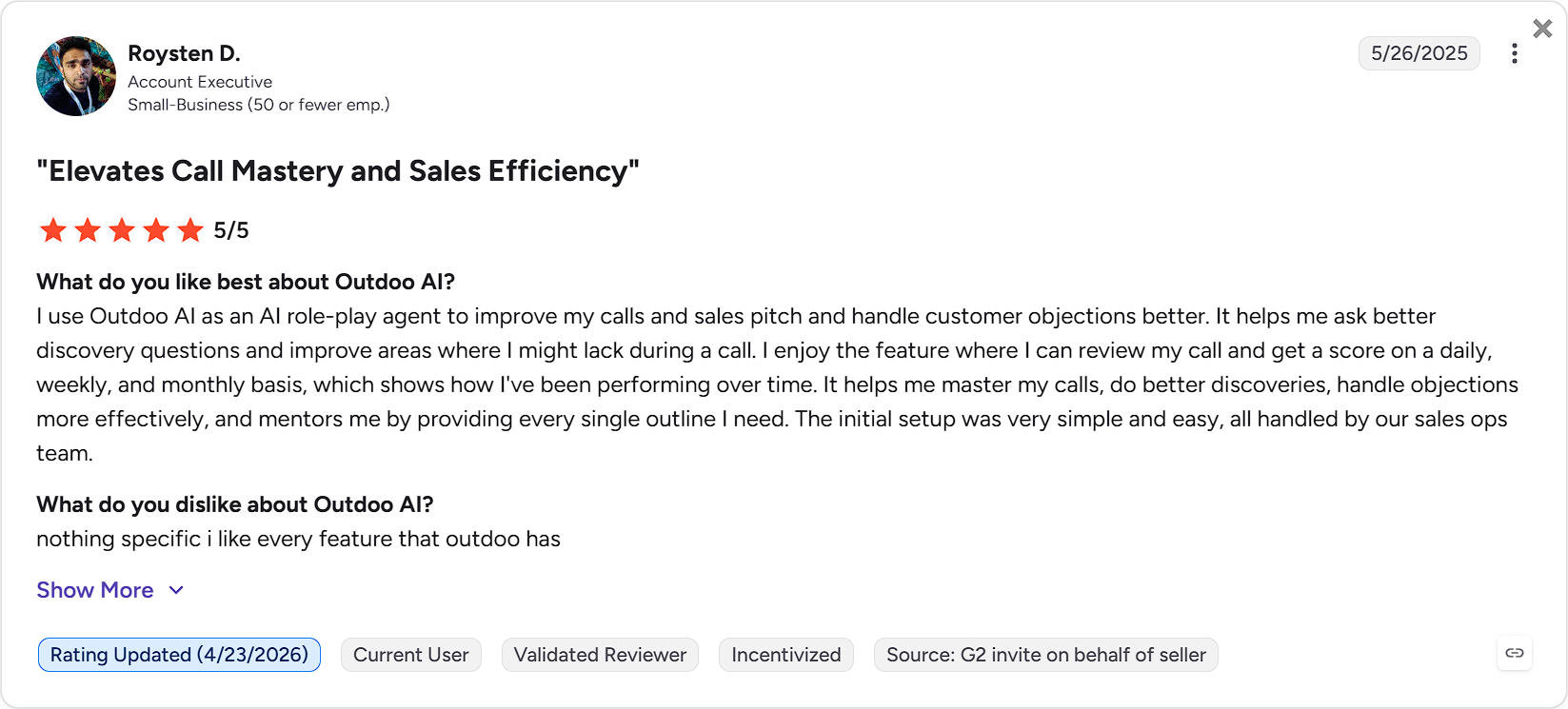
Third-party signals point the same way. Outdoo AI holds a 4.6 rating across 172 reviews on G2. Outdoo AI is the #1 AI Sales Roleplay Platform for Best Results and Most Implementable on G2 (Fall 2026 reports). It also ranked #1 for Highest User Adoption in the same Fall 2026 AI Sales Roleplay reports.
The results hold up outside G2, too. A 5,500+ employee public event management SaaS enterprise cut ramp time by 55% after moving practice and live-call scoring onto one rubric in Outdoo AI.
Hyperbound’s G2 reviews and Second Nature’s G2 profile are worth reading in full, for the same reason this article leans on user discussions: the marketing pages all sound alike, and the users do not.
The verdict the debate points to
Here is where each platform lands across the five questions:
| The debate | Outdoo AI | Hyperbound | Second Nature |
|---|---|---|---|
| Feels like a real buyer | Personas built from your own calls, LinkedIn context, and playbooks; multi-persona and video modes | Strong voice realism on cold and warm calls; can strain on complex B2B turns | Engaging avatars with moods; recurring scripted-feel critique |
| Setup effort | One click from a call, doc, LinkedIn profile, or prompt | First bot in minutes; full setup around two weeks | Fast course editor, praised by users; content upkeep on L&D |
| Pricing clarity | Published structure: Free plan (limited credits, unlimited team members), usage-based, Enterprise custom | Not published. Quoted at $70/user/month at 50 seats, $63 at 150 (August 2026); free tier of pre-built bots | Not published. Credit-based, one credit = one user for one month; $12,000 for 240 credits (August 2026) |
| Scoring that means something | One methodology-aligned scorecard across practice and live calls | Configurable playbook scorecards; coaching depth reported thinner | Strong for certification accuracy; strict on script keywords |
| Shows up on real calls | Closed loop: post-call validation, micro-roleplays, workflow simulation, AI Trainers | Perform scores real calls; Kota (Dec 2025) ties scoring to deal data, but no workflow or process rehearsal | Ends at the practice session; LMS-oriented |
Read as a debate rather than a directory, the outcome is not that Hyperbound or Second Nature are weak. Hyperbound is a respectable pick if you want a dedicated point tool for cold call drilling and nothing beyond it. Second Nature is a respectable pick if avatar-led courses are your entire use case.
But notice that you are not actually forced to trade specialties: Outdoo AI runs SDR cold call drilling natively through call blitzes, runs certification programs natively with SCORM export to any LMS, and connects both to live-call performance on one scorecard.
Reps' own criteria keep pointing the same way: realistic personas built from real deals, scores that hold up against live calls, and proof, not a feeling, that the training worked. That is the standard Outdoo AI was built against, and it covers both specialties on the way.
Whichever way you lean, take the thread wisdom with you: demos all look good. Pressure-test the exact scenario your team struggles with, ask what setup really involves, and get pricing in writing before the trial ends.
If you want to see roleplays built from your own calls and scored against your methodology, schedule a demo with Outdoo AI.
Frequently Asked Questions
.svg)
They aim at different kinds of realism. Hyperbound is known for voice realism on cold and warm calls, which suits SDR practice. Second Nature uses lifelike avatars with adjustable moods, which suits structured scenario practice. Reps handling complex B2B conversations report gaps in both when the AI faces unexpected directions, which is where roleplays generated from real calls and deal context hold up better.
Neither publishes pricing. Pricing quoted by Hyperbound's sales team in August 2026 was $70 per user per month at 50 seats and $63 at 150, with a free tier of pre-built bots. Second Nature prices in credits, one user for one month, and quoted $12,000 for 240 credits in August 2026, roughly $30,000 a year for 50 reps with continuous access. Both are list pricing rather than published pricing, so your own quote may differ. Outdoo AI offers a Free plan with limited credits and unlimited team members, a usage-based tier, and custom-quoted Enterprise plans.
Both handle it well in different ways. Hyperbound is a strong pure-play for high-volume cold call drilling. Outdoo AI covers the same motion through call blitzes, back-to-back voice roleplay drills scored on your rubric, and connects those scores to how reps perform on live calls, so drilling and real-call improvement are measured together.
Three things: roleplays are created from your own calls, transcripts, playbooks, or LinkedIn profiles rather than generic personas; the same AI scorecard applies to practice and live customer calls so improvement is verifiable; and training extends beyond conversation into workflow simulation and interactive AI Trainers.
Hyperbound is built primarily around the sales motion. Second Nature extends into support and HR use cases. Outdoo AI is designed for customer-facing teams broadly, including support, success, claims, onboarding, and L&D, with 74+ languages and enterprise compliance for regulated industries.
Table of Contents
Talk to Sales
Have questions about training and enablement for your sales, CS, support, or leadership team? Let's talk.
Talk to Sales