




Ask a room of sales reps how they feel about roleplay and you will get groans. It is awkward, it feels fake, and half the time the partner playing the buyer either goes too easy or turns into a cartoon villain. Most reps do not hate practice itself, they hate bad roleplay, and there is a lot of it about.
The good news is that almost every reason reps dread roleplay is a fixable flaw, not a reason to give up on practice. This article breaks down the real reasons reps hate roleplay, and how AI roleplay removes each one, so practice stops being theatre and starts building skill.
Why sales reps actually hate roleplay
The complaints are remarkably consistent, and they are worth taking seriously because they are usually right. Here are the real reasons, not the polite ones.
1. It is awkward and exposing
The number one gripe is simple: performing a sales call in front of your colleagues is uncomfortable. The reps who hate it most are often the most self-conscious, and the fear of fumbling in front of peers, or a manager who might judge you for it, makes people hold back. It is hard to take a real risk and try something new when everyone is watching.
In one r/sales discussion on roleplay frustrations, the most upvoted reply summed the whole thing up in three words:
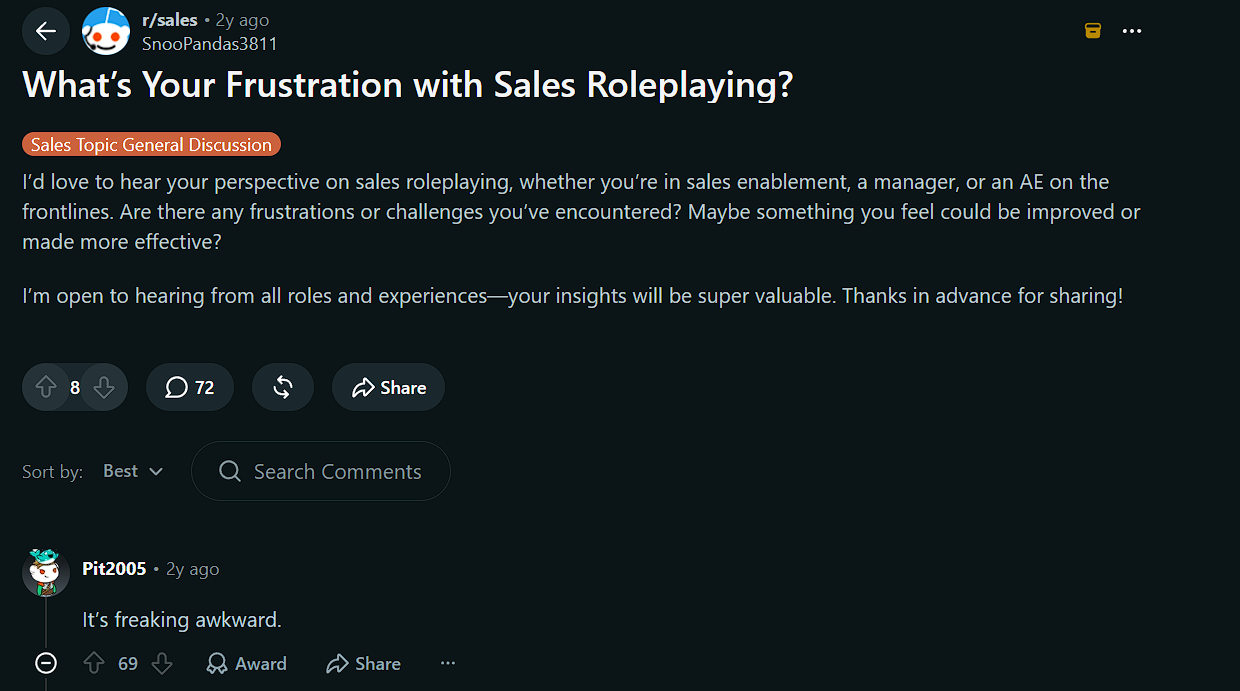
2. The fake buyer is not realistic
Most assigned roleplay partners do not push back like a real buyer. They go easy, cave after the first objection, and wrap it up with a high five. Then, overcorrecting, some swing the other way and become an impossible “catch me out” villain nobody would ever meet. Neither teaches anything, because a real buyer is somewhere in between, and consistent about it.
3. The scenarios are soft and idealised
Too often the scenario has one obvious right answer and no curveballs. Reps lob each other softballs, run the script they already know, and everyone pretends it went well. Practice that only covers the easy case does not prepare anyone for the hard ones, which are the only ones worth practising.
4. There are no stakes
A live deal has consequences; a discord call with a colleague does not. Without anything on the line, roleplay can feel like theatre, going through the motions of a conversation that does not matter. That missing pressure is a big part of why it feels unreal.
5. It happens rarely and without structure
When roleplay is an occasional group exercise, one or two people do all the talking while everyone else waits. It is infrequent, unstructured, and rarely tied to a specific deal stage or skill, so it never builds the repetition that actually changes behaviour.
Roleplay is not the problem, bad roleplay is
It is worth being fair here, because plenty of top reps swear by practice. The best performers treat reps like an athlete treats training: you do not wing greatness, you drill it. The reps who dismiss roleplay entirely are often the ones who have only ever seen the bad version.
When you look at what those top reps describe as good roleplay, a clear pattern emerges. The best sessions are built from real deals, focused on a specific stage like discovery or objection handling, run against someone who behaves like an actual buyer, and end with structured feedback against clear criteria. In other words, everything the hated version is missing. That is exactly the gap AI roleplay is built to close.
How AI roleplay fixes what reps hate
Take the list of complaints above and map each one to what AI roleplay actually changes. The fixes line up almost one to one.
- No audience, no exposure. Practice is private. A rep can fumble, retry, and fail as many times as they need with nobody watching and no manager forming an impression, which is exactly when people are willing to take risks and improve.
- A buyer that behaves like a real one. The AI stays in character, pushes back consistently, and does not cave after one objection or turn into a cartoon, so the difficulty feels real instead of scripted.
- Scenarios from your real deals. Built from actual calls and objections rather than generic softballs, so reps practise the hard cases they actually face, not the easy ones.
- Repetition on demand. A rep can drill the same objection ten times in an evening, on their own schedule, instead of waiting for the occasional group session.
- Objective, consistent feedback. Scoring against a fixed rubric replaces a manager's subjective judgment, so the feedback feels fair and reps stop worrying about being dinged in front of the team.
One caveat worth naming: this is not about telling reps to practise with a generic chatbot. Reps who have tried improvising with an off-the-shelf assistant usually find it needs heavy prompting and still feels off. The fix is purpose-built AI roleplay grounded in your real deals and scored on how you sell, not a general-purpose bot.
How Outdoo AI makes sales roleplay worth doing for sales reps
For teams whose reps roll their eyes at roleplay, Outdoo AI stands out because it removes the exact things reps hate about it, and keeps the part that builds skill.
Outdoo AI, the enterprise AI roleplay and training platform for customer-facing teams, is built to feel real and stay private:
- Realistic AI buyers built in one click from your own calls, transcripts, or a prompt, that push back and stay in character across voice, video, or chat.
- Private practice reps can repeat as often as they want, with no audience and no fear of judgment.
- Scenarios from real deals focused on the specific stage or objection a rep needs to work on, not generic sell-me-this-pen exercises.
- Consistent scoring on one methodology-aligned rubric, so feedback is objective and every rep is held to the same standard.
The result is practice reps will actually do, because it is realistic, private, and clearly worth their time. Teams can start on a Free plan with limited credits, then move to usage-based pricing as they scale.
Fix the roleplay, and reps stop hating it
Reps do not hate practice. They hate awkward, fake, low-stakes roleplay that wastes their time, and they are right to. Make it private, realistic, built from real deals, and scored fairly, and the objections fall away. AI roleplay does exactly that, turning the drill everyone dreads into the one that actually makes them better.
To see roleplay your reps will not roll their eyes at, built from your own calls, schedule a demo with Outdoo AI.
Frequently Asked Questions
.svg)
The most common reasons are that it feels awkward and exposing in front of peers, the fake buyer is unrealistic (going too easy or becoming an impossible villain), the scenarios are soft with an obvious right answer, there are no real stakes, and it happens rarely and without structure. Most reps do not hate practice itself, they hate bad roleplay, and those flaws are fixable.
Yes, when it is done well. Top performers treat practice like athletes treat training, drilling skills rather than winging them. The catch is that good roleplay is built from real deals, focused on a specific stage or skill, run against a realistic buyer, and followed by structured feedback. The version reps hate is usually missing all of that, which is why it feels like a waste.
AI roleplay maps to each complaint: practice is private so there is no peer exposure or fear of judgment, the AI buyer pushes back consistently and stays in character, scenarios are built from your real deals instead of generic softballs, reps can repeat on demand instead of waiting for a group session, and scoring is objective against a fixed rubric rather than a manager's subjective take.
A general-purpose chatbot can help a little, but reps who try it usually find it needs heavy prompting and still feels off, because it is not grounded in your product, deals, or objections. Purpose-built AI roleplay is different: it is trained on your real calls and scenarios and scores reps on how your team actually sells, which is what makes the practice feel real and transfer to live calls.
Remove the reasons they avoid it. Make practice private so they are not performing for an audience, build scenarios from real deals so it feels relevant, use a realistic AI buyer so it is not a soft script, and score it consistently so feedback feels fair. When roleplay is realistic, private, and clearly worth their time, reps stop resisting it.
Table of Contents
Talk to Sales
Have questions about training and enablement for your sales, CS, support, or leadership team? Let's talk.
Talk to Sales