



The search for the best AI sales roleplay tools in 2026 looks different than it did even a year ago. Sales leaders are not asking whether AI roleplay works. They are asking which platform actually changes rep behavior in front of customers, which one scales without breaking the budget, and which one matches their specific motion (SDR, AE, enterprise, contact center, regulated industry). Buyers are evaluating against a more mature set of trade-offs and a more crowded vendor landscape.
The category has reached mainstream adoption, 87% of sales organizations now use some form of AI, and 35-40% of companies are already investing in AI coaching technology with another 40-45% expecting to invest within the next year. At the same time, 75% of sales reps and leaders believe the need for coaching has increased because of AI, not decreased, and 39% of reps still report their coaching is too generic to help them improve on specific skills. The opportunity gap is real and the platforms below address it differently.
We evaluated 12 AI sales roleplay platforms across eight dimensions: realism of AI buyer simulations, multi-persona simulation depth, modality coverage (chat, voice, video with screen sharing), methodology alignment (SPIN, BANT, MEDDIC, MEDDPICC, Challenger), live call scoring versus practice-only, integrated resources and battle cards, CRM and conversation intelligence integration depth, and pricing transparency. Sources include G2 and Capterra reviews, third-party procurement data from Vendr and BetterCloud, vendor documentation, and public competitor analyses. Every tool below gets the same honest praise and friction treatment based on patterns flagged by real users.
What to look for in an AI sales roleplay tool in 2026
Eight criteria separate the platforms worth shortlisting from the ones that look good in a demo but stall in production. To apply them to your own team step by step, see our guide on how to choose an AI sales roleplay tool.
1. Realistic AI buyers, not template prospects: If you are practicing against "Budget Bob from Generic SaaS Co," you are not preparing for your actual pipeline. The platform should let you build AI prospects that match your real ICP, with the specific objections your buyers actually raise.
2. Multi-persona simulations that reflect real buying committees: Modern enterprise B2B deals involve three to seven stakeholders. The skill of running a one-on-one practice call is fundamentally different from the skill of holding a buying committee meeting where a CFO interrupts with an ROI question while procurement pushes on terms and the champion stays quiet. Platforms that support multi-persona scenarios (up to 3 AI stakeholders in a single resumable session) prepare reps for the conversations that actually decide enterprise deals.
3. Modality coverage: chat, voice, and video with screen sharing: Voice-only roleplay works for SDR phone motion. AE demos require video roleplay with screen-sharing simulation so reps can practice the deck-walkthrough and product-navigation flow they will run live. Chat-based roleplay handles quick objection drills between calls. Platforms covering only one modality limit your use cases, especially as your sales motion spans SDR, AE, and post-sale teams.
4. Scoring that survives the practice-to-live gap: Most platforms score practice sessions. Few score live customer calls against the same rubric. Without consistent scoring across both, you cannot tell whether practice is actually changing behavior in front of customers.
5. Methodology that maps to your actual playbook: SPIN, BANT, MEDDIC, MEDDPICC, or Challenger, plus custom rubrics for teams with their own methodology, pre-built scorecards save weeks of setup. Generic "communication" scoring will not validate methodology adoption.
6. Integrated resources and battle cards that surface in context: Practice without reinforcement assets is incomplete. Look for platforms that connect a library of battle cards, playbooks, and approved messaging to roleplay scoring, so when a gap is identified, the relevant resource surfaces automatically rather than living in a separate LMS or content hub.
7. Pricing transparency, even when custom: Vendors that hide all pricing behind sales calls slow your evaluation. Even with custom enterprise quotes, you should be able to find directional pricing publicly. If you cannot, expect a slower procurement cycle.
8. Integration depth and compliance disclosure that match your industry: Native CRM integration, conversation intelligence ingestion (Gong, Clari), dialer integration, LMS or SCORM support, plus published compliance certifications (SOC 2 Type 2, GDPR, HIPAA, CCPA, FINRA, EU AI Act, ISO 42001), all matter at enterprise scale. "Integration available" in a feature list is not the same as deep, governed data flow, and vendors that do not publish compliance posture are not ready for regulated procurement. If post-call CRM entry is where your reps slip, see our guide to the best AI roleplay tools for workflow and CRM training.
The 12 best AI sales roleplay tools in 2026 at a glance
| # | Tool | Best for | Free tier? | Starting price | One-line key advantage |
|---|---|---|---|---|---|
| 1 | Outdoo AI | Enterprise AI roleplay and coaching solution | Yes | Dynamic, adaptive pricing based on the needs of the customers | Multi-persona roleplay, live call scoring, and workflow simulation in one platform |
| 2 | Zenarate | Contact centers in regulated industries | No | Custom | Compliance-validated practice with audit trails |
| 3 | Second Nature | Enterprise onboarding and certification using avatar-led practice | No | $30-$40/user/month | Avatar-led conversations with Jenny, the virtual AI coach |
| 4 | Quantified | Fortune 500 in life sciences, pharma, finance | No | $85-$110/user/month (est.) | 92% realism rating, photorealistic avatars |
| 5 | Hyperbound | SDR teams that need real call scoring and dialer integration | Yes | Custom | Real call scoring through native dialer integration, 25+ languages |
| 6 | Mindtickle | Large enterprises consolidating training, content, coaching, and readiness | No | ~$92K annual avg | Most comprehensive enablement suite, AI roleplay is one of many modules |
| 7 | Avarra | Avatar-immersion with Socratic-style coaching debriefs | No | Custom | 3D Zoom-native avatars, intentionally non-numeric coaching |
| 8 | Nooks AI | High-volume SDR teams in dialer-centric outbound | No | ~$5,000/user/year | Parallel dialer with embedded coaching and roleplay |
| 9 | PitchMonster | SMB teams that want low-cost pitch practice with gamification | Yes | $19-$21/user/month | Self-serve pricing, leaderboards, fast launch |
| 10 | Yoodli | Individual reps and small teams focused on speech delivery | Yes | $20/month Pro | Communication coaching, real-time speech analytics |
| 11 | Kendo AI (upcoming) | SMB teams seeking transparent usage-based pricing | Yes | $55/month | Transparent usage-based pricing, fast self-serve onboarding |
| 12 | FullyRamped (upcoming) | Teams already in the Gong ecosystem | Trial available | Custom | Gong-integrated, "AI twins" of real customer calls |
1. Outdoo AI: Best for enterprise roleplay and training
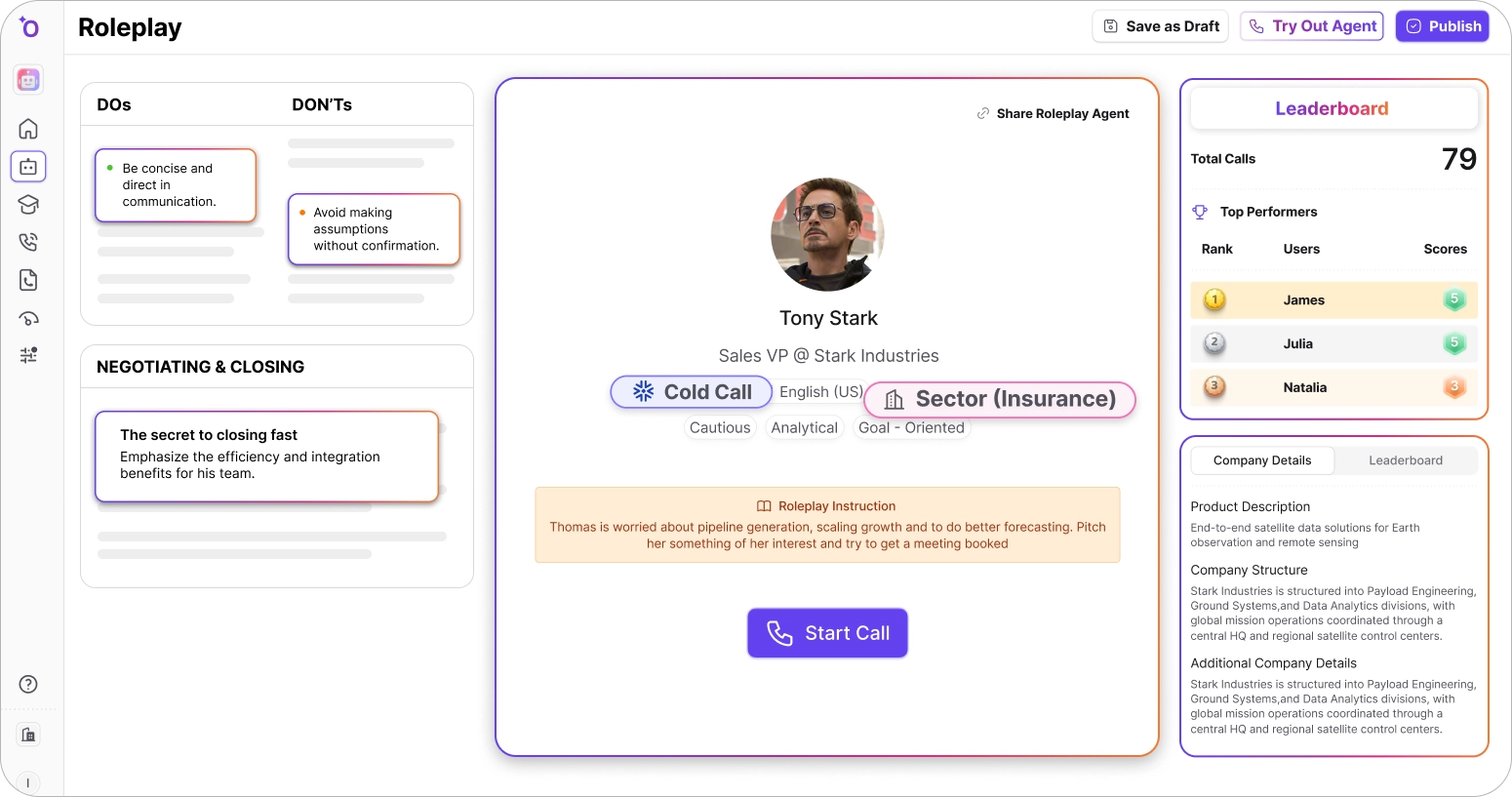
Outdoo AI is a complete AI roleplay and training platform
Outdoo AI is built for enterprise teams that need a clearer link between training, practice, and real customer conversations. Many AI roleplay tools help reps practise scenarios and receive feedback, but the bigger question for leaders is whether that practice changes behavior in real customer interactions.
For sales, customer success, and support teams, the challenge is not only giving people more practice. It is understanding whether the right behaviors are being applied when conversations become complex, emotional, or high-pressure. Outdoo AI's readiness research frames this as a gap between what teams know in training and what they can execute in customer-facing situations.
Outdoo AI addresses this by connecting three parts of the coaching workflow:
- AI roleplay practice: Reps practise realistic scenarios based on customer situations, playbooks, personas, and business context.
- Consistent evaluation: Teams can use structured scoring to assess skills such as discovery, objection handling, tone, clarity, and value articulation.
- Real-call performance analysis: The same coaching lens can be applied to real customer conversations, helping managers compare practice behavior with real-call execution.
- Targeted reinforcement: When gaps appear, teams can assign focused micro-roleplays to help reps improve specific skills instead of relying on broad, one-size-fits-all coaching.
This is the core difference in Outdoo AI's approach, it treats roleplay as part of a larger readiness system, not as a standalone training activity. Outdoo's materials describe this as connecting roleplay, interaction analysis, and structured reinforcement so customer-facing teams can build more consistent execution over time.
What Outdoo AI actually does
- Three roleplay modes: chat for quick objection drills, voice for SDR phone motion, and video with lifelike AI avatars and screen-sharing simulation for AE demos and discovery practice.
- Multi-persona simulations: practice against up to three AI stakeholders in a single scenario (CFO, champion, procurement, or any combination), each behaving distinctly based on configured priorities; long sessions can be paused and resumed.
- Methodology-aligned scorecards: pre-packaged for SPIN, BANT, MEDDIC, MEDDPICC, and Challenger, plus custom rubrics built from your governance documents.
- Live call scoring on the same scorecard as practice: ingest from Gong, Clari, or native CI, score against the methodology you use, surface adoption gaps automatically.
- Workflow simulation beyond conversation: reps practice CRM logging, disposition selection, data entry, and process navigation in environments that mirror actual Salesforce, HubSpot, or Pipedrive instances.
- LinkedIn-based scenario creation: generate practice scenarios from LinkedIn profiles for outbound preparation against named accounts.
- Multi-lingual roleplays in 74+ languages: Outdoo AI supports practice runs across 74+ languages, helping global GTM teams coach reps, localize conversations, and prepare for customer interactions across regions.
- Dynamic micro-roleplays: when scoring identifies a gap, Outdoo AI automatically generates a targeted reinforcement roleplay aligned to your methodology and surfaces relevant battle cards.
- Revenue outcome correlation: Outdoo AI connects roleplay scores, live call scores, and pipeline data to surface which specific behaviors correlate with won deals.
- 120+ enterprise integrations: Salesforce, HubSpot, Pipedrive, Gong, Clari, Docebo, TalentLMS, Cornerstone, SCORM, xAPI, SSO.
- Enterprise compliance: SOC 2 Type 2, GDPR, HIPAA, CCPA, PII scrubbing, private cloud deployment
Where Outdoo AI delivers the most value
Outdoo AI is built for sales teams that want practice to translate into real performance. It combines AI roleplays across chat, voice, and video modes, real-call analysis, structured scoring, and manager visibility so teams can coach reps more consistently and see whether training is changing behavior:
- Realistic AI roleplays based on real business context: Outdoo AI can generate practice scenarios from playbooks, customer conversations, LinkedIn profiles, internal docs, and real sales situations, helping reps prepare for conversations that closely match their day-to-day work.
- Faster sales rep readiness: Teams use Outdoo AI to help new and existing reps ramp faster by giving them repeatable practice, instant feedback, and clear coaching guidance before high-stakes customer conversations.
- Real-call coaching and performance validation: Outdoo AI helps connect practice performance with real-call execution, so managers can see whether reps are applying the right discovery, objection handling, messaging, and methodology in actual conversations.
- Manager visibility into rep skill gaps: Leaders get a clearer view of where reps need support, making coaching more specific, measurable, and easier to scale across the team.
- Consistent sales coaching across teams: Outdoo AI helps standardize what good looks like across reps, managers, regions, and teams, reducing inconsistent coaching and creating a shared performance benchmark.
- Personalized AI feedback for every rep: Reps receive targeted feedback based on company playbooks, sales frameworks, and internal materials, while managers can track progress without manually reviewing every practice session.
- Support for complex sales conversations: Outdoo AI is especially useful for teams that need to practise discovery, qualification, objection handling, value articulation, negotiation, tone control, and multi-stakeholder customer conversations.
"If someone does ten roleplays in Outdoo AI, you can see the improvement instantly on real calls. The speed of feedback is huge. We tweak a bot, test it, and improve the training loop in hours, not weeks."
Beau Cullen, Regional Director of Sales, Globe Life Insurance
What to know before signing with Outdoo AI
The main thing to evaluate before committing is whether your team is ready for a team-based rollout.
Outdoo AI is designed for sales teams, enablement teams, and managers who want consistent coaching across multiple reps. Production deployments typically start at 5+ users, so it is a better fit when there are enough reps to compare patterns, track improvement, and make coaching repeatable.
Individual reps can still explore Outdoo AI for free with the free tier plan but solo users or very small teams may find lightweight practice tools easier to start with.
A few smaller things are also worth confirming before launch, such as who will own the rollout, how many reps will join the first pilot, and what a successful first month should look like. These are simple setup questions, not major blockers.
Outdoo AI's tiered pricing scoped to deployment
Outdoo AI uses a tiered pricing model designed for both initial adoption and enterprise-scale deployments. Pricing scales with usage, integration depth, and compliance requirements rather than simple per-seat licensing.
- Free plan with usage credits and unlimited team members. Get staretd for free here .
- Flex tier (usage-based) adds multi-persona roleplays, certifications, workflow simulation, and methodology-aligned scoring
- Enterprise tier includes full integration scope (CRM, CI, LMS, SCORM, xAPI), enterprise compliance (SOC 2 Type 2, GDPR, HIPAA, CCPA, private cloud), and custom deployment
Enterprise pricing is custom-scoped because deployment varies materially by team size, integration scope, methodology configuration, and compliance requirements.
Want to see how Outdoo AI can help your team? Schedule a demo and talk to our experts.
2. Zenarate: Best for contact centers in regulated industries

Zenarate is purpose-built for contact center simulation, not sales conversation roleplay
Zenarate was founded by a former contact center operator and built around what the company calls a "flight simulator for customer engagement." Its design center is agents handling high-volume, process-driven customer interactions in banking, insurance, healthcare, and telecommunications, where script adherence, compliance, and software navigation matter as much as the conversation itself.
For sales teams, the fit is narrower. What makes Zenarate strong for contact centers (structured simulation flows, screen and conversation simulation in parallel, compliance-grade scoring) is also what makes it less flexible for multi-stakeholder, methodology-driven B2B sales conversations. Zenarate is used by 8 of the top 10 U.S. financial institutions and 3 of the top 5 BPOs, and its 2025 merger with Bright added live call analysis to the platform.
What Zenarate actually does
- Voice and conversation simulation: AI roleplays without scripts, evaluated through speech recognition and sentiment analysis
- Software and screen simulation in parallel: agents practice navigating CRM, ticketing, billing systems alongside conversations, no IT integration required
- Real-time AI coaching during simulations: immediate feedback on tone, pace, soft skills, and compliance adherence
- Live call analysis (post-Bright merger): same skills practiced in simulation are scored on actual customer calls
- 13 languages and 12 country deployments: including U.S., Canada, Mexico, Philippines, India, Europe
- KPI-based dashboards aligned to contact center metrics: first-call resolution, average handle time, CSAT, compliance pass rates
What Zenarate users praise about contact center simulation
- Proven outcomes in contact center metrics. Customers report 56% faster agent speed to proficiency and 32% lower agent attrition, with some reporting 40-70% faster proficiency by combining voice, screen, and chat simulation.
- Soft skills coaching is unusually deep. Active listening, empathy, de-escalation, and tone control are evaluated through speech and sentiment analysis with precision other platforms lack.
- G2 High Performer in two relevant categories. Recognized for both Contact Center Quality Assurance Software and Sales Training and Onboarding Software based on customer satisfaction scores from verified users.
Where Zenarate users hit friction with rigidity and content upkeep
- Content maintenance is the biggest tax. Unlimited customization also means unlimited maintenance, especially in fast-changing contact center environments.
- Simulations feel linear for tenured agents. Structured flows that work for new hire onboarding are less valuable for experienced agents who need open-ended training approaches.
- AI recognition gaps in unscripted conversations. The system occasionally misinterprets responses when conversations move beyond expected paths.
What to know before signing with Zenarate
- Validate the fit if your use case is sales motion. Zenarate is built for contact center, healthcare, and customer support. Sales teams should validate whether multi-stakeholder, methodology-driven B2B conversations (MEDDIC, SPIN, BANT) are supported at the depth your team needs.
- Plan for the content maintenance workload. Budget for a dedicated content owner if simulation libraries will be deployed at scale across multiple regions or product lines.
- The Bright merger changes the value proposition. Confirm whether live call analysis is included in your contract scope, as it materially changes the closed-loop value compared to practice-only deployments.
Zenarate's enterprise-only sales-led pricing
Zenarate does not publish pricing tiers. Pricing is fully sales-led and customized based on team size, deployment scope, industry, and simulation depth. There is no free tier or self-serve option.
- Positioned for enterprise contact center deployments
- Costs vary based on number of agents, simulation library size, language coverage, and integration scope
- Contract terms typically scope onboarding, training configuration, and ongoing support
- No publicly listed plans; teams engage Zenarate's sales team for a tailored quote
3. Second Nature: Best for enterprise onboarding and certification using avatar-led practice
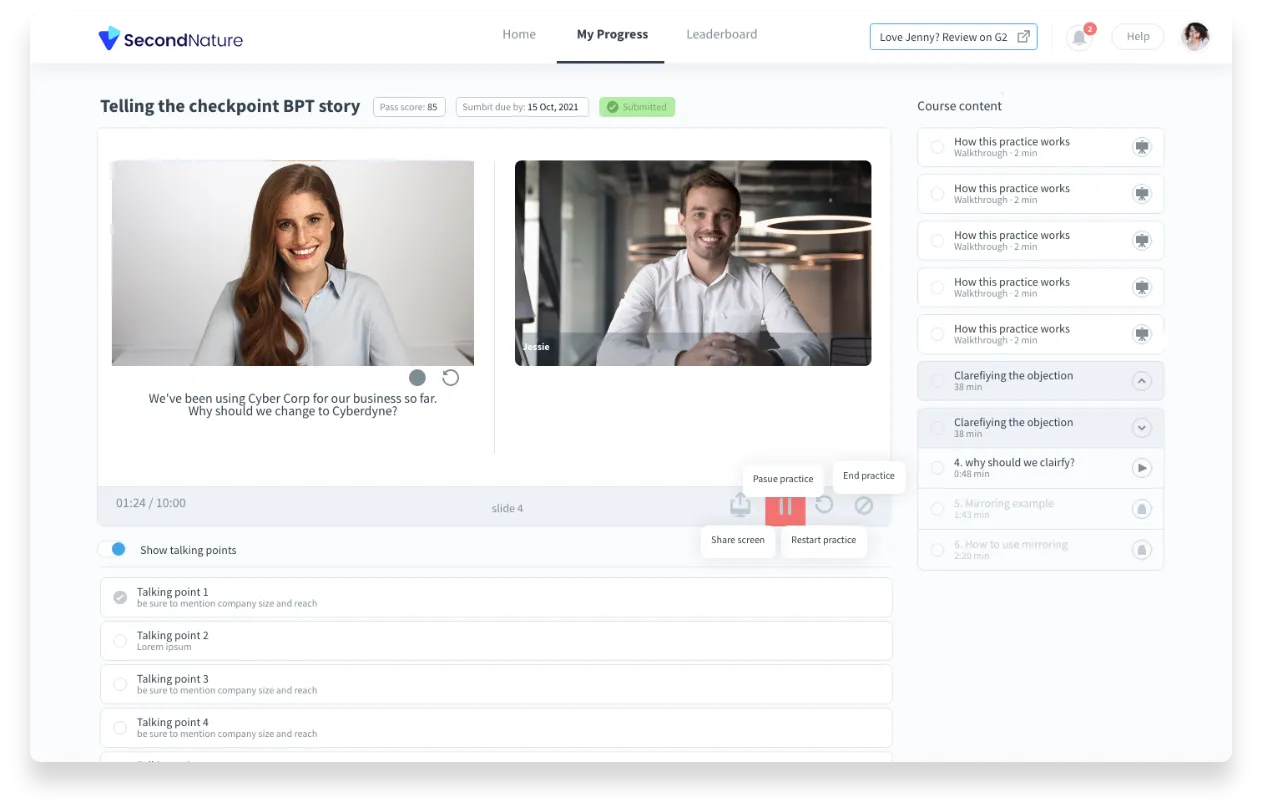
Second Nature built its product around a virtual coach named Jenny
Second Nature is one of the most recognizable platforms in enterprise enablement, built around an avatar-based virtual sales coach named Jenny. The platform is designed for organizations that need to standardize communication training, pitch certification, and onboarding programs across large sales teams.
What makes Second Nature distinct is its commitment to certification-driven learning paths. Reps progress through predefined scenarios, receive feedback on delivery, and are evaluated against set benchmarks before progressing to customer-facing activity. Performance is measured through training outcomes and certification milestones rather than real deal execution, which works well for sales onboarding but less well for ongoing methodology-aligned coaching.
What Second Nature actually does
- Avatar-led virtual coaching with Jenny: the platform's signature feature, simulating discovery, demos, and objection handling in a guided format
- Detailed soft-skill feedback: tone, pacing, clarity, filler words, and presentation style
- Structured certification workflows: fits into formal onboarding programs used by enterprise teams
- Predefined scenario libraries: scenarios curated by Second Nature, customization available for enterprise tiers
- Integration with LMS and onboarding stacks: supports enterprise training program workflows
What Second Nature users praise about structured communication training
- Virtual coaching feels natural for soft skills. Reviewers call out Jenny's avatar-led conversations as the most natural feel among structured training tools, especially for new hires building confidence.
- Strong fit for certification programs. Purpose-built for pass/fail certification workflows, which works for enterprise sales onboarding where readiness validation is required before customer calls.
- Standardized training scales across regions. Reviewers report Second Nature's scenario libraries enable consistent delivery across distributed enterprise sales teams.
Where Second Nature users hit friction with scenario flexibility and pricing
- Scenarios feel scripted in unexpected directions. Reviewers note that predefined scenario paths do not adapt as fluidly to unscripted rep responses, which limits realism when conversations go off-script.
- Customization for industry context is admin-heavy. Adapting scenarios to specific industries, deal contexts, or evolving messaging requires effort that some teams find disproportionate to value delivered.
- Pricing transparency is limited. Sales-led pricing with no public tiers can slow evaluation and procurement timelines compared to platforms with published pricing.
What to know before signing with Second Nature
- Confirm scenario flexibility for your motion. Certification-friendly scenarios are predefined by design. If your team needs scenarios that adapt to industry context, multi-stakeholder dynamics, or evolving messaging, validate that customization scope upfront.
- Budget for the enterprise minimum. Community data indicates minimum annual deals often start around $20K for mid-sized and enterprise teams, with pricing scaling based on size, onboarding support, and customization.
- Plan for 4-8 week implementation. Enterprise rollouts typically take this long to configure scenarios, certifications, and team structures.
Second Nature's sales-led pricing in the $30 to $40 per user per month range
User-reported data places typical pricing at approximately $30 to $40 per user per month (last updated November 2025), with minimum annual deals around $20K.
- No public pricing on the website; teams must engage sales
- Pricing varies based on users, onboarding support, training modules, and additional services
- Community feedback suggests pricing scales with both team size and program complexity, especially for structured onboarding and certification programs
Considering alternatives to Second Nature? Explore tools that offer better flexibility and pricing.
4. Quantified: Best for Fortune 500 in life sciences, pharma, and finance with photorealistic avatars
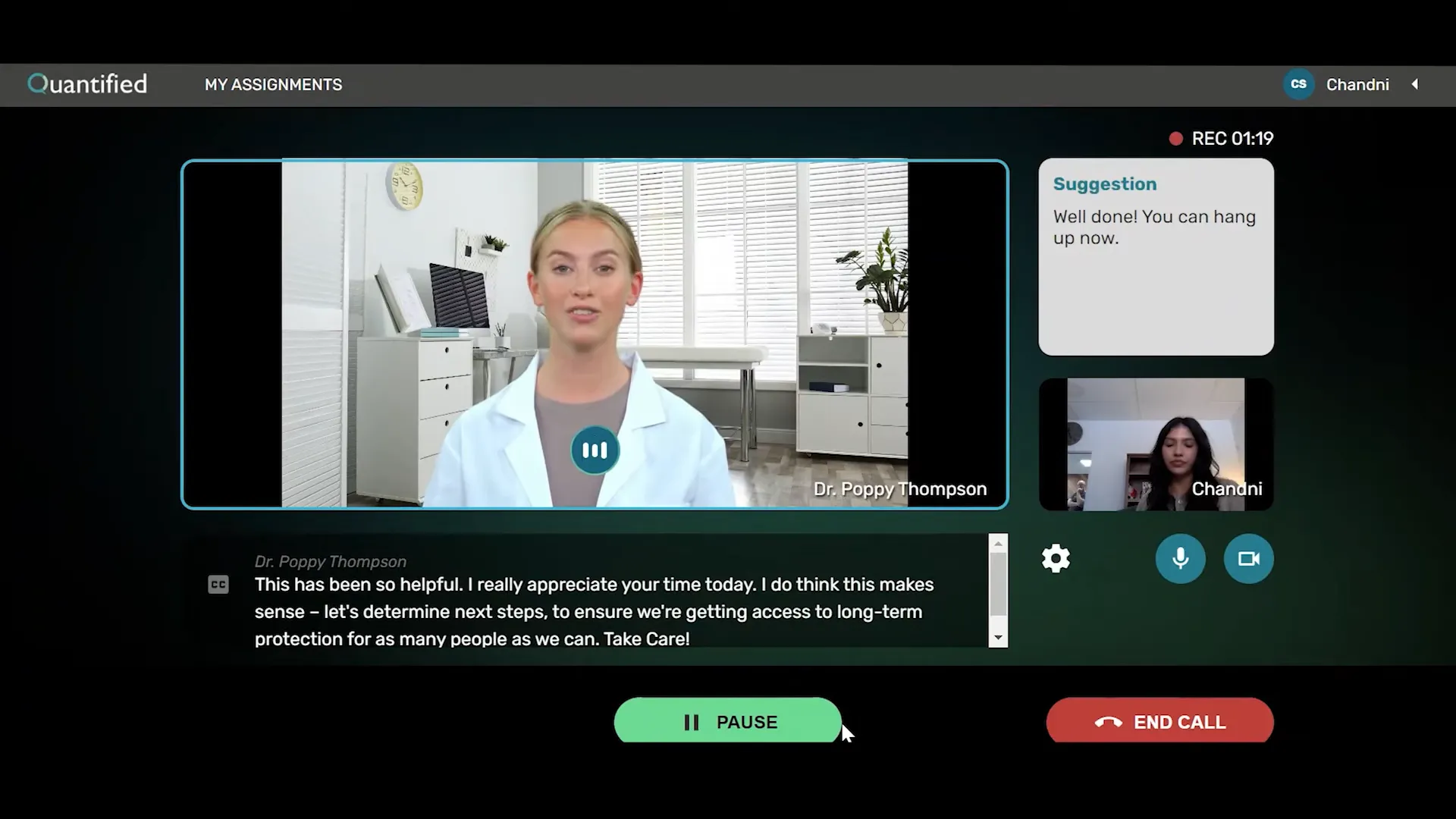
Quantified built the most photorealistic avatars on this list
Quantified is positioned at the premium end of the AI sales roleplay market, focused on Fortune 500 customers in regulated industries like life sciences, pharma, and financial services. The platform's distinctive capability is photorealistic avatar technology that approaches the realism of video conferencing with real humans, with a 92% realism rating cited in published competitor comparisons.
That focus drives both the platform's strengths and its limitations. Quantified is purpose-built for enterprise teams that need formal assessment, certification, and compliance-validated training. The approach is more assessment-driven than coaching-driven: simulations evaluate readiness against predefined criteria, helping teams track progress and benchmark across cohorts.
What Quantified actually does
- Photorealistic avatar-based simulations: the most lifelike avatars on this list, approaching real video-call realism
- Structured assessment frameworks: scoring against predefined readiness criteria for benchmarking and certification
- Industry-specific scenarios: templates designed for life sciences, pharma, financial services
- Compliance-driven scoring: evaluation frameworks designed to support audit trails
- Standardized benchmarking: scoring designed for consistent comparison across reps and cohorts
- Enterprise integrations: SSO and LMS connectors typical of enterprise software
What Quantified users praise about realism and assessment depth
- The most realistic avatars in the category. Reviewers consistently call out photorealistic avatars as closest to real video-call experience, improving engagement for high-stakes practice.
- Strong fit for regulated-industry certification. Structured assessment framework is purpose-built for organizations that need pass/fail outcomes, audit trails, and cohort benchmarking.
- Enterprise-grade rigor that other platforms do not match. Fortune 500 customers in life sciences, pharma, and finance choose Quantified specifically for formal assessment and compliance posture.
Where Quantified users hit friction with flexibility and AI rigidity
- AI needs repeated exposure to feel natural. Reviewers note simulations improve with more practice cycles, increasing the effort to make them effective across use cases.
- Conversational flexibility is limited. Simulations do not handle conversations that move in multiple directions as fluidly as more adaptive platforms.
- Adoption depends on workflow embedding. Usage remains limited unless training is tightly embedded into daily workflows, which requires more organizational commitment than lightweight tools.
What to know before signing with Quantified
- Confirm the regulated-industry fit matches your use case. Quantified is built for life sciences, pharma, and financial services compliance training. Sales teams outside regulated industries should validate the value relative to platforms designed for general sales motion.
- Budget for premium per-user pricing. Estimated pricing places Quantified at $85 to $110 per user per month, materially higher than mid-market platforms.
- Plan for longer sales cycles. Deployments typically involve procurement, compliance, and L&D teams, with multi-stakeholder approval extending timelines.
Quantified's enterprise pricing at $85 to $110 per user per month estimated
Quantified follows a subscription-based model not publicly disclosed on the official website. Based on third-party sources, estimated pricing is $85 to $110 per user per month.
- Customized based on team size, use case, and training scope
- Enterprise deployments may include additional onboarding, configuration, and compliance support costs
- No upfront pricing visibility; teams engage sales for accurate quotes
Evaluating alternatives to Quantified? Read our complete guide to top Quantified alternatives.
5. Hyperbound: Best for SDR teams that need real call scoring and dialer integration

Hyperbound is the AI roleplay platform built around real call scoring
Hyperbound has positioned itself specifically against avatar-led platforms by emphasizing what those tools do not do: score real customer calls through dialer integration. The platform supports both simulated practice (with AI buyer bots, gamified leaderboards, and rapid bot setup) and live call scoring against the same rubric.
Hyperbound's design center is the SDR motion. The platform excels at high-volume cold call practice, persona-based outbound bots, and 25+ language coverage, with bot setup under 10 minutes. For SDR teams that want avatar-style realism without voice latency, plus the ability to score real customer calls, Hyperbound is the most direct fit. For AE and enterprise sales motion, the platform's coverage of multi-stakeholder enterprise deals is less developed.
What Hyperbound actually does
- Real call scoring through dialer integration: connects to dialers and call recorders to score live customer calls against the same scorecard used in practice
- AI buyer bots with persona configuration: first bot setup typically under 10 minutes, full module rollout in about two weeks
- Demo call type with screen sharing: supports the screen-sharing motion AEs run during product demos
- Multi-language coverage across 25+ languages: including Spanish, French, German, Mandarin, Japanese, Hindi, Hebrew
- Custom scorecards aligned to methodology: SPIN, BANT, MEDDIC, MEDDPICC, Challenger frameworks supported
- Free tier with limited bots: entry-point includes basic scorecards and transcription
What Hyperbound users praise about SDR-focused practice
- Bot setup is genuinely fast. Reviewers note first bot configuration takes under 10 minutes, compared to enterprise platforms with multi-month implementation.
- Gamification drives consistent SDR adoption. Leaderboards, streaks, and team competition keep reps practicing daily.
- Multi-language coverage exceeds most competitors. 25+ languages including underserved markets make Hyperbound a fit for global SDR teams.
Where Hyperbound users hit friction with bot setup effort and AE coverage
- Building a full bot library takes upfront enablement effort. While first bot setup is fast, building scenarios for multiple industries and personas takes meaningful enablement team time.
- AE and enterprise coverage is still maturing. Coverage of multi-stakeholder enterprise deals, late-stage negotiation, and complex sales motion is less developed than outbound capabilities.
- Sales-cycle reporting is still developing. Practice-level analytics are strong, but pipeline-tied insights are evolving.
What to know before signing with Hyperbound
- Validate AE coverage if you need beyond SDR. Hyperbound is purpose-built for SDR motion. Teams expecting use across AE discovery, demo, negotiation, and enterprise motion should pilot with a representative use case first.
- Plan for the bot library buildout. Adoption depends on a meaningful library of persona-configured bots. Budget enablement team time for the first 30-60 days.
- Confirm the integration scope. Most advanced capabilities (analytics, integrations, security) require engagement with sales. Verify scope before committing.
Hyperbound's free tier plus demo-gated custom enterprise pricing
- Free plan: limited roleplay bots, basic scorecards, transcription, coaching feedback
- Custom plan for teams: unlocks unlimited bots, custom scorecards, analytics, integrations, security configurations
- Demo-led access: most advanced capabilities require engaging sales through a demo
Looking beyond Hyperbound? See how leading platforms compare for AI sales roleplay in 2026.
6. Mindtickle: Best for large enterprises consolidating training, content, coaching, and readiness
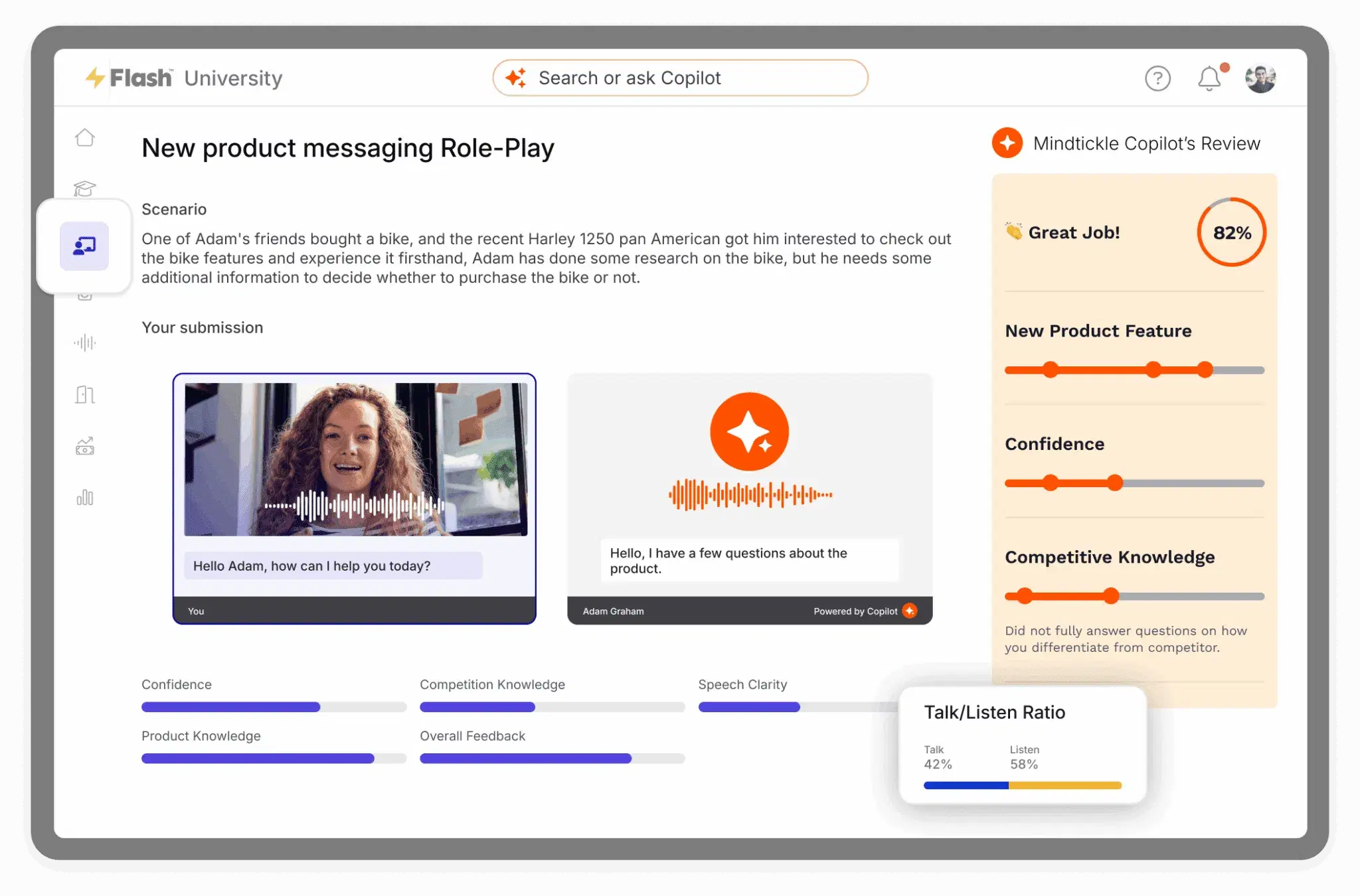
Mindtickle is an enablement suite first, an AI roleplay platform second
Mindtickle is not primarily an AI sales roleplay platform. It is a sales enablement and readiness suite that includes AI roleplay as one of many modules across training, coaching, certifications, content management, digital sales rooms, conversation intelligence, and analytics.
That distinction matters for buyers. Teams evaluating Mindtickle mainly for AI roleplay may end up adopting a much broader platform than they originally needed, which can increase implementation scope, admin effort, and total cost.
For organizations that need a full revenue enablement stack, Mindtickle can be a comprehensive option. But if roleplay is the core requirement, buyers should confirm whether the broader platform adds measurable value or simply creates more rollout complexity than a dedicated AI roleplay solution requires.
How Mindtickle's AI roleplay fits inside the broader enablement story
- AI Role Play module: structured roleplay scenarios with AI buyer personas, scoring against methodology, and integration into broader certification programs
- Mindtickle Copilot: AI assistant that auto-grades roleplay submissions on empathy, keyword usage, pacing, and methodology adherence
- Readiness Index: single composite metric to track proficiency across certifications and skills
- Conversation Intelligence (Call AI): ingests live customer calls and scores them, included in the Transform tier
- Digital Sales Rooms: centralized buyer-facing rooms for deal follow-up, with engagement analytics
- Sales Content Management: centralized playbooks, battle cards, and approved messaging
- Structured learning paths: sequenced training modules with prerequisites, gating, and progression tracking
- Certifications: multi-stage certification flows with pass/fail thresholds for customer-facing readiness
- 120+ integrations across CRM, LMS, conversation intelligence, and SSO
- AI Role Play tier-gating: available only in Readiness, Enable, and Transform packages, not in the entry-level LMS tier
What Mindtickle users praise about the integrated platform
- All enablement workflows sit in one place. Training, coaching, certifications, content management, digital sales rooms, and conversation intelligence are managed inside one platform, reducing the need to stitch together multiple enablement tools.
- Certifications and learning paths are structured. Mindtickle works well for teams that need role-based onboarding, pass/fail gates, and readiness validation before reps move into customer-facing activity.
- Dashboards make coaching more specific. Competency views help reps and managers identify focus areas like product knowledge, methodology adherence, discovery quality, or messaging gaps instead of relying only on subjective feedback.
- Gamification helps drive adoption. Leaderboards, points, badges, and progress tracking give reps daily reasons to return to the platform, which can improve engagement beyond initial onboarding.
Where Mindtickle users hit friction with the platform's complexity
- Common tasks can take too many clicks. Because training, certifications, coaching analytics, content, and digital sales rooms live across different areas, reps and managers may spend extra time navigating before completing simple actions.
- Performance can slow down daily workflows. Users often flag slow page loads or delays when switching modules, pulling reports, or working across larger content libraries, which becomes frustrating during busy sales weeks.
- Setup requires meaningful upfront effort. Mindtickle is an enterprise-grade platform, so implementation usually involves configuring learning paths, content, integrations, analytics, and permissions before teams see full value.
- AI Role Play needs clear confirmation before buying. Teams evaluating Mindtickle for roleplay should confirm whether AI Role Play is included in their package, whether it requires opt-in, and whether any usage limits or add-on costs apply.
What to know before signing with Mindtickle
Three things buyers consistently underestimate about Mindtickle deployments:
- Confirm what is actually included. Mindtickle is a bundled revenue enablement platform, not just LMS or AI roleplay. Buyers should verify whether AI Role Play, Call AI, Digital Sales Rooms, and content management are included or priced as add-ons.
- Watch the contract mechanics. Contracts often include annual prepayment, 30-90 day renewal notice windows, and 3-7% annual price increases unless negotiated out. These terms can make the real commitment higher than the headline price.
- Budget for rollout and total cost carefully. Vendr notes onboarding and implementation can add $10,000-$50,000+, with premium support and integrations costing extra. Platforms like Outdoo AI follow customized pricing as well, but with full transparency upfront and no hidden implementation or support costs.
Mindtickle's bundled enterprise pricing requiring six-figure annual commitment
Mindtickle does not publish public pricing. According to BetterCloud, its estimated price is $47,000 to $82,000 per year, based on 6 purchases.
Vendr shows a wider enterprise range: $50,000 to $150,000 annually for small deployments, $150,000 to $400,000 for mid-market deployments, and $400,000 to $1M+ for enterprise rollouts. Vendr also frames pricing as annual, per-user subscriptions, with commonly cited per-user pricing around $30 to $50 per user per month, or $360 to $600 per user per year.
Vendr also calls out extra costs that can materially increase total contract value: onboarding and implementation can run $10,000 to $50,000+, premium support may add 10-20%, integrations can add fees, and contracts may include 3-7% annual price increases. Mindtickle contracts are usually negotiated around user count, modules, contract length, annual prepayment, and multi-year commitments.
Mindtickle is best understood as a bundled revenue enablement platform, not a standalone AI roleplay tool. Its packages can include LMS/readiness, assessments, certifications, coaching, AI role play, sales content management, digital sales rooms, analytics, and Call AI.
That breadth can work for teams consolidating enablement tools, but for teams only looking for AI roleplay or coaching simulations, Mindtickle may feel heavier and more expensive than a focused point solution.
Looking for a better-scoped alternative to Mindtickle? Read our complete guide to top Mindtickle alternatives.
7. Avarra: Best for avatar-immersion with Socratic-style coaching debriefs

Avarra is intentionally avatar-first and Socratic, not scorecard-first
Avarra is the avatar-immersion specialist in the category. The platform's signature feature is its 3D Zoom-native avatars, designed to create natural conversation flow rather than structured assessment. Backed by an $8M Series A from Lightspeed Venture Partners with participation from GTM Fund, Avarra targets BFSI, healthcare, and pharma teams that value conversational realism and reflective coaching over numeric scoring.
The platform's coaching philosophy is deliberately reflective: AI coaches lead Socratic debriefs after each conversation rather than producing structured scores. This is a real product choice for habit formation, but it makes Avarra a poor fit for teams that need methodology-aligned numeric scoring, certification gates, or post-call workflow simulation. The platform also has no demo simulation with screen sharing, no real call scoring through dialer integration, and no native CRM integration.
What Avarra actually does
- 3D Zoom-native avatars: the platform's distinctive feature, optimized for natural conversation flow
- Socratic-style coaching debriefs: reflective debriefs rather than structured numeric scores
- Scenario libraries built from uploaded materials: simulations created from transcripts, playbooks, uploaded content
- Multilingual via LLM: described as multilingual, with specific coverage less publicly documented than competitors
- BFSI, healthcare, pharma vertical traction: specific industry positioning in regulated and high-stakes verticals
What Avarra users praise about avatar immersion
- Conversation flow feels natural. Reviewers call out Avarra's avatar conversations as the closest to natural dialogue among avatar-led platforms.
- Socratic coaching encourages reflection. The deliberately non-numeric style creates space for reps to think through choices rather than chase a score.
- Funding and stage credibility. Lightspeed-led $8M Series A signals backing that matters for enterprise procurement evaluating long-term viability.
Where Avarra users hit friction with structural gaps
- Voice latency breaks immersion. The 3D avatar rendering introduces noticeable delays during objection handling and back-and-forth exchanges.
- No demo simulation with screen sharing. AE and enterprise teams that need to practice deck walkthrough and product demo flow find this a structural gap.
- No real call scoring or native CRM integration. Avarra evaluates only simulated practice sessions; the coaching loop closes inside Avarra's environment.
What to know before signing with Avarra
- Confirm the Socratic approach matches your team's needs. The deliberately non-numeric style works for habit formation but not for teams that need certification gates, methodology-aligned scoring, or pass/fail outcomes.
- Account for the missing capabilities. No demo simulation, no real call scoring, no native CRM integration, no methodology-aligned scorecards. Teams that need any of these should evaluate Outdoo AI, Hyperbound, or Quantified.
- Validate compliance posture for regulated industries. Avarra targets BFSI, healthcare, and pharma but has not publicly emphasized compliance certifications or audit trails at the level required by some regulated procurement teams.
Avarra's custom enterprise pricing with no public tiers
Avarra does not publicly list pricing. Industry research suggests basic plans begin around $99 per month and Pro plans around $119 per month, with custom enterprise pricing for larger deployments.
- No public pricing tiers; teams engage sales for a quote
- Custom enterprise scope around team size, use case, training scope, and onboarding requirements
- Mid-market pricing positioned below Mindtickle and Quantified but above PitchMonster and Yoodli
Considering Avarra alternatives? Read our complete guide to Avarra alternatives.
8. Nooks AI: Best for high-volume SDR teams in dialer-centric outbound
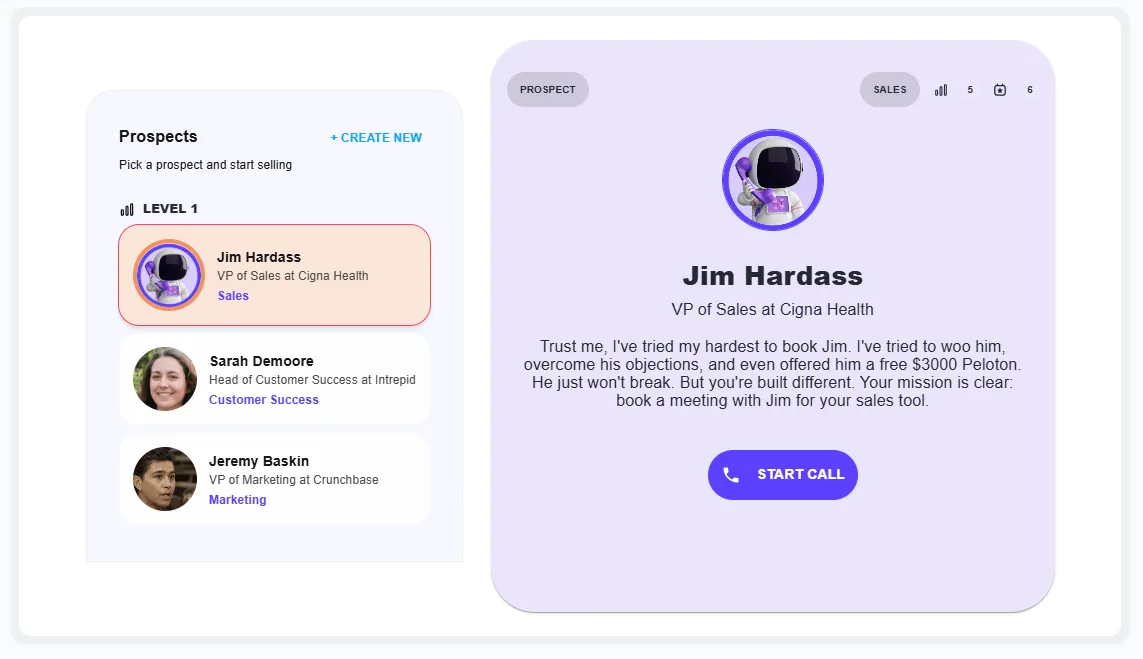
Nooks AI is primarily a parallel dialer with coaching embedded, not a roleplay platform
Nooks AI is not really an AI sales roleplay platform in the same category as the others on this list. Nooks is the leading AI-powered parallel dialer (allowing SDRs to dial up to 5 prospects simultaneously), with embedded coaching, virtual salesfloor, and AI roleplay practice as supporting features.
Founded in 2020 with $43M+ in venture funding and a 4.8/5 G2 rating from 1,167 reviews, Nooks is the premium dialer in the SDR market. For SDR teams committed to phone as the primary outbound motion and dialing 100+ calls per day, Nooks delivers measurable outcomes. For teams looking for AI sales roleplay outside the dialer use case, Nooks is overbuilt and overpriced at roughly $5,000 per user per year.
What Nooks AI actually does
- Parallel dialer: calls up to 5 numbers simultaneously, routing the first live answer to the rep
- Virtual salesfloor: shared digital space where remote SDRs dial together and build team energy
- Embedded AI coaching: real-time AI coaching during live customer calls, with call scoring, scorecards, transcripts
- AI roleplay practice bots: practice conversations against AI buyer bots for outbound scenarios
- CRM integrations: Salesforce, HubSpot, Salesloft, Outreach, Gong
- AI Coach add-on: sold separately from core platform license
What Nooks AI users praise about dialer-embedded coaching
- Best-in-class interface for a parallel dialer. Reviewers praise the clean interface and continuous platform investment.
- Virtual salesfloor genuinely solves remote team energy. The shared digital space for reps dialing together is consistently called out as a unique remote-team feature.
- Measurable productivity gains. Reviewers report 3-5x increase in conversations per day, with documented case studies of connect-to-meeting rate climbing from 20% to 35%.
Where Nooks AI users hit friction with cost and dialer tradeoffs
- ~$5,000 per user per year is a significant commitment. Reviewers flag annual-only pricing and ~5-seat minimum (creating a $20K+ baseline) as a meaningful barrier for teams unsure about phone-first commitment.
- Connection lag creates "robocall" effect. A verified G2 user reported slow connection time causes prospects to hang up; the 1-3 second delay signals robocall before the rep speaks.
- No free trial without sales conversation. Inability to evaluate self-serve creates evaluation friction compared to platforms with published pricing.
What to know before signing with Nooks AI
- Confirm phone-first commitment matches your motion. Nooks delivers value when SDRs dial 100+ calls per day. Hybrid email/LinkedIn/phone teams or those under 50 calls per day will find the cost difficult to justify.
- Budget for the full annual commitment with seat minimum. Annual-only pricing with ~5-seat minimum creates a typical $25,000 baseline. Add Twilio number costs ($10-15/number/month) and the AI Coach add-on if needed.
- Validate connect-rate impact in pilot. Parallel dialing creates real connect-rate tradeoffs (connection lag, spam flag risk). Pilot with actual lists and reps before full deployment.
Nooks AI's premium dialer pricing at ~$5,000 per user per year
Nooks does not publish pricing. Based on aggregated third-party sources (Prospeo, OutboundSalesPro, MarketBetter):
- Per-seat license: $4,000 to $5,000 per user per year
- Billing: annual only, no monthly option
- Minimum seats: approximately 5 users
- Twilio numbers: $10 to $15 per number per month (additional)
- 5-SDR team total: approximately $26,500 per year
- AI Coach module: sold as an add-on
Nooks customers include ZoomInfo, HubSpot, Airbase, Modern Health, and Fivetran.
Comparing Nooks alternatives? Read our complete guide to Nooks AI alternatives.
9. PitchMonster: Best for SMB teams that want low-cost pitch practice with gamification
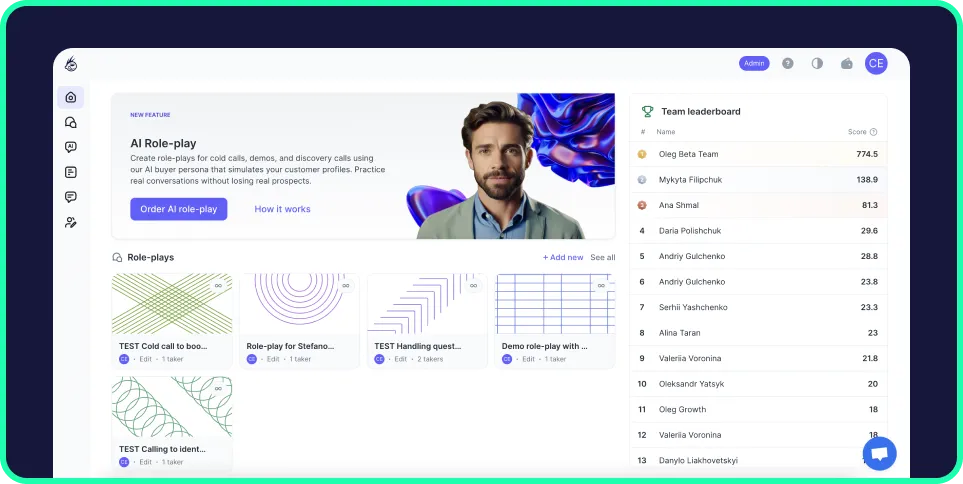
PitchMonster trades depth for accessibility, and the math works for smaller teams
PitchMonster is the SMB-friendly entry point in the AI sales roleplay category. Where enterprise platforms require six-figure annual commitments and multi-month implementation, PitchMonster publishes pricing publicly, offers self-serve onboarding, and emphasizes gamified leaderboards over methodology-aligned scoring.
The platform is built for speed and engagement rather than depth. Reps quickly run through scenarios, receive instant feedback, and stay motivated through leaderboards. This works for high-velocity SDR and SMB sales teams where consistent practice and rep engagement matter more than structured coaching or deep performance analysis. As teams grow past 50 reps or adopt formal methodology requirements, limitations become more visible.
What PitchMonster actually does
- Pitch roleplays with instant feedback: short practice sessions focused on pitches, cold calls, demos
- Gamified leaderboards and badges: team-based competition, points, streaks, progression tracking
- 48+ pre-built scenarios: scenario library spanning common SDR and outbound situations
- Self-serve onboarding: sign-up and first roleplay within minutes, no sales conversation required
- Public pricing with free tier: transparent pricing structure unusual in this category
What PitchMonster users praise about fast adoption and engagement
- Time to first roleplay is genuinely fast. Self-serve sign-up and first session happens within minutes, removing procurement friction.
- Gamification drives daily SDR engagement. Leaderboards, badges, and competition keep reps practicing voluntarily.
- Pricing transparency builds trust. Public pricing (free plan plus $19/user/month) contrasts favorably with platforms that hide all pricing behind demos.
Where PitchMonster users hit friction with depth and scale
- Scenario creation becomes manual at scale. Building variations for different use cases, industries, or segments creates ongoing maintenance overhead.
- Managing many users at scale becomes harder. Interface limitations affect usability as teams grow, with reviewers noting the need for better bulk actions and hierarchy.
- Product depth limits use beyond SMB. Scenario depth, methodology alignment, and integration depth limit PitchMonster's usefulness as teams scale past 50 reps.
What to know before signing with PitchMonster
- PitchMonster fits SMB and growth-stage teams, not enterprise. The platform's depth is intentionally limited to keep pricing accessible. Teams expecting enterprise certification, methodology-aligned scoring, or live call scoring should evaluate Outdoo AI, Mindtickle, or Quantified instead.
- Plan for scenario maintenance as you scale. Scenarios require ongoing updates as messaging, products, and ICPs evolve. Smaller teams can manage this, but teams approaching 50+ reps should budget enablement time.
- Contracts and pricing terms. Typically 12 months with 3- and 6-month options in some cases. Final pricing customized based on team size for larger deployments.
PitchMonster's transparent self-serve pricing starting at $19 per user per month
- Free plan: available for basic usage and initial evaluation
- Paid plans: starting around $19 per user per month per SaaS Advisor
- Per-seat pricing: scales with team size, with volume discounts for larger teams
- Support: chat and email included across plans
Looking beyond PitchMonster? See how leading platforms compare for sales teams in 2026.
10. Yoodli: Best for individual reps and small teams focused on speech delivery
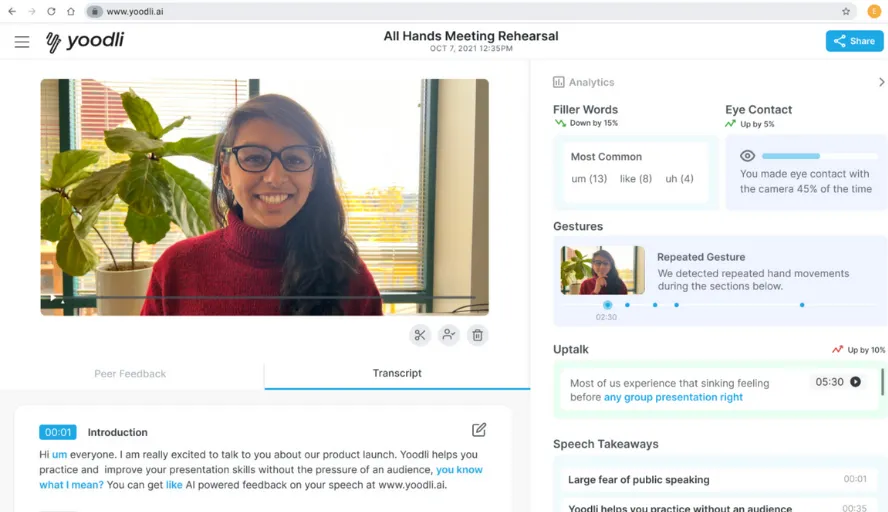
Yoodli is a communication coaching platform that does some sales roleplay
Yoodli is the most well-known platform in adjacent communication coaching territory. The company started as a public speaking and presentation coach (used by Google, Snowflake, Databricks for executive communication training) and expanded into sales roleplay as the category matured. The platform's roots show in what it evaluates: pacing, filler words, eye contact, tone, clarity, and presentation effectiveness rather than methodology adherence or deal progression.
For individual reps practicing public speaking, interview prep, or presentation rehearsal, Yoodli is excellent. For enterprise sales orgs running structured training and certification, Yoodli stops short of what enablement teams need. The platform has limited native CRM integration, evaluates conversations primarily on delivery rather than methodology adherence, and does not simulate post-call workflow execution.
What Yoodli actually does
- Real-time speech feedback: evaluation of pacing, clarity, filler words, eye contact, tone
- AI roleplays with dynamic follow-up questions: interactive conversations with context-relevant follow-ups
- Multi-persona simulations (up to 3 personas): buying committees and panel-style interactions
- Multi-use-case scope: sales onboarding, pitch certification, manager training, interviews, public speaking
- Enterprise compliance: SOC 2 Type 2, GDPR, SSO, SCIM, LMS integration
- Self-serve pricing with public tiers: transparent pricing from free tier to enterprise
What Yoodli users praise about communication coaching
- Real-time speech feedback is granular and actionable. Reviewers consistently call out depth of feedback on pacing, filler words, eye contact, and clarity as the strongest feature.
- Easy adoption across diverse use cases. Works for sales practice, interview prep, public speaking, and manager training, making it valuable across multiple scenarios.
- Enterprise customer base in communication training. Google, Snowflake, Databricks, Korn Ferry, and Sandler use Yoodli, signaling enterprise-grade reliability.
Where Yoodli users hit friction with sales-specific limitations
- Feedback evaluates delivery, not deal progression. Yoodli evaluates how a rep speaks rather than whether the rep handled objections, qualified opportunities against MEDDIC or BANT, or advanced the deal.
- Limited connection to real deals and CRM data. Roleplays start from generic prompts or user-created scripts. No native way to generate a scenario from a specific deal a rep is working on.
- Methodology-aligned scorecards are not native. No pre-built scorecards for SPIN, BANT, MEDDIC, MEDDPICC, or Challenger.
What to know before signing with Yoodli
- Confirm the use case is communication, not deal-progression coaching. Yoodli excels at communication and presentation practice. Teams needing methodology-aligned scoring, CRM-grounded scenarios, or live call scoring should evaluate Outdoo AI, Hyperbound, or Mindtickle.
- The enterprise tier requires a sales conversation. Individual and team tiers are self-serve with published pricing. Enterprise deployments with SSO, SCIM, LMS integration require engaging sales.
- Plan for the standalone-platform tradeoff. Yoodli operates as a standalone communication tool rather than part of a broader enablement system.
Yoodli's tiered pricing from free to $20 per month Pro to enterprise
Yoodli publishes pricing publicly on yoodli.ai/pricing.
- Free plan: limited roleplays, no credit card required
- Pro plan: approximately $20 per month (annual billing saves up to 40%)
- Advanced plan: higher usage and unlimited roleplays
- Enterprise plan: custom pricing including SSO, SCIM, LMS integration, custom roleplays
Considering Yoodli alternatives? Read our complete guide to Yoodli alternatives.
11. Kendo AI: Best for SMB teams seeking transparent usage-based pricing
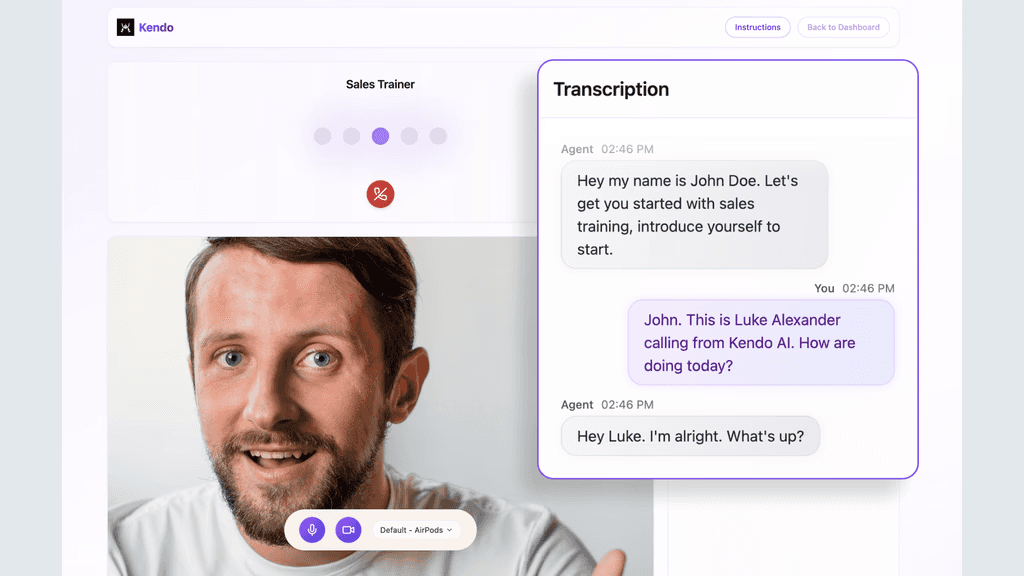
Kendo AI is the rare AI roleplay platform with transparent published pricing built for SMB self-serve
Kendo AI is the newest entrant on this list to gain meaningful market traction, and its positioning is built around a specific gap most platforms ignore: SMB-friendly pricing transparency. Where Mindtickle requires $47K-$82K annual commitments and most enterprise platforms require sales conversations to see any pricing, Kendo publishes usage-based pricing on the website starting at $55 per month for 3 hours of AI training.
The transparent pricing model serves a real category gap. For SMB sales teams that cannot run multi-stakeholder enterprise procurement, the ability to evaluate Kendo on the website, see exact costs, and start practice within 10 minutes is a meaningful advantage. The tradeoff is that Kendo is intentionally SMB-focused. Enterprise depth on methodology scorecards, CRM integration, conversation intelligence ingestion, and compliance certifications is less developed than the platforms above.
What Kendo AI actually does
- Live AI roleplays: real-time practice with AI buyer bots
- Custom prospect builder: configurable industry, persona, voice, and objection styles
- B2B and B2C training modes: support for both enterprise sales and consumer-facing motions
- Real-time scoring: immediate feedback on conversations
- Transparent usage-based pricing: $55/month for 3 hours, $0.33/minute overages
- Fast self-serve onboarding: 10-minute trial without sales conversation
What Kendo AI users praise about transparency and accessibility
- Pricing transparency is genuinely rare in this category. Public usage-based pricing is the most accessible in AI sales roleplay, especially for SMB teams that cannot procure through demo cycles.
- Time to first practice is unusually fast. 10-minute trial with no sales conversation removes friction common to enterprise procurement.
- B2B and B2C modes broaden the use cases. Coverage of both motions makes Kendo a fit for diverse SMB businesses.
Where Kendo AI users hit friction with enterprise depth limitations
- Methodology-aligned scorecards are not pre-built at enterprise depth. While custom scoring criteria can be configured, the platform does not ship with pre-packaged SPIN, BANT, MEDDIC, MEDDPICC, or Challenger scorecards at the depth enterprise teams need.
- CRM integration scope is limited compared to enterprise platforms. Native integration depth with Salesforce, HubSpot, and Pipedrive is less developed than Outdoo AI, Mindtickle, or Hyperbound.
- Compliance posture is less publicly emphasized. SOC 2, GDPR, HIPAA, CCPA certifications are not currently emphasized in public materials at the level required by regulated procurement.
During your Kendo AI evaluation
- Validate SMB fit, not enterprise stretch. Kendo is purpose-built for SMB self-serve. Teams running structured methodology programs, compliance training, or multi-stakeholder enterprise sales should evaluate the larger platforms on this list.
- Understand the usage-based pricing math. $55/month for 3 hours is accessible, but $0.33/minute overages add up quickly for high-volume practice teams. Model actual usage to compare against fixed-fee platforms.
- Plan for the integration limitations. SMB teams without deep CRM dependencies will find scope sufficient. Teams expecting CRM-grounded scenarios or live call scoring should set expectations accordingly.
Kendo AI's transparent usage-based pricing starting at $55 per month
Kendo AI is the only platform on this list with fully public per-minute pricing.
- Starter: $55 per month for 3 hours of AI training
- Overage pricing: $0.33 per minute beyond included hours
- Custom enterprise tier: for larger deployments with custom requirements
- No annual commitment required at entry tier: monthly pricing available
12. FullyRamped: Best for teams already in the Gong ecosystem
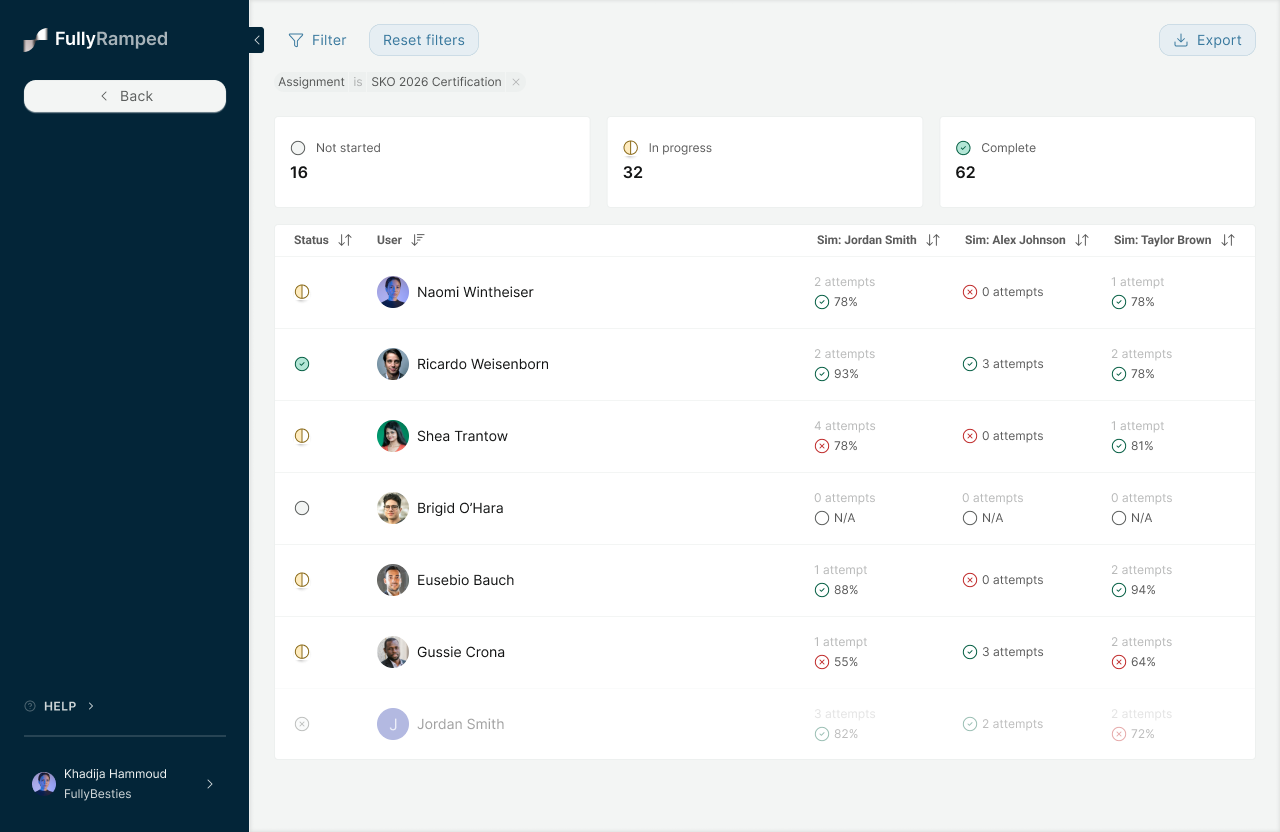
FullyRamped is the newest entrant and the Gong integration is the whole pitch
FullyRamped is the newest of the 12 platforms in this comparison and has built its differentiation around a specific positioning: Gong-native AI sales roleplay. Where most platforms generate scenarios from uploaded materials or generic prompts, FullyRamped pulls directly from Gong call recordings to create "AI twins" of real customer calls that reps can practice against repeatedly.
The integration depth is the platform's whole story. FullyRamped requires existing Gong infrastructure to deliver full value, making it a strong fit for teams already deeply embedded in the Gong ecosystem but a less obvious choice for teams not already running Gong. The platform also emphasizes white-glove implementation, which contrasts with self-serve onboarding common to SMB-focused tools.
What FullyRamped actually does
- Gong integration as the core feature: pulls real call recordings from Gong to generate "AI twins" of difficult conversations
- AI twins of real calls: reps practice against simulations built from actual customer interactions
- Custom AI scorecards: scoring frameworks configured per customer and use case
- Multi-language support: practice runs in multiple languages
- White-glove implementation: vendor-supported setup and configuration, not self-serve
- Voice-led practice: primary modality is voice, with limited chat roleplay
What FullyRamped users praise about Gong integration depth
- Real call training is genuinely differentiated. Practicing against AI twins of actual customer calls makes preparation feel more relevant and grounded in real deal context than generic AI buyers.
- White-glove implementation reduces enablement workload. For teams without dedicated enablement resources, vendor-supported setup is a meaningful advantage versus platforms requiring internal bot library buildouts.
- Strong fit for Gong-committed enterprise teams. Organizations already running Gong find the integration depth a natural extension of their existing infrastructure investment.
Where FullyRamped users hit friction with platform breadth limitations
- Self-serve bot creation is not available. Creating new bots requires vendor support, limiting agility compared to platforms where enablement teams can configure bots in minutes.
- Chat roleplay coverage is limited. Voice-first design means chat-based objection drills and quick practice modes are less developed than platforms with full multi-modal coverage.
- Gong dependency limits the addressable market. Teams not already running Gong get materially less value from FullyRamped.
What to know before signing with FullyRamped
- Confirm Gong infrastructure is in place and committed. FullyRamped's value proposition is built on Gong integration. Teams without Gong, or teams considering switching conversation intelligence platforms, should validate the Gong commitment before signing.
- Plan for the white-glove implementation tradeoff. Vendor-supported setup reduces internal workload but also means less internal control over bot creation, scenario updates, and ongoing iteration.
- Evaluate against established platforms with broader coverage. As an emerging platform, scenario library breadth, chat modality, and self-serve flexibility are still developing.
FullyRamped's demo-gated tiered pricing with minimum seat requirements
FullyRamped does not publish pricing on the website. Based on third-party analysis:
- Free trial: available for initial evaluation
- Business tier: custom pricing with a minimum seat requirement (commonly cited as 5 seats)
- Enterprise tier: custom pricing for larger deployments with full integration scope
- Implementation: white-glove setup included
- Demo-led access: all paid tiers require engaging FullyRamped's sales team
How to choose the right AI sales roleplay tool?
No single AI sales roleplay tool wins across every category. Each platform is built around a different strength, so the right choice depends on the gap your team is actually trying to close.
Use the questions below as a buying filter. Start with the ones that matter most to your team, rather than treating all criteria equally.
1. Are you a small team or an enterprise organization?
If you are a team of 1-15 reps, prioritize transparent pricing and fast onboarding. Yoodli ($20/month), PitchMonster ($19/month), and Kendo AI ($55/month) all offer self-serve onboarding and published pricing. If you are a team of 50+ reps with defined methodology and CRM-integrated workflows, prioritize Outdoo AI, Mindtickle, or Quantified, all designed for enterprise scale but with longer evaluation cycles.
2. Do you need to score real customer calls, not just simulated practice?
If yes, your shortlist narrows to Outdoo AI, Hyperbound, Mindtickle, and Zenarate. All four integrate with dialers or conversation intelligence systems to score live calls. Hyperbound is most SDR-focused. Mindtickle is broadest for enterprise. Outdoo AI scores roleplay practice and live customer calls on the same scorecard, which is useful when you want direct comparability. Zenarate added live call scoring after its Bright merger, focused on contact center motion.
3. Is demo call simulation with screen sharing a hard requirement?
For AE teams that rely heavily on product demos, voice-only roleplay is not enough. In that case, Outdoo AI and Hyperbound are the stronger fits. Avarra, Second Nature, and most other platforms in this list are less suitable if demo simulation is a core requirement.
4. Does your team run on a defined sales methodology?
If your team uses MEDDIC, MEDDPICC, SPIN, BANT, Sandler, or Challenger, look for platforms with pre-built methodology scorecards. Outdoo AI offers pre-built and custom scorecards. Mindtickle and Quantified support methodology-aligned certification through broader enablement. Avarra's Socratic coaching approach is intentionally non-numeric and may not be the best fit when managers need methodology-tied scoring.
5. Do you need CRM-grounded scenarios or enablement-built scenarios?
Enablement-built scenarios (uploaded playbooks, battle cards, scenario libraries) are easier to launch and work for most platforms in this list. CRM-grounded scenarios, pulling from real deal context, stakeholders, and current pipeline objections, are deeper but require integration setup and clean CRM data. Outdoo AI is the platform in this comparison that pulls scenarios from live CRM data most natively.
6. Does post-call workflow execution matter?
Some teams struggle not with the conversation but with what happens after it: CRM logging, disposition selection, follow-up quality, process adherence. If post-call execution affects forecasting, manager visibility, or handoffs, include workflow simulation in your evaluation. Outdoo AI is the option in this comparison that simulates post-call workflow alongside conversation; other platforms cover the conversation only.
7. Are audit trails and compliance non-negotiable?
For regulated industries, financial services, healthcare, pharma, insurance, compliance matters more than roleplay realism. In these cases, Quantified is often strongest for formal assessment and auditability. Zenarate fits contact centers in regulated environments. Outdoo AI's enterprise tier covers SOC 2 Type 2, GDPR, HIPAA, CCPA, PII scrubbing, and private cloud. If you are not in a regulated industry, this criterion may be lower priority.
8. Do reps need certification gates before going customer-facing?
If your team requires certification gates, choose a platform that produces structured pass/fail outcomes. Second Nature is strong for certification-led onboarding. Quantified fits structured assessment programs. Mindtickle supports certification as part of a broader enablement suite. Outdoo AI's enterprise tier supports certification workflows. Avarra's Socratic approach is less suited to certification gating because it is designed around guided practice, not formal pass/fail assessment.
Which AI sales roleplay tool is best for your team?
The best AI sales roleplay tool depends on your specific need:
- For enterprise teams that need closed-loop coaching across practice, live calls, and post-call workflows: Outdoo AI
- For contact centers in regulated industries with compliance requirements: Zenarate
- For enterprise onboarding and certification using avatar-led practice: Second Nature
- For Fortune 500 in life sciences, pharma, and finance: Quantified
- For SDR teams that need real call scoring and dialer integration: Hyperbound
- For avatar-immersion and Socratic-style coaching debriefs: Avarra
- For high-volume SDR teams in dialer-centric outbound: Nooks AI\
- For large enterprises consolidating training, content, coaching, and readiness into one platform: Mindtickle
- For SMB teams that want low-cost pitch practice with gamification: PitchMonster
- For individual reps and small teams focused on speech delivery: Yoodli
- For SMB teams seeking transparent usage-based pricing: Kendo AI
- For teams already deeply embedded in the Gong ecosystem: FullyRamped
Most enterprise teams evaluating these platforms eventually need more than isolated improvements. The challenge is not just improving how reps practice, but ensuring that improvements carry through into real deals, methodology adherence, and measurable revenue outcomes across the customer-facing workflow.
Outdoo AI is built specifically for this challenge. The platform combines AI roleplays across chat, voice, and video modes (with screen sharing for demos), multi-persona simulations for buying committees with up to three AI stakeholders, methodology-aligned scorecards across SPIN, BANT, MEDDIC, MEDDPICC, and Challenger, live call analysis using the same scorecard as practice, multilingual support across 120+ languages, and in-call and post-call workflow simulation covering CRM logging and dispositioning. Enterprise teams use Outdoo AI to prepare before conversations, execute during live customer interactions, and complete workflows in environments that mirror actual systems, with sales coaching tied directly to deal outcomes rather than completion metrics.
If your goal is to move beyond isolated roleplay and build a system that measurably improves real performance across conversations, demos, and workflows, book a demo to see how Outdoo AI fits your environment.
Frequently Asked Questions
.svg)
Pricing ranges from free to six figures annually. Self-serve tools publish pricing: Yoodli Pro at $20/month, PitchMonster from $19/user/month, Kendo AI at $55/month. Mid-market platforms require sales conversations: Second Nature at $30-$40/user/month, Hyperbound custom with a free tier. Enterprise platforms run higher: Mindtickle averages $47K-$82K annually, Nooks AI at $4K-$5K/user/year, Quantified estimated at $85-$110/user/month. Outdoo AI uses custom tiered pricing with free plan, a flex plan which is usage-based and an enterprise plan which is custom quoted
Hyperbound is the most direct fit for SDR teams needing real call scoring through dialer integration, with under-10-minute bot setup and 25+ language coverage. Nooks AI suits dialer-heavy teams but costs ~$5,000/user/year. PitchMonster and Kendo AI fit smaller SDR teams with self-serve pricing under $60/month. Outdoo AI covers SDR plus AE motion in one platform with methodology-aligned scoring and live call coaching.
Outdoo AI, Hyperbound, Mindtickle, and Zenarate score real customer calls. Outdoo AI uses the same scorecard across practice and live calls, ingesting from Gong, Clari, or native conversation intelligence. Hyperbound scores real calls through dialer integration. Mindtickle uses its Call AI module in the Transform tier. Zenarate added live call analysis after its 2025 Bright merger. Avarra, Yoodli, PitchMonster, Kendo AI, and Second Nature evaluate only simulated practice.
Outdoo AI, Yoodli, Mindtickle, and Hyperbound support multi-persona simulations with up to three AI personas in a single scenario. Outdoo AI's scenarios are pause-and-resumable and pull from live CRM data, call transcripts, and LinkedIn profiles, so practice reflects actual stakeholder dynamics. Yoodli's scenarios are built from uploaded materials inside Yoodli's environment, not live deal data. Avarra and Second Nature primarily focus on single-persona avatar conversations.
Outdoo AI combines AI roleplay across chat, voice, and video with screen sharing, multi-persona simulations for buying committees, methodology-aligned scorecards (SPIN, BANT, MEDDIC, MEDDPICC, Challenger), and live call scoring on the same scorecard used in practice. It also simulates post-call workflow execution: CRM logging, disposition selection, and process navigation in environments that mirror actual Salesforce, HubSpot, and Pipedrive. Plus 120+ languages, 120+ integrations, and enterprise compliance (SOC 2 Type 2, GDPR, HIPAA, CCPA, private cloud).
Table of Contents
Talk to Sales
Have questions about training and enablement for your sales, CS, support, or leadership team? Let's talk.
Talk to Sales