




When AI roleplay tools like Hyperbound or Second Nature come up in a community like r/sales, you do not get a direct answer. You get a debate. One rep says AI roleplay fixed his cold call openers. Another tried a demo of the same tool, watched the bot struggle with an unexpected question, and decided the whole thing is not worth it. Both are describing real experiences, often with the same tools.
A discussion like that needs a deeper look. So we went through the Reddit threads and the G2 reviews for Hyperbound, Second Nature, and Outdoo AI, and organized what users actually say. It comes down to five questions that keep coming up: Does the AI feel like a real buyer? How much work is setup? What does it actually cost? Does the scoring mean anything? And does any of it show up on real calls? This article goes through each one, with the quotes and reviews, and gives a clear verdict at the end.

Does the AI actually feel like a real buyer?
This is where every discussion starts, because it is where most tools lose reps. The most common complaint is about practicing with general chatbots like ChatGPT. As one rep put it: “It just agrees and tells me why I’m right.” Real buyers interrupt, change topics, and push back. If your practice partner never does that, you are building false confidence, and reps know it.
The dedicated tools do better, but not evenly. Hyperbound gets strong praise for realism. Its G2 reviews (4.9 across 40 reviews) repeatedly mention bots that sound like real buyers, with real pain points and objections. One reviewer even says the AI can get aggressive on objections, then adds that real prospects do too. But reps working complex B2B deals see the gaps. The rep who opened one Reddit thread tried the demo and found it “a bit unrealistic for B2B sales role-playing” because prospects take conversations in unexpected directions. Another team was more blunt: they “found it a bit robotic” and kept looking.
[IMAGE PLACEHOLDER: reddit-thread-op-b2b-realism.png | ADD SCREENSHOT: from the r/sales thread, crop the OP (SnooPandas3811) reply saying the Hyperbound demo felt "a bit unrealistic for B2B sales role-playing" because prospects ask unexpected questions | Alt text: "Reddit comment from a sales rep finding Hyperbound unrealistic for B2B roleplay when prospects go off script"]
Second Nature gets the opposite reactions. One rep who switched from ChatGPT called it “a lot more realistic” because you can adjust voices and difficulty, so the practice does not get monotonous. But its own G2 page tells the other side. A 2.5-star review titled “Review of Jenny” says the AI wants answers phrased a very specific way, not how the reviewer would naturally speak. Another review is simply titled “The NOT human experience.” In short: the scripted approach works until a rep goes off script the way real buyers do.
[IMAGE PLACEHOLDER: g2-second-nature-review-of-jenny.png | ADD SCREENSHOT: from Second Nature's G2 page, crop Stephanie D.'s 2.5-star review titled "Review of Jenny" (says the AI wants answers phrased a very specific way, not how she would naturally speak) | Alt text: "G2 review of Second Nature describing the AI expecting answers phrased in a specific scripted way"]
The pattern behind both complaints is the same: realism breaks when the persona is generic. Outdoo AI avoids the problem by not starting from a generic persona at all. Roleplay agents are built from your own calls, transcripts, playbooks, or even a prospect’s LinkedIn profile. So the AI pushes back with your customers’ actual language and objections. And the practice is not limited to voice: video roleplays with lifelike avatars, including screen sharing, cover the face-to-face and demo conversations avatar-led tools are known for. A sales advisor on G2 describes practicing “real-world conversations and objections against dynamic AI digital twins” instead of awkward generic drills. A GTM leader at Cloudflare said the same thing about complex conversations: “Practicing against an AI that pushes back like a real engineer changes how you walk into the actual conversation.”
The honest verdict on realism: Hyperbound earned its reputation in structured outbound calls, and Second Nature holds up while reps stay close to the script. But personas built from your own calls hold up everywhere, including cold call drills, which Outdoo runs as back-to-back call blitzes against personas made from your real prospects, and especially in conversations that wander, which is most B2B conversations.
How much work before reps can actually practice?
This question gets less attention, but it decides whether a tool gets used at all. In the threads, an AE who moved from inbound to outbound says Hyperbound gave him “more structure in how to approach cold calls.” In the same comment, he mentions their tools team needed outside developers to build the right AI personas. Hyperbound’s own documentation is upfront about this: your first bot takes minutes, but the full setup of personas, modules, and real-call scoring averages around two weeks.

Second Nature does well here, and reps say so. Its course editor gets specific praise in the threads for cutting scenario building from hours or days down to minutes, as long as your L&D team owns the content upkeep. The friction shows up on the rep side instead: one low-star G2 review complains that mandatory sessions take too much time when they land in the fourth quarter of the fiscal year. Admin-side speed and rep-side time cost are two different questions.
Outdoo removes the setup project for most cases. Agents are generated in one click from a real call, a transcript, a document, a LinkedIn profile, or a single prompt. Prompt-level controls update personas at scale without manual rework. Setup is a solved problem in this category. The difference is whether solving it takes an enablement project or a click.
What does it cost, and why is that so hard to find out?
No question frustrates buyers more, partly because the answers only exist in threads. When someone asked what Hyperbound costs per seat, the answer came from another user’s memory: “I think it’s around $15k USD for the license,” with a note that he did not know the user limit. That a buyer has to learn pricing from a stranger’s recollection is the complaint in itself. Current third-party reporting lands in the same range for enterprise plans. On the plus side, Hyperbound does offer a genuinely useful free tier of pre-built bots.
Second Nature is custom quote only. User reports put it around $30 to $40 per user monthly for mid-market teams. Its own reviewers say the trade plainly: one G2 review is titled, in full, “Strong B2B Call Training: Effective but Pricey and Setup-Intensive.” The sharpest verdict in the thread came from someone at a 600-person company that switched away entirely: “Second nature pricing is ridiculous.”
[IMAGE PLACEHOLDER: g2-second-nature-pricey-setup-intensive.png | ADD SCREENSHOT: from Second Nature's G2 page, crop Jyoti C.'s review titled "Strong B2B Call Training: Effective but Pricey and Setup-Intensive" | Alt text: "G2 review titled Strong B2B Call Training Effective but Pricey and Setup-Intensive"]

[IMAGE PLACEHOLDER: reddit-thread-pricing-exchange.png | ADD SCREENSHOT: from the r/sales thread, crop the exchange where Overall_Cabinet8702 asks "What is the cost per seat?" and the deleted user replies "around $15k USD for the license"; include Many-Bug-2738's "Second nature pricing is ridiculous" comment in the same or a second crop if it fits | Alt text: "Reddit thread comments discussing Hyperbound license pricing and Second Nature cost complaints"]
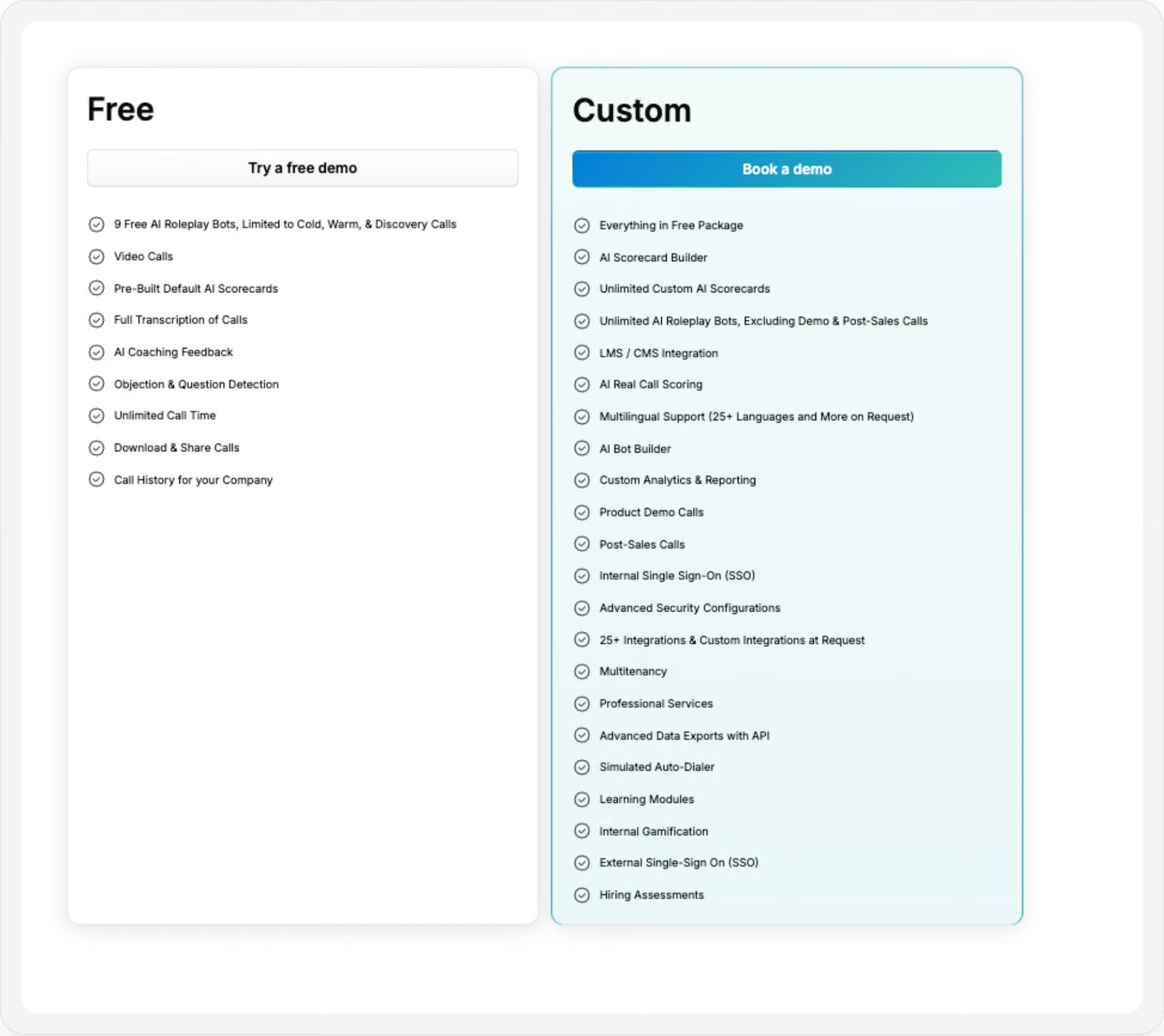
Outdoo publishes its pricing structure: a Free plan with limited credits and unlimited team members, a usage-based tier as you scale, and custom-quoted Enterprise plans for full integration and compliance scope. A team can start practicing today without booking a sales call, which is exactly what those threads keep asking for.
On pricing clarity, there is not much of a contest: two custom quotes you learn about from strangers on Reddit, and one published structure you can start on today. Whether the usage-based math works for your team at scale is worth checking, but at least you can check it.
Does the score actually mean anything?
Scoring is where reps split the most. One side of the thread likes Second Nature’s scoring, in exactly these words: “It makes it feel like I’m actually improving.” The other side, echoed across its G2 reviews, finds the scoring strict when reps deviate from expected script keywords. That works for certification accuracy. It frustrates reps who are naturally good talkers.
Hyperbound’s configurable scorecards get praise for matching playbooks. The limits its own fans mention sit at the analytics layer: one director running 100+ SDRs notes the global dashboards his org needs do not exist yet, and another reviewer wishes the reporting page were slicker. Small complaints on their own, but they land exactly where enterprise coaching programs live.

Now look at what that rep actually said: it feels like improving. That is the ceiling of a practice-only score. Outdoo’s scoring is built to go past it. The same AI scorecard, aligned to MEDDIC, SPIN, BANT, Challenger, or your own methodology, evaluates both roleplays and live customer calls. So a practice score and a real-call score are directly comparable. An account executive on G2 describes exactly this: he tracks his scores daily, weekly, and monthly, and watches his objection handling improve on real work, not just in rehearsal. Feeling like you are improving becomes seeing that you are.
That is the line worth drawing on scoring: a score you can compare against live calls beats a score that feels good in the practice room, whichever tool produces it.
Does any of it show up on real calls?
This is the question that settles the others, and the one the skeptics in every thread are really asking. A realistic bot, fast setup, fair pricing, and a clean score still add up to nothing if behavior on live calls does not change. To be fair, the reviews show these tools moving real numbers: Second Nature reviewers describe measurable gains for reps who started behind, and low-performer improvement visible within a month. Hyperbound reviewers credit faster ramps and more confident cold callers. What none of the practice-only tools can show is the connection itself. The session ends, and whatever happens on live calls is measured somewhere else, by something else, if at all.
Outdoo is built as a closed loop for exactly this handoff. Practice scores and live call scores sit on one rubric. Post-call analysis checks whether the practiced skill actually showed up in the real conversation. Gaps trigger targeted micro-roleplays instead of another generic module. And training goes past the conversation itself: workflow simulation lets reps practice the logging, disposition, and data entry that follow a call, in environments that mirror the team’s real systems. Voice-led AI Tutors turn playbooks and SOPs into interactive training that tests whether someone can actually use the material, not whether they clicked through it.
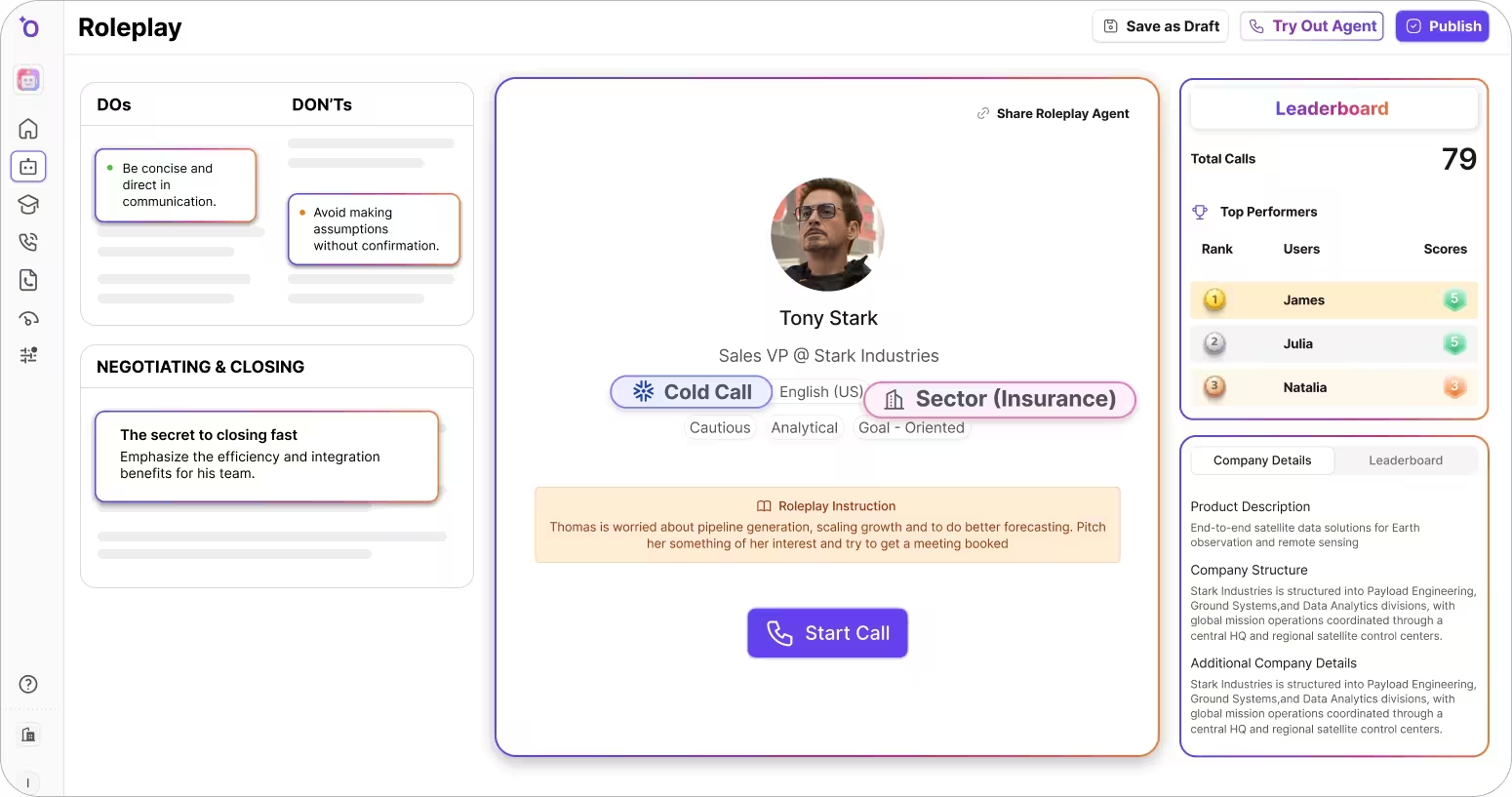
And the two jobs the other tools specialize in are both native here. For the SDR motion, reps run call blitzes: back-to-back voice drills against changing buyer personas, all scored on your rubric. For structured onboarding, teams build courses with branded certifications, exportable to any LMS via SCORM. Neither lives in a silo. Blitz scores and certification results feed the same readiness picture as live call performance.
[IMAGE PLACEHOLDER: outdoo-g2-review-md-a-roleplay.png | ADD SCREENSHOT: from Outdoo's G2 page, crop Md A.'s (sales advisor) 5-star review dated 6/18/2026 titled "Hyper-Realistic AI Roleplay That Bridges Training and Real-World Execution" | Alt text: "G2 review of Outdoo AI describing hyper-realistic AI roleplay bridging training and real-world execution"]
[IMAGE PLACEHOLDER: outdoo-g2-review-roysten-d-scoring.png | ADD SCREENSHOT: from Outdoo's G2 page, crop Roysten D.'s (Account Executive) 5-star review titled "Elevates Call Mastery and Sales Efficiency" (daily, weekly, monthly score tracking) | Alt text: "G2 review from an account executive on Outdoo AI roleplay and call score tracking over time"]
Third-party signals point the same way. Outdoo AI holds a 4.6 rating across 169 reviews on G2, with badges including Highest User Adoption and Momentum Leader, and it was ranked #1 for satisfaction in G2’s AI Sales Roleplay Tools category in May 2026. Hyperbound’s G2 reviews and Second Nature’s G2 profile (4.6 across 300+ reviews) are worth reading in full, for the same reason this article leans on user discussions: the marketing pages all sound alike, and the users do not.
The verdict the debate points to
Here is where each platform lands across the five questions:
Read as a debate rather than a directory, the outcome is not that Hyperbound or Second Nature are weak. Hyperbound is a respectable pick if you want a dedicated point tool for cold call drilling and nothing beyond it. Second Nature is a respectable pick if avatar-led courses are your entire use case. But notice that you are not actually forced to trade specialties: Outdoo runs SDR cold call drilling natively through call blitzes, runs certification programs natively with SCORM export to any LMS, and connects both to live-call performance on one scorecard. Reps’ own criteria keep pointing the same way: realistic personas built from real deals, scores that hold up against live calls, and proof, not a feeling, that the training worked. That is the standard Outdoo was built against, and it covers both specialties on the way.
Whichever way you lean, take the thread wisdom with you: demos all look good. Pressure-test the exact scenario your team struggles with, ask what setup really involves, and get pricing in writing before the trial ends.
If you want to see roleplays built from your own calls and scored against your methodology, schedule a demo with Outdoo AI.
Frequently Asked Questions
.svg)
They aim at different kinds of realism. Hyperbound is known for voice realism on cold and warm calls, which suits SDR practice. Second Nature uses lifelike avatars with adjustable moods, which suits structured scenario practice. Reps handling complex B2B conversations report gaps in both when the AI faces unexpected directions, which is where roleplays generated from real calls and deal context hold up better.
Neither publishes pricing. Hyperbound offers a free tier with pre-built bots, with enterprise plans reported by users at roughly $15K per year and up. Second Nature is custom quote only, with user reports around $30 to $40 per user monthly for mid-market teams. Outdoo offers a Free plan with limited credits and unlimited team members, a usage-based tier, and custom-quoted Enterprise plans.
Both handle it well in different ways. Hyperbound is a strong pure-play for high-volume cold call drilling. Outdoo covers the same motion through call blitzes, back-to-back voice roleplay drills scored on your rubric, and connects those scores to how reps perform on live calls, so drilling and real-call improvement are measured together.
Three things: roleplays are created from your own calls, transcripts, playbooks, or LinkedIn profiles rather than generic personas; the same AI scorecard applies to practice and live customer calls so improvement is verifiable; and training extends beyond conversation into workflow simulation and voice-led AI Tutors.
Hyperbound is built primarily around the sales motion. Second Nature extends into support and HR use cases. Outdoo is designed for customer-facing teams broadly, including support, success, claims, onboarding, and L&D, with 74+ languages and enterprise compliance for regulated industries.