



Who Is Highspot Best For?
- Highspot: Best for enterprise teams whose top priority is content governance, digital sales rooms and deal-risk signals. Deal Agent's live pipeline signals are its strongest piece.
- Highspot AI Role Play: Best for teams already on Highspot that want practice built from their own content and live deal context. It sits in the middle 'Better' pricing tier.
- Outdoo AI: Best for teams where practice quality and coaching depth are the point. One scorecard grades roleplay and live calls, with multi-persona, gatekeeper and video avatar practice.
| At a glance | Highspot |
|---|---|
| Best for | Enterprise teams whose top priority is content governance, digital sales rooms, and deal-risk signals |
| Pricing | Quote-only; real contracts run roughly $16K to $178K/year (median ~$60K), plus $15K to $45K in setup fees |
| Rating | 4.6/5 on Capterra (75 reviews); 4.7/5 on G2 (1,206 reviews) |
| Watch for | Interface reviewers call "outdated," plus a pending Seismic merger that adds roadmap uncertainty |
What Is Highspot?
Highspot (highspot.com) is a sales enablement platform, not a roleplay company that added enablement later.
The product is built around four pillars: sales content management and digital sales rooms, sales plays and playbooks for buyer engagement, training and coaching (including its AI Role Play product), and a set of AI agents. Those agents are Highspot's current headline positioning.
GTM Agent, launched in its Spring 2026 release, identifies content and training gaps and turns strategy into rep-level action.
Deal Agent surfaces deal-risk signals and next-step recommendations, and as of the Summer 2026 Launch it works directly inside Slack and Salesforce, delivering deal-specific feedback to reps after every call.
AI Role Play, the piece most relevant to a comparison with Outdoo AI, got its own expansion in that same Summer 2026 Launch, adding deal-simulation scenarios.
On February 12, 2026, Highspot and Seismic, its largest direct competitor, announced a definitive agreement to merge. The deal is pending regulatory approval, and both companies are marketing the combination as the presumptive category leader in sales enablement.
Until it closes, nobody, including Highspot, can tell you exactly what the combined product, pricing, or support model will look like. That's a real question worth asking in any active evaluation, not a hypothetical one.
Highspot Pricing
Highspot does not publish pricing.
The pricing page lists three named tiers: "Good" (Equip and engage), "Better" (Train and practice), and "Best" (Coach and reinforce), gated by company size (1 to 30 seats up through 5,001+) and by which use cases you select: content, plays, analytics, training, coaching, or AI.
Every single CTA on that page reads "Contact sales." There is no number anywhere on Highspot's own site.
Worth flagging: AI Role Play sits in the middle "Better" tier, not the entry "Good" tier. Coaching and roleplay aren't part of Highspot's cheapest published package at all.
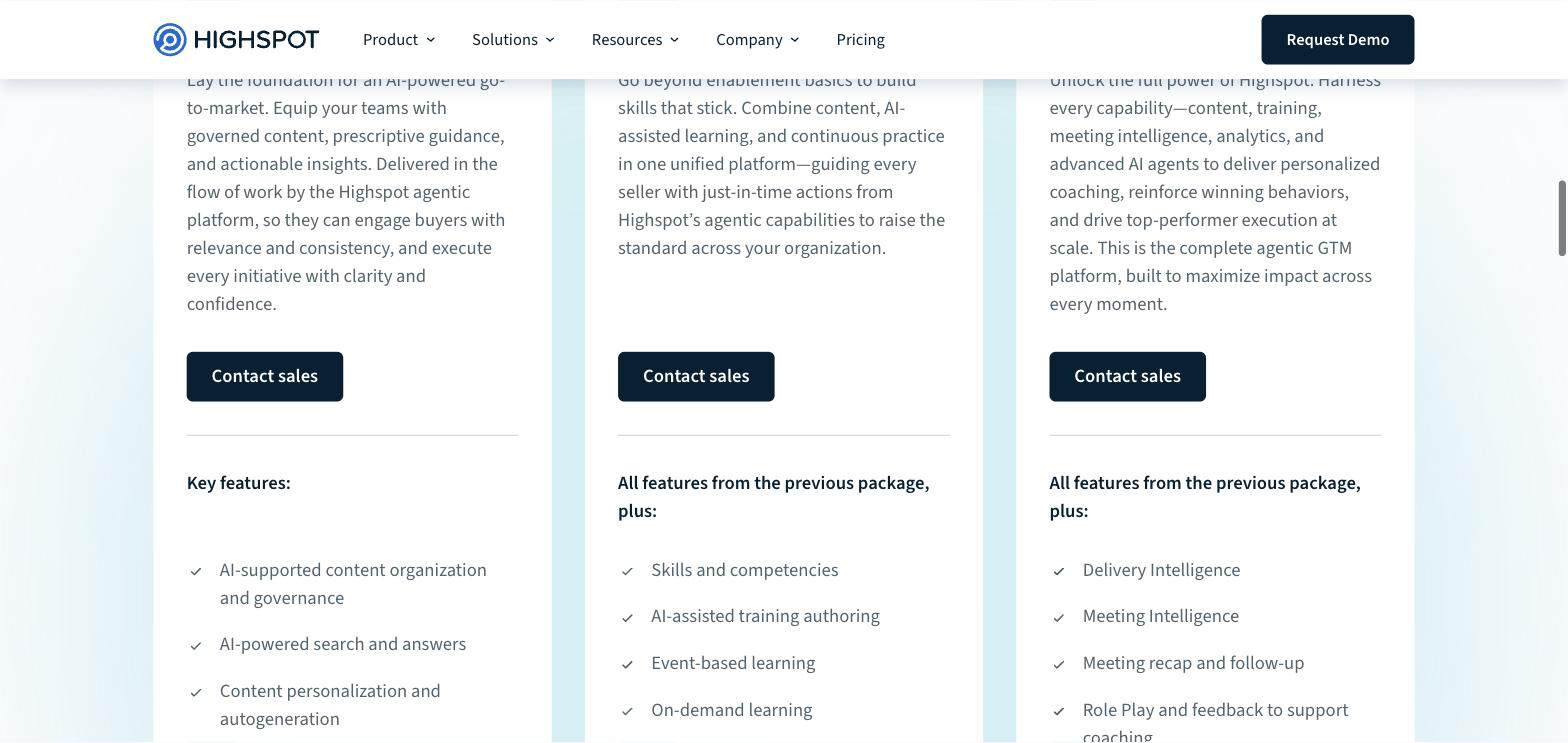
Screenshot: Highspot pricing page (Good/Better/Best tiers), captured directly from highspot.com/pricing, August 2026.
Third-party procurement data fills in the gap, and it's consistent enough across sources to be useful, even though none of it is official.
| Source | What it reports |
|---|---|
| Vendr (167 deals analyzed) | Median annual spend $60,405; range $16,163 to $178,090; average negotiated savings 14.59%; volume discounts around 50+ users |
| Flowla / Arrows.to | Enterprise contracts average roughly $91,000/year; a Business plan quoted around $1,250/month; implementation and migration add-ons of $15,000 to $45,000 common on top |
| ContentCamel | Per-user pricing of $600 to $1,200/user/year on annual-only contracts, with 50+ user minimums and $15,000 to $45,000 setup fees; a 25-person team's first-year total lands at $38,000 to $100,000 including setup |
Real buyers echo the same complaint. On Capterra, an anonymous Business Development manager gave Highspot 4 stars but titled the review "Strong but a little pricy for whats needed," writing that the cost "pushed our budget more than expected."
Read those together and the shape is clear: no public number, a 50-plus-user floor before volume pricing kicks in, and a setup fee stacked on top of the subscription in most deployments.
That's a poor structural fit if you're a mid-market team trying to prove value before committing to a multi-year, five-figure-plus contract.
Highspot Features
| Category | What it does |
|---|---|
| Content management | Sales content search, governance, and digital sales rooms. Plays and playbooks turn strategy into buyer-facing engagement. Initiative scorecards track adoption and analytics. |
| GTM Agent | Identifies content and training gaps across the go-to-market org and converts strategy into rep-level action. Launched Spring 2026. |
| Deal Agent | Surfaces deal-risk signals and recommends next steps from live pipeline data. Available inside Slack and Salesforce, delivering feedback after every call. Expanded in the Summer 2026 Launch. |
| AI Role Play | Scenarios built from Highspot's own content, messaging, and coaching guidance, plus live deal context, rather than a generic script library. Supports multi-persona practice against a full buying committee (champion, skeptic, technical buyer, economic buyer) in one session. Feedback is framed against an org's go-to-market skill framework, with progress tracked on Rep Scorecards by region, segment, or program. Expanded with deal-simulation scenarios in Summer 2026. |
| Integrations | Embedded in workflow rather than a separate app. Connects to 100+ external tools via Highspot's own MCP server, with new integrations announced for ChatGPT and Claude. |
The strongest, most differentiated piece here is the connection between Deal Agent and AI Role Play.
Building practice scenarios out of live deal context and an org's own content library, rather than a fixed rubric, is a genuine strength, and it's tied to real pipeline data at a scale Outdoo AI doesn't match today.
What Highspot's public product pages don't show: any quantified performance or ROI figures for AI Role Play, a language-count claim for multi-lingual practice, or a gatekeeper cold-call phase.
And despite reps sometimes describing Highspot's roleplay as a bolted-on partnership, Highspot's current public materials brand the whole thing as native Highspot AI Role Play, with no third-party roleplay vendor named anywhere on the product page.
Worth confirming directly with Highspot if that distinction matters to your evaluation.
What Users Say
Highspot holds a 4.6 out of 5 rating across 75 reviews on Capterra, and a similar aggregate on Software Advice. Reviewers are split on the interface.
Khyan A., a Senior Business Development Representative, praised the search: Highspot "removes a lot of friction when you're looking for the right deck, case study, or messaging."
But in that same review, Khyan A. flagged the flip side: "search results can feel a bit too broad" and the platform "relies heavily on internal discipline to stay effective."
On the interface overall, Peter M., an Account Key Manager who otherwise gave Highspot 5 stars, still flagged in his cons that the "user interface... can feel outdated."
Thumindu Apoorwa D., a Founder and Research Lead, cited "syncing delays with cloud storage" and "Dashboard customization options limited" as recurring friction points in an otherwise 5-star review.
A verified enterprise user on G2 went further, in a review titled "Poor sales experience, not suited to large enterprises": "Highspot is slowing me down and proving to be a bottleneck for daily sales tasks."
On search specifically: "Content is difficult to find. The search functionality does not show relevant results. If I search financial services, it gets confused and shows me content for a finance persona."
And on the day-to-day experience: "The UX is very clunky... The landing page looks like a rip off of Sharepoint, and the content preview a rip off of Box," adding that the mobile app was outdated enough that "I deleted it."
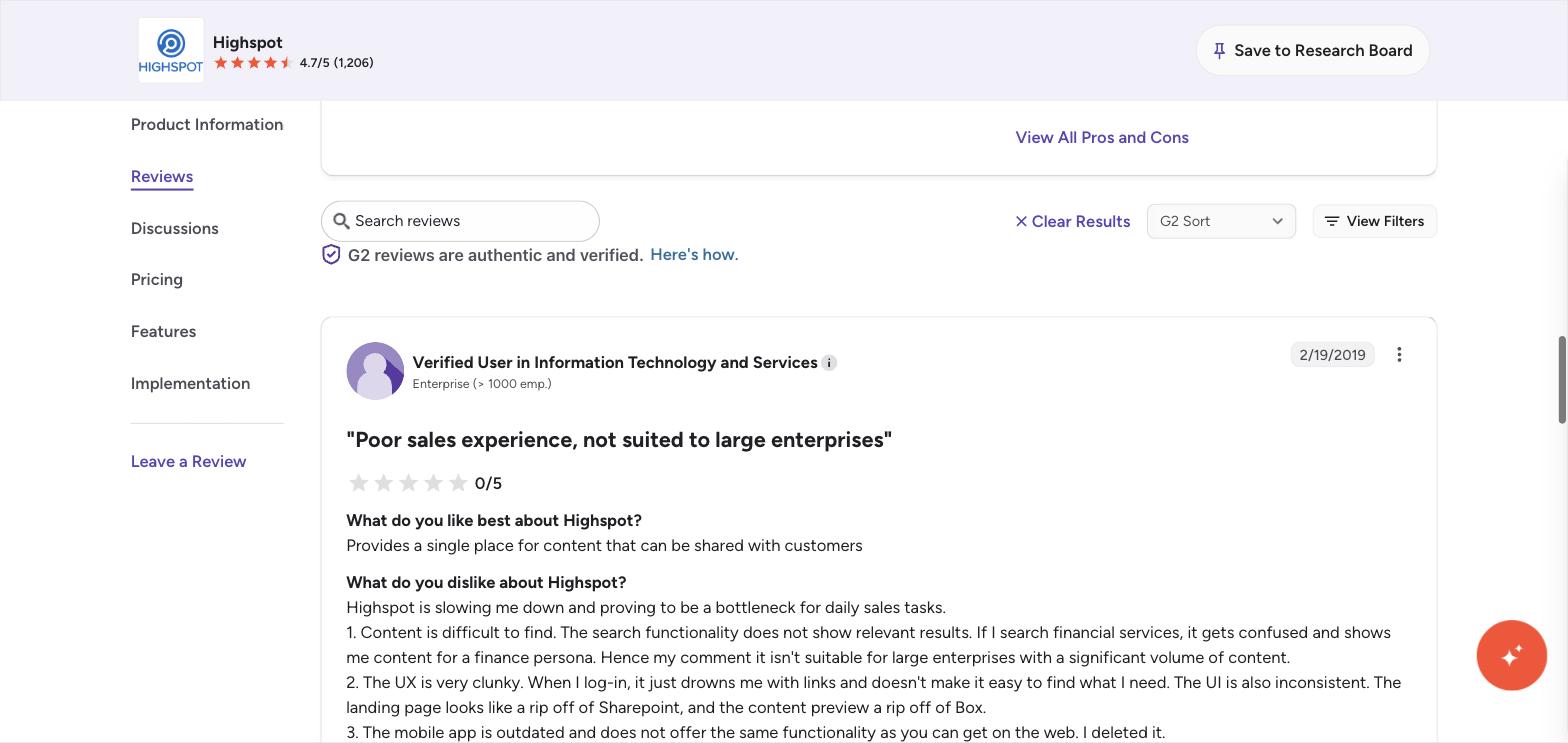
Screenshot: negative Highspot review on G2, captured directly from G2, August 2026.
That's a pattern, not a one-off gripe.
The platform works well when content is actively curated and a team knows exactly what to search for.
It gets harder to use as content volume grows and discipline slips, which is exactly the tradeoff you'd expect from a tool built primarily around housing and governing large content libraries.
Where Highspot Falls Short
Pricing opacity is the first, most avoidable friction. Five-to-six-figure annual contracts, 50-plus-user minimums, and $15,000 to $45,000 setup fees are a poor match for a mid-market team that wants to start small and prove the tool works before committing.
The interface complaints are real and specific, not vague. "Not intuitive," "can feel outdated," dashboard customization that's "limited," and search that swings between "very basic" and "almost too broad" all come directly from Highspot's own reviewers. None of that is a rumor.
Roleplay is architecturally a bolt-on inside a much bigger content suite. Highspot's own marketing still leads with content governance and Deal Agent, not coaching depth.
Its product pages show no gatekeeper cold-call phase, no video avatar practice, and no quantified performance stats for AI Role Play itself, unusual for a feature Highspot is actively promoting as a headline capability.
Its own review base underscores the point: filtering Highspot's 1,200-plus G2 reviews specifically for "role play" turns up almost nothing, a gap the "Where Highspot Wins" section below unpacks further.
And the pending Seismic merger is a legitimate near-term risk, not a manufactured one. Nobody, including Highspot, can promise today what the combined product, pricing, or support model looks like after close. If you're mid-evaluation, that uncertainty is worth raising directly.
If that uncertainty is reason enough to look beyond Highspot altogether, our guide to Highspot alternatives covers the wider field.
Where Highspot Wins
Give Highspot its due, because parts of this are real advantages, not sales-page noise.
Deal Agent's real-time CRM and deal-risk signal maturity is a meaningfully deeper capability than Outdoo AI's roleplay-adjacent scoring today.
It's tied to live pipeline data at a scale Outdoo AI doesn't yet match, and tying roleplay scenarios to that same live deal context is a smart move.
Highspot is also a full content management and sales-enablement platform, not a roleplay tool with extras bolted on.
For a buyer whose primary need is content governance, search, and digital sales rooms, with roleplay as a secondary ask, Highspot wins outright.
That's a different buyer than the one evaluating Outdoo AI, and it's worth being honest about that.
Enterprise trust signals matter too. A 2025 Gartner Magic Quadrant Leader placement for Revenue Enablement Platforms, an established compliance posture, 100+ integrations through its own MCP server, and, post-merger, the combined scale and resourcing of two market leaders will out-muscle a smaller vendor on an RFP checklist at the largest accounts.
Highspot already has real enterprise logos and review volume that a newer platform can't match on pure social proof yet.
That volume is worth one caveat, though. Most of it predates or sits outside the roleplay feature specifically. On G2's own AI Sales Roleplay category, the exact category Highspot is also listed under, Outdoo AI ranked #1 for Highest User Adoption in the Fall 2026 reports, a narrower but more directly comparable signal for a roleplay-specific evaluation than total review count.
How Outdoo AI Compares
Highspot's breadth is real, but it comes at the cost of depth in the one area that matters most to a buyer evaluating roleplay specifically: does practice reflect what your team actually sells, and does it tie back to real coaching outcomes.
Outdoo AI is the #1 AI Sales Roleplay Platform for Best Results and Most Implementable on G2 (Fall 2026 reports).
Outdoo AI builds roleplays and scorecards straight from a team's own calls, transcripts, playbooks, and battlecards, and even from a rep's LinkedIn profile, not from a vendor-housed content library.
One scorecard grades both roleplay practice and live calls, so a coaching leader can show that practice moved a real revenue metric, not just a completion count.
Outdoo AI also scores the post-call CRM and workflow logging inside the same practice session, using workflow simulation that Highspot's Deal Agent only approaches from the outside, as a risk signal, rather than simulating directly.
On format, Outdoo AI supports multi-persona roleplay for committee-based deals, a gatekeeper phase for cold-call screening, and video avatar practice with screen-share scoring, none of which currently appear on Highspot's public feature pages.
And on commercial terms, Outdoo AI prices on usage instead of Highspot's seat-based, 50-user-minimum, setup-fee-stacked model, a real wedge for a mid-market team that wants to prove value before signing a five-figure-plus annual contract.
None of that erases Highspot's Deal Agent maturity, its content-platform breadth, or its enterprise trust signals. Those are genuine strengths for the right buyer, and the merger with Seismic will only add to its scale once it closes.
But if what's slowing your decision down is Highspot's pricing opacity, an interface reviewers call outdated, or a roleplay feature that's secondary to a much bigger content suite, that's the gap Outdoo AI is built to close.
Frequently Asked Questions
.svg)
Sales teams use it for content management and digital sales rooms, sales plays and playbooks, AI-driven deal-risk signals through Deal Agent, and training and coaching, including its AI Role Play product.
No. Highspot's pricing page lists three tiers gated by seat count and use case, and every CTA reads "Contact sales." Outdoo AI starts free with 60 minutes of roleplay credits and unlimited team members, no credit card and no sales call, then scales on usage-based Flex pricing with a custom enterprise plan for larger deployments.
Reviewers don't rate AI Role Play specifically in the review data available today, and Highspot's own pages give no quantified performance stats for it. What is clear: it's built from Highspot's own content and live deal context, supports multi-persona practice, and lacks a gatekeeper phase, video avatar mode, or workflow simulation.
It's worth asking about directly. The deal was announced February 2026 and is pending regulatory approval. Until it closes, no one, Highspot included, can confirm what the combined product, pricing, or support experience will look like.
Launched in Highspot's Spring 2026 release, GTM Agent identifies content and training gaps across the go-to-market org and turns strategy into rep-level action. It's separate from Deal Agent, which surfaces deal-risk signals from live pipeline data.
Table of Contents
Talk to Sales
Have questions about training and enablement for your sales, CS, support, or leadership team? Let's talk.
Talk to Sales