



Is Hyperbound Worth It?
- Hyperbound Free: Best for reps who want to try prebuilt practice at no cost. It includes 45 prebuilt roleplays and no published paid tier.
- Hyperbound Practice and Perform (Enterprise): Best for enterprise teams with budget and patience for a sales-driven buying process. Kota ties roleplay performance to real deal data.
- Outdoo AI: Best for mid-market teams that want practice built from their own calls. One scorecard grades both roleplays and live calls, and a Free plan comes with unlimited team members.
At a Glance
| Hyperbound | |
|---|---|
| Starting price | Free tier ($0) with 45 prebuilt roleplays; paid tiers aren't published on the site, but pricing quoted in 2026 puts the rate around $70/user/month at 50 seats and $63/user/month at 150 seats (~$42K/year and ~$113K/year), pitched as one all-inclusive rate |
| Standout feature | Kota, an AI revenue analyst tying roleplay performance to real deal data via Slack and Cmd+K, including a "why we believe this is likely to come up" reasoning panel for each recommended roleplay |
| Best fit | Enterprise teams with budget and patience for a sales-driven buying process |
| Where it falls short | No pricing transparency, reporting and analytics that reviewers say get harder to manage at scale, a strict 10-day trial, and reviewer-reported engagement drop-off after month one |
What Is Hyperbound?
Hyperbound is a company that started as an AI cold-call practice tool and has since expanded into what it now calls a "Revenue Activation Platform." The product has three connected pieces.
Practice builds custom AI buyer personas from a company's ideal customer profile so reps can rehearse cold calls, discovery, demos, and objection handling.
Perform scores live and recorded customer calls against configurable scorecards tied to a team's own sales methodology.
Kota, the newest piece, is an AI revenue analyst that sits on top of both. It answers questions about calls and pipeline through Slack or an in-app command bar, and auto-generates practice scenarios from a rep's actual skill gaps.
The company's success-stories page names enterprise customers including Vanta and Klaviyo, and it lists Salesforce AppExchange, Microsoft Marketplace, and Zoom marketplace integrations (Hyperbound success stories).
It's built primarily for B2B sales orgs that want practice and live-call coaching in one system rather than stitching together a roleplay tool and a separate conversation intelligence tool.
Hyperbound Pricing
Hyperbound publishes exactly one tier of pricing. Everything beyond it requires a sales conversation.
| Tier | Price | What's included |
|---|---|---|
| Free | $0/user/month | 45 prebuilt AI roleplays plus prebuilt example scorecards, cold/warm/discovery call practice, video roleplay calls, full transcription, AI coaching feedback. No credit card required. Trial beyond the free tier runs a strict 10 days. |
| Practice (Enterprise) | Not publicly listed, quote-based | AI sales roleplays, buyer bot customization, reporting and analytics, custom AI scorecards, custom AI coaching, Kota Ask Anything, dedicated AM and CSM. |
| Perform (Enterprise) | Not publicly listed; $70/user/mo at 50 seats ($63 at 150), vendor-quoted | Everything in Practice, plus real call scoring, deal coaching, CRM intelligence, conversation intelligence, Bite-Sized Roleplays, call capture and integrations. Marked "Recommended" on Hyperbound's own pricing page. |

Screenshot: Hyperbound pricing page, captured August 2026.
The Hyperbound pricing page only details the free tier. Historically, Practice and Perform have been sold as two separate per-user licenses, not one bundled price, and Hyperbound's own pricing FAQ confirms that structure directly.
No G2 or Capterra review we found cites an actual dollar figure, and Hyperbound doesn't publish one on its site. The clearest number available comes from the pricing Hyperbound quoted in 2026 instead: a 50-seat deal was quoted at $70/user/month, about $42,000 a year, scaling to $63/user/month, about $113,000 a year, at 150 seats. That's a real volume discount, but a small one, the per-seat rate barely moves even as headcount triples, so total cost still tracks close to linear with team size.
The rep quoting that number pitched it as one all-inclusive rate, unlimited calls, no platform fee, no onboarding fee, call recording, deal insights, and CRM automation all bundled in, without describing Practice and Perform as two separate charges. That may mean Hyperbound has simplified its licensing since the two-product split was last documented, or it may just reflect how that specific deal was scoped. Either way, if you're evaluating Hyperbound directly, ask point-blank whether the quote in front of you covers one license or two.
That's consistent with a genuinely custom-quote model, not a hidden price list. If you're evaluating Hyperbound, budget for a sales cycle before you get a real number, and expect the quote to scale with seats.
Hyperbound Features
| Category | What it does |
|---|---|
| Roleplay (Practice) | AI buyer personas generated from your ICP and competitive context in under two minutes, covering cold calls, gatekeeper screens, warm/inbound calls, discovery, demos, and multi-party roleplays for cross-functional buying committees. Managers can fill in specific prospect details to mirror real accounts. Video roleplay with full transcription in 25+ languages. |
| Scoring (Perform) | Configurable AI scorecards built around your own sales methodology, applied to both roleplay and live/recorded customer calls rather than a single fixed rubric. |
| Kota (revenue analyst) | An AI agent, launched December 2025, that surfaces objection trends, skipped questions, and coaching gaps across a team's calls via Slack or a Cmd+K interface, and auto-triggers targeted practice from live deal signals. Its Deal Dashboard recommends a specific roleplay for a specific named stakeholder on a real deal, and a "why we believe this is likely to come up" panel explains the reasoning in plain language rather than just handing over a score. |
| Team engagement | Leaderboards and gamification aimed at driving practice adoption. |
| Integrations and security | CRM and call-system integrations, an API for data export, SSO on paid plans, and listings on Salesforce AppExchange, Microsoft Marketplace, and Zoom App Marketplace. |
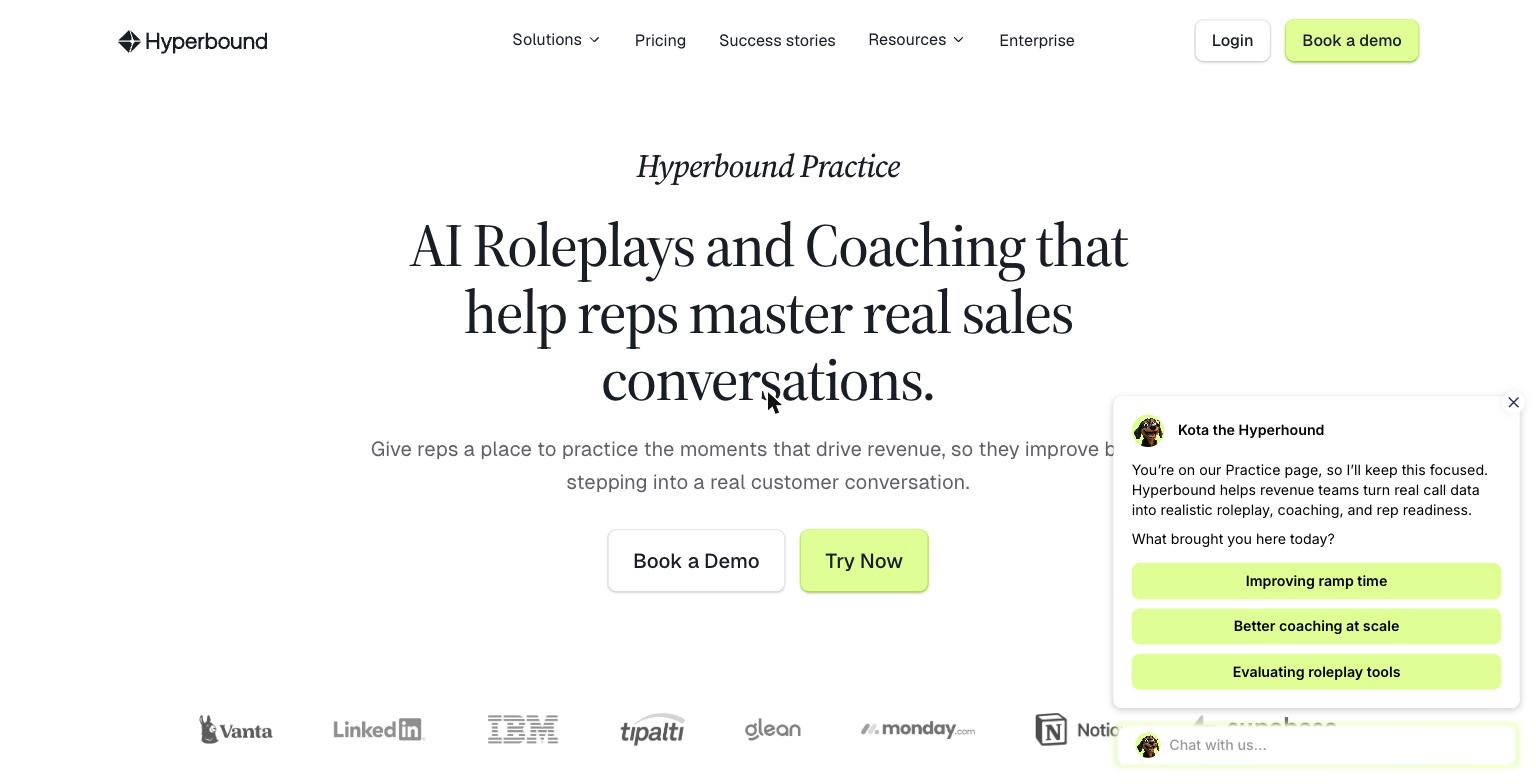
Screenshot: Hyperbound Practice product page, captured August 2026.
The strongest part of this list is the scoring layer. Grading live customer calls with the same rubric used in practice, instead of treating roleplay and real calls as separate products, is the right instinct. It is one of the key features in AI sales training software, alongside scenario creation from your own calls.
Kota pushes that further by explicitly framing coaching as something that should move deal outcomes, not just completion rates.
Reported early results from Kota adopters include a 6.9% increase in close rates, a 50% decrease in new-hire ramp time, and a 30% increase in productive talk time.
Those are company-reported figures, not independently verified, so treat them as directional rather than proof.
What Users Say
Hyperbound holds a 4.9/5 rating on G2 from roughly 38 to 40 reviews and carries a Summer 2026 Leader badge, a strong trust signal for a company this size (G2 reviews).
Reviewers on G2 are positive about the parts of the product that feel hands-on.
One verified user wrote: "The bot creation tool is spectacular, I love being able to fill in specific details about the prospect to make the conversations as realistic as possible" (G2 reviews).
Other reviews echo the same point about the leaderboard specifically: gamified rankings turn practice reps used to skip into something they show up for.
A Sales Development Representative reviewing on G2 made a similar point about speed and autonomy: "You can create lifelike buyer roleplays in minutes, get instant feedback on your objection handling or discovery skills, and iterate without waiting on a manager" (G2 reviews).
A Senior Director of Sales Strategy at ALKU credited the platform with a real shift in onboarding: "Since integrating Hyperbound into our sales process at ALKU, we have experienced a profound positive shift in the way we onboard and develop our account managers... this repeated practice has not only boosted our team's confidence but has directly contributed to closing deals more quickly" (G2 reviews).
But a recurring theme in the same review set is engagement decay. A pattern across multiple G2 and Capterra reviews describes adoption dropping off after the first month, with reps practicing once and not returning unless management forces it.
Put those two patterns together and a clear shape emerges: Hyperbound's roleplay tool works well when someone is actively building scenarios and pushing a leaderboard, and stalls once that manual push stops.
That's a real product gap, not a training problem, since a tool that only sustains engagement through gamification and management enforcement isn't yet closing the loop on its own.
Where Hyperbound Falls Short
Pricing is the first issue. There's no published starting price, and Practice and Perform are sold as two separate per-seat licenses rather than one bundled plan, so a team that wants both stacks two enterprise quotes instead of one.
That's a real friction point for mid-market buyers who want to start small and scale spend with adoption, rather than commit to per-seat licensing across two products before they've proven value.
Even happy customers say as much.
One G2 reviewer, a VP of Technology at a mid-market freight and logistics company, put it plainly: "Hyperbound does come at a cost, and is not the cheapest solution out there, but I do believe you get what you pay for in this instance. They believe in their product and price accordingly." (G2 reviews)
Second, reporting and analytics reportedly get harder to manage at scale. A Director of Customer Success at a 100+ SDR org wrote: "Our org has over 100 SDRs so what we are trying to accomplish in the platform can be unique. Because of this, there are global dashboards and analytics that we would be interested in that do not exist today." (G2 reviews)
Other reviewers echo the theme in G2's own pros/cons tally: the reporting view could be "prettier" and "more customizable," and a fast-growing bot library has no easy bulk-delete.
Third, the roleplay format's newer call types have breadth but not confirmed depth. Hyperbound's own product pages list Gatekeeper Calls and Multi-party Roleplays as named call types, and the platform confirms 25+ supported languages, so those formats do exist.
What isn't documented is how rigorously each is scored: no separately graded gatekeeper phase, and no defined cap on how many stakeholders a multi-party scenario simulates.
Fourth, and this is the pattern the reviews themselves surface, engagement isn't self-sustaining. If practice depends on a leaderboard and a manager checking in, the tool hasn't actually solved the adoption problem, it's just made it visible.
Fifth, the live-generation step has real reliability gaps. In a demo we observed directly, Hyperbound's own "AI Bot Creator" stalled mid-generation on a "crafting realistic buyer persona" screen and never resolved into a working roleplay in front of the prospect. And getting into a sandbox at all can take longer than expected: Hyperbound's stated policy is no trial access until a buyer's own founder or leadership joins a call, real friction for a team that just wants to test the product quickly.
Where Hyperbound Genuinely Wins
Credit where it's due. Kota is a real, actively-invested differentiator, not a battlecard talking point.
Fusing roleplay performance with live pipeline and deal data, and marketing it directly on close-rate lift, is a sharper "coaching moves pipeline" story than most competitors in this space currently tell, and Hyperbound shipped it in December 2025 rather than just promising it.
G2 reviewers back that up: several call Kota's saved-prompt and deal Q&A experience better than Gong's bundled AI assistant, a real endorsement for a product line that's barely eight months old.
The case studies carry specific, dated numbers instead of vague claims. Vanta reports $125M+ in pipeline influenced and 60% faster ramp; Klaviyo reports a 42% increase in new-hire productivity; JumpCloud's case study, published as recently as March 2026, cites 2x faster time to first meeting (Hyperbound success stories).
A 4.9/5 rating on G2 and enterprise logos like Vanta and Klaviyo all point the same direction: real traction, not just a pitch deck.
If you're an enterprise buyer who wants a vendor with growth and a credible roadmap tying practice to revenue outcomes, that's a legitimate reason to put Hyperbound on your shortlist.
Is Hyperbound Worth It for a Mid-Market Sales Team? How Outdoo AI Compares
For a large enterprise team with a dedicated budget for a custom quote and patience for a sales cycle, Hyperbound is a reasonable bet, especially if Kota's deal-data integration is the specific thing you're after.
For a mid-market team, the calculus changes. For a full side-by-side, see Hyperbound vs Outdoo AI.
Outdoo AI's closed-loop scoring already ships as a single feature today, not a December 2025 launch layered on top of two separate products.
One scorecard grades both roleplay practice and live calls through unified call scoring and feedback, so a sales leader can point to one number and show that coaching moved a real metric, not just a completion rate.
Outdoo AI is the #1 AI Sales Roleplay Platform for Best Results and Most Implementable on G2 (Fall 2026 reports).
Where Hyperbound's Kota generates practice from deal signals, Outdoo AI builds AI sales roleplay agents directly from a team's own calls, transcripts, playbooks, and even LinkedIn profiles from day one, not as a bolt-on analytics layer.
Outdoo AI also goes deeper on roleplay format itself. Hyperbound's product pages list Gatekeeper Calls and Multi-party Roleplays as named call types, but neither is documented as separately scored; Outdoo AI runs a scored gatekeeper phase and a defined multi-stakeholder cap for buying-committee scenarios.
Language coverage tells a similar story. Hyperbound confirms 25+ supported languages, while Outdoo AI supports 120+ languages and 74+ voices, a real gap once a team sells across regions or hires reps who aren't native English speakers.
Outdoo AI also scores the part of the job Hyperbound doesn't touch: what happens after the call ends.
Workflow simulation has reps practice the actual CRM and process logging in the same session as the conversation, so the tool covers the full job, not just the talking part.
And on pricing, Outdoo AI uses a usage-based model instead of Hyperbound's fully custom per-seat rate, which pricing quoted in 2026 put at $70/user/month at 50 seats and $63/user/month at 150, so mid-market teams can pay for training that's actually driving impact rather than committing to enterprise-scale, per-seat licensing before they know it'll stick.
None of that erases Hyperbound's real strength. Its deal-data story through Kota is newer than Outdoo AI's shipped unified scoring but conceptually ambitious, and its G2 rating and logos are genuine signals of momentum.
If your team is enterprise-scale and deal-signal integration is the priority, evaluate Hyperbound seriously.
If you're mid-market and want practice grounded in your own calls, a scorecard that follows the rep past the call, and pricing that doesn't require a sales cycle just to see a number, that's exactly the gap it fills. Outdoo AI is built for mid-market teams making that call.
Frequently Asked Questions
.svg)
There's a genuine free tier with 45 prebuilt roleplays and unlimited call time, no credit card required. Anything with real-call scoring, custom scorecards, or Kota sits behind a custom quote. Outdoo AI starts free with 60 minutes of roleplay credits and unlimited team members, no credit card and no sales call, then scales on usage-based Flex pricing with a custom enterprise plan for larger deployments.
No. The pricing page lists only the free tier. Pricing quoted in 2026 puts the rate at $70/user/month at 50 seats and $63/user/month at 150 seats, quoted as one all-inclusive rate rather than the two separate Practice/Perform licenses Hyperbound's own FAQ has historically described, worth confirming directly which structure applies to your deal.
Hyperbound recently added deal-data integration through Kota on top of two separate per-seat products.
It can work, but a custom-quote pricing model split across two separate licenses and reviewer-reported adoption drop-off after the first month are worth weighing against a usage-based alternative before you commit to a sales cycle.
Yes, with caveats. Hyperbound's product pages list Gatekeeper Calls and Multi-party Roleplays as named call types and the platform confirms 25+ languages, but neither call type is documented as separately scored the way Outdoo AI's gatekeeper phase and multi-stakeholder cap are, and Outdoo AI's 120+ languages and 74+ voices go further still.
Table of Contents
Talk to Sales
Have questions about training and enablement for your sales, CS, support, or leadership team? Let's talk.
Talk to Sales