



Who Is Second Nature Best For?
- Second Nature (roleplay plus course authoring): Best for large, multi-region enterprise teams that want practice bundled with course authoring and certification tracking. It holds SOC 2 Type II, ISO 27001 and ISO 27701.
- Second Nature (video avatar practice): Best for English-speaking teams that want lifelike single-persona video practice. Its video avatars nod, react and hold eye contact.
- Outdoo AI: Best for sales teams that want coaching tied to real call outcomes. One scorecard grades roleplays and live calls, roleplays are built from your own calls and playbooks, and voice roleplay runs in 74+ languages.
At a Glance
| Pricing | Quote-only, no public pricing page. Vendor-quoted: $50 per credit, and one credit is one user for one month, so ~$30,000/yr for 50 reps in continuous use |
|---|---|
| Reviews | 4.7/5 on G2 across 416 reviews (High Performer badge); 5.0 on Capterra from only 4 reviews |
| Built for | Large, multi-region enterprise sales/CS/service teams that want roleplay bundled with course authoring and certification |
| Recurring complaint | AI persona feedback described as "robotic"; no CRM/workflow scoring; 30+ languages vs. Outdoo AI's 74+/120+ |
What Is Second Nature?
Second Nature (secondnature.ai) is an AI-driven roleplay and training platform for sales, customer success, and service teams.
Reps talk to an AI buyer persona, most famously one named "Jenny," built from a freeform scenario description or uploaded content like a script or deck, and the AI scores the conversation right after the session with feedback on messaging, product knowledge, and delivery.
It's not sold as a standalone roleplay tool. Second Nature packages practice inside a broader learning and development suite: course authoring with video, decks, and quizzes, certification tracking, manager dashboards, and support for over 30 languages.
That positioning points at large enterprise buyers who want one system for both training content and practice, and the customer list backs that up: Zoom is a customer.
In July 2026, Second Nature added video avatar roleplay. The AI persona now nods, reacts, and holds eye contact during a session, which is a real step up in visual realism for single-persona practice.
It launched English-only, with multi-persona and scripted-roleplay video avatars announced as coming soon.
Second Nature Pricing
Second Nature does not publish pricing. There's no working pricing page on its own site, and Capterra's listing simply says "contact vendor for pricing." Every deal goes through a sales conversation.
That matters for a mid-market buyer more than it sounds. Third-party estimate roundups (not Second Nature's own disclosures) put typical deals in the range below, but treat these as outside estimates, not confirmed numbers:
| What third parties estimate | Reported range |
|---|---|
| Per-seat cost | Around $30 to $40 per seat per month, a model Second Nature does not actually use (see the credit billing below) |
| Minimum annual contract | Around $20,000, unconfirmed and not surfaced in the 2026 quote |
| Implementation timeline | About 2 months |
We're not presenting those figures as fact because Second Nature hasn't confirmed them anywhere public. What we can say with more confidence: quote-only pricing and a multi-week implementation fit how Second Nature sells to large enterprise teams.
There's also a wrinkle in how the billing actually works, and it's not a flat per-seat license the way it's often described. Second Nature bills on monthly-active-user credits: one credit is consumed for each month a licensed user is active, so 150 licensed users active across two months burns 300 credits, not 150. Data for inactive users is retained at no extra charge, so a seat that goes quiet doesn't lose its history. The trade-off is that a credit costs the same whether that active user does one roleplay session that month or thirty, so cost tracks activation, not actual practice volume.
For a mid-market buyer, that mix of cost and implementation lag is worth raising early, before a deal reaches a proposal.
If you want a number before you talk to sales, you're not going to get one from Second Nature's website.
Second Nature Features
Second Nature's feature set splits into two buckets: the roleplay engine itself, and the L&D scaffolding wrapped around it.
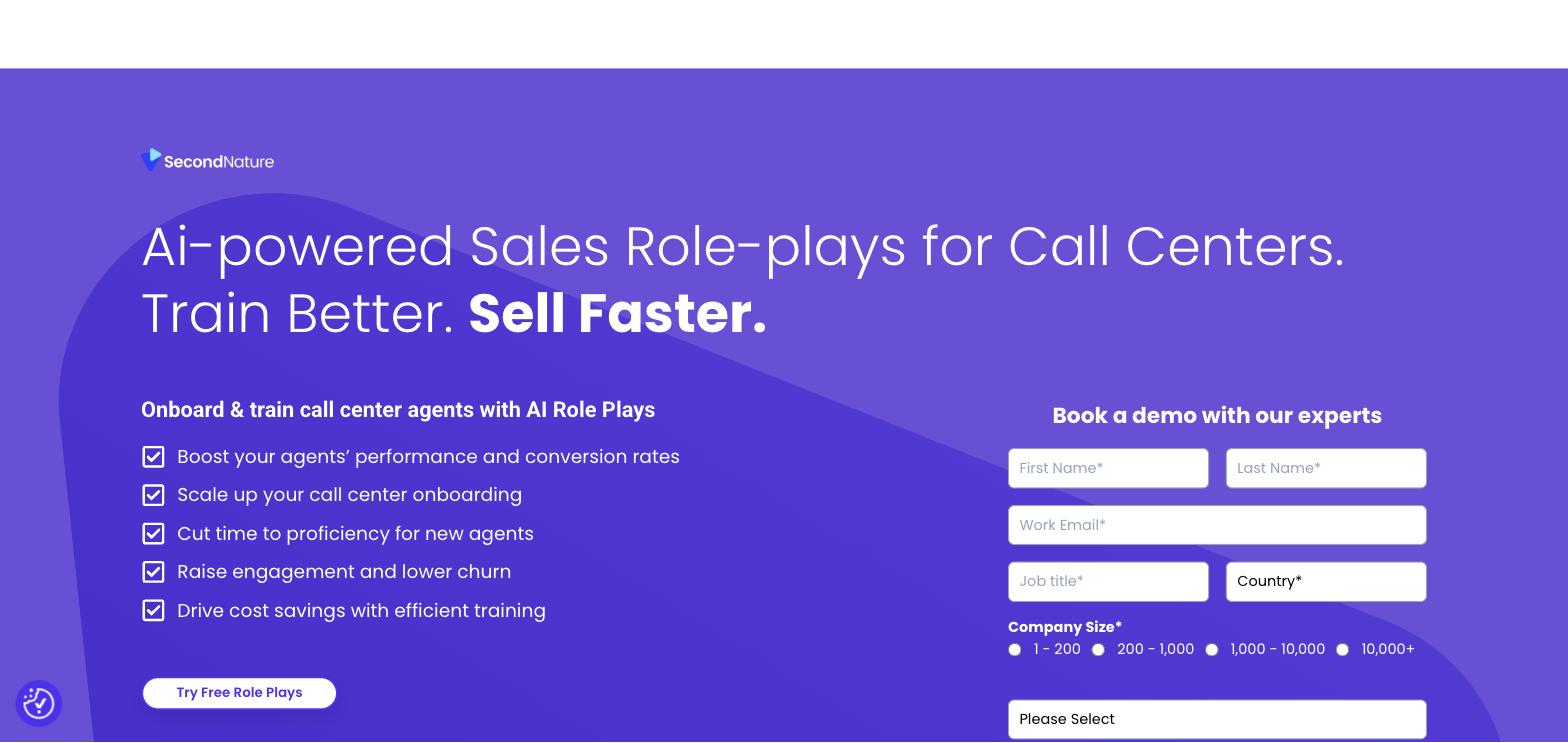
Screenshot: Second Nature's call-center AI roleplay feature page, captured directly from the vendor's site, August 2026.
| Category | What it does |
|---|---|
| Scenario creation | Describe a scenario in freeform text or upload source content (a script, deck, or call), and the AI builds a full roleplay in minutes. |
| Practice formats | 1:1, group, and chat-based roleplay, plus text, voice, and now video avatar sessions. |
| Scoring | Automatic AI feedback after every session on messaging, product knowledge, and delivery, against Second Nature's own rubric. |
| Video avatars | Launched July 2026. The AI persona reacts and holds eye contact for more lifelike single-persona practice. English only at launch. |
| Course authoring | Combine video, decks, and quizzes with roleplay practice inside one course structure, with certification tracking. |
| Manager visibility | Dashboards for tracking performance and trends across a team. |
| Deal Coach | AI guidance and risk flags on live, in-flight deals. Closer to a deal-risk assistant than a training tool, and a different job from scoring the post-call CRM workflow. |
| Language support | 30+ languages for global rollouts. |
| Access | Browser-based, mobile-friendly, no app install. |
| Security | SOC 2 Type II, ISO 27001, and ISO 27701 certified, GDPR compliant. |
The scoring and scenario-generation pieces are genuinely capable. What's missing from the table is any workflow beyond the roleplay session itself.
It doesn't touch what happens in the CRM after the call, and the rubric is Second Nature's rubric, not built from your own playbook.
What Users Say
Second Nature holds a 4.7 out of 5 rating on G2 across 416 reviews, which is a real sample size and earns it a G2 High Performer badge. Its Capterra rating is a perfect 5.0, but that's built on only 4 visible reviews, too small to treat as meaningful social proof on its own.
The reviews that are verifiable point at a consistent split. On the positive side:
"This is a very successful artificial intelligence driven tool for improving sales capabilities," according to a Capterra reviewer.
Another, listed as a co-founder, wrote: "Everything is measurable with data to back it up... data driven, measurable, and intelligent training."
On the critical side, two complaints show up that matter more than star ratings:
"This needs more languages, I had a customer in Japan that was interested but couldn't deploy with English only," a Capterra reviewer wrote.
Another, listed as a CEO, put it this way: "Sometimes talking to a robot feels a little... robotic. It takes getting used to."
That same wording shows up again, independently, from the same reviewer on SoftwareAdvice. One person, two separate review sites, one unprompted complaint. That's a corroborated pattern, not a stray gripe.
A G2 reviewer, a lab assistant at an enterprise employer, went further, giving the product a 0-star rating in a review titled "This Platform needs an overhaul": asked what they disliked, they wrote "automated voice, robotic talking, unresponsive to my responses, dehumanizing."
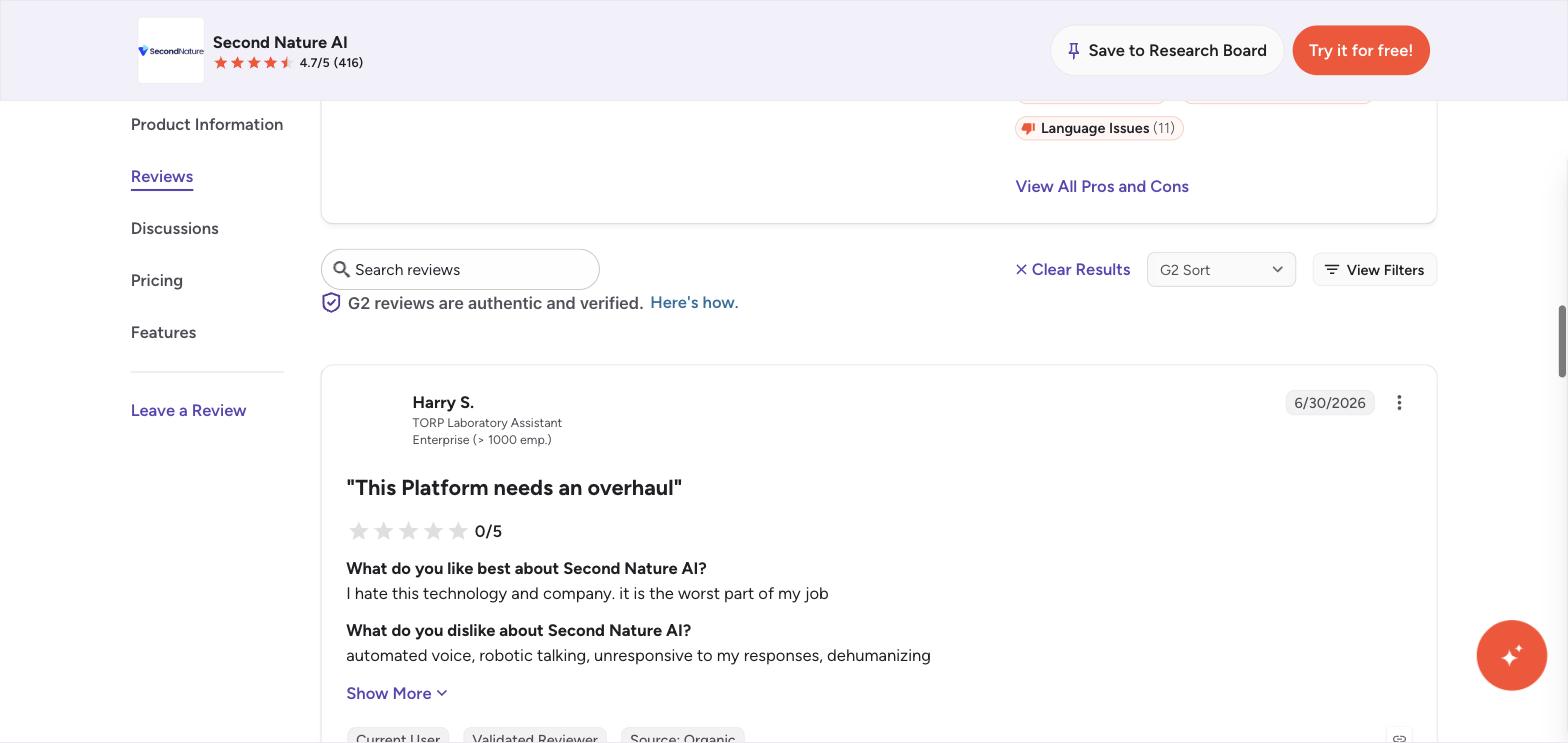
Screenshot: G2 review of Second Nature, "This Platform needs an overhaul," captured August 2026.
Second Nature isn't a bad product.
But the two weaknesses reviewers volunteer on their own, language coverage and how convincingly human the AI persona feels, happen to be the same two things our sales conversations keep surfacing.
Two different customer bases raising the same two issues without prompting is worth taking seriously rather than writing off as a couple of bad reviews.
Where Second Nature Falls Short
Language coverage is real and measurable. Second Nature supports 30+ languages.
Outdoo AI supports 74+ in voice roleplay and 120+ overall. For any team selling across regions, that gap decides whether the tool works for your whole org or just your English-speaking reps.
The "robotic" feedback isn't a one-off complaint. It shows up in Second Nature's own G2 and Capterra reviews, and the same wording appears again on SoftwareAdvice.
When the same complaint surfaces from customers who have no reason to coordinate their feedback, that's a product pattern, not bad luck.
Pricing opacity creates friction most mid-market buyers don't want. No public pricing, no self-serve tier, a sales conversation required just to see a number. That adds weeks to a buying cycle that a smaller team may not have.
And structurally, Second Nature stops at the roleplay session. There's no equivalent to scoring the post-call CRM or workflow process, and no option to grade against a customer's own playbook instead of a fixed rubric.
Deal Coach doesn't close that gap either. It gives live guidance and risk flags on real, in-flight deals, a genuinely different job from grading the CRM and process steps a rep executes once the call ends.
It scores how the conversation went. It has no view into what a rep does with that conversation five minutes later.
Where Second Nature Genuinely Wins
Credit where it's due, because a comparison that only lists weaknesses isn't a comparison you should trust.
Second Nature holds ISO 27001 and ISO 27701 certification in addition to SOC 2 Type II, matching Outdoo AI's own security and compliance posture. If those certifications are a hard requirement in your procurement process today, both vendors clear that bar.
The video avatar roleplay is also a genuine advance. A persona that nods, reacts, and holds eye contact is a more convincing single-persona practice experience than most competitors ship in 2026, and every customer reportedly gets 6,000 free trial minutes of it.
Second Nature has a longer track record in market, with named case studies at SAP and United Rentals. The United Rentals study, published August 2026, self-reports up to 35% revenue uplift and 5,000 reps trained over 12 months; treat those figures as vendor-reported, not independently verified, but it's a real, dated proof point.
It also has a broader pre-built integration surface than Outdoo AI currently offers: SAML/SSO, Microsoft Active Directory, major LMS platforms, and a live Salesforce AppExchange listing.
A built-in course-authoring and certification layer rounds out the pitch, one some buyers will prefer over stitching a separate LMS into their stack. If your team already wants one vendor for both training content and practice, that bundling is a real reason to look at Second Nature seriously.
If you're still weighing the wider field, our Second Nature alternatives roundup covers more of the market than this head-to-head does.
Is Second Nature Worth It for a Mid-Market Sales Team?
For a large enterprise team that wants roleplay bundled with course authoring, certification tracking, and doesn't mind a quote-only sales process, Second Nature is a credible choice with a real track record behind it. For a mid-market team trying to prove coaching moves revenue, the picture looks different. For a full side-by-side, see Second Nature vs Outdoo AI.
Outdoo AI's core bet is that practice should connect to what actually happens on real calls, not sit next to it. One scorecard grades both roleplay sessions and live calls, so a sales leader can show that coaching moved an actual metric, not just a completion rate.
Outdoo AI is the #1 AI Sales Roleplay Platform for Best Results and Most Implementable on G2 (Fall 2026 reports).
Roleplays are built from a team's own calls, transcripts, playbooks, and battlecards, not a freeform prompt describing a hypothetical scenario.
Scoring runs against a company's own playbook, not a vendor's built-in rubric, which means the AI is grading against how your team is actually supposed to sell, not a generic idea of a good call.
Outdoo AI also scores the part of the job Second Nature and its Deal Coach both skip: workflow simulation has reps practice the actual CRM and process logging in the same session as the conversation, not as a separate live-deal-monitoring feature bolted on top.
And where Second Nature requires a sales conversation to get a number, Outdoo AI prices on usage, so a team pays for training that's driving impact rather than carrying idle per-seat licenses no one asked for.
None of that erases Second Nature's head start in market and documented case studies. But if the honest weaknesses reviewers keep naming, being robotic and hard to price, are the ones holding your evaluation back, that's the gap Outdoo AI is built to close.
Frequently Asked Questions
.svg)
Sales, customer success, and service teams use it to practice conversations with an AI buyer persona and get automated scoring on messaging, product knowledge, and delivery, usually alongside course content and certification tracking.
No. There's no public pricing page, and Capterra lists it as contact-vendor-for-pricing only. Second Nature's sales team quoted $50 a credit in 2026, and a credit is one user for one month. That is list pricing rather than published pricing, so your own quote may differ. A $12,000 proposal for 240 credits reads like $240 a seat for 50 people, but it buys 50 people 4.8 months; continuous access for 50 reps needs about 600 credits, roughly $30,000 a year. Older third-party estimates of $30 to $40 per seat per month were never confirmed by Second Nature and describe a per-seat model it does not use. Outdoo AI starts free with 60 minutes of roleplay credits and unlimited team members, no credit card and no sales call, then scales on usage-based Flex pricing with a custom enterprise plan for larger deployments.
It can work, but it's built and priced for enterprise buyers, and reviewers consistently flag the AI persona as feeling robotic. Outdoo AI's scoring spans both roleplay and live calls, and pricing is usage-based rather than per-seat.
Second Nature scores the roleplay session, and its Deal Coach flags live deal risk separately. Outdoo AI scores roleplay and live calls on the same scorecard, and also runs post-call CRM workflow scoring, so coaching is measured against what actually happens after the conversation ends.
Yes. Second Nature added video avatar roleplay in July 2026, where the AI persona nods, reacts, and holds eye contact during a session. It launched English-only, with multi-persona and scripted-roleplay video avatars announced as coming soon.
Table of Contents
Talk to Sales
Have questions about training and enablement for your sales, CS, support, or leadership team? Let's talk.
Talk to Sales