



The biggest problem with most AI roleplay programs is that the scenarios are hypothetical. An enablement team writes a buyer persona based on their understanding of the market, scripts a few objections they think reps will face, and publishes it as a practice scenario. The result is practice against a buyer who behaves the way enablement imagines, not the way real buyers actually behave.
Real sales calls reveal things that no amount of persona design can anticipate: the specific way a CFO deflects a pricing question in your industry, the exact objection pattern that appears in competitive deals you keep losing, the stakeholder dynamic where the champion goes silent when the VP joins the call. These patterns are already captured in your call recordings. They just are not being used for training.
This guide covers how to turn real recorded calls into AI roleplay practice scenarios that mirror the actual conversations your team faces. The result is practice that feels like preparation for a specific deal, not a generic exercise.
Why Scenarios Built from Real Calls Produce Better Practice Than Hypothetical Ones
The difference between hypothetical and real-call scenarios is not about quality of writing. Enablement teams write good personas. The difference is about what the scenarios contain.
The practical upside is significant. Teams that practice against scenarios extracted from their own pipeline data report that reps recognize the patterns faster on live calls because they have already encountered them in practice. The practice feels familiar, not academic, and the training transfer to real calls is stronger.
Which Recorded Calls Make the Best Practice Scenarios
Not every recorded call is worth turning into a roleplay scenario. The calls that produce the best practice share specific characteristics that make them teachable, not just memorable.
A good starting filter: pull 10 lost deals and 10 won deals from the last quarter. Identify the three to five calls with the clearest teachable moments. Those calls become your first scenario pack.
The Workflow: From Recorded Call to Practice-Ready AI Roleplay Agent
Turning a real call into a practice scenario is a workflow, not a creative exercise. Outdoo AI automates much of this through native conversation intelligence that feeds directly into roleplay agent creation. Here is how the workflow operates, whether automated or manual.
Identify the call and tag the teachable moment
Start with the call recording and transcript. Identify the specific moment or pattern you want reps to practice: the objection that derailed the deal, the discovery question that opened up the conversation, the stakeholder dynamic that changed the room. Tag that moment with a timestamp and a brief description of why it matters. This tag becomes the scenario objective.
Extract the buyer behavior pattern
From the tagged moment, extract what the buyer did: what they said, how they said it, what triggered it, and how they responded to the rep's reaction. This is the behavioral blueprint for the AI persona. In Outdoo AI, conversation intelligence can extract these patterns automatically from call transcripts, identifying objection types, sentiment shifts, stakeholder dynamics, and questioning patterns without manual transcript review.
Configure the AI persona from the extracted pattern
Build the AI roleplay agent using the extracted buyer behavior. The persona should replicate the buyer's role (title, industry, company size), their communication style (direct, evasive, technical, executive), their specific objection or concern, and the trigger condition (what the rep says or does that prompts the key moment). The persona does not need to replicate the entire 45-minute call. It needs to replicate the pattern that matters for practice.
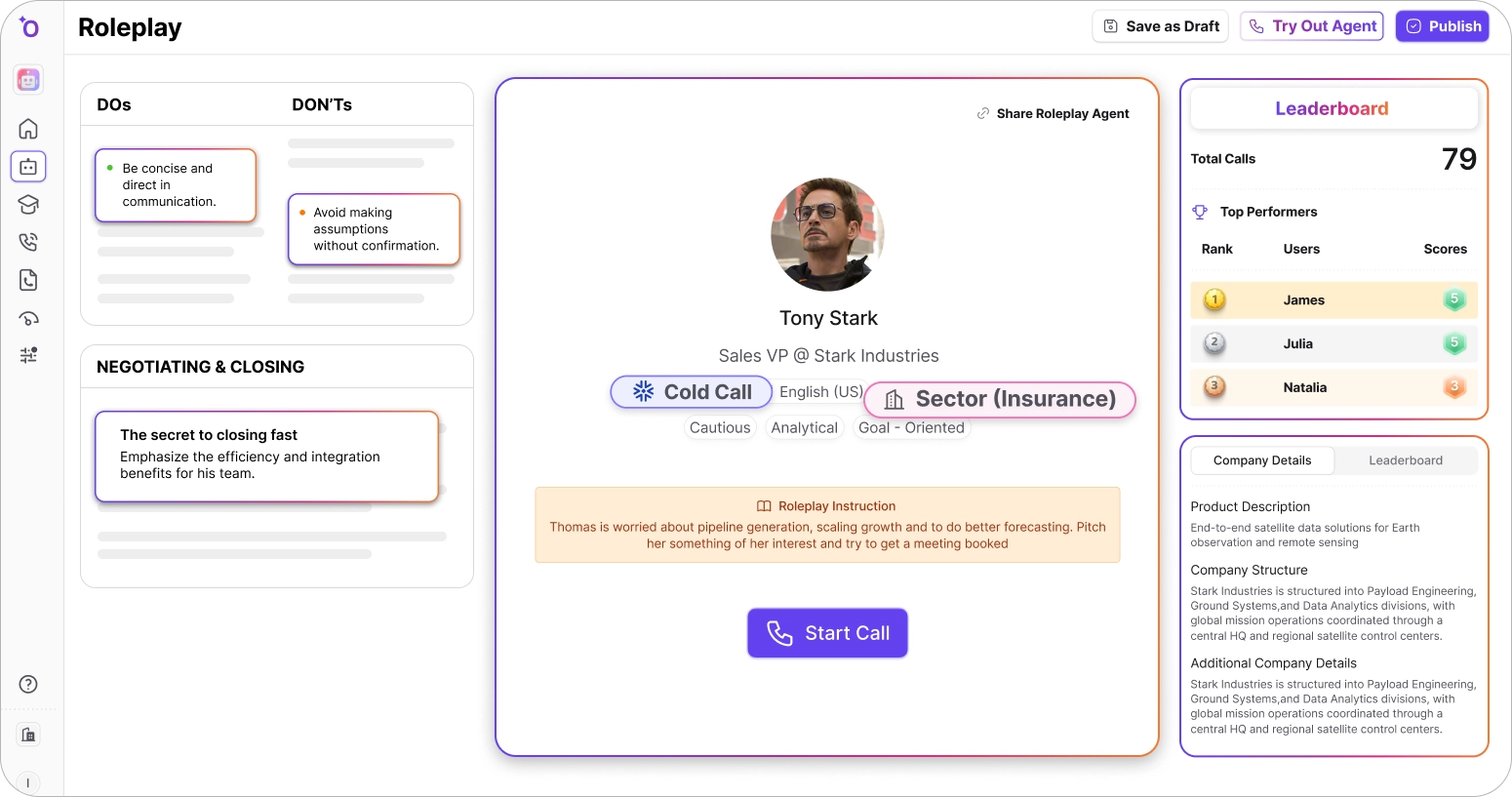
Here is how easy it is to create custom roleplay agents in Outdoo AI from real call patterns:
Define the scoring criteria from what the real call revealed
The recorded call tells you what went wrong (in a lost deal) or what went right (in a won deal). Build the scorecard from that evidence. If the deal was lost because the rep did not quantify pain, the scoring criteria should evaluate pain quantification depth. If the deal was won because the rep repositioned against a competitor using a specific reframe, the criteria should evaluate whether the practicing rep uses a similar reframe. Align criteria to your methodology framework where applicable.
Validate with a top performer before rolling out
Have your best rep run the scenario before publishing it to the team. If the top performer finds the AI persona unrealistic ("a real buyer would never say that"), adjust the persona configuration. If they find it too easy, increase the difficulty. If they find it realistic and challenging, the scenario is ready. Top performer validation is the quality gate that ensures practice mirrors reality.
This Workflow Works for Every Recorded Customer Conversation
Sales calls are the most obvious source material, but any recorded customer conversation can be turned into a practice scenario using the same workflow.
The principle is the same across all teams: the best practice scenarios come from real interactions, not imagined ones. Any team that records customer conversations has a library of practice material waiting to be activated.
Keeping Scenarios Fresh as Your Pipeline and Market Evolve
Scenarios built from real calls have a shelf life. Competitors change their positioning. Your product ships new features that shift the demo. Buyer behavior evolves as the market matures. A scenario built from a Q1 competitive loss may not reflect the competitive landscape in Q3.
Build a scenario refresh cadence tied to your sales cycle
Review and update scenarios on a cadence that matches your average deal cycle. If deals take 90 days, refresh scenarios quarterly. If deals close in 30 days, refresh monthly. Each refresh should pull new call recordings that reflect current buyer behavior, current competitive dynamics, and current product capabilities.
Use win/loss data to retire and replace scenarios
When a scenario stops correlating with real pipeline challenges, retire it. If your team is no longer losing deals to a specific competitor objection because the product addressed it, that scenario is wasting practice time. Replace it with the new pattern that is causing losses. Win/loss reviews are the input that keeps your scenario library relevant.
Let conversation intelligence surface new scenario candidates automatically
Rather than manually reviewing calls to find new scenarios, use conversation intelligence to surface patterns: objections that are appearing more frequently, new competitor mentions, calls where rep performance drops at a specific moment. These patterns are scenario candidates that emerge from the data without requiring an enablement team to listen to every recording. Outdoo AI's native CI integration surfaces these patterns and can generate roleplay agents directly from the identified call segments.
Measuring Whether Real-Call Scenarios Produce Better Outcomes
If you are investing the effort to build scenarios from real calls rather than hypothetical ones, you should be able to measure whether the investment is producing better results.
Getting Started: Your First Real-Call Scenario in One Week
The best practice scenarios are already sitting in your call recordings. Every lost deal, every competitive win, every complex multi-stakeholder conversation contains patterns that are worth practicing. The gap is not source material. It is the workflow that turns recordings into practice.
Here is how to build your first real-call scenario in one week.
Day 1: Pull your last 10 lost deals and identify the three with the clearest turning points. Look for the specific moment where the deal shifted: an unhandled objection, a missed follow-up, a stakeholder dynamic that was not managed. Pick the one that your team encounters most frequently.
Day 2: Extract the buyer behavior pattern from that call. What did the buyer say at the turning point? What triggered it? How did they respond to the rep's reaction? Document the behavioral blueprint: role, communication style, specific concern, and trigger condition.
Day 3: Build the AI roleplay agent. Configure the persona using the extracted pattern. Set up the scenario objective (what the rep needs to practice), the trigger moment (when the key challenge appears), and the scoring criteria (what a successful navigation looks like). In Outdoo AI, this can be done directly from the call transcript without manual persona scripting.
Day 4: Validate with your top performer. Have your best rep run the scenario three times. Collect feedback: is the persona realistic? Is the difficulty appropriate? Does the scoring criteria capture what matters? Adjust based on their input.
Day 5: Publish and run a team practice session. Roll the scenario out to your team. Have each rep run it three to five times. Review scores and debrief as a group: what worked, what patterns emerged, and what should the team do differently the next time this situation appears on a live call.
Outdoo AI is built for this workflow end to end. The platform's native conversation intelligence analyzes call recordings and extracts buyer behavior patterns automatically: objection types, sentiment shifts, stakeholder dynamics, and questioning sequences. Those extracted patterns feed directly into AI roleplay agent creation, so the path from recorded call to practice-ready scenario takes hours, not weeks. Reps practice against personas built from the buyers they actually face, scored against the behaviors that actually predict wins, on the same rubric used to evaluate their live calls. That closed loop, from real call to practice scenario to scored live performance, is what turns call recordings from a passive archive into an active training system.
If your team has call recordings that are being stored but not used for training, book a demo to see how Outdoo AI turns them into practice scenarios your reps will actually use.
Frequently Asked Questions
.svg)
Hypothetical scenarios are logically consistent. Real buyers are not. They contradict themselves, raise unexpected objections, change priorities mid-call, and exhibit behavior patterns that enablement teams would never think to script. Scenarios extracted from real recordings contain the actual complexity reps face on live calls, which produces stronger training transfer.
The highest-value source calls are lost deals with identifiable turning points, competitive wins where the differentiation moment was specific, complex multi-stakeholder calls, calls with unusual or industry-specific objections, and top performer calls with consistently effective patterns. Not every recording is worth turning into a scenario. Focus on calls with clear teachable moments.
With manual transcript review and persona scripting, the process typically takes one to two weeks. With conversation intelligence that extracts buyer patterns automatically, it can be done in hours. Outdoo AI's native CI analyzes call recordings, extracts behavior patterns, and feeds them directly into roleplay agent creation, compressing the workflow significantly.
Yes. Any recorded customer conversation can become a practice scenario. Customer success onboarding calls become CS practice, support diagnostic calls become troubleshooting practice, renewal conversations become retention practice, and demo recordings become presentation practice. The workflow is the same: identify the teachable moment, extract the behavior pattern, build the AI persona.
Refresh scenarios on a cadence tied to your deal cycle. Quarterly for 90-day cycles, monthly for 30-day cycles. Retire scenarios when the pattern they practice no longer reflects current buyer behavior, competitive dynamics, or product capabilities. Use win/loss data and conversation intelligence to identify new scenario candidates automatically.
Table of Contents
Talk to Sales
Have questions about training and enablement for your sales, CS, support, or leadership team? Let's talk.
Talk to Sales