




Most retail banks don't have a cross-sell product problem. They have a rep preparation problem. The product suite is broad, the customer data is rich, and the mandate from leadership is clear. But when a home insurance renewal caller hits the queue, the rep processes the transaction and moves on. Not because they lack product knowledge, but because they never practiced the discovery conversation enough times to make it automatic under pressure.
This is a systems failure, not a talent failure. The gap between "knows the product" and "surfaces the product in a live inbound call" closes only through structured, high-volume practice. In most call centre environments, that practice volume is structurally impossible before reps go live. Two or three facilitated roleplays during onboarding, maybe a refresher session each quarter, and then hundreds of live calls where the transactional default wins every time.
We see this pattern across nearly every banking and credit union team we work with. The training content is solid. The gap is in reps being asked to execute behaviors they've barely rehearsed. Multiple sales enablement benchmarks, including Gartner's research and studies grounded in Ebbinghaus's forgetting curve, consistently show that up to 87% of new knowledge learned in sales training is lost within 12 weeks, and only 10 to 20% of what is retained actually gets applied on the job. In call centre environments where reps face dozens of live interactions daily, that decay happens even faster.
The banks closing this gap aren't doing it with better scripts or more classroom training. They're doing it with AI roleplay coaching that gives reps the repetition volume they actually need, scored on the same framework used to evaluate live calls. That closed loop, from practice to performance and back, is what turns cross-sell from a strategic aspiration into a daily behavior.
What Is AI Roleplay Coaching?
AI roleplay coaching is on-demand practice where reps rehearse real customer conversations against AI personas and get scored right away, on the same framework used to evaluate their live calls.
The Preparation Gap That Kills Cross-Sell Performance in Call Centres
A typical call centre rep handles 60 to 80 inbound calls per day. In onboarding, that same rep may have completed three to five roleplay exercises covering cross-sell scenarios. That preparation-to-execution ratio would be unacceptable in any other performance domain.
Imagine a pilot who practices three landings in simulation and then flies 80 commercial flights. Or a surgeon who rehearses a procedure five times before performing it daily. We'd call that reckless. But in call centre sales, it's standard operating procedure.
The products exist. The customer data signals are there. The ERP/CRM flags eligible customers. What's missing is the behavioral readiness of the rep to act on that signal in real time, while also resolving the customer's stated issue, managing the call timer, and staying compliant.
Cross-sell in inbound call centres isn't a pitch. It's a conversational sequence that requires the rep to resolve a service need and open a discovery thread simultaneously, often in under seven minutes. That kind of situational fluency doesn't come from a product knowledge quiz. It comes from repeated practice against varied customer personas, with structured feedback after each attempt. In our experience working with credit unions and retail banks, the reps who struggle with cross-sell almost never have a knowledge gap. They have a confidence gap. They know the product exists. They just haven't practiced surfacing it in a live conversation enough times for it to feel natural.
When banks invest in product training but not in practice infrastructure, they're building a car without fuel. The engine is there. The knowledge is there. But nothing moves on live calls because the behavioral habit was never formed.
Why Cross-Sell Breaks Down at the Rep Level on Inbound Calls
Inbound service calls are structurally hostile to cross-sell for a simple reason: the customer called with a problem, and solving it is the easiest thing to do. The rep knows what the customer wants. The system makes it easy to process the request. The call timer is ticking. Every incentive in the moment points toward resolution and disconnection.
Cross-sell requires the rep to do something counterintuitive: slow down, ask questions that aren't directly related to the stated issue, and open a conversation the customer didn't initiate. That's not a knowledge problem. It's a habit problem. Habits only form through repetition under conditions that approximate the real thing.
When a rep skips the cross-sell moment, it doesn't feel like a failure. It feels like efficiency. The customer's issue was resolved. The handle time was reasonable. The satisfaction score will probably be fine. The missed revenue opportunity is invisible in the moment. It only shows up weeks later as a flat products-per-household number that nobody can trace back to a specific call.
The Discovery Sequence That Cross-Sell Depends On
Effective inbound cross-sell follows a five-step discovery sequence, and the order matters.
Step 1: Acknowledge the stated need. The customer called about a home insurance renewal. Address it. Demonstrate competence and empathy before attempting anything else. Skipping this step triggers customer resistance to everything that follows.
Step 2: Open with a context question. After resolving or progressing the stated need, ask a question that expands the conversation beyond the transaction. "While I'm looking at your account, I noticed your policy has been with us for three years. Has anything changed at home recently?" This isn't a pitch. It's a door.
Step 3: Run the pain identification sequence. Based on the customer's response, probe for unmet needs or gaps. "You mentioned the extension. Have you looked at whether your current cover reflects the new value?" This is where cross-sell opportunities are surfaced or lost. Most reps skip this entirely.
Step 4: Qualify rather than pitch. If a need surfaces, confirm it before recommending. "It sounds like there might be a gap there. Would it be useful if I checked what options would cover that?" Qualification feels collaborative. Pitching feels transactional. One team lead we work with described this distinction perfectly when he validated our AI coaching feedback on active listening: "So it says, okay, I understand that you're not really looking to buy anything right now, but would it be okay if you reiterate what they say? And this gives you pointers on how to get better. So saying, oh, okay, this is what I understand, and repeat what it is. 1000 percent correct." That moment of reflecting the customer's words back to them is what makes qualification feel like a conversation rather than a sales motion.
Step 5: Transition or log for follow-up. Either transition to the relevant product conversation or, if the timing isn't right, log the opportunity with enough context for a follow-up. Both outcomes count as successful cross-sell behavior.
The most common failure mode is skipping steps 2 and 3. Reps jump from acknowledging the stated need (step 1) directly to a product mention (skipping qualification) or, more often, straight to call resolution with no discovery attempt at all. The problem isn't that they don't know the sequence. It's that they haven't practiced it enough for it to feel natural when a real customer is on the line.
What Actually Happens After Training Ends
The pattern is predictable. During training, reps learn the discovery sequence. They practice it a few times in facilitated exercises. They score well on assessments. They're certified and routed to live calls.
Within two to three weeks, the structured framework erodes. It doesn't collapse dramatically. It fades. The context question in step 2 gets dropped first because it feels awkward without enough practice. Then step 3 disappears because probing for pain requires confidence the rep hasn't built yet. What remains is step 1 (resolve the issue) and maybe an occasional, unprompted product mention that sounds scripted because it is. Research on knowledge decay confirms this isn't unique to banking: individuals can lose up to 90% of newly acquired knowledge within weeks, and only 1 to 2% of training content ever makes it into practice.
The missed opportunity doesn't show up as a failed test score. It shows up as a renewal processed cleanly, a satisfied customer, and a zero in the cross-sell column. Multiply that by 70 calls a day across 200 reps, and you start to see the revenue gap that no amount of product training will close.
This isn't a rep motivation issue. It's a practice volume issue. The rep who completed three roleplays in training didn't build the repetition to override default behavior under pressure. And the manager who's responsible for 15 reps can't sit in on enough calls to coach the habit into existence. We hear this tension repeatedly from banking and credit union teams. As one talent development manager at a credit union told us, "We do have working managers who also do the job. So that's a challenge that we are always looking to better fill that gap." The managers want to coach. They believe in it. But when you're also handling member interactions, staffing the branch, and managing day-to-day operations, consistent one-on-one coaching across every rep simply doesn't happen at the volume needed.
Industry analysis shows that traditional enablement models consume roughly 12 coaching hours per manager per week. Structured AI coaching platforms can cut that to around 6 hours per week while increasing consistency, because the coaching quality no longer varies based on which manager happens to be on shift.
Why Traditional Call Centre Training Doesn't Build the Habit
Conventional training makes a category error: it treats knowledge transfer as if it were habit formation. They're different cognitive processes, and they respond to different interventions.
Knowledge transfer works through explanation, demonstration, and assessment. You can teach someone the five-step discovery sequence in a 90-minute workshop, and they'll recite it back to you the next day. That's learning.
Habit formation works through repetition, feedback, and contextual variation. Someone needs to practice the discovery sequence against different customer types, with different objection patterns, under simulated time pressure, and receive corrective feedback after each attempt. That's training.
Hermann Ebbinghaus's research on the forgetting curve, first published in 1885 and validated repeatedly since, shows that people forget roughly 70% of new information within 24 hours without reinforcement. More recent analysis from the Sales Management Association paints a bleaker picture: nearly 90% of all sales training has no lasting impact on behavior. The implication for call centres is clear. The product knowledge and conversational frameworks taught in onboarding begin degrading the moment the workshop ends. Without structured practice that reinforces those frameworks in context, decay is inevitable.
The second structural problem is feedback latency. In most call centres, quality assurance reviews happen days or weeks after the call. By the time a rep learns they missed a cross-sell opportunity, they've already handled hundreds more calls using the same default behavior. The feedback arrives too late to change the habit.
This isn't a curriculum problem. Most training content is perfectly adequate. It's a volume and timing problem. Two or three facilitated roleplays before deployment is not enough repetition to form a durable habit. QA feedback delivered a week later is not timely enough to shape behavior in real time.
A training team of four people supporting 200 reps cannot deliver the individual practice volume each rep needs. The bottleneck isn't willingness or skill on the part of trainers. It's physics. There aren't enough hours in the day to give every rep 15 to 20 contextual practice runs against varied scenarios before they take live calls. One credit union we work with has 50 to 60 member service representatives across multiple branches, with coaching sessions running weekly in 5 to 30 minute windows per person. Their L&D team described their current approach: "We do live skill practicing with them. So we traditionally will do that face to face in person training. We do conduct those trainings virtually depending where our employees are located." The intent is right. The structure is thoughtful. But when you're running that model across geographically dispersed branches, with new locations opening and headcount growing, the practice volume each individual rep receives cannot keep pace with what's needed.
Why "Hybrid" Coaching Still Falls Short Without a Practice Layer
A Harvard Business Review study frequently cited in the AI coaching space suggests that blending AI tools with human coaching delivers better outcomes than either approach in isolation. This is worth taking seriously, but also worth interrogating. Most platforms that claim a "hybrid" model combine conversation intelligence (reviewing past calls) with manager coaching sessions. That combination improves feedback quality. It does not solve the practice volume problem.
Reviewing a call recording with a manager is valuable. But the rep still only gets one attempt at each live call. If the discovery sequence broke down, the learning happens after the fact, on a call that already happened with a real customer. The hybrid model, as most platforms implement it, adds better analysis to the same limited number of practice opportunities. What's missing is the repetition layer: the ability for a rep to practice the corrected behavior immediately, multiple times, before the next live call. Without that layer, even the best post-call analysis decays in the same way classroom training does. The insight lands, but the behavioral change doesn't stick because the rep never builds the repetition to execute it under pressure.
What AI Roleplay Changes About Call Centre Coaching
The two structural problems traditional coaching can't address at scale are repetition volume and feedback latency. AI roleplay solves both.

Repetition volume
With AI roleplay, a rep can practice the same scenario type 15 to 20 times against varied personas before going live, without consuming a single hour of trainer or manager time. Each attempt features a different customer personality, different objection patterns, and different emotional states. The rep isn't memorizing a script path. They're building situational fluency across a range of realistic interactions.
That volume changes the math entirely. Instead of three practice runs before deployment, a rep can complete enough repetitions for the discovery sequence to become automatic. The context question in step 2 stops feeling awkward because the rep has asked it 20 different ways to 20 different customer types. Pain identification in step 3 becomes natural because the rep has practiced it under enough variation to improvise rather than recite. The downstream impact is measurable: teams using AI sales tools report 76% higher win rates, 78% faster deal cycles, and 70% bigger deal sizes. For retail banking, that translates directly into products per household, revenue per call, and time to cross-sell competency.
Feedback latency
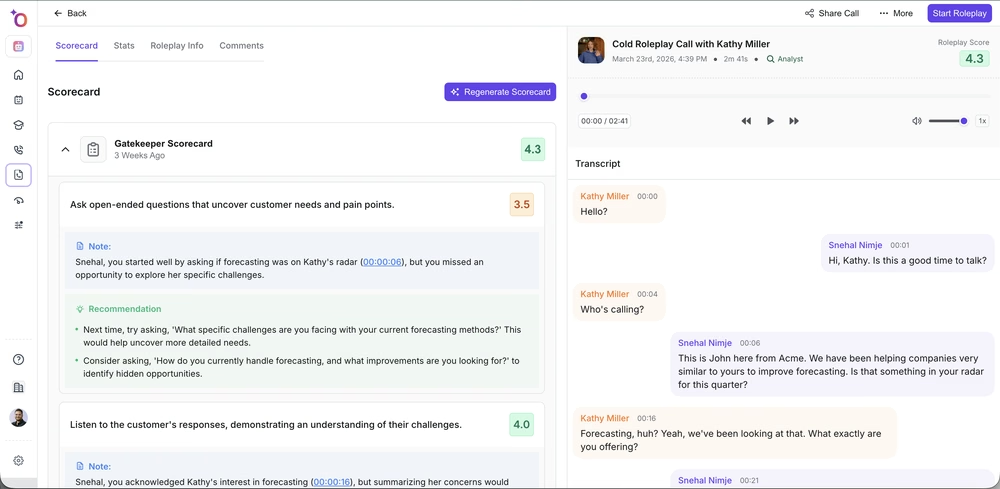
AI scoring happens within the session, not days or weeks later. The rep finishes a practice call and immediately sees where the discovery sequence broke down, which steps were skipped, and how the conversation could have been redirected. This immediacy converts feedback into behavioral change. The rep can try again, right now, with the correction fresh. This is the core difference between AI roleplay coaching and conversation intelligence platforms like Gong or Jiminny, which analyze calls after they happen. Post-call analysis tells a rep what went wrong. Immediate practice with scoring tells them what went wrong, lets them try again, and confirms whether the correction took hold, all before the next live interaction. Analysis without practice is diagnosis without treatment.
Coaching coverage
According to Ask Elephant, traditional manager coaching covers roughly 10 to 15% of a rep's calls, while automated AI coaching can evaluate 100% of conversations. Coaching gaps no longer depend on whether a manager happened to listen to a particular call. For cross-sell specifically, this matters because missed opportunities are invisible by nature. A call where the rep resolved the service issue and skipped discovery sounds fine on a random QA sample. Only systematic scoring across all calls reveals the pattern.

One objection that surfaces consistently in call centre conversations is handle time. If reps slow down to run the discovery sequence, average handle time goes up, service levels suffer, and the efficiency metrics that operations teams watch most closely start to move in the wrong direction. This concern is legitimate and deserves a direct answer. In our experience, reps who have practiced the discovery sequence enough times for it to feel natural add roughly 15 to 20 seconds to calls where they attempt cross-sell. That increase is real. But it needs to be weighed against two things: first, a successful cross-sell generates significantly more revenue per call than the cost of 20 additional seconds; second, reps who are still building the habit add far more than 20 seconds, because an under- practiced discovery sequence stalls and recovers awkwardly, taking longer than a smooth one. The AHT argument against cross-sell practice is usually an argument against insufficient practice, not against the behavior itself. Banks that have run the numbers consistently find that a modest AHT increase on cross-sell calls is more than offset by the revenue per converted call.
Outdoo AI's roleplay agents are built from real call recordings, which matters more than it might seem at first glance. When scenarios are constructed from actual customer conversations, the AI personas use the language, objections, and conversational patterns that reps will encounter on live calls. The practice feels real because it's grounded in real data, not in a trainer's best guess about what customers might say. We've heard from teams in banking, real estate, and insurance that this grounding in real conversations is what separates useful practice from the kind of generic roleplay reps dread.
When a credit union training leader first saw how the AI scorecard and coaching guidance populated alongside the roleplay, they immediately wanted to understand the mechanics: "So is it giving you the stuff on the side? Where does that get populated from?" That reaction tells us something important. L&D leaders in these environments are already thinking about how AI coaching fits into their existing workflow. The question isn't whether they want it. It's whether it's specific enough to be useful. For financial services teams in particular, the ability to attach SOPs and compliance documents directly to AI agents means that practice simulations follow the same required steps reps must follow on live calls. Process compliance scoring then confirms whether those required actions are actually happening in each session. In regulated environments, a missed disclosure or an out-of-sequence step isn't just a coaching note. It's a compliance risk.
Building Roleplay Agents From Real Banking Conversations
The gap between theoretical roleplay and useful roleplay is the gap between invented scenarios and real ones. A generic "difficult customer" persona doesn't prepare a rep for the specific way a home insurance renewal caller pushes back when asked about coverage gaps. The words are different. The emotional register is different. The objections are specific to the product, the price point, and the customer's relationship history.
Enablement teams can upload actual call recordings and transcripts to create roleplay agents. The AI analyzes the language patterns, objection types, and conversational dynamics in those real calls and generates personas that mirror them. Teams can also upload product decks, scripts, or methodology documents and instantly generate AI agents from those files. This means reps learn how to use playbooks in conversation instead of just reading them.
So instead of practicing against a generic persona, the rep practices against the home insurance renewal caller who wants to get off the phone quickly. Or the protection prospect who's skeptical about add-on products because they've been pitched too aggressively in the past. Or the customer who's open to a conversation but needs to be guided rather than sold. The pattern we see most often is that enablement teams underestimate the variation in their own call data. When they upload recordings, they discover four or five distinct member personality types they'd been treating as one "typical customer" in training. Suddenly, practice becomes specific in a way classroom exercises never were.
Roleplay agents can be created with a single click from a real call recording. No IT involvement. No lengthy configuration process. High-value or problematic calls become training scenarios within minutes, which means the gap between "that was a tough call" and "every rep on the team can now practice that exact scenario" collapses from weeks to minutes. When BMO Bank piloted the platform, the team was able to get into the sandbox and start building agents despite enterprise firewall restrictions that required IT domain whitelisting. The technical barriers were real, but the remediation path was straightforward, and the team was running scenarios within days. When products change, when regulations shift, or when new objection patterns emerge from live calls, the enablement team updates the scenarios directly. This keeps practice aligned with reality on a rolling basis rather than waiting for the next quarterly training refresh.
Agent variations let managers generate multiple customer profiles from a single base scenario, creating a range of difficulty levels and personality types from one upload. A rep might practice the same home insurance cross-sell conversation against a receptive customer, a time-pressured customer, and a skeptical customer, all derived from the same real-world call data.
Scoring Practice and Live Calls on the Same Framework
In most call centres, the rubric used to evaluate training exercises and the rubric used in quality assurance are different. Sometimes subtly different, sometimes wildly different. A rep can score well in practice and poorly in QA, not because their behavior changed, but because the criteria shifted.
When the scoring framework is inconsistent between practice and live evaluation, the feedback loop breaks. Reps can't tell whether they're actually improving or just optimizing for two different tests. Managers can't tell whether training is working because the measurement system changed between practice and production.
Outdoo AI applies the same AI scoring framework across roleplay practice and real customer conversations. The scorecard that evaluates discovery quality in a practice session is the same scorecard that evaluates discovery quality on a live call. This consistency makes it possible to answer the question that matters most: are the behaviors practiced in simulation actually showing up in real conversations?
Scorecards can be configured to the bank's specific cross-sell objectives and linked directly to the bank's framework documents. When we worked with CMC Tensar, a Fortune 500 company, their team focused on enforcing a specific sales methodology (BANT) and improving visibility into how reps executed on real calls. They planned to load their own custom scripts into the platform and iterate on them, using AI scoring not as a generic assessment but as a way to measure adherence to their framework. That same principle applies in banking: scoring criteria and feedback are grounded in whatever playbook or compliance checklist the bank uses, not in a generic best-practice template. Scorecard prioritization controls ensure the right evaluation framework fires for the right scenario type across teams and branches.
Extending the Loop Into Post-Call ERP/CRM Workflows
The conversation is only half the cross-sell cycle. Step 5 of the discovery sequence, logging the opportunity with enough context for a follow-up, only produces pipeline impact if the rep executes the post-call workflow correctly. Wrong disposition codes, missing eligibility flags, or incomplete CRM entries don't just create admin problems. They erase the cross-sell opportunity from the pipeline entirely. A rep who identified a genuine need during the call and then misclassified the outcome produces the same revenue result as a rep who skipped discovery completely.
In most call centres, CRM logging is learned under live call pressure. Reps find the fastest path through the disposition screen, and the fastest path is rarely the most accurate one. The urgency of the next call in queue makes thoroughness a casualty. This is the same habit formation problem as the discovery sequence: without structured practice in a controlled environment, default behavior under pressure is rarely the right behavior.
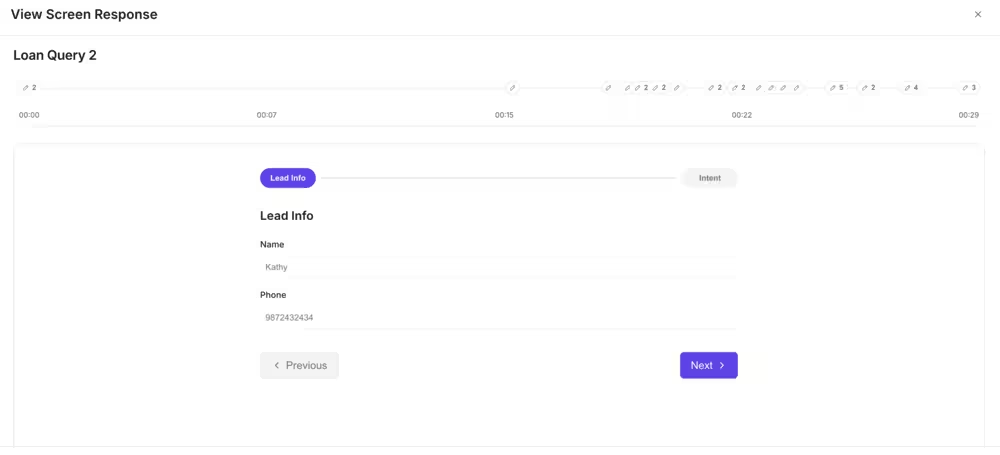
Outdoo AI's software simulation extends practice beyond the conversation and into the post-call workflow. Reps navigate CRM interfaces, select disposition codes, flag cross-sell opportunities, and complete data entry steps in a structured environment that mirrors the actual system. Every field input, navigation step, and validation action is captured and evaluated against defined workflow standards, giving reps immediate feedback on where the process broke down before it costs them a real cross-sell.
For retail banking teams, this closes a gap that most training programs miss entirely. Identifying an eligible customer during an inbound call and then losing the opportunity in the post-call logging process is a systems failure. Software simulation makes workflow execution a trainable, measurable skill rather than something reps learn by making mistakes on live customers, costing the bank the cross-sell in the process.
The Closed-Loop System: Prepare, Perform, Prove, Refine
Isolated training events don't produce sustained behavior change. Systems do. The difference between a bank that moves cross-sell performance and one that doesn't usually comes down to whether coaching is structured as a loop or as a calendar event.
As one credit union L&D leader put it to us plainly: "It's a big part of our environment here, and the reps who improve fastest are the ones getting consistent reps in practice before they ever pick up the phone."
That consistency is what makes the loop work. It starts with roleplay practice scenarios that give reps structured repetition against realistic customer interactions before they go live. It continues through post-call software simulation that trains reps to log opportunities accurately in the CRM, covering the right disposition code, eligibility flag, and enough context for follow-up, all before the next call begins. Reps then perform on actual calls, where the same scoring framework evaluates their behavior. Managers review the delta between practice scores and live scores to identify specific coaching opportunities. Reps then return to practice with targeted scenarios that address the gaps surfaced in live performance.
Each cycle tightens the connection between what reps rehearse and what they deliver. Over time, the discovery sequence stops being something reps remember to do. It becomes something they do by default.
The behavioral shift is measurable. One retail banking call centre we worked with started with a cross-sell capture rate of 12 percent on eligible inbound calls. After introducing structured AI roleplay practice, with reps completing 15 or more practice sessions per cross-sell scenario type before going live, connected to live call scoring on the same framework, that rate moved to 41 percent within a single quarter. Discovery quality scores moved from 2 out of 5 to 4.5 out of 5. Manager re-coaching events, previously a weekly occurrence for most reps, became rare. The change was not in the products, the scripts, or the incentives. It was in how many times each rep had practiced the discovery conversation before picking up a live call.
The banks making real progress on cross-sell treat this loop as infrastructure, not as a program. They don't run a "cross-sell initiative" once a year. They run a system where every rep's practice, performance, and coaching data feeds the next iteration. That compounding effect is what separates teams that move products-per-household numbers from teams that talk about moving them.
For retail banking and credit union teams serious about closing the cross-sell gap, Outdoo AI is worth evaluating closely because it's one of the few platforms that connects roleplay practice, live call scoring, post-call CRM workflow simulation, and manager coaching into a single loop. The banks getting results aren't the ones with the best training decks. They're the ones where reps have practiced both the hardest conversations and the post-call workflows enough times that the right behavior shows up without thinking.
Frequently Asked Questions
.svg)
The primary barrier is not product knowledge but behavioral readiness. Reps typically complete only three to five roleplay exercises during onboarding before handling 60 to 80 live calls per day, which means the conversational sequence required to surface a product naturally never becomes automatic. This preparation gap causes reps to default to processing the stated request and ending the call without opening a discovery thread.
AI roleplay coaching closes the gap by giving reps high-volume, on-demand practice against varied customer personas tied to real cross-sell scenarios. Each session is scored against the same quality framework used to evaluate live calls, which creates a direct feedback loop between practice behavior and on-the-job performance. This repetition builds the situational fluency reps need to handle service resolution and product discovery simultaneously within tight call windows.
Research from the Sales Management Association shows that up to 87% of knowledge from sales training is lost within 12 weeks, and only 10 to 20% of what remains is ever applied on live calls. In call centres, this decay accelerates because reps face dozens of interactions daily where speed and issue resolution are rewarded over consultative selling. Without a structured practice layer that reinforces trained behaviors between classroom sessions, even well-designed training programs produce minimal lasting change in cross-sell execution.
The highest-impact window is during onboarding, before reps begin taking live calls, so they build conversational habits from the start rather than trying to retrofit them later. Ongoing practice cadences matter just as much because cross-sell scenarios shift with product launches, seasonal campaigns, and evolving compliance requirements. Banks seeing the strongest results layer AI roleplay into both new hire readiness gates and quarterly reinforcement cycles for tenured reps.
Even when a rep successfully identifies a cross-sell need during an inbound call, the opportunity is frequently lost in the post-call workflow. Wrong disposition codes, missing eligibility flags, or incomplete CRM entries remove the lead from the pipeline before any follow-up can happen. Outdoo AI's software simulation trains reps to execute post-call workflows accurately in a controlled environment, covering CRM logging, disposition selection, and opportunity flagging against the bank's defined process. Because every field input and navigation step is captured and scored, reps see exactly where the workflow breaks down before it costs them a real cross-sell on a live call.
Table of Contents
Talk to Sales
Have questions about training and enablement for your sales, CS, support, or leadership team? Let's talk.
Talk to Sales