




There’s a line from a Reddit thread that every sales leader nods at: “Most reps know the product. They just don’t know how to connect.”
And if you’ve been in sales or enablement for a while, you’ve probably felt that in your own team, you’ve seen how the small metrics and activity shape the entire quarter. A rep takes a call a bit underprepared. A manager skips a coaching session because the day just got away from them. A message gets interpreted in three different ways.
None of it seems like a crisis in the moment. But over a month? You see it in stagnant deals, delayed execution, and a forecast that feels a little weaker than it should.
That’s what makes sales enablement challenging today: the issues are subtle, constant, and easy to miss until they start pulling performance off track.
This guide breaks down the challenges that hold teams back in 2026 and why they keep resurfacing. But before we get into them, let’s start by understanding why sales enablement is so complex in the first place.
Why Sales Enablement Is Complex (and Getting Harder)
Sales enablement is hard because the environment around it keeps shifting faster than teams can adapt. Anyone who’s been in sales, enablement, RevOps, or coaching for a few years has felt this change firsthand.
1. Buyers now run their own process and sellers get invited in late
The biggest shift isn’t inside your sales team; it’s in how buyers behave. They research quietly, compare options on their own, and form opinions before your team ever gets a chance to influence anything.
Today, 50 - 90% of the B2B buying journey is done before a buyer talks to sales.
That means your reps step in when the buyer already has a shortlist, a point of view, and a ticking clock. There’s no warm-up, no slow build. One ambiguous answer or confused message, and the deal freezes.
Enablement gets harder because you’re preparing sellers for conversations they don’t control but must deliver perfectly.
2. Reps are expected to absorb more than they can apply
If you’ve led a sales team for any length of time, you’ve seen this pattern:
New messaging lands. New brand positioning. New product updates. New ICP criteria.
Everyone nods in training… and a week later half the team defaults back to the old way.
Not because they don’t pay attention but because the pace of change outstrips the time reps have to practice it.
This is the reality of enablement: teaching is easy; turning knowledge into muscle memory is not.
3. Too many teams influence the buyer, and not enough of them are aligned
Sales leaders observe this every day in their team.
- Marketing updates the deck
- Product updates the pitch
- Enablement updates the training
- Managers coach their own version of the message
- RevOps updates the process.
By the time it reaches the rep, it’s five different interpretations of what “success” looks like.
Thus the execution gets inconsistent, and reps end up choosing whichever version feels safest in the moment.
The real challenge is that alignment now requires more coordination than most teams have time for.
4. Tech has piled up faster than workflows have evolved
Every revenue team says they want a simpler workflow, but most end up with a tool stack that looks like a scavenger hunt.
A rep updates contact records and deal notes in the CRM, searches the content library for the latest deck, checks the call library to replay a previous conversation, jumps into a training platform to finish a module, and relies on separate AI prompts or coaching tools to prep for the next meeting.
Each tool does its job. None of them work together.
And that’s the real problem: you don’t fix execution by adding more tools; you fix it by choosing a solution that pulls the whole workflow together.
So yes, enablement isn’t getting tougher because people forgot how to sell. It’s tougher because the entire motion around them has changed. With that in mind, let’s look at the challenges that keep showing up in every sales team, no matter how experienced or well-resourced.
The Core Sales Enablement Challenges Every Team Faces
Ask any sales leader or enablement manager what’s actually slowing their team down, and you’ll never hear just one answer. You’ll hear a pattern. A familiar set of issues that show up in different forms but always lead to the same outcome.
Here are the challenges every sales team faces today, and why they matter more than most leaders realize.
Challenge #1: Misalignment Between Sales and Enablement
Misalignment shows up when sales and enablement are working hard but not toward the same outcomes. Sales has one set of targets. Enablement builds programs for something else. And because the goals, metrics, and expectations aren’t agreed on upfront, the team spends time and energy on work that doesn’t move the numbers that actually matter.
You can see the impact of misalignment in everyday moments. Sales leaders might be pushing hard to improve qualification because deals are entering the pipeline too early and dying late. Meanwhile, enablement invests its time in refining demo skills because they heard “presentations need improvement.” Reps end up trying to walk on both paths. They split their focus, and neither initiative produces the lift leadership hoped for.
Research found that 39% of teams struggle because there’s no clear agreement across the organization on what enablement should own and deliver.
A practical fix is simple: build one shared plan. Agree on the outcomes, define the expectations, and sync regularly so priorities stay aligned as the quarter evolves. When sales and enablement operate from the same scoreboard, task execution gets a lot cleaner.
Challenge #2: No Clear Sales Enablement Strategy
A lot of enablement challenges don’t really kick off with how things are executed; they often stem from a lack of clear direction. When there isn’t a clear strategy that ties enablement work to business outcomes like win rates, ramp time, or qualification quality, the function becomes reactive.
You can see the absence of strategy in everyday situations. For instance, leadership might call for “more training” when results aren’t up to par, but no one takes the time to pinpoint which specific skill gaps are hindering deals or how success will actually be measured.
Research shows that 84% of sales reps hit quota when the organization operates with a best-in-class enablement strategy in place. When that strategy is missing, teams work hard but achieve unpredictable results.
The solution is pretty simple: create a strategy that begins with measurable outcomes. Identify the behaviors that will lead to those outcomes. Get buy-in from sales leadership. Then, make sure every enablement program, piece of content, roleplay, coaching session, and tool aligns with those specific KPIs. When strategy takes the lead and activities follow, execution becomes more consistent, and improvement can finally be something you can count on.
Challenge #3: Content Overload
In most sales teams, sellers can’t find the right version when they actually need it. Content is scattered in too many places, gets updated without clear ownership, and often isn’t mapped to the buyer journey in a way reps can use in real time.
You see this play out in the simplest but most important moments. A rep is prepping for a discovery call and needs the updated product messaging for a specific industry. Instead of pulling it up in seconds, they dig through Slack threads, old email chains, shared drives, and half-synced folders.
The cost of this chaos is bigger than inconvenience. Research shows that underused or unused marketing content costs enterprises an estimated $2.3 million every year in missed opportunities.
The answer lies in treating content as an integral part of the sales process, rather than just a collection of resources. Centralize where everything is stored. Clearly designate who’s responsible for updates. Link each piece of content to a specific stage, persona, or type of conversation, so reps know precisely when and how to use it.
Challenge #4: Inconsistent or One-Time Training
A lot of training misses the mark because it’s often a one-time event, and people are expected to remember everything forever. Reps tend to forget what they don’t regularly use, and without consistent practice, new habits just don’t stick. Plus, managers usually don’t have the time to keep reinforcing those lessons.
You can really see this gap in actual onboarding experiences. A rep might breeze through a few modules and watch some videos, but then they jump into live calls that require a level of nuance that the training didn’t cover. The old “one-and-done” training approach just doesn’t cut it anymore. Coaching and training need to go hand in hand.
Research shows that 26% of sales reps consider their sales training ineffective, largely because it doesn’t match what they face in real conversations or get reinforced consistently.
The solution is to integrate micro-learning into their daily routines and back it up with brief, focused coaching sessions. Implement digital-twin scenarios that reflect the types of conversations reps are likely to encounter, allowing them to practice before crucial calls and step in feeling ready. After the call, leverage the same AI-generated insights to review what happened and hone in on key areas for improvement.
Challenge #5: Lack of Measurement and ROI Tracking
Most teams don’t track the outcomes that actually matter
- Win-rate improvement
- Rep ramp time
- Pipeline quality
- Talk-track consistency
- Call behavior shifts
If you can’t measure impact, you can’t improve it or scale it. Without a clear measurement model, enablement becomes a cost center instead of a performance enhancer.
You can see the impact of this in a simple scenario. Enablement rolls out a new discovery training because qualification is slipping. Reps attend, but no one tracks whether their questions, call flow, or follow-ups actually changed. There’s no before-and-after scorecard, so when deals keep stalling, no one knows if the training helped or if the real issue is still untouched.
Reports found that only 51% of teams are aligned with leadership on what metrics enablement should be measured against. When measurement isn’t agreed upon, enablement ends up chasing assumptions instead of real objectives.
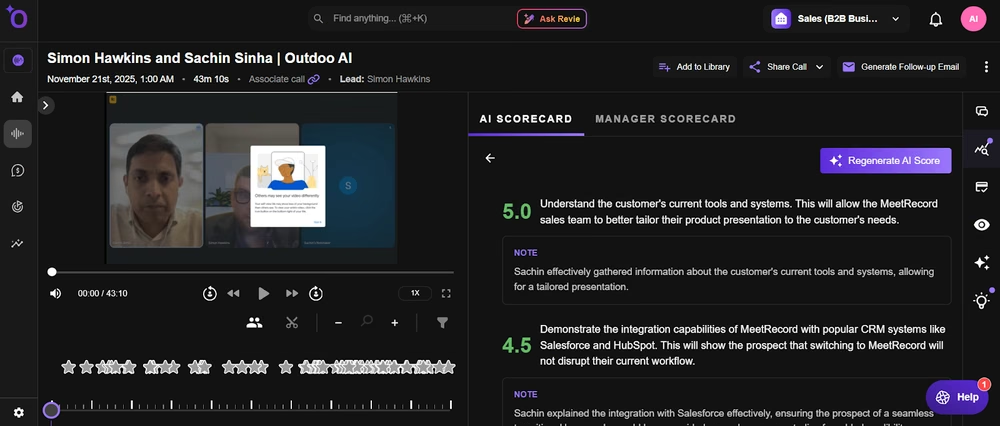
The fix is to use scorecards to track behavior change on calls, not just activity metrics. When you can show how a training, piece of content, or coaching program moved a number everyone cares about, enablement stops being “nice to have” and becomes part of the revenue system.
Challenge #6: Tech Overload Without a Cohesive Workflow
Over time, teams add a platform for content, another for call reviews, another for training, another for coaching, another for analytics, and a few AI add-ons. Individually, each tool solves a problem. Together, they create a workflow that’s scattered, slow, and hard for reps to follow.
You can see this clearly in how reps gear up for a single call. They’re busy updating deal notes in the CRM, pulling a presentation from the content library, reviewing past conversations in the call archive, completing a module on the training platform, skimming through AI-generated insights, and checking performance dashboards.
This matches a broader industry pattern: 28% of organizations now use ten or more tools to drive sales productivity, yet most still fall short of their quota and revenue targets.
The answer isn’t to throw in yet another tool. Instead, it’s about integrating the entire workflow into one cohesive ecosystem. A tool like Outdoo brings together the essential elements of enablement; content, conversations, performance insights, coaching, and revenue impact, so reps can operate from a single hub instead of juggling ten different tools.
Challenge #7: Difficulty Scaling Personalized Coaching
Coaching is one of the most reliable ways to improve performance, but it’s also the hardest to deliver consistently. Managers want to coach more, reps want clearer guidance, and enablement wants behavior change, yet most teams rely on ad hoc conversations, scattered notes, and whatever time is left after pipeline reviews.
You see this in the moments leading up to and following a call. One rep goes in without a clear plan, improvises through tough questions, and walks out unsure what actually went well. Another rep gets detailed feedback one week and none the next.
Research shows that sales coaching programs often include content, plays, and training (42%); manager feedback on rep training (40%); and links to real-world actions (29%), but few teams manage to do all three consistently at scale.
The solution is to adopt a solution that makes coaching continuous, personalized, and connected to real calls. From pre-call preparation to post-call feedback to ongoing reinforcement to deliver targeted coaching at scale.

Challenge #8: Lack of a Buyer-Centric Enablement Approach
Majority enablement programs often miss the most crucial aspect: understanding how buyers really want to evaluate and make decisions today. They crave clarity, relevance, and quick assistance in making the right choice. When enablement fails to prepare reps for the way buyers prefer to engage, even the most skilled sellers find it tough to push deals forward.
You see this gap in real conversations. A rep walks into a call armed with the same script for every persona, despite the fact that the buying committee has five distinct priorities. They respond to questions reactively instead of steering the conversation, causing the buyer to lose interest.
Reports found that 78% of organizations say buyers increasingly prefer self-service journeys, which means reps are entering conversations later and expected to deliver value much faster.
The answer lies in structuring enablement around the buyer’s journey rather than the internal sales process. Equip reps with insights tailored to their roles, scenario-based examples, and clear guidance on what matters to buyers at each stage. When coaching, content, and training align with real buyer expectations, reps transition from “pitching” to genuinely helping buyers make informed decisions.
Now that we’ve broken down the real challenges holding teams back, let’s look at how high-performing sales teams are starting to fix them.
How High-Performing Teams Are Fixing These Enablement Gaps
1. Shift from seller-centric programs to buyer-centric conversations
Top teams don’t just prepare reps to "deliver the pitch." They train reps to understand how buying groups make decisions, what each stakeholder values, and how to guide complex evaluations. Reps get scenario-based practice, buyer-specific talk tracks, and real examples so they can add value the moment they join the conversation, not repeat what buyers already researched.
2. Build one GTM plan across Sales, Marketing, CS, and RevOps
Instead of fixing problems in isolation, leading organizations create a unified set of messages, handoffs, and KPIs across every team that touches the buyer. Content, training, campaigns, and coaching all map to the same motion. This eliminates rework, keeps messaging consistent, and creates a smoother buyer experience from first touch to renewal.
3. Tie every enablement initiative to a measurable revenue outcome
Completion rates and attendance don’t impact revenue numbers. High-performing teams measure lift in win rate, ramp time, qualification quality, and deal velocity. They use scorecards to track behavior change on calls and map improvements directly to performance. When enablement ties activity to revenue metrics, the function becomes a growth driver, not a cost center.
4. Simplify the tech stack and bring workflows into one ecosystem
Instead of adding new tools to old problems, strong teams choose a complete solution with all required aspects. Reps prepare, learn, review calls, and get feedback in one place. Search is simple. Coaching insights appear where reps work, not in another tab and roleplays are accessible in the same. This removes cognitive load and gives sellers more time to sell.
5. Replace one-off training with continuous, targeted development
High-performing teams treat training as a continuous cycle. Reps learn in small, repeatable blocks, practice before important calls, and get structured coaching afterward. Managers follow a clear framework so feedback is specific and consistent. Skills don’t fade because reps are always reinforcing them through real conversations.
6. Make reinforcement part of the daily workflow, not an afterthought
Instead of hoping reps “remember,” leading teams build reinforcement into everyday actions. Short refreshers, peer examples, manager checkpoints, and micro-learning woven into the flow of work. Nothing peaks at launch; learning evolves as the market, product, and buyer change.
7. Use AI to personalize coaching and predict where performance will break
High-performing teams don’t launch AI onto broken workflows. They use it to create digital-twin practice scenarios, surface coaching opportunities, highlight behavior gaps, and prepare reps before key meetings. AI becomes part of the enablement system, helping managers scale coaching and reps stay ready for real-world situations.
You now know what keeps sales enablement from reaching its full potential, so let’s look at how the right system can finally fix these patterns instead of repeating them every quarter.
Where Outdoo AI Fits In: The System That Turns Enablement Into a Growth Engine

Modern sales teams don’t fail because reps lack intelligence or managers lack intent. They fail because their enablement is disconnected, with strategy in one place, content in another, coaching somewhere else, and performance data in tools no one checks. Outdoo changes that by turning enablement into one connected system.
Outdoo is built on the same principles that drive the world’s most effective sales organizations and aligns directly with what leadership actually cares about: win rate, ramp time, quota attainment, pipeline quality, and manager effectiveness.
Below is how Outdoo maps to the exact gaps we uncovered and why high-performing teams choose it.
1. Strategy & Sponsorship: Enablement that starts with business outcomes
Most teams invest in training. Few invest in tying training to revenue metrics.
Outdoo anchors every initiative to the numbers leadership tracks, win rate lift, faster ramp, better qualification, deal inspection, and coaching consistency.
It gives CROs and Heads of Sales the visibility they need to treat enablement as a strategic lever, not an activity function.
2. Talent & Training Design: Role-specific, behavior-driven learning
Outdoo identifies the real skill gaps that slow teams down, discovery, negotiation, multithreading, objection handling and builds role-based paths that link every module to a measurable outcome.
Reps aren’t trained on theory. They’re trained on the exact moments that move deals.
3. Readiness & Reinforcement: Learning that actually sticks
Most organizations see training disappearing after a week.
Outdoo prevents this with ongoing microlearning, AI-driven scenarios, and continuous reinforcement built right into the workflow. Reps practice with digital twins before calls, get precise feedback afterward, and build habits through repetition, not memory.
4. Intelligence & Insights: Data that proves what actually changed
Outdoo connects CRM data, call behavior, and learning insights into one dashboard, so leaders can finally answer the question, “Did this initiative move a number we care about?”
Scorecards track behavior change. AI surfaces coaching opportunities. Revenue data validates impact. Enablement earns executive trust because it proves commercial causality, not participation.
5. Development & Coaching: Scalable, personalized coaching for every rep
Managers want to coach; they just don’t have time or structure.
Outdoo fixes that with pre-call prep, post-call analysis, AI-assisted coaching, and guided frameworks. Every rep gets personalized improvement paths; every manager gets clear visibility into what to coach and why.
6. Practice and Roleplay: Faster Ramp, Better Conversations
Outdoo treats practice like a core part of revenue, not a nice-to-have. Structured roleplays and simulations help new reps ramp faster, contribute to the pipeline sooner, and hit quota earlier. When reps can rehearse key moments before they face real buyers, ramp time drops and revenue shows up sooner.
7. Enablement Operations: A unified ecosystem instead of a tool pile
Sales teams shouldn’t need 10 tools to prepare for one call.
Outdoo brings all the core elements of enablement into one workflow: content, call recordings, readiness checks, AI-assisted coaching, roleplay scenarios, and performance analytics, so reps don’t have to assemble their own process. Everything they need to prepare, practice, and improve sits in one place, fully connected.
The Outcome: Enablement That Moves the Metrics Leadership Actually Reports
Organizations that operate with a structured enablement system outperform peers with:
- Up to 49% higher win rates
- 30–40% faster ramp time
- More consistent coaching discipline
- 150%+ ROI within two quarters
One system, three outcomes: faster ramp, sharper conversations, and coaching that moves the right metrics.
Now that we’ve broken down how Outdoo brings strategy, coaching, readiness, and data into one system, the only question left is what this means for your team’s performance moving forward.
Conclusion: Sales Enablement Needs to Evolve
Sales enablement doesn’t fail because teams lack talent or intent. It fails because the work sits in too many places, is owned by too many functions, and is measured by too many disconnected metrics. When content lives in one platform, coaching in another, call insights somewhere else, and AI is scattered across tools, even strong teams struggle to turn learning into performance.
What sales and revenue leaders need today is not “more training,” “better content,” or another dashboard; they need a system that consistently makes their team ready. A system that turns practice into habits, coaching into behavior change, and data into clear direction. When all of that works together, performance stops being unpredictable and starts becoming repeatable.
That’s what Outdoo is built to solve: not the activity of enablement, but the outcome of it.
If you want an enablement system that improves win rate, shortens ramp, and gives leaders real visibility into what’s working, Outdoo brings all of it into one place.
→ See Outdoo in action and learn how top teams turn readiness into revenue.
Frequently Asked Questions
.svg)
The main challenges of sales enablement in 2026 include misalignment between sales and enablement teams, a lack of clear sales enablement strategy, content overload, inconsistent training, and difficulties in measuring ROI. These challenges stem from the fast-paced changes in buyer behavior, the overwhelming amount of information, and the need for better coordination among various teams.
Organizations can improve their sales enablement strategies by creating a clear plan that aligns sales and enablement goals, centralizing content for easier access, and implementing continuous training rather than one-time sessions. Additionally, they should measure outcomes that matter, such as win rates and ramp time, to ensure that enablement efforts are driving real results.
Common mistakes that lead to sales enablement failures include failing to align sales and enablement goals, neglecting to establish a clear strategy, and providing inconsistent training. Additionally, an overload of content without proper organization can hinder reps' ability to find and use the right resources effectively.
Effective solutions for sales enablement issues involve creating a unified strategy that ties training to measurable outcomes, simplifying the tech stack to ensure cohesive workflows, and integrating continuous learning and reinforcement into daily routines. Utilizing AI for personalized coaching and feedback can also enhance performance.
Outdoo enhances sales enablement by creating a seamless connection between roleplay practice, live customer interactions, and post-call assessments tailored for enterprise teams. Our adaptive AI-driven platform allows reps to engage in realistic scenarios, apply learned skills during actual calls, and receive structured feedback that quantifies their improvement over time. By leveraging insights from real conversations, Outdoo ensures that training is not only relevant but also directly aligned with the complexities of enterprise sales, enabling teams to close the loop between practice and performance effectively.
Table of Contents
Talk to Sales
Have questions about training and enablement for your sales, CS, support, or leadership team? Let's talk.
Talk to Sales