

- The readiness-to-revenue gap is the core enablement problem: Reps who complete training still lose deals. The missing layer is practice from real pipeline data, scoring that covers both roleplay and live calls, and coaching triggered by actual execution gaps, not training schedules.
- Outdoo AI is the only platform that covers the full loop natively: AI roleplay built from real pipeline calls, built-in conversation and revenue intelligence, unified scoring across practice and live work, and closed-loop coaching in one platform with 120+ integrations and roleplays in 120+ languages.
- Enablement stacks need five categories, not one platform: Practice and coaching, full-suite enablement, conversation intelligence, buyer engagement, and in-workflow execution each serve a distinct job. The strongest stacks combine tools across categories rather than trying to cover everything with one.
- Highspot and Seismic announced a merger in February 2026: The combined entity will operate under the Seismic brand. Buyers evaluating either platform should negotiate contract flexibility while the post-merger integration plays out.
Note: Last updated in June 2026. This guide is based on a detailed review of each platform's publicly available product information, G2 reviews, community feedback, and verified user data as of the time of writing. Platform capabilities, pricing, and positioning change frequently. We revisit and update this guide regularly to ensure accuracy.
Sales enablement teams carry an unusual kind of accountability. They own what happens between a training session and a closed deal, without owning the close itself. It is a function defined by influence rather than authority, which means the tools in its stack have to earn trust the hard way: by producing results reps and managers actually see in the numbers.
The problem most enablement leaders describe in 2026 is not a shortage of content or programs. It is that reps complete onboarding, pass certifications, and still do not execute consistently when it matters. Completion rates are not closing the readiness-to-revenue gap, and in most organisations that gap is widening rather than shrinking. AI is changing what sales enablement teams can actually do about it, not just by automating content creation or tagging assets faster, but by making it possible to practice the exact conversations reps will face, analyse what is happening on live calls, and connect all of it to the pipeline data that makes the case to leadership.
Enablement today is a broader function than its job title suggests. Where it once meant onboarding decks and a content library, it now spans rep readiness, coaching programs, sales content, buyer engagement, and the intelligence tools that connect all of it to revenue outcomes.
The ten tools in this guide reflect that full scope, grouped into five categories that map to the jobs a modern enablement stack actually needs to do: AI roleplay and coaching, revenue enablement platforms, conversation and revenue intelligence, buyer engagement, and in-workflow execution.
What Is an AI Sales Enablement Platform?
An AI sales enablement platform is software that uses AI to prepare reps for buyer conversations and coach them on the calls they actually run, through practice roleplays, conversation intelligence, content recommendations, and coaching tied to revenue outcomes. Most teams combine tools from the five categories below rather than buying one platform for everything.
Why AI Is Reshaping Sales Enablement in 2026
Traditional enablement delivered training once, stored content in a portal, and measured success by completion rates. That model worked when selling was simpler. In 2026, buyers are more informed, deal cycles are longer, and the gap between what top reps do and what average reps do has widened significantly. Enablement teams that still measure success by certifications passed and courses completed are fighting the wrong battle.
The metric that matters is execution. According to RAIN Group, only 18 percent of buyers think salespeople show up prepared. That gap is not a content problem. It is a practice and coaching problem: reps are not rehearsing enough, managers are not coaching on the right signals, and content is not reaching buyers in the moments that influence decisions. AI now addresses all three directly.
Enablement AI in 2026 falls into two distinct types. The first automates and accelerates what enablement teams already do: generating content, tagging assets, personalizing learning paths. The second changes what is possible: AI that lets every rep practice against realistic buyers before a call, surfaces what winning reps say in the moments that matter, and closes the loop between training and execution by scoring both practice and live performance against the same rubric. The tools in this guide represent both types, but the second category is where the real enablement leverage sits in 2026.
Tools at a Glance: Grouped by What They Do in the Enablement Stack
Enablement teams are not a single function. Some own onboarding and coaching programs. Others own content and messaging governance. Most own some combination of all of it. Here is how the 10 tools map to the jobs enablement teams actually need done.
1. AI Roleplay, Practice and Coaching
These tools let reps rehearse real sales scenarios with AI and receive scored feedback, so practice is scalable, consistent, and measurable. Best for closing the readiness-to-revenue gap and reducing rep ramp time.
For how enablement leaders roll this out, see our guide to AI roleplay for Sales Enablement Directors.
Tools: Outdoo AI, Hyperbound
2. Revenue Enablement Platforms
Full-suite platforms that combine training, content management, coaching workflows, and buyer engagement under one roof. Best for enablement teams that want a single system of record for the function.
Tools: Mindtickle, Seismic
3. Conversation Intelligence and Deal Coaching
These tools record, transcribe, and analyze every sales conversation to surface coaching opportunities, deal risks, and what winning behaviors look like. Best for managers and enablement leaders who want to coach from real execution data.
Tools: Gong, Clari
4. Buyer Engagement and Digital Sales Rooms
These platforms improve the buying experience: interactive demos, curated content rooms, and engagement analytics that tell reps what buyers actually care about. Best for late-stage deal support and multi-stakeholder selling.
Tools: Consensus, Showpad
5. AI-Assisted Execution and Certification
These tools cover what happens when reps are in the field: video coaching and peer learning for skills certification, and AI-assisted engagement to reinforce messaging in the workflow. Best for teams that need to govern rep execution and validate readiness at scale.
Tools: Allego, Salesloft
Outdoo AI is listed under Category 1, but its capabilities run across more of the stack than that. It includes its own conversation intelligence and revenue intelligence, scores practice and live calls against the same rubric, and connects to 120+ integrations across LMS, CRM, Dialers, and CI platforms, so it functions as the readiness layer that runs alongside tools in every other category. The full review covers this.
Quick Comparison of the 10 Best AI Tools for Enablement Teams
| Tool | Category | Best For (Enablement) | Key AI Feature | Starting Price |
|---|---|---|---|---|
| Outdoo AI | AI Roleplay, CI and Closed-Loop Coaching | Enablement teams that want one platform for practice, live call analysis, and coaching tied to revenue outcomes | Unified scoring across roleplay and live calls | Custom (Free & usage-based tier available) |
| Hyperbound | AI Roleplay for SDR and AE Practice | High-volume cold calling and outbound practice for SDR teams and new AEs | ICP-to-bot in under 2 minutes for simulated cold-call practice | Custom; from ~$15K/year for teams |
| Mindtickle | Revenue Enablement Platform (Full Suite) | Enablement teams that need training, content, coaching, and CI in one system | Readiness Index combining knowledge, roleplay, and call scores | From ~$450/user/year; custom enterprise |
| Seismic | AI Sales Content Management | Teams with large content libraries needing AI-powered management and guided selling | Aura AI copilot for content generation and guided selling | Custom quote; from ~$32/user/mo estimates |
| Gong | Conversation Intelligence and Deal Analytics | Revenue and enablement teams that need deep call analysis and deal health scoring | Conversation intelligence at scale across every recorded call | Custom; ~$1,400-$1,600/user/year + platform fee |
| Clari | Revenue Intelligence and Pipeline Forecasting | RevOps and enablement leaders who need pipeline visibility and forecast accuracy | AI pipeline inspection and forecasting from deal signals | Custom; ~$100-$120/user/month (Core) |
| Consensus | Buyer Engagement and Demo Automation | SEs and AEs running complex deals with multiple stakeholders who need to self-educate | Buyer intent analytics from self-guided demo engagement | Custom quote |
| Showpad | Field Sales and In-Person Enablement | Field teams in MedTech, manufacturing, and CPG needing content plus coaching for in-person selling | RolePlayAI for multilingual field-rep pitch practice | Custom quote |
| Allego | Video Coaching and Skills Certification | Enablement teams running formal certification, compliance training, and peer coaching programs | AI-scored video practice with peer-learning coaching | Custom quote |
| Salesloft | AI Sales Engagement and Workflow Coaching | Enablement teams that govern rep outreach messaging, cadences, and in-the-moment coaching | Rhythm AI surfacing next-best actions from deal signals | Custom; ~$100-$125/user/month estimates |
Sources: G2, Capterra, Vendr, and vendor pricing pages. Pricing is based on publicly available data as of 2026 and varies by team size, features, and negotiation. Most platforms on this list do not publish list pricing.
1. Outdoo AI: Best Overall AI Roleplay and Coaching Platform for Enablement Teams
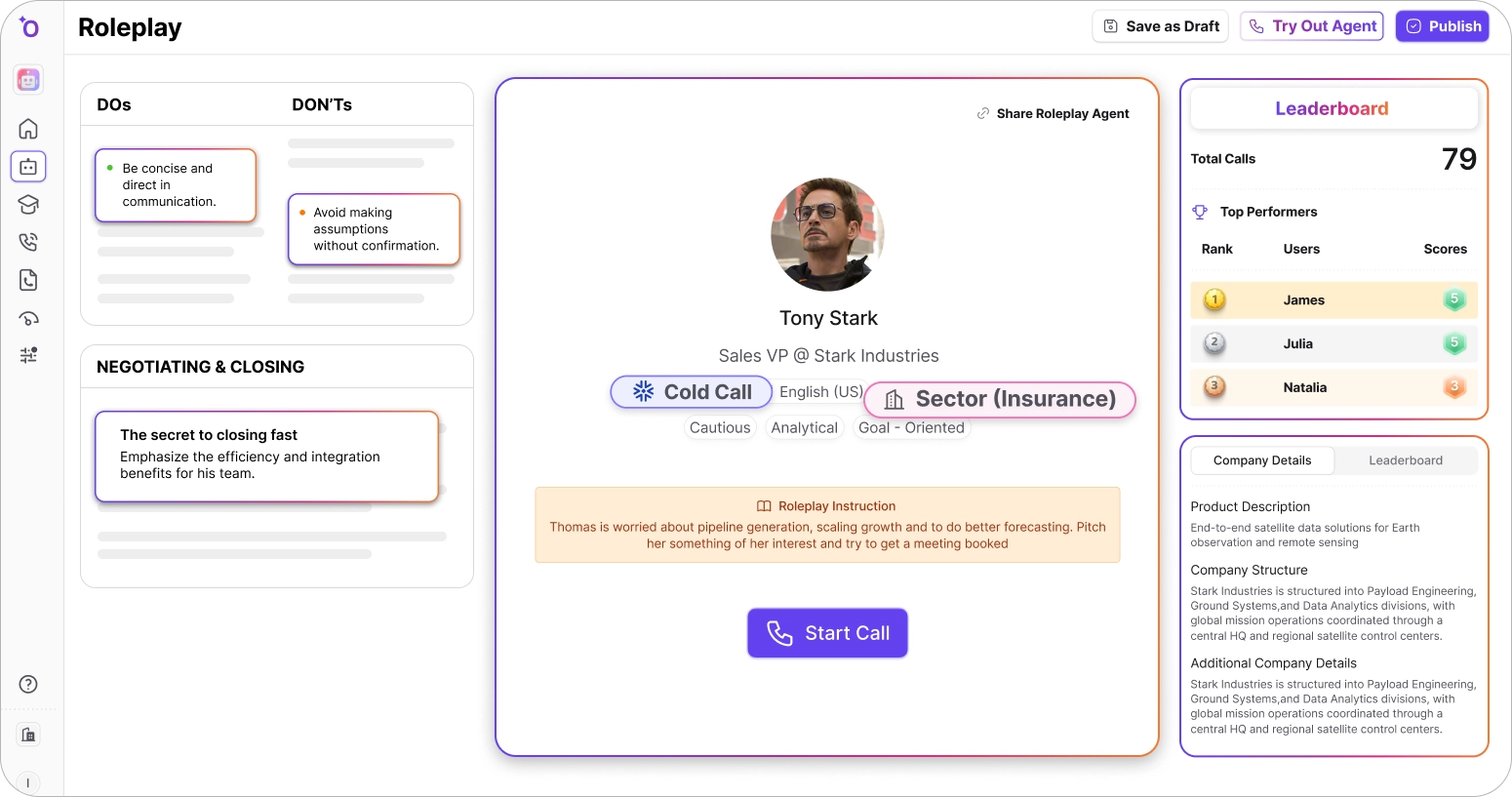
Outdoo AI — Best for: Closing the readiness-to-revenue gap with roleplay built from real pipeline data, unified scoring across practice and live calls, and conversation intelligence in one platform, with roleplays available in 120+ languages.
Outdoo AI is an enterprise roleplay and closed-loop coaching platform built for customer-facing teams. For enablement, it is the platform that sits at the intersection of every gap the function is responsible for closing: it lets reps practice the exact conversations they face before they face them, analyzes what happens on live calls with its own built-in conversation and revenue intelligence, scores practice and live performance against the same rubric, and closes the loop with targeted AI coaching triggered by real execution gaps. In short, it replaces the patchwork of practice tool plus CI tool plus coaching workflow with a single platform where all three connect.
What Outdoo AI covers across roleplay, intelligence, and coaching:
- AI Roleplays Built From Real Pipeline Calls: Generate practice scenarios directly from CRM data, call recordings, battlecards, and objection libraries. Reps practice the exact buyers and objections their team faces, not generic scripts.
- Multi-Persona Roleplays: Simulate up to 3 stakeholders at once, each with competing priorities and agendas, preparing reps for the multi-threading and buying-committee dynamics of enterprise deals.
- Voice, Video, and Chat Roleplays: Practice in the same format as the real interaction, across voice calls, video with screen sharing, and chat, plus team-selling modes for collaborative deal scenarios.
- Workflow and Software Simulation: Go beyond talk tracks. Reps rehearse the actual workflows tied to the role, including CRM logging, call disposition, and post-call steps, so they practice doing the full job, not just saying the right things.
- Built-In Conversation Intelligence: Outdoo AI records and analyzes every live customer call natively, surfacing talk ratios, sentiment, objection handling, competitive mentions, and key moments without a separate CI tool.
- Revenue Intelligence: Deal risk detection, stakeholder mapping, and automated CRM updates connect individual rep performance to pipeline health, so enablement leaders can see which skill gaps are costing deals, not just affecting scores.
- Unified AI Scoring: The same AI rubric scores roleplay sessions and live calls, so enablement can directly compare how a rep performs in practice versus execution and identify exactly where the gap is.
- Closed-Loop Coaching and AI Micro-Learning: When a rep performs well in training but struggles on real calls, coaching tasks are triggered automatically. AI-generated micro-learning closes the specific skill gap rather than sending reps back to a full course.
- Roleplays in 74+ Languages: Run consistent, scored practice for global GTM teams across regions, making Outdoo AI practical for international onboarding, product launches, and compliance training.
- 120+ Integrations: Connect across the full enablement stack including LMS (Docebo, TalentLMS, Cornerstone), CRM (Salesforce, HubSpot), Dialers, CI platforms, collaboration tools, and calendars, with SCORM, xAPI, and AICC support.
- AI Coaching for Sales Reps: Reps practice against lifelike buyer personas built from your own calls, transcripts, and playbooks, and the same AI scorecard then grades their live calls against that playbook. Globe Life saw 28% better objection handling and 3.7x practice volume per agent.
- An AI Sales Enablement Platform, Not Just a Practice Tool: Outdoo AI combines conversation intelligence, AI roleplays, and closed-loop coaching, so the gaps a rep shows on real calls become the next practice assignment, with SCORM/xAPI export to your LMS.
How Outdoo AI closes the readiness-to-revenue gap:
Most enablement teams are running three separate tools to cover what Outdoo AI does in one platform: a roleplay tool for practice, a CI tool for call analysis, and a coaching workflow to connect the two. Outdoo AI's advantage is that the data stays unified throughout. A rep practices a discovery call, gets scored. They run the same discovery call live, and Outdoo AI's built-in CI scores it against the same rubric. The gap between the two scores triggers a targeted coaching task and an AI-generated micro-learning reinforcement. The manager sees both scores in one dashboard and knows exactly what to address before the rep's next call.
Because Outdoo AI integrates natively across the stack through 120+ connectors covering LMS, CRM, Dialers, and CI tools, it plugs into what teams already run rather than replacing it. Enablement leaders can trace a direct line from practice performance, through live execution, to pipeline outcomes, which is the measurement story most enablement teams have never been able to tell.
What makes Outdoo AI a strong fit for enablement teams:
- Unified scoring across practice and live calls means enablement can measure whether skills actually transfer to execution, not just whether reps passed a certification.
- Built-in CI and revenue intelligence remove the dependency on a separate call recording tool for the coaching loop, keeping data connected and reducing tool sprawl.
- Roleplays built from real pipeline calls and CRM data make practice feel like the actual job, which drives both adoption and skill transfer.
- Roleplays in 74+ languages make the same readiness program work for global GTM teams and multilingual compliance requirements.
What to know before rolling it out:
- Built for organizations and customer-facing teams. Not a fit for individual learners, freelancers, or one-off self-study use cases.
- Pricing is tailored by team size and capabilities rather than published per seat, so a consultation is needed to scope a plan.
What sets Outdoo AI apart:
The category Outdoo AI occupies is broader than its competitors acknowledge. Other roleplay tools practice the conversation. Other CI tools analyze it. Outdoo AI is the platform that scores both sides of that interaction against one rubric and uses the gap to drive coaching. For enablement teams that are tired of proving impact to leadership with nothing better than completion rates, that unified data layer is what finally makes the case.
The revenue intelligence layer adds a dimension that pure practice tools do not have: the ability to see which skill gaps are showing up in deals that are at risk, not just in training environments. When enablement programs are tied to deal outcomes rather than certification scores, the conversation with the CRO changes entirely.
Best For:
Enablement managers, VPs of Sales Enablement, and revenue team leaders who want one platform for AI roleplay, built-in conversation and revenue intelligence, closed-loop coaching, and the measurement data to prove that programs are moving rep ramp time, win rates, and quota attainment.
Pricing and how it is structured:
Three tiers (Free, Premium, and Enterprise) with tailored pricing based on team size and capabilities. No fixed per-seat list price, no paid onboarding, and no forced multi-year lock-ins.
Testimonial:
“There was one roleplay agent that I put together named Chester... I made him be a little off kilter, talking about metaphors, be very artsy, talk about jazz a lot. That’s something we want to see within the senior population. They like to talk. Sometimes they’re not super clear. That’s been really good for our agents to experience before experiencing it in the wild”
Assistant Director of Human Development, ProvideSure
2. Hyperbound: Best for SDR and Cold Calling Practice at Scale

Hyperbound is an AI sales roleplay platform that converts an ICP description into a playable AI buyer in under two minutes. It is built specifically for high-volume outbound practice: cold calls, warm calls, and discovery conversations. With a simulated autodialer for call volume practice, Hyperbound is the go-to for enablement teams running SDR onboarding programs and AE ramp sprints.
Key features of Hyperbound:
- ICP-to-Bot in Under 2 Minutes: Describe your ideal customer profile and get a realistic AI buyer ready to practice against, no manual scripting required.
- Simulated Autodialer: Reps practice high-volume cold calling with AI bots in a simulated dialer environment, building call confidence before going live.
- AI Coaching Feedback: Personalized, session-level feedback on objection handling, talk time, and technique after every practice call.
- Analytics and Reporting: Track rep progress, identify skill gaps, and compare performance across cohorts over time.
Where Hyperbound works well:
- Fastest path from ICP description to a playable practice scenario in the category.
- Simulated autodialer makes it genuinely useful for high-volume cold calling programs, not just scripted warm call practice.
- Free tier with 9 pre-built bots lets reps start practicing before a contract is signed.
What to know before rolling it out:
- Focused primarily on outbound and cold calling scenarios. Less suited to complex discovery, multi-stakeholder enterprise deals, or the full coaching loop.
- Enterprise-only pricing model with no self-serve plans beyond the free tier, and no public pricing page.
What sets Hyperbound apart:
Hyperbound's edge is speed and volume. For SDR-heavy teams where rep turnover is high and onboarding cycles need to be short, the ability to spin up a new ICP bot in minutes and put a new hire in a simulated dialer on day one is a meaningful operational advantage. It is purpose-built for the top of funnel.
Where it differs from a closed-loop platform like Outdoo AI is scope: Hyperbound is strong for outbound practice, while Outdoo AI also covers live call scoring, revenue intelligence, multi-persona enterprise roleplays, and the full coaching loop that connects practice to live performance.
Best For:
Enablement teams running high-volume SDR onboarding and AE ramp programs where cold calling confidence and objection handling are the primary skill gaps.
Pricing and how it is structured:
A free tier with 9 pre-built bots and unlimited call time. Enterprise custom pricing, with team plans reported to start around $15,000 per year based on available user reports. Contact Hyperbound for a quote.
3. Mindtickle: Best Full-Suite Revenue Enablement Platform
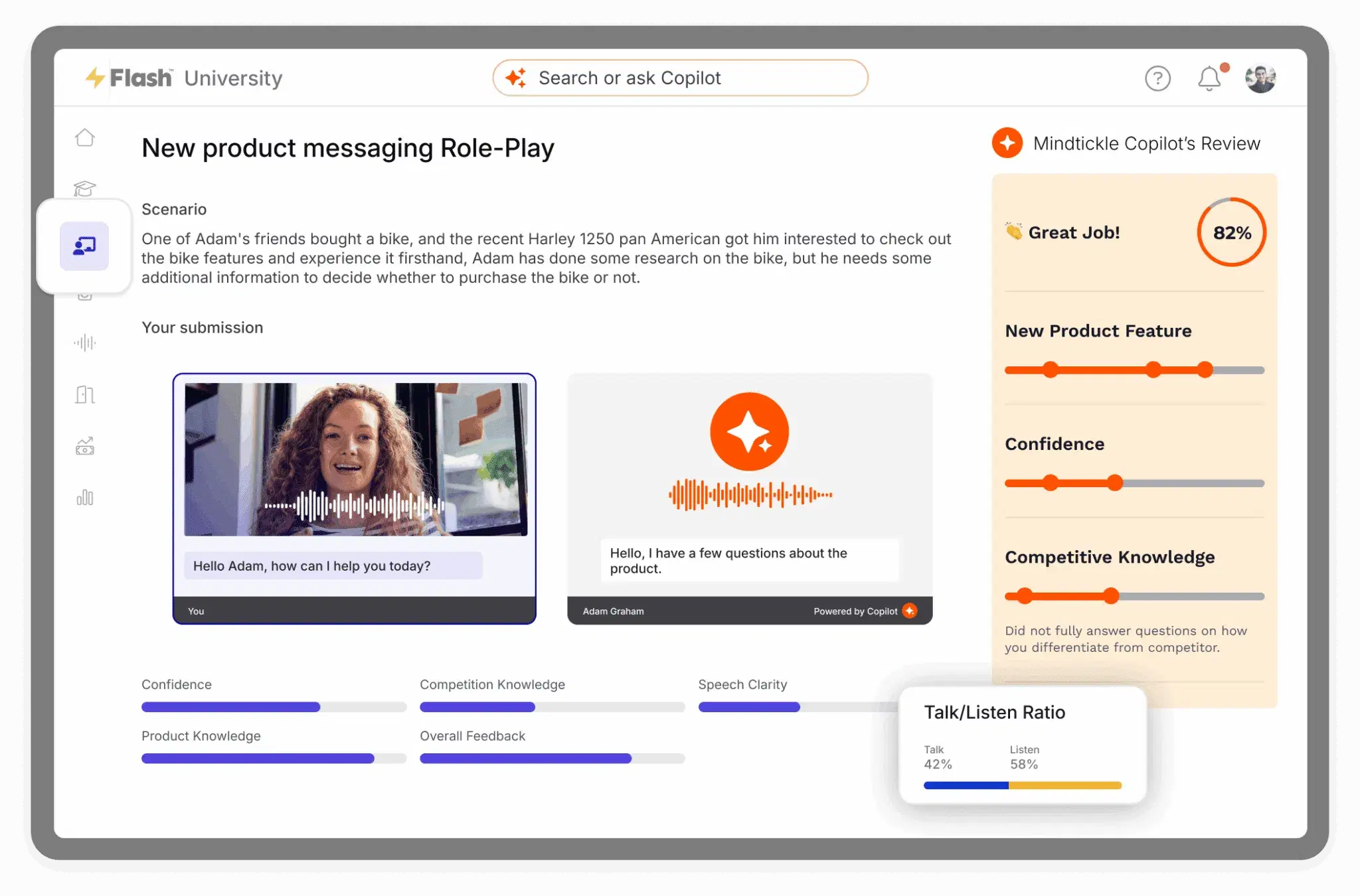
Mindtickle is a revenue enablement platform that covers training, AI roleplay, content management, call intelligence, and digital sales rooms in a single system. It is built around the idea that rep readiness and buyer engagement belong on the same platform, and its Sales Readiness Index gives managers a real-time view of where every rep stands before a pipeline review.
Key features of Mindtickle:
- Sales Readiness Index: A live dashboard scoring every rep across product knowledge, skill certifications, and call quality so managers see readiness gaps before pipeline reviews.
- AI Roleplay and Practice: Scenario-based practice with immediate AI feedback on objection handling, value articulation, and conversation structure.
- Call AI: Conversation intelligence module that analyzes recorded calls for talk-time ratios, competitive mentions, and deal risk signals.
- Digital Sales Rooms: Curated, personalized content experiences for buyers that track engagement and surface deal intelligence.
- Sales Content Management: AI-powered content organization so reps find the right asset for the right deal stage without manual searching.
Where Mindtickle works well:
- Strong if the primary problem is rep inconsistency: top reps significantly outperform the rest and enablement needs to close that gap at scale.
- Full-suite approach means fewer integration points to manage for teams that want training, content, coaching, and CI in one contract.
- Readiness Index gives a single score that ties together skill development and call performance, which is useful for executive reporting.
What to know before rolling it out:
- Full-suite breadth comes with implementation complexity. Most deployments require dedicated enablement resources to administer.
- Navigation receives consistent criticism in user reviews, especially for reps using the mobile or self-serve experience.
What sets Mindtickle apart:
Mindtickle's differentiator is the Readiness Index: a single composite score for every rep that combines knowledge assessments, AI roleplay scores, and call performance. For enablement leaders who need a defensible metric to bring into a CRO conversation, it is a more complete view of readiness than any single-category tool provides.
Best For:
Mid-market to enterprise enablement teams where rep performance inconsistency is the primary problem and a full-suite platform covering training, content, CI, and buyer engagement is preferred over best-of-breed point solutions.
Pricing and how it is structured:
Core Readiness Platform from approximately $450 per user per year. Full Revenue Enablement suite (content, coaching, CI, and digital sales rooms combined) runs roughly $700 to $950 per user per year. Custom enterprise pricing negotiated based on modules and user count.
4. Seismic: Best for AI-Powered Sales Content Management

Seismic is the dominant AI-powered sales content platform, combining content management, guided selling, buyer engagement, and enablement intelligence in one system. A significant development for buyers to note: Seismic and Highspot announced a definitive merger agreement in February 2026. The combined entity will operate under the Seismic brand, with both products running independently through the integration process. The merger creates the largest dedicated sales enablement platform in the market.
Key features of Seismic:
- Aura AI Copilot: Condenses documents into presentations, deduplicates and tags content at scale, and generates personalized sales assets in minutes.
- Guided Selling: AI surfaces the most relevant content based on deal stage, buyer persona, industry, and CRM data, reducing the time reps spend searching for assets.
- LiveDocs and Dynamic Content: Content that automatically updates when underlying data changes, so reps always share current pricing, case studies, and specs.
- Enablement Intelligence: Tracks which content gets used, shared, and engaged with by buyers, giving enablement teams data on what is actually working in deals.
- Seismic Learning (formerly Lessonly): Onboarding and just-in-time learning layered on top of the content platform.
Where Seismic works well:
- Best-in-class for large content libraries where findability and governance are the primary pain points.
- Aura AI is one of the more mature content automation engines in the category for document generation and content deduplication.
- Buyer engagement analytics (what buyers actually open and spend time on) give reps and managers deal intelligence that most LMS tools do not capture.
What to know before rolling it out:
- Built for enterprise teams with dedicated enablement resources. Implementation complexity and cost are significant, typically running $70,000 to $180,000 or more per year.
- The Highspot merger introduces roadmap uncertainty for buyers evaluating either platform. It is worth negotiating contract flexibility while the deal plays out.
What sets Seismic apart:
Seismic's edge is content intelligence. It is not just a library: it tracks what buyers engage with, feeds that back to reps and managers as deal signal, and uses that data to recommend what to share next. For content-heavy sales motions with long buying cycles and multiple stakeholders, the buyer engagement layer is where Seismic earns its price tag.
Best For:
Enterprise enablement teams with complex, high-volume content libraries and a dedicated team to manage implementation, where buyer engagement analytics and AI-powered content automation are the priority.
Pricing and how it is structured:
Enterprise custom pricing. Estimates from third-party sources suggest $60 to $120 per user per month depending on modules and contract terms. The Salesforce connector is priced separately. Contact Seismic for a current quote.
5. Gong: Best for Conversation Intelligence and Call Coaching

Gong is the market-leading revenue intelligence platform, built around conversation analysis. It records and analyzes every sales call, email, and meeting, then uses AI trained on billions of sales interactions to surface what is happening in deals: objections raised, competitors mentioned, buying signals detected, and deals flagged at risk. For enablement, it provides the data layer that makes coaching systematic rather than anecdotal.
Key features of Gong:
- Conversation Intelligence: Deep analysis of every call including talk ratios, monologue length, sentiment, interruptions, and topic tracking across the team.
- Deal Boards and Risk Scoring: A real-time view of every opportunity sorted by risk level, based on actual conversation signals rather than rep-entered CRM data.
- Coaching from Real Calls: Managers can pull specific moments from calls, leave timestamped feedback, and build coaching programs from what top reps actually do.
- Gong Enable: A module specifically for developing and scaling revenue-winning behaviors using conversation data as the source of truth.
- Gong Agents: AI that automates follow-ups, pipeline edits, and forecast corrections based on call data.
Where Gong works well:
- Best-in-class call analysis with coverage of objections, competitor mentions, buying signals, and sentiment across every conversation.
- Library of winning calls is a powerful onboarding and coaching asset that enablement teams can use to show new reps exactly what good looks like.
- Gong Enable bridges CI data and structured coaching programs, making it relevant to the enablement function beyond just recording calls.
What to know before rolling it out:
- Pricing is among the highest in the category. Effective per-user cost rises significantly when Forecast and Engage modules are added, and platform fees start at $5,000 annually on top of per-user rates.
- Most of the value is post-call. It analyses what happened, but practice and pre-call preparation require a separate tool.
What sets Gong apart:
Gong's moat is the data set. With billions of sales conversations analyzed, its ability to identify what separates a winning discovery call from a losing one is genuinely differentiated. For enablement teams building coaching programs from real patterns rather than trainer instinct, Gong is the source of record.
Worth noting: Outdoo AI integrates with Gong so that real call data from Gong can seed Outdoo AI roleplay scenarios, creating a loop where reps practice the exact objections and buyer behaviors captured from live deals.
Best For:
Mid-market and enterprise revenue teams with enough call volume (typically 50+ reps, 200+ calls per week) to justify the platform fee and extract meaningful pattern data for coaching and forecasting.
Pricing and how it is structured:
Custom pricing. Per-user rates typically run $1,400 to $1,600 per year, plus a platform fee starting at $5,000 annually. Add-on modules (Forecast, Engage) increase total cost significantly. Volume discounts apply at 100+ seats.
6. Clari: Best for Revenue Intelligence and Pipeline Forecasting

Clari is a connected revenue operations platform that brings AI to pipeline inspection, forecasting, deal risk scoring, and mutual action plans. For enablement leaders who need to tie program impact to pipeline outcomes, Clari provides the revenue data layer: it captures every activity signal, scores every deal, and shows in real time whether the quarter is on track. It also includes Clari Copilot, a conversation intelligence module that brings call recording and coaching insights into the same platform.
Key features of Clari:
- AI Pipeline Inspection: Scores every deal based on engagement patterns, activity signals, and historical data to surface risk before it shows up in a missed number.
- AI Forecasting: Predicts quarterly outcomes independent of rep-entered CRM data, reducing the subjectivity that makes most forecasts unreliable.
- Clari Copilot: Conversation intelligence module with call recording, transcription, AI summaries, and automatic CRM field updates.
- Clari Align: Mutual action plans that keep buyers and sellers aligned on next steps, timelines, and stakeholder requirements.
- Revenue Data Warehouse (RevDB): A unified data layer aggregating CRM, call, email, and calendar signals into a single view.
Where Clari works well:
- Best-in-class forecasting, especially for teams that need to separate signal from rep optimism in pipeline reviews.
- Copilot adds CI to the same platform without a separate Gong contract, which is a meaningful cost and integration simplification for some teams.
- Enablement leaders can use Clari's pipeline data to demonstrate which programs correlate with improved deal health, making ROI reporting more credible.
What to know before rolling it out:
- Pricing compounds quickly when multiple modules (Core, Copilot, Groove) are combined. Total cost of ownership is higher than initial per-user estimates suggest.
- Most valuable to teams with mature RevOps discipline and clean CRM data. Teams without data hygiene often find Clari surfaces noise rather than signal.
What sets Clari apart:
Clari's edge is forecasting accuracy. Even Gong customers frequently run Clari alongside it, because Gong's Forecast module has not displaced Clari's core forecasting capability. For enablement teams that report into a CRO and need to show program impact on pipeline outcomes rather than training metrics, Clari is the tool that connects those two conversations.
Best For:
Enterprise revenue and enablement teams that need to tie learning and coaching data to pipeline health and forecast accuracy, especially organizations with 100+ reps and dedicated RevOps support.
Pricing and how it is structured:
Custom modular pricing. Core platform estimated at $100 to $120 per user per month. Copilot (CI) and Groove (sales engagement) priced separately. Most enterprise contracts negotiate across modules. Contact Clari for a quote.
7. Consensus: Best for Demo Automation and Buyer-Led Selling
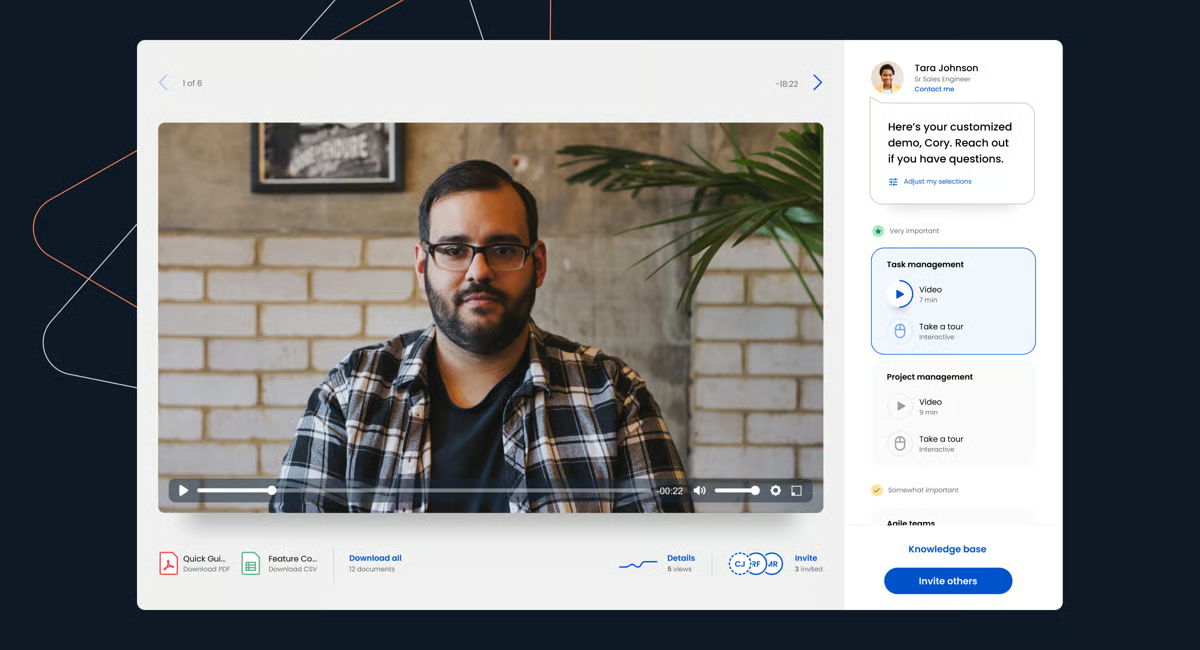
Consensus is a buyer enablement platform that lets prospects experience interactive, personalized product demos on their own time, then surfaces exactly what they engaged with and for how long. For enablement teams managing complex deals with multiple stakeholders, it solves a specific and expensive problem: the discovery call that produces ten follow-up demo requests from people who were not on the original call.
Key features of Consensus:
- Interactive Demo Automation: Prospects self-select which features matter to them and receive a personalized demo experience without requiring SE or AE time.
- Buyer Intent Analytics: Tracks exactly which features buyers watched, replayed, and shared, giving reps signal on what the buying committee actually cares about.
- Multi-Stakeholder Tracking: When a buyer shares the demo internally, Consensus tracks each new viewer and alerts the rep to new stakeholders entering the deal.
- Demo Templates and Libraries: Enablement teams build and manage a library of modular demo content that reps assemble without SE involvement.
Where Consensus works well:
- Solves the SE bottleneck in complex deals by letting buyers self-educate before and between live conversations.
- Buyer engagement data (what they watched, shared, and skipped) gives reps genuine deal intelligence that most content tools cannot provide.
- Multi-stakeholder tracking surfaces new buying committee members who enter a deal through a shared demo link.
What to know before rolling it out:
- Most valuable in complex, multi-stakeholder deals with a strong product demonstration component. Less relevant for transactional or outbound-heavy motions.
- Requires investment in building and maintaining a demo content library to realize full value.
What sets Consensus apart:
Consensus' edge is buyer-led selling. Rather than pushing content at buyers, it lets them pull what is relevant to them, which produces engagement data that passive content sharing never generates. For enablement teams that want to improve late-stage win rates in complex deals, the ability to know exactly what the CFO watched before the business case meeting is a meaningful advantage.
Best For:
Enablement teams supporting complex B2B deals with product demonstration requirements, multiple stakeholders, and a dedicated Solutions Engineering function.
Pricing and how it is structured:
Custom pricing based on usage volume and team size. Contact Consensus for a quote.
8. Showpad: Best for Field and In-Person Sales Enablement
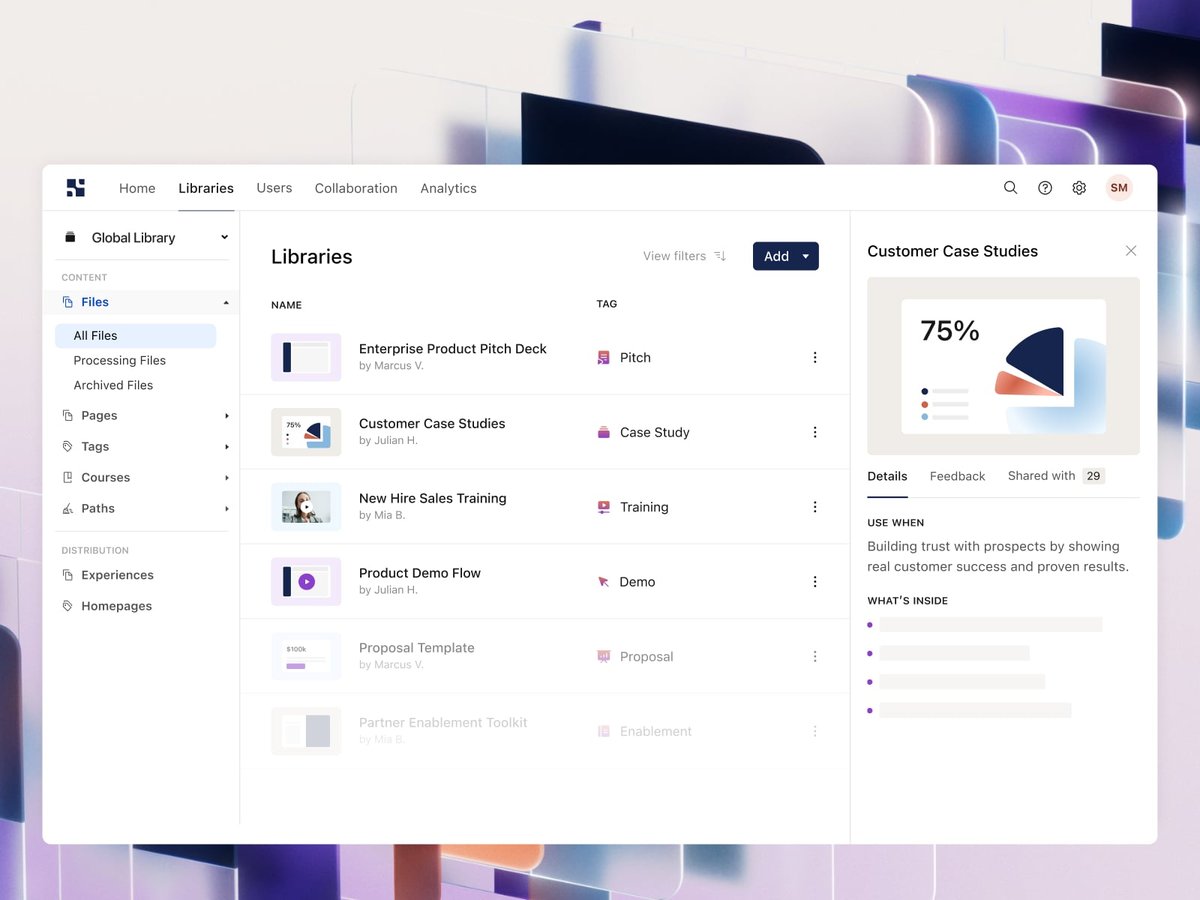
Showpad is a sales enablement platform that merges content management, seller readiness, and buyer engagement into one system purpose-built for industries where in-person selling drives revenue: MedTech, manufacturing, life sciences, and CPG. Following its combination with Bigtincan in late 2025, Showpad now carries a broader capability footprint, including its RolePlayAI feature for in-person pitch practice.
Key features of Showpad:
- AI Content Recommendations: Surfaces the most relevant collateral, presentations, and case studies based on deal stage, buyer persona, and industry context.
- RolePlayAI: Real-time multilingual sales simulations so field reps can rehearse pitches and objection handling before high-stakes in-person meetings.
- Offline Access: Full content access without connectivity, built for field reps in manufacturing and healthcare environments where reliable internet is not guaranteed.
- Buyer Engagement Rooms: Digital spaces for sharing content with buyers post-meeting and tracking what they engage with.
Where Showpad works well:
- The only platform built specifically for the constraints of field selling: offline access, in-person presentation, and compliance-heavy content governance.
- Strong in MedTech and manufacturing where product complexity, compliance requirements, and in-person dynamics are all in play simultaneously.
- RolePlayAI is a meaningful addition for teams that need pitch practice but do not want a separate standalone tool.
What to know before rolling it out:
- The Bigtincan combination is still in post-merger integration, which introduces some product roadmap uncertainty.
- Less suited to inside sales or purely digital-first motions where the field-first design philosophy does not map to how reps work.
What sets Showpad apart:
Showpad is the only enterprise enablement platform built ground-up for the physical selling environment. For organizations where a rep walks into a hospital, a factory floor, or a retail buyer meeting with a tablet and needs the right content, offline access, and a confident pitch, Showpad's field-first design is a genuine differentiator that platforms built for inside sales teams simply do not match.
Best For:
Enablement teams in MedTech, manufacturing, life sciences, CPG, and other industries where in-person, field, or channel selling is the primary revenue motion.
Pricing and how it is structured:
Custom enterprise pricing. Contact Showpad for a quote.
9. Allego: Best for Video Coaching, Peer Learning and Skills Certification

Allego is a sales learning and enablement platform built around video: reps record practice pitches, managers leave timestamped video feedback, and peers share winning examples. It layers formal certification programs and compliance training on top, making it a natural choice for enablement teams in regulated industries (financial services, life sciences, insurance) where documented proof of competency is required.
Key features of Allego:
- Video Practice and Coaching: Reps record pitches and practice responses; managers review and annotate with video or text feedback at specific moments.
- Peer Learning and Content Sharing: Top performers share winning call clips and tactics that the broader team can learn from and replicate.
- AI-Powered Feedback: AI analyzes recorded practice for energy, clarity, and key message coverage, supplementing manager review at scale.
- Certification and Compliance Tracking: Structured certification paths with documented completion evidence, audit trails, and compliance reporting.
Where Allego works well:
- Strong for regulated industries where documented competency evidence is a legal or regulatory requirement.
- Peer learning model surfaces what top reps actually do rather than what trainers believe they do.
- Video feedback is more effective for pitch coaching than written comments, particularly for tone, energy, and delivery.
What to know before rolling it out:
- Video-first format requires reps to be comfortable recording themselves, which can be a cultural barrier in some organizations.
- More limited on live call analysis and revenue intelligence than platforms like Gong or Outdoo AI.
What sets Allego apart:
Allego's edge is certification with evidence. For financial services and life sciences enablement teams that need to prove every rep is competent before a customer interaction, Allego provides the audit trail that other coaching platforms skip. The video format also makes the proof of competency more credible than a multiple-choice quiz result.
Best For:
Enablement teams in regulated industries (financial services, life sciences, insurance) that need formal video-based certification programs, compliance documentation, and scalable peer coaching.
Pricing and how it is structured:
Custom pricing based on team size and modules. Contact Allego for a quote.
10. Salesloft: Best for AI Sales Engagement and In-Workflow Coaching

Salesloft is an AI-powered revenue workflow platform that combines sales engagement (cadences, email, dialing), conversation intelligence, and coaching in one system. For enablement teams, it is the platform where messaging governance and in-the-moment coaching happen: enablement-built cadences and playbooks reach reps in the tool they use for every outreach, rather than living in a separate portal nobody opens.
Key features of Salesloft:
- Rhythm AI: An AI prioritization engine that surfaces the most important rep actions based on deal signals, buyer engagement, and pipeline data.
- Cadence and Messaging Governance: Enablement teams build approved outreach sequences that reps execute with AI-generated personalization, keeping messaging consistent without removing flexibility.
- Conversation Intelligence: Records and analyzes calls for coaching moments, and surfaces AI-generated feedback and next-step recommendations post-call.
- In-Workflow Coaching Nudges: AI surfaces coaching recommendations as reps are working a deal, so feedback arrives in context rather than in a separate coaching session.
Where Salesloft works well:
- Bridges the gap between enablement-built content and actual rep execution by delivering both into the daily workflow.
- Rhythm AI reduces the cognitive load on reps by surfacing what to do next based on signal, which helps enablement programs stick in the flow of work.
- Conversation intelligence and coaching live in the same platform as outreach, reducing the number of tools reps switch between.
What to know before rolling it out:
- Primarily a sales execution tool. Enablement teams use it for messaging governance and in-workflow reinforcement but not for structured training or deep skill development.
- Licensing typically sits with Sales Ops or RevOps rather than the enablement function, so budget and ownership conversations need to involve multiple stakeholders.
What sets Salesloft apart:
Salesloft's differentiator for enablement is delivery. Most enablement content never reaches reps at the moment it is relevant because it sits in a separate system. Salesloft puts enablement-built cadences and coaching nudges inside the tool reps use for every deal, which is where the reinforcement actually happens.
Best For:
Enablement teams that need to govern outreach messaging and deliver coaching reinforcement in the daily workflow, particularly for inside sales and high-velocity deal motions.
Pricing and how it is structured:
Custom pricing. Per-user estimates from third-party sources suggest roughly $100 to $125 per user per month. Contact Salesloft for a current quote.
How to Close the Readiness-to-Revenue Gap with AI
The readiness-to-revenue gap is the distance between a rep completing an onboarding program and a rep consistently winning deals. Most enablement programs close the first half of that distance well: they build knowledge, teach the pitch, and certify competency. The second half is where revenue is won or lost, and it is the part most traditional programs leave to chance.
Step 1: Build practice from real pipeline data. Generic roleplay does not transfer to real deals. Practice built from your own call recordings, CRM objection data, and competitive battlecards produces reps who recognize the situations they are about to face because they have already faced them in simulation. Outdoo AI generates roleplays directly from pipeline calls and CRM data, so practice mirrors reality.
Step 2: Score practice and live performance on the same scale. A rep can pass every practice scenario and still lose deals if the rubric used in training does not match what winning looks like in execution. Unified scoring across roleplay and live calls closes that gap. When the same AI rubric evaluates a practice discovery call and a real one, the difference in score is the coaching target.
Step 3: Coach the specific gap, not the whole playbook. When a rep performs well in training but struggles on live calls, the coaching intervention should address the exact behavior that diverged, not send the rep back to a full course. AI-triggered micro-coaching based on the gap between practice and live scores is what makes coaching scalable across large teams.
Step 4: Connect skill data to deal outcomes. Enablement impact is only credible when it is expressed in revenue terms. Tools that produce skill scores in isolation give enablement managers training metrics. Tools that connect those skill scores to deal health, win rates, and quota attainment give them a business case. The combination of Outdoo AI's unified scoring and revenue intelligence, Gong's call-to-deal analysis, and Clari's pipeline data is what makes that connection visible.
Step 5: Make enablement show up in the workflow, not beside it. Training that lives in a separate portal competes for rep attention with every other priority in their day. Salesloft puts messaging and coaching nudges into the tool reps use for every outreach. Seismic surfaces the right content at the deal stage where it is relevant. Consensus delivers buyer enablement material that reps share in the deal rather than talking about. The programs that stick are the ones that show up where the work happens.
The principle: Enablement is not a phase that ends at onboarding. The teams that prove the most impact in 2026 are running a continuous loop of practice, live execution, measurement, and coaching that starts on day one and runs through every deal cycle.
How to Choose the Right AI Tools for Your Enablement Stack
The right starting point depends on what is breaking down between your enablement programs and the revenue outcomes they are supposed to drive. Here is how to map the gap to the category:
1. If your reps are completing training but not executing consistently on calls: The gap is practice and coaching. Start with Outdoo AI to build a closed-loop system where reps practice from real pipeline calls, get scored against the same rubric used on live work, and receive targeted coaching triggered by actual execution gaps. Add Hyperbound if SDR cold calling volume and ramp time are the most urgent problems. Once the practice loop is running, layering Gong or Clari on top connects coaching data to deal outcomes.
2. If you need a single platform for training, content, coaching, and CI: A full-suite revenue enablement platform reduces integration overhead. Mindtickle is the strongest option if rep readiness consistency and a composite score for executive reporting are the priority. Seismic is the stronger choice if content management and buyer engagement analytics are where the program breaks down most visibly.
3. If your managers are coaching from gut feel rather than data: Conversation intelligence is the missing layer. Gong gives the deepest call analysis and the largest winning-call library for onboarding. Clari connects that call data to pipeline health and forecast accuracy. Both integrate with Outdoo AI so that practice scenarios can be generated from real objection and buyer patterns captured in live deals.
4. If content exists but is not reaching buyers or influencing decisions: The gap is buyer enablement. Seismic surfaces the right asset at the right deal stage through guided selling. Consensus automates interactive demos so buyers self-educate and give reps engagement signal without requiring SE time. Showpad covers the same problem for field and in-person selling motions.
5. If you need to certify competency and prove it to compliance or leadership: Allego's video-based certification with documented audit trails is the strongest option in regulated industries. For teams that need messaging governance and coaching reinforcement in the daily workflow, Salesloft delivers both inside the tool reps use for every deal.
Bottom line: A complete enablement stack in 2026 runs a continuous loop from practice, through execution, to measurement. Tools that only cover one stage leave the rest to chance. The fastest path to proving enablement ROI is connecting practice data to live performance data to pipeline outcomes, and that loop starts with making practice realistic, scorable, and tied to the conversations your reps actually face.
Final Thoughts
The enablement function has always been asked to do something hard: change how people sell at scale, using programs that compete for rep attention with every other priority in their day. AI does not make that easier automatically. The tools in this guide are only as useful as the clarity behind them on what is actually breaking down between training and revenue.
Start with the gap. If reps are not executing consistently, the practice and coaching layer is where to invest first. If content exists but is not reaching buyers, the answer is guided selling and buyer engagement. If managers are coaching without data, conversation intelligence is the unlock. And if the CRO is asking why enablement spend is not showing up in win rates, the answer is building the measurement loop that connects skill scores to deal outcomes, which is the problem Outdoo AI is built to solve from the ground up.
Outdoo AI combines AI roleplay built from real pipeline calls, built-in conversation and revenue intelligence, unified scoring across practice and live work, and closed-loop coaching that triggers from real execution gaps. With 120+ integrations across every category in this guide and roleplays in 120+ languages, it is the readiness layer that connects the rest of the enablement stack to the revenue outcomes it is supposed to produce.
Book a demo to see how Outdoo AI fits into your enablement stack.
Outdoo builds AI Roleplays from your own calls and scores practice and real calls with one scorecard. Rated #1 for Best Results on G2.
Frequently Asked Questions
What are the best AI tools for sales enablement teams in 2026?
The best AI tools for enablement teams in 2026 span five categories: AI roleplay and coaching (Outdoo AI, Hyperbound), revenue enablement platforms (Mindtickle, Seismic), conversation intelligence (Gong, Clari), buyer engagement (Consensus, Showpad), and sales certification and execution (Allego, Salesloft). Outdoo AI stands out for combining AI roleplay, built-in conversation intelligence, revenue intelligence, and closed-loop coaching in one platform.
What is the readiness-to-revenue gap and how do enablement teams close it?
The readiness-to-revenue gap is the distance between a rep completing a training program and consistently winning deals. Enablement teams close it by connecting practice (AI roleplays built from real pipeline data), execution (unified AI scoring across practice and live calls), and coaching (targeted interventions triggered by actual performance gaps) in a continuous loop. Outdoo AI is built specifically to run that loop.
Does Outdoo AI have its own conversation intelligence and revenue intelligence?
Yes. Outdoo AI includes built-in conversation intelligence that records and analyzes live customer calls natively, plus revenue intelligence covering deal risk detection, sentiment tracking, stakeholder mapping, and automated CRM updates. It also scores practice roleplays and live calls against the same AI rubric, so enablement leaders can directly compare practice performance to real execution. Outdoo AI connects to 120+ integrations across LMS, CRM, Dialers, and CI platforms.
How is a sales enablement AI stack different from an L&D stack?
An L&D stack focuses on building capability across the full workforce through course creation, LMS delivery, and skills tracking. An enablement stack is focused on revenue outcomes: rep ramp time, win rates, and quota attainment. The tools differ accordingly. Enablement stacks prioritize conversation intelligence, deal analytics, buyer engagement, and practice built from real pipeline data, categories that L&D platforms rarely cover at the depth revenue teams need.
What should enablement teams look for in an AI roleplay platform?
The most important factors are whether practice scenarios reflect real buyer situations (ideally built from your own CRM data and call recordings), whether the platform scores practice and live work on the same rubric so you can measure transfer, whether coaching is triggered by actual execution gaps rather than trainer schedules, and whether the platform integrates with the rest of your stack. Outdoo AI covers all four, and Hyperbound is a strong complementary option specifically for cold calling and SDR practice.