



Compliance training at global enterprise scale broke in 2026. Static e-learning modules, annual certifications, and PowerPoint walkthroughs were built for a world where regulations changed slowly, workforces were concentrated, and click-through completion counted as proof of readiness.
None of that holds anymore. The EU AI Act entered force on August 1, 2024 as the first comprehensive AI-specific regulation and now applies globally to any AI system serving European users.
The FCC declaratory ruling of February 2024 made AI-generated voices in calls illegal under TCPA unless prior express consent has been obtained, which materially changes how contact centers and outbound sales teams must structure live conversations. Regional regulators across APAC and LATAM have tightened consumer protection rules in parallel.
FINRA enforcement data shows $59.8 million in fines across 552 enforcement actions in 2024, with 15 of those fines exceeding $1 million per case per the Eversheds Sutherland analysis. HIPAA penalty tiers now range from $145 to $2,190,294 per violation following the January 2026 inflation adjustment by HHS. The IBM data breach report found that the global average cost of a data breach reached $4.88 million in 2024, a 10% increase over the prior year and the largest annual jump since the pandemic.
The gap between training and execution is wider than most enablement leaders realize. Research cited in the Outdoo AI Readiness Report, drawn from 15,000+ simulated customer-facing conversations across 40 organizations, shows reps forget up to 90% of new training content within one week and apply only 10 to 20% of what they retain.
This guide covers how AI roleplays for compliance training are emerging as the operational layer that connects compliance policy to demonstrated competency.
The post walks through the five structural reasons traditional compliance training fails at global scale, the three-layer model AI roleplay introduces, six industry-specific use cases across financial services, healthcare, insurance, credit unions, contact centers, and professional services, the audit defensibility requirements regulators now expect, eight evaluation criteria for choosing a platform, and the five-step rollout playbook enterprises follow to deploy successfully.
What Is AI Roleplay for Compliance Training?
AI roleplay for compliance training is a practice method where reps rehearse regulated customer conversations, such as HIPAA, FINRA, GDPR or MiFID II disclosures, against an AI customer and are scored on the organization's own compliance rubric before any live interaction.
The compliance training problem at global enterprise scale
Five problems break compliance training at enterprise scale. Each one has a measurable cost.
1. Reps forget training faster than they apply it
Research in the Outdoo AI Readiness Report shows up to 87% of new sales reps forget training content within 12 weeks. Broader workplace research finds 90% of new material is lost within a week without reinforcement, with only 10 to 20% retained and just 1 to 2% influencing real performance. A rep who passed HIPAA certification last month may now mishandle a PHI escalation when a real patient situation arises.
2. Completion certificates do not prove competency
Outdoo AI analyzed 15,000+ simulated customer-facing conversations across 40 organizations and found a consistent pattern. Reps who completed every training module still struggled to deliver mandatory disclosures cleanly during multi-stakeholder conversations, particularly when customers pushed back emotionally or asked questions outside the prepared script. Audit-ready competency requires active practice with measurable validation, not passive instruction.
3. Workforce dispersion creates language and jurisdiction gaps
Global enterprises run customer-facing teams across 10+ jurisdictions and as many languages, with each region carrying different regulatory frameworks. Static training assumes one framework and one primary language, forcing enablement teams to maintain parallel content libraries. Every regulatory change in any one jurisdiction multiplies the maintenance burden.
4. Cost of compliance violations continues to escalate
FINRA imposed $59.8 million in fines across 552 enforcement actions in 2024, with 15 individual fines exceeding $1 million per case. HIPAA civil monetary penalties now range from $145 to $2,190,294 per violation following the January 2026 HHS inflation adjustment. The IBM Cost of a Data Breach Report 2024 puts the global average breach cost at $4.88 million, up 10% year over year. A single avoidable compliance event costs more than several years of compliance training combined.
5. Audit defensibility is a board-level question
Regulators now expect enterprises to demonstrate readiness with timestamps, scoring rubrics, remediation trails, and pass-fail certification gates that prove every rep was competent on the date of the customer interaction. Click-through completion logs do not survive a modern audit. Compliance officers face an evidence problem traditional LMS reporting cannot solve. For a dealership example, see how an F&I menu presentation is scored separately for persuasion and compliance.
Every one of these problems shares a root cause: passive learning cannot validate competency under the conditions where competency actually matters. AI roleplay is the structural alternative.
What AI roleplay actually delivers for compliance training
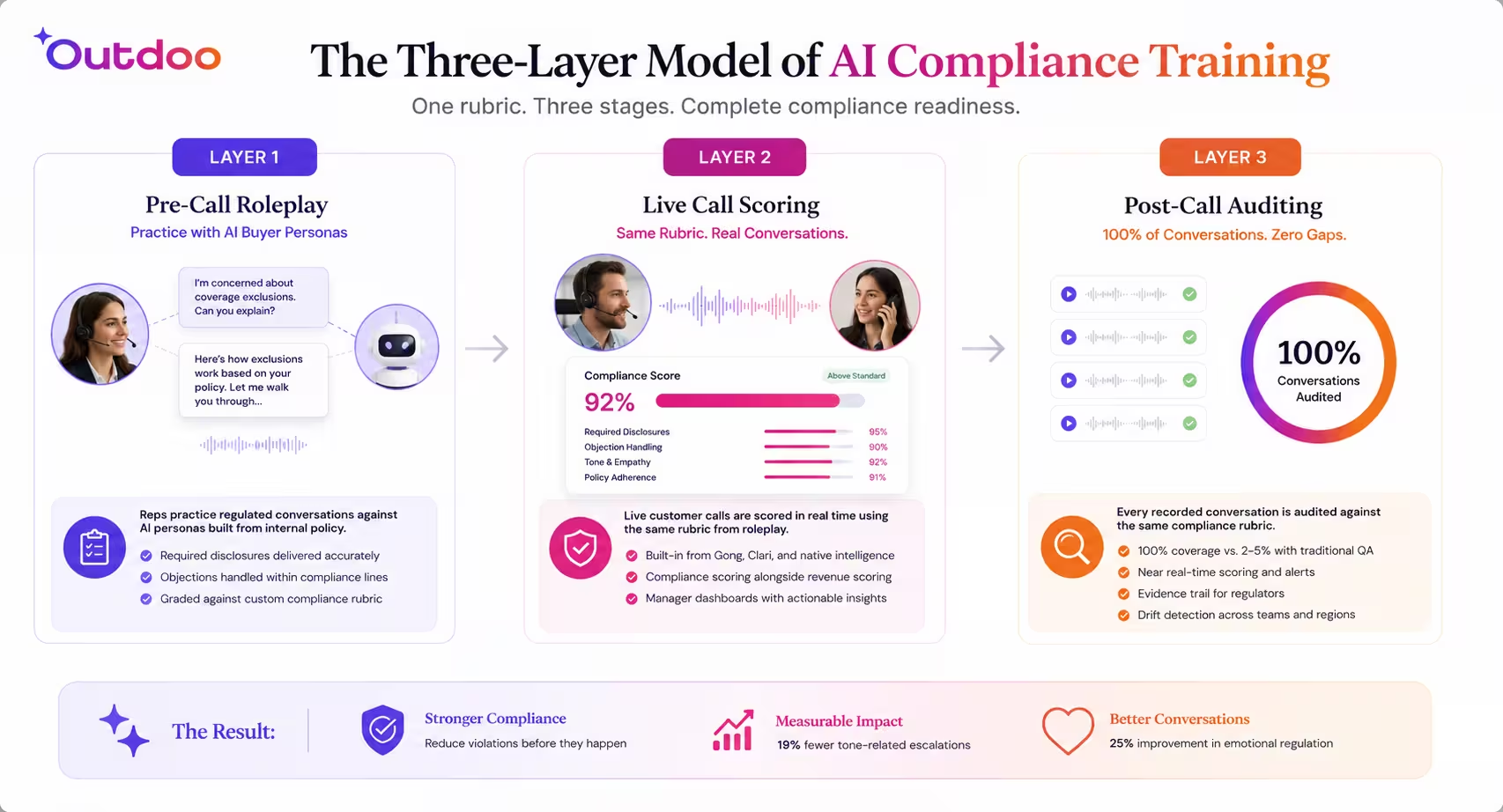
AI roleplay for compliance training operates across three layers that together close the gap between training and execution.
Layer 1: Pre-call roleplay built from internal policy
Reps practice regulated conversations against AI buyers, customers, patients, or members built directly from internal compliance policy. The platform tests whether the rep delivers required disclosures accurately, handles objections without crossing compliance lines, and adapts to scenario variations.
A HIPAA-protected family member asks for PHI. A financial customer pushes back on suitability documentation. An insurance prospect asks about coverage exclusions while emotionally distressed. The AI grades each interaction against a custom rubric built from the organization's actual compliance language, not generic templates.
Layer 2: Live call scoring on the same rubric as practice
Once reps are certified through practice, their real customer conversations are scored against the same rubric used during training. This is the closed loop that turns AI roleplay from a training tool into a readiness system.
The methodology a rep practiced against becomes the methodology that gets enforced in production. Outdoo AI's coaching module delivers this through ingestion from Gong, Clari, and native conversation intelligence, with compliance scoring surfaced alongside revenue scoring in manager dashboards.
Layer 3: Post-call auditing across 100% of conversations
Traditional QA samples 2 to 5% of customer interactions. Outdoo AI's coaching module extends auditing to every recorded conversation, scoring each one against the same compliance rubrics used in roleplay practice in near real time.
This creates the evidence trail regulators demand and surfaces compliance drift across teams, regions, or tenure cohorts before it becomes a violation pattern that draws enforcement attention.
The combined operational result is meaningful. AI compliance training reduces violations across regulated industries by replacing passive instruction with active rehearsal and measurable competency validation.
Across customer organizations deploying Outdoo AI, the 2026 Readiness Report documents tone-related escalations dropping by 19% and emotional regulation in difficult conversations improving by 25%, both metrics directly tied to the conversation patterns where most compliance violations originate.
Beyond the three-layer model
AI roleplay introduces additional capabilities that traditional compliance training cannot match. Scenarios are built from internal policy documents, with Outdoo AI's roleplay agent creation workflow supporting direct upload of compliance policy documents, regulatory training material, and real recorded customer calls.
Custom rubrics built from internal governance documents work alongside methodology scorecards for SPIN, BANT, MEDDIC, MEDDPICC, and Challenger, with compliance officers configuring scoring criteria that match exactly what regulators audit against.
Multi-language coverage at parity scoring means a HIPAA scenario in English and the same scenario in Spanish or German use identical rubrics. In production today, a leading global enterprise SaaS company runs Spanish and Italian AI agents alongside English for sales teams serving European markets, with the same compliance rubric applied consistently across all three languages.
Audit logging timestamps every roleplay attempt with the rubric version used and the policy version the rep was tested against, which means exporting an evidence trail takes minutes rather than days.
Certification gates enforce pass-fail readiness before reps engage live customers, with automated remediation paths for failed scenarios. And when regulations change, scenarios update in days rather than months, with the next certification round running against the updated rubric automatically.
Industry-specific compliance use cases
Compliance training is not a single problem. Every regulated industry has its own framework, its own conversation patterns, and its own audit expectations. AI roleplay adapts to each, and the operational pattern below covers six industries where Outdoo AI deployments are most common.
1. Financial services and banking: FINRA, MiFID II, AML, suitability
Reps in retail banking, wealth management, and commercial finance navigate FINRA Rule 2111 suitability obligations in the US, MiFID II Article 24 and 25 disclosure requirements in the EU, anti-money laundering protocols globally, and product recommendation rules that change by jurisdiction.
AI roleplay scenarios cover suitability questionnaire delivery with realistic customer pushback, AML red-flag conversations during onboarding, investment recommendation walkthroughs with mandatory risk disclosures, multi-stakeholder conversations across customer, advisor, and compliance officer, and cross-border wealth management with jurisdictional handoffs.
Outdoo AI supports these motions across retail and commercial banking deployments with the enterprise security required for regulated procurement.
2. Healthcare and life sciences: HIPAA, PHI, patient privacy, FDA promotional rules
Patient-facing teams, payer outreach, pharma sales representatives, and medical device reps face HIPAA in the US, GDPR in the EU when handling patient data, FDA promotional regulations governing what drug reps can and cannot say about indications, and patient privacy laws that vary by jurisdiction.
AI roleplay scenarios cover patient interactions with PHI safeguarding under family-member pressure, pharmacy benefit conversations with insurance and patient consent flows, pharma sales conversations with physicians where off-label discussions must be avoided, medical device sales conversations with surgeons and OR staff where multiple stakeholders are present simultaneously, and patient escalation handling that maintains empathy alongside HIPAA-compliant data discipline.
3. Insurance: TCPA, coverage exclusion disclosure, fear-based selling
Insurance sales is among the most regulated motions globally. Reps must navigate TCPA consent on outbound dial, accurate coverage exclusion disclosure under customer pushback, waiting period and deductible accuracy where fear-based selling crosses compliance lines, claims conversations under emotional pressure, and suitability flows for whole life versus term products.
Outdoo AI's insurance solution covers these motions with industry-specific scenario libraries, including pre-built drills for the conversation patterns where most insurance compliance violations originate.
4. Credit unions and lending: ECOA, fair lending, hardship conversations
Credit unions and consumer lenders operate under Equal Credit Opportunity Act requirements, fair lending audit expectations, and emotionally complex member conversations that carry real regulatory exposure.
AI roleplay scenarios cover loan denial conversations with empathy plus ECOA-compliant language, delinquency discussions without creating discriminatory patterns, financial hardship conversations that protect both member relationships and regulatory exposure, new member onboarding with required disclosures, and cross-sell conversations that respect member-first standards.
Outdoo AI's solution for credit unions directly addresses these scenarios, with front-line staff practicing loan denials, delinquency discussions, and financial hardship cases against AI customers before facing real members.
5. Contact centers and telecom: consumer protection, dispute handling, FCC AI disclosure
Contact center reps now face the FCC's February 2024 ruling on AI-generated voices in calls under TCPA, alongside standard consumer protection requirements across dispute handling, refunds, and outbound sales.
AI roleplay scenarios cover dispute escalation with compliance-friendly de-escalation language, refund and cancellation conversations under TCPA constraints, outbound disclosure delivery including the required AI disclosure on AI-handled calls, and cross-border consumer protection that respects GDPR in the EU, CCPA in California, and country-specific consumer rules.
Performance impact across contact centers using Outdoo AI includes tone-related escalations reduced by 19% and first-contact resolution improved by 13% per the readiness study.
6. Professional services and consulting: confidentiality, conflict of interest, regulatory adherence
Consultants, lawyers, accountants, and advisory professionals face confidentiality requirements, conflict-of-interest checks, and industry-specific regulatory frameworks that vary across client engagements.
AI roleplay scenarios cover client onboarding conversations with conflict-of-interest disclosures, engagement scoping with proper confidentiality language, cross-jurisdiction advisory conversations with appropriate disclaimers, and sensitive client conversations where regulatory and reputational risk overlap.
Outdoo AI supports this segment with practice motions for client introductions, scoping calls, and discovery conversations that protect billable work alongside compliance posture.
How AI roleplay solves the audit defensibility gap
The audit defensibility problem deserves a dedicated section because it is the question Chief Compliance Officers and risk leaders ask first when evaluating AI roleplay platforms. Static compliance training fails this question structurally. Click-through completion logs do not prove competency, and modern regulators know it. Four operational benefits of AI roleplay close the audit defensibility gap directly.
Audit logging produces an exportable evidence trail
Every roleplay attempt produces a timestamped record showing what rubric version was used, what the rep said, how the AI scored each compliance dimension, and whether the rep passed or failed the certification gate. When regulators request training records for a specific rep on a specific date, the response time drops from days of manual evidence gathering to minutes of report generation.
Certification gates enforce readiness before live calls
Reps cannot engage live customers in regulated motions until they pass pre-defined scenarios. Compliance officers define the rubric. The platform enforces it. No human bottleneck, no certification drift, and no rep slipping through the cracks because their manager was busy when certification was scheduled.
Across enablement and L&D deployments documented in the Readiness Report, certification accuracy improved by 23% and skill heatmap visibility increased by 31% through behavioral data, both critical signals for audit-ready readiness systems.
Cohort-level risk visibility surfaces exposure before it becomes a violation
Manager dashboards surface compliance adherence variance by team, region, tenure, and product line. The Chief Compliance Officer sees where exposure is concentrated and can deploy remediation before a regulator does. This is the operational shift from reactive compliance investigation to proactive risk management, and it depends on the dataset only AI roleplay produces at scale.
Closed-loop validation against live customer calls
The rubric reps practiced against is the rubric their live customer calls are scored against through Outdoo AI's integrations with Gong, Clari, and native conversation intelligence. When compliance scores in practice diverge from compliance scores in production, leaders see the gap immediately. The signal is structural rather than anecdotal. Reps who consistently practice well but execute poorly get flagged automatically, and remediation runs against the same rubric until practice and production scores align.
Compliance training stops being a quarterly box-check and becomes a continuous readiness signal directly tied to revenue protection. For Chief Compliance Officers reporting to the board, this is the difference between confidence and exposure. Schedule a demo to see how Outdoo AI's audit logging, certification gates, and closed-loop validation work for your specific compliance framework.
What to evaluate when choosing an AI roleplay platform for compliance training
Eight evaluation criteria separate enterprise-ready compliance platforms from tools built for lighter use cases. Each one matters in regulated industry procurement.
1. Multi-language coverage at scoring parity
Does the platform support the languages your global workforce actually operates in, with the same compliance rubric applied consistently across all of them? Look for 25+ languages at minimum, 75+ for true global enterprise deployment. Outdoo AI supports 74+ languages with scoring rubrics that translate across them.
2. Enterprise security certifications
SOC 2 Type 2, GDPR, HIPAA, CCPA, and ISO 27001 are table stakes for regulated industries. Without all of these, procurement will not approve a deployment. Outdoo AI is fully compliant with SOC 2 Type 2, HIPAA, GDPR, and CCPA, with all data encrypted in transit and at rest and hosted in ISO-certified cloud infrastructure.
3. Data residency and private cloud options
For regulated industries, training data must stay in specific jurisdictions. The platform must support private cloud deployment with PII scrubbing for organizations subject to data residency rules. Outdoo AI offers private cloud deployment for regulated procurement.
4. Custom rubric support from internal governance documents
Pre-built methodology scorecards are necessary but not sufficient for compliance. The platform must let compliance officers upload internal policy and have the AI score reps against that exact language. Outdoo AI supports methodology scorecards across SPIN, BANT, MEDDIC, MEDDPICC, and Challenger plus custom rubrics built from internal governance documents.
5. Audit logging and exportable reporting
Full session logs, rubric versioning, timestamps, and exportable reports for regulator-facing audits. The platform should produce an evidence trail in minutes rather than days when regulators request training records.
6. LMS, CRM, and conversation intelligence integrations
Docebo, Cornerstone, TalentLMS, SCORM, and xAPI on the LMS side. Salesforce, HubSpot, and other CRMs on the customer-record side. Gong, Clari, and native conversation intelligence for live call validation. Outdoo AI maintains 120+ integrations across these categories.
7. Live call scoring on the same rubric as practice
The closed loop matters. Practice and production should be measured against the same standard, or the organization has training that never translates to live execution. Outdoo AI is built around this closed loop as the core architecture rather than as an integration add-on.
8. Pre-built scenario libraries by industry
Building compliance scenarios from scratch takes months. Platforms with mature industry libraries for financial services, healthcare, insurance, and credit unions accelerate time-to-value materially. Outdoo AI ships pre-built libraries across nine industries with compliance-relevant scenarios in each.
How Outdoo AI handles enterprise compliance training
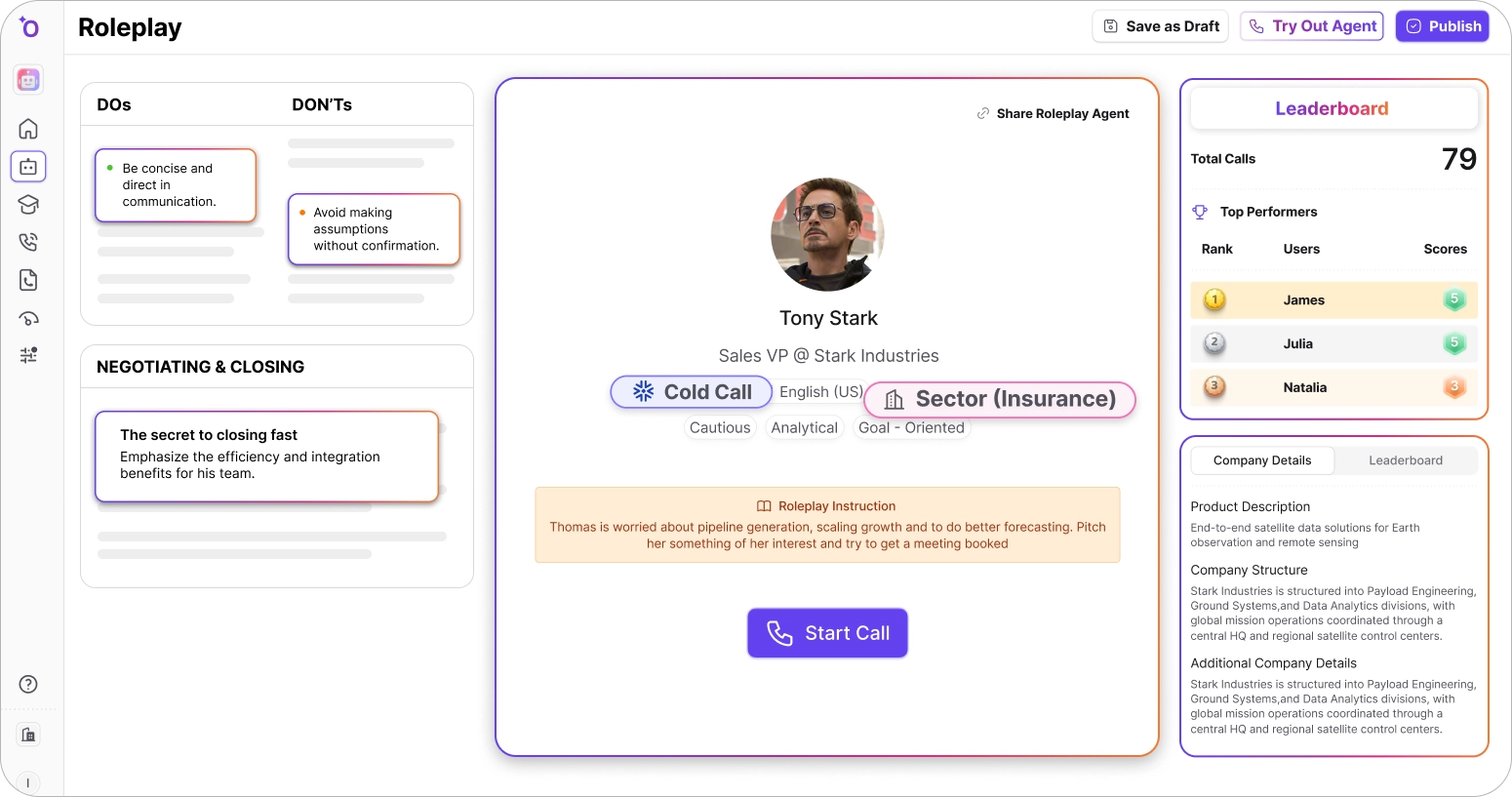
Outdoo AI is the enterprise AI roleplay platform designed to translate training into execution and measurable performance outcomes. The platform is built to meet enterprise standards with compliance, auditability, and scale, and it is deployed in regulated industries including financial services, banking, insurance, credit unions, healthcare, life sciences, professional services, contact centers, and software and technology.
Five capabilities tied directly to compliance training requirements anchor enterprise deployments.
1. Scenarios built from internal compliance policy
Outdoo AI's roleplay agent creation workflow supports direct upload of compliance policy documents, regulatory training material, and real recorded customer calls. The AI builds buyer or customer personas from that source material rather than from generic templates, which means practice reflects the exact compliance language reps must use in production conversations.
2. Custom rubrics built from internal governance documents
Outdoo AI ships methodology-aligned scorecards for SPIN, BANT, MEDDIC, MEDDPICC, and Challenger, and supports custom rubrics built directly from the organization's compliance policy. Compliance officers define the scoring criteria. The platform applies it consistently across every rep, every region, and every language.
3. 74+ language support for true global enterprise deployment
Outdoo AI's language coverage means a HIPAA scenario in English, a MiFID II scenario in German, a SEBI scenario in Hindi, and a FINRA scenario in Spanish all run on the same platform with the same rubric. This eliminates the parallel-content problem most global enterprises face when running compliance training across regions.
4. SOC 2 Type 2, GDPR, HIPAA, and CCPA compliance with audit logging and private cloud
Outdoo AI is fully compliant with SOC 2 Type 2, HIPAA, GDPR, and CCPA. All data is encrypted in transit and at rest, hosted in ISO-certified cloud infrastructure. SSO, role-based access, audit logging, and private cloud deployment options are standard for enterprise procurement.
5. Live call scoring on the same rubric as practice
Outdoo AI ingests from Gong, Clari, and native conversation intelligence to score live customer calls against the same compliance rubric used in roleplay practice. This closes the loop regulators care about. The standard practiced is the standard enforced, and divergence between practice scores and production scores surfaces immediately in manager dashboards.
6. Customer evidence: multilingual rollout at a leading enterprise SaaS company
A leading global enterprise SaaS company with $1.3B in revenue and 6,500+ employees ran a structured multi-stage AI Roleplay pilot with Outdoo AI in early 2026. The pilot moved from a February kickoff through a March midpoint feedback session into an April expansion across additional markets, with stakeholders across sales, L&D, and procurement all involved in evaluation.
Outdoo AI built Spanish and Italian AI agents for the customer's global sales team, allowing reps to practice in the native languages of their European prospects with culturally adapted personas. Scorecards tracked objection handling, presentation flow, and confidence indicators per rep across all three languages on the same compliance rubric. Two iterations of scenario refinement happened based on rep feedback, and the rollout moved from launch to midpoint with zero major issues reported by the L&D team.
A sales rep at the customer described the value of the deployment this way:
“The tool allows reps to verbalize their presentation and receive feedback before they ever get on a call with a real prospect.”
Leading global enterprise SaaS company
Quantified impact across enterprise deployments
Across 40 customer organizations analyzed in the Outdoo AI 2026 report, drawn from 15,000+ simulated customer-facing conversations, structured AI roleplay deployment for compliance and readiness use cases delivered measurable improvements across the metrics enablement leaders track.
- Certification accuracy improved by 23%, replacing subjective manager assessments with behavioral data.
- Skill heatmap visibility increased by 31% through behavioral pattern recognition, giving leaders the cohort-level view audit teams expect.
- Time to recertification dropped by 29%, which materially shortens the cycle when regulations change and reps need to be revalidated against updated rubrics.
- Readiness Index scores across teams improved by 17%, the composite measure Outdoo AI uses to track operational readiness across cohorts.
- Tone-related escalations dropped by 19% and emotional regulation in difficult conversations improved by 25%.
- Gap identification speed increased by 3.1 times and managers saved an average of 9 hours per week previously spent on manual coaching.
The Readiness Capability Index
Outdoo AI introduced the Readiness Capability Index (RCI), a proprietary algorithm that evaluates simulation performance across four behavioral dimensions: Skill Mastery (accuracy of messaging and structure), Adaptive Agility (ability to pivot during unexpected scenarios), Emotional Competence (tone, empathy, and emotional presence), and Objection Resilience (recovery speed under pressure).
For compliance training specifically, the four-dimension RCI surfaces patterns traditional certification scoring misses, including reps who pass scripted compliance scenarios but fail when customers introduce unexpected variations. This is the gap regulators care about most.
Schedule a demo to see how the platform fits your organization's compliance framework, language coverage, and audit requirements.
How to roll out AI roleplay for compliance training at enterprise scale
Five operational steps separate successful AI roleplay deployments for compliance training from pilots that stall. Each step has a specific output that the next step depends on.
Step 1: Map the regulatory perimeter
Document every regulation the customer-facing teams are subject to (HIPAA, GDPR, FINRA, MiFID II, TCPA, SEBI, ECOA, FCC AI rules) across every jurisdiction the team operates in. Confirm what each one requires in terms of disclosure language, consent flows, and prohibited statements. This output becomes the rubric input for the platform.
Step 2: Convert policy documents into scenario material
Upload existing compliance policy, training material, and recorded examples of well-handled compliance conversations into the platform. Outdoo AI uses these as the foundation for scenarios rather than relying on generic templates, which means practice reflects the organization's actual compliance language rather than approximate substitutes.
Step 3: Define pass-fail certification gates by role
Front-line bankers face different scenarios than wealth advisors. Patient-facing nurses face different scenarios than pharma reps. Build role-specific certification paths with clear pass-fail thresholds tied to the compliance dimensions that matter most for each function. Automated remediation paths assign targeted practice scenarios to reps who fail specific dimensions.
Step 4: Layer in live call scoring with the same rubric
Connect Gong, Clari, or native conversation intelligence so practice rubrics extend into production scoring. Manager dashboards surface variance between practice and live performance, which is the early warning signal for compliance drift that traditional reporting cannot produce.
Step 5: Establish quarterly rubric refresh and audit reporting cadence
Regulations change. Scenarios should refresh every quarter at minimum, faster when material regulatory updates land. Audit reports run automatically against the rubric version active on the date of each interaction, which preserves the evidence trail regulators expect.
This phased structure mirrors how Outdoo AI deploys in production. The leading global enterprise SaaS customer described earlier ran their AI Roleplay rollout in 2026 across a structured kickoff in February, a midpoint feedback session in March that refined scenarios based on rep input, and an April expansion phase that added new languages and new business units once initial adoption proved out.
Multi-stakeholder alignment across sales, L&D, and procurement at the kickoff stage allowed the expansion phase to move without procurement friction, since the buying committee had already validated the platform during the pilot.
For enablement leaders, compliance officers, and L&D teams running compliance training at global scale, AI roleplay is no longer an experimental category. It is the operational layer that connects compliance policy to demonstrated competency, with multi-language coverage, audit-defensible evidence trails, and the closed-loop validation regulators expect. Schedule a demo to see how Outdoo AI fits your compliance framework, language requirements, and rollout timeline.
Frequently Asked Questions
.svg)
AI roleplay for compliance training simulates regulated customer conversations across frameworks like HIPAA, FINRA, GDPR, and MiFID II. Reps practice disclosure delivery, consent flows, and risk language against an AI buyer before facing live interactions, with scoring against the organization's compliance rubric.
AI roleplay shifts compliance training from passive module completion to active practice with measurable competency validation. Customer organizations using Outdoo AI report tone-related escalations dropping by 19% and emotional regulation in difficult conversations improving by 25% per the 2026 Readiness Report.
Yes. Enterprise-grade AI roleplay platforms like Outdoo AI are SOC 2 Type 2, HIPAA, GDPR, and CCPA compliant, with custom rubric support that lets compliance officers configure scoring against any regulatory framework including FINRA Rule 2111, MiFID II Article 24 and 25, and HIPAA PHI requirements.
Outdoo AI supports 74+ languages on a single platform with consistent compliance rubrics across regions. Global enterprises run the same HIPAA, MiFID II, or FINRA scenario in English, German, Hindi, Spanish, or Japanese without maintaining separate content libraries per jurisdiction.
Every roleplay session produces a timestamped log showing the rubric version used, the rep's response, the AI's scoring across compliance dimensions, and pass-fail certification status. Combined with live call scoring against the same rubric, this creates the evidence trail regulators expect during audits.
Table of Contents
Talk to Sales
Have questions about training and enablement for your sales, CS, support, or leadership team? Let's talk.
Talk to Sales