



Every sales leader wants better numbers: faster ramp, higher win rates, more reps hitting quota. The harder question is what actually moves them. Content and dashboards do not; what changes a metric is a rep doing something differently on a live call. AI roleplay improves performance metrics because it changes that behaviour first, and the behaviour is what the metric measures.
This article maps the connection directly: which sales performance metrics AI roleplay improves, and the mechanism behind each one. Not vague promises of better results, but the specific chain from practice, to skill, to the number on your dashboard.
What Are Sales Performance Metrics?
Sales performance metrics are the numbers that show how well a sales team turns effort into revenue, such as ramp time, win rate, conversion rate by stage and quota attainment. They are lagging indicators: each one reflects what reps actually say and do on live calls.
The mechanism: why practice moves metrics at all
Before the individual metrics, it helps to see the engine underneath, because the same mechanism drives all of them. Sales metrics are lagging indicators of rep behaviour, and behaviour changes through practice, not information. For the learning science behind that, see why AI makes sales training stick.
AI roleplay works because it delivers what learning scientists call deliberate practice: high-frequency repetition, immediate feedback, and progressive difficulty, applied to the exact conversations reps have. The effect on outcomes is not subtle. Research finds that prepared interactions advance deals at 6.8 times the rate of unprepared ones, and strong objection handling drives 4.2 times higher win rates. When a rep rehearses discovery or objections until they are fluent, the live call goes better, and every downstream metric reflects it.
The metrics AI roleplay improves
Here is the direct line from practice to each core metric, and the skill in between.
1. Ramp time
This is the fastest and clearest to move. New reps normally learn on real prospects, slowly and expensively. With roleplay, they arrive at their first live calls already fluent in your objections and discovery, so they hit productivity sooner. Research shows reps who practise with realistic simulations reach quota around 40% faster than those trained with content alone. The mechanism: reps get their at-bats in practice instead of burning live pipeline to learn.
2. Win rate
Win rate moves because roleplay drills the exact moments deals are won or lost, objection handling, discovery depth, and competitive positioning. Reps who have practised the hard objections a hundred times handle them calmly when it counts. Studies link AI roleplay to meaningfully higher win rates, with reports of around 36% higher win rates and 31 to 40% higher quota attainment for teams using structured practice.
3. Conversion rates by stage
You can move conversion at a specific stage by targeting practice there. If demo-to-proposal is leaking, reps practise multi-stakeholder demos and surprise objections; if discovery-to-demo is weak, they drill discovery. Because you can aim roleplay at the exact stage, the metric responds. One reported result: demo-to-proposal conversion improving 18% over three months after adding advanced demo scenarios, with fewer no-decision outcomes.
4. Quota attainment
Quota attainment is the sum of the above, and it rises for two reasons: individual reps get better, and the whole team gets more consistent. Roleplay raises the floor by giving every rep, not just the naturals, structured reps at the skills that close deals. That consistency is why teams using AI roleplay report materially higher quota attainment, on the order of 52% higher, than teams without it.
The multiplier: consistency across the team
One effect deserves its own callout because it is easy to miss. Manual coaching tends to help a handful of reps a manager has time for, which widens the gap between top and bottom performers. Roleplay does the opposite.
Because every rep gets the same realistic practice and the same objective feedback, the variability between new hires drops and the baseline skill level rises across the board. Moving your middle and bottom performers a few points each does more for aggregate metrics than squeezing your top reps, and that is exactly what team-wide practice delivers. The metric improvement compounds because it is spread across everyone, not concentrated in a few.
How Outdoo AI turns practice into metric movement
For teams that want roleplay to show up in the numbers, not just the training log, Outdoo AI stands out because it connects each practice session to the behaviour, and the metric, it is meant to move.
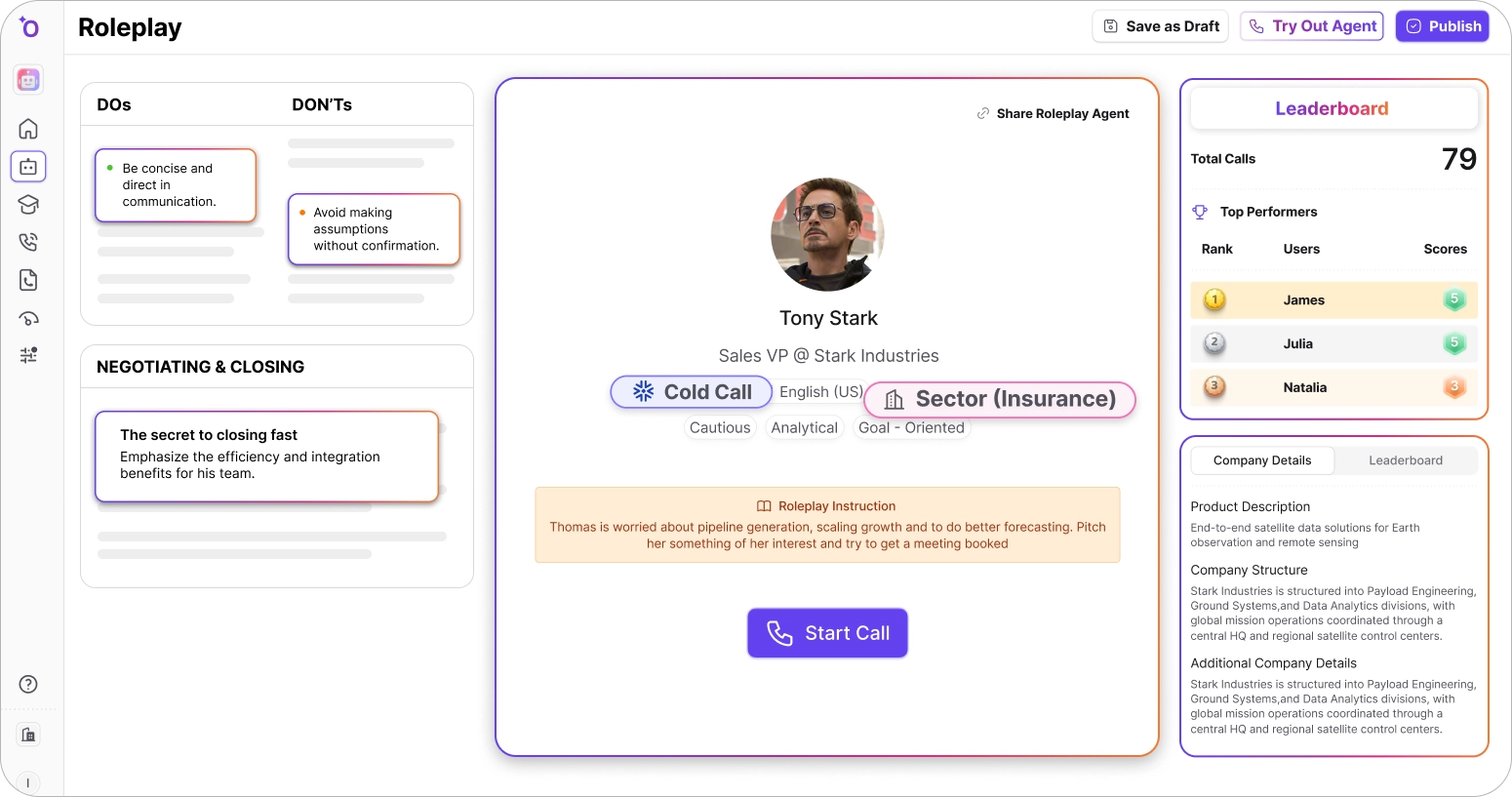
Outdoo AI, the enterprise AI roleplay and training platform for customer-facing teams, is built to drive performance, not just activity:
- Targeted practice built from your real calls, so reps drill the exact objections and stages where your metrics are leaking.
- Deliberate practice at scale: unlimited realistic roleplay with instant scoring and adjustable difficulty, the repetition and feedback that actually change behaviour.
- Shared scoring across practice and live calls, so you can trace a rep's improving practice through to ramp, conversion, and win-rate gains.
- Team-wide consistency: every rep gets the same practice and rubric, raising the baseline that moves aggregate metrics.
That line of sight, from a specific practice session to a specific metric, is what turns training from a cost into a performance lever. Teams can start on a Free plan with limited credits, then move to usage-based pricing as they scale.
Move the behaviour, and the metrics follow
AI roleplay improves sales performance metrics because it changes the one thing metrics actually measure: what reps do on live calls. Practice the right conversations, with repetition and feedback, and ramp time falls, win rates and conversion rise, and more of the team hits quota, not by chance, but by a clear chain from practice to skill to result. Target the practice, and the numbers follow.
To connect practice to the metrics you care about, from your own calls, schedule a demo with Outdoo AI.
Frequently Asked Questions
.svg)
The main ones are ramp time (reps reach productivity faster), win rate (they handle objections and discovery better), conversion rates by stage (you can target the leaking stage), and quota attainment (the sum of the above, plus team consistency). Each moves because roleplay changes the specific rep behaviour that the metric measures, rather than just delivering content.
Sales metrics are lagging indicators of rep behaviour, and behaviour changes through practice, not information. AI roleplay delivers deliberate practice, high-frequency repetition, immediate feedback, and progressive difficulty, on the exact conversations reps have. Research shows prepared interactions advance deals at 6.8 times the rate of unprepared ones, so when reps rehearse until fluent, the live call improves and the metric follows.
Research shows reps who practise with realistic simulations reach quota around 40% faster than those trained with content alone. The mechanism is that new reps get their at-bats in practice, arriving at their first live calls already fluent in your objections and discovery, instead of learning slowly and expensively on real prospects.
Yes, because it drills the exact moments deals are won or lost: objection handling, discovery depth, and competitive positioning. Reps who have practised hard objections repeatedly handle them calmly live. Studies link structured AI roleplay to meaningfully higher win rates, with reports of around 36% higher win rates and 31 to 40% higher quota attainment for teams that use it.
Because every rep gets the same realistic practice and objective feedback, which lowers variability between reps and raises the baseline skill level across the team. Manual coaching only reaches the few reps a manager has time for. Moving your middle and bottom performers up a few points each improves aggregate metrics more than optimising top reps, and that is what team-wide practice delivers.
Table of Contents
Talk to Sales
Have questions about training and enablement for your sales, CS, support, or leadership team? Let's talk.
Talk to Sales