





The BANT Qualification Framework: A 2026 Guide for Sales Team
Time is the one thing in sales that teams use up very quickly, and most of that time goes away in the first few calls with buyers who were not going to buy anyway.
A rep logs a “good conversation,” the deal moves forward, and a few weeks later it hits a wall. Then you find out there was no real budget, the decision process wasn’t clear, or the problem wasn’t serious enough to act on. The effort was there, but the qualification wasn’t.
It’s not a small issue either. 67% of deals are lost because of poor qualification. Not because reps don’t try, but because they don’t have a clear way to understand the buyer early enough.
BANT has been around since IBM introduced it in the 1950s. And despite everything that has changed in how buyers research, evaluate, and make decisions, sales teams still rely on it. Not because it’s old, but because it solves a timeless problem: helping teams avoid spending weeks on deals that were never real.
The challenge is that many reps still treat BANT like a checklist. Modern buyers don’t fit into checkboxes, budgets shift, decisions involve more people, and timelines change depending on internal priorities.
This guide breaks down how BANT works in 2026 and how to make it a natural part of your team’s conversations, coaching, and workflow, without adding more complexity.
What Is BANT Sales Methodology?
Why the Old Way of Using BANT No Longer Works
Most teams learned BANT as a checklist: ask four questions, fill in the blanks, and move to the next step. That approach made sense years ago when deals were more linear and the complexities from budget approval to the number of decision-makers were far more limited.
But that’s not how buying works anymore.
Take a simple, common scenario:
A manager sets up a demo because they understand the team’s challenges. They’re impressed with what they see and want to share the solution with their team. But when it comes time to discuss the budget, they say they need to “bring finance into the conversation.” Then, a director hops on the next call and introduces a whole new set of priorities. A few days later, IT chimes in with their own demands. Suddenly, what began as one eager manager turns into a small buying group with evolving needs, various concerns, and a confusing route to getting approval.
In these situations, asking, “Do you have a budget?” or “Are you the decision maker?” doesn’t tell you much. Buyers often don’t know the full picture themselves. Priorities continuously evolve, plus approval processes aren’t always clear from the get-go.
This is why the old, question-by-question version of BANT falls short.
What teams need today is a way to understand the deal and not just jot down information.
That means paying attention to things like
- How clearly the buyer explains the problem,
- Who they naturally mention in the conversation,
- Whether the impact is big enough to get leadership involved,
- And what might force the team to take action sooner or later.
When reps use BANT this way, it does what it was always meant to do: help them avoid spending weeks on deals that won’t move and focus on the ones that actually can.
All of this brings BANT back to its core purpose. Each part Budget, Authority, Need, and Timeline helps you understand a different piece of what’s really happening inside the deal. And when you look at these four areas through a modern buyer’s reality, they become far more practical and accurate than the old checklist version.
The 4 Key Components of BANT

1. Budget: Can They Afford the Change?
Budget isn’t about getting a number on the first call. Most buyers won’t have one. What matters is understanding how this kind of problem gets funded inside their company.
- Do they need finance involved?
- Does another department own this cost?
- Are they waiting for a project or headcount approval?
Budget today is less about “Do you have it?” and more about “Is there a path to getting it?” If that path exists or can be created, the deal has room to move.
2. Authority: Who Actually Makes the Decision?
There is almost never a single decision maker anymore, especially when you are interacting with a growing organization or an enterprise. A manager may start the conversation, but a director, finance partner, or IT lead might shape the final call. These complexities is increasingly becoming a norm because organizations wants to be vigilant where they invest their money and, most importantly, their time.
So, considering all this authority is now not about identifying the right decision maker; rather, it is about understanding
- the roles,
- priorities,
- and influence each person brings to the table
Instead of asking, “Are you the decision maker?” reps should look for who gets consulted, who pushes things forward, and who can stop the deal. When they understand the decision makers, influencers, and gatekeepers involved in a given deal, then it paints a clear picture of how to possibly navigate through and drive the deal towards fruition.
3. Need: What Problem Hurts Enough to Act Now?
Most buyers can explain their challenges, but that doesn’t mean the issue is serious enough for leadership to prioritize or fund a change.
“Need” is about uncovering what the problem is actually costing the business, the ripple effects behind the symptoms. Getting to that level of clarity often requires more follow-up questions, not interrogation, but genuine curiosity.
This process also helps the buyer understand their problem more deeply. It brings the root cause to the surface and often reveals issues they hadn’t fully recognized. When done well, it gives the buyer the language and clarity they need to build a strong internal case for your solution.
- lost time,
- missed revenue,
- team inefficiencies,
- or targets at risk.
When reps understand what the problem is costing the business, they can see whether the buyer is browsing, exploring, or truly motivated to act. Strong need creates real urgency; weak need stalls deals.
4. Timeline: When Will They Decide (and Why Then)?
Timeline isn’t just a date. It’s the reason behind the date.
Most buyers don’t come in with a fixed timeline, and if they do, it often changes. What drives the real timing is usually an internal event:
- a quarter ending,
- a project kickoff,
- a goal they need to hit,
- or a process they want to fix by a certain time.
When reps understand what’s driving the decision, they get a much more realistic view of when the deal can close and what could move it forward or push it back.
Understanding the four parts of BANT is one thing. Using them in real conversations is another. The real value of BANT shows up not in what reps know, but in how they apply it before the call, during the call, and after the call, while deals are still taking shape.
How to Use the BANT Framework in Your Sales Process
Many customer-facing teams assume BANT starts when the call begins. In reality, top reps use BANT long before they ask their first question. Modern qualification is a mix of preparation, active listening, and documenting what actually happened, not what you expected or hoped would happen.
Here’s how BANT fits naturally into each stage of your process.
1. Before the Call: Make Smart Assumptions
Good qualification starts with preparation, not interrogation. Before the call, reps should use what they already know, industry, role, company size, and recent news to build a few reasonable assumptions about Budget, Authority, Need, and Timeline.
For example:
- If the prospect is a mid-market company hiring quickly, there’s likely a Need tied to productivity or scaling.
- If a director requested the demo, they probably have influence but might still need to involve finance or IT.
- If the company just raised funding, Budget may be flexible for the right problem.
These aren’t answers. They’re starting points. Smart assumptions help reps ask better questions and avoid wasting time.
2. Early Call: Look for Signals, Not Answers
Early in the conversation, buyers rarely know the full picture. That’s why the goal isn’t to go through the BANT checklist; rather, it is to capture signals through BANT.
Signals can sound like
- “We’ve been talking about fixing this for months.” → Need
- “My director has been asking for a better way to do this.” → Authority
- “We’re trying to solve this before Q3 hits.” → Timeline
- “Finance will want to understand the ROI.” → Budget
In the early call, reps should let the buyer talk and pick up on these clues. The information will be incomplete, but it’s enough to understand whether the deal is worth moving forward or not.
3. Mid Call: Turn Signals Into Real Discovery
Once the conversation opens up, reps can naturally layer in deeper questions tied to the buyer’s context, which will provide them with direct information from prospects. this can give more context on top of what signals that you have captured in the previous step.
Examples:
- Budget: “How does a project like this usually get approved on your side?”
- Authority: “Who else should we keep in the loop as this moves forward?”
- Need: “What happens if this problem isn’t solved this quarter?”
- Timeline: “Is there anything coming up that would affect when this needs to be done?”
These questions don’t feel scripted because they’re based on what the buyer already said. This is where reps confirm the path to funding, understand the buying group, uncover impact, and validate timing.
4. After the Call: Log What You Learned, Not Just Fields
A CRM field that says “Budget: Yes” tells you nothing.
A note that says “Needs finance approval; director supportive; ROI will matter” tells you everything.
After the call, reps should record:
- Who was involved
- What each person cared about
- How the problem affects the business
- What’s driving the timing
- What blockers came up
Logging context gives managers and AEs a real, shared picture of the deal, not checkbox data that creates false confidence.
Note: Use Conversation Intelligence or CRM Automation tools that can automatically update these fields based on the framework you follow. This lets data flow straight from your conversation insights into the CRM with no manual gaps, giving your sales managers full, reliable context.
5. Pipeline Reviews: Coach the Gaps
Pipeline issues aren’t usually about effort; they’re about missing information.
When managers review deals through BANT, they can quickly spot where reps need help.
Examples of gaps:
- Strong Need, weak Authority
- Clear Authority, no Timeline
- Budget path unclear
- Many stakeholders, but no internal champion
When managers coach these gaps, deals move seamlessly, and teams stop wasting time on opportunities that won’t work.
Pro tip: You can spot these gaps with Outdoo’s Coaching module. It analyzes every conversation against the framework your company follows, in this case BANT, so you can ensure compliance, pinpoint gaps, and coach each sales rep on their specific weaknesses.
6. Enablement: Teach Reps to Notice BANT Naturally
BANT shouldn’t be something reps memorize and repeat. It should be something they recognize during real conversations.
Enablement’s role is to help reps spot BANT signals as they happen: a budget clue hidden inside a complaint, a decision-maker mentioned casually, or a timeline hint buried in a story.
- Short call snippets that highlight strong or weak BANT moments,
- Real scenarios where buyers shift direction or bring new people in,
- Objection examples that reveal hidden needs,
- And roleplays built around these situations.
The goal is to build the skill of spotting signals, understanding buyer context, and asking follow-up questions that feel natural, not forced.
7. Multi-Threading: Build the Full Buyer Picture
As deals progress, reps should revisit BANT with each new stakeholder. Every person on the buyer side will have a different view of Budget, Authority, Need, and Timeline.
- A manager sees the day-to-day pain.
- A director sees efficiency and targets.
- Finance sees ROI justification.
- IT sees security and risk.
Good reps connect these perspectives and understand how each one shapes the final decision. BANT becomes more accurate as the buying group grows, not less.
BANT in Modern B2B: When It Works (and When It Doesn’t)
By now we have already discussed nuances of the modern sales cycle, and it is high time we understood how it works in modern B2B sales and, more importantly, when it works.
1. When the buyer already has a budget range in mind
If the buyer has set aside money for the problem or is actively comparing vendors, BANT quickly confirms whether your solution fits within their expected spend.
2. When the decision-maker is known from the start
Some deals come with clear authority, a department head, VP, or founder who is directly driving the initiative. BANT helps validate the basics without a long stakeholder-mapping exercise.
3. When sales cycles are short and straightforward
In fast-moving sales cycles, BANT acts as an efficient filter. A quick understanding of Budget, Authority, Need, and Timeline is usually enough to qualify confidently.
4. When inbound intent is strong
If the buyer is experiencing an obvious pain and is actively searching for solutions, BANT helps uncover what’s driving urgency and what must happen internally to move forward.
5. When teams need high-volume triage
SDRs and high-velocity teams need a reliable way to separate real opportunities from noise. Even partial BANT signals, like a defined problem or early timeline clue, help prioritize the right conversations quickly.
When BANT Doesn’t Work
1. When buying groups are complex
Enterprise deals rarely have a single authority. Multiple influencers and approvers get involved at different stages, making early “authority answers” incomplete or misleading.
2. When the buyer hasn’t defined a budget yet
In many modern cycles, a budget is created, not discovered. You often need to prove value first before any formal numbers appear, which makes early budget questions unproductive.
3. When the problem is still forming
If the buyer is still diagnosing or debating the problem internally, BANT won’t uncover real need yet. These deals require deeper discovery before qualification is meaningful.
4. When cycles are long and priorities shift
Timelines in multi-quarter deals change based on internal projects, leadership decisions, and budgeting cycles. Early answers often become outdated within weeks.
5. When reps treat BANT like a checklist
Asking direct BANT questions too early (“Do you have a budget?” “Are you the decision-maker?”) creates friction and reduces trust. Buyers shut down, and reps walk away with false clarity.
Why This Matters
Knowing when BANT fits and when it doesn’t helps reps avoid two common mistakes:
- pushing for BANT answers too early,
- or ignoring BANT completely and hoping the deal “figures itself out.”
Neither approach works in recent buying behavior.
The goal is balance: use BANT for clarity, but stay flexible enough to explore what the buyer actually needs.
BANT vs. MEDDIC (and Other Frameworks)
There’s no shortage of qualification frameworks in sales. BANT, MEDDIC, SPICED, and CHAMP, they all aim to answer the same question: Is this deal worth our time?
But they approach the answer differently, and they’re useful at different moments in the buying cycle.
Where BANT Fits
Most sales teams use BANT at the top of the funnel because it gives them a quick way to judge whether an opportunity deserves more time. It’s especially useful in early conversations where the goal is to understand:
- Whether a real problem exists,
- Whether the buyer is open to exploring solutions,
- Who might be involved in the decision,
- And what could influence timing.
BANT isn’t designed to replace deep discovery. It simply helps teams avoid spending time on buyers who aren’t ready, aren’t aligned internally, or don’t have a realistic path to getting something approved. Used this way, BANT helps keep the early pipeline cleaner and ensures reps spend more time on deals that can actually move forward.
Where MEDDIC Fits
MEDDIC tends to show up later in the cycle, especially in deals with multiple stakeholders or more complex internal processes. It’s used by teams who need to understand:
- The measurable business impact,
- Who influences or approves budget,
- What the decision criteria and process look like,
- And who is championing the initiative internally.
This makes MEDDIC a strong fit for opportunities that are already qualified and need deeper validation or a more structured business case. It’s not a replacement for early qualification; it’s a framework that helps sellers progress and win complex deals with fewer late-stage surprises.
BANT vs. MEDDIC
If you’d like a deeper breakdown of how these frameworks compare across different sales motions, you can explore this detailed guide.
Other Frameworks: SPICED, CHAMP & More
While BANT and MEDDIC are the most commonly paired frameworks in modern sales teams, others play useful roles depending on your motion:
SPICED: Great for Understanding Motivation and Impact
SPICED works well when a buyer already feels the pain but hasn’t connected it to business impact yet.
It helps reps explore:
- the situation today,
- what is the challenge?
- the cost of not fixing it,
- what event might force action?
- and how the decision will be made.
SPICED is strong for mid-funnel conversations where emotion and business outcomes matter. It’s useful when you need to build urgency or strengthen the case for change—not necessarily when you’re just trying to see if the deal should move forward.
CHAMP: Helpful in Early Outbound Conversations
CHAMP is a good fit when the buyer isn’t actively looking and your team reaches out cold.
It focuses on:
- the buyer’s challenges,
- who needs to be involved,
- whether money exists in general,
- and where this problem sits on their priority list.
It’s flexible, light, and works well before the buyer has a budget, a timeline, or a buying process in mind. That makes CHAMP a strong alternative to BANT in outbound discovery.
Other Frameworks (FAINT, GPCT, etc.)
There are many others, but most of them tend to be variations with the same goal: help reps understand the business situation, the urgency, and who will decide.
These frameworks can be useful in specific situations, but they’re rarely used across full sales teams because they’re either too narrow or too detailed for day-to-day qualification.
Framework Comparison Table

Understanding how BANT fits alongside other frameworks helps teams apply it in the right moments. But even when teams know where BANT belongs, many reps still make common mistakes fixing these patterns is what turns BANT from a checklist into a real advantage.
6 Common BANT Mistakes (and How to Fix Them)
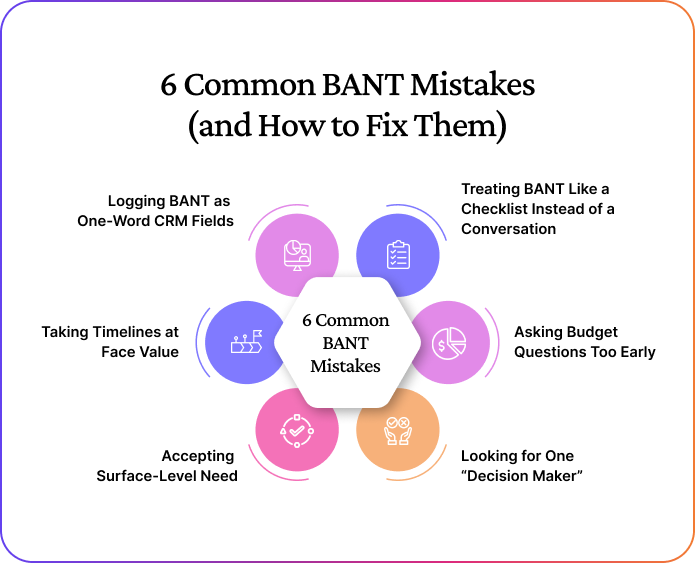
Even experienced reps struggle with implementing BANT when they treat it as something they “have to note down” instead of something they need to understand. Here are the mistakes teams run into most often and how to coach your reps through them.
Turning BANT Into a Sales Training & Sales Enablement Asset
Most teams know the acronym. Very few teams turn it into a consistent outcome-driven process.
For BANT to actually improve qualification and forecasting, it needs to show up in how reps are trained, coached, and supported every day. This is where sales training and enablement teams play the biggest role.
Here’s how BANT becomes a practical, repeatable skill inside your sales organization.
A. From Acronym to Behavior: BANT as a Coaching Framework
BANT becomes valuable when managers use it to guide how reps think, not just what they ask. That means coaching beyond the four letters and focusing on the behaviors reps show on calls.
1. Shadowing and Live Feedback
Shadowing is one of the easiest ways for reps to see how experienced sellers uncover Budget, Authority, Need, and Timeline naturally.
Instead of pointing out just missed questions, managers can point out missed signals—the moments when the buyer hinted at impact, involvement, or urgency.
2. Call Scoring That Matches Real Conversations
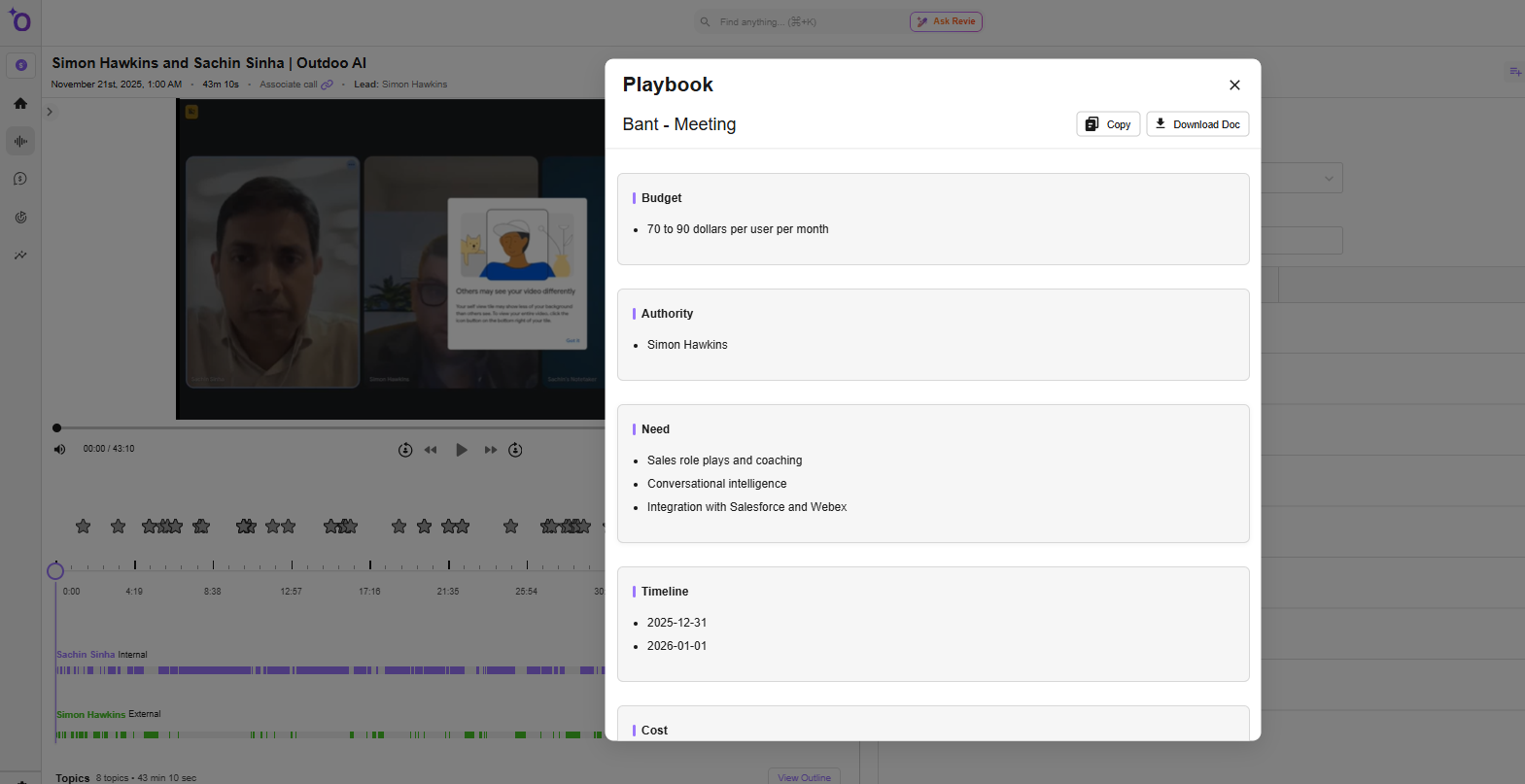
Scoring shouldn’t be about whether the rep “asked the BANT questions.”
It should reflect whether the rep actually understood:
- how the deal might get funded,
- who is involved and why,
- the true impact of the problem,
- and the reason behind the timing.
With a solution like Outdoo, teams can automatically surface these BANT aspects without manually going through recordings.
If you want a clearer way to measure how well reps apply BANT in real calls, this guide breaks down a simple structure you can use.
3. Coaching Questions Managers Can Use
Simple questions help managers evaluate deal clarity without overwhelming reps:
- “How do you know this deal has real urgency?”
- “Who else do we need to understand in this process?”
- “What’s the approval path for this type of spend?”
- “What risk should we be watching for in the next call?”
These questions shift reps from collecting information to thinking critically.
4. Teaching Reps to ‘Follow the Thread,’ Not the Acronym
Great reps don’t run down a list. They follow threads in the conversation, words buyers repeat, concerns they highlight, or gaps they dance around.
Enablement can train this by showing reps how to notice these threads and ask the right follow-up questions even if they don’t mention BANT explicitly.
This is how the acronym becomes a behavior guide, not a checklist.
B. Embedding BANT in Sales Enablement Content & Tools
To make BANT repeatable, it needs to live inside the tools and content reps rely on daily.
1. Sales Playbooks

Your playbook should include simple examples of what strong BANT signals sound like in your market. Not scripts, examples.
With a solution like Outdoo, enablement teams can update these examples based on real call patterns, making the content more relevant and easier for reps to apply.
2. Onboarding Flows
New reps should practice identifying BANT signals from day one, not memorize definitions.
Roleplays, call examples, and guided listening exercises work better than slides.
3. Qualification Checklists
Checklists shouldn’t be long. They should guide judgment.
For example:
- “Is there a path to budget?”
- “Do we understand the buying group?”
- “Is the problem tied to a measurable impact?”
These help reps self-diagnose.
4. CRM Fields That Capture Context, Not Boxes
CRM fields should allow reps to explain how each part of BANT works in the deal, not just mark Yes/No.
This gives RevOps clean data and gives managers real insight.
C. Conversation Intelligence and AI Feedback Loops
Conversation Intelligence tools help teams see patterns:
- Are reps uncovering real need or staying surface-level?
- Are authority gaps showing up late-stage?
- Are timeline signals accurate or optimistic?
AI can surface these trends automatically and feed them into coaching.
With a platform like Outdoo, BANT signals can be flagged automatically, whether they were uncovered, missed, or left unclear.
D. AI Sales Training: Practicing BANT With AI Roleplay
1. Practice BANT in Realistic Roleplays
AI roleplay is where BANT implementation becomes muscle memory.
Reps can practice realistic scenarios, get pushback, and learn to adjust without risking real deals.
With a solution like Outdoo, reps can:
- Practice uncovering Budget paths in different buyer situations.
- Learn how to navigate multi-stakeholder Authority,
- Explore deeper Need conversations,
- And handle Timeline answers that are vague or optimistic.
Once real calls happen, Outdoo can analyze them and show how well BANT was applied, from missed follow-ups to unclear decision paths. This closes the loop between training, real conversations, and ongoing coaching.
2. Reinforce BANT Through Conversation Intelligence
After reps practice or take real calls, Outdoo can automatically flag:
- missing BANT signals,
- weak or incomplete follow-up questions,
- overlooked or unmentioned stakeholders,
- timeline assumptions that don’t have a real internal driver.
This saves managers from listening to hours of recordings. The system surfaces the key moments that matter for qualification and coaching.
3. Assess BANT in Actual Deals
Once reps start applying BANT in live conversations, the next step is understanding how well they’re doing it, not just whether they filled out the right fields. This is where teams often struggle: the CRM shows activity, but not the quality of the conversation.
With Outdoo, teams can review real calls through the lens of BANT. Instead of scoring checkbox answers, the system analyzes the actual flow of the conversation:
- Did the rep uncover the real problem or stay at surface level?
- Did they identify who matters, or assume the first person they spoke with had authority?
- Did they clarify what’s driving the timeline or accept vague statements?
- Did they follow the thread or stick to a script?
-
This creates a real improvement cycle across your team:
analyze → coach → practice → apply → review → repeat
Implementing BANT in Your Sales Process: A Simple Rollout Plan
Rolling out BANT across a sales team doesn’t need to be complicated. The goal isn’t to create new work for reps; it’s to bring more clarity into the work they’re already doing. Here’s a simple, practical 30-day plan for implementing BANT in a way that sticks.
Week 1: Align the Team on What “Good” Looks Like
Start by creating a shared definition of strong qualification.
This includes:
- what strong Budget, Authority, Need, and Timeline signals sound like,
- what weak or unclear signals look like,
- and what information must be captured before a deal moves forward.
Keep this simple: one page, one short workshop, or one team meeting.
If possible, bring a few real call recordings showing good BANT and bad BANT. Reps learn faster when they hear actual examples.
Week 2: Update Playbooks, Checklists, and CRM Fields
Now that the team understands BANT, embed it into the tools they use every day.
1. Playbooks
Add short examples of real BANT moments from your best calls.
Not scripts, signals, questions, and follow-up prompts.
2. Qualification Checklists
Create a simple checklist with four prompts:
- Is there a path to budget?
- Do we understand the buying group?
- Is there a measurable impact driving the need?
- What’s behind the timing?
3. CRM Fields
Replace yes/no fields with brief context fields.
For example:
“Budget Path,” “People Involved,” “Business Impact,” and “Timeline Driver.”
4. Conversation Intelligence Setup
If you use a tool like Outdoo, configure BANT-specific alerts so leaders can see where reps are strong and where deals are weak.
Week 3: Train Reps Through Practice and Coaching
This is where the implementation becomes real.
1. Team Training Sessions
Run short, simple BANT-focused coaching sessions where reps:
- practice turning early signals into better questions,
- walk through messy real-life scenarios,
- and learn to follow the thread through a deal.
2. AI Roleplay Practice
With a solution like Outdoo, reps can practice BANT across multiple buyer types, industries, and scenarios until it feels natural.
3. Manager Coaching Loops
Have managers review 1–2 calls per rep that week, focusing only on BANT:
- What did the rep understand?
- What did they miss?
- What needs clarity before moving the deal forward?
Week 4: Operationalize and Measure
By the final week, BANT becomes part of the team’s rhythm.
1. Pipeline Reviews Using BANT
Managers run pipeline reviews using four questions tied to BANT.
This creates alignment fast and removes ambiguity.
2. Run BANT Health Checks With CI Tools
If you’re using Outdoo or something similar, evaluate:
- which reps consistently uncover Need,
- where Authority gaps appear,
- where deals get stuck on budget,
- and which timelines don’t have a clear driver.
3. Scorecards and Improvement Plans
Use a simple scorecard to evaluate rep progress.
You’ll see clear patterns:
- who qualifies well,
- who needs help,
- and where coaching should focus next.
4. Final Debrief With the Team
Discuss what’s working, what’s confusing, and what examples you want to keep refining.
This reinforces the behavior and removes friction early.
BANT Sales Qualification Questions (Interactive Assessment)
Use this quick assessment to see how modern your team’s approach really is.
Most teams think they have a qualification process, but what they really have is a mix of habits, guesswork, and whatever the rep remembered to enter into the CRM.
Choose the answers that best match your team’s reality. You’ll get a tailored set of recommendations based on how modern your current approach is.
No matter where your team scored, what matters most is how consistently reps apply BANT in real conversations, not how well they remember the acronym. That’s where the modern BANT mindset begins.
The “New BANT” Mindset for 2026 and Beyond
BANT still matters in 2026 because the buying journey has become more complex than ever. The shift isn’t about reinventing the framework; it’s about updating the way teams apply it.
Modern qualification requires reps to connect the dots:
- who’s involved,
- what’s driving the problem?
- why it matters now,
- and how the buyer is navigating internal pressure.
That level of clarity doesn’t come from memorizing a set of questions. It comes from reps who can listen, interpret signals, and guide the conversation with confidence.
Teams that excel at this do a few things differently:
- They train reps to understand buyer context, not just gather information.
- They coach based on real conversations, not assumptions.
- They use deal reviews to strengthen judgment, not just stage accuracy.
- And they create space for reps to practice these skills consistently.
This is where most organizations struggle, not because they lack good frameworks, but because they lack a scalable way to build and reinforce the behaviors behind them.
That’s the gap Outdoo fills.
It gives reps a realistic environment to test their thinking, sharpen their discovery skills, and get targeted feedback before those moments happen in live deals. And when they do get into real conversations, Outdoo helps surface the signals they missed so managers can coach with precision.
If you’re ready to build a team that qualifies with clarity and wins with consistency,
👉 See Outdoo in action and train your team on the qualification skills today’s buyers expect.
Frequently Asked Questions
.svg)
BANT is a qualification framework that helps sales teams determine if a deal has real potential by assessing Budget, Authority, Need, and Timeline. Modern teams use BANT to spot buying signals early and avoid wasting time on low-quality opportunities. Platforms like Outdoo help reps practice uncovering these signals in real calls.
BANT is best for early-stage qualification, helping reps quickly judge whether a deal deserves more time. MEDDIC is a deeper, mid-to-late-stage framework used for complex, multi-stakeholder enterprise deals. Teams often use BANT first, then MEDDIC as the opportunity matures.
Yes, BANT is still effective, but only when applied flexibly. Today’s buying groups involve more stakeholders and shifting priorities, so modern BANT focuses on signals, impact, and decision dynamics, not checklist questions. Tools like Outdoo make practicing this modern approach easier for reps.
BANT works best in the first or second conversation, during inbound qualification, or when reps need to quickly decide if a problem is real, urgent, and fundable. It’s ideal for SDR teams, mid-market AEs, and early enterprise discovery.
AI surfaces missed signals, analyzes buyer intent, and highlights authority gaps or unclear timelines automatically. With Outdoo, reps can practice realistic qualification scenarios and get personalized coaching, turning BANT from a memory exercise into a repeatable skill.
Table of Contents
Talk to Sales
Have questions about training and enablement for your sales, CS, support, or leadership team? Let's talk.
Talk to Sales