

- Outdoo AI is the pick for a group that has to prove results: it scores practice and real customer calls on one rubric, and scores the DMS work alongside the conversation.
- DealSpeak is the fastest way for one store to start: $59 per user per month, 700 automotive scenarios, live the same week, and a published price in a category that hides one.
- The gap nobody covers is the system work: a service advisor talks while searching Xtime and validating a warranty in Tekion. Almost every training tool scores only the talking.
- AI phone agents made this urgent, not optional: they absorb the routine calls, so what reaches a person is the escalation and the negotiation.
Which AI Tool Is Best for Dealership Training?
- Outdoo AI: Best for dealer groups that need practice, live calls and DMS work on one scorecard. Roleplays are built from your own calls and playbooks.
- DealSpeak: Best for a single salesperson or one rooftop wanting practice today. It ships 700 prebuilt automotive scenarios at $59 per user per month.
- RockED: Best for dealers who want mobile microlearning first and roleplay second. It offers 180+ courses with certifications and gamification.
- Exec: Best for teams wanting AI roleplay plus call scoring, not automotive-only. It publishes automotive scenarios inside a multi-industry platform.
- Joe Verde (JVTN): Best for teams that want a named sales methodology taught properly. It uses video, audio coaching, workbooks and workshops.
- Elliott Group: Best for stores that respond to high-energy in-person workshops. It runs courses, in-dealer workshops and coaching masterminds.
At a Glance
| Platform | Best fit | Pricing snapshot |
|---|---|---|
| Outdoo AI | Dealer groups that need practice, live calls, and DMS work on one scorecard | Usage-based, tiered |
| DealSpeak | A single salesperson or one rooftop wanting practice today | $59/user/month or $590/user/year (confirmed) |
| RockED | Dealers who want mobile microlearning first and roleplay second | Not published |
| Exec | Teams wanting AI roleplay plus call scoring, not automotive-only | Not published |
| Joe Verde (JVTN) | Teams that want a named sales methodology taught properly | Roughly $200 to $400 per user per month, plus workshops (third-party estimate) |
| Elliott Group | Stores that respond to high-energy in-person workshops | Courses roughly $500 to $1,500; in-dealer workshops into five figures (third-party estimate) |
Why Dealership Training Needs a Purpose-Built Tool
This piece is scoped to automotive retail specifically, sales floor, service drive, F&I box, and BDC, not general B2B sales coaching, where the right answer is different.
What Is AI Roleplay for Dealership Training?
AI roleplay for dealership training is practice software where an AI plays the car buyer, service customer or F&I prospect, reacts to what the employee says, and scores the conversation against a rubric.
Two things changed in the last eighteen months, and together they broke the old training model.
The first is turnover. Dealership employee turnover runs in the mid-forties annually, and sales consultant turnover at non-luxury stores runs far higher. The standard onboarding is a script, a day next to a veteran, and the phones. That was survivable when the calls were easy.
The second is that the calls stopped being easy.
AI phone agents are now installed across thousands of rooftops, answering after-hours, booking service, and handling the routine questions. Containment rates in published dealer case studies sit around 62 percent. That is a genuine operational win, and it has a consequence almost nobody has priced in.
What reaches a human is now the residue: the escalation, the price negotiation, the complex trade, the customer the AI transferred precisely because it detected frustration it could not defuse.
The easy half of the job was automated. The hard half was left with people whose training did not change.
There is a third problem, and it is the one the software market keeps missing.
A service advisor is not having a conversation. They are talking while searching the scheduler, checking a VIN, validating a warranty, and staying inside a handle-time target. That is one job. The moment you split it for training, you have stopped training the thing.
The Tools That Actually Compete Here, Compared
| Platform | Approach | What it doesn't do | Pricing |
|---|---|---|---|
| Outdoo AI | Roleplay built from your own calls and playbooks, scored on the same rubric as live customer calls, with the DMS or CRM work recorded and scored alongside the conversation | Does not ship a prebuilt automotive scenario library the size of a specialist's | Usage-based, tiered; book a demo for a quote |
| DealSpeak | 700 prebuilt automotive scenarios across 11 roles, voice roleplay with a role-specific scorecard after each call | No published DMS or CRM integration, no live-call scoring, capped at 100 calls per user per month | $59/user/month or $590/user/year (dealspeak.ai) |
| RockED | Mobile microlearning at scale: 180+ courses, certifications, gamification, leaderboards. An AI Coach roleplay module sits on top and is still badged "New feature" on their own site. | No live-call scoring and no published DMS integration. The roleplay interface is a phone, not a desktop work environment. | Not published; a free "RockED Preview" tier exists |
| DealerSpark.Ai | Three named AI coaches: Coach Maverick for sales, Coach Sterling for F&I, Coach Atlas for service advisors. 300+ sections across 58 modules, plus post-transaction debriefs. | No reviews yet, and no published evidence of live-call scoring or workflow grading | Not published |
| DealerSim | AI roleplay, objection handling and manager coaching scenarios, positioned as an operating system for dealership performance | No reviews yet; scope of scoring not published | Not published |
| SalesTrainer | 460+ modules across seven verticals including automotive, marine, motorcycle and RV. AI voice coach, gamified. | Breadth across verticals rather than automotive depth | Not published |
| Exec | AI roleplays, call scoring, live coaching and courses in one platform. Publishes automotive scenarios including EV hesitancy, trade-in disputes and first-time buyer education. | Multi-industry rather than automotive-native. No published DMS integration. | Not published |
| Joe Verde (JVTN) | Video, audio coaching, workbooks and workshops built around a named sales process | No AI practice, no scoring of an individual's actual conversation | Roughly $200 to $400 per user per month plus project-priced workshops (third-party estimate) |
| Elliott Group | Courses, in-dealer workshops, and coaching masterminds | No practice environment or per-person measurement between sessions | Courses roughly $500 to $1,500; workshops into five figures (third-party estimate) |
| Conversation intelligence (CallSource, CallRevu, Marchex) | Analyses real dealership calls and surfaces where the conversation went wrong | Finds the coaching need, does not close it | Varies, quote-based |
What the Review Data Actually Shows
Here is the most useful fact in this comparison, and it takes about a minute to check.
We looked up every automotive-specific AI roleplay product on G2 in August 2026. DealSpeak, DealerSpark.Ai, DealerSim, SalesTrainer and Apex Sales Training AI all show zero reviews. Not low ratings. Zero.
That is not a criticism. Most launched recently, and a new product without reviews is normal. It does mean something practical for a buyer though: every performance claim on those sites is currently unverifiable by anyone outside the company.
For scale, G2's AI Sales Roleplay Tools category lists 67 products. Within it, Outdoo AI holds 172 reviews at 4.6 out of 5, and Exec holds 42 at 4.8. Retorio, which surfaces on automotive searches, holds 17. Everything else built specifically for dealerships holds none.
Whichever vendor you shortlist, ask for two reference calls with dealerships of your size and brand mix. If references are not available yet, that is useful information rather than a dealbreaker, and it should shape how much you commit on day one.
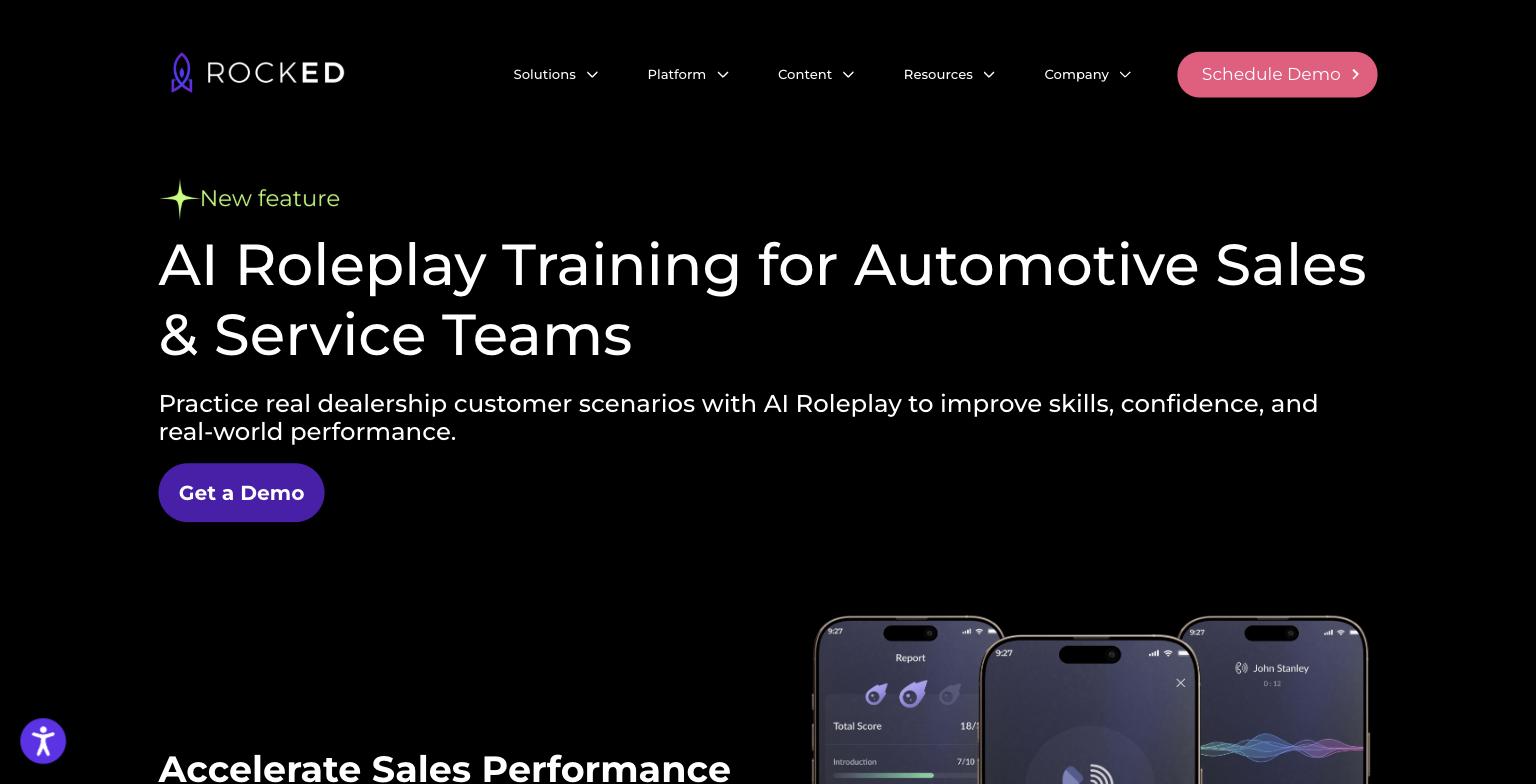
RockED's own AI Coach page labels the roleplay module "New feature," and the product imagery is three phone screens. Source: rocked.us, captured August 2026.
One honest note on that last row, because it frames the whole category. Surfacing a coaching need and closing it are two different actions. Call analytics tell a service director that four advisors are fumbling the estimate price hold. Nothing in that product gives those four people somewhere to practise it thirty times before Saturday.
That is the seam this comparison sits in, and it is why analytics vendors are integration partners here rather than rivals.
The Four Conversations Worth Training First
Every dealership training conversation reduces to four rooms. Here is what changes in each one now that AI agents handle the easy calls.
Car Sales: The Meet-and-Greet, the Trade Reveal, the Price Hold
The phone-up that reaches a salesperson has usually already been qualified by software. The customer arrives knowing the number they saw online and often knowing more about the vehicle than the person greeting them.
The trade reveal is where deals die, and it is almost never rehearsed. Neither is the price hold, which is a composure skill more than a script.
Outdoo AI builds these agents from your own recorded calls, so the objection someone practises is the objection your market actually raises about your inventory, not a generic version of it. Multi-persona roleplay puts a couple and a co-signer in the same conversation, which is closer to a real desk than a single AI buyer.
Service Advisor: The Write-Up, the Recommendation, the Estimate Hold
This is the highest-value room in the building and the one where the system work matters most.
The write-up, the recommendation walk-through, the estimate price hold, the wait update, and the comeback conversation all happen while the advisor is inside the scheduler and the DMS. The declined-service follow-up is the single largest pool of unbooked revenue in most stores, and almost nobody trains the call.
Outdoo AI's workflow training covers the half other tools cannot see. An administrator records the ideal path once inside the real system using a browser extension, so nothing is rebuilt in an editor and a system change means re-recording a three-minute path rather than maintaining a replica that drifts. Attach that to a roleplay agent and the advisor practises the conversation and the lookup together, then gets both scored: steps completed, order, whether verification happened before disclosure, and time per step.
That timing number answers a question fixed operations directors ask constantly. When handle time is high, was the advisor lost in the system or over-explaining on the phone? Those look identical on a report and need completely different coaching.
F&I: The Menu, VSC and GAP, the Cash Buyer
F&I is where compliance and persuasion sit in the same sentence, which makes it the riskiest room to train informally.
Menu presentation, VSC and GAP objections, rate conversations, the cash buyer, and the bump all need repetition, and all of them carry disclosure requirements that a warm, likeable presentation can quietly skip.
This is exactly the failure a conversation-only tool cannot catch. A pleasant, well-scored presentation that missed a required disclosure reads as a pass. Pleasant and compliant are not the same thing, and only one of them is visible in a transcript.
Outdoo AI also supports video roleplay with screen sharing, which matters for a remote or virtual delivery where the menu is being presented over a shared screen rather than across a desk.
BDC and Phones: Internet Leads, Price Shoppers, No-Show Follow-Up
The BDC is where the AI-handoff problem is sharpest, because the agent has usually already touched this customer.
The internet lead, the inbound price shopper, the appointment confirmation, and the no-show follow-up now often begin mid-thread. Picking up a conversation an automated system started is a real skill, and it is taught nowhere.
Outdoo AI's AI Trainers help with the other half of BDC readiness: product and process knowledge. Upload a manufacturer bulletin, a recall procedure, a new service menu, or an incentive sheet, and Outdoo AI generates an AI Trainer that explains it out loud, checks understanding, and asks follow-up questions. For tool training it can guide someone through a workflow with screen guidance, so a new hire moves from watching a demo to using the scheduler correctly.
That closes the gap between assigning a PDF and knowing the person can use it, which for a role with this much turnover is most of the onboarding problem.
Outdoo AI for Dealership Training: Practice and Performance on One Rubric
The structural difference is not the roleplay. Roleplay is becoming table stakes across this whole market.
The difference is that Outdoo AI applies the same scoring framework to practice and to real customer conversations. A fixed operations director can compare how a write-up went in rehearsal against how it went on the drive, on one scorecard, and see whether the coaching actually landed. Our unified scoring announcement covers the mechanics.
Without that, completion rate is the only number a training platform can produce, and completion rate has never convinced a dealer principal of anything.
Three more things matter at group scale.
Roleplays are built from your own material: calls, transcripts, playbooks, battlecards, or a connected conversation intelligence tool. A bad call becomes a practice scenario in one click, which means the library reflects your market rather than a vendor's idea of it.
When scoring finds a gap, Outdoo AI generates targeted micro-roleplays and battlecards aimed at that specific issue, so a service advisor who keeps fumbling the estimate hold gets five minutes on the estimate hold, not a general course.
And it survives a security review. GDPR, HIPAA, CCPA and SOC 2 compliance, ISO 27001 and 27701 certification, private cloud storage, SSO, role-based access, and PII scrubbing, plus SCORM and xAPI export into an existing LMS, 120+ integrations, practice and scoring in more than 120 languages, and a mobile app for people who work on a drive rather than at a desk.
Outdoo AI is trusted by 250+ enterprises worldwide, including Globe Life, CMC, Invitation Homes, and Keller Williams, and is ranked #1 in customer satisfaction on G2.
Where we will concede ground: DealSpeak's prebuilt automotive scenario library is larger than anything we ship out of the box, and if your requirement is 700 ready-made scenarios on day one at a single store, that is a fair reason to choose it. Our answer is that scenarios built from your own calls beat a library, but that takes an hour of setup rather than zero.
"Your Sales Manager Is Your Trainer"
This is the real objection, and it deserves a straight answer because it comes from the floor rather than from a competitor.
Ask a dealership community which training program to buy and someone will reply that if your sales manager isn't training, they aren't a sales manager. Someone else will offer a version of "those that can, do; those that can't, teach" and say they would never spend a penny on an outside program. Both turn up reliably in r/CarSalesTraining threads on exactly this question.
They are right about the principle and wrong about the conclusion.
The manager should own development. What a manager cannot do is be present for a new hire's fiftieth repetition of the trade reveal. There is one of them and ten or fifteen salespeople, and they are also desking deals. Roleplay in a Monday meeting gives each person one attempt in front of an audience, once a week, graded by opinion.
The same discussions contain a sharper version of the argument. On accountability, one manager put it plainly: don't let people skip steps, and if your process says the salesperson enters the trade into the CRM before getting a pencil, and they walk up with the keys instead, send them back to do it right.
That is correct, and it is also the thing nobody has time to enforce consistently across a floor. It is also, incidentally, a description of workflow scoring by someone who has never used the term.
Practice software does not replace a sales manager. It supplies the repetitions a manager cannot personally supervise and a consistent score to coach against, so their time goes to the conversation that needs judgment rather than the fifth run of a script.
What to Ask Any Vendor Before You Sign
Five questions, in the order that matters.
Can you score a real customer call on the same rubric as the practice call, and show me both side by side?
Can you see what happened in the DMS or scheduler while the conversation was running, and score it?
Where do the scenarios come from, and can you build one from a call we recorded last week?
Who can see an individual's scores, and is that a setting or a philosophy?
Can I speak to two dealerships of my size and brand mix who are running this now?
That last one is the fastest way to size how far along a vendor actually is.
Book a demo and bring one recorded service call. We will score it, then build the roleplay out of it while you watch.
Outdoo AI starts free: 60 minutes of roleplay credits, unlimited team members, no credit card and no sales call. From there it moves to usage-based Flex pricing, with a custom enterprise plan for larger rollouts.
Outdoo builds AI Roleplays from your own calls and scores practice and real calls with one scorecard. Rated #1 for Best Results on G2.
Frequently Asked Questions
We already bought an AI phone agent. Do we still need training software?
More than before. The agent absorbs the routine calls, which means what reaches a person is the escalation, the negotiation, and the complex trade. The remaining conversations got harder while onboarding stayed a script and a day of shadowing.
Is this a replacement for Joe Verde or Elliott Group?
Not really, and we would rather be straight about it. Those programmes teach a methodology and they teach it well. What they do not provide is repetition between sessions or per-person measurement. Methodology without practice produces people who know the process and stall under live pressure.
What makes automotive different from general sales training?
The system work. A service advisor's job is a conversation running on top of a scheduler, a DMS, and a warranty lookup, against a handle-time target. Training tools that score only the talking miss the half of the job that generates the compliance finding.
Can we train service advisors and salespeople on the same platform?
Yes. Outdoo AI runs role-specific scorecards, so the service write-up and the trade reveal are graded against different criteria while a fixed operations director and a general sales manager see their own teams on one system.
How does workflow training handle our specific DMS?
It records the real application rather than rebuilding it. An administrator performs the ideal path once in Tekion, CDK, Reynolds, Xtime, or whatever you run, and that recording becomes the standard the practice run is scored against. When the system changes, you re-record instead of maintaining a replica.