
- Outdoo AI is the strongest fit for continuous coaching: if your reps need to practice on scenarios pulled from your own calls and playbooks, get graded the same way whether they're in a roleplay or on a live deal, and you want pricing tied to actual usage instead of a flat per-seat bill, Outdoo AI is the strongest fit for continuous coaching in 2026.
- Hyperbound for a ready-made scenario library: it's worth a look if you specifically need a deep library of pre-built practice scenarios and don't mind demo-gated pricing.
- Second Nature for large, multi-region governance: it has the review base to back governance across a large, multi-region team.
- Kendo AI for transparent, self-serve pricing: it's the one vendor here that publishes pricing upfront, making it the cheapest self-serve entry point.
Which AI Roleplay Tool Is Best for Continuous Coaching?
- Outdoo AI: Best for teams that want roleplay practice and live calls graded on one scorecard. Roleplays and criteria are built from your own calls, transcripts and playbooks.
- Hyperbound: Best for teams that want a large, ready-made practice scenario library. Buying is sales-led and pricing is demo-gated.
- Second Nature: Best for large, multi-region teams that need one governed messaging standard. It has the largest G2 review base in this set.
- Kendo AI: Best for small or mid-market teams that want to try before talking to anyone. It publishes per-seat pricing: $0 trial, $55 Pro, $100 Max.
At a Glance
| Tool | Best for | Pricing model |
|---|---|---|
| Outdoo AI | Scoring roleplay practice and live calls on one playbook-built scorecard | Usage-based, tied to training actually run |
| Hyperbound | A large, ready-made practice scenario library | Demo-gated; $70/user/mo at 50 seats ($63 at 150), quoted by Hyperbound's sales team in August 2026 (list pricing rather than published pricing, so your own quote may differ) |
| Second Nature | Governed messaging across large, multi-region teams | Demo-gated; $50/credit (1 credit = 1 user-month), ~$30k/yr for 50 reps |
| Kendo AI | Cheapest self-serve entry point | Transparent per-seat: $0 trial / $55 Pro / $100 Max |
Full vendor-by-vendor breakdown below.
Why Continuous Coaching and Skill Reinforcement Needs Purpose-Built Sales Training
Most sales training still runs like a one-time event. A bootcamp during onboarding, a refresher before a big product launch, then nothing until the next crisis.
Reps forget most of what they hear within weeks, and managers don't have hours in the week to sit in on every call and coach it live.
"Continuous coaching" is the industry's answer to that gap, and by 2026 it's become a crowded category. This roundup is for sales enablement leaders and frontline managers who need reps to keep improving after onboarding ends, not just pass a certification once and move on.
Every vendor in this space is selling against the same failure mode: training that happens once and then stops. Reps who complete a certification in month one aren't necessarily better in month six, and messaging drifts the moment a new competitor objection shows up that nobody scripted for.
What Is Continuous Coaching?
Continuous coaching is an ongoing practice-and-scoring loop that keeps reps rehearsing and getting graded after onboarding ends, instead of training once and then stopping.
A few things make this a genuinely different buying motion than a standard LMS purchase. The buyer isn't just L&D.
Sales enablement leaders and frontline sales managers are the ones asking for this, because the bottleneck they're describing is specific: a manager cannot personally listen to and coach every rep on every call.
Second Nature's own G2 reviews capture this directly.
One enterprise reviewer, a Market Director in hospital and health care, put it plainly: "Personalized coaching felt impossible across thousands of reps, but the analysis now pinpoints each person's specific gaps" (G2, Second Nature AI reviews).
Team size doesn't gate the need the way it does for compliance-driven verticals. The evidence spans small teams using self-serve tools like Kendo AI and PitchMonster up through enterprise deployments like Second Nature's 2,000+ teams and Yoodli's Google Cloud rollout at 15,000+ employees.
What's constant isn't headcount, it's that manual, in-person coaching has stopped scaling.
And the sales motion itself is consumption-based, not project-based. Hyperbound's own positioning is explicit that the practice loop has to run continuously to actually change behavior, not get bought once and shelved (see their continuous coaching blog post).
That's a fundamentally different commercial relationship than a one-time training project, and it's why usage-based and per-seat pricing models matter more here than in a single compliance-driven purchase.
Compliance is present in this buying group but it's table stakes, not the driver. SOC 2, GDPR, and HIPAA come up, but they're assumed baseline rather than the reason someone starts evaluating vendors.
How the Top Continuous-Coaching Tools Compare
We narrowed this to the four vendors with the clearest, most substantiated continuous-coaching mechanism, based on published product detail, review volume, and pricing transparency.
| Outdoo AI | Hyperbound | Second Nature | Kendo AI | |
|---|---|---|---|---|
| Reinforcement mechanism | One scorecard across roleplay practice and live calls, plus workflow/CRM-process scoring and auto-generated micro-learning when a scoring pattern shows up | Two-tier Practice + Perform system; a branded "everboarding" concept for post-onboarding practice | Master roleplays (discovery, cold call, objection handling, multi-persona avatar meetings) plus a live-deal Deal Coach | Automated call review with custom scorecards, feeding a named "Improvement Flywheel" that assigns targeted roleplay to each rep's specific gap |
| Pricing model | Usage-based, tied to training actually run | Demo-gated, no published number | Demo-gated, no published number | Transparent per-seat: $0 trial, $55/seat/month Pro, $100/seat/month Max (kendo.ai) |
| Proof point | Standing claim of 53% faster rep ramp-up across existing case studies | Deepest published content library on this exact keyword territory of any vendor checked (Hyperbound's blog) | 4.7/5 across 416 G2 reviews, the largest credible review base in this set (G2) | Only vendor here besides Yoodli's individual tiers with fully public pricing |
| Best fit | Teams that want scoring grounded in their own playbook and calls, not a vendor's fixed rubric | Teams that want a large, ready-made scenario library and are comfortable with a sales-led buying process | Large, multi-region teams that need one governed messaging standard everywhere at once | Small or mid-market teams that want to try it before talking to anyone |

Source: Hyperbound pricing page, archived July 2026. No dollar figure is published for either paid tier.
Yoodli didn't make the top four here because its own "AI Continuous Coaching" feature is real and named directly, but its G2 review base is thin (8 reviews, same 4.7/5 average as Second Nature's 416, which is not the same evidence weight).
Its individual pricing is public and cheap ($8 to $20 per month, yoodli.ai/pricing), but team and enterprise tiers are custom, same as everyone else. Our Yoodli review and pricing guide covers the tiers in more detail.
Where Outdoo AI Fits for Continuous Coaching and Skill Reinforcement
The core problem with most "continuous coaching" tools is that the practice loop and the real-world result never get tied together on the same yardstick. A rep can ace a roleplay scorecard and still lose deals for reasons the roleplay never tested.
Outdoo AI grades roleplay practice and live calls on the exact same scorecard, so a manager can point at a number and say coaching moved actual revenue behavior, not just a completion rate.
Outdoo AI is the #1 AI Sales Roleplay Platform for Best Results and Most Implementable on G2 (Fall 2026 reports).
That scorecard isn't a generic rubric either. Roleplays and grading criteria are built from a team's own calls, transcripts, playbooks, and battlecards, so a rep is rehearsing the objections their specific market actually raises, not a stock scenario a vendor wrote once and reused across every customer.
Reinforcement is also automatic instead of manager-driven. When a scoring pattern shows a specific gap, whether that's stalling on a particular objection or fumbling one part of discovery, Outdoo AI generates targeted micro-learning against that exact gap without a manager having to go hunt for it manually.
That's the actual mechanism behind "continuous," not a marketing label on top of the same static content library.
One feature genuinely stands apart from every other tool in this comparison: workflow training. In Outdoo AI, a roleplay session covers the post-call CRM and process work alongside the conversation itself.
Competitors bundle deal-risk signals (Highspot's Deal Agent, Allego's Deal Navigator) into their coaching, but none of them simulate the actual click-by-click logging and follow-up work a rep has to do after the call ends.
If the reinforcement goal is behavior change that survives contact with a real deal, that's the part most vendors skip.
For teams operating across regions or languages, Outdoo AI covers 120+ languages overall and 74+ in voice roleplay specifically, a wider range than Yoodli or Second Nature publish.
And because pricing is usage-based rather than a flat per-seat license, a team pays for training that's actually running, which is a real, honest wedge against Highspot's reported $70,000 to $180,000-plus annual enterprise footprint and against seat-based incumbents generally.
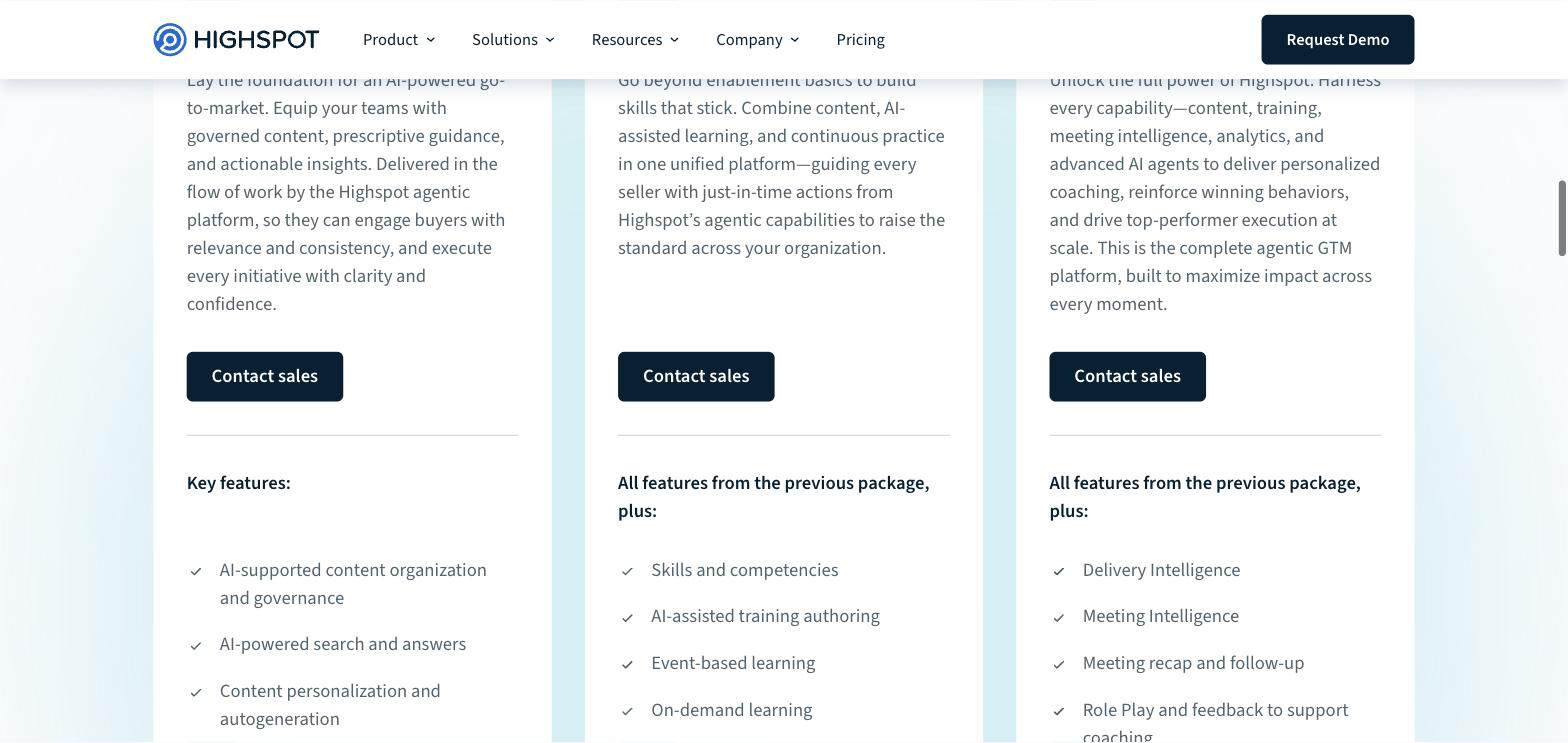
Source: Highspot pricing page. All three tiers route to "Contact sales" rather than a published number.
On compliance certification specifically, Outdoo AI is at parity with Second Nature, Highspot, and Allego: all hold ISO 27001 and ISO 27701, so it's not a dimension that separates them.
The Next Most Relevant Alternatives to Consider
Two vendors are worth a look if your reinforcement need is closer to content-in-workflow than practice-rep scoring.
Highspot reinforces training by surfacing content and coaching inside the CRM itself, so a rep sees the right playbook material at the moment they need it rather than in a separate practice session.
Reviewers back this up. One verified user in enterprise e-learning wrote: "onboarding new reps has become faster because everything they need to learn is structured and accessible in one spot rather than pieced together from different sources" (G2, Highspot reviews).
But this is a content-surfacing mechanism, not a repeated-practice-until-you-hit-a-score-threshold loop, so it solves a different problem than the roleplay-first tools above.
Allego ties AI-powered roleplay and video practice directly to its Conversation Intelligence and Deal Navigator deal-risk signals, and it's the one matchup in this set where the feature overlap with Outdoo AI is genuine rather than superficial. Our Allego review and pricing guide goes deeper on that overlap.
G2-reported data puts its average ROI payback around 13 months, an average discount around 11%, and average time-to-implement around 2 months (G2, Allego reviews).
Cost is also where at least one reviewer pushes back directly: a mid-market user in management consulting rated it 1/5, writing "the technology is solid, the challenge is the cost, it is not financially feasible at scale."
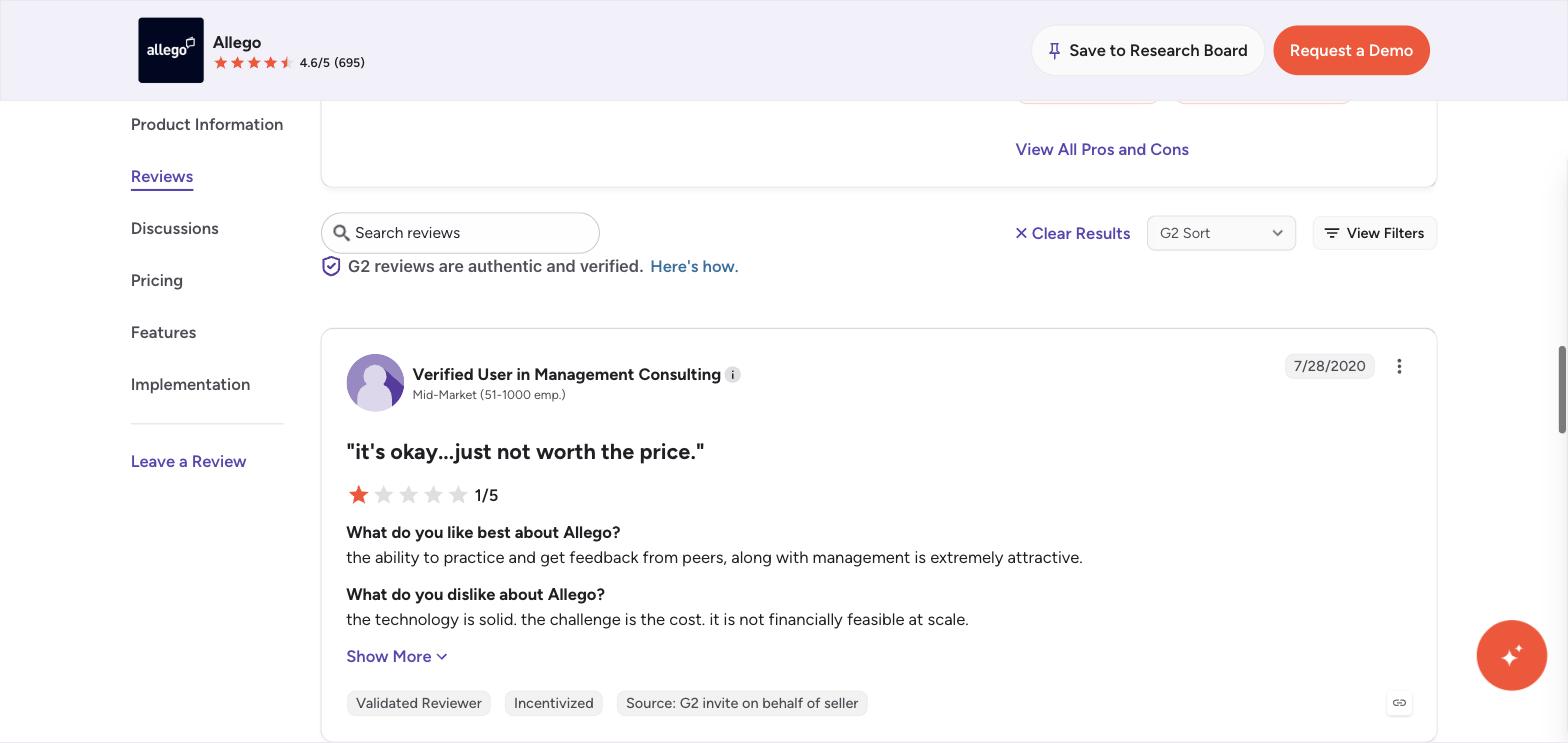
Source: G2, Allego reviews.
Allego's own pricing page confirms per-user-per-month billing on typically 3-year contracts, with no published dollar figure (allego.com/pricing).
Outdoo builds AI Roleplays from your own calls and scores practice and real calls with one scorecard. Rated #1 for Best Results on G2.
Frequently Asked Questions
What does "continuous coaching" actually mean, versus regular sales training?
It means the practice and scoring loop runs on an ongoing basis after onboarding ends, not just once during a bootcamp. The vendors in this category all sell against the same failure mode: reps forget one-time training within weeks, and messaging drifts without regular reinforcement.
Does Outdoo AI replace an existing LMS?
No, and it shouldn't try to. Outdoo AI exports completions and scores via SCORM/xAPI so results flow into whatever LMS a team already runs (LearnUpon, Cornerstone, Docebo).
Is usage-based pricing actually better than per-seat for this use case?
It depends on how consistently a team trains. Usage-based pricing means you pay for training that's actually running rather than idle licenses sitting unused, which matters most for teams with uneven training cadence across the year. A team that trains every rep heavily every month may find per-seat pricing simpler to forecast. Outdoo AI starts free with 60 minutes of roleplay credits and unlimited team members, no credit card and no sales call, then scales on usage-based Flex pricing with a custom enterprise plan for larger deployments.
Can the same tool grade both roleplay practice and real sales calls?
Most tools in this category score one or the other well but not both on a shared standard. A unified scorecard spanning roleplay and live calls, the kind that lets a manager compare a rep's practice score to their real-call score, is the exception here, not the default, so it's worth confirming directly with any vendor rather than assuming it.
Why isn't Yoodli included in the top four continuous-coaching vendors?
Its "AI Continuous Coaching" feature is real and named directly, but its G2 review base is thin: 8 reviews at a 4.7/5 average, versus Second Nature's 416 reviews at the same rating, which isn't equivalent evidence weight. Its individual pricing is public and cheap ($8 to $20 per month), but its team and enterprise tiers are custom-quoted, the same as the other vendors in this comparison.