



Who Is Yoodli Best For?
- Yoodli (Team/Enterprise): Best for live, in-call coaching on real customer calls. Its browser extension gives real-time feedback inside video-conferencing calls.
- Yoodli (individual plans): Best for solo reps and speakers working on pacing, filler words, and tone, at $0 to $20 a month.
- Outdoo AI: Best for sales teams that want roleplays built from their own calls and playbooks, with practice and live calls graded on one scorecard, plus post-call CRM and workflow practice.
At a Glance
| Best for | Live, in-call coaching on real customer calls |
|---|---|
| Individual pricing | $0 to $20/month, published (Starter free, Pro $8/mo, Advanced $20/mo) |
| Team/Enterprise pricing | Not published; Yoodli quoted $600/user/year with unlimited usage as of 2026 (list pricing, so your own quote may differ) |
| G2 rating | 4.7/5, but based on a small sample, just 8 reviews at time of capture |
| Known gap | Reviewers flag stiff roleplay personas and a thin scenario library for objection-heavy B2B selling; trial access is capped at 72 hours |
What Is Yoodli?
Yoodli is an AI roleplay and communication coaching platform that started as an AI speech coach for public speaking and has since pushed hard into enterprise sales enablement, interview prep, and leadership coaching. The sales product is real and used by companies like Snowflake and SAP.
It's also still carrying some of the DNA of a general-purpose communication tool, not a purpose-built revenue platform.
Individual plans are cheap and public. The team/enterprise tier that actually matters for a sales org is not, and prospects who've priced it out report real sticker shock and slow response times.
Yoodli Inc. was founded in 2021 by Varun Puri and Esha Joshi in Seattle.
The original product analyzed real-time speech, things like filler words, pacing, and tone, and gave instant feedback to anyone who wanted to get better at talking: public speakers, job interviewees, students. That "experiential learning" core still shows up everywhere in the product today.
The company has since built a dedicated sales enablement layer on top of it.
Teams can upload their own scripts, battlecards, and product docs to ground AI roleplay personas, build custom evaluation rubrics tied to their sales methodology, and run objection-handling or multi-persona "buying committee" simulations.
A browser extension also brings live coaching directly into major video-conferencing calls.
In 2026 Yoodli added auto-generated learning content (upload source material, get structured lessons built automatically into the roleplay loop), expanded multilingual coverage to 40+ languages, and shipped an MCP connector for pulling workplace and call data straight into the platform.
Yoodli names Google and Snowflake as customers on its site.
Whatever else is true about Yoodli, it isn't a struggling or under-resourced vendor. It's growing fast and investing in the enterprise motion.
Yoodli Pricing
Yoodli publishes pricing for its individual plans. It does not publish pricing for the team and enterprise tier, which is the one that actually competes with a platform like Outdoo AI.
| Plan | Price | What you get |
|---|---|---|
| Starter (Free) | $0 | 5 lifetime roleplay sessions. A trial, not a working plan for a sales team. |
| Pro | $8/month, billed annually | Up to 10 roleplays a week, live AI roleplays, feedback on uploaded recordings, community access. |
| Advanced | $20/month, billed annually | Unlimited roleplays, option to exclude your data from AI training, professional-development reimbursement support. |
| Team / Enterprise | Custom, contact sales | Custom scenarios, rubric-based scoring aligned to your methodology, manager dashboards, SSO, SCIM, LMS/HRIS integrations, unlimited roleplays per user. |
Source: yoodli.ai/pricing
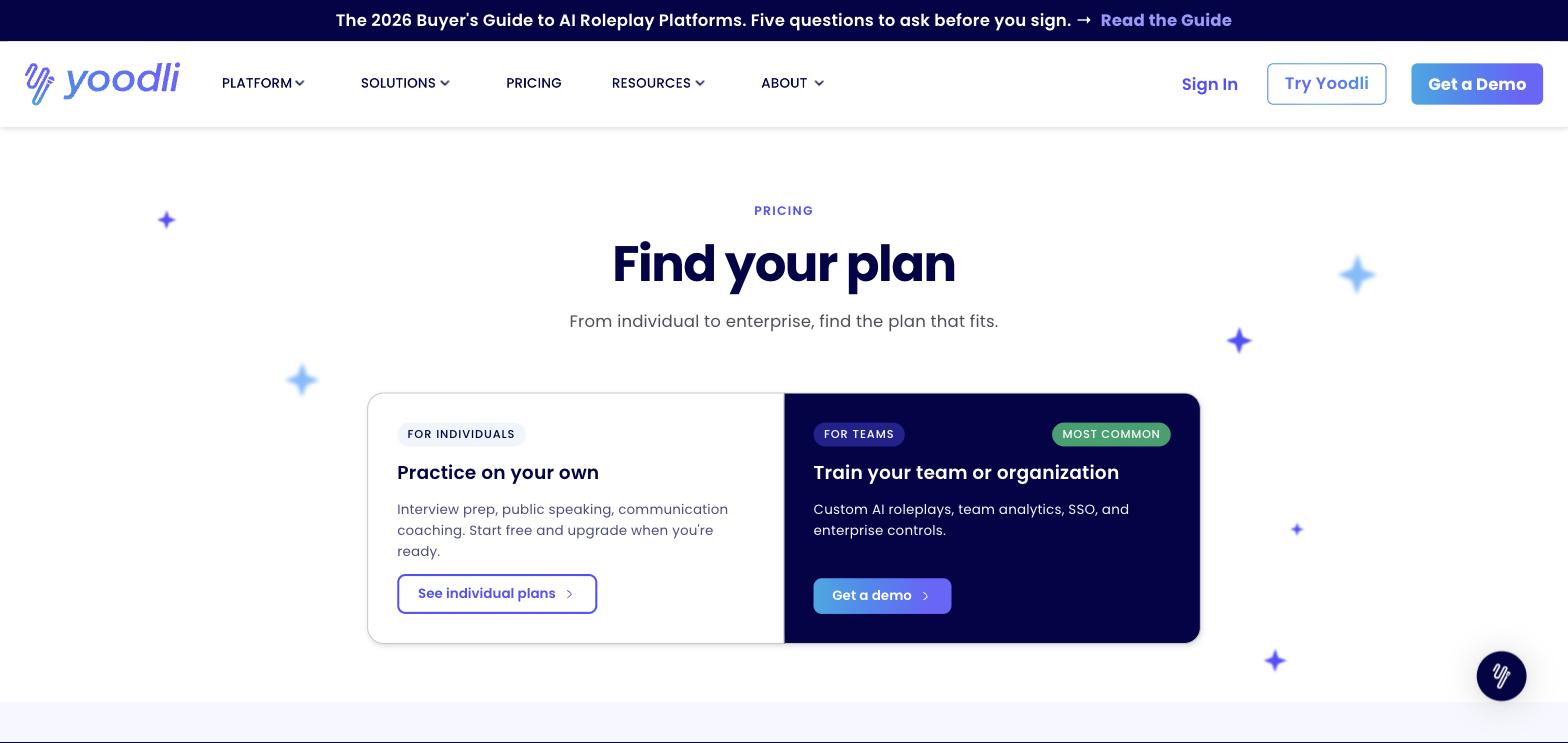
Screenshot: Yoodli pricing page, captured August 2026.
The individual plans are consumer pricing, not built for a revenue team rolling out roleplay across a rep floor. Once you need custom scenarios, methodology-aligned scoring, or admin controls, you're routed to a sales call with no number attached.
That's not unusual for enterprise SaaS, but it does mean any dollar figure you see floating around for Yoodli's team tier has mostly been guesswork. Pricing quoted in 2026 gives a firmer anchor: $600 per user per year, about $50 per user per month. That is confirmed fully unlimited usage, with no per-minute or token metering and no separate billing for the underlying LLM or voice costs, a direct answer to the pain point that pushes some teams to Yoodli after outgrowing a DIY build on raw AI APIs.
At 50 seats that works out to $30,000 a year for practice alone, which is the number worth holding up against what else the budget could cover.
One catch worth knowing before you sign: reassigning a seat to a new person wipes that seat's historical data. A team with normal rep turnover, someone leaves, a new hire takes the license, starts every reassigned seat over with a blank slate instead of carrying forward whatever coaching history existed on it. Trial access is also short: a real sales conversation confirmed the sandbox is capped at 72 hours, with a few extra invited seats available on request.
Without a public number, a buyer comparing Yoodli has nothing to anchor a cost conversation against until a quote arrives.
A third-party review, unrelated to enterprise pricing, also flagged that the free plan's five lifetime sessions is stingy and that Yoodli's best individual rate requires annual commitment, not month-to-month flexibility.
Yoodli Features
Yoodli's feature set breaks down into practice, live coaching, and admin and reporting.
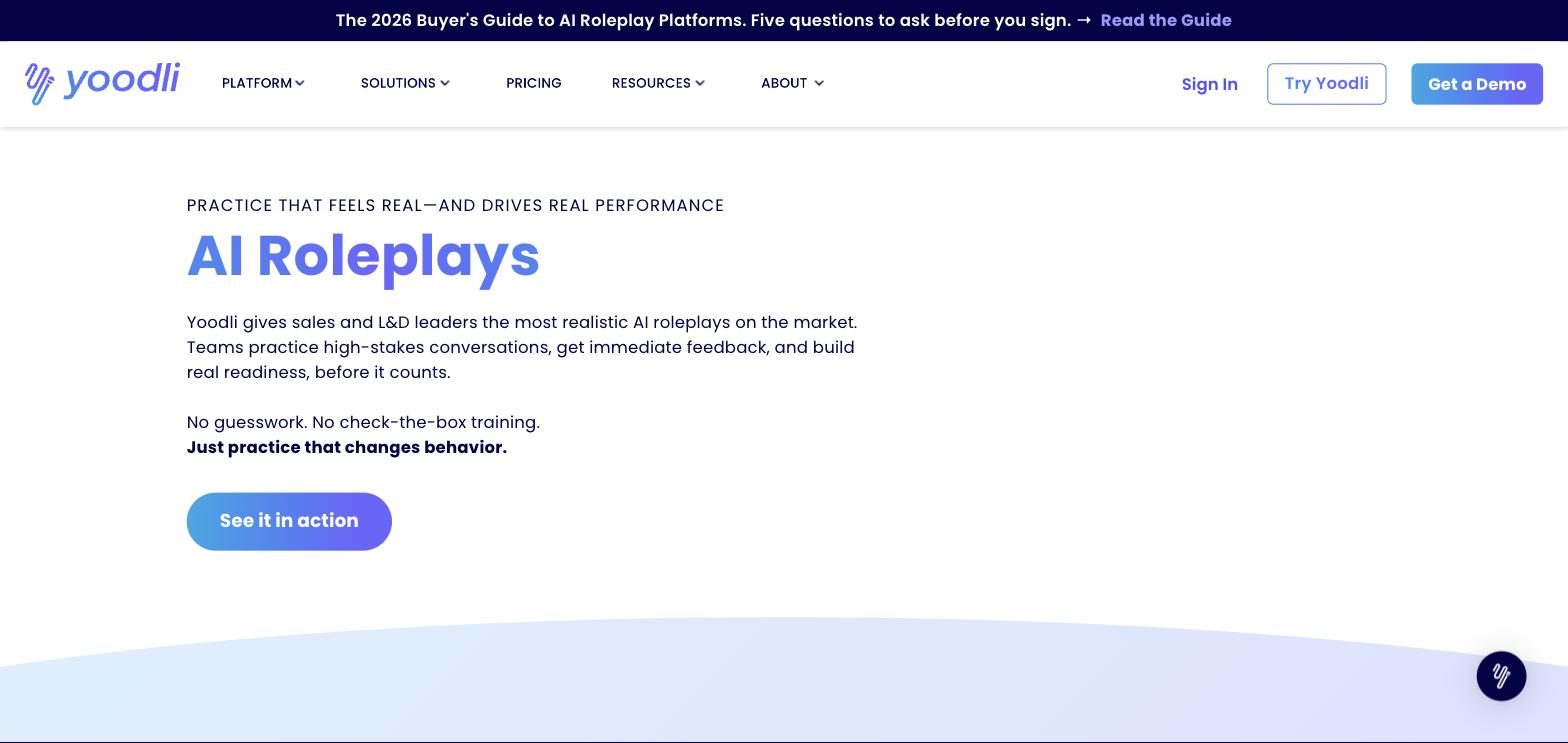
Source: Yoodli, AI Roleplays product page
On the practice side, it has AI roleplay simulations with customizable personas and scenarios, multi-persona group roleplays for buying-committee or panel-style B2B selling, and rubric-based scoring built around named sales methodologies like Sandler, MEDDPICC, and Challenger, or a custom weighted rubric an admin builds by hand or with AI (goal types include binary, rated, and compound goals made of sub-goals). A rep demoing the product in 2026 also pitched a multi-LLM architecture, three LLMs running simultaneously, as the reason roleplay responses hold up under load.
Live, in-call coaching is Yoodli's strongest differentiator, and it actually runs two distinct real-time formats. The browser extension plugs directly into major video-conferencing tools and gives real-time feedback, on pacing, filler words, tone, conciseness, and talk-track adherence, while the conversation happens, not after. Separately, a two-avatar "live roleplay coaching" mode lets a second AI avatar play an embedded sales coach that can interrupt and correct a rep mid-roleplay, distinct from an async "Coach Me" feature that turns an uploaded real call into a standalone 5-10 minute AI coaching session.
On the admin and reporting side, Yoodli has certification and onboarding automation with readiness tracking, team and manager dashboards with skill-progression trends, SSO, SCIM, LMS/HRIS integrations, SOC 2 Type 2 certification, and GDPR compliance.
A CRM connection exists through an MCP connector, not a native embed: a roleplay can't run or be embedded inside the CRM itself, but a connected LLM can pull live deal data out to generate a custom roleplay around it. An expanded call-recording integration, announced in 2026, turns real call recordings into personalized AI practice scenarios.
The 2026 "Learn, Practice, Do" launch and auto-generated learning content push Yoodli further into territory that overlaps with an LMS, not just a coaching tool.
Yoodli's own sales page cites a case study claiming 1,200+ manager hours saved per quarter, a 3.3x improvement in quota attainment, and roughly 50% ramp-time reduction. These are self-reported marketing numbers, not independently verified figures, so treat them as directional rather than guaranteed outcomes for your own team.
What Users Say
Independent verification here is harder than it should be. Yoodli's G2 page is widely cited at 4.7 to 4.8 out of 5 with around 87% five-star reviews, but G2 blocks direct fetching of its review pages, so we couldn't confirm that rating firsthand.
Yoodli's Capterra listing exists but currently shows zero user reviews, so there's no independent review base there to cite yet.
What we could source, from a secondary aggregator characterizing G2 feedback and from an independent third-party review:
"Simulations are not interactive enough for realistic, objection-heavy conversation practice; roleplay personas sound a little stiff." (Secondary aggregator characterizing G2/user feedback)
"It lacks advanced custom scenarios, methodology-based simulations, and a broader training library that revenue teams expect." (Secondary aggregator characterizing G2 feedback on sales-specific use)
"Yoodli analyzes speech and gives immediate feedback on pacing, clarity, tone, and filler words, instant, data-driven feedback that helps people improve faster and with less pressure." (Secondary aggregator paraphrasing G2 reviewer praise)
"The free plan's 5 lifetime sessions is stingy, and the best individual pricing requires annual billing." (MakerStack independent review)
We were also able to pull up a live-rendered G2 review page directly, which confirms the 4.7-out-of-5 rating rests on a small base, just 8 reviews at the time of capture.
One validated reviewer, an Account Executive at an enterprise-sized company, put the product's actual limitation more specifically than any paraphrase above:
"Yoodli is great at analyzing how you speak (pacing, filler words, clarity), but it doesn't always evaluate the quality or strategy of what you're saying." (G2 review, Account Executive, Enterprise)
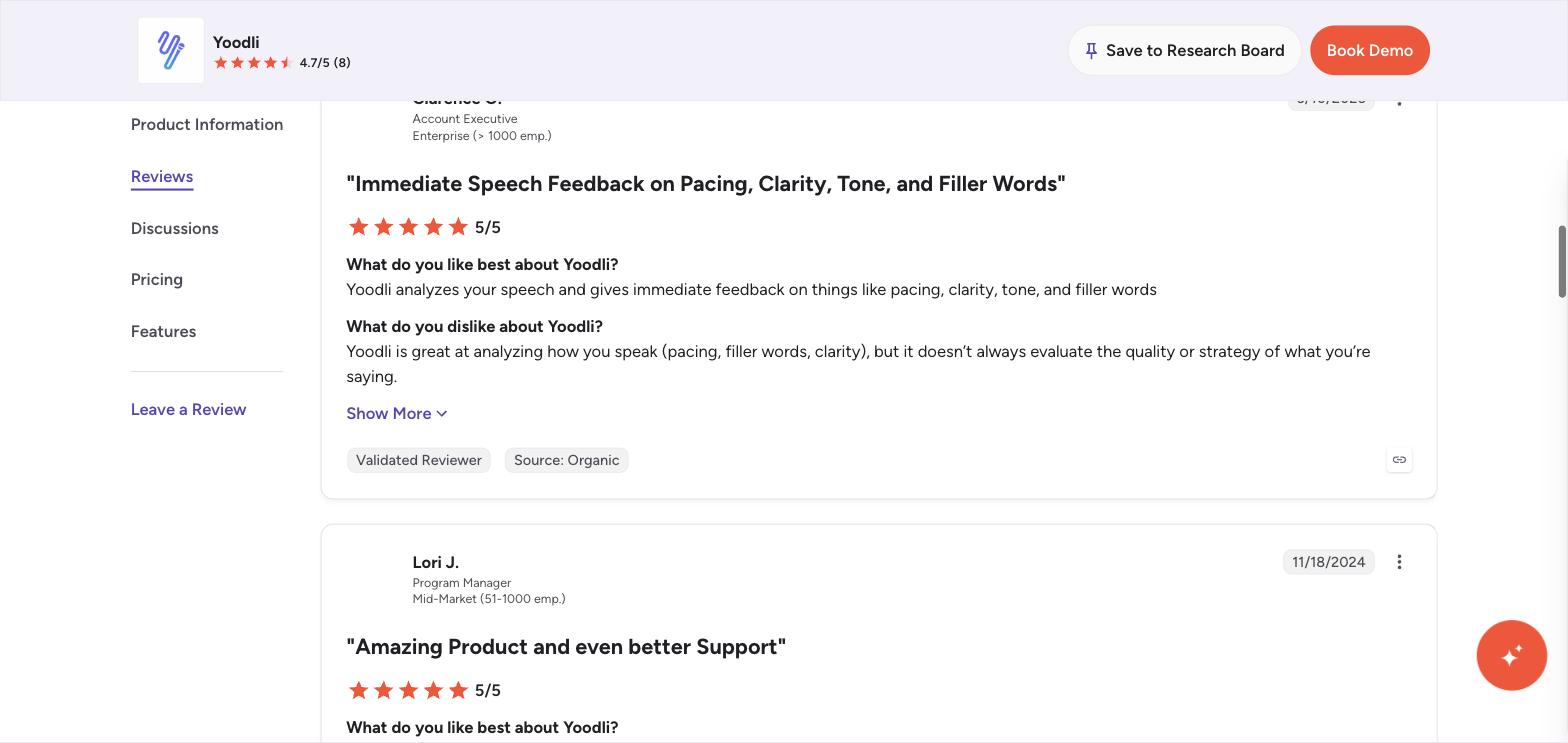
Screenshot: Yoodli G2 review, critical/dislikes section, captured August 2026.
The pattern across these is consistent: people like the speech-feedback mechanics Yoodli was originally built for, and the same reviewers flag that the sales-specific roleplay layer, the personas, the scenario depth, the methodology alignment, feels less mature than the core coaching product.
That tracks with a company whose roots are in general communication coaching and whose enterprise sales product is a newer addition on top.
Where Yoodli Falls Short
The gap reviewers point to is real: Yoodli's roleplay personas can feel stiff for objection-heavy, high-stakes B2B conversations, and the scenario library isn't as deep as what dedicated revenue teams expect.
Language coverage is narrower too. Yoodli's own product page lists 40+ languages, while Outdoo AI covers 120+ languages overall and 74+ languages in voice roleplay, a real gap once a team sells across regions or hires reps who aren't native English speakers.
Pricing opacity compounds this. When the tier that matters most, team and enterprise, has no published number, prospects have to burn a sales cycle just to find out if it fits the budget, and at least one real deal we're aware of stalled on exactly that combination of cost uncertainty and slow response.
Yoodli is also visibly expanding beyond its original lane. The 2026 "Learn, Practice, Do" platform and auto-generated learning content are explicit moves to fold in content creation and LMS-style functionality, on top of a coaching tool.
That's a reasonable growth strategy, but it also means a buyer evaluating Yoodli today is evaluating a moving target, not a settled product with one clear job.
Two more specific gaps worth flagging before you sign. First, propagating a rubric change, a new objection, an updated goal, across an existing library of roleplays isn't a bulk operation today: a rep confirmed directly it "would need to be done one by one," with no verified batch path even through the newer MCP connector. Second, the free trial for a team evaluation is short, a strict 72 hours, tight for anyone trying to actually test roleplay quality against their own calls before deciding.
Where Yoodli Genuinely Wins
Credit where it's due. Yoodli's real-time, in-call coaching during actual live customer calls, via its video-conferencing browser extension, is genuinely strong, and it's ahead of what most roleplay-first platforms, Outdoo AI included, offer today.
If your priority is a coach whispering in a rep's ear mid-call, Yoodli built that well and built it early.
Its enterprise identity and IT plumbing are also more filled out than a lot of competitors in this space: SSO, SCIM, LMS and HRIS integrations, and SOC 2 Type 2 are all called out directly on its pricing page, which matters to security teams trying to move fast through procurement.
Any comparison content that treats Yoodli as a fading or thin competitor is wrong.
It's a company actively building toward the same "coaching tied to outcomes, not completions" territory that revenue-focused platforms claim as their edge, and the gap is narrowing, not fixed.
Is Yoodli Worth It for a Mid-Market Sales Team? How Outdoo AI Compares
Yoodli is worth a look if in-call coaching on live customer calls is the single most important thing you're buying, and if you're comfortable with a sales-led enterprise pricing conversation with no public anchor.
For a full side-by-side, see Yoodli vs Outdoo AI.
If what you actually need is a system where roleplay practice and real customer calls get graded against the same scorecard, so leaders can show coaching moved real revenue numbers instead of just completion rates, that's Outdoo AI's specific angle, not Yoodli's.
Outdoo AI builds roleplays straight from a team's own calls, transcripts, playbooks, battlecards, and even LinkedIn profiles, so reps are practicing against their actual deals, not generic scenarios.
Customers rate that approach highly: Outdoo AI is the #1 AI Sales Roleplay Platform for Best Results and Most Implementable on G2 (Fall 2026 reports).
It also scores the part most tools skip entirely: the post-call CRM and workflow logging, practiced in the same session as the conversation itself, not bolted on as an afterthought.
Yoodli's newest move here, an expanded call-recording integration, turns real call recordings into AI roleplay scenarios. That's still conversation practice; it doesn't score the CRM data entry or process steps a rep does after the call, which is exactly where Outdoo AI's workflow scoring picks up.
And Outdoo AI prices on usage, so a team pays for training that's actually driving activity, instead of a $600/user/year per-seat license sitting partly unused across a roster.
None of that erases Yoodli's live-call coaching lead or its deeper enterprise IT integrations. It just means the two tools are optimized for different jobs, and a mid-market sales team deciding between them should be honest about which job they're hiring for.
Frequently Asked Questions
.svg)
Individual plans run $0 to $20 a month. The team and enterprise tier that fits an actual sales org isn't publicly priced, but Yoodli quoted $600/user/year with unlimited usage as of 2026, list pricing rather than published pricing, so your own quote may differ. See the pricing table above. Outdoo AI starts free with 60 minutes of roleplay credits and unlimited team members, no credit card and no sales call, then scales on usage-based Flex pricing with a custom enterprise plan for larger deployments.
Yes, this is Yoodli's strongest feature. Its browser extension gives real-time coaching feedback during actual video-conferencing calls.
Yes. Beyond LMS and HRIS integrations, SSO, and SCIM on its enterprise tier, Yoodli has a CRM integration that embeds roleplays in the CRM and an expanded call-recording integration that turns real call recordings into practice scenarios.
Not fully. Outdoo AI grades roleplay practice and live sales calls on one scorecard, scores post-call CRM and workflow logging, and prices on usage rather than per seat.
Real but thin. Its G2 page is widely cited at 4.7-4.8 out of 5, but that rating rests on a small base, just 8 reviews at time of capture, and Capterra currently shows zero. Read the rating as a real, positive signal, not proof of scale.
Table of Contents
Talk to Sales
Have questions about training and enablement for your sales, CS, support, or leadership team? Let's talk.
Talk to Sales