



Cold calling is the skill most sales teams claim to train but rarely practice in a structured way. Reps get a call script, a list of common openers, maybe a few recordings of top performers, and then they are sent to the phones. The result is predictable: the first 50 to 100 dials are essentially live practice at the expense of real prospects.
The problem is not motivation. Most SDRs and BDRs know that cold calling is how pipeline gets built. The problem is that cold calling is a real-time performance skill that depends on the first 15 to 30 seconds of a conversation, and there is almost no way to practice those seconds in a realistic environment without picking up the phone and calling a real person.
HubSpot data shows that only 2% of cold calls result in a meeting. That means 98% of a new rep's early dials are rejection, and the learning happens slowly, painfully, and inconsistently. Peer role-play does not replicate the pressure. Call shadowing does not give the rep a turn. Script review does not build the timing and tone that separate a productive cold call from one that gets hung up on in six seconds.
That is what AI roleplay changes. This guide covers how enablement leaders and sales managers can use AI roleplay to build a structured cold calling training program that actually prepares reps for the first 30 seconds, not just the script behind them.
Why Traditional Cold Call Training Produces Slow Ramp and Inconsistent Results
Cold calling training in most organizations follows a pattern that has not changed in decades. The tools are newer, but the approach has the same structural gaps.
The fundamental issue is that cold calling is a speed skill. It depends on reactions measured in seconds, not minutes. AI roleplay for sales training solves this by giving reps a realistic practice environment where they can build those reaction patterns before touching a real prospect list.
Why AI Roleplay Works for Cold Calling When Other Training Methods Do Not
AI roleplay platforms solve the specific problem that makes cold calling so hard to train: the gap between knowing what to say and delivering it under time pressure against an uncooperative audience. The differences are structural.
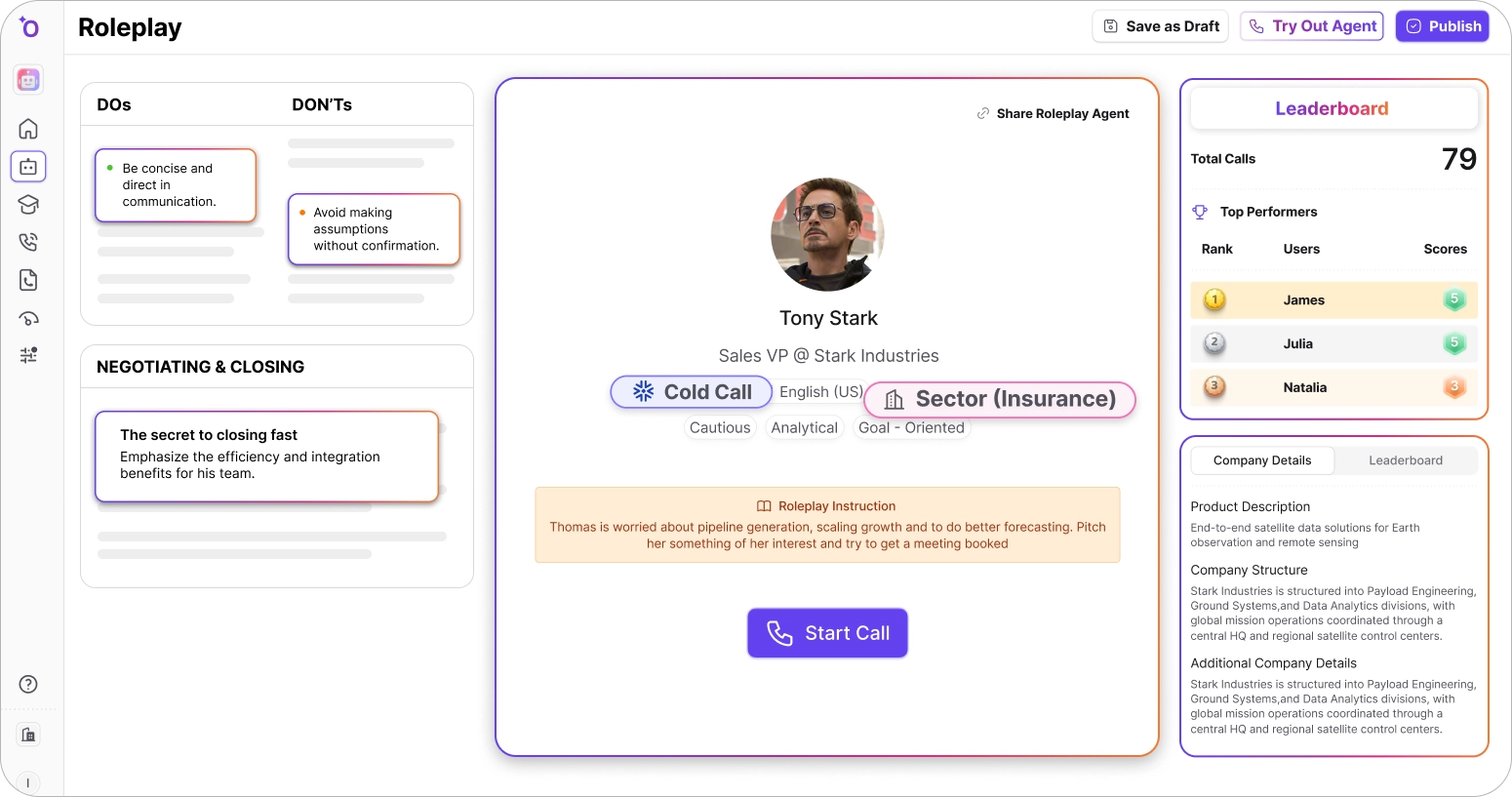
Here is how easy it is to set up roleplay agents in Outdoo AI for specific cold calling scenarios:
Five Cold Call Skills Every Rep Should Master Before Going Live
Cold calling is not one skill. It is a sequence of micro-skills that each require separate practice. A rep who has a strong opener but cannot navigate a gatekeeper will never reach the decision-maker. A rep who can qualify quickly but leaves terrible voicemails is wasting 80% of their dials. Training programs that treat cold calling as a single competency miss the fact that each of these five skills fails independently.
1. The opening: earning the right to continue in under 15 seconds
What it sounds like: The first sentence after "hello." It needs to establish who you are, why you are calling, and why the prospect should not hang up, all in roughly 15 seconds.
Why it is hard: Most cold call openers fail because they sound like cold call openers. "Hi, this is [name] from [company], we help companies like yours..." triggers an automatic rejection response. The skill is pattern-interrupting: saying something unexpected enough that the prospect pauses instead of reaching for the hang-up button, without being gimmicky or dishonest.
What good looks like: A strong opener references something specific to the prospect (their role, company, or a relevant trigger event), states a concrete problem rather than a company description, and asks a question that requires more than a yes or no answer. The goal is not to pitch. The goal is to earn 30 more seconds.
How to practice this with AI roleplay: Configure AI personas with three response modes: polite but busy (will listen if the opener is relevant), skeptical (will challenge "how did you get my number?"), and hostile (will try to end the call in under five seconds). Score against two criteria: did the rep reference something specific to the persona rather than delivering a generic opener, and did they ask a question within the first 15 seconds. Reps who can earn the right to continue against the hostile persona are ready for live dials.
2. Gatekeeper navigation: getting past the person who is not your buyer
What it sounds like: "Can I ask what this is regarding?", "She's in a meeting, can I take a message?", "We don't take sales calls."
Why it is hard: Gatekeepers are doing their job. Tricks and manipulation erode trust and burn the account. The skill is being direct, professional, and specific enough that the gatekeeper feels comfortable passing the call through, without over-explaining or sounding like every other sales call they have fielded that morning.
What good looks like: State the decision-maker's name confidently, provide a one-sentence reason that sounds like business (not a pitch), and make it easy for the gatekeeper to transfer rather than screen. If you cannot get through, ask when the best time to reach the person would be and get a direct line or extension.
How to practice this with AI roleplay: Build a gatekeeper persona who uses three escalating levels of screening: casual ("may I ask what this is about?"), firm ("she asked me to screen all vendor calls"), and gatekeeping ("we have a no-solicitation policy"). Score against whether the rep was direct without being pushy, whether they used the decision-maker's name, and whether they secured an alternative path when blocked. This is one of the hardest skills to practice with peers because colleagues cannot replicate the professional detachment of a real executive assistant.
3. Rapid qualification: deciding in 60 seconds whether this call is worth continuing
What it sounds like: The 30 to 60 seconds after the prospect agrees to keep listening. This is not discovery. This is triage: does this person have the problem, the authority, and the timing to be worth a meeting?
Why it is hard: Reps either over-qualify (asking too many questions and losing the prospect's attention) or under-qualify (booking meetings with people who will never buy). The skill is asking two or three sharp questions that reveal fit without turning the cold call into an interrogation. SPIN situation and problem questions work well here when compressed to cold call pace.
What good looks like: Two to three questions that confirm the prospect has the problem you solve, has some form of decision authority or influence, and has a timeline that makes a meeting worthwhile. The questions should feel conversational, not like a checklist, and the rep should be willing to disqualify and move on if the answers do not fit.
How to practice this with AI roleplay: Configure three persona variants: a strong fit (has the problem, has authority, has timeline), a partial fit (has the problem but no authority), and a poor fit (no real problem, just being polite). Score against whether the rep identified the fit level correctly within 60 seconds and took the right action: booked a meeting for the strong fit, asked for a referral to the decision-maker for the partial fit, and politely disqualified the poor fit rather than forcing a meeting. Learning when not to book is as important as learning when to book.
4. Early-call objections: handling pushback before you have built any rapport
What it sounds like: "We already have a solution for that," "I'm not interested," "Send me an email," "We don't have budget for anything new."
Why it is hard: Cold call objections are fundamentally different from mid-deal objections. The prospect has no relationship with you, no understanding of your product, and no reason to give you the benefit of the doubt. The objection handling frameworks that work in discovery or negotiation need to be compressed to 10 to 15 seconds on a cold call. A rep who tries to do a full acknowledge-reframe-question cycle on a cold call will lose the prospect before they finish the reframe.
What good looks like: Acknowledge in one sentence, pivot to a relevant question in the next. "That makes sense. Out of curiosity, how are you handling [specific problem] right now?" The goal is not to overcome the objection. The goal is to redirect the conversation to something the prospect cares about enough to keep talking.
How to practice this with AI roleplay: Configure the AI to deliver the objection within the first 10 seconds of the call, before the rep has finished their opener. This is the realistic scenario: prospects do not wait for you to finish before objecting. Score against speed of recovery (did the rep pivot in under 10 seconds?), relevance of the redirect question (was it specific to the persona?), and whether the rep kept the call alive for at least 30 more seconds after the objection. Running this scenario 15 to 20 times in a row builds the reflex that new reps need most.
5. Voicemail: the message that earns a callback or the next pickup
What it sounds like: The 20 to 30 second message reps leave on 60% to 80% of their dials. Most voicemails are deleted within three seconds.
Why it is hard: Reps treat voicemail as an afterthought, but it is often the first impression. A rambling, generic voicemail guarantees the prospect will not pick up on the next attempt. The skill is delivering a concise, specific message that creates enough curiosity for the prospect to either call back or, more realistically, answer the next time your number appears.
What good looks like: Under 20 seconds. State your name, a one-sentence reason for calling that references something specific to the prospect, and a clear next step ("I will try you again Thursday afternoon"). Do not pitch. Do not ask them to call you back. The voicemail is a seed for the next dial, not a standalone pitch.
How to practice this with AI roleplay: Configure a scenario that goes to voicemail after two rings. Score against three criteria: was the message under 20 seconds, did it reference something specific to the persona, and did the rep state a concrete next step? Have reps record five voicemails in a row for five different personas and review the scores as a batch. Voicemail practice is one of the fastest ways to improve cold calling outcomes because it affects the majority of dials and most teams never practice it at all.
How to Build a Cold Calling Training Program with AI Roleplay
A structured program turns the five skills above into a repeatable training system. Here is how to build one using AI roleplay.
Step 1: Audit your current cold call performance data
Before building scenarios, understand where your team is actually struggling. Pull conversation intelligence data on connect rates, average call duration, and meeting-booked rates by rep. Identify which reps are getting past the first 15 seconds and which are getting hung up on. The data tells you whether the biggest gap is in openers, qualification, objection handling, or voicemail, and that determines where you focus first.
Step 2: Build scenario packs for each cold call skill
Create separate roleplay scenarios for each of the five skills. Do not combine them into one long call. A rep who needs to practice openers should be able to run 15 opener-only scenarios in 30 minutes without wasting time on the qualification section they have already mastered. Skill isolation is what makes AI roleplay practice more efficient than full-call practice.
Step 3: Use real prospect profiles for scenario grounding
The strongest cold call practice uses personas built from real data, not hypothetical buyers. Pull titles, industries, and company profiles from your actual target account list. Platforms like Outdoo AI can generate roleplay scenarios from LinkedIn profiles, so reps practice against personas that match the people they will be calling tomorrow. The specificity makes practice feel like preparation for a real call, not a generic exercise.
Step 4: Score against cold-call-specific criteria
Generic sales scorecards do not work for cold calls. Build a rubric that evaluates the behaviors specific to this call type: time to relevance (how fast did the rep say something the prospect cares about?), pattern interrupt quality, qualification speed, objection recovery time, and voicemail conciseness. Align these criteria to your methodology framework where applicable.
Step 5: Connect practice performance to live dial outcomes
The closed loop matters most for cold calling because the feedback cycle on live dials is so noisy. A rep might have a great week because they happened to call a friendly list, or a terrible week because of bad timing. When practice scores and live call scores are on the same rubric, managers can separate skill from luck. A rep who scores 85 on practice but converts at 1% on live calls has a different problem than a rep who scores 60 on both, and the coaching response is different for each.
Solving the First-Week Ramp Problem for New SDRs
Cold calling has the steepest ramp curve of any sales skill because there is no way to ease into it. A new rep's first dial is a live performance, and the prospect on the other end does not know or care that it is day one.
AI roleplay inverts this. Instead of spending the first week making bad calls to real prospects, a new SDR can spend two days running intensive roleplay sessions across all five cold call skills before ever picking up the phone. The math is straightforward:
This approach does not replace live call practice. It compresses the worst part of it: the early period where reps are learning at the expense of real pipeline. A rep who arrives at their first live dial having already handled 90 realistic AI cold calls is a fundamentally different performer than a rep whose first 90 calls were all live.
How to Measure Whether Cold Call Training Is Improving Live Performance
Cold calling metrics are noisy because outcomes depend on list quality, timing, and industry in addition to rep skill. The metrics below isolate the skill component so you can measure whether training is actually working.
Getting Started with AI Roleplay for Cold Calling
Cold calling is the hardest sales skill to train because it is the most unforgiving. There is no warm-up, no rapport, no second chance to make the first impression. Every live dial is a live performance, and most reps spend their first weeks performing badly against real prospects because they never had a way to practice realistically before going live.
AI roleplay gives reps that practice environment. They build the reactions, timing, and recovery instincts that cold calling demands before they burn a single name on their list. The combination of realistic AI resistance, structured scoring, and unlimited repetition produces reps who arrive at the phones with confidence that used to take months to build.
If you are building this for the first time, start with the skill that is causing the most damage on live calls right now.
Week 1: Identify your biggest cold call failure point. Is it the opener (calls ending in under 10 seconds)? Gatekeepers (calls never reaching the decision-maker)? Qualification (meetings booked but never converting)? Pull the data and focus your first scenario pack on the single skill that is costing the most pipeline.
Week 2: Build and test targeted scenarios. Create five to ten roleplay scenarios for that one skill, using prospect profiles from your actual target account list. Run them yourself and with your top performer to validate that the AI pushback is realistic. Adjust difficulty and scoring criteria based on their feedback.
Week 3: Run an intensive practice sprint. Have each rep complete 20 to 30 practice calls focused on the target skill. Review scores as a team, identify the top three response patterns that work, and share them as repeatable frameworks, not rigid scripts. This is also when you set the practice score threshold that a rep must hit before live dialing.
Week 4 and beyond: Score live calls on the same rubric. Once practice scores establish a baseline, start scoring live cold calls on the same criteria. The gap between practice and live performance is the coaching conversation. A rep who scores well in practice but poorly on live calls needs confidence and call rhythm work. A rep who scores poorly on both needs more fundamental skill development.
Outdoo AI is built for this. The platform supports voice roleplays configured as cold call scenarios with AI personas that interrupt, resist, and screen like real prospects. Scorecards evaluate opener quality, qualification speed, objection recovery, and voicemail effectiveness on the same rubric used for live call scoring. Reps can generate roleplay scenarios from LinkedIn profiles for outbound preparation against named accounts, practice against multiple persona types in a single session, and track their skill progression across every cold call competency. Teams like Globe Life, CMC, and RAIN Group use this system to compress cold call ramp from weeks to days.
If your SDR team is ready to stop learning at the expense of real prospects, book a demo to see how AI roleplay works for cold calling in your environment.
Frequently Asked Questions
.svg)
AI roleplay gives reps a realistic practice environment where they can run dozens of cold call scenarios against AI personas that interrupt, resist, and hang up like real prospects. Reps build the opener timing, gatekeeper navigation, and objection recovery instincts that cold calling demands before burning real prospects. Structured scoring evaluates each call against cold-call-specific criteria, and the same rubric scores both practice and live calls to measure whether training is translating to real performance.
The five cold call skills that have the highest impact are the opening (earning the right to continue in under 15 seconds), gatekeeper navigation, rapid qualification (deciding fit in 60 seconds), early-call objection handling (recovering from pushback before rapport exists), and voicemail (the message that earns the next pickup). Each requires separate practice because they fail independently.
AI roleplay can compress cold call ramp from the typical two to four weeks to three to five days. A new SDR can run 90 or more realistic cold call roleplays across all five skill types in two days of intensive practice, arriving at their first live dial with pattern recognition and recovery instincts that would normally take weeks of live calling to develop.
Yes. AI personas can be configured as executive assistants and receptionists with escalating screening behavior: casual inquiry, firm screening, and active gatekeeping with no-solicitation policies. This is one of the hardest skills to practice with peers because colleagues cannot replicate the professional detachment of a real gatekeeper. AI roleplay solves this completely.
Track opener survival rate (percentage of calls lasting beyond 15 seconds), practice-to-live score gap on the same rubric, call-to-meeting conversion correlated by skill score, time to first booked meeting for new hires, and voicemail-to-pickup rate. The practice-to-live score gap is the most actionable metric because it reveals exactly where training is translating to real calls and where it is not.
Table of Contents
Talk to Sales
Have questions about training and enablement for your sales, CS, support, or leadership team? Let's talk.
Talk to Sales