



Most sales teams teach objection handling from a document. A list of common objections on the left, approved responses on the right, maybe a few examples from top performers at the bottom. Reps read it during onboarding, reference it during their first few weeks, and then never look at it again.
The problem is not the content. Most objection handling guides contain genuinely useful responses. The problem is that reading a response and delivering it under pressure are completely different skills. A rep who has memorized the perfect answer to "we are already working with a competitor" will still freeze when a prospect says it with frustration in their voice halfway through a discovery call. Knowledge does not automatically become performance, and sales training that stops at knowledge transfer is training that stops too early.
HubSpot research identifies more than 40 common sales objections across categories like budget, authority, need, and timing. The volume alone makes it clear that memorization is not a viable strategy. Reps need to practice these conversations repeatedly in a safe environment, get scored on how they handle them, and build the muscle memory that lets them respond naturally when the moment arrives on a live call.
That is exactly what AI roleplay is built for. This guide covers how enablement leaders and sales managers can use AI roleplay to build a structured objection handling training program that actually changes how reps perform on real calls, not just what they know on paper.
Why Traditional Objection Handling Training Falls Short
Traditional objection handling training typically takes one of three forms: documentation, peer role-play, or call shadowing. Each has a structural limitation that prevents it from building the skill it is trying to teach.
The common thread across all three methods is the same: they treat objection handling as something reps can learn by absorbing information rather than something they need to build through repetition. AI roleplay for sales training changes that equation by making structured, repeatable, scored practice available on demand.
What Makes AI Roleplay Different for Objection Handling Training
AI roleplay platforms let reps practice objection handling against AI-generated buyer personas that behave like real prospects: they push back, ask unexpected questions, express frustration, and do not let a weak response slide the way a colleague might. The key differences from traditional methods are structural, not just technological.
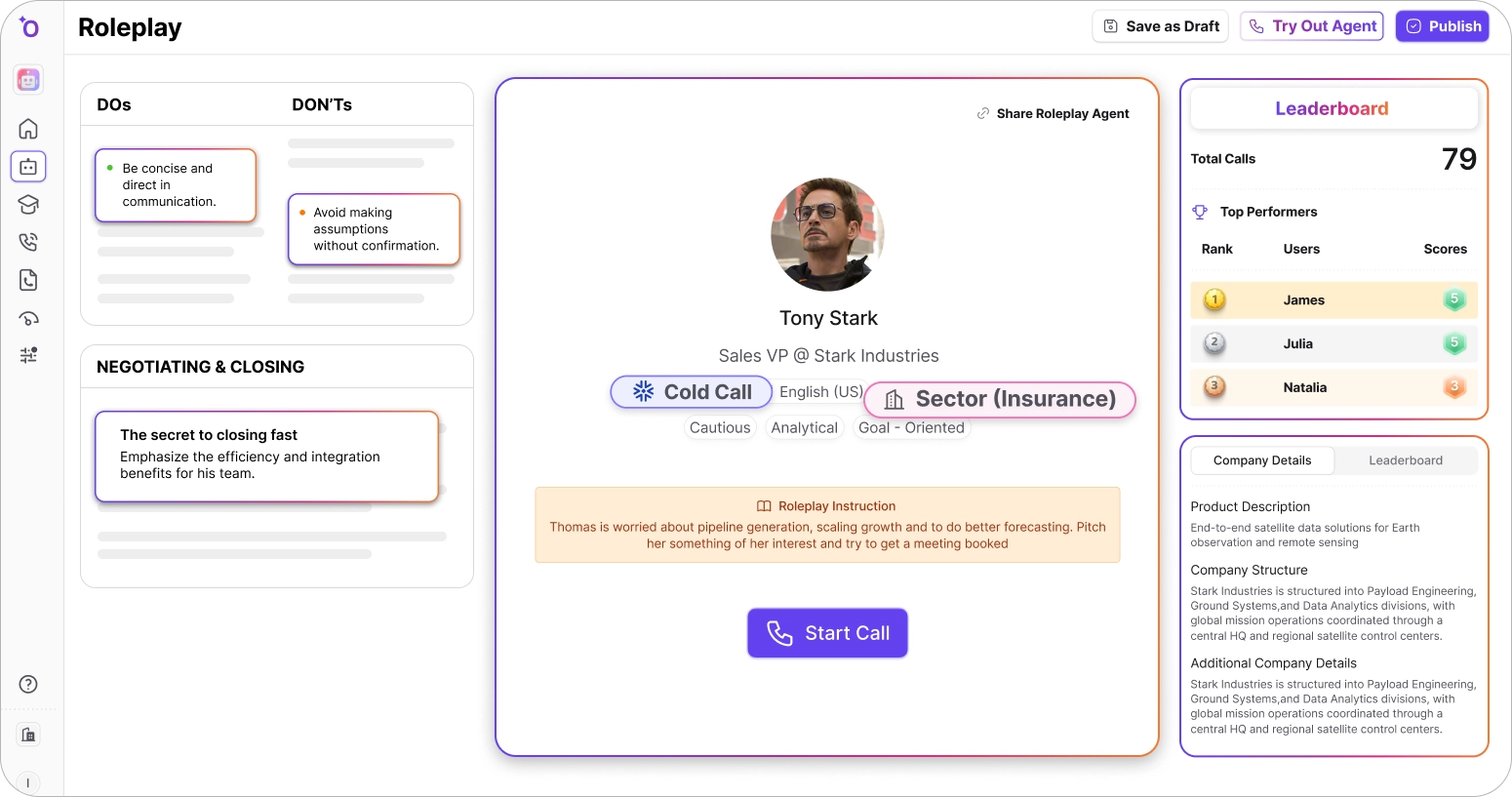
Here's how easy it is to setup roleplay agens in Outdoo AI for specific objections or sales scenarios:
Five Objection Types Every Rep Should Practice Before Going Live
Not all objections require the same skill. A pricing objection demands value reframing. A competitor objection demands differentiation without disparagement. A timing objection demands urgency creation without pressure. Training programs that lump all objections into one category miss the fact that each type requires a distinct conversational muscle.
1. Price and budget objections
What it sounds like: "This is more than we budgeted for," "Your competitor is 30% cheaper," "We need to cut costs this quarter."
Why it is hard: Price objections feel like rejection, and the instinct is to discount or justify. Neither response builds value. The skill is reframing the conversation around the cost of the problem, not the price of the solution, without sounding rehearsed or dismissive of a real budget constraint.
What good looks like in practice: Acknowledge the concern as valid, quantify the cost of the current state (lost deals, wasted rep time, missed targets), and connect that cost to the specific outcomes the solution delivers. The reframe should feel like math, not persuasion.
How to practice this with AI roleplay: Configure an AI persona as a finance-conscious buyer who opens with "this is 40% over our budget" and escalates if the rep leads with discounting. Score against two criteria: did the rep quantify the cost of the current problem before discussing price, and did they connect the reframe to a specific business outcome the persona cares about. Run the scenario at three difficulty levels: budget-conscious (receptive to reframe), price-anchored (competitor benchmark), and hard-no (executive mandate to cut spend). Reps who can handle the third level are ready for live calls.
2. Competitor objections
What it sounds like: "We are already using [competitor]," "What makes you different from [competitor]?", "Our team is happy with what we have."
Why it is hard: Reps either overcorrect into disparaging the competitor (which erodes trust) or undercorrect into vague differentiation that does not land. The skill is positioning your specific advantage against the specific gap the prospect is experiencing, without turning the conversation into a feature comparison. Competitive selling requires reps to lead with the prospect's pain, not the competitor's weaknesses.
What good looks like in practice: Ask what they like about the current solution (builds rapport and reveals gaps), then position your differentiation against those gaps specifically. Never lead with what the competitor lacks. Lead with what the prospect needs and is not getting.
How to practice this with AI roleplay: Build a persona who is actively using a named competitor and is satisfied with it. The AI should push back on differentiation claims with "our current tool does that too" and test whether the rep can identify the specific gap without disparaging the competitor. Score against whether the rep asked discovery questions about the current solution before positioning, and whether the differentiation they offered was specific to the persona's stated pain, not generic. This scenario is especially effective with multi-persona simulation: pair a satisfied end-user with a skeptical manager to practice navigating split loyalty within a buying committee.
3. Timing and urgency objections
What it sounds like: "This is not a priority right now," "Can we revisit next quarter?", "We have too much on our plate."
Why it is hard: Timing objections are often real, and pushing back can feel tone-deaf. The skill is distinguishing a genuine timing constraint from a polite deflection, and in either case, making the cost of delay concrete without creating pressure that damages the relationship.
What good looks like in practice: Validate the competing priorities, then quantify what the delay costs in specific terms the prospect cares about (pipeline velocity, rep ramp time, missed quota). If the timing is genuinely wrong, set a concrete next step rather than leaving it open-ended.
How to practice this with AI roleplay: Configure the AI persona to surface the timing objection at two different moments: early in discovery (where it is often a deflection) and late in negotiation (where it is often real). Score against whether the rep correctly identified which type of timing objection they were facing and adapted their response accordingly. The key scoring criterion is whether the rep quantified the cost of delay using data the persona had already shared earlier in the conversation, not generic urgency language. Reps who can pull a prospect's own words back to make the case for acting now are significantly more effective than reps who rely on artificial deadlines.
4. Authority and stakeholder objections
What it sounds like: "I need to run this by my manager," "Our VP makes these decisions," "The procurement team handles vendor selection."
Why it is hard: The rep is not being told no, they are being redirected, and most reps do not know how to coach a champion through an internal selling process. The skill is equipping the person in front of you to advocate for the deal when you are not in the room. This is core to MEDDIC qualification: identifying the economic buyer and coaching your champion to reach them.
What good looks like in practice: Ask what the decision-maker cares about most, offer to build a business case or summary they can share, and propose a meeting that includes the decision-maker. The goal is to stay involved in the process rather than hand off the deal to someone you have never spoken to.
How to practice this with AI roleplay: This is where multi-persona simulation delivers the most value. Configure a scenario with two AI personas: a mid-level champion who is enthusiastic but cannot sign off, and a VP or CFO who joins the call skeptical and time-pressed. Score against whether the rep equipped the champion with a clear business case before the executive entered, and whether they adapted their pitch for the executive's priorities without repeating the full discovery. This directly maps to MEDDIC's "Identify Pain" and "Champion" elements, and the scorecard should reflect that alignment.
5. Status quo and inertia objections
What it sounds like: "What we have works fine," "We have always done it this way," "Switching would be too disruptive."
Why it is hard: The prospect is not objecting to your product. They are objecting to change itself, which is a deeper and harder barrier to overcome. The skill is making the cost of inaction more tangible than the cost of switching, without invalidating the work they have already done.
What good looks like in practice: Acknowledge that the current state is working, then surface the specific pain points they mentioned earlier in the conversation and quantify what those are costing them over time. The reframe is not "your current approach is bad" but "your current approach is costing you more than you think."
How to practice this with AI roleplay: Build a persona who is genuinely comfortable with the status quo and not experiencing acute pain. This is the hardest objection to practice because the rep cannot rely on stated pain. Score against whether the rep surfaced latent pain the persona had not articulated, and whether they quantified it in terms the persona's organization would recognize (revenue impact, competitive risk, team attrition). Progressive difficulty works well here: start with a persona who has mild dissatisfaction, then move to one who is actively resistant to change. Reps who can create urgency without manufactured pressure are ready for the most difficult live conversations.
How to Build an Objection Handling Training Program with AI Roleplay
A structured program turns ad-hoc practice into a repeatable system that scales across your team. Here is how enablement leaders and sales managers can build one using AI roleplay.
Step 1: Start from real calls, not scripts
Pull the actual objections your team encounters from call recordings and conversation intelligence data. Categorize them by type (price, competitor, timing, authority, status quo) and by deal stage (discovery, demo, negotiation, closing). The goal is to build objection-handling scenarios that mirror real pipeline conversations, not textbook examples.
Step 2: Build scenarios by objection type and deal stage
Create separate roleplay scenarios for each combination that matters to your team. A price objection during discovery requires a different response than a price objection during contract negotiation. Configuring AI personas that deliver these objections at the right moment in the right context is what makes practice realistic.
Step 3: Score against your methodology
Configure scorecards that evaluate objection handling against the framework your team uses, whether that is MEDDIC, BANT, SPIN, or Challenger. Generic "good job" feedback does not build skill. Specific feedback like "you acknowledged the concern but did not reframe value before asking a follow-up question" does. Methodology-aligned scoring ensures every practice session reinforces the behaviors your team is trying to build.
Step 4: Connect practice scores to live call performance
The most important step is closing the loop. When the same scorecard evaluates both a roleplay session and a real customer call, managers can see exactly where a rep performs well in practice but struggles live, or vice versa. That specific gap, between practice performance and live performance, is the AI-driven coaching opportunity that most training programs miss because they never measure both sides.
Step 5: Use micro-roleplays for targeted reinforcement
When scoring identifies a specific objection type where a rep consistently struggles, trigger a short, focused roleplay on that exact scenario. A five-minute micro-roleplay on price reframing is more effective than a one-hour session covering all objection types. Targeted reinforcement closes sales skills gaps faster than broad repetition.
How to Measure Whether Objection Handling Training Is Working
Training that cannot be measured cannot be improved. Here are the metrics that connect objection handling practice to business outcomes.
Getting Started with AI Roleplay for Objection Handling
Objection handling is not a knowledge problem. It is a practice problem. Reps who can recite the right response from a document but cannot deliver it under pressure are not ready for live calls, and most training programs stop before they address that gap.
AI roleplay closes the gap by giving reps a safe, repeatable environment to practice the specific objections they will face, scored against the methodology their team uses, with the feedback loop that connects practice performance to live call performance. The result is reps who arrive at calls already prepared for the pushback, not reps who learn to handle it at the expense of real deals.
If you are building this for the first time, start small and expand based on what the data tells you.
Week 1: Identify your top three objection types. Pull the last 30 days of call recordings and tag the objections that appear most often in lost or stalled deals. Most teams find that price, competitor, and timing account for 70% or more of the pushback their reps face. Start there rather than trying to cover everything at once.
Week 2: Build and test your first scenarios. Create one AI roleplay scenario per objection type, configured with the buyer persona and deal context your team encounters most. Run each scenario yourself before rolling it out. The test is whether the AI persona's pushback feels realistic enough that a rep has to think on their feet, not just recall a script.
Week 3: Run a pilot with 5 to 10 reps. Have each rep complete three to five practice sessions per objection type. Review their scores as a cohort: where is the team strong, and where do individual reps diverge? The patterns in pilot data tell you exactly where to focus coaching and whether the scenarios need adjustment.
Week 4 and beyond: Connect practice to live performance. Once reps have baseline practice scores, start scoring their real customer calls on the same rubric. The gap between practice scores and live call scores is the single most actionable metric in your training program. A rep who scores 85 on practice but 60 on live calls has a different coaching need than a rep who scores 60 on both, and the scorecard data tells you exactly what to work on.
Outdoo AI is built for exactly this workflow. The platform supports AI roleplays across chat, voice, and video with screen sharing for demo-stage objections, methodology-aligned scorecards for SPIN, BANT, MEDDIC, MEDDPICC, and Challenger, and multi-persona simulations where reps handle objections from multiple stakeholders in a single session. The same scorecard evaluates both practice and live customer calls, so the practice-to-performance gap is visible from day one. Teams like Globe Life, CMC, and RAIN Group use this closed-loop system to turn objection handling from a classroom topic into a measurable, coachable skill.
If your team is ready to move objection handling training from documentation to measurable skill development, book a demo to see how it works in your environment.
Frequently Asked Questions
.svg)
AI roleplay provides unlimited, on-demand practice against consistent buyer personas that deliver realistic objections. Unlike peer role-play or documentation review, AI roleplay scores each response against specific criteria and methodology frameworks, gives instant feedback, and lets reps repeat the same scenario until the skill becomes automatic. The combination of repetition, consistency, and structured scoring builds muscle memory that knowledge-based training alone cannot.
The five most common and highest-impact objection categories are price and budget, competitor comparison, timing and urgency, authority and stakeholder, and status quo or inertia. Within each category, objections differ by deal stage. A price objection during discovery requires a different response than during contract negotiation. Effective training programs build separate scenarios for each combination.
Track practice score progression by objection type, the gap between practice scores and live call scores on the same rubric, objection-to-advance rate (how often reps move deals forward after encountering an objection), time to competency for new hires, and win rate correlation by objection type. The practice-to-live score gap is the single most important metric because it reveals whether training is translating to real conversations.
Yes. Platforms like Outdoo AI support multi-persona simulations with up to three AI stakeholders in a single scenario. This lets reps practice handling objections from a CFO focused on cost while a champion advocates internally, or navigating a procurement lead's process concerns alongside a technical evaluator's integration questions. These buying committee dynamics are common in enterprise sales but nearly impossible to replicate in traditional role-play.
A basic program covering the five core objection types can be built in one to two weeks. Start by pulling real objections from call recordings, categorize them by type and deal stage, configure AI personas and scorecards, and run a pilot with a small group of reps. Full methodology-aligned programs with live call scoring integration typically take three to four weeks for enterprise deployments.
Table of Contents
Talk to Sales
Have questions about training and enablement for your sales, CS, support, or leadership team? Let's talk.
Talk to Sales