
- What it is: Cornerstone OnDemand is a Fortune-100-scale talent management and learning platform, not a sales roleplay or coaching tool.
- Where it's a strong fit: it works well as one system of record for compliance training, certifications, and skills data across a large, multi-department workforce.
- Where it falls short: it's the wrong tool if what you actually need is AI-simulated buyer conversations, call scoring, or coaching scorecards, since none of that exists as a shipped, sales-specific offering anywhere in the platform.
- Honest verdict: Cornerstone is a mature, credible LMS with real enterprise traction, but comparing it to Outdoo AI is comparing a filing cabinet to a batting cage; they solve different problems, and the smart move is connecting them, not picking one over the other.
Who Is Cornerstone Best For?
- Cornerstone OnDemand: Best for large organizations that need one system of record for compliance training, certifications and skills data. It serves 50% of the Fortune 100, per the company.
- Cornerstone Immerse Companion: Best for teams exploring general soft-skills VR or desktop roleplay. It is still behind a beta waitlist, with no scorecard or sales-specific scenarios.
- Outdoo AI: Best for sales teams that need AI roleplay built from their own calls, playbooks and battlecards. Completions export via SCORM and xAPI into an existing Cornerstone instance.
Cornerstone at a Glance
| Cornerstone OnDemand | |
|---|---|
| Category | Talent management / learning management system (LMS) |
| Pricing | Not published; custom quote only, per official pricing page |
| Roleplay or call coaching | No sales-specific practice tool. Immerse Companion, Cornerstone's one AI-roleplay feature, is generic soft-skills VR training, still gated behind a beta waitlist, with no scorecard or sales-specific rubric |
| Best for | Large organizations needing compliance tracking, certifications, and skills data in one system |
| G2 category | Corporate Learning Management Systems, compared against SAP SuccessFactors, Docebo, Litmos |
What Is Cornerstone?
Cornerstone OnDemand (cornerstoneondemand.com) is an enterprise talent-management suite that has rebranded around what it calls "Cornerstone Workforce AI," positioned as "the intelligence platform for workforce readiness." The company says it serves 50% of the Fortune 100.
The product spans several lines: Workforce Intelligence, Skills Optimization (built on a Skills Engine and labor-market data), Talent Development, Learning (the Cornerstone Learn LMS, which supports SCORM, AICC, and xAPI content), Content Suite, Recruiting and Onboarding, Talent Marketplace, Succession Planning, Performance Management, and Core HR.
It also carries legacy platforms from past acquisitions, including Saba, SumTotal, TalentLink, and Skill Passport.
The newest layer is a set of "Readiness Agents," which the company names Future of Work Agent, Embark Navigator, and Skills Architect. These are workforce-planning and skills-gap analytics tools.
They orchestrate HR workflows and surface skills data.
They do not run conversations with a simulated buyer, and Cornerstone has never positioned them that way.
One feature does overlap with Outdoo AI's category, and it's worth naming honestly. Immerse Companion, an ex-Talespin acquisition unveiled in October 2024, is a VR and desktop AI-roleplay tool built on Meta's Llama 3.1 model.
It's built for general soft skills like communication, conflict resolution, and leadership. Sales shows up only as one example use case in Meta's own published case study, not as a focus on Cornerstone's own product page.
There's no scorecard or rubric tied to a company's own playbook anywhere in it, no CRM or workflow practice, and as of this writing it's still gated behind a "Sign Up Now" beta waitlist rather than shipped as a self-serve, generally available product.
Cornerstone sits in a completely different competitive category from Outdoo AI. On G2, it's benchmarked against SAP SuccessFactors, Docebo, and Litmos, all LMS peers, never against roleplay or coaching platforms.
That's the correct comparison set for Cornerstone. It's also why a head-to-head "Cornerstone vs. a sales roleplay tool" framing doesn't really hold up.
Recent moves reinforce the direction. In May 2026, Cornerstone announced deeper Salesforce and AWS ecosystem partnerships alongside the Workforce AI launch.
In August 2026, it was named a leader in an IDC MarketScape talent-management report. Every recent announcement is about workforce intelligence and ecosystem integrations, none of it about sales training, roleplay, or coaching.
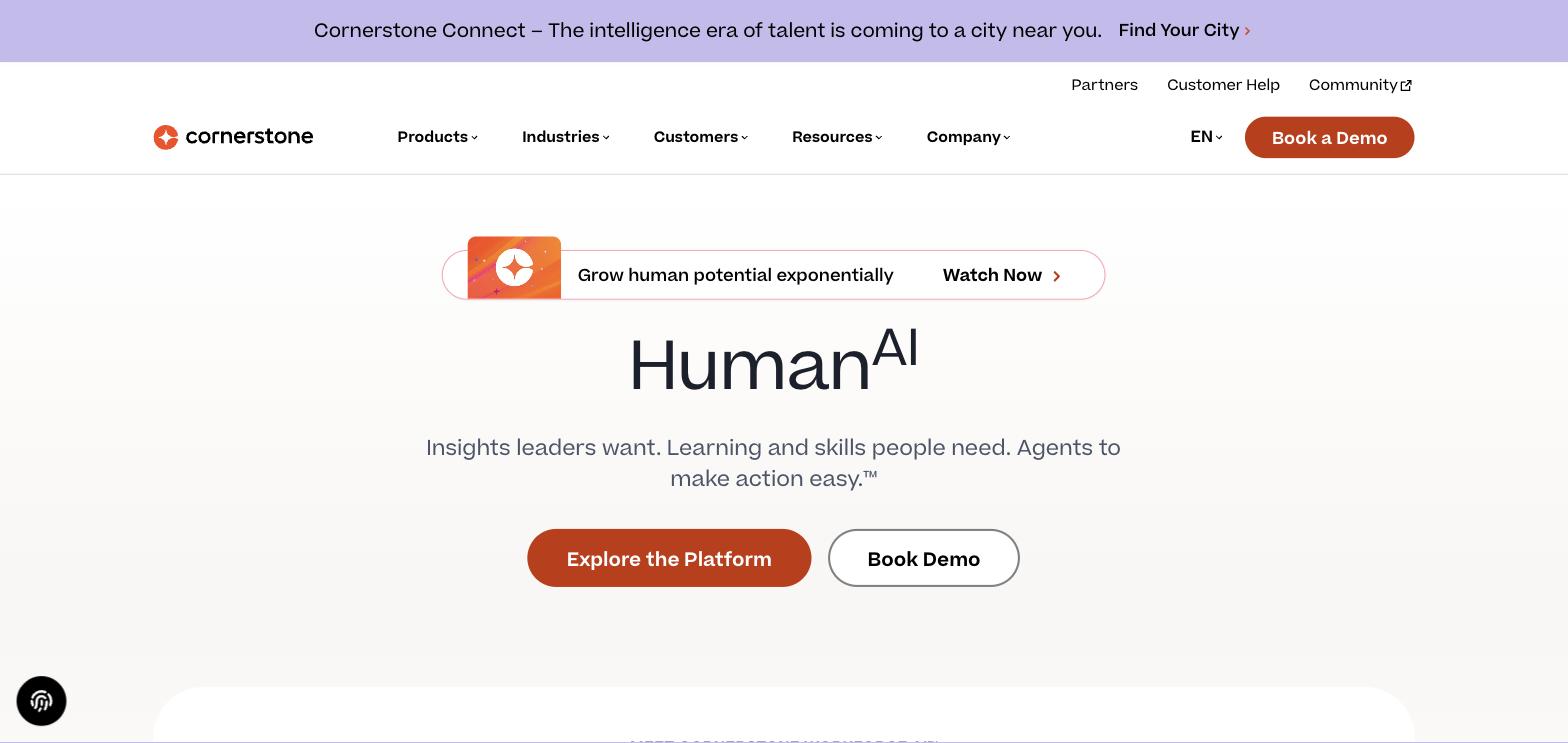
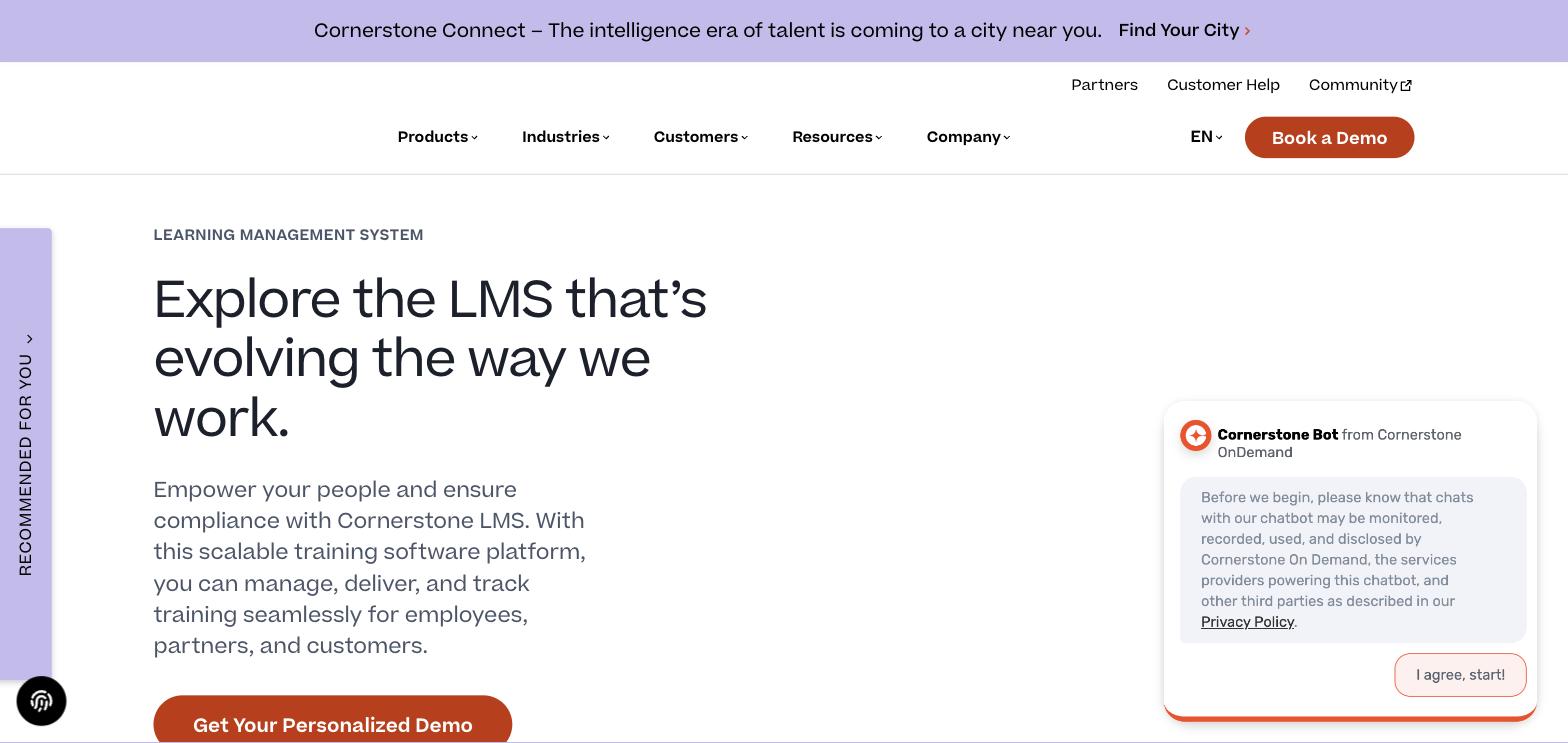
Screenshot: Cornerstone OnDemand homepage, captured August 2026. Source.
Cornerstone Pricing
Cornerstone does not publish pricing anywhere. The official pricing page contains exactly one line on cost: "Each organization will have a different cost depending on needs and size. Reach out to us for a free personalized demo and we can give you an estimate."
There's no tier breakdown, no per-seat number, no starting price. That's a real gap if you're trying to build a business case before talking to sales.
What does exist is G2's aggregated Pricing Insights panel, built from reviewer self-reports rather than anything Cornerstone discloses directly:
| Metric | Reported figure |
|---|---|
| Average time to implement | 7 months |
| Average ROI period | 26 months |
| Average discount negotiated | 14% |
A 7-month implementation and a 26-month ROI window are consistent with what you'd expect from an enterprise talent-management suite sold through a custom-quote sales process.
G2 also scores Cornerstone's perceived cost at $$$$ out of a possible $$$$$, a 4-out-of-5 rating built from its own reviewer base calling it an expensive platform.
If you need a number to bring into a budget conversation before a first call, Cornerstone won't give you one, and reviewers' own reported timelines suggest this isn't a quick or cheap rollout regardless of what the eventual quote says.
Screenshot: Cornerstone's official pricing page, no price shown anywhere, captured August 2026. Source.
Cornerstone Features
| Area | What it covers |
|---|---|
| Content management | SCORM, AICC, and xAPI support, plus marketplace integrations with LinkedIn Learning, Coursera, and Skillsoft |
| Compliance and certification | Automated renewal tracking and certification workflows |
| Learning paths | Role-based curricula organized by role, product area, or certification level |
| Engagement | Assessments, gamification, and social or collaborative learning features |
| Skills intelligence | A Skills Engine, Skills Inference Model, and Context Graph that map workforce skills gaps |
| Workforce planning | "Readiness Agents" that automate planning workflows and surface skills data for HR and leadership |
| AI roleplay (general soft skills) | Immerse Companion: VR/desktop practice built on Meta's Llama 3.1, still beta-waitlist, no scorecard or sales-specific scenarios |
| Platform architecture | Six named components: Context Graph, Skills Engine, Agent Orchestration, Trust and Governance, Integrations and Ecosystem, and Ethical AI |
That's a broad feature set, and it's built for a different job than Outdoo AI's.
Content management, compliance renewal, and role-based curricula are core LMS functions Cornerstone has had for years.
The Skills Engine and Readiness Agents are the newer, more ambitious layer, and they're aimed at answering "where are our workforce's skill gaps" at a company-wide level, not "how well did this rep handle a discovery call."
Search Cornerstone Learn, the Readiness Agents, or the full site sitemap, and none of them use the words roleplay, practice, or coaching. The one exception is Immerse Companion, and even there, sales is a footnote in someone else's case study, not the product's stated focus. That's still effectively a category boundary for anyone evaluating sales-specific practice tools.
What Users Say
Reviewers on G2 describe a platform that's comprehensive but not always easy to navigate. From the G2 Cornerstone Learning reviews:
"Everything I need regarding my courses, tasks, and even the course completion process were all placed in one area... This did not come across as being very intuitive right from the start... it sometimes takes several clicks to navigate through basic information."
On AI capability specifically, one reviewer wrote:
"Cornerstone Learning isn't as modern as newer LMS systems. We wish it had more AI capabilities that are easy to find and use. The system is so complex that it makes it difficult to find the tools we need... you would think AI functions would have been at the top of their list to implement."
Another review is more positive about the content organization, while flagging reporting as a weak spot:
"The content organization and curriculum management tools are solid... The reporting module is functional, but it has clear limitations when it comes to building truly custom reports... requires workarounds or exporting to Excel."
And one reviewer likes the centralized tracking:
"Everything is centrally and clearly bundled at Cornerstone Learning. I can track the learning progress well without constantly having to manually follow up."
The pattern across reviews is consistent: Cornerstone does centralized tracking and curriculum management well, but complexity and dated AI capability show up repeatedly, even after the Workforce AI rebrand.
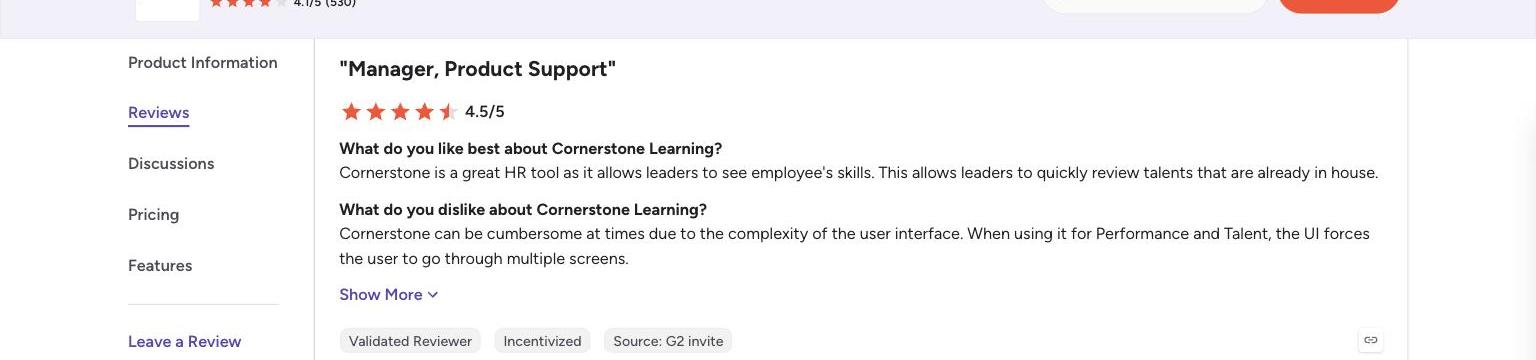
Screenshot: G2 review from a Manager, Product Support, citing a cumbersome, multi-screen UI for Performance and Talent modules. Source.
Where Cornerstone Falls Short
There's no sales-specific roleplay, call scoring, or coaching scorecard anywhere in the core platform. Immerse Companion, the one feature that does simulate a conversation, is built for general soft skills, not sales, and it's still gated behind a beta waitlist rather than shipped as a generally available product.
It also has no scorecard tied to a company's own playbook, no CRM or workflow practice, and no way to grade a roleplay and a live sales call on the same scale. If your need is training reps to handle real sales conversations better, against your own scorecard, Cornerstone doesn't have a shipped answer today.
Pricing is completely opaque. No tiers, no starting price, nothing beyond "contact us for an estimate." Combined with G2's reported 7-month average implementation time, this is not a fast or cheap system to stand up.
Reviewers themselves flag the AI gap. Even under the new "Workforce AI" branding, 2026 G2 reviewers are on record wanting AI capabilities that are easier to find and use, and describing the system as complex enough to slow down basic navigation.
Custom reporting is another recurring complaint. Reviewers describe the reporting module as functional for standard use but limited for custom analysis, often requiring an export to Excel to get real answers out of the data.
Where Cornerstone Genuinely Wins
Give credit where it's due. Cornerstone is a mature, battle-tested system of record, and that matters at scale.
Fortune-100 companies use it to track compliance, certifications, and skills data across thousands of employees and multiple departments, and it's held up long enough to earn repeat analyst recognition, including the 2026 IDC MarketScape leader placement.
The SCORM, AICC, and xAPI support is real infrastructure, not a checkbox.
If your organization already runs certification renewals, role-based learning paths, and multi-department curricula through Cornerstone, ripping that out to replace it with anything else, including Outdoo AI, would be the wrong call.
The Skills Engine and Context Graph layer is an ambitious bet, backed by real partnerships with Salesforce and AWS announced in 2026.
If your actual need is company-wide skills-gap visibility for workforce planning, Cornerstone is a legitimate, credible answer, and one of the more advanced options in that specific space.
Give credit on the AI-roleplay front too. Immerse Companion isn't vaporware: it runs on a real fine-tuned model, supports 40+ languages, and per Meta's own case study cut simulation-authoring time from months to about 10 minutes for content authors.
How Outdoo AI Compares
This isn't really a competitive matchup, and we're not going to pretend it is. Cornerstone is a system of record for learning and compliance.
Outdoo AI is an AI roleplay platform built specifically to train reps for real sales conversations. Those are different jobs, even where Immerse Companion technically overlaps on paper.
The gap is depth, not existence. Immerse Companion is general soft-skills practice, still behind a beta waitlist, with no scorecard tied to a company's own playbook.
Outdoo AI's roleplay is live today, built directly from a team's own calls, playbooks, and battlecards, and graded against that team's own scorecard rather than a shared soft-skills rubric.
Outdoo AI is the #1 AI Sales Roleplay Platform for Best Results and Most Implementable on G2 (Fall 2026 reports).
Where the two actually meet is integration, not replacement. Outdoo AI's roleplay and coaching completions export via SCORM and xAPI with auto-updating builds, so sessions feed directly into a Cornerstone instance a company already has.
That matters most for L&D teams already invested in Cornerstone as their system of record: adding Outdoo AI doesn't mean ripping anything out.
The deeper difference is what each platform measures. Cornerstone tracks course completion and certification status.
Outdoo AI's Closed-Loop Coaching grades roleplay practice and live sales calls on the same scorecard, so a sales leader can point to a number and say coaching moved real revenue performance, not just a completion percentage.
Cornerstone's reporting reviewers already flag as limited for custom analysis isn't built to answer that question, because it was never meant to.
Here's the part worth sitting with: Cornerstone's own 2026 G2 reviewers are asking for more accessible AI capabilities, not fewer, even after the Workforce AI rebrand and even with Immerse Companion in beta. That's the exact gap Outdoo AI's category exists to close, already shipped, with no waitlist to join.
If your team already runs Cornerstone, "we have an LMS" is not a reason to skip AI roleplay. It is a reason to use the SCORM export and let the two systems work together.
Outdoo builds AI Roleplays from your own calls and scores practice and real calls with one scorecard. Rated #1 for Best Results on G2.
Frequently Asked Questions
Does Cornerstone have a sales roleplay or coaching feature?
Not a sales-specific one. Its Immerse Companion feature does general soft-skills VR/desktop roleplay (communication, conflict resolution, leadership), still gated behind a beta waitlist, with no scorecard and sales named only as one example in a partner case study, not the product's focus.
How much does Cornerstone cost?
Cornerstone doesn't publish pricing. The official pricing page routes every visitor to a custom demo request. G2's reviewer-reported data puts average implementation at 7 months and average ROI at 26 months. Outdoo AI starts free with 60 minutes of roleplay credits and unlimited team members, no credit card and no sales call, then scales on usage-based Flex pricing with a custom enterprise plan for larger deployments.
Is Cornerstone a competitor to Outdoo AI?
Not directly. Cornerstone is an LMS and talent-management system; Outdoo AI is an AI sales roleplay and training platform. Outdoo AI's SCORM and xAPI export is built to feed into a Cornerstone instance, not replace it.
What do Cornerstone users complain about most?
Navigation complexity and AI capability that feels behind newer LMS platforms, per multiple G2 reviews, plus a reporting module reviewers say needs Excel workarounds for custom analysis.
What products is Cornerstone compared against on G2?
SAP SuccessFactors, Docebo, and Litmos, under G2's Corporate Learning Management Systems category. It's never benchmarked there against roleplay or coaching platforms.