
- Enterprise LMS first, roleplay tool second: Docebo is a large, mature learning management system that now sells a separate AI Roleplay add-on, not a purpose-built sales coaching platform.
- Strong fit for compliance and scale: it's a strong choice if you need compliance training, certifications, and a massive ready-made content library at scale.
- Pricing is entirely unpublished: Docebo doesn't disclose pricing for its AI Roleplay add-on.
- Honest verdict: the roleplay add-on is real, but it's a generic practice feature bolted onto an LMS, not a purpose-built sales coaching platform, and Docebo's own marketing barely talks about it.
Docebo at a Glance
| Docebo | |
|---|---|
| Category | Enterprise LMS / LXP, with a separately sold AI Roleplay add-on |
| Pricing | Not published; two named tiers (Elevate, Enterprise) gated behind "Get Your Pricing" |
| Roleplay scorecard | Clarity, confidence, energy, non-verbal cues; upgraded to quantitative 1-5 scoring plus human manager review in July 2026, still admin-authored, not built from your calls |
| Best for | Orgs that need compliance, certifications, and a huge content marketplace at scale |
| Weak for | Teams that want roleplay graded against their own playbook or built from real calls |
Full pricing detail and feature breakdown below.
Is Docebo the Right Fit for Your Team?
- Docebo: Best for orgs that need compliance, certifications and a huge content library at scale. Its Content Marketplace has more than 80,000 ready-made courses.
- Docebo AI Roleplay add-on: Best for teams already on Docebo that want generic communication practice. It scores clarity, confidence, energy, non-verbal cues and assertiveness.
- Outdoo AI: Best for B2B sales teams that want roleplay built from real calls and graded against their own playbook. One scorecard grades practice and live calls.
- Docebo plus Outdoo AI: Best for teams keeping Docebo as the LMS of record. Outdoo AI feeds completions back into Docebo via SCORM/xAPI.
What Is Docebo?
Docebo (docebo.com) is an enterprise learning management system (LMS) that has delivered courses and certifications for years, and its homepage now rebrands it as an "AI Workforce Readiness Platform."
Strip away the repositioning and the core business is still course delivery, certifications, compliance tracking, and content management, sold to more than 3,500 customer organizations including Zoom and Booking.com.
Over the last year or so, Docebo has layered AI on top of that LMS core: an AI content-authoring assistant, a copilot called Harmony, a no-code agentic layer called AgentHub, and a Skills Intelligence product built from its acquisition of 365Talents in April 2026.
It also picked up a FedRAMP Moderate authorization, opening the door to federal customers.
The piece that matters for this review is Docebo AI Roleplay, sold at its own product page (docebo.com/products/ai-roleplay/) as a separate, usage-based add-on embedded inside Docebo's "Creator" content-authoring experience.
It supports phone, web-chat, and video-meeting practice modes, lets admins customize scenarios, avatars, and personas, and scores sessions on clarity, confidence, energy, and non-verbal cues. Docebo positions it across Customer Success, Leadership Development, Sales Enablement, Talent Onboarding, and Compliance, not narrowly at B2B sales teams.
That breadth is a tell. Docebo's own internal blog post rounding up sales coaching tools doesn't even cite its own AI Roleplay product when it talks through the category. It cites a competitor instead.
For a feature launched at Docebo Inspire 2025, that's a sign the add-on is new and hasn't been folded into Docebo's own sales narrative yet, let alone its customers' evaluation process.
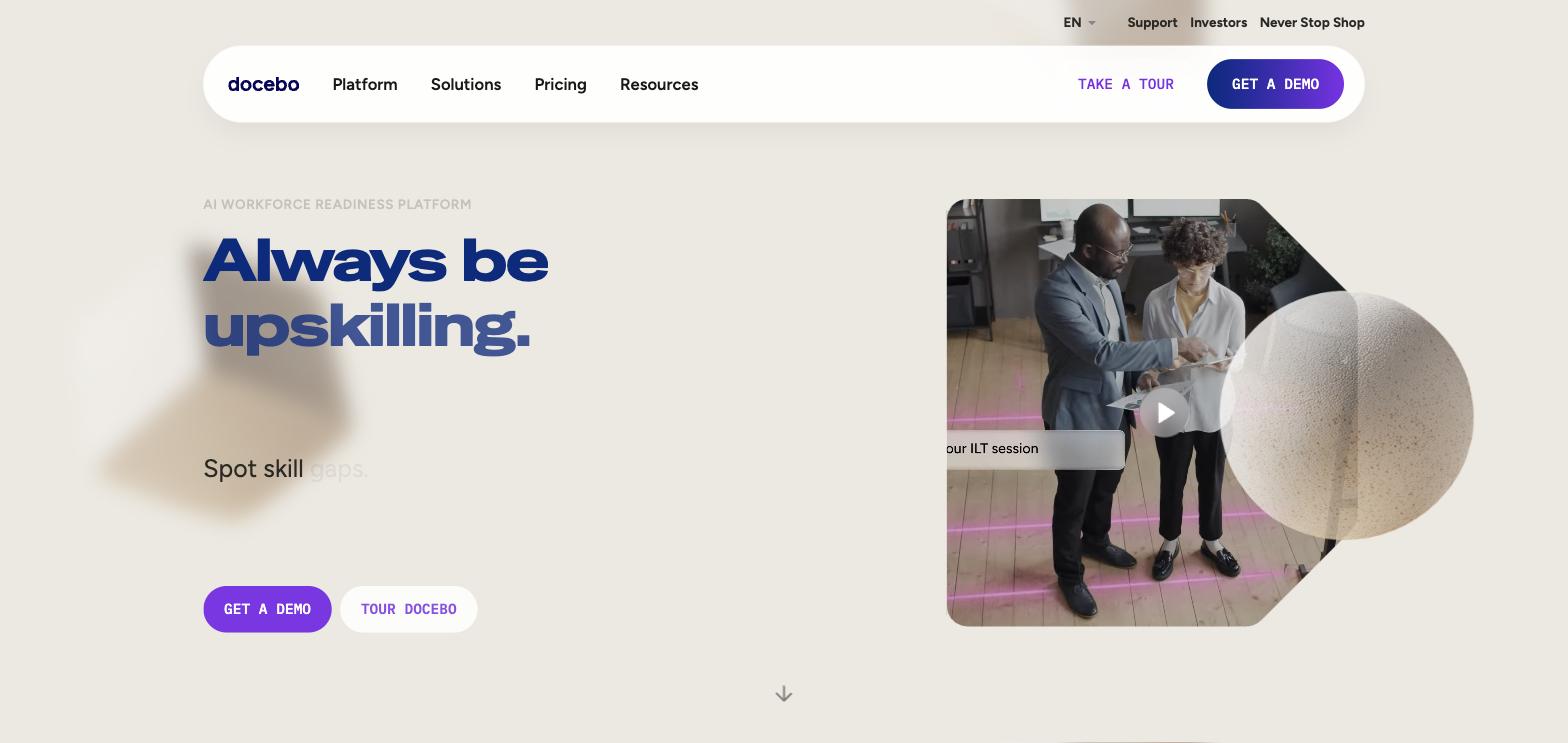
Screenshot: Docebo homepage, captured August 2026. Source.
Docebo Pricing
Docebo does not publish pricing anywhere on its site. The pricing page names two base tiers, Elevate and Enterprise, but every tier and every add-on, including AI Roleplay itself, sits behind a "Get Your Pricing" or "Speak with a learning expert" form.
Pricing is set by tier plus active-user volume, billed as Monthly, Yearly, or Registered Active Users (MAU/YAU/RAU), whichever model a buyer picks. Docebo's own FAQ recommends the platform for organizations training 250+ learners, with most customers signing 1- to 5-year contracts.
No per-seat number, no credit-bundle price, no dollar figure of any kind is published.
| Tier | Listed price | What the pricing page shows |
|---|---|---|
| Elevate | Not published | Named on the pricing page, gated behind a sales form |
| Enterprise | Custom | Consistent with Docebo's enterprise-heavy customer list |
| AI Roleplay add-on | Not published | Sold as "usage-based AI credits" on top of a base tier |
What we do have is third-party signal on cost, and it comes from Docebo's own reviewers. Docebo holds a strong 4.4/5 across 237 Capterra reviews and 4.3/5 across 749 G2 reviews, but cost is a recurring complaint even inside those scores.
Capterra reviewer Kara C., an AVP Director of Education in banking, listed her top cons as "1. pricing, 2. customization limitations and 3. complexity."
Paul D., a Creative Services Director, was blunter: "I don't like that they like to charge for a la carte services, instead of including them in a larger package deal... Add-ons keep adding up $$$," a complaint that lines up directly with how AI Roleplay itself is sold, as metered credits stacked on top of a tier a buyer already pays for.
That's consistent with Docebo's reputation as a mid-to-high five-figure-plus enterprise annual commitment, though no specific dollar figure for the roleplay add-on itself could be confirmed from any accessible source.
If you need a number to bring to a budget conversation before you talk to a rep, Docebo won't give you one, on the LMS or on the roleplay add-on.
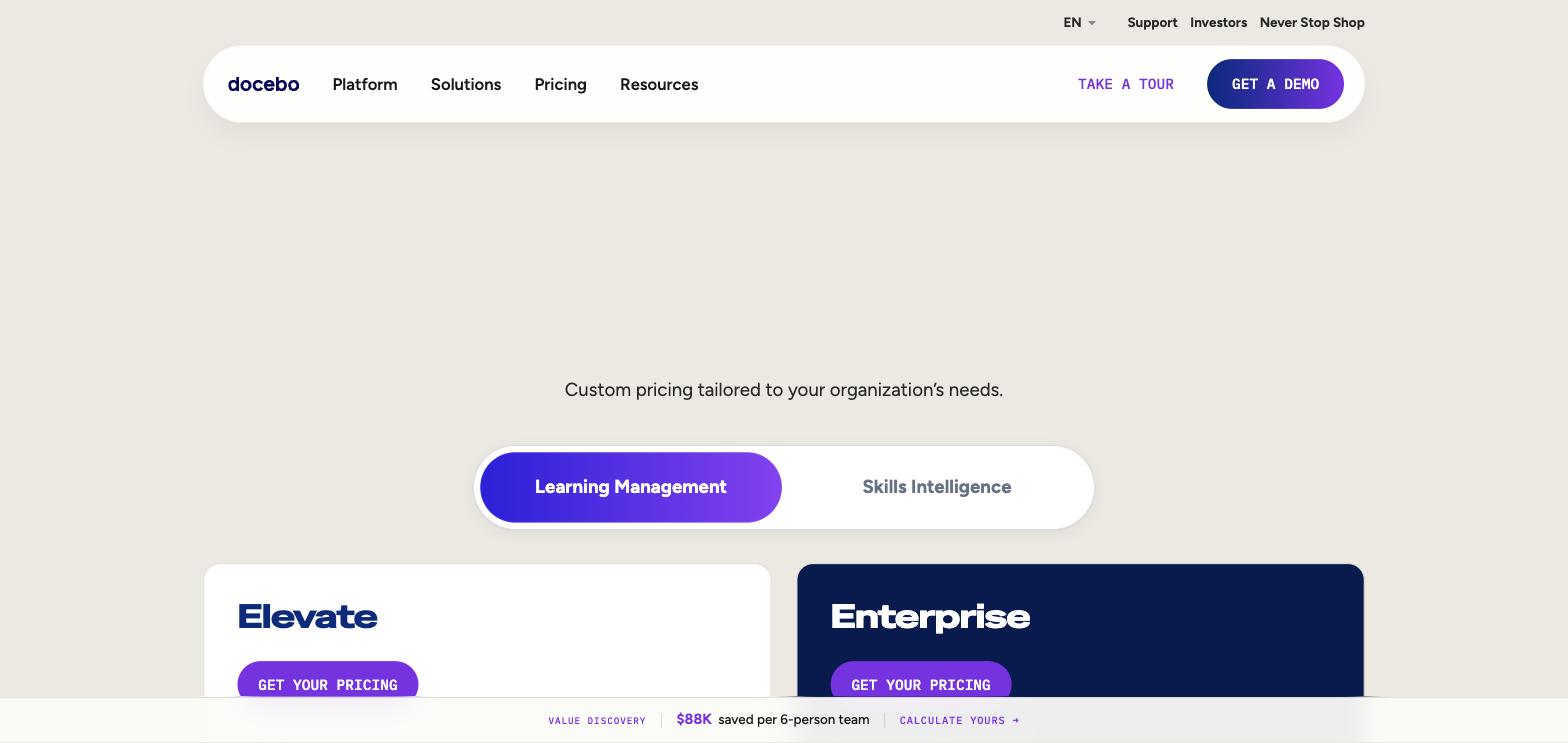
Screenshot: Docebo's pricing page, no price shown behind either named tier, captured August 2026. Source.
Docebo Features
Core LMS. Course delivery, certifications, compliance tracking, blended learning, and a Content Marketplace with more than 80,000 ready-made courses.
White-labeling, extended enterprise and partner training, a mobile app, gamification, e-commerce, and immersive VR/AR learning round out the base platform. More than 400 integrations are listed.
AI layer. Harmony is an AI copilot for admin support, smarter search, and reporting insights. AgentHub is a no-code layer for building autonomous agents that handle learner guidance, admin tasks, and compliance workflows.
Skills Intelligence, built on the 365Talents acquisition, maps skills gaps and career paths and runs a talent marketplace. There's also an Enterprise Knowledge search layer, a Docebo MCP Server, and a Companion browser extension.
AI Roleplay. This is the part that overlaps with Outdoo AI. It runs practice over phone, web-chat, or video-meeting formats, with full customization of scenario, avatar, and persona for pitches, cold calling, and objection handling.
A Prompt-to-Scenario feature, added in January 2026, lets an admin type a plain-language prompt and get a full coaching scenario back in minutes. That's faster scenario-building, but the scenario still starts from an admin's prompt, not a team's actual calls or CRM records.
Scoring got a genuine upgrade in July 2026: sessions now get a quantitative 1-5 score per criterion, with optional weighting and pass/fail thresholds, plus a named manager or SME can review the AI's evaluation before it counts, with the recording, scores, and transcript bundled into one report.
The criteria themselves are unchanged, though: clarity, confidence, energy, non-verbal cues, and assertiveness, generic communication-skill measures rather than a grading of whether a rep ran the actual play a team trains on.
A roleplay scenario can also double as a formal certification event, useful for compliance teams that want coaching and certification in one system.
Docebo's own materials don't fully agree on video avatars. A January 2026 release note announced shipped "AI Virtual Coaching with Video Simulations," but the live AI Roleplay product page still lists video avatars as "coming soon."
It integrates with Salesforce, Microsoft Teams, Zoom, and Google Drive, and Docebo states plainly that customer data never trains its models.
Security posture across the platform includes ISO 27001, SOC 2, GDPR, and CCPA.
Here's what's still missing from that feature set, even after the July 2026 update. There's no visible support for grading against a company's own playbook or SOP, a human checking the AI's score doesn't change where the rubric comes from. No mention of building scenarios directly from a team's real calls, transcripts, or CRM records.
No multi-persona practice for committee-based deals. No unified scorecard spanning roleplay and live calls. And no simulation of the post-call CRM or workflow step. For how teams add those layers without leaving Docebo, see how AI roleplay fits into Docebo-based sales training.
Docebo's product page cites customer outcomes like La-Z-Boy's jump in active learners and Cloudbeds' drop in churn, but both trace back to case studies about the base LMS and Content Marketplace rollout, not the roleplay add-on specifically. No case study ties a result to AI Roleplay usage.
What Users Say
On overall platform maturity: "One of the better modern enterprise LMS platforms available today, especially for organizations that need scale." (Software Advice, aggregated review summary)
On features and results: "Docebo offers a comprehensive suite of features that empower organizations to deliver effective training programs, enhance learner engagement, and achieve measurable results." (Pallavi J., Quality Engineering Lead, Banking, Capterra, Dec 2025)
On switching from a competitor: "I was previously with LinkedIn Learning. Docebo is simply better." (Craig K., Dir. of Culture and Leadership, Capterra, Feb 2025)
On support below Enterprise tier: "It wasn't uncommon to wait two weeks for a response to a simple technical issue." (Verified Reviewer, Multimedia Developer, Education, Capterra, 2019)
Cost complaints, quoted in the pricing section above, run alongside these otherwise positive reviews rather than instead of them.
Docebo holds 4.4/5 across 237 Capterra reviews and 4.3/5 across 749 G2 reviews, genuinely strong scores for the core LMS. None of the individually attributed reviews above mention AI Roleplay by name, which tracks with how new and lightly marketed the feature still is.
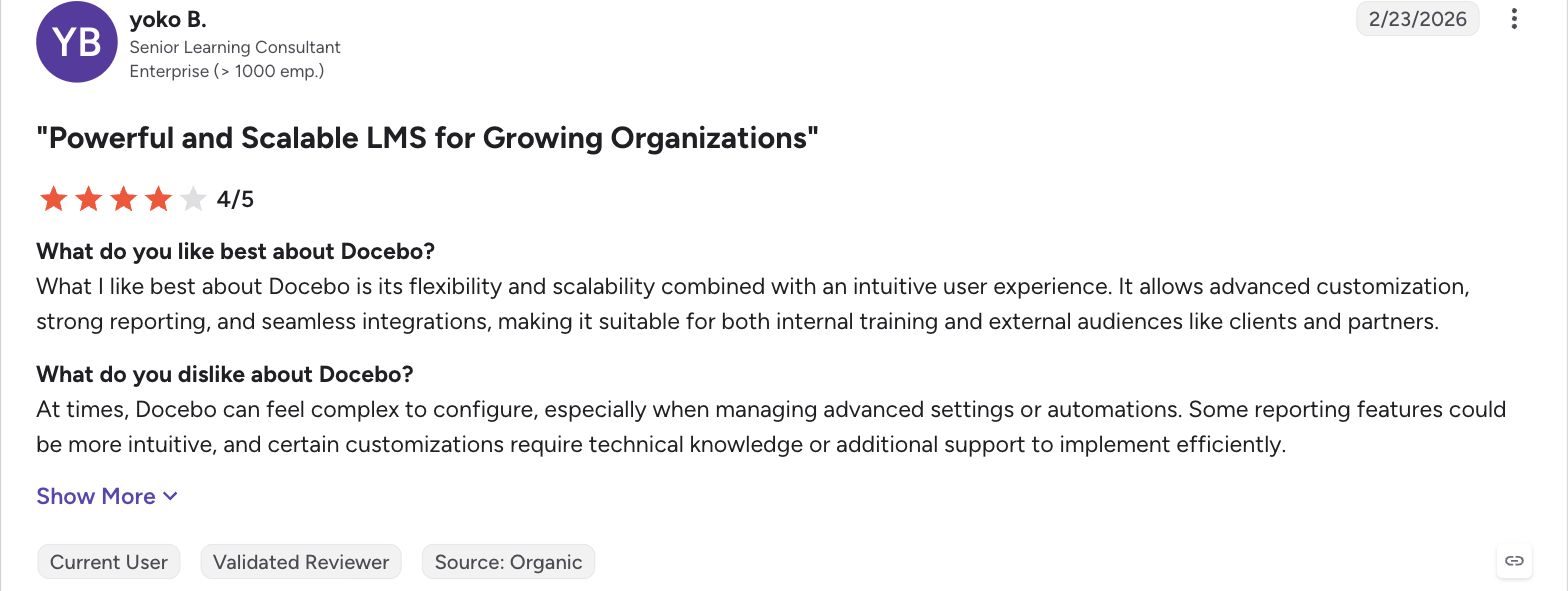
Screenshot: 4/5 G2 review citing configuration complexity and reporting features that need technical knowledge, Feb 23, 2026. Source.
Where Docebo Falls Short
The roleplay add-on is generic. A scorecard on clarity, confidence, energy, non-verbal cues, and (since July 2026) assertiveness tells a rep how they came across, not whether they ran the actual play your team trains on.
Even with a human manager now checking the score, there's still no sign it can be graded against a company's own methodology.
It's not built from real conversations. Nothing in Docebo's public materials suggests scenarios get generated from a team's own call recordings, transcripts, or CRM data. Even January 2026's Prompt-to-Scenario feature just turns an admin's typed prompt into a scenario faster; it doesn't change where the scenario comes from.
Scenarios are configured by an admin, not derived from what your reps actually hear on live calls.
It doesn't unify roleplay and live-call scoring. There's no single scorecard spanning practice sessions and real calls, so proving that coaching moved a real revenue number, not just a completion rate, isn't something the product is built to do.
It skips the part after the call. Nothing in the roleplay add-on simulates the CRM logging or post-call workflow a rep actually has to do once the conversation ends.
Its own materials can't agree on the roleplay's video mode, either. A January 2026 release note claims shipped video-avatar coaching; the live product page still calls video avatars "coming soon."
Pricing is opaque, and cost is a recurring complaint. Reviewers flag Docebo for a la carte add-on costs that "keep adding up," and license-seat rigidity shows up more than once in third-party feedback.
And the add-on is aimed broadly, not at sales. Docebo pitches AI Roleplay across Customer Success, Leadership Development, Sales Enablement, Talent Onboarding, and Compliance.
The case studies referenced on its own roleplay page, La-Z-Boy and Cloudbeds, skew retail and hospitality, frontline associate training rather than quota-carrying B2B sales reps.
If your buyer is a B2B sales org, that's a different product built for a different user than you.
Where Docebo Genuinely Wins
Docebo's real strength is on ground Outdoo AI doesn't compete on.
The Content Marketplace alone, with more than 80,000 ready-made courses, is a genuine scale advantage for compliance and certification programs that need broad, off-the-shelf content.
Add extended enterprise training, more than 400 integrations, and a mature reporting and automation layer that reviewers consistently call out as strong, and you have a platform built for organizations that need to run learning at real scale, not just sales coaching.
The installed base backs that up. More than 3,500 customer organizations, with logos like Zoom and Booking.com, is a genuine enterprise moat that a newer coaching-focused product can't match on breadth.
The recent Skills Intelligence layer, built on the 365Talents acquisition, adds skills-gap mapping and career pathing that goes well beyond what any roleplay tool, Outdoo AI included, is trying to do.
Credit where it's due on Roleplay itself, too. Shipping video-avatar coaching in January 2026 and quantitative scoring with a human manager-review layer in July 2026 is real engineering investment in seven months, not a shelf feature Docebo forgot about.
If your evaluation is actually an LMS decision, Cornerstone or Moodle or SumTotal alternative, Docebo is a legitimate, well-reviewed contender. That's the evaluation Docebo is built for.
How Outdoo AI Compares
Docebo is an LMS with a bolted-on roleplay feature.
Outdoo AI is a purpose-built AI roleplay and training platform, and the two aren't really solving the same problem, even where the feature lists briefly overlap.
Outdoo AI is the #1 AI Sales Roleplay Platform for Best Results and Most Implementable on G2 (Fall 2026 reports).
Outdoo AI grades roleplay practice and live calls on the same scorecard (unified scoring across roleplay and real calls), so a sales leader can point to one number and show that coaching moved a real revenue metric.
Docebo's July 2026 update added a quantitative scale and a human manager reviewing the AI's score, real progress, but a manager checking a clarity-confidence-energy number isn't the same as tying that number to what happened on a live call.
Outdoo AI builds roleplays and scorecards straight from a team's own calls, transcripts, playbooks, battlecards, and even a rep's LinkedIn profile (roleplays built from real calls), then grades against that team's own playbook instead of a vendor's built-in rubric.
Docebo's Prompt-to-Scenario feature still starts from whatever an admin types into a prompt box, faster scenario-building, not scenarios derived from a team's real conversations.
Outdoo AI also scores the post-call CRM and workflow-logging step inside the same session as the roleplay itself (workflow training and post-call process scoring), something nothing in Docebo's public materials claims to do.
And Outdoo AI supports multi-persona practice for committee-based B2B deals, a format Docebo's roleplay page doesn't mention.
There's a smaller but telling gap, too. Docebo's own materials can't agree on whether its video avatar mode has actually shipped, a January 2026 release note says it did, the live product page still says "coming soon." Outdoo AI's video avatar roleplay has been live and unambiguous the whole time.
On pricing, it's worth being direct: neither company publishes real numbers, so this isn't a transparency win the way it would be against a seat-licensed pure-play.
What Outdoo AI does offer is usage-based pricing scoped to actual training activity, not idle per-seat licenses stacked with metered add-on credits, a structure that maps more naturally to how sales teams actually use a coaching tool day to day, and one that avoids the "a la carte add-ons keep adding up" complaint Docebo's own reviewers raise.
For teams that already run Docebo as their LMS, the honest move isn't to rip it out.
Outdoo AI can feed completions back into Docebo via SCORM/xAPI, the same integration pattern it uses with other LMS incumbents.
Treat Docebo as the compliance and content system of record, and Outdoo AI as the layer that actually builds and grades the sales coaching Docebo's generic add-on wasn't built to do.
Outdoo builds AI Roleplays from your own calls and scores practice and real calls with one scorecard. Rated #1 for Best Results on G2.
Frequently Asked Questions
Does Docebo publish pricing?
No. The pricing page names two tiers, Elevate and Enterprise, but every price, including the AI Roleplay add-on's usage-based credits, sits behind a "Get Your Pricing" form. Outdoo AI starts free with 60 minutes of roleplay credits and unlimited team members, no credit card and no sales call, then scales on usage-based Flex pricing with a custom enterprise plan for larger deployments.
Is Docebo a sales roleplay competitor to Outdoo AI?
Not primarily. Docebo is an enterprise LMS that added a generic AI Roleplay add-on across Customer Success, Leadership Development, Sales Enablement, Onboarding, and Compliance use cases. It's not built specifically for B2B sales teams.
What does Docebo's AI Roleplay actually score?
A rubric of clarity, confidence, energy, non-verbal cues, and assertiveness, across phone, web-chat, or video-meeting practice. Since July 2026 it's scored on a quantitative 1-5 scale with a human manager or SME reviewing the AI's evaluation, but the criteria are unchanged: there's still no public evidence it grades against a company's own playbook or unifies scoring with live-call performance.
Has Docebo's video avatar roleplay actually shipped?
Unclear from Docebo's own materials. A January 2026 release note announced "AI Virtual Coaching with Video Simulations," but the live AI Roleplay product page still lists video avatars as "coming soon." Confirm directly with a rep before assuming either answer.
Can Outdoo AI work alongside an existing Docebo deployment?
Yes. Outdoo AI can feed roleplay and coaching completions back into Docebo via SCORM/xAPI, so Docebo remains the LMS of record.