



Is LinkedIn Learning Right for Your Team?
- LinkedIn Learning: Best for companies that want a deep catalog for career and soft skills. It has over 26,000 courses plus Professional Certificates from partners like Microsoft.
- LinkedIn Learning Teams plan: Best for groups of up to 20 seats that want a published price. It runs $379.88 per seat per year.
- LinkedIn Learning AI Role Play: Best for teams already on LinkedIn Learning Enterprise that want a bundled, low-effort practice add-on. It is capped at 20 sessions a day with a single AI counterpart.
- Outdoo AI: Best for sales teams that need roleplay built from their own calls and playbooks. One scorecard grades practice and live calls, with multi-persona roleplay and workflow simulation.
At a Glance
| LinkedIn Learning AI Role Play | |
|---|---|
| Best for | Teams already on LinkedIn Learning Enterprise who want a bundled, low-effort practice add-on |
| Not built for | Dedicated sales roleplay, live-call scoring, or revenue coaching |
| Pricing | Individual ~$19.99 to $39.99/mo · Teams $379.88/seat/yr · Enterprise (where AI Role Play lives): "Contact Sales" only |
| Usage limits | 20 sessions/day, 10/hour, 5 per 5 minutes |
| Rating | 4.4/5 on G2 (721 reviews) and 4.6/5 on Capterra (171 reviews), both reflecting the course library, not AI Role Play specifically |
What Is LinkedIn Learning?
LinkedIn Learning is Microsoft's corporate e-learning platform, sold as a consumer subscription through LinkedIn Premium and as an enterprise product through LinkedIn Learning for Teams, Enterprise, and Career Hub plans.
The core product is a video course library covering business, technology, and creative skills, used by individuals building career skills and by L&D teams running company-wide training programs.
Inside that library sits one AI feature relevant to sales and coaching buyers: Role Play with AI-Powered Coaching. It's a chat or voice conversation practice tool where a user talks to an AI persona through a workplace scenario, then gets written feedback afterward.
It launched as a small pilot and has grown since, but it remains one module inside a much larger course catalog, not a standalone product with its own pricing page, its own admin console, or its own sales motion.
That matters for how you should evaluate it: you're not buying a roleplay tool that happens to have courses attached. You're buying a course library that happens to have a roleplay feature attached. Workday Learning follows the same pattern inside the Workday HCM suite, as our Workday Learning review explains.
For a look at what a platform built around AI sales roleplay from the ground up actually offers, rather than bolted onto an LMS, it's worth comparing the two side by side.
LinkedIn Learning Pricing
LinkedIn Learning publishes individual and small-team pricing but not the enterprise pricing where AI Role Play actually lives, which forces most sales-training buyers into a sales call before they see a number.
| Plan | Price | What it includes |
|---|---|---|
| Individual (monthly) | About $39.99/month | Full course library, LinkedIn Premium bundling available |
| Individual (annual) | About $239.88/year (~$19.99/month) | Same library, billed annually |
| Teams (up to 20 seats) | $379.88 per seat/year | Course library plus team admin reporting |
| Enterprise Learning / Career Hub | Not published, "Contact Sales" | Full catalog, admin controls, and where AI Role Play is positioned |
Source: LinkedIn Learning for Teams pricing, compare plans page.
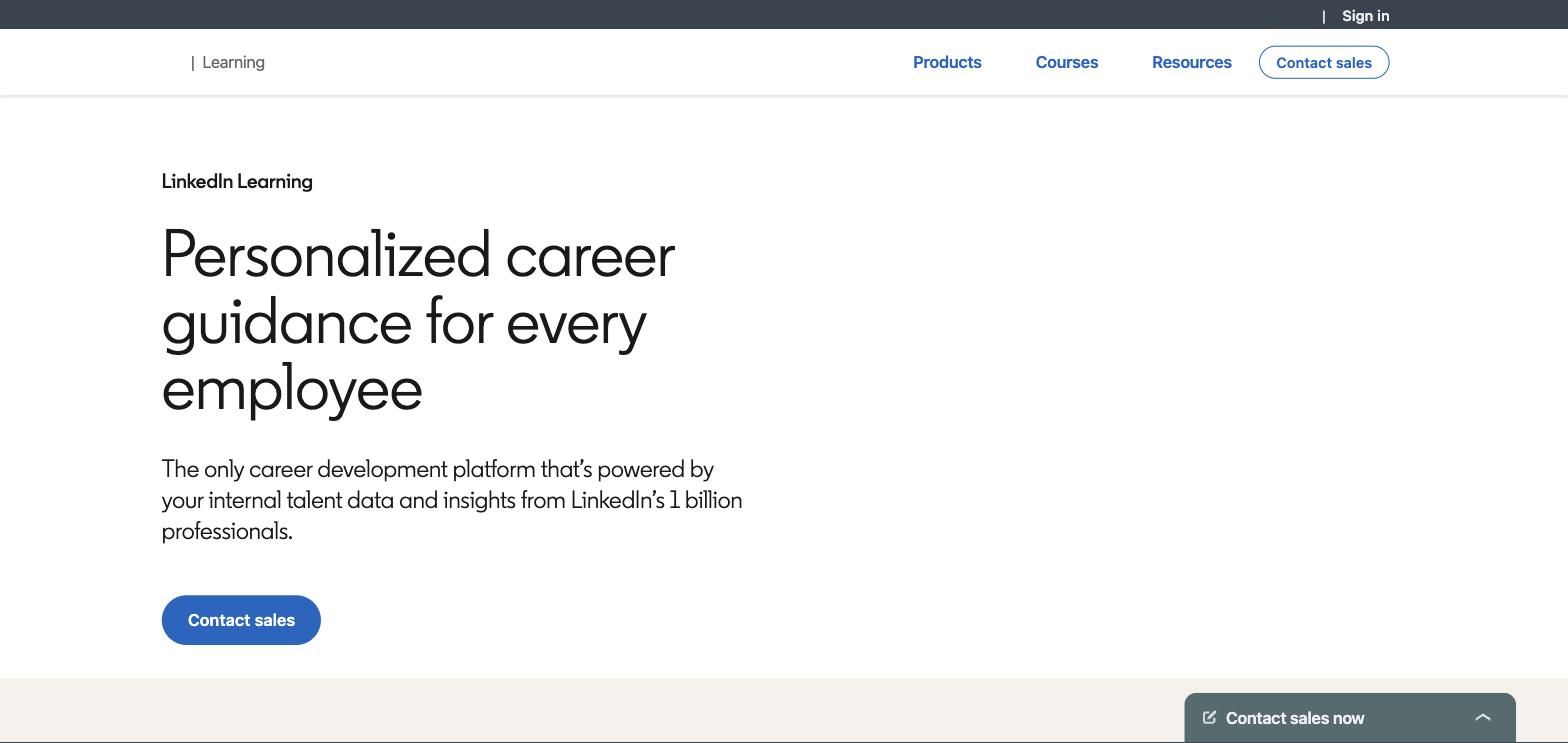
Screenshot: LinkedIn Learning's Enterprise page, captured directly from business.linkedin.com in August 2026. Enterprise pricing is gated behind "Contact sales," matching the "not published" row above.
Two things worth flagging plainly. First, LinkedIn doesn't confirm anywhere in its public materials whether AI Role Play ships at the Teams tier or is Enterprise-only, so a smaller team paying the $379.88/seat rate may not even get the feature.
Second, reviewers already call the platform expensive independent of AI Role Play. One G2 reviewer summed up their entire experience with the line: "There's nothing I dislike about this platform apart from one that it is not budget friendly."
That's the general course library talking, before you've added a dedicated sales roleplay tool on top of it.
LinkedIn Learning Features
Role Play with AI-Powered Coaching works like this: a user picks a scenario or writes a custom prompt describing a situation, then has a voice or text conversation with an AI counterpart. You can adjust the AI's personality, making it "more defensive," "more agreeable," or "more professional," before starting.
LinkedIn's own help documentation cites "more than 80" standalone scenarios, but that figure is specifically scoped to the French, German, Japanese, and Spanish libraries. The fuller picture, confirmed via LinkedIn's June 2026 announcement of its Microsoft 365 Copilot integration, puts the total scenario library at more than 350, spanning sales, leadership, and technical topics.
That's real growth from the handful of fixed HR scenarios the feature launched with. Most of the library is still generic workplace territory: performance feedback, conflict resolution, negotiation, career conversations, with sales now a genuine but non-exclusive slice of it.
Since September 2025, admins can build org-specific custom scenarios from the admin portal, and individual users can do the same by describing a situation in a prompt. That personalizes the situation, but the grading rubric behind it stays LinkedIn's own generic criteria. Even a rep-written custom scenario isn't graded against that rep's own playbook.
There's no CRM connection, no call-transcript ingestion, and no mechanism for grounding a scenario in what a specific rep's pipeline actually looks like.
After each session, the tool gives written feedback on clarity, empathy, and whether the person achieved their conversational goal, along with suggested alternative phrasing. That feedback then links back to LinkedIn Learning courses, feeding the user deeper into the catalog rather than into a coaching scorecard.
LinkedIn's help documentation also confirms there's no persistent session history. A user can't pull up last month's practice results inside the product; the most they can do is copy and paste feedback out manually before it's gone. There's no trend line for a manager to review.
Admin reporting tracks usage: number of role play conversations run and which scenarios are most popular. That's engagement data, useful for justifying the L&D subscription line item, but it isn't tied to quota attainment, win rate, or any other revenue metric.
Since June 2026, the same scenario library also surfaces directly inside Microsoft 365 Copilot (Word, Excel, PowerPoint, Teams) through an admin-enabled "Learning Agent," for any organization running both a Microsoft 365 Copilot license and an active LinkedIn Learning Enterprise or Premium subscription. It's a distribution expansion, not a capability one: the same single-counterpart format, the same generic rubric, just reachable from more places.
Under the hood, the feature itself runs on Microsoft's Azure OpenAI API for dialogue and Azure AI Speech for voice, not a purpose-built sales-training model. That's worth knowing if a vendor's underlying AI investment matters to your evaluation, separate from what AI coaching built specifically around revenue data can add on top.
A few structural limits worth knowing before you evaluate this seriously for a sales team:
| Capability | LinkedIn Learning AI Role Play |
|---|---|
| Session caps | 20 sessions/day, 10/hour, 5 per 5 minutes |
| Languages (roleplay practice) | English, French, German, Japanese, Spanish (5 total) |
| Persona complexity | Single AI counterpart per session |
| Grounding source | Generic prompt or scenario library, not company data |
| Persistent session history | None — feedback can't be recalled after the session ends |
| Post-call workflow practice | None |
| Scoring tied to live calls | None |
Source: LinkedIn Help Center, AI Role Play FAQ.
The session throttling in particular tells you what this was built for. Twenty sessions a day is fine for an employee practicing a feedback conversation once before a review cycle. It's a real constraint for a sales team that wants reps running multiple cold-call practice sessions a day.
What Users Say
LinkedIn Learning holds a 4.4/5 rating on G2 across 721 reviews, mostly reflecting the general course library rather than AI Role Play specifically, since that's what most reviewers are describing.
On the positive side: "I like LinkedIn Learning because the courses are easy to understand and are taught by experienced professionals," one reviewer wrote.
Another liked the platform's improving recommendation engine: "I like that LinkedIn Learning now offers more personalized course recommendations based on my learning history."
On the critical side, two complaints recur. Cost, already noted above, and content depth: "I dislike about LinkedIn Learning is courses on LinkedIn Learning aren't as in-depth or regularly updated as I'd like," one reviewer wrote.
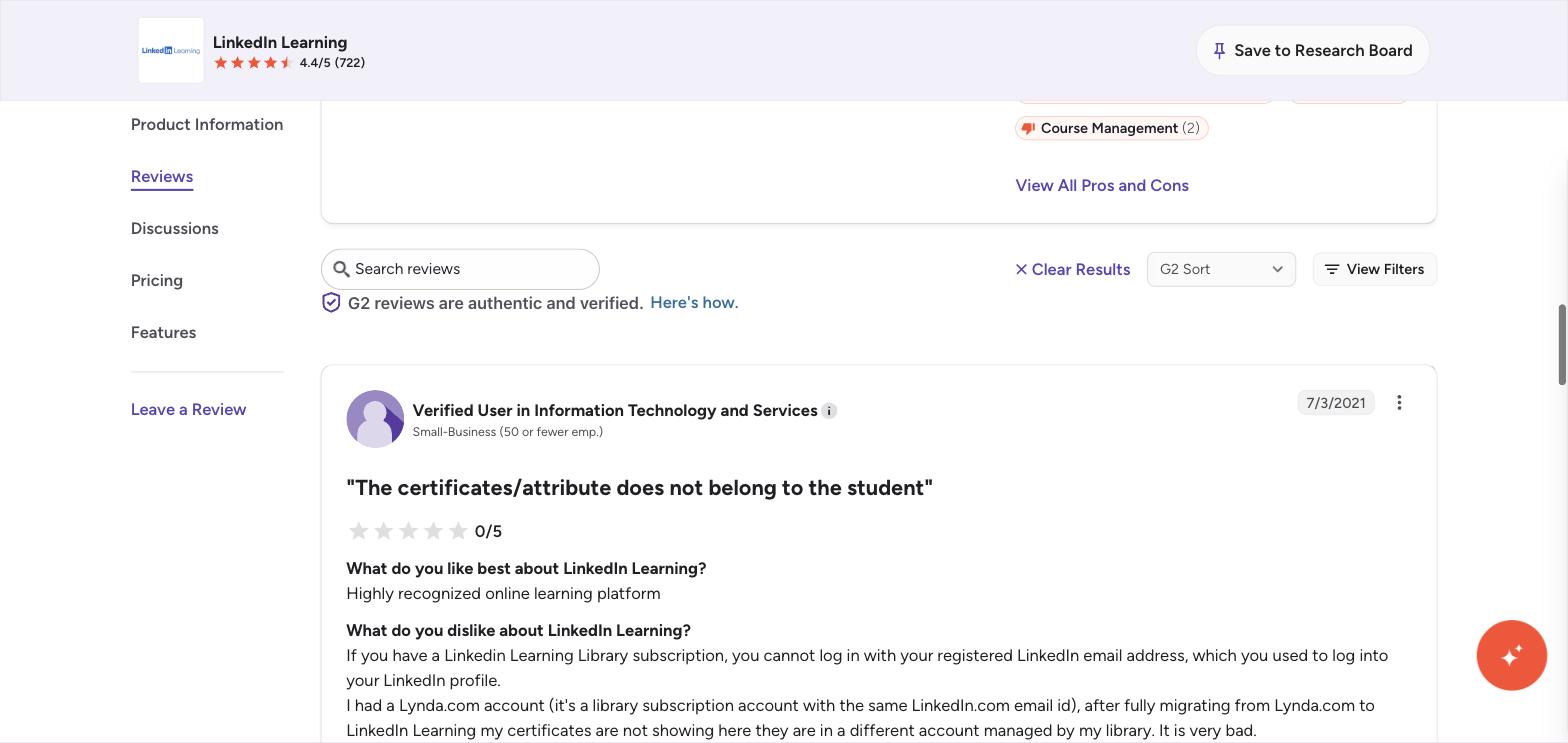
Screenshot: LinkedIn Learning's G2 reviews page, captured August 2026, showing the platform's 4.4/5 rating alongside a critical review.
A reviewer on Software Advice made the content-depth complaint even more specific to what matters here: "The content LinkedIn offers is mainly for soft-skills and does not cater towards deeper learning of technical skills."
That's a telling line for anyone evaluating the AI Role Play scenarios specifically, since those scenarios sit squarely in that same generic soft-skills territory.
Neither complaint is about AI Role Play directly, since the feature is too new and too narrowly scoped within the platform to have accumulated its own separate review body. That absence is itself informative: a category-defining sales coaching feature usually generates its own review chatter. This one hasn't yet.
For a sense of what that review chatter looks like once a roleplay feature is the whole product, not a footnote, our customer stories cover teams that adopted one on purpose.
Source: G2 reviews, LinkedIn Learning; Software Advice reviews, LinkedIn Learning.
Where LinkedIn Learning Falls Short
For a sales team specifically, the gaps are structural, not cosmetic.
There's no grounding in a company's own sales motion. Scenarios come from a generic prompt-to-scenario generator or a fixed vendor library, not from a team's actual call recordings, CRM data, or playbook. Two reps at two different companies selling two different products get the same generic negotiation scenario.
There's no multi-persona practice for committee-based deals, no gatekeeper or cold-call screening phase, and no way to rehearse the CRM logging and workflow steps that follow a real call.
Feedback is written commentary that routes back into course recommendations, not a scorecard that connects practice performance to quota, win rate, or any other number sales leaders are actually accountable for.
There's also no persistent history behind that feedback. LinkedIn's own help documentation confirms a user can't reference past session results once a session ends, so a manager can't pull up what a rep practiced last month, let alone chart improvement over time.
Even the personalization has a ceiling. A learner can type a custom scenario in their own words, but the grading criteria underneath it stays LinkedIn's fixed generic rubric, never the rep's own playbook or a manager's actual coaching priorities.
Language coverage for the coaching feature itself sits at five languages, a fraction of what a genuinely global sales org needs.
And the whole thing is throttled to course-subscription session limits, 20 a day, which is the wrong shape for a team trying to build practice volume and reps.
None of this is a knock on LinkedIn Learning doing what it set out to do. It's the honest description of a course library's AI add-on evaluated against a sales team's actual requirements.
Where LinkedIn Learning Genuinely Wins
Credit where it's due, because pretending otherwise doesn't help anyone make a real decision.
If a company already pays for LinkedIn Learning Enterprise or Career Hub, AI Role Play is close to free marginal spend. No new procurement cycle, no new vendor to onboard, no new admin console to learn. Any employee with a seat can open it today.
That's a real objection sales teams run into: "we already have this, why pay for something else."
It's a common reason buyers pass on a dedicated tool: LinkedIn Learning feels good enough, and there's no urgency to add something new.
The course catalog itself is deep too, over 26,000 courses with established admin reporting and HRIS integrations for internal talent and skills data.
Professional Certificates from partners like Microsoft, Zendesk, and BluePrism add real weight to that catalog, even though none of them touch the AI Role Play feature specifically.
By LinkedIn's own count, that installed base runs to more than 42 million enterprise seats across 16,300-plus organizations, including 78% of Fortune 100 companies. Since mid-2026, the same roleplay scenarios also reach any of those seats through Microsoft 365 Copilot directly, not just through LinkedIn Learning's own app.
That breadth and installed-base trust is real, and it's the actual competitive threat here: not a feature fight, but complacency.
A team that already has LinkedIn Learning doesn't feel a gap until they look closely at what the roleplay feature can't do.
How Outdoo AI Compares
The honest framing: this isn't a feature-for-feature roleplay comparison, because LinkedIn Learning wasn't built to win one.
Outdoo AI is a dedicated AI sales roleplay and training platform built for revenue teams; LinkedIn Learning is a course library with a generic practice feature attached.
Outdoo AI is the #1 AI Sales Roleplay Platform for Best Results and Most Implementable on G2 (Fall 2026 reports).
Where LinkedIn Learning's roleplay stops at a single AI counterpart, Outdoo AI runs multi-persona roleplay with up to three stakeholders, plus a separate gatekeeper and cold-call phase for reps who need to get past a screener first. That structure matters for committee-based B2B deals, where a single AI voice never mirrors what a real buying group actually looks like across a negotiation.
LinkedIn Learning's feedback also stops at the conversation itself, with no way to practice what happens after a call ends. Outdoo AI closes that gap with workflow simulation, where reps rehearse the CRM and process logging that follows a real call in the same practice session, not as a separate exercise bolted on afterward.
Scoring follows the same pattern. LinkedIn Learning's feedback dead-ends in course recommendations rather than anything a sales leader can act on, and there's no way to connect a good roleplay session to a good real call.
Outdoo AI's call scoring and feedback closes that loop, tying roleplay practice and live calls into one scorecard graded against a team's own playbook rather than a generic rubric shared across every customer.
| Outdoo AI | LinkedIn Learning AI Role Play | |
|---|---|---|
| Scenario grounding | Built from a team's own calls, transcripts, playbooks, and battlecards | Generic prompts or fixed scenario library |
| Scoring | One scorecard grading both roleplay practice and live calls, tied to your own playbook, not a generic rubric | Written feedback linking to more courses |
| Call structure | Multi-persona roleplay (up to 3 stakeholders) and a separate gatekeeper/cold-call phase | Single AI counterpart |
| Post-call practice | Workflow simulation: reps rehearse the CRM/process logging that follows a real call | None |
| Persistent history | Full practice history tied to the same scorecard as live calls | None — feedback can't be recalled after the session ends |
| Languages | 74+ voice, 120+ overall | 5 (roleplay practice) |
| Pricing model | Usage-based, pay for training that's actually driving activity | Per-seat subscription bundled into course tiers |
The features that don't exist anywhere in LinkedIn's public materials are the ones that matter most for revenue teams: a scorecard that connects roleplay practice to live-call performance, workflow training that scores the post-call CRM work, and a persistent record a manager can actually review over time.
Those close the loop between practicing a skill and proving it moved a real number, which is the part a generic course-library feature was never built to do.
One caveat worth naming honestly: Microsoft's backing gives LinkedIn Learning enterprise-grade compliance credentials that come from decades of enterprise IT infrastructure. If your evaluation is purely about vendor certification maturity rather than what the roleplay product itself can do, that's a legitimate factor to weigh.
If it's LinkedIn Learning's broader course-library commitment giving you pause rather than the roleplay feature itself, that's a different evaluation than the one this page is making. Our guide to LinkedIn Learning alternatives walks through the wider field of course-library and LMS competitors on those terms, from Coursera to Pluralsight.
If the roleplay feature itself is what's actually under evaluation, though, the comparison is narrower and far more direct than a general LMS bake-off. For the full side-by-side on scenario grounding, scoring, session limits, and pricing, both drawn from the same sources cited throughout this page, see our dedicated LinkedIn Learning alternatives comparison.
Either way, the honest test isn't a features list. It's whether practice built from a team's own calls and playbook changes what happens on the next real one, and whether a manager can still point to the scorecard that proves it, months later, rather than only on the day the session happened.
See how Outdoo AI compares on your own calls: book a demo.
Frequently Asked Questions
.svg)
It's a chat or voice practice tool inside LinkedIn Learning where users have a conversation with an AI persona through a workplace scenario, then get written feedback on clarity, empathy, and goal achievement. It launched with a handful of scenarios and has grown to more than 350, spanning sales, leadership, and technical topics, though HR and soft-skills scenarios still make up most of the library.
Not as a dedicated product. Sales is now one of several tagged categories in its scenario library, but there's no CRM or call-data grounding, no multi-persona practice, no persistent session history, and no scoring tied to revenue outcomes. It's a general-purpose practice tool, not a sales training system.
If you already pay for LinkedIn Learning Enterprise, trying the feature costs nothing extra. If you're evaluating specifically for sales team coaching, a dedicated tool would need to provide CRM or call-data grounding, multi-persona practice, and scoring tied to live-call performance, none of which LinkedIn Learning's feature currently offers. Outdoo AI starts free with 60 minutes of roleplay credits and unlimited team members, no credit card and no sales call, then scales on usage-based Flex pricing with a custom enterprise plan for larger deployments.
No. Individual and small-team (up to 20 seats) pricing is public, but Enterprise Learning and Career Hub, the tiers where AI Role Play is positioned, require contacting LinkedIn's sales team directly.
Sessions are capped at 20 per day, 10 per hour, and 5 per 5 minutes. That throttling fits an employee practicing occasionally but is a real constraint for a sales team trying to build daily practice volume.
Table of Contents
Talk to Sales
Have questions about training and enablement for your sales, CS, support, or leadership team? Let's talk.
Talk to Sales